
You're probably dealing with a familiar problem. You need branded shirts, polos, hoodies, or uniforms. The artwork is ready, the event date is close, and someone on your team is asking the question that always comes up first: should this be screen printed or heat transferred?
That decision affects more than the look of the final piece. It changes your cost per item, your minimum practical order size, how the print feels in hand, and how the garment represents your brand after repeated wear. A shirt for a staff uniform has a different job than a giveaway tee. Retail merch has a different standard than a one-day promo item.
In real shop terms, screen printing and heat transfer solve different business problems. One is built for repeatable volume and long-term wear. The other is built for flexibility, speed, and small runs. If you choose the wrong one, you usually feel it in one of two places: your budget or the finished result.
Table of Contents
- Choosing Your Custom Apparel Printing Method
- How Each Printing Process Works
- Comparing Screen Printing and Heat Transfer by Key Factors
- Recommended Use Cases for Your Business
- Visualizing the Quality and Finish
- Your Final Decision Checklist
- Beyond the Basics A Look at Modern Alternatives
Choosing Your Custom Apparel Printing Method
A lot of buyers come in thinking this is just a print-method question. It usually isn't. It's a business-goal question wearing a production label.
If you're ordering shirts for a restaurant team, your priorities are usually consistency, durability, and reordering the same logo later without surprises. If you're launching a limited run for a pop-up brand, the priority may be artwork detail, low minimums, or testing several graphics before committing to volume. If you're planning event giveaways, you may care most about hitting a budget without making the shirts look cheap.
That's why screen printing vs heat transfer shouldn't be treated like a simple pros-and-cons list. The right choice depends on what the garment has to do after it leaves the box.
Practical rule: Start with the purpose of the apparel, not the print method. A uniform, a retail shirt, and a promo giveaway rarely need the same production approach.
Here's the decision frame that tends to work best:
- Retail or resale apparel: You usually want a finish that feels intentional, clean, and consistent across a full run.
- Promotional giveaways: Budget and turnaround often matter as much as print longevity.
- Staff uniforms and workwear: Repeat wear and repeated washing matter more than novelty.
- Personalized pieces: If each garment changes with a name, number, or unique design, flexibility moves to the top of the list.
A new buyer often focuses on the artwork first. An experienced buyer asks a different set of questions. How many pieces? Will every item be identical? Is this meant to last through regular washing? Does the design have simple spot colors, or does it include detailed shading and gradients?
Those answers usually point clearly toward one method. The rest of the article puts that choice into plain business terms so you can match the method to the job instead of forcing the job to fit the method.
How Each Printing Process Works
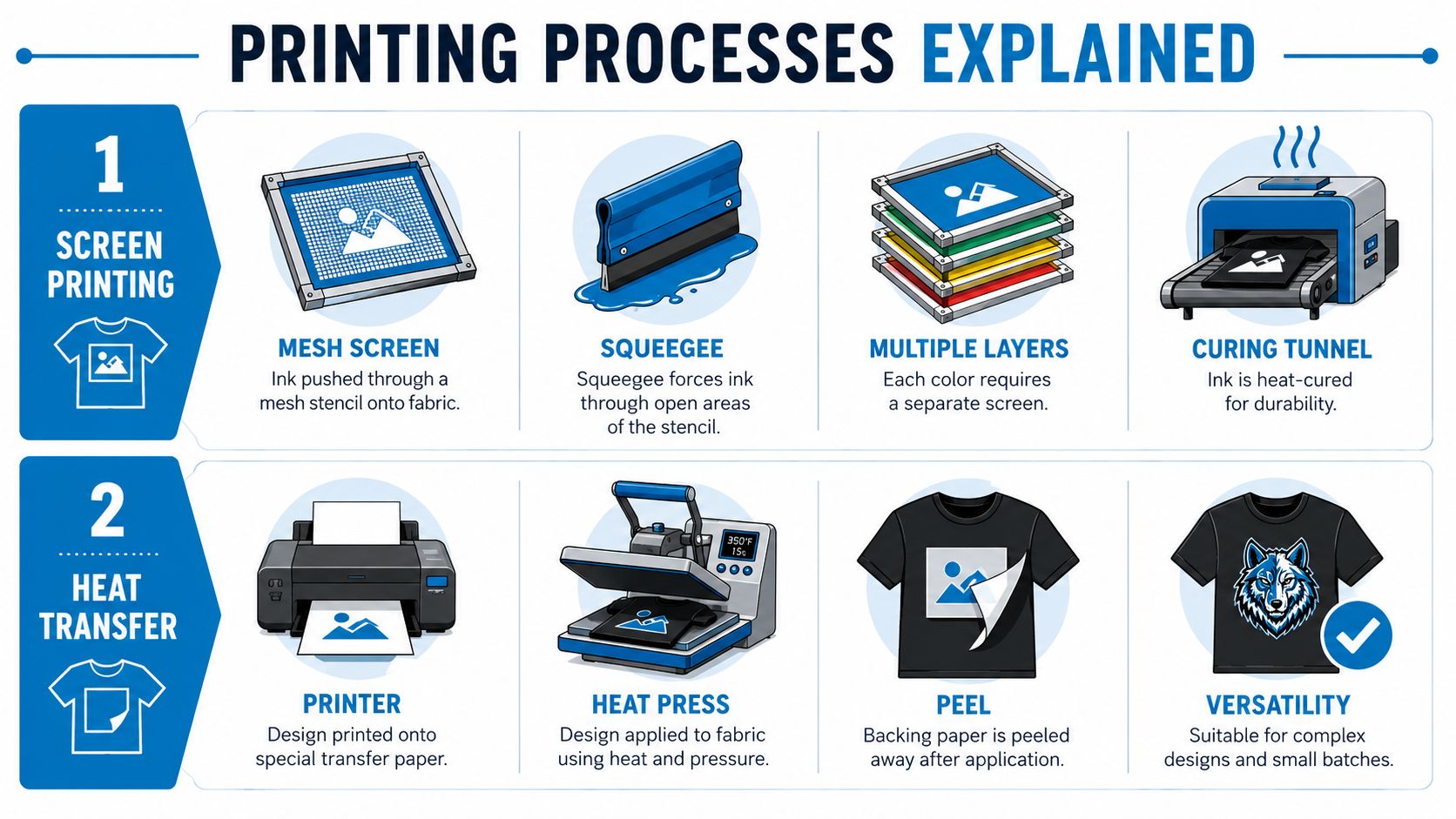
The reason these methods behave so differently comes down to where the design lives. With screen printing, ink is applied through a stencil system and cured onto the garment. With heat transfer, the design is first created on a transfer medium, then pressed onto the surface of the fabric.
Screen Printing
Screen printing uses a mesh screen as a stencil. Ink is pushed through the open parts of that screen and deposited onto the garment. A squeegee moves the ink across the screen, and each print location gets the same artwork in the same position as the run continues.
For multi-color art, the shop builds a separate screen for each color. That setup takes time, but once production starts, the process is efficient for repeat designs. The printed garment then goes through curing so the ink sets properly.
The practical result is straightforward. This method is built around repetition. If you need the same left-chest logo on a stack of uniforms or the same front graphic across a full merchandise order, screen printing is designed for that kind of consistency.
Heat Transfer
Heat transfer starts differently. Instead of pushing ink directly through a screen onto the shirt, the design is produced on a transfer material first. Then a heat press applies that design to the garment using controlled heat, pressure, and time.
That's why heat transfer works well for short runs and artwork that changes from piece to piece. You can produce a design, place it, press it, and move on without building screens for every color.
If you want a simple visual overview of shirt decoration methods, this guide on how to print a design on a shirt is a helpful starting point.
Screen printing places production efficiency up front. Heat transfer places flexibility up front.
Why the Process Difference Matters
This mechanical difference explains most of the trade-offs buyers notice later. One method is optimized for repeatability and run efficiency. The other is optimized for speed, customization, and lower setup friction.
That's also why two shirts can look similar from a distance but perform differently in use. The production method affects the hand feel, the edge quality of the art, and how the print behaves after real-world wear.
Comparing Screen Printing and Heat Transfer by Key Factors
A business buyer usually is not choosing a print method in the abstract. The primary question is which method fits the job the garment needs to do, the budget you need to protect, and the impression you want the shirt to leave after people have worn it more than once.
That decision gets clearer when you compare the factors that affect cost, appearance, and long-term use.
| Factor | Screen Printing | Heat Transfer |
|---|---|---|
| Order size | Strong fit for larger identical runs | Strong fit for short runs and one-offs |
| Setup | More prep before production | Minimal setup before pressing |
| Durability | Better choice for repeated wear and frequent washing | Better choice for flexibility, testing, and shorter-term use |
| Complex artwork | Best with cleaner, simpler color separations | Better for highly detailed or variable designs |
| Personalization | Less efficient for changing every item | Well suited for names, numbers, and design variations |
| Print feel | Often feels more integrated with the garment | Often feels more like a layer on top |
Cost and Order Size Economics
Cost usually decides the method before anything else does.
Screen printing asks you to pay for setup up front. Each color needs its own screen, and that labor has to be built before production starts. Heat transfer skips most of that setup, which is why small runs, sample programs, and test launches often pencil out better with transfers. This screen printing and heat transfer cost comparison outlines how the math tends to shift as quantities rise.
For a business, the practical cutoff is simple. If every shirt carries the same design and the quantity is healthy, screen printing usually gives you the better unit cost. If you are ordering a small batch, changing the artwork from piece to piece, or testing whether a design will sell, heat transfer reduces the risk of spending setup money too early.
If you are budgeting before asking for quotes, this guide on how much it costs to screen print a shirt explains the pricing factors that move a job up or down.
Durability and Longevity
Durability matters more for some business goals than others.
For staff uniforms, field apparel, and branded shirts that will be washed hard and worn often, screen printing usually holds up better over time. In a shop setting, that matters because replacement costs add up fast if a print starts looking tired before the garment itself is worn out.
Heat transfer still has a place. It works well for event shirts, short-term promotions, limited campaigns, and jobs where flexibility matters more than long-run wear. The trade-off is straightforward. You are often accepting a shorter performance window in exchange for easier customization and lower setup friction.
If the garment is supposed to represent your brand for months, not just one event, print lifespan affects cost and brand perception at the same time.
Print Quality and Color Complexity
Good print quality starts with matching the artwork to the method.
Screen printing tends to look strongest with bold logos, solid spot colors, readable type, and graphics built with clean separations. That is one reason it is common on uniforms, retail-style merch, and repeat brand marks. The result usually looks intentional because the art has been prepared for that production style from the start.
Heat transfer earns its place when the artwork is more demanding. Fine detail, gradients, photographic elements, and variable information are easier to produce without rebuilding screens for every version. If a campaign needs individual names, changing numbers, or multiple design variations in one order, transfers solve a real production problem.
Fabric Compatibility
The blank garment can change the answer.
Cotton tees, poly blends, performance wear, fleece, and outerwear do not all react the same way to ink, heat, or pressure. Some fabrics print cleanly with very little adjustment. Others need tighter temperature control, special inks, or extra testing to avoid dye migration, adhesion issues, or a finish that feels out of place.
That is why experienced buyers approve decoration and garment together. A print method that looks right on a ringspun cotton tee may not be the best call on a lightweight athletic shirt or a fleece jacket.
Feel and Appearance
This is often the tie-breaker for brands that care how the apparel is perceived.
A strong screen print usually feels more integrated into the garment, especially on designs with controlled ink coverage. Heat transfer more often leaves a distinct top layer. Customers may never use those terms, but they notice the difference in hand feel, drape, and how polished the finished piece feels out of the box.
For promotional giveaways, that difference may be minor. For retail merch, premium branded apparel, or front-facing staff uniforms, it can shape how people judge the quality of the brand itself.
In practice, screen printing usually wins when the goal is repeatability, lower unit cost at scale, and a more established retail feel. Heat transfer usually wins when the goal is speed, flexibility, personalization, or testing demand before committing to volume.
Recommended Use Cases for Your Business
A common buyer question sounds simple: “Which one should we use?” The better question is, “What does this apparel need to do for the business?”

A café ordering 300 staff shirts, a startup testing 24 pieces of merch, and a tournament coordinator needing names and numbers are not buying the same product, even if all three orders start with a T-shirt. The right method depends on the job the garment has to perform, how long it needs to stay in rotation, and whether the order will repeat.
When Screen Printing Makes More Sense
Screen printing usually makes the strongest business case when the order is built around consistency, repeat runs, and cost control at higher quantities. It fits programs where the print needs to hold up across months of wear and still look like part of a credible brand presentation.
It is usually the better call for:
- Staff uniforms: Good for restaurants, contractors, school programs, retail teams, and service businesses that reorder the same logo placements and want a steady look across departments.
- Event merchandise: Works well for larger runs where everyone gets the same design and the budget improves as volume goes up.
- Retail graphics: A strong option for branded tees and simple merch lines where buyers care how the print feels and how the piece presents on a rack.
- High-volume promotional apparel: Best when the message stays the same across the full order and the goal is to keep per-shirt cost under control.
In shop terms, this is the method I recommend when a client says, “We need these to look the same every time, and we'll probably reorder.” That usually points to uniforms, school spiritwear, venue merchandise, and branded basics.
It also protects brand perception. If a customer or employee is going to wear the piece often, a print that continues to look stable matters more than saving a little on setup.
When Heat Transfer Is the Better Fit
Heat transfer is the better business decision when flexibility is worth more than scale. It earns its keep on projects with short timelines, low quantities, changing names or numbers, or artwork that would be expensive to set up as a traditional screen print.
Use it for projects like these:
- Short-run testing: Useful when you want to test a design, a slogan, or a product concept before placing a larger order.
- Personalized apparel: Strong fit for jerseys, staff names, numbered garments, and role-specific titles.
- Complex artwork: Often the easier route for detailed full-color art, gradients, and graphics that would require heavy separation work in screen printing.
- Rush jobs and one-offs: Helpful when the order is small and speed matters more than long-run efficiency.
This is often the right choice for campaign shirts, internal team apparel, limited event runs, and pilot merch drops. If the goal is to get product out quickly, prove demand, or create variation within the same order, heat transfer gives you more room to work without committing to a large production setup.
The practical rule is simple. Choose screen printing for repeatable programs and volume. Choose heat transfer for speed, variation, and small-batch decision-making.
Visualizing the Quality and Finish
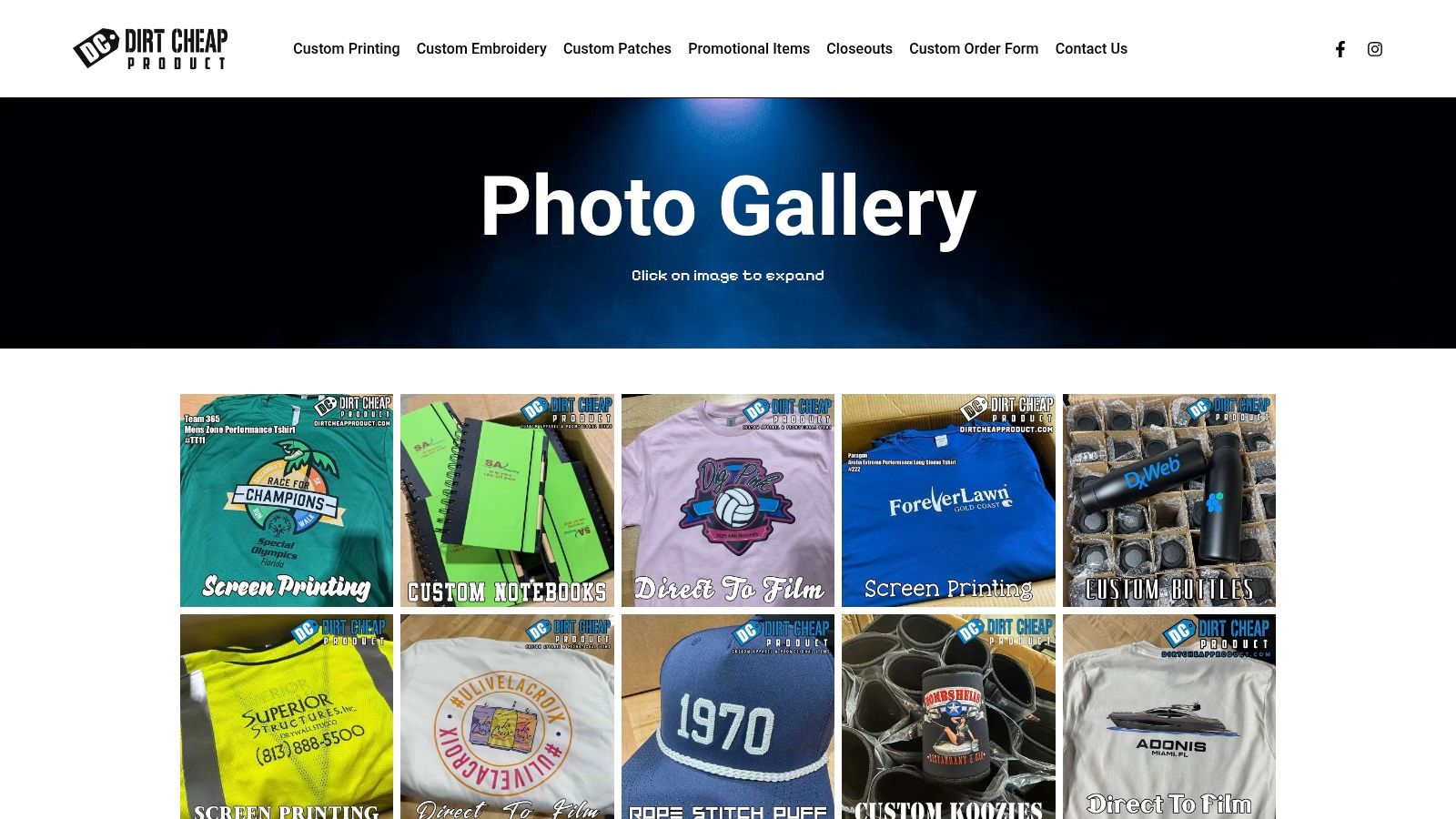
You can explain print methods all day, but buyers usually understand the difference fastest when they see finished work.
What a Strong Screen Print Looks Like
A good screen print usually has a clean, confident look. Solid areas of color appear deliberate. Edges look crisp. On the right garment, the print feels tied to the shirt instead of floating above it.
This matters for businesses selling merch or trying to look established in person. A staff shirt with a sharp chest logo sends a different signal than one with a print that feels thick, glossy, or temporary. The customer may not know why one feels better, but they'll often react to it immediately.
For retail-style graphics, screen printing also tends to suit simpler design systems. Bold logos, straightforward branding, and readable event art usually benefit from that cleaner finish.
What Heat Transfer Does Best Visually
Heat transfer has a different visual advantage. It handles complexity well. If the art includes dense detail, color transitions, or individualized changes, this method often preserves the artwork more directly without forcing it into a simplified setup.
That makes it useful for creative campaigns, player names and numbers, small brand drops, and artwork that would lose something if reduced to flatter spot-color shapes. In those situations, the visual fidelity can outweigh the different feel of the final print.
A practical way to judge both methods is to ask for finished examples on garments similar to yours. Don't review art only as a digital mockup. Look at the actual print surface, edge clarity, and how the decoration sits on the fabric.
Your Final Decision Checklist
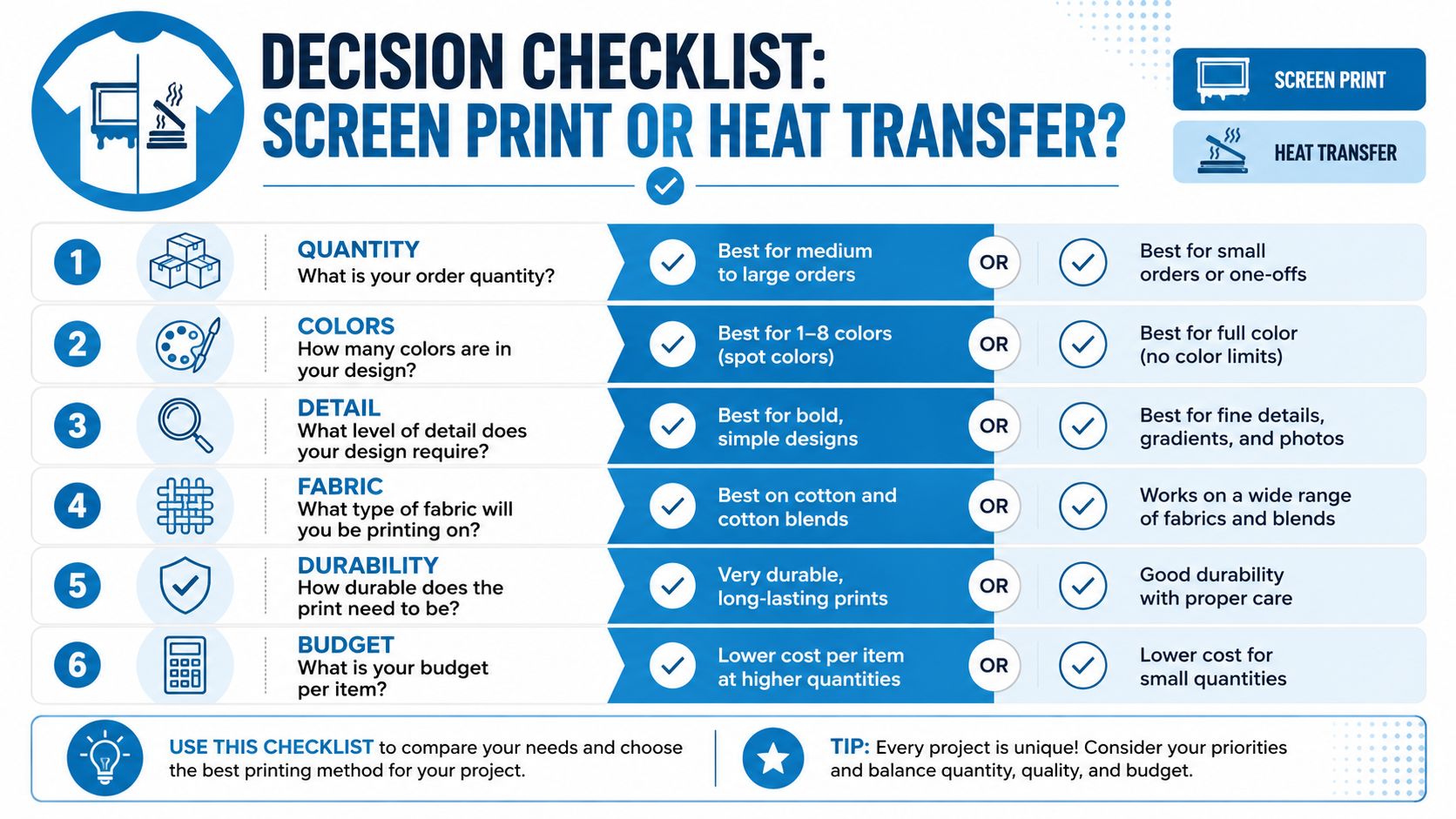
If you need a quick answer, use this checklist the same way a print manager would.
Questions That Push You Toward Screen Printing
Ask yourself these first:
Are most or all garments using the same design?
If yes, screen printing becomes more practical because repetition is where it performs best.Is this apparel meant for steady, repeated wear?
Uniforms, work shirts, and resale basics usually favor the method that delivers a more established finish over time.Do you care about long-run cost efficiency?
If your quantity is moving out of small-batch territory, screen printing usually deserves serious consideration.Is the artwork clean and brand-driven rather than photo-style?
Logos, simple front prints, and bold event graphics often align well with screen printing.
Shop-floor advice: If your design is stable, your quantity is healthy, and you want the order to feel professional from the first wear to the later reorders, screen printing is usually the safer bet.
Questions That Push You Toward Heat Transfer
These point the other direction:
- Do individual garments need different names, numbers, or roles?
- Are you ordering a small run or testing a concept before scaling?
- Does the artwork rely on detail, gradients, or image-heavy composition?
- Is speed more important than long-term print life for this project?
If the answer to several of those is yes, heat transfer is often the smarter operational choice.
One more rule helps avoid expensive mistakes. Decide on the garment and the print method together. A design file alone isn't enough. The blank shirt, intended use, reorder plan, and budget all affect what “best” means.
Beyond the Basics A Look at Modern Alternatives
A lot of business buyers start with a screen printing versus heat transfer decision, then realize the core question is broader: what method fits the job you are trying to accomplish?
Where DTG Fits
Direct-to-garment, or DTG, usually makes sense for short runs, full-color artwork, and designs that need a softer print feel. I bring it up most often for online merch tests, artist-driven graphics, and small batches where setup cost matters more than squeezing down the unit price on a large run.
Garment choice matters here. DTG tends to perform best on shirts that are well-suited to the process, and that limitation affects whether it works for a retail program, a staff uniform order, or a one-off campaign. For the right project, it gives brands a way to print detailed artwork without forcing a screen print minimum.
Why Many Buyers Also Ask About DTF
Direct-to-film, or DTF, gets attention because it fills a gap that many businesses run into. It can handle detailed art, works across a wider range of garments, and still supports short-run ordering without the setup structure of screen printing.
For buyers comparing newer methods, this guide on what direct-to-film printing is gives helpful background.
From a shop perspective, DTF is worth discussing when a client needs flexibility. That could mean mixed garment types, fast reorders in small quantities, or artwork that does not fit cleanly into a standard screen print plan. It is not automatically the best choice for every brand program, especially if your priority is long-run cost control or a traditional printed finish, but it belongs in the decision process.
That is the bigger point here. Good apparel buying decisions are not about picking the newest method or forcing every order into two familiar categories. They are about matching the print method to the business goal, whether that goal is resale, promotion, team identification, or testing demand before a larger reorder.
If you want a practical recommendation before placing an order, Dirt Cheap Product, Inc. can review your artwork, garment choice, and quantity, then point you toward the method that fits your budget, timeline, and brand standards.