Direct-to-film printing is a modern decoration method where a design is printed onto special film, coated with adhesive powder, and heat-transferred onto a garment. It has grown into a major part of the custom apparel market, with the global DTF market valued at USD 2.72 billion in 2024 and projected to reach USD 3.92 billion by 2030.
If you're ordering shirts, hoodies, uniforms, or event apparel right now, you're probably seeing a lot of print terms thrown at you. Screen printing. DTG. DTF. Embroidery. For most buyers, the confusing part isn't the name. It's what the finished item will look like, feel like, and hold up like after people start wearing it.
DTF, or Direct-to-Film, has become popular because it solves a very practical problem. It lets printers create vibrant, full-color designs on a wide range of fabrics by printing onto a special film first and then heat-transferring that image onto the garment. That matters when your order includes cotton tees, polyester polos, blended hoodies, tote bags, or mixed staff uniforms and you don't want a different decoration method for every item.
A lot of articles stop at the definition. Most business owners need more than that. They want to know if the print feels soft or heavy, whether it works well on dark garments, and when it makes more sense than DTG or screen printing.
Table of Contents
- Your Guide to Modern Custom Apparel
- The DTF Printing Process Explained Step by Step
- DTF vs DTG vs Screen Printing A Complete Comparison
- When to Choose DTF for Your Custom Apparel
- Artwork Prep and Care for Lasting DTF Prints
- How Dirt Cheap Product Inc Creates Your DTF Order
- Frequently Asked Questions About DTF Printing
Your Guide to Modern Custom Apparel
A common scenario goes like this. A company needs staff shirts for a trade show, a few branded hoodies for the team, and maybe some tote bags for giveaways. The logo has gradients, the garments aren't all the same fabric, and nobody wants to place three separate decoration orders just to get a consistent look.
That's where DTF usually enters the conversation.
Direct-to-Film printing is a transfer method. The design is printed onto a special film, then applied to the final garment with heat. Because the image starts on film instead of being printed straight onto one specific type of shirt, printers can use it across cotton, polyester, cotton-poly blends, silk, nylon, and even some non-fabric materials, as described by Printful's explanation of direct-to-film printing.
Why DTF has become easier to understand in real business terms
For a buyer, the key question isn't "what machine is used?" It's "what problem does this solve for me?"
DTF is often a practical fit when you need:
- Mixed garments in one order. Cotton tees, polyester performance shirts, and blend hoodies can all live in the same project.
- Full-color artwork. Logos with fades, textures, or small details translate better than with simpler decoration methods.
- Dark or light apparel. The white underbase in the process helps the design show up clearly on both.
- Flexibility. You don't have to think in old categories like "cotton only" or "simple spot colors only."
DTF is easiest to understand if you think like a buyer, not a printer. You need a decoration method that works across real-world garment choices.
If you want another plain-language overview before comparing methods, this short guide on what is DTF printing is a useful companion read.
The question most shoppers actually mean
When people ask, "What is direct to film printing?" they usually mean something broader. They're asking whether it's right for uniforms, merch, staff apparel, promo wear, or resale products.
That answer depends on more than the definition. It depends on hand-feel, durability, fabric type, design complexity, and order style. Those are the details that make DTF either a smart fit or the wrong tool for the job.
The DTF Printing Process Explained Step by Step
A lot of buyers hear "direct to film" and picture a glossy sheet fused to a shirt. The process, however, is more precise than that. The film is a temporary carrier, and the print layer is what stays on the garment after pressing.
Why the process matters to a buyer
DTF works like making a custom decal for fabric, then pressing it into place under controlled heat and pressure. That matters because the process helps explain the result you care about later: how the print looks on dark garments, how fine details hold up, and why the surface feel is different from ink that soaks directly into cotton.
If you are comparing decoration methods for a logo, staff uniform, or merch run, our guide to choosing the right logo decoration method can help you match the process to the job.
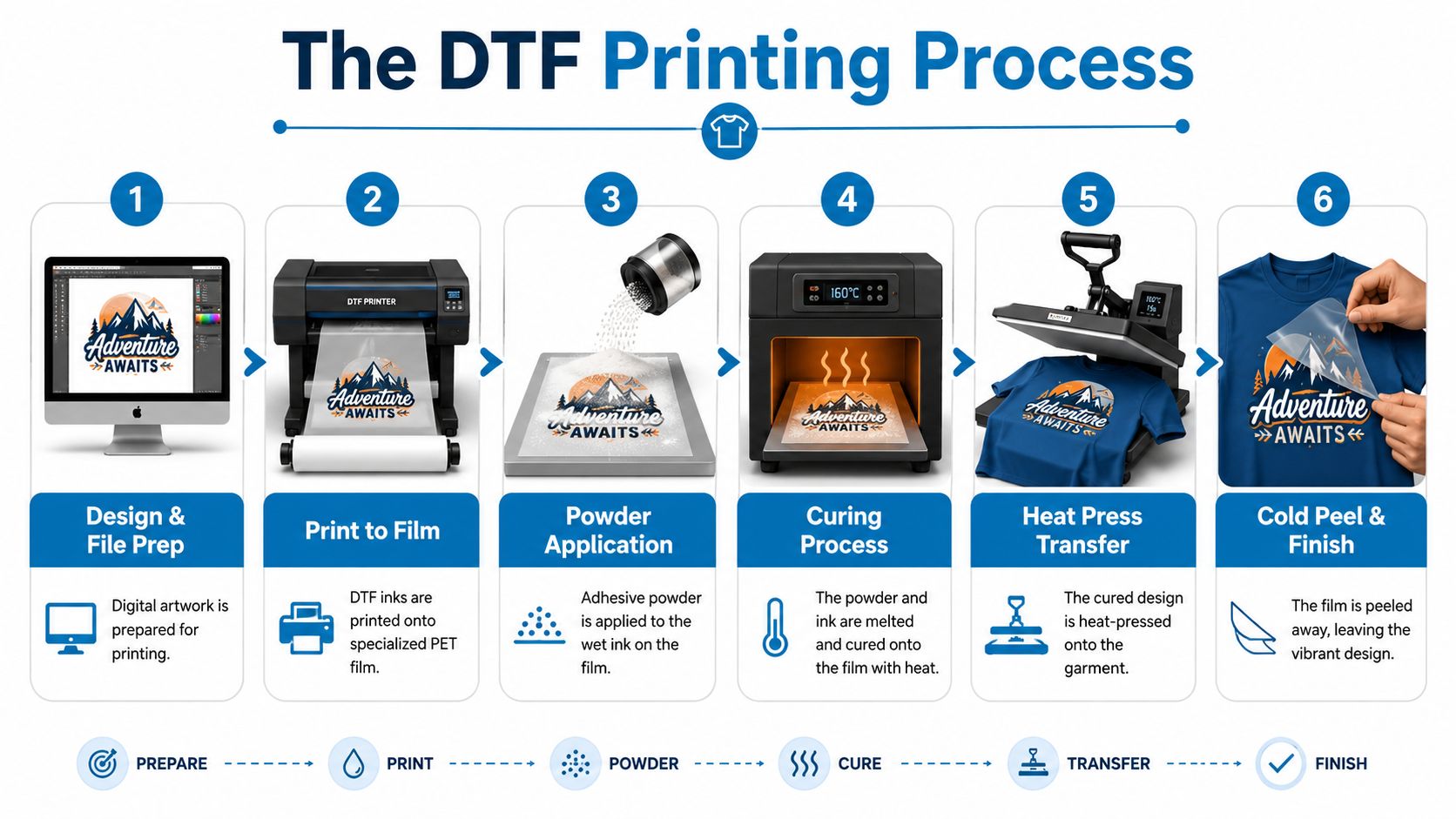
The six basic steps
Design and file prep
The artwork is cleaned up and sized before production starts. Edges, small text, transparency, and color transitions all matter here because the printer is building a transfer first, then applying it to the garment.Printing onto film
The design is printed in reverse onto coated PET film. That reverse layout makes sense once you remember the sheet will be turned onto the shirt during pressing, like placing a stamp face-down before it transfers.Adding adhesive powder
Adhesive powder is applied to the printed areas while the ink is ready to bond. This layer is a big reason DTF can move across different fabric types more easily than methods that rely on the shirt absorbing ink.
After those steps, it helps to watch the sequence in motion.
Curing the transfer
Heat cures the adhesive so the printed sheet becomes a ready-to-press transfer. At this stage, it has shifted from wet print to a controlled layer built for application.Heat pressing onto the garment
The film is positioned on the shirt and pressed with heat and pressure. This is the bonding stage, where the design attaches to the fabric surface in a consistent way.Peel and finish
Once the transfer is set, the film is peeled away and only the printed layer remains on the garment. A finishing press can smooth the surface and improve the final appearance.
Practical rule: The film is temporary. The transfer is the product.
That distinction clears up a common point of confusion. The shirt does not keep a full plastic sheet on top. It keeps the bonded ink-and-adhesive layer, which is why DTF can deliver bright color and sharp detail while still feeling different from prints that sink deeper into the fabric.
DTF vs DTG vs Screen Printing A Complete Comparison
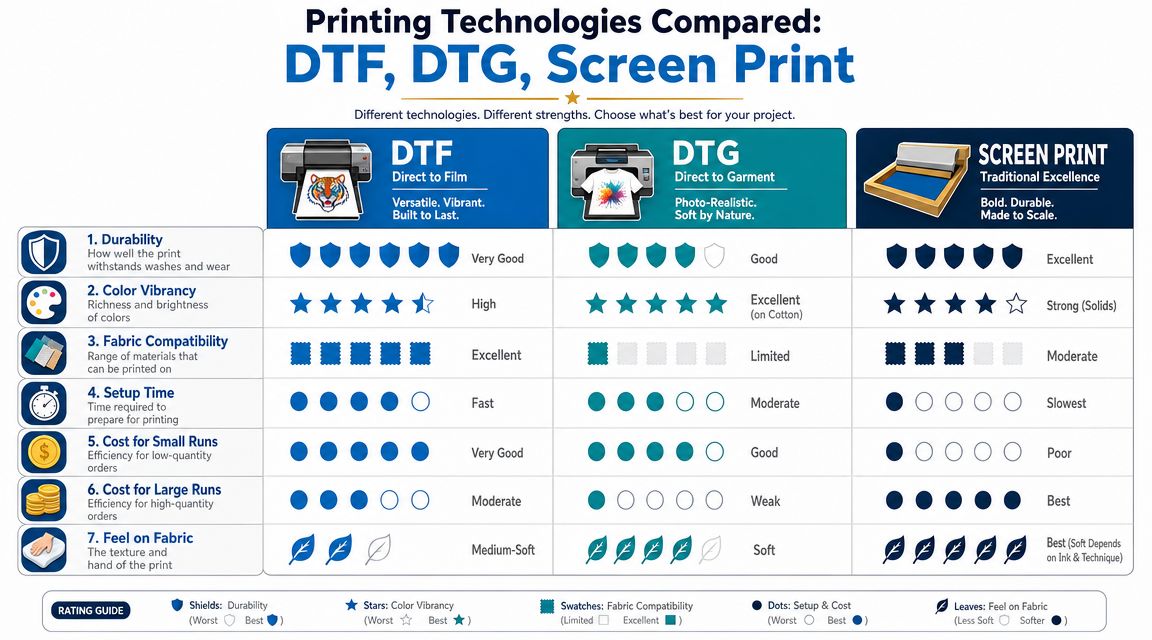
If you're deciding between decoration methods, the easiest way to compare them is by outcome. Not by equipment. Not by industry jargon. By what matters when the order arrives.
A side-by-side look
| Attribute | Direct-to-Film (DTF) | Direct-to-Garment (DTG) | Screen Printing |
|---|---|---|---|
| Fabric compatibility | Works across many fabric types | Best known for cotton-focused use | Common choice across many garments |
| Dark garment printing | Strong option because of white underbase | Can work well on dark garments depending on setup | Commonly strong on dark garments |
| Detail and color range | Very good for full-color graphics | Very good for detailed artwork | Great for simpler graphics and bold spot colors |
| Feel on fabric | Transfer feel varies by design coverage | Often preferred when a softer print feel is the top goal on cotton | Feel depends on ink and coverage |
| Small orders | Often practical | Often practical | Usually less attractive when setup is heavy for the job |
| Large repeat orders | Can work well | Can work, but not always the first choice | Often preferred for high-volume repeat designs |
| Mixed-fabric orders | Strong fit | Less flexible | Depends on garment and art needs |
One major reason DTF changed the conversation is fabric flexibility. ColDesi's explanation of DTF printers and process notes that traditional DTG works best on cotton, while DTF can be applied to cotton, synthetics, poly blends, silk, and more. It describes that shift as significant for print shops that need flexibility.
How to think about the trade-offs
DTF is often the practical middle ground when a client wants rich graphics without being boxed into one fabric category. If your order includes performance wear, blended fleece, and cotton tees, DTF removes a lot of those compatibility headaches.
DTG still gets attention when buyers highly value a softer-feeling print on cotton and the design belongs on that type of garment. The print approach is different, so the hand-feel discussion is different too.
Screen printing remains a classic choice when the design is simple, the quantity is substantial, and consistency across a long run matters more than photographic detail. It's not outdated. It's just a different tool.
For buyers comparing options for a logo project, this guide on how to choose a logo decoration method is useful because it frames the decision around garment type, artwork style, and order goals instead of just machine names.
The best print method isn't the most modern one. It's the one that fits the fabric, the artwork, and the way you'll actually use the apparel.
When to Choose DTF for Your Custom Apparel
DTF makes the most sense when flexibility matters more than tradition. That's why so many businesses now consider it early in the quoting process rather than as a backup option.
The technology isn't a niche anymore. The global direct-to-film printing market was valued at USD 2.72 billion in 2024 and is projected to reach USD 3.92 billion by 2030, driven by demand for customized, on-demand apparel and DTF's versatility, according to this market summary on DTF printing growth.
Projects where DTF makes sense fast
You should look closely at DTF when your project includes one or more of these conditions:
- Your garments are mixed. Team polos, staff tees, lightweight hoodies, and bags don't all behave the same. DTF handles variety well.
- Your logo is detailed. Gradients, layered color, small text, and illustration-style art usually fit the method better than basic one-color marks.
- You need dark garments. Bright art on black or navy apparel is a common use case.
- Your order is brand-driven. Retail-style merch, launch apparel, event shirts, and promotional wear often need crisp visual impact more than old-school ink texture.
A few examples make this clearer. A gym ordering moisture-wicking staff shirts and cotton event tees may prefer one decoration method across both. A restaurant group outfitting front-of-house and kitchen teams may want the same artwork on different garment blends. A marketing team launching limited-run merch may need full-color graphics without simplifying the art.
When another method may fit better
DTF isn't automatically the answer.
Screen printing may still be the cleaner choice for a big reorder with simple art. Embroidery may be better for polos, hats, or uniforms that need a stitched look. DTG may appeal if the garment is cotton-focused and soft-hand print feel is the top priority.
If you're ordering for a growing brand or local company and want examples of where the method fits, this page on DTF printing for small business is a useful reference point.
DTF is often the right answer when your order doesn't fit neatly into one fabric type or one simple logo style.
Artwork Prep and Care for Lasting DTF Prints
A good DTF result starts before printing and continues after delivery. Two things shape the outcome more than buyers expect. First, the quality of the artwork file. Second, how the finished garment is washed and worn.
How to send artwork that prints cleanly
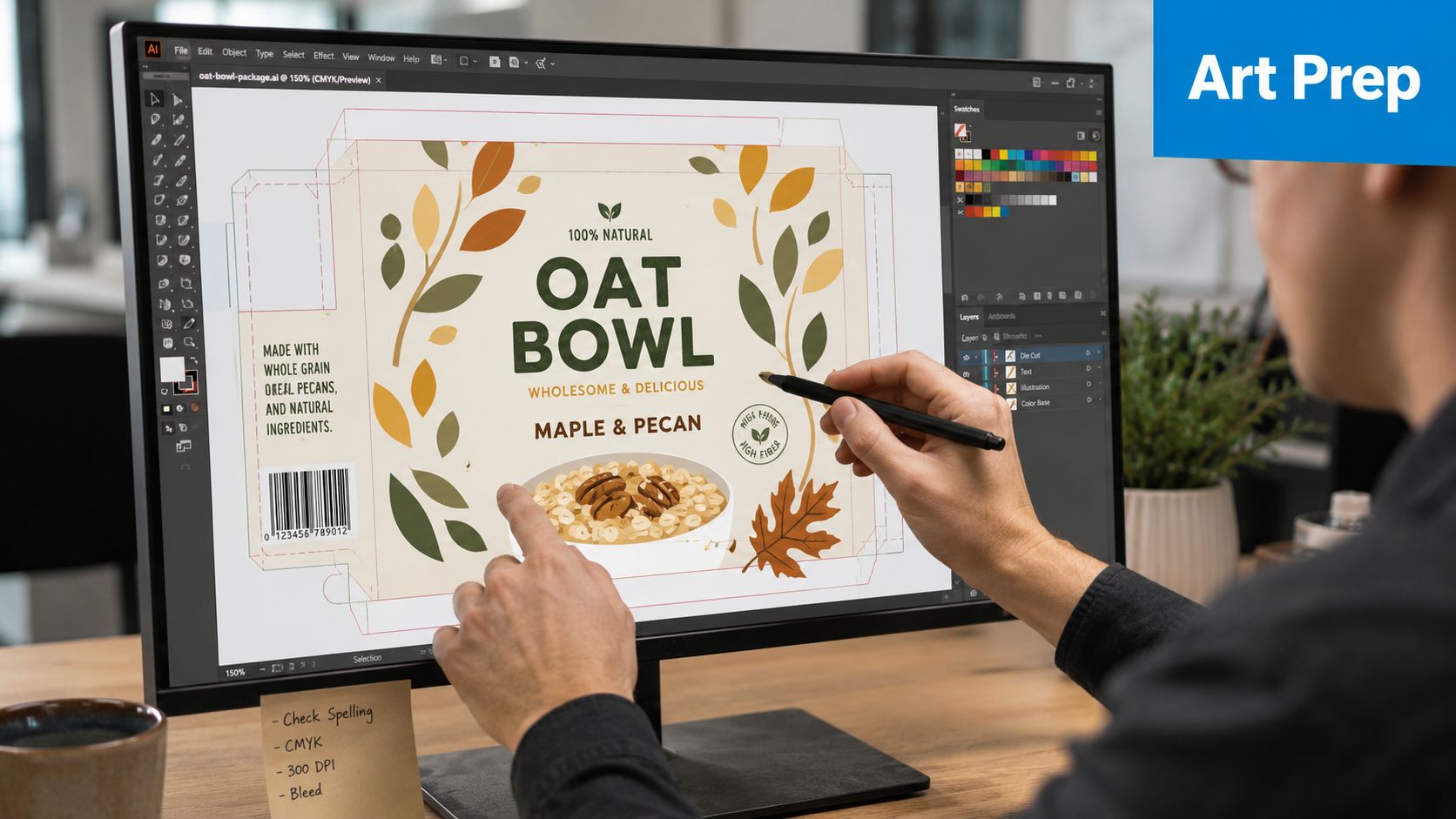
The cleaner the file, the cleaner the transfer.
Here are the habits that help most:
- Use sharp source art. Blurry screenshots and tiny web graphics usually don't improve when enlarged.
- Keep backgrounds intentional. If your design should have a transparent background, make sure the file has one.
- Preserve small details carefully. Fine lines and tiny text can print well, but only if the file starts clean.
- Ask before re-creating logos yourself. A print shop can often tell quickly whether the file is production-ready or needs adjustment.
If you've ever worked on oversized stage graphics, some of the same file discipline applies. This tutorial for stage-ready drum heads is about a different product, but it's a helpful reminder that artwork prep affects how any printed graphic looks at final size.
How to wash and wear DTF apparel
Performance questions matter here because DTF is a bonded transfer, not dye integrated into the fabric. Wikipedia's overview of direct-to-film printing notes that the process involves heat pressing at about 160–170 °C and that this thermoplastic bond affects hand-feel and how the print responds to stretching and washing.
That doesn't mean the print is fragile. It means care matters.
A good everyday care routine looks like this:
- Wash inside out. This reduces surface abrasion against other garments.
- Use cooler water when possible. Gentler wash conditions help preserve the print surface.
- Skip harsh treatment. Rough handling, aggressive heat, and repeated over-stretching can shorten the life of any applied graphic.
- Dry with care. Lower heat is usually kinder to transfer-based decoration than high heat.
A full-front graphic will usually feel different from a small chest logo. Coverage changes hand-feel more than the print method name alone.
The other common question is stretch. DTF can work well on many garments, but "works on many fabrics" doesn't mean every fabric behaves the same under every use condition. A flexible tee, a slick performance shirt, and a heavily stretched athletic garment won't all feel identical after decoration.
How Dirt Cheap Product Inc Creates Your DTF Order
For most buyers, the hardest part isn't understanding the print technology. It's making sure the final order matches the brand. Color, placement, garment choice, and approval timing are usually where projects go right or wrong.
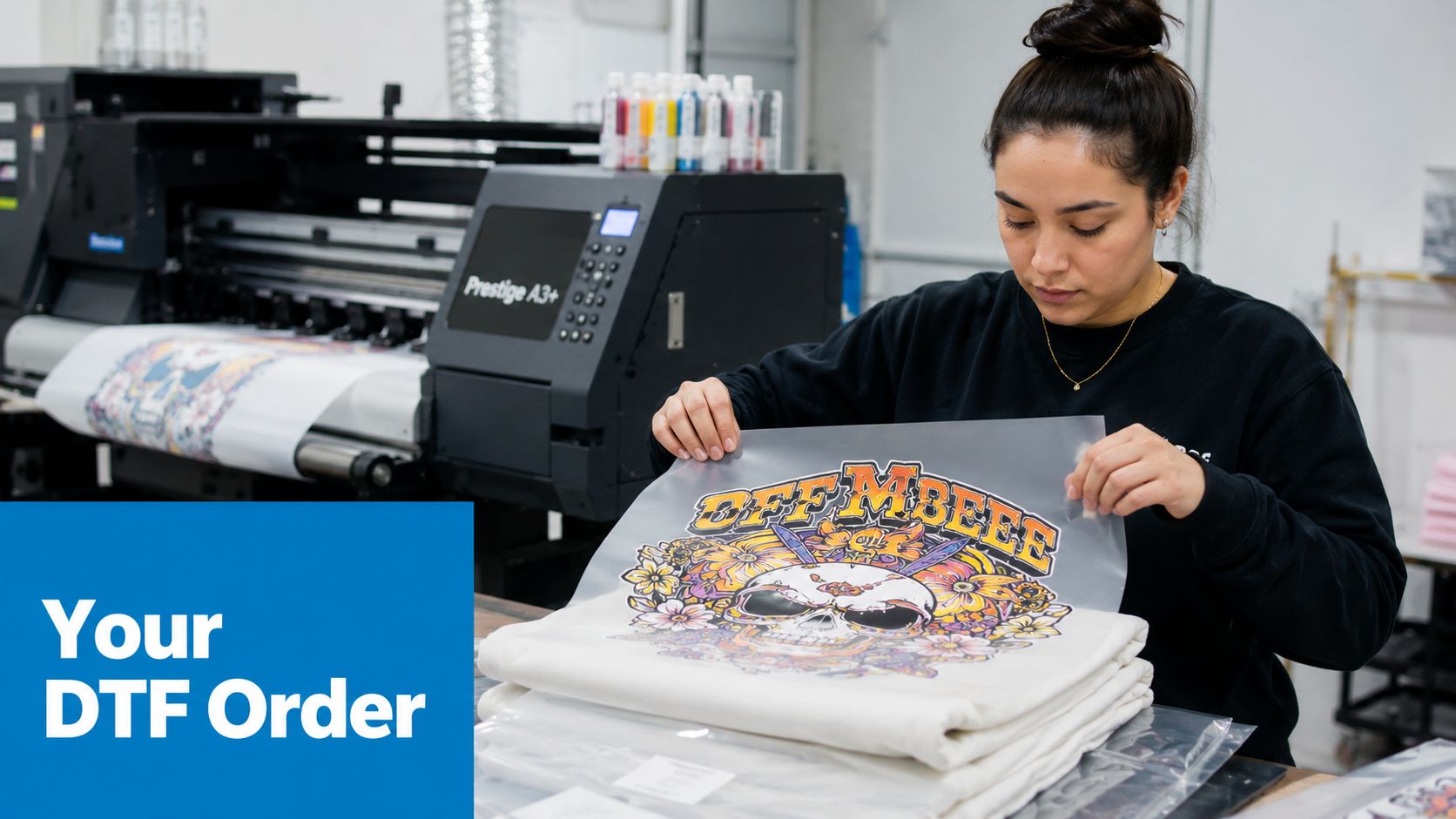
From logo upload to proof approval
A straightforward order flow helps remove guesswork:
You submit the project details
That usually includes logo files, garment choices, quantities, sizes, and decoration placement.A rep reviews the artwork and order needs
Practical issues get spotted early, such as file quality problems or logo placement questions.A digital proof is created for approval
The proof gives you a chance to confirm scale, position, and appearance before production starts.
If you already know what you need, the custom order form for branded apparel projects is the place where those specs get organized.
Where quality control matters most
Small adjustments matter a lot in custom apparel. A logo that looks centered on screen can feel low on the shirt once it's worn. A bright brand color can shift visually depending on garment color and fabric surface. That's why proofing isn't paperwork. It's production control.
Dirt Cheap Product, Inc. handles custom apparel and promotional item decoration with a process built around uploaded artwork, responsive sales support, and proof approval before production. For buyers, that means the technical side of DTF can stay in the background while the order decisions stay clear.
Frequently Asked Questions About DTF Printing
Does DTF feel plasticky
It can feel that way if the design has a lot of solid coverage.
A good comparison is a sticker versus dye soaked into fabric. DTF adds a thin printed layer on top of the garment, so a large full-front block of ink will feel more noticeable than a small chest logo or a design with open space. For business buyers, the practical question is not just "Will it print?" but "How will it feel during a full workday?" That answer depends on print size, ink coverage, and the type of garment underneath.
Can DTF print very detailed artwork
Yes. It is a strong choice for detailed, full-color art.
Logos with small text, gradients, illustrated elements, and photo-style images are common fits for DTF because the process holds fine visual detail well. The catch is simple. Print quality starts with the file you send. If the artwork is blurry, compressed, or low resolution, the transfer will reproduce those flaws rather than hide them.
Is DTF better than embroidery
DTF and embroidery solve different problems.
DTF works well when your design needs color range, smooth edges, or details that thread cannot reproduce cleanly. Embroidery fits better when you want texture, dimension, and a classic stitched look on items like polos, hats, jackets, and uniform pieces. If your brand mark includes tiny text or color fades, DTF will translate it more faithfully. If you want a tactile, premium stitched finish, embroidery is the better match.
Is DTF a good option for smaller orders
Yes, it is a good option for many smaller runs, especially when the artwork is detailed or the garments are not all the same.
That matters for businesses ordering a mix of tees, hoodies, and performance wear with one logo treatment. Instead of forcing one decoration method onto very different fabrics, DTF gives you more flexibility across the order. Minimums still depend on the shop and the exact item mix, so the smartest move is to bring up fabric variety and artwork complexity at the start of the quote.
Can DTF be used beyond standard T-shirts
Yes, in many cases.
Buyers ask about tote bags, hoodies, and other non-tee items because the method is flexible across many materials. The better question is whether the final result fits the job the item needs to do. A giveaway bag, a retail-style hoodie, and a work uniform all wear differently. That means feel, durability, and surface texture should guide the decision as much as print compatibility.
If you're deciding between DTF, screen printing, embroidery, or another apparel decoration method, Dirt Cheap Product, Inc. can help you sort through the options based on your garments, artwork, and order goals so you end up with custom apparel that fits the way your business will use it.