Screen printed shirts can cost anywhere from $3 to $25 each, and the final price depends heavily on order quantity and design complexity. If you're ordering a handful of shirts with a detailed design, expect the high end of that range. If you're ordering in bulk with a simple print, the price usually drops fast.
If you're shopping for shirts for a company event, staff uniforms, a fundraiser, or merch, you're probably seeing quotes that feel all over the place. That doesn't mean shops are making up numbers. It usually means you're pricing different production setups without realizing it.
The biggest mistake buyers make is treating screen printing like buying a finished retail product. It isn't. You're paying for a production run. The shirt itself matters, but the primary factor is the work required to prepare and print your design.
That's why two jobs that look similar on the surface can price very differently. A one-color front print on a standard tee is a very different job from a multi-color design with front and back placement. The same kind of budgeting logic shows up in other visual branding projects too. If you're comparing event apparel with branded headshots or team images, this breakdown of team photography cost factors is useful because it shows how scope, complexity, and usage can shape pricing in a service business.
Table of Contents
- Your Guide to Screen Printing Prices
- The 7 Key Factors That Determine Your Cost
- Why Order Quantity Is the Biggest Price Lever
- Sample Screen Printing Price Scenarios
- 5 Smart Ways to Lower Your Screen Printing Costs
- Get Your Custom Screen Printing Quote Today
Your Guide to Screen Printing Prices
Most buyers start with one question. How much does it cost to screen print a shirt?
The honest answer is that there isn't one flat rate. A commonly cited independent pricing guide puts typical screen-printing prices at $3 to $25 per shirt, with 1 to 10 shirts often landing around $10 to $25 each, 20 to 50 shirts around $7 to $12 each, and 500+ shirts around $3 to $6 each, as explained in this breakdown of screen printing cost per shirt.
That spread makes sense once you understand what you're buying. You're not just buying cotton and ink. You're paying for art prep, screen setup, press time, garment handling, and the decisions that make the print look right on the shirt you chose.
Why shoppers get confused
Business owners often compare quotes line by line and focus only on the unit price. That usually leads to bad decisions. A lower unit price can hide compromises in garment choice, print placement, or how much setup work is included.
Practical rule: If two quotes seem far apart, check the job specs before you judge the price. Quantity, color count, and print locations often explain the difference.
What actually helps you budget
When I explain pricing to a client, I tell them to think in layers:
- Base garment: The blank shirt sets the floor.
- Production setup: Screens, alignment, and prep create fixed costs.
- Design complexity: More colors and placements usually mean more work.
- Order size: The more pieces you run, the more efficiently those fixed costs get spread out.
If you understand those four layers, you'll stop guessing and start shaping the quote in your favor.
The 7 Key Factors That Determine Your Cost
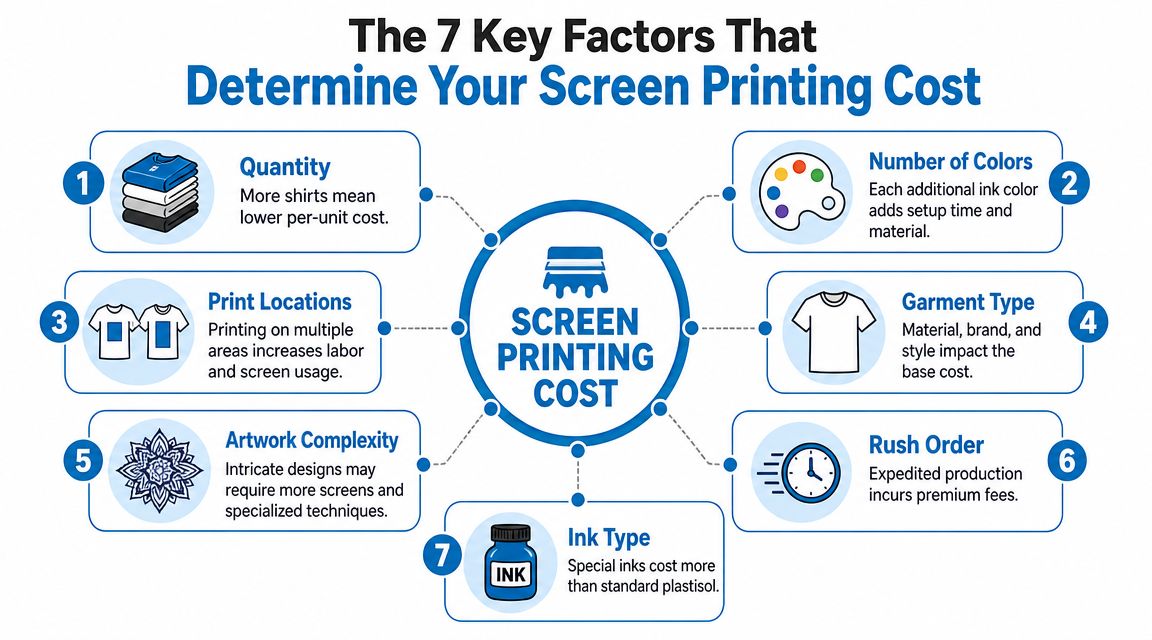
A shirt quote usually moves for seven reasons. Some affect the base cost. Others affect labor, setup, or how many times the garment has to go through production.
Setup fees shape the starting point
The first cost many buyers notice is the setup fee. This is one of the least understood parts of screen printing, but it explains a lot. A pricing guide referenced by Raygun Printing's price guide lists a $30 screen charge per spot color with screens stored for up to 3 months, and another shop lists a $35 one-time screen charge per color per side.
That means the first color on the first location carries weight. The setup work happens whether you print a few shirts or a large batch.
Here are the first three factors that usually affect the quote fastest:
- Quantity: More units lower the cost per shirt because the setup gets spread out across more pieces.
- Number of colors: Each color can require its own screen and setup.
- Print locations: A front print and a back print are not one print. They're two production steps.
When buyers say, "It's just a logo," the next question is where, how big, and how many colors. That's where the cost lives.
The other choices that move your quote
The next four factors are less obvious, but they matter:
- Garment type: A basic cotton tee and a premium retail-style tee don't start at the same base cost.
- Artwork readiness: Clean, print-ready art saves time. Messy files can slow down proofing and setup.
- Turnaround time: Rush jobs squeeze production schedules and usually reduce your options.
- Ink choice: Standard inks are straightforward. Specialty finishes can require extra handling. If you're weighing feel and finish, this overview of water-based ink printing helps clarify when a softer-hand print may affect your production choices.
A separate pricing discussion from Oh Boy Print Shop's t-shirt printing overview notes that each color and each print location can require a separate screen, and it gives a useful example. A 1-color print on 24 shirts runs around $10 per shirt, while 72 shirts can fall to about $8 per shirt. That gap shows why complex layouts hurt small orders the most.
What works and what doesn't
A good value order usually looks simple on paper. One strong print location. Tight artwork. Realistic turnaround. A garment that fits the use case.
What doesn't work is piling on small choices that each seem minor. Add a back print, another ink color, a premium shirt, and a short deadline, and the quote climbs quickly even before the order leaves the art stage.
Why Order Quantity Is the Biggest Price Lever
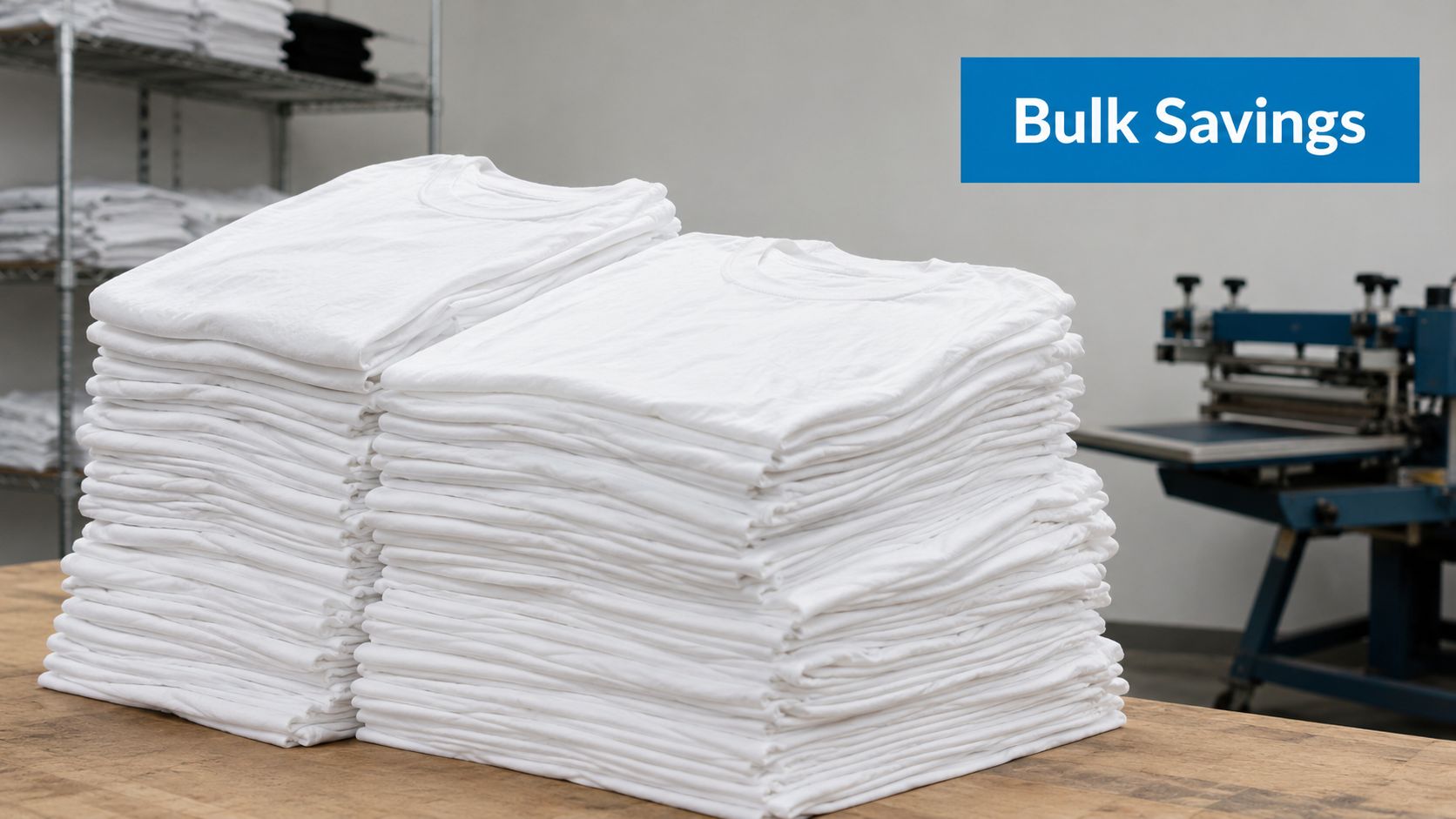
If you only remember one thing about screen printing, remember this. Quantity controls the value of the whole run more than anything else you can change.
A bakery is a good comparison. Opening the shop, prepping ingredients, heating ovens, and organizing trays all take effort before the first cookie gets sold. Once that setup is done, producing more cookies is much easier. Screen printing works the same way.
Why small runs feel expensive
The hard part isn't only printing the shirt. The hard part is getting ready to print the shirt. Screens have to be prepared. Artwork has to be aligned. Ink has to be loaded. Test prints often have to be checked before the full run starts.
That's why a small order can feel disproportionately expensive. The shop still has to do the setup work, but there are fewer shirts available to absorb that cost.
A buyer ordering a few extra pieces often gets better value than a buyer trying to hit the absolute minimum.
This is also why bulk planning matters. If you know your staff will need uniforms for onboarding, events, and replacements, it often makes more sense to think in one production run instead of several tiny ones. A practical place to start is a bulk order custom apparel guide so you can compare how ordering strategy affects the final quote.
How buyers use quantity strategically
Experienced buyers don't ask only, “What's the cheapest way to print this?” They ask, “How many pieces can I justify printing now so the price makes sense?”
That shift changes the math. Instead of treating extra shirts as waste, they treat them as inventory, backup sizing, or future hires covered in advance.
A smart order often includes:
- Staff growth planning: Add shirts for new employees before you need a reorder.
- Size buffer: Include common replacement sizes so one missing medium doesn't trigger a new setup later.
- Event overage: If the shirts are for public distribution, small extras reduce stress on event day.
Quantity isn't always the whole answer, but it's the strongest lever a buyer can control without changing the look of the design.
Sample Screen Printing Price Scenarios
Numbers help, but they only help if you read them the right way. The table below is best used as a planning tool, not as a universal rate sheet. It combines the verified price ranges already discussed with the basic rule that more colors and more setup complexity usually push the cost upward.
How to read the table
Use the quantity column first. Then look at your design complexity. A simple one-color logo generally sits lower in the range, while multi-color art usually moves toward the upper end because each added color can require more setup work.
| Quantity | 1-Color Print | 3-Color Print | 5-Color Print |
|---|---|---|---|
| 1 to 10 | $10 to $25 each | Higher within the same small-run range | Higher within the same small-run range |
| 20 to 50 | $7 to $12 each | Often toward the upper end of the range | Often toward the upper end of the range |
| 24 shirts | About $10 per shirt | Higher than the 1-color example | Higher than the 1-color example |
| 72 shirts | About $8 per shirt | Higher than the 1-color example | Higher than the 1-color example |
| 500+ | $3 to $6 each | Higher within the large-run range | Higher within the large-run range |
The source numbers behind those ranges come from the earlier cited independent pricing references. One guide shows typical pricing at $3 to $25 per shirt depending on quantity, and another shop example shows a 1-color print on 24 shirts at about $10 per shirt, dropping to about $8 per shirt at 72 shirts.
What matters most in this table is the pattern. Small orders carry the heaviest setup burden. Mid-size orders start to feel more efficient. Large runs push the effective print cost down because the fixed work gets spread across many more garments.
If you're asking how much does it cost to screen print a shirt for your business, this is the practical answer. Start with quantity first, then simplify the design where you can.
5 Smart Ways to Lower Your Screen Printing Costs
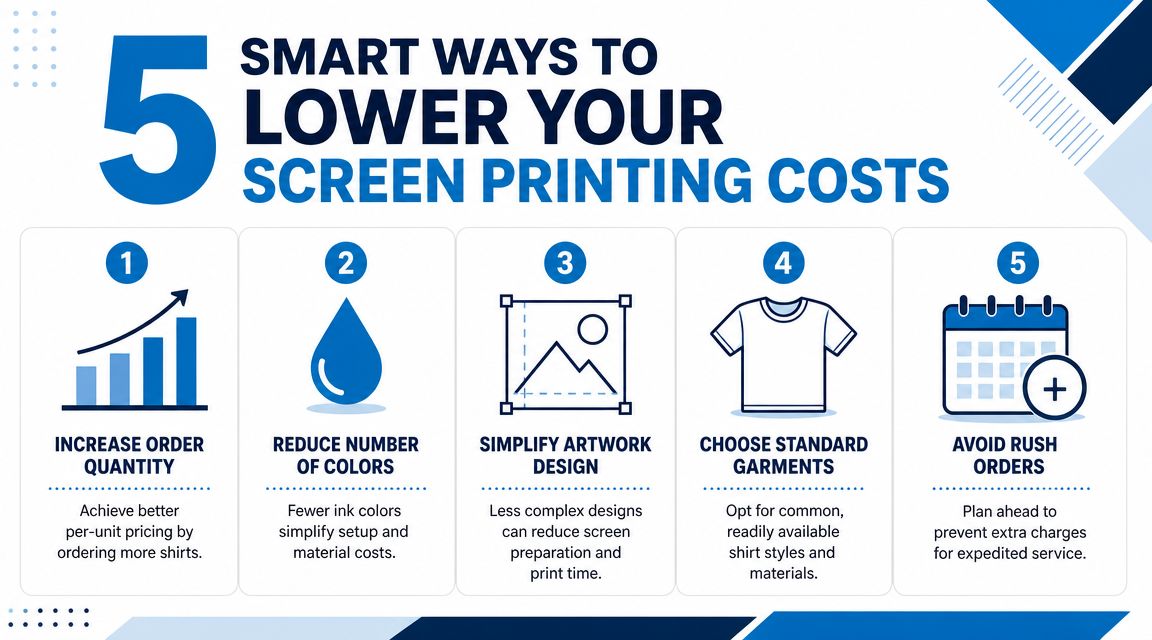
A business owner approves a shirt design, gets the quote back, and wonders why two versions of the same idea are priced so differently. The answer is usually in production choices that do not look expensive on screen but create extra labor at press. The best savings come from cleaning up those choices before the job is built.
Cut cost by making the job easier to produce
These five moves save money without gutting the design:
- Use halftones instead of adding another spot color: If the artwork needs shading or a softer transition, halftones can often create that effect with fewer screens. That matters because fewer screens usually means less setup, less registration work, and a simpler run.
- Pick ink colors that work across more than one shirt color: If your team wants black tees, gray tees, and white tees, choose art colors that stay readable on all three. A design that can run with the same ink set across multiple garment colors is easier to schedule and less likely to turn into separate setups.
- Choose artwork that tolerates standard underbase choices: On dark garments, bright prints often need an underbase. Some designs also need highlight whites or special layering to stay sharp. If the art can be adjusted to print cleanly with a simpler white base, the job usually runs faster and with less press adjustment.
- Be careful with garment blend upgrades: Triblends, heavy fleece, pigment-dyed goods, and other fashion blanks can print well, but they often bring trade-offs like dye migration risk, fuzzier print detail, or slower curing. A standard cotton or cotton-poly shirt is usually easier to print consistently and can reduce spoilage risk.
- Standardize repeat orders: If this is a program order for staff, events, or ongoing merch, keep the garment, print size, and art placement consistent from run to run. That gives the shop a cleaner production path and makes reorders easier to quote. If you are pricing an ongoing apparel program, send the details through this custom screen printing quote form.
A lot of buyers focus on the visible parts of the shirt. Shops also price the invisible parts. Ink coverage, curing behavior, registration tolerance, and how forgiving the garment is on press all affect labor.
What smart buyers ask before approving art
A better question than "How do I get the cheapest shirt?" is "What is making this design harder to print?"
That question usually leads to useful changes:
- Simplify large solid areas that lay down a lot of ink: Big heavy prints can take longer to flash and cure, especially on darker garments.
- Avoid tiny distressed details unless they serve the brand: Fine texture can look good, but it can also require tighter screen prep and closer press attention.
- Match the print method to the goal: If the design depends on photo detail or a full-color gradient, screen printing may not be the lowest-cost path for a small run.
- Approve art early enough for the shop to suggest fixes: Good prepress can catch expensive issues before they reach production.
The strongest budget decisions come from understanding why the quote moves. Once that is clear, it gets much easier to cut cost without cutting impact.
Get Your Custom Screen Printing Quote Today
Once you understand what drives the quote, the buying process gets simpler. You stop comparing shirt prices like a shelf item and start evaluating the job the way a print shop does. That usually leads to better decisions, fewer surprises, and a result that fits both your brand and your budget.
A strong quote starts with clear information. Have your quantity, garment type, print locations, artwork, and deadline ready. If you're still deciding, that's fine too. A good shop can help you narrow the job into something practical.
When you're ready to move forward, use this custom order form for branded apparel to submit the basics and get pricing based on the specific details of your project.
If you need a reliable partner for custom apparel, Dirt Cheap Product, Inc. can help you price the job clearly, refine the artwork, and choose the right decoration method for your budget and timeline. Request a quote, send over your logo, and their team will help you turn a rough idea into a production-ready order.