Screen printing on shirts is a stencil-based method where ink is pushed through a fine mesh screen onto fabric, producing durable, vibrant designs ideal for bulk orders of 24 or more shirts. The process creates one screen for each color, so it rewards repeatable artwork and larger quantities rather than one-off experiments.
You may be ordering shirts for a staff uniform, planning event merchandise, or testing a retail design for the first time. The quote might mention screens, mesh counts, underbases, curing, and color separations, leaving you unsure what you're buying. Once you understand how the process works, those production terms become useful decision points instead of confusing shop language.
Table of Contents
- Understanding Screen Printing on Shirts
- How the Screen Printing Process Works
- Ink Types and Mesh Selection for Quality Results
- Advantages and Limitations of Screen Printing
- 2026 Trends and When Screen Printing Makes Sense
- Cost Factors and Choosing the Right Print Vendor
- Caring for Screen Printed Shirts and Final Takeaways
Understanding Screen Printing on Shirts
At a print shop, a shirt order begins with the artwork and the number of garments you need. Screen printing on shirts transfers ink through a stencil. The printer covers selected areas of a fine mesh screen with emulsion or another stencil material, then pulls ink across it with a squeegee. Ink passes through the open areas and reaches the fabric underneath.
The result is built one color at a time, much like applying separate stamps that combine into one image. A one-color logo may need one screen, while a multi-color illustration requires individual screens that must align accurately. That alignment, called registration, affects whether the finished design looks clean or slightly blurred.
Why buyers choose it
A landscaping company ordering crew shirts is a good example. The logo uses a few solid colors, the same artwork appears on every garment, and the print needs to remain visible through regular work and washing. The shop can prepare the screens once and repeat the design across the order, making the setup more practical as quantity increases.
The method also suits team uniforms, school apparel, event merchandise, nonprofit campaigns, and retail-style graphics. According to Turner Library's history of screen printing at California State University, Chico, modern commercial screen printing traces back to Samuel Simon's patented screen-printed process in 1907. By the 1960s, screen printing had moved decisively into T-shirt production, and later rotary garment-printing equipment helped expand printed shirts in the United States market. The same history reports that garment printing now represents over half of screen-printing activity in the United States. Read the history of screen printing from California State University, Chico.
Practical rule: Screen printing is easiest to justify when the same design repeats across many shirts.
With a suitable ink and mesh combination, the finished print can look bold and highly saturated. The method still depends on the artwork and order details. Small quantities, photographic images, soft gradients, or designs with many colors may make a digital or hybrid method the better purchase, especially when minimizing screen setup matters more than repeat-production efficiency.
How the Screen Printing Process Works
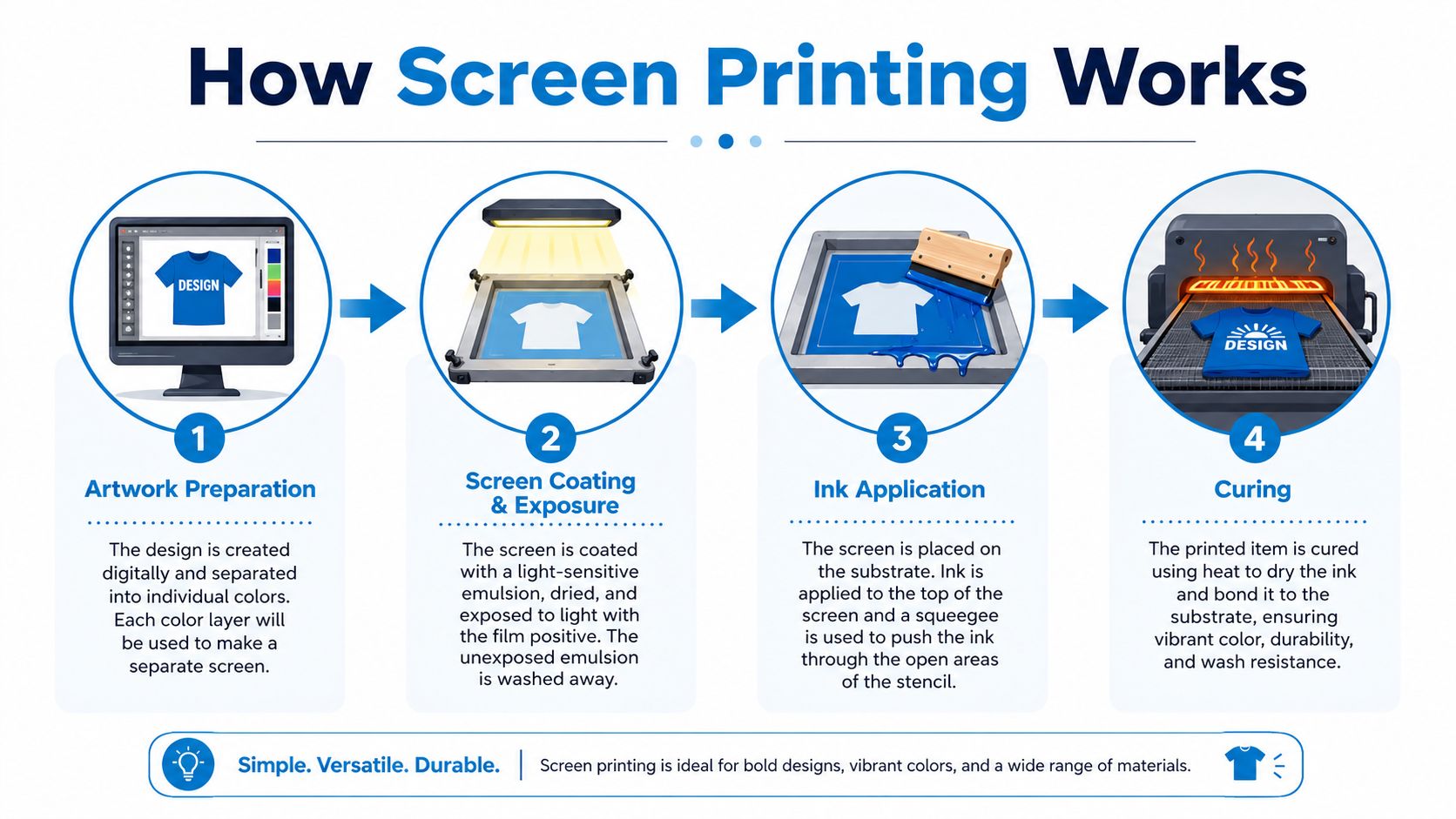
A print shop begins with the artwork, then converts that file into a controlled sequence of print steps. For a four-color mountain design, the printer checks the file, separates each color, and prepares every separation to become its own stencil. This early review can reveal details, color overlaps, or registration needs that affect the final quote and production plan.
From artwork to stencil
Each color is assigned to a separate screen. The screen receives a coating of light-sensitive emulsion, which hardens under light. The artwork blocks light in selected areas, while the exposed emulsion becomes solid. During washout, the unexposed emulsion rinses away, leaving open mesh where that color's ink will pass. See a visual explanation of the shirt screen-printing process.
The process follows a set sequence: prepare the artwork, expose the screens, wash out the stencil, and inspect each opening before printing. A four-color design therefore needs four screens, one for each color. More colors can mean more setup, alignment checks, and production time, which matters when comparing screen printing with a digital or hybrid method for a smaller order.
Ink application and registration
The printer places the shirt on a platen, positions the first screen, and pulls ink across the mesh with a squeegee. Pressure pushes ink through the open stencil and onto the fabric. A multi-color shirt passes through each screen in order, with the garment held in a consistent position.
Registration means aligning every color with the others. If the red, blue, and black areas of the mountain shift, the edges can look blurry or offset. Operators use registration marks and press adjustments to keep each layer in place. Buyers should ask how the shop handles registration when artwork has fine outlines or several overlapping colors.
A flash cure may occur between colors, depending on the press setup and ink system. The final cure sets the ink so the print reaches its finished state. Plastisol commonly requires heat curing around 320°F to 330°F, or 160°C to 166°C. Water-based ink also needs moisture evaporation, often around 160°C, or 320°F, for 1 to 2 minutes with good air movement. Compare plastisol and water-based curing requirements.
Setup takes time, but that preparation is distributed across more garments on a larger order. Automated systems can produce hundreds of T-shirts per hour, helping explain why screen printing remains practical for high-volume production. Review the global screen-printing market and production context.
The video below shows another view of the equipment and workflow.
Ink Types and Mesh Selection for Quality Results
Ink changes the shirt's appearance, texture, and production requirements. The two choices buyers hear most often are plastisol and water-based ink, although a shop may recommend other specialty systems for particular fabrics or effects.
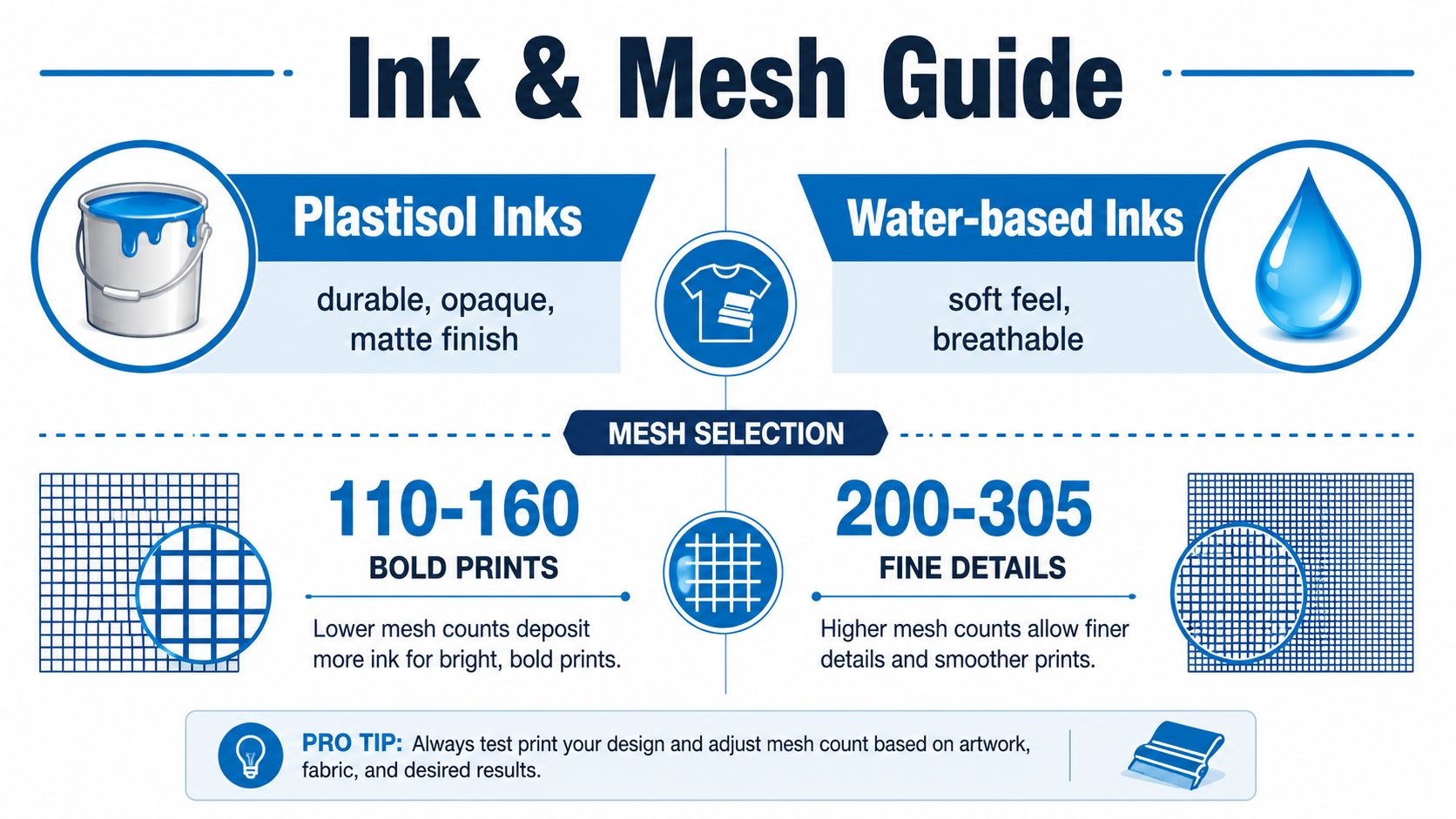
Plastisol sits on top of the fibers and produces a strong, opaque print. It doesn't air-dry, so the printer must heat-cure it before the garment is ready. That makes temperature control important, especially when the print includes a dark-shirt underbase or several layers of ink.
Water-based ink penetrates the fibers and can produce a softer, lighter hand feel. It still needs proper curing because moisture must leave the ink before the print reaches its finished state. The result can feel more integrated with the fabric, but the shop must match the ink, garment, airflow, and curing process carefully.
Mesh count controls the deposit
Mesh count describes how open or fine the screen is. A lower mesh deposits more ink, which helps create opacity on dark garments. A higher mesh deposits less ink and supports finer artwork, small details, and halftones.
Apparel printing often uses a 110-mesh screen, while finer artwork and halftones may call for 156-mesh or higher. Review the relationship between mesh, ink, opacity, and detail. The correct choice depends on more than the artwork alone. Shirt color, fabric texture, ink type, and the desired feel all matter.
Ask your printer: “What mesh and ink combination are you recommending for this shirt color and artwork?”
A common dark-shirt strategy uses a lower-mesh screen for an opaque underbase, followed by a finer screen for the visible colors. The underbase prevents the shirt from dulling the artwork, while the overlay helps preserve sharper edges and limit unnecessary ink buildup.
| Production choice | What it usually prioritizes |
|---|---|
| Lower mesh | Ink coverage and opacity |
| Higher mesh | Fine detail and lighter ink deposit |
| Plastisol | Bold coverage and strong color |
| Water-based ink | Softer feel and breathability |
If you want a softer print, ask whether the garment and artwork support water-based ink rather than assuming every design can use it. For additional context on that option, review this guide to water-based ink printing.
Advantages and Limitations of Screen Printing
If you are ordering matching shirts for a team, event, or retail line, screen printing can be a practical choice when the design repeats and the quantity justifies setup. It produces bold logos, solid colors, and strong coverage. With suitable materials and curing, the print can also withstand regular wear.
The method suits many garment colors and products, including cotton shirts, heavier blanks, hoodies, and bags. A printer may adjust the underbase, screen setup, and ink approach for light or dark garments. Those production choices affect both appearance and cost, so the same artwork may not be priced or printed identically on every blank.
Where the economics work
Screen printing has front-loaded preparation. The shop creates screens, separates the artwork, prepares inks, and registers each color before the run begins. A short order carries that work across fewer garments, which can make the per-shirt cost feel high.
As the quantity increases, setup accounts for less of each shirt's cost. The broader textile printing market also shows continuing demand for screen printing across apparel and related uses, as reflected in this textile screen-printing market outlook.
Screen printing is often a good fit when:
- The artwork repeats: One setup can support a consistent run.
- The design uses solid colors: Straightforward separations keep production manageable.
- The order is substantial: More garments spread setup across the order.
- The print needs bold coverage: Ink and underbase choices can produce strong color.
Where another method may win
Photographic images, soft gradients, and highly varied artwork require more color handling than a simple spot-color design. Each added screen brings more preparation, registration, ink handling, and production time. A small order, especially one in which every shirt has different artwork, may therefore suit direct-to-film or direct-to-garment production better.
Digital methods also let buyers test artwork without committing immediately to a full screen setup. A hybrid shop can screen print the repeated parts of a collection, then use digital decoration for names, detailed images, or short-run samples. If heat transfer is another option under consideration, compare the production differences in this guide to screen printing versus heat transfer.
Ask the vendor how the setup charge, artwork variation, garment choice, and desired quantity affect the recommendation. The lowest per-shirt price is not useful if the method requires more inventory than you can sell.
2026 Trends and When Screen Printing Makes Sense
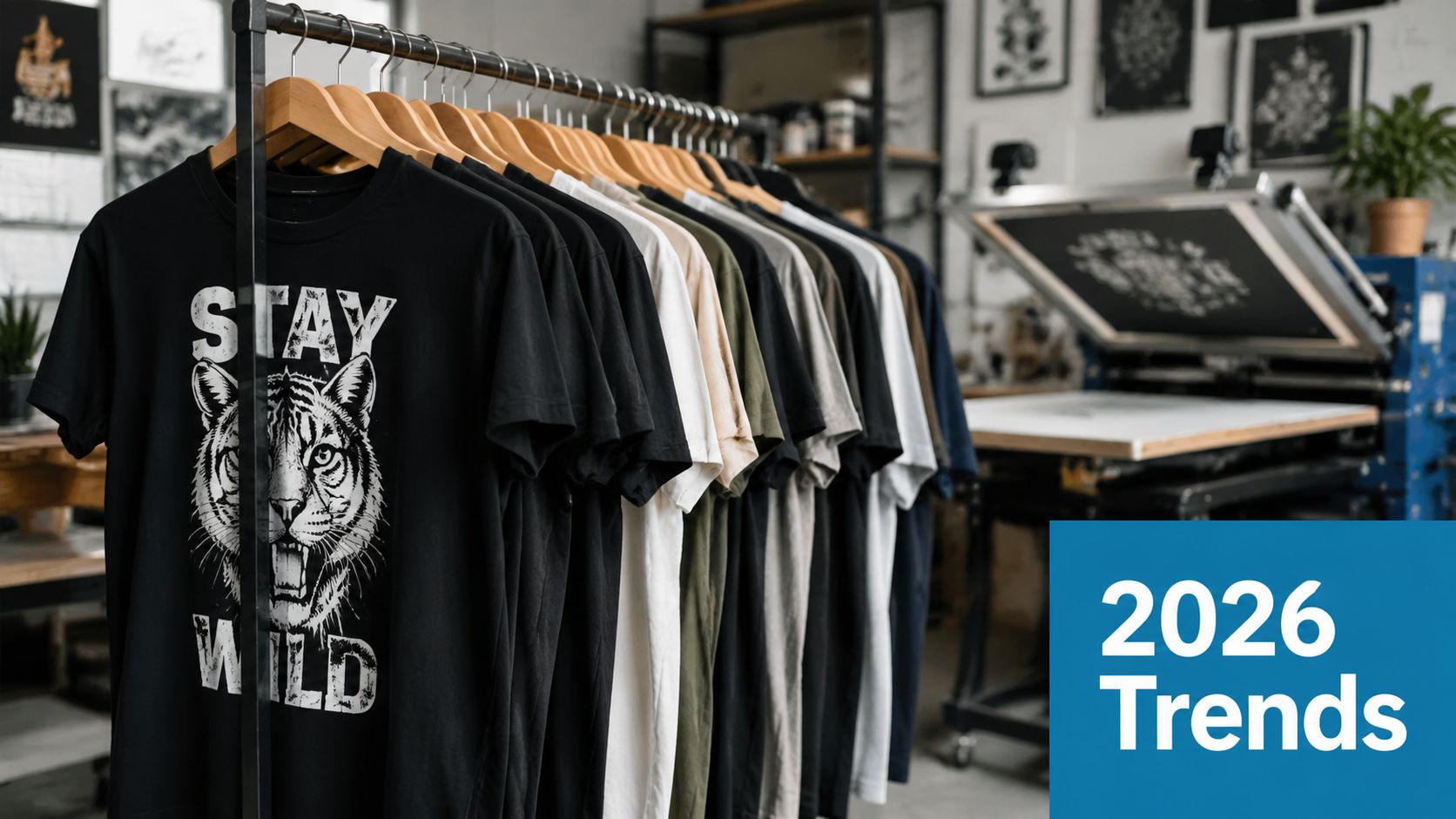
A buyer choosing shirts for a launch, event, or retail collection should start with the artwork and the order, not with a preferred printing machine. Current 2026 design coverage points to smaller front prints with larger back graphics, distressed and vintage treatments, limited-color artwork, and retail-style placements. These choices suit screen printing because they rely on clear shapes, controlled color, and intentional texture instead of photographic detail. Review current screen-printing design trends for 2026.
A small chest mark with a large back illustration can give staff apparel or an event tee a more considered appearance. Distressed artwork makes a new garment look familiar and worn in, while a restricted palette creates a cleaner product identity. Heavyweight or structured blanks can support these placements by providing a steadier surface for graphic-focused designs.
The practical buying filter
Review the design and order as one decision. Screen printing is often a strong candidate for 24 or more shirts, repeated artwork, and a limited color palette. A digital method may suit a small test run, individualized names, highly detailed artwork, or a collection in which every design changes.
Screen printing works like a reusable stencil system. Once the screens are prepared, repeating the same image is efficient. Digital printing works more like sending a new file to a printer for each garment, so changing names, images, or quantities does not require the same screen setup. Industry coverage describes hybrid screen-printing and digital workflows as an important 2026 operating model, allowing shops to combine higher-volume screen work with digital methods for detailed or changing artwork. Read about hybrid apparel-printing workflows.
That approach gives buyers more control over mixed projects. A shop might screen print a repeated back graphic, use digital decoration for a short-run capsule, and produce a digital sample before approving the final screen setup.
If the shirts will be sold through a boutique, pop-up, or another retail channel, selling in stores with taap.bio offers guidance for considering presentation, inventory, and placement alongside the decoration method.
Use this decision sequence:
- Count the repeat garments: Repetition makes screen setup easier to justify.
- Inspect the artwork: Solid shapes and limited colors generally favor screen printing.
- Decide how the shirt should feel: Ink choice affects hand feel and appearance.
- Ask about a hybrid quote: A mixed approach can preserve flexibility.
Screen printing remains valuable for repeatable, bold artwork. Digital or hybrid production may make better sense when the order needs variation, detailed imagery, or a low-commitment test. Ask the vendor to recommend the method for each part of the project rather than forcing every garment through one process.
Cost Factors and Choosing the Right Print Vendor
A screen-printing quote usually reflects four practical variables: color count, garment choice, quantity, and turnaround. More colors require more screens and more registration work. A premium or heavyweight blank costs more than a basic shirt, while unusual garments may require additional testing.
Quantity affects how setup is distributed across the order. Urgent production can also affect scheduling because the shop may need to rearrange press time, artwork approval, garment sourcing, or curing capacity.
Before comparing prices, send the same information to every vendor:
- Artwork file: Provide the cleanest logo or design file available.
- Garment details: Name the shirt style, color, size range, and preferred fabric.
- Decoration plan: Specify print locations, approximate dimensions, and color expectations.
- Order details: State the quantity and the date the finished shirts must be ready.
For a first-order pricing overview, consult this guide to how much it costs to screen print a shirt.
Proofing protects the finished order
A reputable shop should provide a proof before production. Treat that proof as a production document, not a formality. Check the design's placement, print dimensions, colors, garment color, and the spelling of every word.
Ask whether the proof shows the actual shirt color and whether the artwork has been adjusted for the fabric. A logo that looks balanced on a white digital canvas may need an underbase or color adjustment on a black shirt. If the design includes fine lines, tiny text, or distressed texture, ask how the printer expects those details to reproduce at the selected size.
Questions worth asking
Ask the vendor about experience with similar artwork, available garment catalogs, expected production timing, and what happens if the artwork needs refinement. You should also confirm whether the quote includes setup, screens, garment sourcing, folding, packing, and shipping.
Dirt Cheap Product, Inc. offers screen printing alongside direct-to-film, embroidery, sublimation, and custom patches, with apparel options that include T-shirts, polos, sweaters, outerwear, hats, and bags. Its stated workflow includes artwork support and proofs for checking color, placement, and detail before production.
Before approving: Confirm the garment, print locations, color count, proof, quantity, delivery date, and total quoted scope in writing.
Responsive communication matters because small artwork or garment decisions can affect the finished result. A vendor who asks specific production questions is giving you useful information, not creating unnecessary friction.
Caring for Screen Printed Shirts and Final Takeaways
Good care starts with reducing unnecessary stress on the printed surface. Turn shirts inside out before washing, use cold water, and choose a gentle cycle when practical. Avoid high-heat drying because excessive heat can affect both the garment and the ink over time.
Don't iron directly over the printed area. If you need to remove wrinkles, turn the garment inside out or place a protective layer between the heat and the design. Store shirts clean and dry, without compressing them under heavy items for long periods.
A simple care routine
- Wash inside out: This limits direct friction against the print.
- Use cold water: Cooler washing is gentler on color and fabric.
- Skip harsh treatment: Avoid aggressive scrubbing across the artwork.
- Dry with care: Use low heat or air drying rather than high heat.
- Protect the print: Keep direct ironing off the decorated surface.
The right production method still depends on the order. Screen printing is a practical choice for repeated artwork, bold color, and larger runs, especially when the design uses a controlled palette. Digital or hybrid production can make more sense for small tests, variable graphics, or detailed images.
Ink and mesh selection shape the final appearance and feel. A low-mesh underbase may support opacity on a dark shirt, while a finer screen can preserve detail in the visible artwork. The printer's proofing process then gives you the opportunity to catch placement, color, and artwork issues before the press run begins.
When requesting a quote, send complete artwork and garment information, ask how the design will be separated, and compare the recommended process rather than just the headline price. That conversation will tell you whether screen printing, digital decoration, or a combination of both fits the project.
Dirt Cheap Product, Inc. provides custom screen printing for T-shirts and other apparel, along with DTF, embroidery, sublimation, and patches for business uniforms, events, retail merchandise, and branded programs. Upload your artwork, review the proof, and visit Dirt Cheap Product, Inc. to discuss the garment, quantity, design, and production method that fit your order.