
You've approved the logo, chosen a popular blank, and planned the launch around a batch of custom tank tops. Then the first sample arrives. The artwork sits too low, the armhole cuts into the graphic, and the lightweight fabric stretches enough to make a clean print look distorted. Tank tops aren't just T-shirts without sleeves. Sleeveless garments require their own printing decisions, from artwork proportions to platen setup and durability testing.
That distinction matters commercially. The global clothing custom printing market was valued at US$14,054.6 million in 2024 and is projected to reach US$25,774.2 million by 2030, with a projected 10.7% CAGR from 2025 to 2030 (Grand View Research clothing custom printing market data). Tank tops benefit from the same demand for personalization, event merchandise, branded apparel, and private-label products. The opportunity is substantial, but a poorly placed or poorly tested design can turn a profitable order into a replacement job.
Table of Contents
- Why Tank Tops Demand a Different Printing Approach
- Comparing Printing Methods for Sleeveless Garments
- Artwork Preparation and Placement Rules for Tanks
- Pricing Strategies and Order Economics
- Quality Checks and Durability Testing
- Scaling Your Tank Top Merchandising Program
Why Tank Tops Demand a Different Printing Approach
A new business client usually starts with a T-shirt template. The logo is centered, the print size looks familiar, and the order moves toward production. That workflow breaks down when the garment has narrow straps, a low neckline, curved armholes, or a loose silhouette. The printable torso is smaller, and the body beneath the design is more exposed, so even a modest placement error becomes obvious.
A standard T-shirt offers broad fabric around the chest and shoulders. A tank top may pull across the upper chest, drape away from the body, or shift as the wearer moves. A graphic that looks centered on a flat mockup can appear too close to an armhole once the garment is worn. A large back print can also move toward the shoulder blades or hem depending on the cut.
Practical rule: Treat the armholes and neckline as active boundaries, not empty space.
The garment changes the artwork brief
Fabric weight and stretch affect the print before ink or film reaches the platen. Ribbed cotton has visible texture and can distort fine details. Soft tri-blends drape differently from heavier cotton. Athletic polyester tanks may need a decoration method that accommodates performance fabric, moisture, and repeated stretching.
Fashion cuts create another problem. Oversized, boxy, and low-armhole tanks leave more skin visible and expose more of the side body. Trend coverage for 2026 highlights relaxed fits, statement graphics, minimal branding, mixed-media decoration, and growing digital workflows (French Press Custom's 2026 custom apparel trend coverage). Those styles can sell well, but they make placement less forgiving than a conventional athletic tank.
Why the category deserves careful production
The closest historical benchmark is custom T-shirt printing. The global custom T-shirt printing market was valued at USD 4.31 billion in 2022, and screen printing accounted for more than 50% of revenue that year, according to the cited industry summary (custom apparel industry statistics). Tank tops use many of the same decoration processes, but the garment's reduced printable area changes how those processes perform.
A successful tank top program starts with three questions: where can the design sit without colliding with the anatomy of the garment, how much can the fabric stretch before the graphic suffers, and which decoration method fits the order size and use case? Answer those before approving artwork, and you'll avoid the most expensive mistake in custom apparel, producing a technically correct print that looks wrong on the person wearing it.
Comparing Printing Methods for Sleeveless Garments
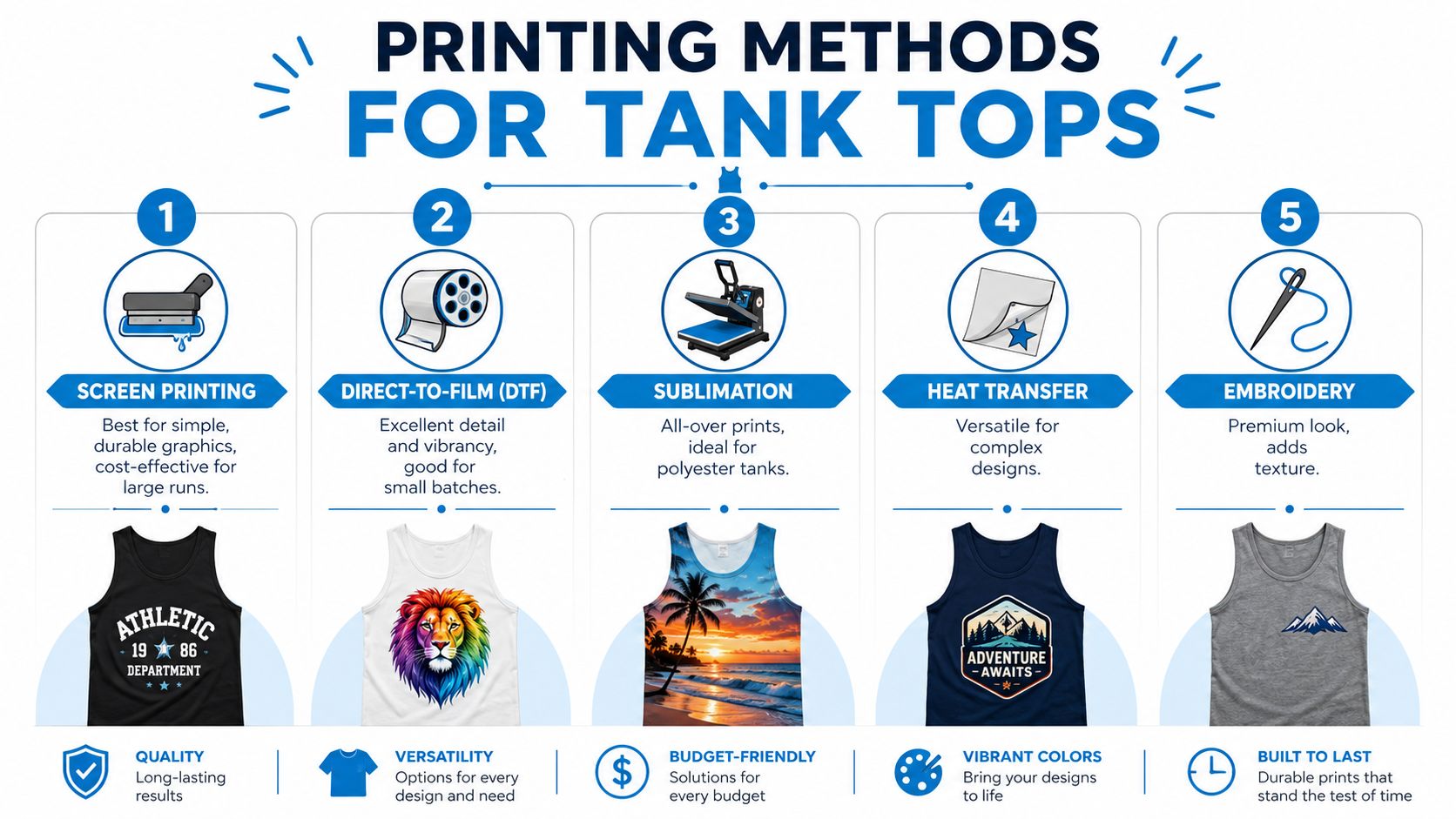
Sleeveless garments expose production problems quickly. Narrow straps, low armholes, curved side openings, and stretch fabric leave less room for registration errors than a standard T-shirt. Choose the decoration method by fabric, artwork, order size, and the parts of the garment that must remain flexible.
| Method | Best Fabric Types | Durability on Stretch | Cost at 100 Units | Minimum Order |
|---|---|---|---|---|
| Screen printing | Cotton, cotton blends, stable ribbed fabrics | Strong when ink and cure are matched to the fabric | Depends on colors, locations, and setup | Often more economical as quantity rises |
| DTF | Cotton, blends, and many performance fabrics after testing | Good for many applications, but test curved and highly stretched areas | Flexible for short runs and detailed art | Usually suitable for small batches |
| Sublimation | White or light polyester | Strong when the garment and process are compatible | Efficient for all-over or multicolor work | Often flexible for smaller runs |
| Heat transfer | Cotton, blends, and selected performance fabrics | Varies by transfer material and stretch | Flexible for names, numbers, and complex graphics | Suitable for small quantities |
| Embroidery | Stable cotton, twill, and structured fabric areas | Limited on thin, highly stretchy panels | Higher setup and stitch-related cost | Usually practical for smaller branded placements |
Screen printing
Screen printing suits bold logos, event graphics, and repeat orders, especially on cotton or stable cotton blends. With a controlled ink deposit, the print can feel relatively soft, while simple artwork becomes more economical as quantity rises. Tanks require tighter control than T-shirts because the platen has less usable fabric around the straps and armholes.
The lightweight blank must remain flat and consistently positioned during printing. Setup guidance for screen printing discusses stabilizing the garment, preparing the screen, and checking alignment before production (screen printing setup guidance). In practice, confirm that adhesive, screen tension, ink choice, and curing settings suit the specific fabric. A misalignment that would disappear on a broad chest panel can become obvious beside a narrow strap or curved opening.
DTF and heat transfer
DTF handles gradients, fine lettering, and multicolor artwork without the screen preparation required for traditional screen printing. It fits test batches, personalized tanks, and designs that would otherwise need several screens. The trade-off is a film-like surface that may feel heavier than a well-executed screen print, particularly on lightweight fabric.
Heat transfer offers similar flexibility for names, numbers, and short runs. Its performance depends on the transfer material, application temperature, pressure, and the garment's stretch. A graphic that looks clean on a flat front panel can split or lift when applied across a flexible side area, so test the print after stretching and laundering.
For a broader comparison of the processes, see this guide to screen printing versus heat transfer.
Sublimation and embroidery
Sublimation is well suited to polyester tanks when the design needs broad or all-over coverage. The process dyes compatible fabric instead of placing a thick layer on top, which helps preserve flexibility. It does not suit every fiber or dark blank, so confirm the garment's fiber content and base color before approving the method.
Embroidery adds texture and visual weight to a restrained logo, but sleeveless garments often lack enough stable chest fabric for dense stitching. Thin, stretchy panels can pucker, stiffen, or distort around the design. Keep the mark compact and place it on a supported area. If you are coordinating branded accessories or fulfillment materials, the reference on pocket sizes from Material Handling USA may help with component planning.
Artwork Preparation and Placement Rules for Tanks
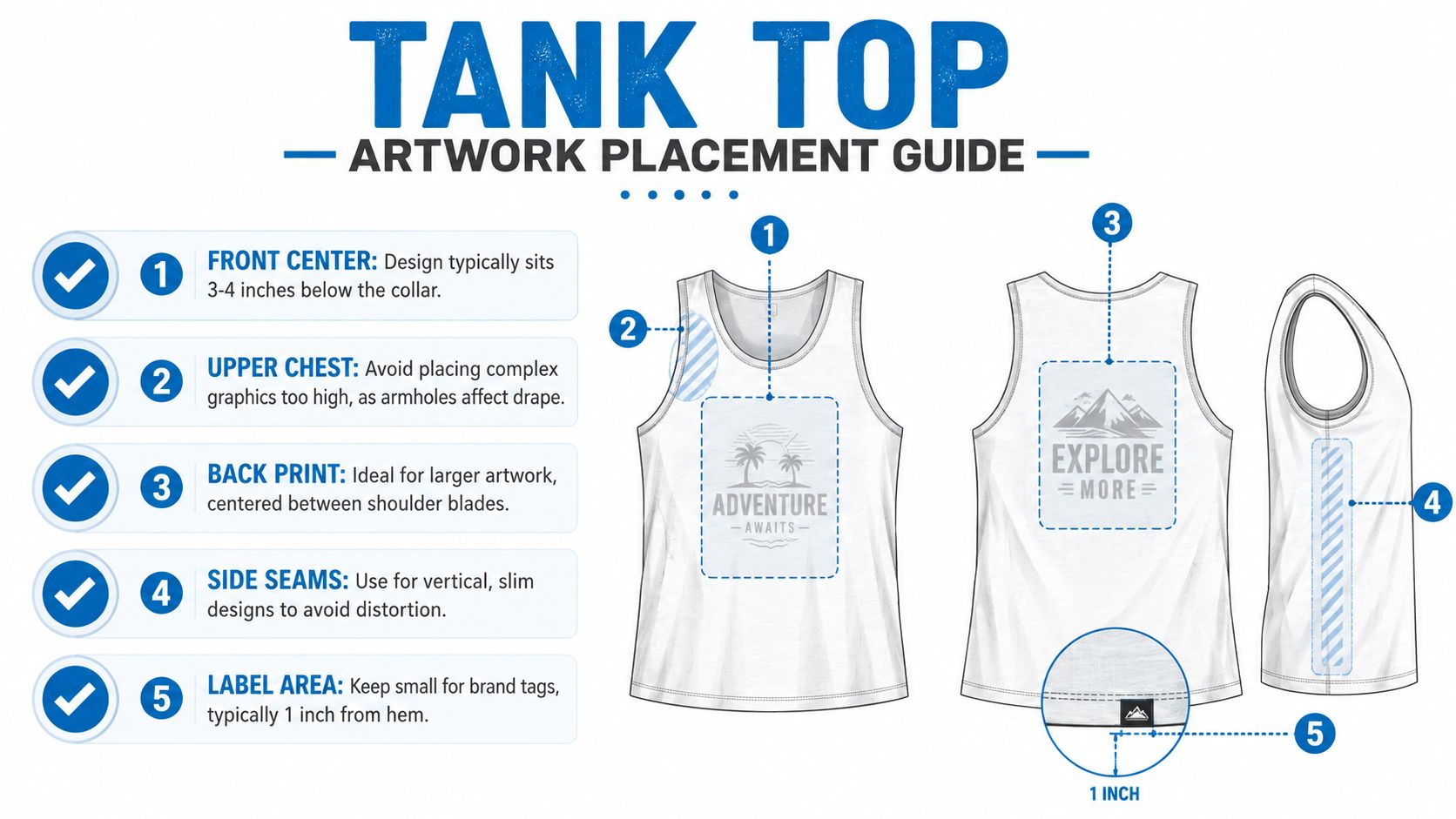
A design can look centered on a T-shirt mockup and still sit too high, too wide, or too close to the openings on a tank. The neckline, narrow straps, low armholes, and side seams reduce the usable print area. Stretch fabric adds another variable, since the graphic can shift or distort when the garment is worn. Build the artwork against the actual blank and review it on a body-shaped mockup, not only on a flat product image.
Start with the physical boundaries
For many screen-printed tanks, begin the image about 1 inch below the top hem. Tanks often hang lower on the body, so a high placement can look awkward across the upper torso. Treat that measurement as a starting point, then measure from the garment's actual top edge and compare the position across sizes. Neckline shape, strap width, and cut can all change the visual center.
Keep lettering and faces away from armholes and side seams. On a low-armhole style, the side edge may show from the front, making a wide logo appear cropped even when it is centered on the platen. A narrow vertical mark can fit near a side seam, but approve it only after checking the drape on a worn garment.
Build files for the decoration method
Use vector artwork for screen printing when the design contains clean shapes, spot colors, or lettering. DTF and heat transfer can use raster files, provided the resolution remains adequate at the final print size. Sublimation requires a compatible polyester blank, careful color planning, and a clear decision about how much of the garment will be covered.
Garment color and texture affect contrast. Bright ink may lose definition on dark ribbed fabric, while a pale graphic may require an underbase or another treatment. Request a physical strike-off when color consistency matters across garment colors or blank batches.
- Check the safe zone: Keep key details inside the area that remains visible when the tank is worn and stretched.
- Simplify fine details: Thin lines and small text can disappear into ribbing, folds, or fabric texture.
- Mock the body, not just the blank: Review front, side, and back views with the armholes exposed.
- Lock the artwork version: Name the approved file clearly so a reorder does not use an outdated logo.
Use this guide to T-shirt design size for proportion and print-size references, then reduce and reposition the artwork for the tank's narrower printable area.
A flat mockup shows placement. A worn mockup shows whether the artwork still looks intentional.
Pricing Strategies and Order Economics
Tank top pricing starts with the blank, but it doesn't end there. Decoration method, garment color, number of print locations, artwork complexity, setup, proofing, packing, and delivery all affect the quote. Sleeveless garments can also require extra handling when the platen needs a different setup or when the print area sits close to seams and openings.
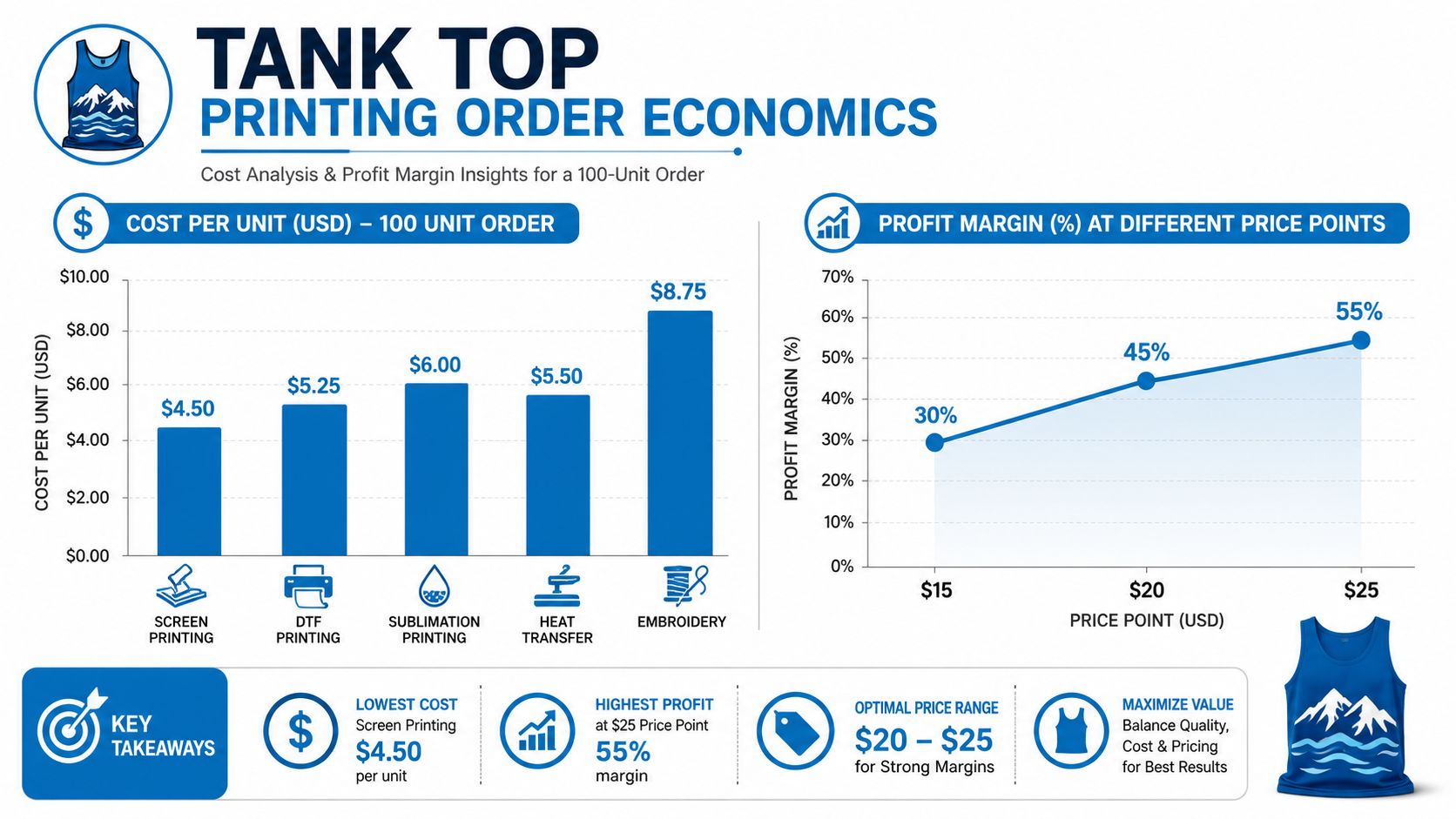
Screen printing generally becomes more attractive as order quantity rises because setup effort is spread across more garments. DTF, sublimation, and heat transfer provide more flexibility for small or varied orders, while embroidery carries stitch and stabilization considerations that can make it a poor fit for a large front design.
The required order-economics visual presents these planning figures for a 100-unit order and should be treated as an illustrative pricing model, not a universal quote:
Build a quote that protects the margin
Separate one-time and per-unit costs. Screen setup, artwork preparation, and proofing belong in the setup portion of the quote. The blank, decoration, folding, labeling, and packing belong in the unit or fulfillment portion. This makes reorder pricing easier because an approved artwork file may not require the same preparation again.
Use quantity tiers rather than one rigid price. A small event order can carry a higher unit price because setup and handling consume a larger share of the order. A larger run can receive a lower unit price without sacrificing margin if the artwork, blank, and placement stay consistent.
A useful quote should answer these questions before the customer pays:
- Which tank style and fabric are included?
- How many print locations and colors are covered?
- Is a proof included, and what happens after approval?
- What changes trigger a revised quote?
- What delivery date applies after artwork approval?
The screen printing costs guide can help buyers understand why screen setup and design variables affect the final price. Don't promise a deadline until the artwork, blank availability, decoration method, and shipping plan are all confirmed.
Proofing is part of order economics
A proof prevents expensive ambiguity. It should show the actual tank silhouette, artwork dimensions, placement, garment color, and any limitations created by the armholes or neckline. For a private-label launch or staff uniform program, approve one decorated sample before committing to a larger quantity.
That sample also gives you a chance to confirm whether the fabric feels comfortable with the chosen decoration. A technically accurate print can still be commercially wrong if the film feels heavy, the embroidery puckers, or the design sits where the wearer's body makes it look unbalanced.
Quality Checks and Durability Testing
A tank top gets more movement than a rigid promotional surface. The fabric stretches across the chest, shifts around the armholes, and may face sweat, abrasion, sun, and frequent washing. A visual inspection alone won't tell you whether the decoration will remain attached after real use.
Peer-reviewed textile research shows that adhesion depends heavily on process settings. Higher extrusion temperature and higher infill density can improve bond strength in relevant printed textile applications, but infill density alone doesn't change adhesion forces, so maximizing one setting isn't a reliable durability strategy (peer-reviewed textile adhesion research). The same literature reports that adhesion forces decrease after washing, which makes pre-wash and post-wash checks essential.
Inspect the first approved sample
Start with the blank. Check the fabric composition, surface texture, seams, armhole binding, and stretch recovery. A tank that arrives with inconsistent panels or excessive distortion can create print problems before production begins.
Then examine the decoration under normal light:
- Placement: Confirm the design stays clear of seams, armholes, and unwanted folds.
- Registration: Inspect multicolor edges for visible shifts or halos.
- Coverage: Look for pinholes, thin spots, incomplete transfer, or ink trapped in ribbing.
- Hand feel: Bend and stretch the fabric to identify stiffness, cracking, or excessive film buildup.
- Color: Compare the sample with the approved proof under consistent lighting.
Test adhesion, washing, and stretch
Pre-wash adhesion testing catches process problems before they reach customers. Gently flex the printed area, stretch it in the direction the garment will move, and inspect the edges for lifting or separation. For DTF, heat transfer, or digitally applied materials, pay special attention to curved areas and highly stretched panels.
Wash validation should follow the intended care label and include the fabric type. Textile research indicates that wash fastness can remain strong across multiple wash cycles once initial adhesion is sufficient, but that outcome depends on the process and the material. Test the exact combination rather than assuming a method will behave the same on ribbed cotton, a soft tri-blend, and athletic polyester.
Performance buyers need an extra layer of scrutiny. Moisture and abrasion can expose weak adhesion faster than casual wear, and repeated stretching can reveal cracking that a flat inspection misses. Document the method, settings, blank style, and result so a future reorder can reproduce the approved standard.
Quality checkpoint: Approve the decoration only after it passes a dry inspection, stretch inspection, and wash validation on the actual tank fabric.
Give customers clear care instructions. Inside-out washing, a gentle cycle, appropriate water temperature, and air drying can help preserve decoration, but the final instructions must match the blank and decoration supplier's requirements. Keep those instructions with the product record instead of relying on memory at reorder time.
Scaling Your Tank Top Merchandising Program
A tank top program becomes easier to manage when you treat it as a repeatable system rather than a series of custom jobs. Start with a small core assortment of blanks, colors, decoration methods, and approved placements. Every additional variation increases inventory, artwork, proofing, and quality-control demands.
Seasonal planning should begin with the customer's use case. Staff uniforms need dependable reorders and consistent sizing. Event merchandise needs a firm delivery plan and clear size allocation. A private-label line needs repeatable color, packaging, photography, and artwork version control.
Create a reorder-ready product record
Record the blank brand and style, fabric composition, color, size range, print method, ink or transfer specification, artwork file name, placement measurements, proof approval, care instructions, and delivery history. That file gives a decoration partner enough information to reproduce the product without rebuilding the job from an email thread.
Keep annual artwork changes separate from the approved production file. Use clear version names and archive retired logos. If a reorder requires a new blank or color, request a fresh sample because even a visually similar garment can drape differently around the armholes.
Merchandise the garment as a product
Retail presentation matters as much as decoration. Photograph the tank on a person as well as on a neutral background. Show the front placement, back artwork, side profile, fabric texture, armhole depth, and size information. Customers need to understand how the tank hangs, not just what the logo looks like on a flat image.
For online catalogs, organize products by use case, fit, fabric, and decoration. A practical digital merchandising guide from NanoPIM can help structure product information so buyers can compare options without sending repeated questions.
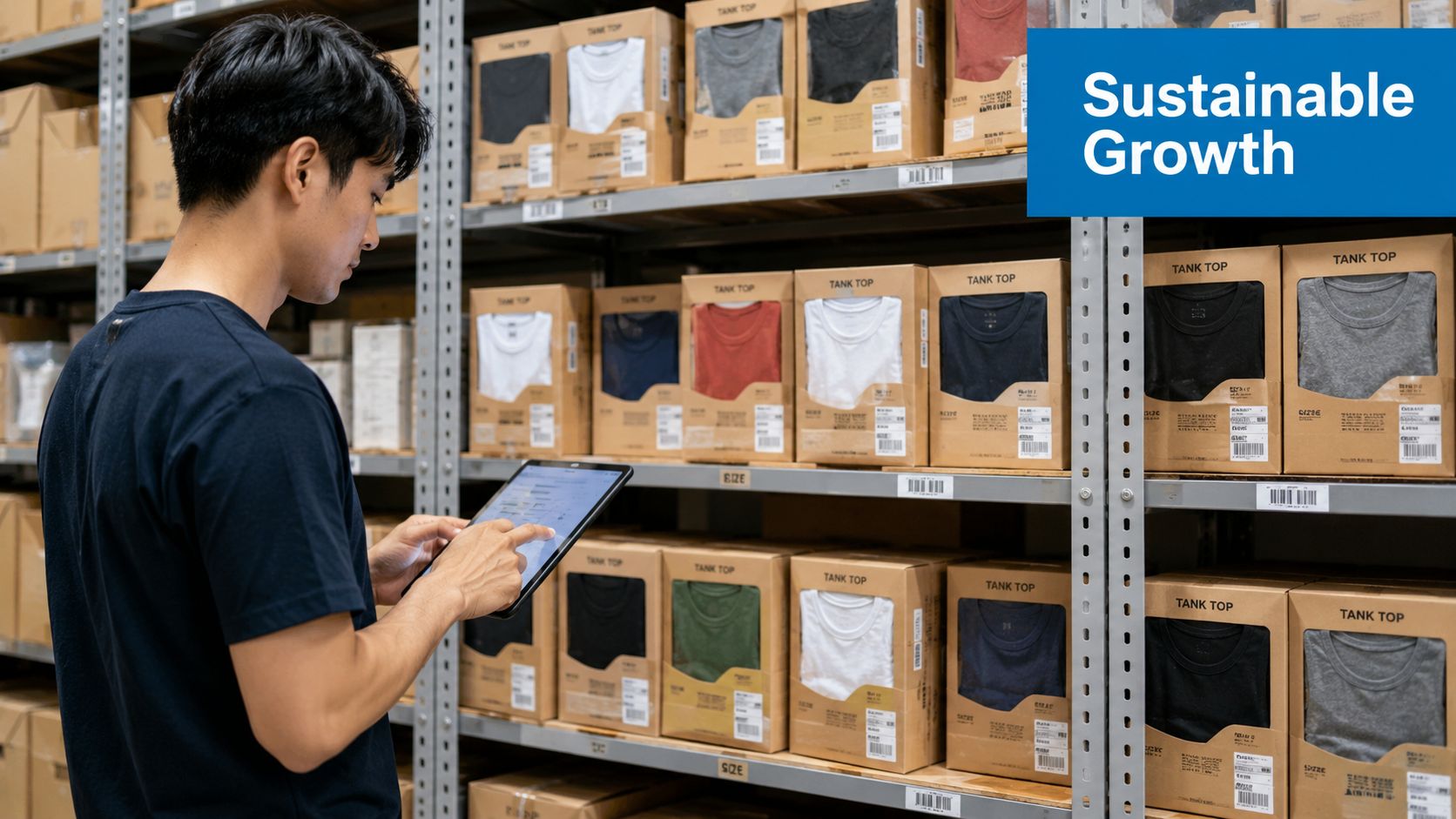
Packaging should protect the print from unnecessary rubbing and keep size identification visible. For recurring programs, align the product code, artwork version, and inventory count across your store, warehouse, and decoration partner.
Dirt Cheap Product, Inc. provides screen printing, embroidery, DTF, sublimation, and custom patches for branded apparel and accessories, with proofs used to review color, placement, and stitching detail. The company can be one decoration partner for businesses coordinating staff apparel, event merchandise, or retail-ready tank tops, provided the buyer confirms the blank, method, artwork, and approval standard before production.
Dirt Cheap Product, Inc. can help you select a suitable tank style, prepare artwork, and coordinate screen printing, DTF, sublimation, embroidery, or other decoration for your use case. Upload your logo and visit Dirt Cheap Product, Inc. to request a proof and discuss a tank top order built around fit, placement, durability, and budget.