A single-color screen-printed shirt in the U.S. usually runs about $8 to $15 for 12 to 24 pieces, drops to roughly $2 to $6 at 250+ pieces, and can fall to $0.40 to $0.55 per shirt at 10,000+ units, with screen fees of about $15 to $30 per color on top. That price swing is the story, because the same design can look cheap or expensive depending on how many shirts you're buying and how many colors you're asking the press to manage.
That's why one quote can look padded and another can look like a bargain, even when they're both honest. Screen printing costs aren't really about ink alone, they're about how much setup gets spread across how many garments, and whether the job forces the shop to add screens, locations, cleanup, and waste.
Table of Contents
- What Screen Printing Costs in the U.S. Today
- Why a Screen Printing Quote Looks the Way It Does
- The Five Cost Drivers That Move Your Quote
- Sample Pricing by Quantity and Color Count
- How Screen Printing Stacks Up Against Other Decoration Methods
- How to Get an Accurate Quote Without Overpaying
- Smart Ways to Lower Screen Printing Costs on Your Next Order
What Screen Printing Costs in the U.S. Today
A 1-color print on 12 to 23 garments was listed at $6.70 per shirt in one 2025 U.S. pricing guide, while the same design fell to $0.55 per shirt at 2,500 to 4,999 garments and $0.40 per shirt at 10,000+ garments. Another industry guide puts small runs of 12 to 24 pieces at $8 to $15 per shirt, then says 250+ piece orders can drop to $2 to $4 per shirt for a simple design. The message is blunt. Volume changes everything.
If your order is tiny, the setup dominates the invoice. If your order is large, the setup gets diluted and the per-unit print price starts behaving the way buyers expect. That's the core reason screen printing can feel expensive for a staff run of a few dozen shirts, then suddenly look very affordable for a repeat merch order or uniform program.
The single biggest pricing truth is this, setup is fixed, units are variable, and the quote gets cheaper fast only when you spread that setup across enough shirts.
The same pricing guide also shows how fast color count can push a small run higher. At 24 to 47 units, pricing moved from $2.00 for 1 color to $9.17 for 10 colors, which is exactly why a busy design can cost more than a clean one even when the shirt count stays the same. That's not a mystery markup, it's the press doing more work.
One more way to read the market. Screen printing is built to reward repeatability. The process gets cheaper as the order gets bigger because the shop is spreading a fixed preparation burden across more pieces, and that's why the smallest jobs look the least efficient on a per-shirt basis.
Why a Screen Printing Quote Looks the Way It Does
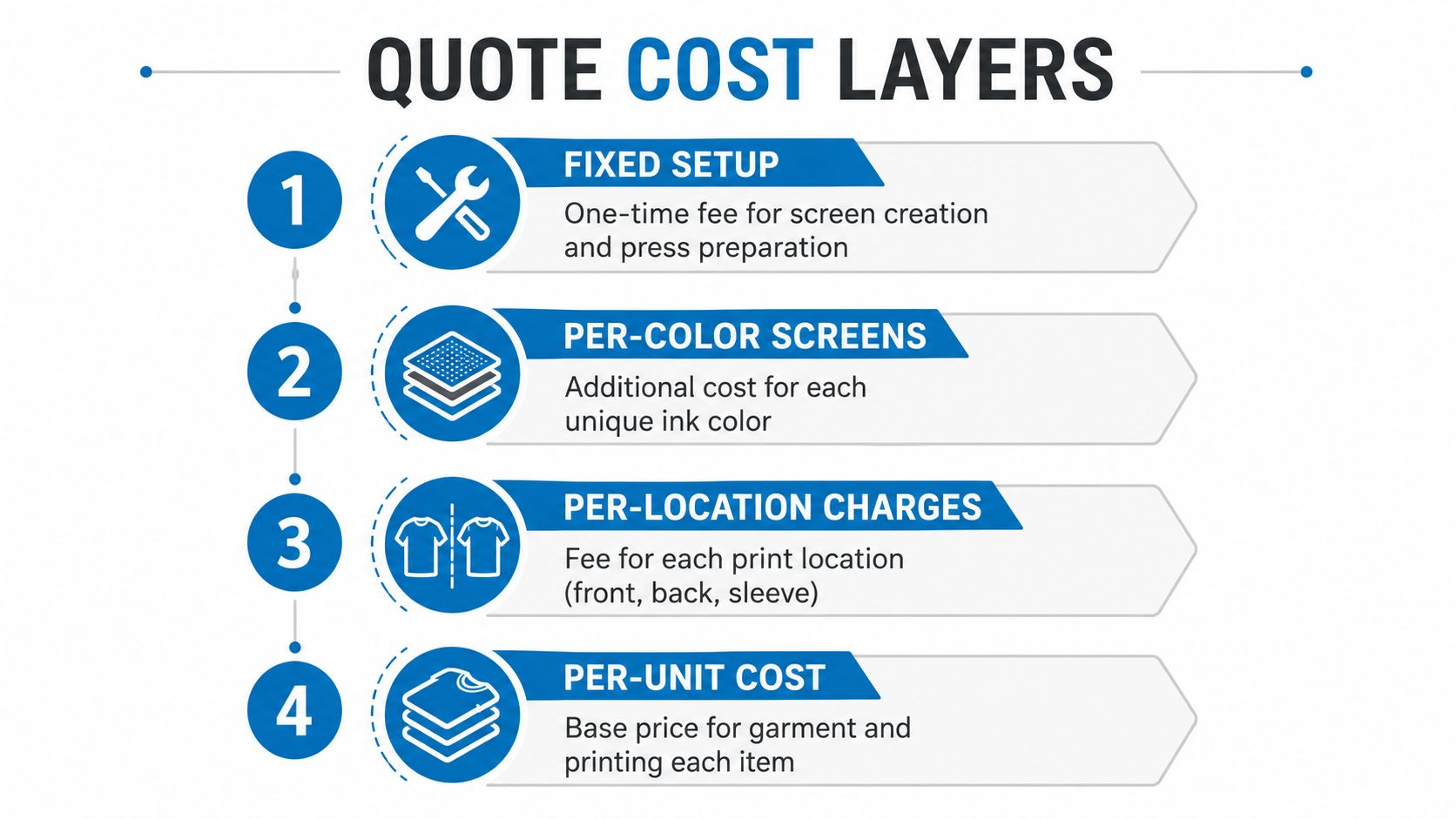
A screen printing quote is not one number. It is a stack of costs built from fixed setup, per-color screens, per-location work, and per-unit printing plus garment cost. Once you read it that way, the price makes sense fast.
Fixed setup is the part buyers underestimate
Setup covers art separation, screen coating, exposure, registration, press setup, and cleanup. That work happens before the first shirt gets printed, so it hits small orders hardest and gets spread out more as the run grows. It also explains why screen printing can feel expensive on short runs and much more efficient on repeat orders or bigger batches.
A shop still has to make ready, even if the order is small. The press must be prepared, aligned, and tested before production starts.
Variable work shows up as the job gets more complex
Each added color means another screen, more registration, more press time, and more cleanup. A second print location does the same thing, because front, back, and sleeve placements are separate operations with separate handling. That is why a quote can hold steady until you add a back print, then jump sharply.
A clean quote exposes those costs. A padded one hides them in vague line items and leaves buyers guessing about what they are paying for.
Screen printing is an industrial pricing problem, not an ink-and-shirt problem.
That is the right way to judge the number on the page. A transparent quote that separates setup, screens, and labor is usually easier to compare than a cheap-looking quote that buries real costs in a single lump sum.
The Five Cost Drivers That Move Your Quote
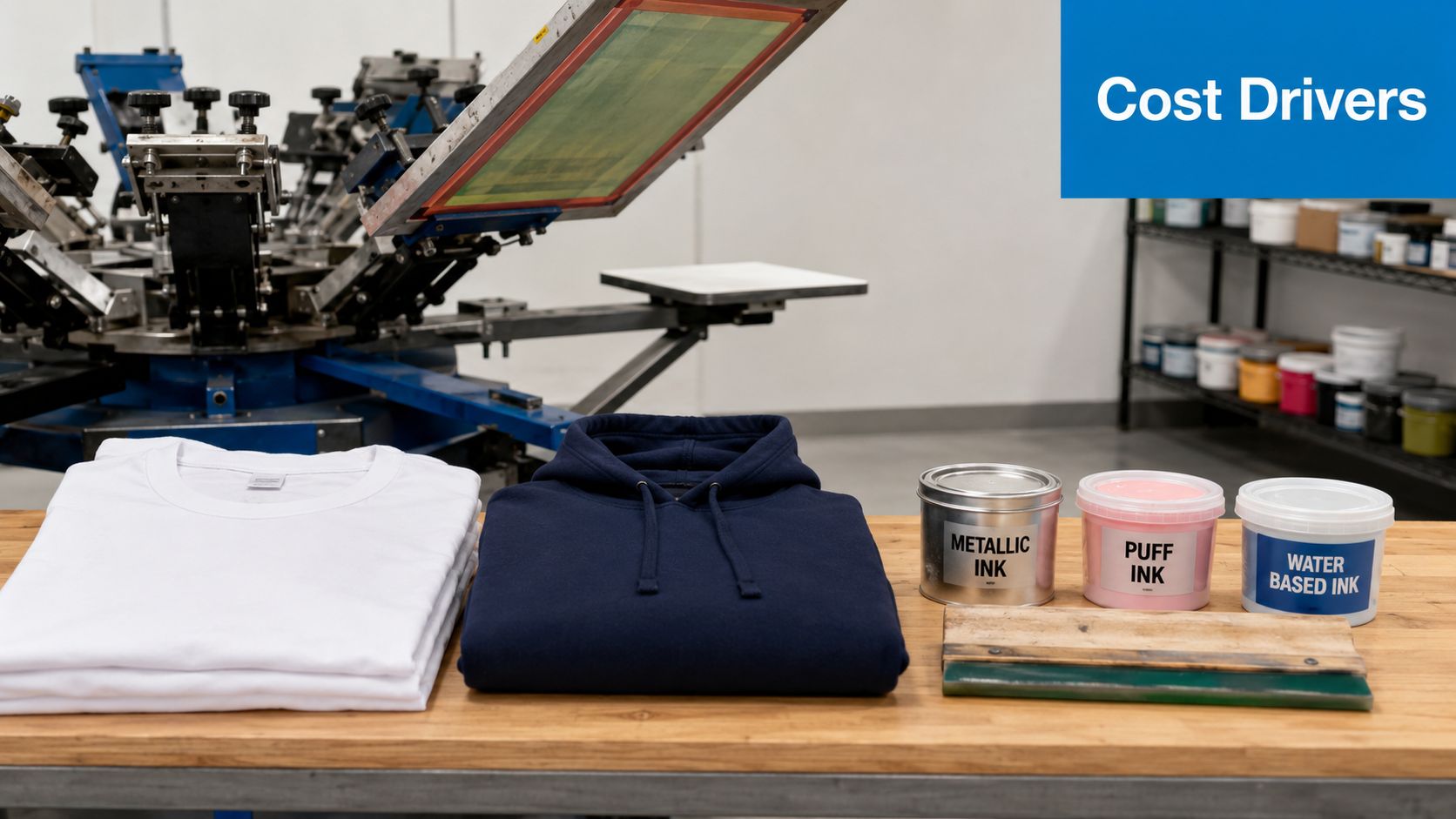
The quote changes when you change the job. Not all changes matter equally, though, and buyers waste money when they obsess over the wrong ones.
Color count is the first knob
Every extra color needs its own screen and setup. One commercial pricing guide says screen fees typically run about $15 to $35 per color, while another notes setup fees commonly sit around $25 to $75 per color. If you want a simple design to stay cheap, keep the ink count tight.
Print locations add hidden labor
Front only is one operation. Front and back is two. Add a sleeve and you're asking the shop to run another setup and another pass. That's why a design that looks small on paper can still price like a bigger job.
Garment choice changes the base
A plain basic tee and a premium blank do not cost the same to decorate, because the shirt itself is part of the invoice. If you pick a heavier or more expensive blank, you're raising the starting point before printing even begins.
Specialty inks are not free decoration
Metallic, puff, discharge, and water-based finishes can be worth it for the right design, but they add handling complexity. That extra detail shows up in setup, in production time, and in the risk of waste if the shop has to dial in the print.
Quantity is still the kingmaker
The bigger the order, the easier it is to hide all the setup cost inside the run. That's why two quotes for similar artwork can be miles apart when one buyer orders a few dozen shirts and the other orders hundreds.
One practical note. If your artwork depends on exact brand colors, use a proper PMS matching workflow so you're not buying revisions later. A PMS color matching guide is useful when a brand color has to land consistently across a run.
Sample Pricing by Quantity and Color Count
Here's the cleanest way to read screen printing costs, by matching your order size to your color count. These are illustrative U.S. pricing guide ranges, not a promise, and your garment choice or specialty ink can move the final number.
| Quantity Tier | 1 Color | 3 Colors | 6 Colors | 10 Colors |
|---|---|---|---|---|
| 12 to 23 pieces | $6.70 per shirt | Higher than 1 color because each added screen raises setup and press time | Higher still as the job becomes more complex | Highest in this tier because the job is carrying the most setup burden |
| 24 to 47 pieces | $2.00 per shirt at the low end of the guide | Higher than 1 color as setup stacks up | Higher again as more screens and passes are added | $9.17 per shirt |
| 250+ pieces | $2 to $4 per shirt for a simple design in industry guides | Lower than small-run pricing because setup is spread across more units | Still higher than 1 color, but the run absorbs more of the fixed cost | Higher than simpler artwork, but bulk volume softens the blow |
The point of the table isn't that every shop charges the same way. The point is that quantity bends the curve and color count steepens it. If your quote is much higher than the row you expected, the first thing to check is how many screens and locations are in play.
At 24 to 47 units, the jump from $2.00 for 1 color to $9.17 for 10 colors shows how fast complexity outruns volume. If you're shopping a small run, simplify the art before you start arguing over pennies.
How Screen Printing Stacks Up Against Other Decoration Methods
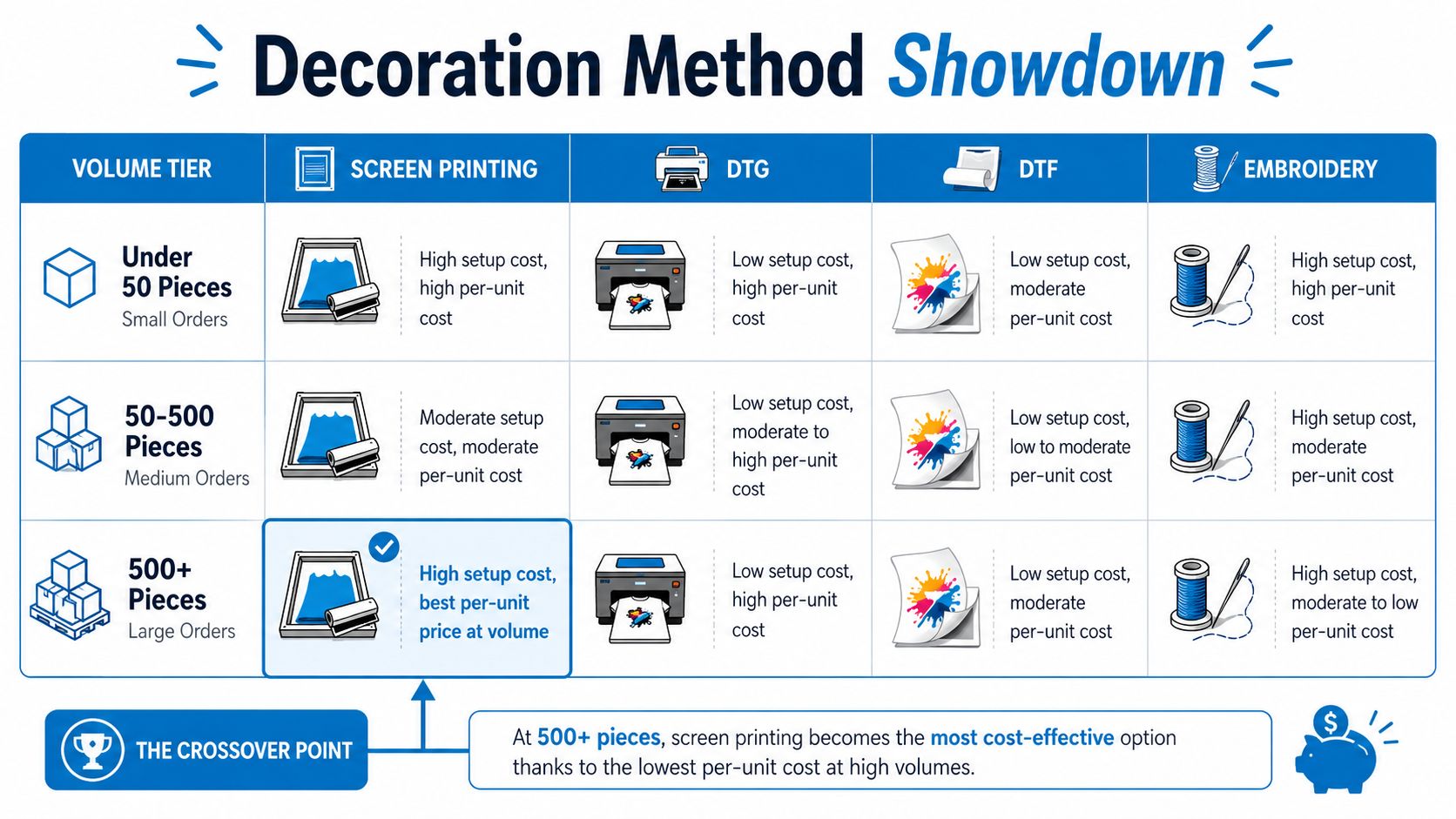
| Volume Tier | Screen Printing | DTG | DTF | Embroidery |
|---|---|---|---|---|
| Under 50 pieces | Often expensive unless the design is simple and one-color | Usually strong for short runs and complex art | Often attractive for low-volume transfers | Good for logos, but setup can be pricey on small orders |
| 50 to 500 pieces | Starts to become competitive fast | Works, but unit economics can lag on basic repeat jobs | Can stay flexible, especially for mixed artwork | Better for logos than full front graphics |
| 500+ pieces | Usually the most cost-effective choice for repeat apparel | Less compelling when the order is simple and large | Useful for variable needs, not always the cheapest at scale | Still strong for logo decoration, but not the cheapest bulk path |
The crossover exists because screen printing has fixed tooling that gets amortized over more units, while DTG and DTF avoid screens but don't benefit as much from large repeat runs. Embroidery has its own setup and is a different animal entirely, especially when the goal is a clean logo rather than a full graphic.
If you're comparing methods, don't just ask what the per-shirt number is. Ask what happens to the total when you add another color, another location, or another 100 units. That's where the decision becomes obvious, and it's why screen printing versus vinyl is often a worse comparison than buyers think.
The cheapest advertised per-shirt price is not always the lowest total cost on a short run.
Here's the practical reading. Screen printing wins when the order is big enough to absorb setup. Digital methods win when the run is small, the art is complex, or the timeline is tight enough that screen prep becomes the bottleneck.
How to Get an Accurate Quote Without Overpaying
A clean quote starts with clean inputs. If you send half the information, you'll get a padded estimate, a guess, or a follow-up email that burns time.
Send the facts a printer actually needs
- Garment brand and style. Name the blank if you already know it, such as a specific tee or hoodie style.
- Sizes and color breakdown. Tell the shop how many mediums, larges, and extra larges you need, and which shirt colors each size will be on.
- Design file and color count. Send a vector file if you have one, and say how many ink colors are in the art.
- Print locations and size. Front left chest, full front, back print, sleeve print, say it plainly.
- Quantity and deadline. Give the total per design and the date you need the order.
- Ink or finish preferences. Mention water-based, discharge, metallic, or any other finish that matters to you.
Read the quote line by line
Legit line items usually include the garment, setup, screens, ink, and print labor. Those are normal. Vague catch-alls are what you should question, especially if a shop can't explain what they cover. If one vendor names setup separately and another rolls it into the shirt price, compare the totals, not the labels.
A practical way to keep the process tight is to request a quote from a shop that can handle the full job in one place. Dirt Cheap Product's online quote process is one example of that kind of workflow, but the bigger point is to make sure the vendor is quoting the same shirt, the same art, and the same deadline you need.
The best comparison is apples-to-apples. If one quote assumes a budget blank and one assumes a premium blank, they're not competing on price, they're competing on assumptions.
Smart Ways to Lower Screen Printing Costs on Your Next Order
The biggest savings usually come from simplifying the order, not from haggling over a few cents on the quote. If you want the number to come down, change the structure of the job first.
Start by cutting print locations. Front only is cheaper than front and back, and front plus sleeve is usually worse still. Next, reduce the color count. A clean two-color design almost always beats a busy multi-color layout on cost, and it's often easier to print well.
Then standardize the garments. Fewer shirt colors and fewer odd size splits make production smoother, and smoother production means less waste. If you can push the quantity above a common break point, do it. Screen printing gets cheaper as the run gets larger, and a bigger order often changes the quote more than any small negotiation does.
Finally, stop re-ordering the same design in tiny chunks if you know you'll need it again. Bundling repeats into one run is usually smarter than paying setup multiple times a year.
Cost-control order of operations, simplify the design first, reduce print locations second, standardize the garments third, and only then chase more volume.
A 2026 guide puts that logic in plain numbers, with small orders of 12 to 24 shirts often landing around $10 to $20+ per shirt, while 250 to 500+ shirts commonly fall to about $2 to $6 per shirt. The cheaper the process gets, the more it rewards planning.
If you're pricing a screen printing job for staff uniforms, merch, or an event run, Dirt Cheap Product, Inc. handles custom apparel decoration across screen printing and other methods, and its team can quote shirts, polos, hoodies, hats, and more. Get your project details together, then visit Dirt Cheap Product, Inc. to request pricing and compare your options without guessing.