You're probably here because a real order is on your desk right now. Staff shirts for a launch. Event tees for a deadline that won't move. Retail merch that has to look consistent across every box you ship. You need the convenience of ordering online, but you don't want the usual gamble of “upload art, hope for the best.”
That's where screen printing online either works beautifully or goes sideways fast.
The difference usually isn't the website. It's whether the shop behind the website handles artwork correctly, prices bulk orders clearly, and gives you a proofing process that catches mistakes before ink hits fabric. If you're placing your first serious apparel order for a business, the safest approach is to treat online ordering like remote production management, not like a casual ecommerce purchase.
Table of Contents
- Why Businesses Choose Online Screen Printing
- Screen Printing vs Other Decoration Methods
- The Online Ordering Workflow From Start to Finish
- Decoding Pricing MOQs and Getting the Best Value
- Ensuring Print Quality and Color Accuracy Online
- How to Choose a Reliable Online Screen Printing Partner
- Common Questions About Screen Printing Online
Why Businesses Choose Online Screen Printing
Most business buyers don't choose screen printing because it sounds old-school. They choose it because they need branded apparel that looks professional, repeats well, and gets more economical as quantity rises.
That still makes sense in a modern online buying process because screen printing is not a fading niche. The global screen printing segment was valued at USD 20,743.3 million in 2024 and is projected to reach USD 37,359.1 million by 2030, with a projected CAGR of 10.3% according to Grand View Research's screen printing market outlook. For buyers, that matters because large, active markets usually support more supplier options, broader garment access, and continued investment in production quality.
Online ordering also fits how companies buy now. Marketing teams need quick quoting. Operations teams need repeat orders. HR teams need size runs for staff onboarding. Event planners need one approval path instead of ten email threads.
Why it still fits business branding
Screen printing online works well when your priorities look like this:
- Brand consistency: Solid spot colors and repeatable placements matter more than one-off novelty.
- Bulk efficiency: You're ordering for a team, event, store drop, or campaign instead of a single shirt.
- Professional appearance: You want ink coverage and color impact that read clearly from a distance.
- Reorder potential: The same design may come back next month on the same or similar garment.
Practical rule: If the order needs to look uniform across many pieces, screen printing usually deserves the first look.
For smaller personal orders, gift-style customization can make sense through sources that focus on personalized custom t-shirt gifts. Business apparel is different. The question isn't just what can be printed. It's what can be printed consistently, on schedule, and with pricing that still makes sense when your order grows.
Screen Printing vs Other Decoration Methods
A lot of ordering mistakes happen before the quote is approved. The buyer picks a decoration method based on habit instead of the artwork, quantity, fabric, and finish they need.
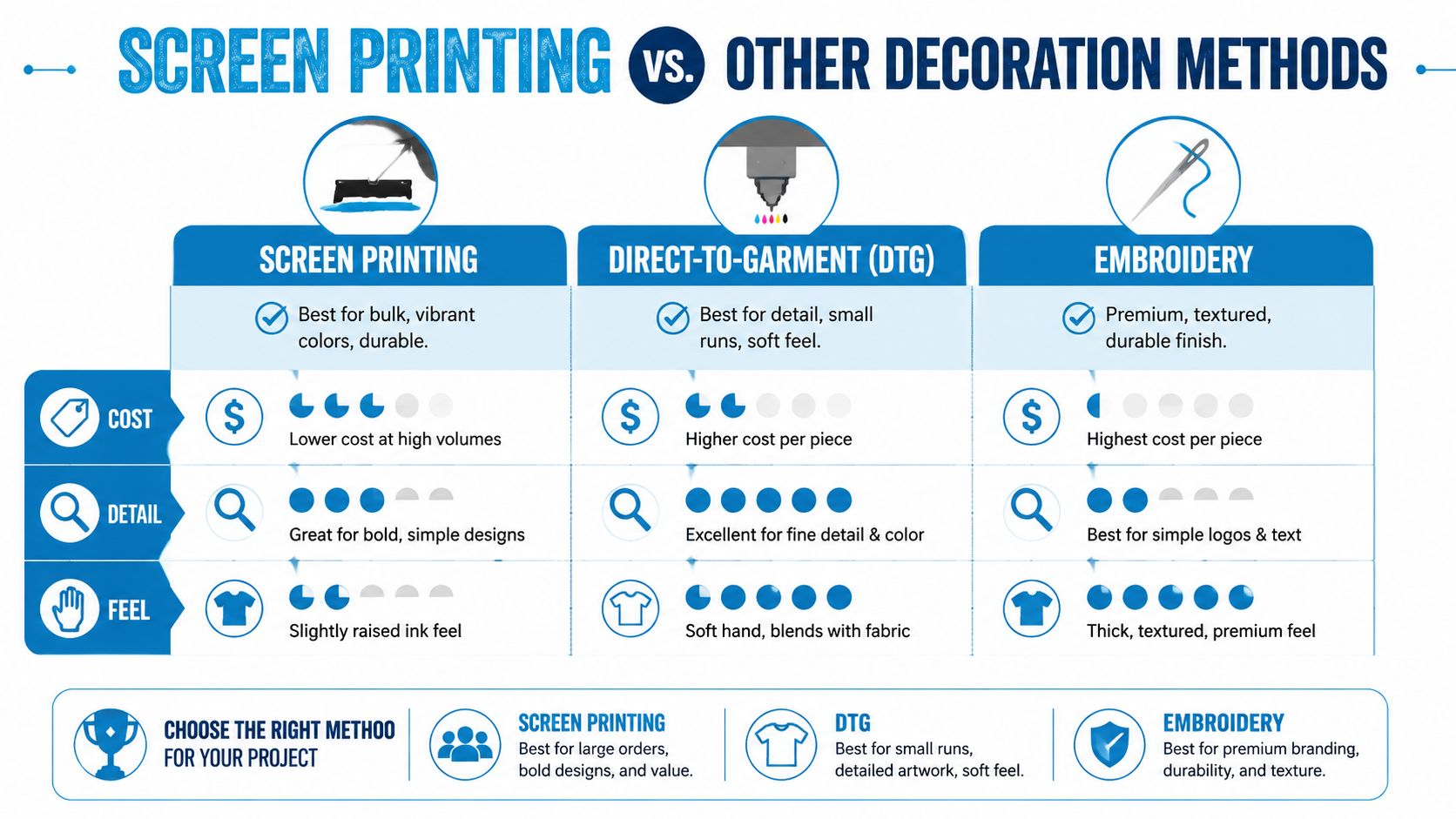
The easiest way to think about it is this. Screen printing behaves more like a setup-heavy production method that becomes efficient at volume. Digital apparel printing is closer to low-setup output that handles complex art more easily in small runs. Embroidery sits in a different lane altogether because it creates a stitched surface, not a printed one.
How the methods differ in practice
Industry guidance often misses the buyer's real decision point for low-quantity orders. A useful framing is that screen printing is ideal for bulk, while newer digital methods may fit complex, small-batch artwork better as discussed in this technical discussion of print-method fit and halftone issues.
Here's the practical comparison:
| Method | Best For | Cost at High Volume | Cost at Low Volume | Durability |
|---|---|---|---|---|
| Screen Printing | Bulk orders, bold logos, team apparel, event shirts | Usually strong value | Usually less efficient | Strong for repeated wear when artwork suits the process |
| Direct-to-Garment (DTG) | Small runs, detailed artwork, gradients, photo-like designs | Usually less efficient | Often easier to justify | Good when garment and art are a good match |
| Embroidery | Polos, hats, outerwear, premium uniform looks | Depends on stitch count and placement | Often acceptable for small branded runs | Very durable with a textured finish |
A simple decision framework
Use screen printing when:
- The design uses solid colors: Simple logos, bold text, and clean shapes translate well.
- You need many pieces: The setup work makes more sense when spread across a larger run.
- You want visual punch: Screen printed inks can produce strong opacity and clear branding.
Use DTG when:
- The order is small: You don't want to absorb setup for a short run.
- The art is complex: Gradients, photographs, and many tones are often easier digitally.
- You need fast art flexibility: Frequent edits are less painful without screen setup.
Use embroidery when:
- The garment is structured: Polos, caps, fleece, and outerwear often benefit from stitching.
- The brand look is more corporate: Embroidery reads differently than ink. It feels more uniform-driven.
- You want texture: Some logos look better stitched than printed.
Don't ask which method is “best.” Ask which method fits the order you're placing right now.
What doesn't work is forcing screen printing onto tiny, highly detailed art with many tonal transitions just because the unit price looked attractive at first glance. What also doesn't work is ordering DTG for a large event run where consistency and volume pricing matter more than fine photographic detail.
The Online Ordering Workflow From Start to Finish
Most first-time buyers assume the hard part is choosing the shirt. It usually isn't. The hard part is getting all the production decisions made before the job enters the queue.
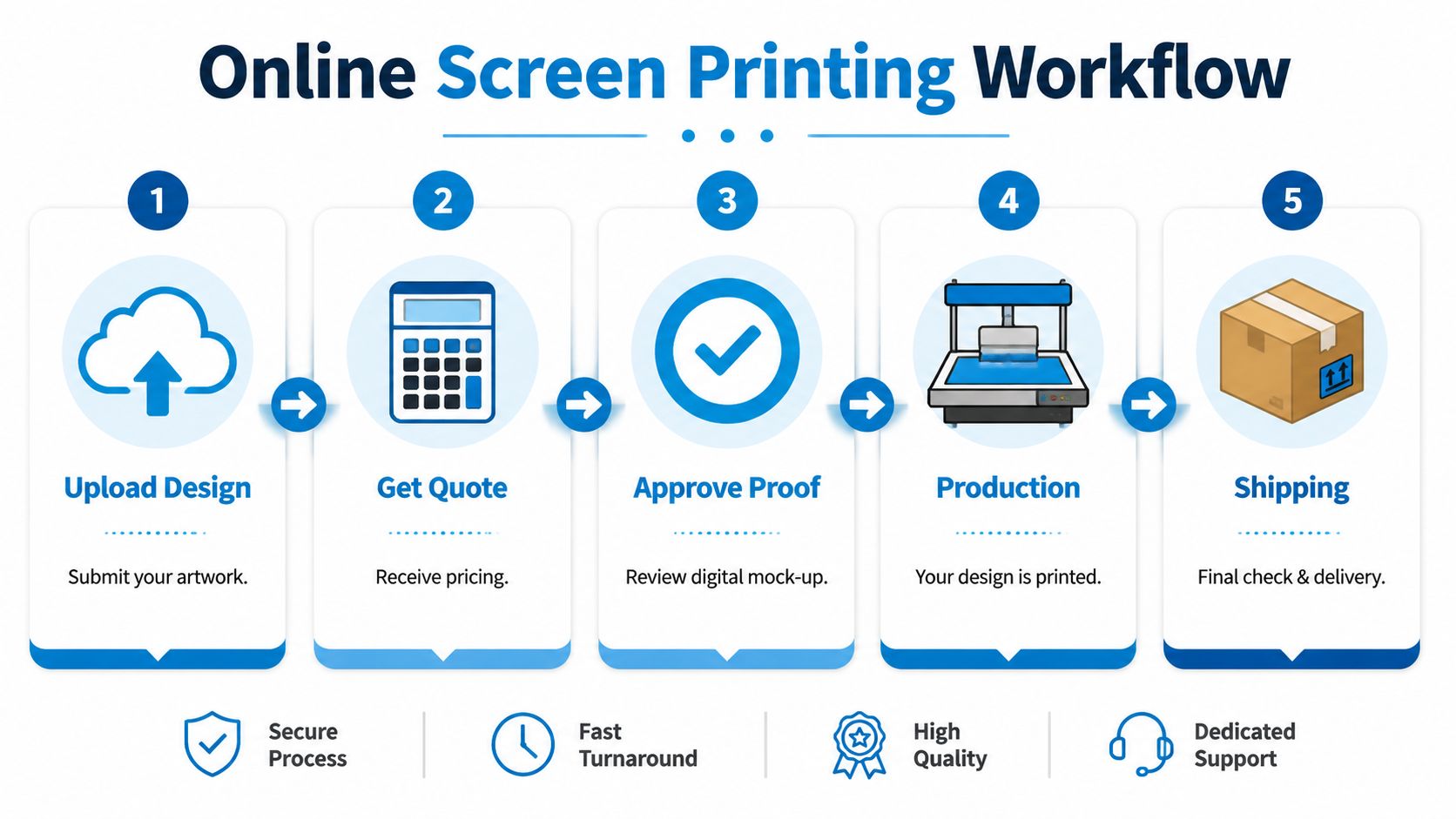
A smooth screen printing online order follows a sequence. Skip one step, and the delays usually show up later as revised proofs, garment substitutions, or prints that don't match expectations.
Start with production-ready artwork
The cleanest jobs start with the right file. For production, vector files in AI or EPS format are preferred because they scale without resolution loss, and for photographic work, one expert workflow recommends setting halftone frequency in relation to mesh count, such as mesh count divided by 4.5, as noted in this screen printing artwork workflow reference.
If you send a low-resolution PNG pulled from a website, a good shop may still help rebuild it, but that adds friction. For business orders, send the original logo package if you have it. Include alternate lockups, approved colors, and any brand standards your team already uses.
A strong upload package usually includes:
- Primary logo file: AI or EPS is the safest starting point.
- Secondary marks: Horizontal, stacked, icon-only, and one-color versions.
- Color references: Brand-approved values, especially if different departments already use the logo.
- Placement notes: Left chest, full front, full back, sleeve, or tag area.
Choose the garment before you approve the art
Artwork doesn't live in a vacuum. The same logo can feel sharp on a ringspun tee, dense on a heavyweight shirt, or understated on a heather blend.
That's why garment choice has to come early. Don't approve a proof until you know the exact shirt, color, and size mix. Fabric and garment color influence how the print reads. A small chest logo on black polos won't feel the same as the same logo on white event tees.
For larger team orders, it helps to collect these details before the quote is finalized:
- End use: Staff uniform, giveaway, merch, or resale.
- Wear environment: Office, outdoors, warehouse, hospitality, trade show.
- Fit preference: Standard, retail fit, relaxed, youth, women's, unisex.
- Color strategy: One shirt color for simplicity or multiple garment colors for departments.
If you're planning a larger run, this bulk custom apparel ordering guide is a useful reference for organizing garment choices and order details before production starts.
Approving art before confirming the garment is one of the fastest ways to create avoidable revisions.
Treat the proof like a pre-production checkpoint
A digital proof is not a formality. It's your last low-cost chance to catch a bad decision.
Review the proof for more than spelling. Check size relative to the garment. Check whether the print sits too high or low. Check that the back print won't crowd the collar. If you're ordering for multiple departments, make sure every version is labeled clearly.
Ask direct questions if anything is unclear:
- What size is the print in inches?
- Is this centered from the collar or from the garment width?
- Are these colors simulated or intended as exact brand matches?
- Will this artwork print as solid ink or halftone?
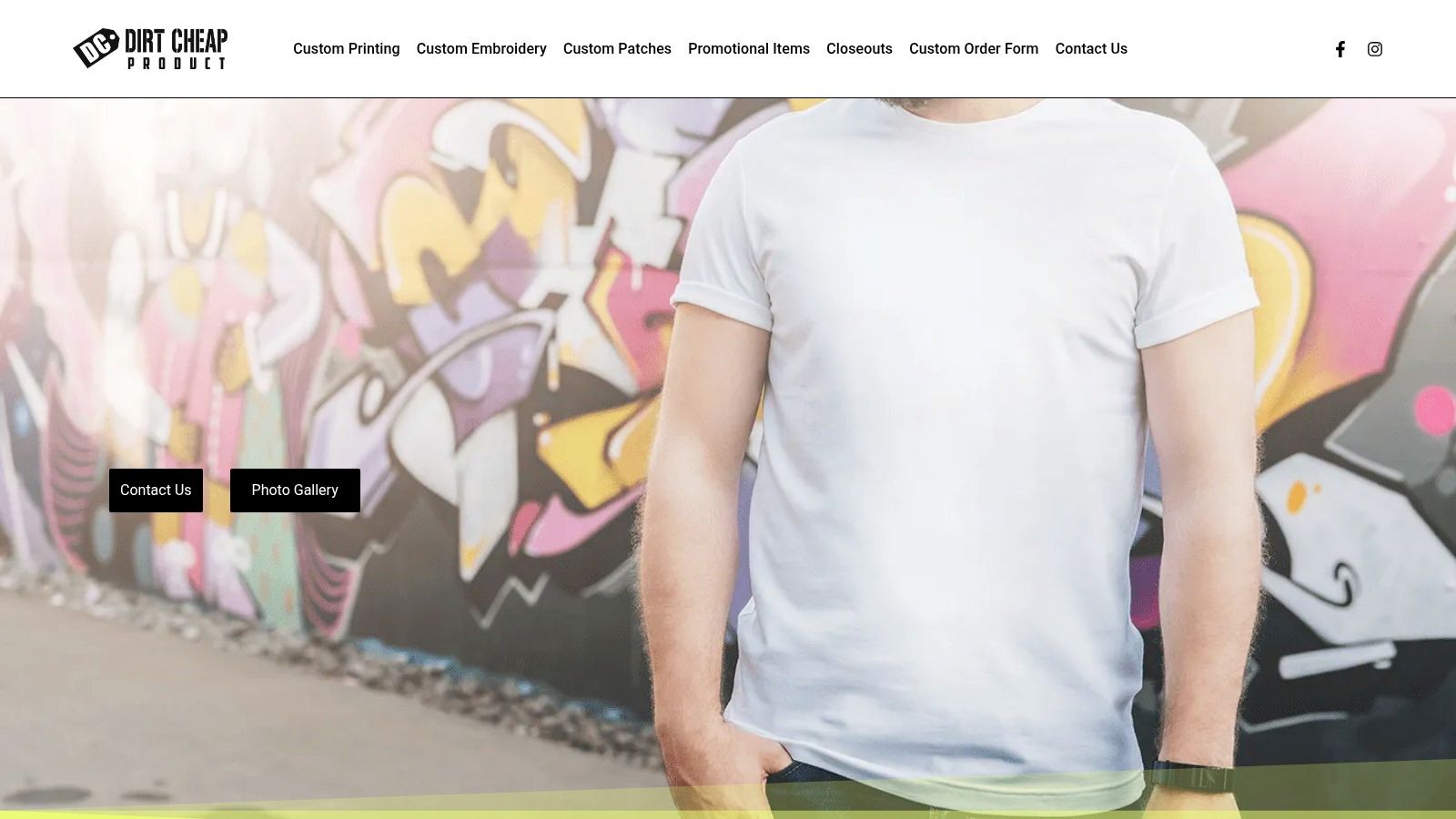
When a shop gives fast, clear proof revisions, remote ordering becomes much safer. Dirt Cheap Product, Inc. is one example of a provider that accepts uploaded logos and returns proofs for review, which is exactly the kind of workflow business buyers should look for when managing orders online.
Confirm shipping details before production starts
Many online jobs get delayed for reasons that have nothing to do with printing. The art is approved, but the ship-to list is incomplete. A size breakdown changes late. Someone forgot the in-hands date is tied to an event setup day, not the event itself.
Before production begins, confirm:
- Final quantities and size breakdowns
- Decoration locations
- Ship-to address or addresses
- Contact person for delivery questions
- In-hands date, not just ship date
If you need multiple destinations, say so at quoting stage, not after approval. Distributed shipping can be managed well, but it changes planning.
Decoding Pricing MOQs and Getting the Best Value
The cheapest quote is often the most expensive order if it creates reprints, weak ink coverage, or rushed approvals. Good buyers look at value, not just the first number on the page.
Why screen printing prices work this way
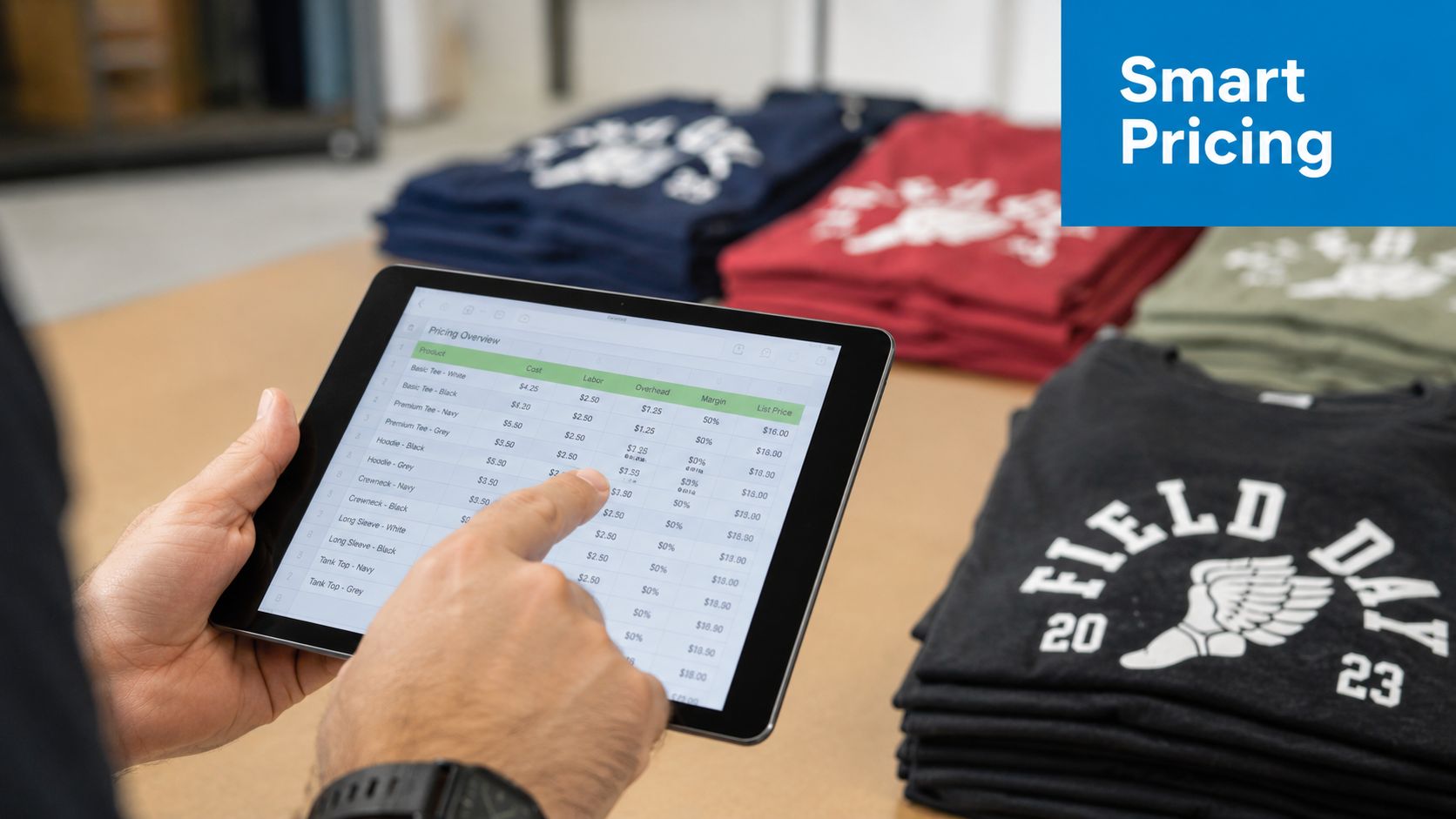
Screen printing pricing is built around setup. Each color requires its own separation, film positive, and mesh screen. That's why minimums often exist and why color count matters.
The U.S. screen printing market included 12,471 individual shops in 2021, reflecting a highly fragmented supplier base according to this historical and market overview of U.S. screen printing. In a crowded market like that, clear volume-based pricing matters because buyers can compare vendors quickly and walk away from vague quotes.
The parts that usually move the price are straightforward:
- Quantity: More pieces spread setup costs across more units.
- Number of ink colors: More colors usually mean more setup.
- Print locations: Front only costs differently than front and back, or front, back, and sleeve.
- Garment choice: Premium blanks change the order value fast.
A lot of buyers make one costly mistake here. They compare quotes without checking whether the garment, print size, and color count are the same.
How to improve value without lowering quality
The easiest savings usually come from simplifying the job, not downgrading the shirt.
Try these moves first:
- Reduce unnecessary print locations: A back hit may help. A sleeve print may not.
- Limit ink colors where possible: A cleaner logo often prints better anyway.
- Group reorders intelligently: One larger run usually prices better than several scattered small ones.
- Standardize garment colors: Fewer variables make production easier and reorder consistency better.
For a closer look at cost drivers on apparel jobs, this article on how much it costs to screen print a shirt helps frame the variables that affect quoting.
This walkthrough is also useful if you want to understand how shops think about pricing and production trade-offs before you approve a run:
A smart bulk order doesn't chase the lowest line item. It minimizes avoidable setup, keeps the art production-friendly, and reserves budget for the shirt quality your team will wear.
Ensuring Print Quality and Color Accuracy Online
Remote ordering gets risky when buyers assume the mockup is the finished product. It isn't. The mockup is only a guide. Final quality depends on how well the artwork, garment, colors, and press setup all align.
Control what you can control remotely
You can't stand next to the press when ordering online, but you can tighten the process before production starts.
Use this checklist:
- Approve exact artwork: Don't approve a “close enough” version pulled from an old email thread.
- State brand colors clearly: If your logo has approved standards, provide them up front.
- Review placement at real scale: Ask how wide the print will be, not just where it sits.
- Check every word and number: Typos on event shirts are expensive lessons.
- Confirm garment color names: Similar shades can change how ink appears.
If your project needs a softer hand feel or a different print character, it also helps to understand the ink approach being offered. This overview of water-based ink printing is useful if you're comparing feel and finish, especially for fashion-forward or retail-style apparel.
A good proof protects the shop and the buyer. A vague proof protects nobody.
Know what affects the final print
Multi-color work introduces more risk than most buyers realize. In screen printing, inks are typically printed from lightest to darkest, and precise registration is critical to prevent contamination and keep details sharp, as outlined in this screen printing standard operating procedure.
That matters because small alignment issues can change the look of type, outlines, and tight logos. If your design includes fine details, thin knockouts, or layered color areas, ask whether the art has been adjusted for printability. Artwork that looks clean on a laptop can still become problematic on press.
Here's what often causes quality complaints in online orders:
- Tiny details that fill in
- Overly ambitious color transitions
- Dark shirts with under-planned artwork
- Last-minute file swaps after proof approval
- No clear standard for brand color matching across reorders
When the order has to match past jobs, save the approved proof, garment style, and print notes. Reorders get easier when everyone works from the same reference set.
How to Choose a Reliable Online Screen Printing Partner
A polished website doesn't tell you much by itself. Plenty of risky vendors look organized until the proof arrives late, the shirt brand changes, or support disappears after payment.
What to look for before you place the order
Start with responsiveness. If a shop takes too long to answer simple pre-sale questions, production communication usually won't improve later.
Then look for practical signals of reliability:
- Clear proofing process: You should know when you'll review art and what can still be changed.
- Visible work samples: A public gallery helps you assess print style and garment range.
- Specific garment options: Serious shops identify actual brands, styles, and colors.
- Review consistency: Read for comments about communication, accuracy, and delivery follow-through.
- Real human support: Business orders often need back-and-forth, not just cart checkout.
There's also a local-versus-national angle worth considering. Even when you order online, communication quality and accountability often improve when the production partner understands regional business needs. This article on local print benefits from Creative Graphic Solutions gives useful context for that trade-off.
Warning signs of a risky low-cost vendor
Low prices aren't the problem. Unclear production standards are.
Watch for these issues:
- No file guidance: If a vendor doesn't care what file you upload, that's not a good sign.
- No mention of proof approval: You need a checkpoint before production.
- Generic mockups only: You should be able to ask about print size and placement, not just see a stock image.
- No discussion of substitutions: Garment availability changes. A reliable shop addresses that early.
- Support that avoids specifics: If answers stay vague, expect surprises later.
A dependable partner doesn't promise perfection. They reduce risk through communication, accurate proofs, and realistic production guidance.
Common Questions About Screen Printing Online
Can I mix sizes in one order?
Usually, yes. That's normal for business apparel. The key is to finalize the size breakdown before approval so the quote and production plan stay aligned.
Can I mix garment colors too?
Often, yes, but it depends on the artwork and how the print behaves on each shirt color. The more garment variation you add, the more important proof clarity becomes.
What if my logo has gradients or photo detail?
That's where you should pause and ask whether screen printing is still the right fit. Some art can be adapted. Some should move to a digital method instead.
Is screen printing online good for reorders?
Yes, if the first order was documented well. Save the approved artwork, garment style, ink notes, and print locations. Reorders become much easier when the shop can work from the same production references.
What's the difference between screen printing and DTF?
Screen printing applies ink through screens onto the garment. DTF uses a transfer workflow and can be useful for certain short-run or complex jobs. They solve different problems, so the better choice depends on artwork, quantity, fabric, and finish.
What should I do if I'm unhappy with the result?
Start by comparing the finished goods against the approved proof and order details. Reliable shops can address issues much faster when you reference the exact approved art, garment, and placement notes rather than a general complaint.
If you're planning a staff uniform order, event run, or retail merch launch, Dirt Cheap Product, Inc. offers online logo upload, proof-based approval, and multiple decoration methods for apparel and promotional products, which makes it a practical option for businesses that need clear communication before production begins.