The event is tomorrow. Someone just noticed the shirts were never ordered. The group text is heating up, the logo file is buried in an old email thread, and everyone wants one answer: can these shirts still happen today?
Sometimes yes. Sometimes no. The difference usually isn't effort. It's whether you make fast, clean decisions in the next few minutes.
Same day shirt printing is less about miracles and more about reducing friction. If the artwork is usable, the garment is in stock, the print method matches the job, and you approve the proof right away, a rush order can move. If any one of those pieces breaks, the whole timeline slips. That's why the smartest move is to stop guessing and work through the order like a shop would.
Table of Contents
- The Last-Minute Shirt Emergency
- Choosing Your Rush Printing Method
- Preparing Artwork for Immediate Production
- Navigating Timelines Cutoffs and Rush Fees
- Final Logistics Proofs Pickup and Quality Checks
- Frequently Asked Questions and Contingencies
The Last-Minute Shirt Emergency
A typical rush call sounds the same. A school club needs staff shirts for a morning event. A restaurant forgot polos for a pop-up. A company has a trade show setup tomorrow and suddenly realizes the team can't show up in random tops. Everyone starts with the same sentence: “We need shirts today.”
The good news is that same day shirt printing is often possible. The bad news is that the first answer you get from a print shop usually depends on how organized you are when you ask. If you call and say, “We need something fast,” that doesn't help much. If you say, “We need black cotton tees, one front print, logo file ready, sizes listed, pickup this afternoon,” you've already cut out half the delays.
Most rush orders fail before printing starts. They fail in email, in missing files, in undecided shirt colors, and in slow approvals.
That's why calm wins here. Start with four decisions right away:
- Choose one garment style: Don't ask for five shirt options if the event is tomorrow.
- Lock the print location: Front only is faster than front and back.
- Use the cleanest logo you have: A print-ready file beats a pretty file that needs repair.
- Plan for pickup: Delivery adds risk you don't need on a tight deadline.
You also need to accept what isn't realistic. A brand-new, highly customized, multi-location order on specialty garments may not happen the same day. A simpler version often can. The clients who get saved on rush jobs are usually the ones willing to simplify without wrecking the purpose of the shirts.
Choosing Your Rush Printing Method
When time is tight, your printing options narrow fast. Traditional screen printing usually isn't the first choice for a brand-new same-day order because setup takes time, especially if the art needs separation, approvals, and multiple screens. Rush work usually moves through direct digital methods or simple heat-applied graphics.
What usually works the same day
The three methods that come up most often are DTG, DTF, and HTV.
DTG (Direct-to-Garment) prints ink directly onto the shirt. It's a strong fit for cotton shirts and artwork with lots of color variation, shading, or photo-style detail. The print sits more naturally in the fabric than a heavy transfer, but garment type matters.
DTF (Direct-to-Film) prints the design onto film, then heat presses it onto the garment. It's flexible and fast for many rush orders because the print can go onto cotton, blends, and many polyester garments with fewer limitations. If you need a quick overview of the process, this explanation of direct-to-film printing is useful background.
HTV (Heat Transfer Vinyl) is the practical answer when the design is simple. Names, numbers, one-color logos, and basic text are where it shines. It's not the best choice for detailed art, but it's often the fastest path for sports uniforms, staff identifiers, and clean event graphics.
If you're coordinating broader visuals for a live activation, it also helps to think beyond the shirt itself. Teams handling tight event timelines often benefit from reviewing event branding solutions from Phantom from Phantom Entertainment so apparel decisions match the rest of the on-site presentation.
How to choose fast without guessing
Use the job itself to choose the method, not personal preference.
| Rush Printing Method Comparison | Best For | Fabric Compatibility | Feel on Shirt |
|---|---|---|---|
| DTG | Full-color artwork, detailed graphics, cotton tees | Best on cotton | Softer, more printed-in feel |
| DTF | Mixed garment types, bold logos, flexible rush jobs | Cotton, blends, many polyester options | Slightly more noticeable transfer feel |
| HTV | Names, numbers, simple text, one-color designs | Works on many common apparel types | Smooth applied layer |
A few practical rules help:
- If the design looks like a photograph: Go with DTG if the shirt is cotton and available.
- If the shirts are performance fabric or mixed materials: DTF is usually the safer rush path.
- If the design is just text, jersey numbers, or a basic mark: HTV is often the quickest clean solution.
Practical rule: For same day shirt printing, the best method isn't the fanciest one. It's the one that fits the artwork, the fabric, and the clock.
What doesn't work well under pressure is changing methods midstream because nobody decided early. Pick one path and let production move.
Preparing Artwork for Immediate Production
A rush order lives or dies on the file. Shops can work fast. They can't work around bad artwork without losing time.
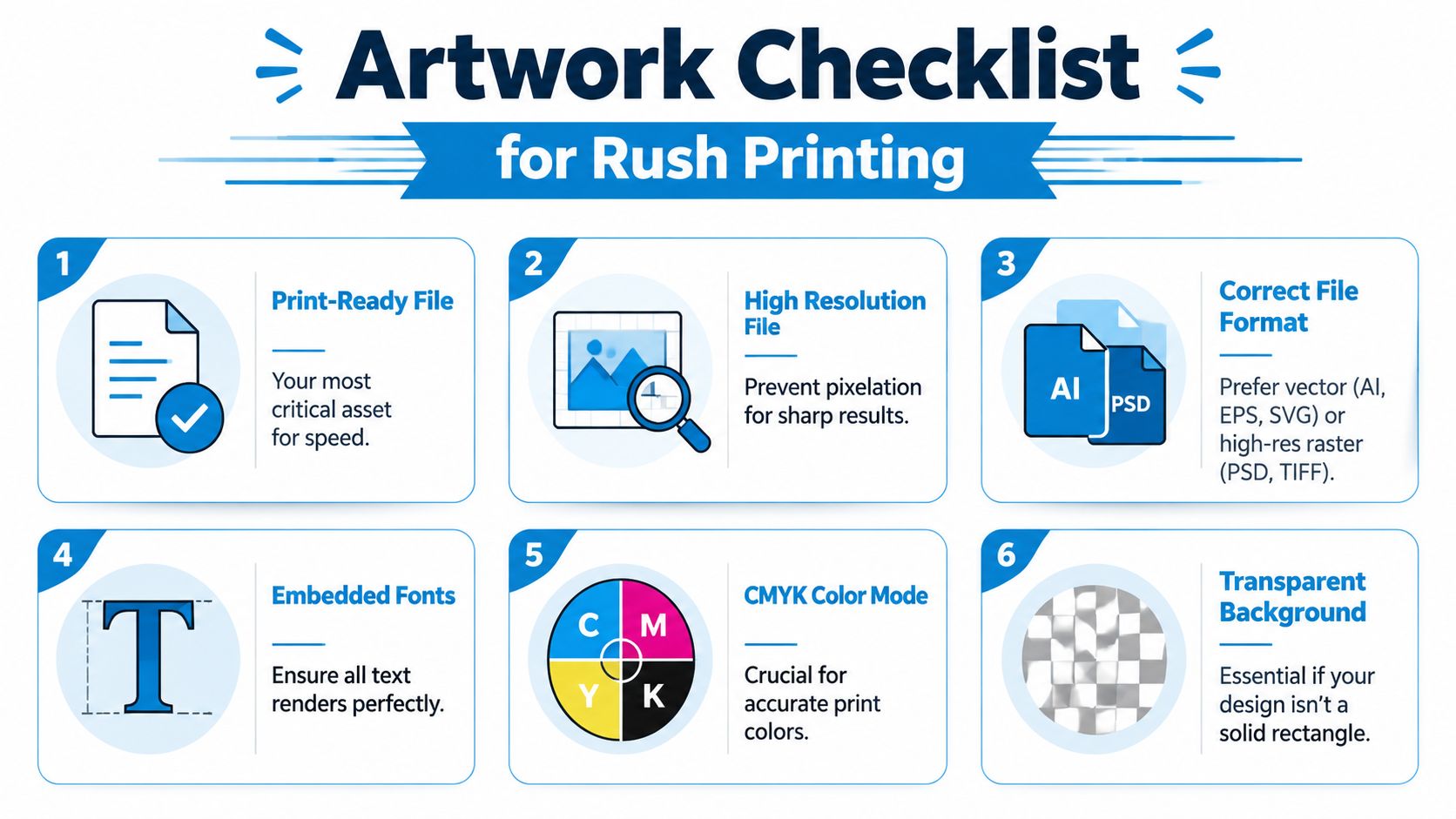
The file checklist that saves rush orders
Send the best file first. Don't send six versions and ask the shop to choose. Don't screenshot a logo from your website and hope it prints cleanly.
Vector files are the closest thing to a rush-order superpower. AI, EPS, and SVG files scale cleanly, open easily, and reduce back-and-forth.
Use this checklist before you hit send:
- Start with vector if you have it: AI, EPS, and SVG are usually the easiest production files.
- If you only have raster art: Use a high-resolution PNG or PSD at final print size, with a transparent background if the design isn't a full rectangle.
- Set the artwork to print size: Don't send a tiny logo and expect it to enlarge cleanly.
- Check resolution: For raster art, sharp files matter. Fuzzy edges on screen usually print worse on fabric.
- Convert colors properly: If your colors need to match print expectations more closely, this guide to RGB to CMYK conversion helps prevent surprises.
- Outline or embed fonts: Missing fonts can shift the whole design when the file opens on another system.
A clean file does more than improve print quality. It saves approval time because the proof looks right sooner.
What slows production down
Some problems show up on almost every panic order.
A JPEG pulled from social media is one of them. It may look fine on a phone, but once it's enlarged for a chest print, edges break down, gradients band, and text gets rough. Another common issue is a non-transparent background. A white box around the logo might not be obvious until someone opens the file on a dark shirt mockup.
Then there's the “editable later” problem. If the final art still needs slogan changes, date fixes, sponsor additions, or layout tweaks, it isn't ready. Same day shirt printing works best when design is already finished, not still in discussion.
Here's the blunt version. If your file needs repair, redraw, font matching, or layout redesign, you're no longer buying printing only. You're buying design time first, and that changes the clock.
Navigating Timelines Cutoffs and Rush Fees
Same day doesn't mean “any time today.” It means the shop still has a production window left when your order becomes usable.
What same day really means
Most shops run rush work around existing production, staffing, garment receiving, and press time. That's why a job sent early with complete details might make the schedule, while a job sent later with missing information usually won't.
The safest move is to call first, then email everything in one package: garment choice, sizes, artwork, print locations, and pickup deadline. If the event itself is part of a larger schedule, PSW Events' planning resources can help you tighten the surrounding timeline so apparel isn't the only moving part you're chasing.
Rush fees also surprise people, but they're easy to understand. The shop may need to interrupt queued work, assign staff to a single urgent order, or compress proofing and production into a smaller window. You're paying for priority, not just ink and fabric.
A rush fee isn't a penalty. It's the cost of asking a production team to change the day's plan around your deadline.
A realistic rush timeline
A same-day order usually follows a simple chain:
- Morning contact: You confirm the job and the shop confirms what's possible.
- Artwork review: The file gets checked for printability.
- Proof approval: You approve placement, size, and garment details.
- Production slot: The order moves when blanks and equipment are ready.
- Pickup window: You collect the job locally.
That's why delays early in the chain hurt the most. If you take too long to answer a proof email, production time doesn't stretch to compensate. It just disappears.
A short demo can help if you want to understand how urgency affects shop workflow and order handling.
The practical takeaway is simple. Ask for the latest realistic pickup time, not a vague promise. Clear expectations are what keep a rush job from turning into a missed event.
Final Logistics Proofs Pickup and Quality Checks
The order isn't safe just because it's in production. The last few steps still matter, and during these, rushed clients often create their own final delay.

Proof approval cannot sit in your inbox
When the proof arrives, open it immediately. Check spelling, shirt color, size run, print location, and design scale. Then approve it right away or correct it right away. Waiting “just a little” so other people can weigh in is how a same-day job turns into a next-day pickup.
For rush work, local pickup is almost always the right move. Shipping adds carrier timing, missed scans, address issues, and front-desk confusion. If you need a more traditional order flow with more lead time, services built around screen printing online fit better than a same-day scramble. But for a true rush, pickup gives you control.
The pickup check that catches problems
Don't grab the box and leave without opening it. Take a minute and check the basics on-site.
- Confirm garment details: Make sure the shirt style, color, and sizes match the order.
- Check print placement: Compare the final print to the approved proof.
- Look for obvious defects: Smudges, crooked placement, and wrong garment substitutions should be caught before you drive away.
- Count quickly: Verify that the total pieces are there.
If something is wrong, the best place to discover it is at the pickup counter, not in a parking lot, backstage, or at the event table.
That quick check isn't distrust. It's standard rush-order discipline.
Frequently Asked Questions and Contingencies
Same day shirt printing works best when the job is simple, the file is ready, and the garment is available. If one of those breaks, you need a backup plan fast.
If your first plan falls apart
If no local shop can complete the exact order today, don't stop at “can't do it.” Ask a better question: what version can be ready by end of day, or first thing tomorrow morning?
Sometimes the answer is switching from a full-front and full-back design to front only. Sometimes it means using a different but in-stock shirt. Sometimes it means printing fewer pieces now for core staff, then finishing the rest later. A partial win is often enough to save the event.
If the preferred garment is unavailable, prioritize function over perfection. Staff can wear matching black or white tees with one clean logo and still look organized. That's better than waiting on a special fabric or exact retail fit that won't arrive in time.
Common rush order questions
What if my design has too many colors?
Use a method that handles complex color well, or simplify the art. Under pressure, a cleaner version usually prints faster and looks better.Can I bring my own shirts?
It's possible sometimes, but it's risky on rush work. Outside garments can introduce fabric issues, hidden defects, or pressing problems, and the shop loses control over one of the biggest variables.What if I only have a bad logo file?
Ask whether the shop can use it as-is at a smaller print size. If not, switch to text-only artwork or a simplified mark you can build cleanly.What if I need more than shirts?
Keep the apparel order focused. We do not create business cards or fliers, so don't fold unrelated print items into the same emergency request.What's the best fallback if same day is impossible?
Ask for the earliest next pickup slot and tighten the order. Overnight compromise often beats chasing an unrealistic promise from a shop that's already overloaded.
The best contingency plan is the one you can approve quickly. Fancy backup plans usually fail for the same reason the first one did. Too many decisions, too late.
If you're under pressure and need a team that can guide the order clearly, Dirt Cheap Product, Inc. helps businesses and event organizers move fast on branded apparel with responsive proofing, practical decoration options, and straightforward support.