
You've just opened a shipment of custom polos for an event, and the quantity looks right until you inspect the decoration. Some logos are cracked, others have drifted in color, and several sit noticeably higher than the approved placement. The order may still be wearable, but it can't represent your brand confidently.
That's where quality control measures earn their keep. They aren't abstract paperwork or an internal factory checklist. They're buyer-visible decisions that show what was checked, when it was checked, and which variation was accepted. A clear system protects your budget, event deadline, and reputation before a defect becomes a public problem.
Table of Contents
- The Moment a Quality Control System Earns Its Keep
- What Quality Control Measures Actually Mean
- The Four Inspection Stages Behind Every Order
- AQL and Sampling Plans in Plain English
- Common Defects by Decoration Method
- Documentation, Corrective Actions, and Your Approval Checklist
- How a Real Custom Apparel Order Flows Through QC
- Buyer Takeaways and Where Quality Control Is Heading
The Moment a Quality Control System Earns Its Keep
A buyer who receives 500 polo shirts and finds 40 with cracked logos, color drift, and misaligned chest pockets has more than a decoration problem. The wasted budget is obvious, but the missed deadline can be worse. If the shirts were intended for a trade show, there may be no practical time for a remake, and staff may arrive wearing inconsistent branding.
The alternative feels very different. Before production, the buyer receives a digital mock-up, confirms the artwork and placement, approves a pre-production sample, and receives an inspection report before shipment. Those steps don't eliminate every possible variation, but they make the production standard visible and give both sides a defined point for resolving disagreement. A buyer can also use guidance on quality without compromise to frame expectations before approving a bulk run.
Practical rule: If a quality decision matters after delivery, it should be documented before production.
A useful system answers four questions:
- What was checked? Garment color, decoration placement, print cure, stitching, quantity, and packaging should have written criteria.
- When was it checked? Incoming goods, the first decorated pieces, finished goods, and the shipment each have a different purpose.
- Who approved it? The buyer and decorator should know which sign-offs are binding.
- What tolerance applies? Slight thread variation, a major placement error, and a critical safety issue shouldn't receive the same treatment.
This guide follows four inspection stages, then explains AQL sampling, defect categories, documentation, and a buyer-side approval workflow. The goal isn't to demand every possible inspection on every order. The goal is to match the control to the risk, so a fast promotional run doesn't carry the same process burden as premium retail merchandise.
What Quality Control Measures Actually Mean
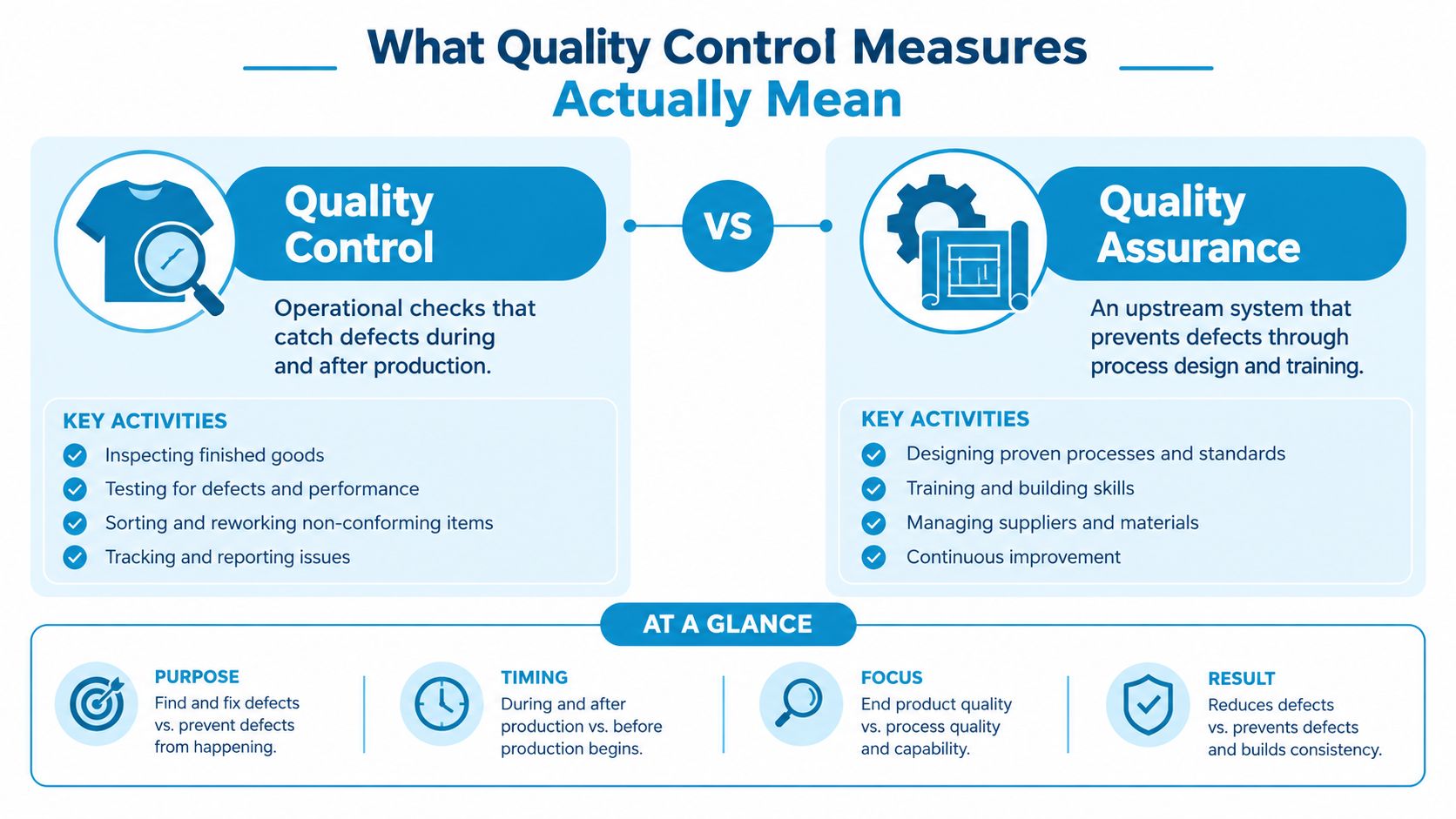
Quality control is the set of operational checks used to find defects during and after production. Quality assurance is the upstream system used to prevent those defects through process design, training, specifications, and supplier control. They work together, but they aren't interchangeable.
A decorator might use quality assurance to define the approved artwork file, train an operator, standardize platen setup, and qualify a blank-garment supplier. Quality control then checks whether the printed shirt matches the approved standard. If the inspection catches a misaligned screen, QC has found the output problem. If the team adjusts the setup so the misalignment doesn't recur, the broader QA system has improved.
The control-chart idea in a decorated shop
Modern statistical quality control took shape in 1924, when Walter A. Shewhart at Bell Labs developed the first modern control chart. His work shifted quality control away from relying only on 100% inspection and toward monitoring process behavior over time. By 1931, the ideas had been formalized in his work on economic control of product quality, and statistical methods later moved further into product development and manufacturing systems worldwide. The history of quality control provides that development in context.
The basic idea is straightforward. Plot a measurement over time, then investigate unusual movement instead of treating every difference as a separate mystery. In decorated apparel, a shop could track ink viscosity, stitch counts, registration measurements, or colorimeter readings. Most small decorators won't run a formal control-chart program for every order, but the principle still helps: a stable process produces fewer surprises.
The distinction matters during negotiation. If a buyer asks for “perfect” shirts, the decorator needs measurable criteria. If the decorator promises “standard QC,” the buyer needs to know whether that means a first-piece check, a final visual review, or a documented sampling plan. For online decoration work, the screen-printing process also needs defined approval points, because artwork, ink, garment, and press settings all influence the finished result.
The Four Inspection Stages Behind Every Order
A custom apparel order moves through four practical inspection gates. Each catches a different class of failure, and each is useful evidence a buyer can request without asking for confidential factory procedures.
Incoming inspection
The first check verifies the blank goods before decoration changes their condition. Staff compare fabric weight, garment color, size breakdown, and color lot against the order specification. They also look for holes, stains, knitting faults, incorrect labels, damaged trims, zippers, and drawcords.
This stage matters because decorating a defective blank creates rework. A print operator can't repair a fabric flaw with better registration, and an embroidery operator can't correct the wrong garment color after stitching.
In-process inspection
In-process checks happen while the order is still adjustable. A screen printer checks registration and ink coverage on the first pieces. An embroidery team checks alignment after the first 5 to 10 pieces, while a sublimation operator reviews press temperature logs. A DTF operator verifies powder shake coverage before the transfer reaches the garment.
The trigger is usually a setup change, a new batch, or the beginning of production. A shop that catches drift early can hold a small number of units instead of sorting the entire order later.
Final inspection
Final inspection evaluates finished garments against the approved standard. The reviewer checks image quality, placement from a defined reference such as the collar or hem, thread or ink color, visible stains, loose threads, and packaging condition. Wash-testing samples can reveal adhesion or cure problems that a quick visual inspection won't detect.
For complex production, a PFMEA implementation resource from Forge Reliability can help teams connect failure modes with controls, owners, and escalation rules.
Pre-shipment inspection
The last gate confirms quantity, carton labeling, packing configuration, and the sampled defect count before release. It often uses AQL sampling against the signed approval sample. This is the buyer-defensible point because the inspection record can show what the decorator evaluated before shipping.
Use this process-flow video as a visual reference for how inspection checkpoints can connect in manufacturing:
Skipping an early stage usually shifts the risk downstream, where correction costs more and deadlines are tighter. Buyers don't need to demand identical paperwork from every supplier, but they should ask for evidence that each relevant gate exists.
AQL and Sampling Plans in Plain English
Acceptance Quality Limit, or AQL, is a statistical lot-acceptance control used under ISO 2859-1. It connects lot size, inspection level, sample size, defect category, and accept or reject numbers. It isn't a promise that every released batch contains no more than the AQL percentage, and it isn't a substitute for written defect definitions.
The sampling plan asks whether the inspected sample supports releasing the lot under the chosen risk profile. A batch can pass even when defects exist, but only within the acceptance rules selected for that order. Guidance aligned with ISO 2859-1 commonly separates critical, major, and minor defects, with settings often described as 0 for critical, 2.5 for major, and 4.0 for minor defects. See this AQL reference for apparel inspection for the distinction between a statistical decision rule and a simple production target.
A sample plan example
For a concrete ISO 2859-1 example, Code Letter H corresponds to a 50-unit sample. Those units should be selected randomly across cartons and serial numbers, not pulled from the easiest boxes to reach. One published table gives 3/4 as the accept/reject threshold at AQL 2.5 for major defects and 5/6 at AQL 4.0 for minor defects. This sample-plan example shows how the decision changes by defect severity.
| Lot Size | Code Letter | Sample Size | Accept (Minor) | Reject (Minor) | Accept (Critical) | Reject (Critical) |
|---|---|---|---|---|---|---|
| Example lot | H | 50 | 5 | 6 | 0 | 1 |
The table should be treated as an example of a written plan, not a universal rule for every apparel order. The purchase order should identify the actual lot definition, inspection level, AQL class, defect categories, and Ac/Re limits.
Normal, reduced, and tightened inspection
ANSI/ASQ Z1.4-2003 (R2018), the U.S. acceptance-sampling equivalent, defines normal, reduced, and tightened operating modes. Switching rules adjust the inspection burden based on recent lot quality, rather than forcing every shipment through the same level. The ANSI/ASQ sampling resource explains those operating modes.
Tighter targets and higher inspection levels generally increase sample size and inspection cost, while reducing the chance that a materially defective lot ships. Reduced plans can protect throughput when recent quality is stable, but they shouldn't be used to avoid a required check. For premium runs, a buyer may negotiate a stricter AQL, such as 1.0%, when the brand and selling environment justify the additional control. Put the chosen threshold, defect definitions, and switching rules on every purchase order.
Common Defects by Decoration Method
Each decoration method has its own failure modes. Some are process-controllable, some begin in artwork, and others reveal a fabric-compatibility problem that inspection alone can't solve.
| Defect | Screen Print | Embroidery | DTF | Sublimation |
|---|---|---|---|---|
| Registration or alignment drift | Misregistration between colors, artwork layers, or print position | Registration drift between stitch layers | Transfer placed off-center or inconsistent across units | Artwork shifted during press setup |
| Coverage and surface appearance | Ink opacity gaps, pinholes in fine detail, off-contact ghosting | Puckering on knits, inconsistent density in small lettering | Rough hand from incomplete powder shake-off | Banding across wide platen seams |
| Color problems | Dye migration on polyester, ink color mismatch | Bobbin show-through on light garments, thread color variation | White outlines on dark garments, artwork-edge artifacts | Color shift between proof and press |
| Durability failures | Poor cure or adhesion, especially after washing | Thread breaks or loose stitching | Adhesion failure after the first wash | Ghosting from slow transfer release |
| Material or artwork limits | Fine detail may exceed the screen setup or garment surface | Small lettering may need a different density or digitizing approach | Gradients and transparency can expose banding | Tight seams may cause edge loss when they can't be flattened |
Screen printing depends heavily on screen setup, ink behavior, garment dye, and cure. Misregistration, pinholes, and opacity gaps can often be corrected through process controls, while dye migration may require a different ink system or a compatible garment.
Embroidery defects often begin with digitizing and stabilizer selection. Thread breaks and placement drift are process issues, but puckering can signal a mismatch between stitch density and a knit fabric. Small lettering that looks acceptable on a screen may become unreadable when stitched.
DTF creates a sharp transfer, but powder coverage, pressing conditions, artwork edges, and wash durability remain important. Sublimation depends on compatible fibers and controlled heat transfer, so a proof can look right while a press setup introduces ghosting, banding, or color shift.
A buyer should ask whether a defect comes from operator setup, artwork construction, or material compatibility. The remedy differs. Color-fastness and durability concerns also deserve documented testing, such as the color fastness testing guidance used to evaluate how decoration and fabric behave together.
Documentation, Corrective Actions, and Your Approval Checklist
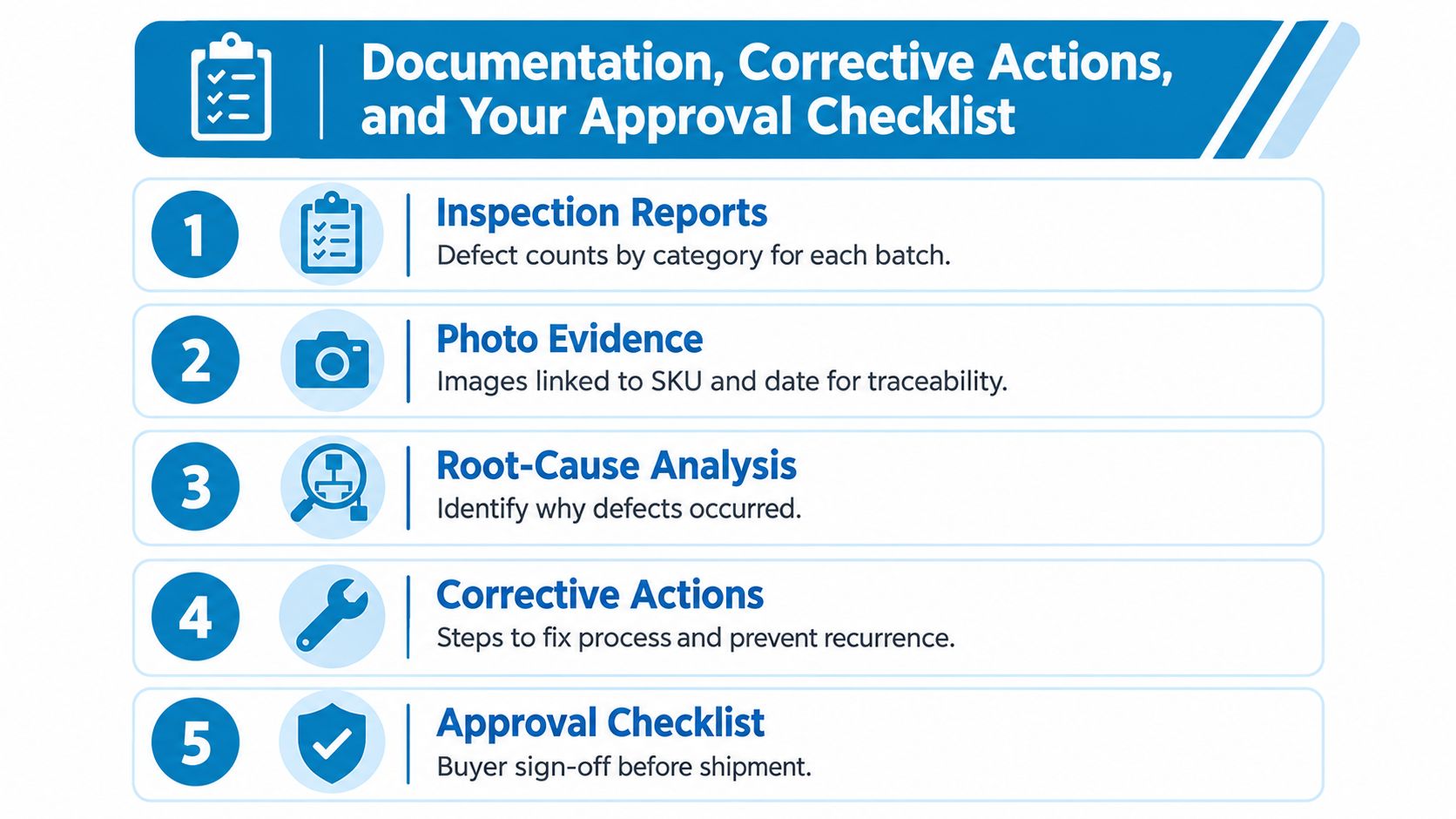
Inspection only becomes a quality system when someone can reconstruct what happened. A useful report records defect counts by category, photographs tied to the SKU and date, the inspected quantity, the approval reference, and the disposition of the lot.
A rejected lot also needs a root-cause note. “Bad print” isn't enough. A useful entry might identify low screen tension, a pallet alignment problem, incorrect artwork separation, or a fabric lot that reacted differently to the ink. The corrective action should state who fixed the issue, what changed, and when the fix was verified.
The six buyer approval gates
Use these gates in the order that matches production:
- Digital mock-up sign-off. Confirm artwork version, garment color, print area, decoration method, and approximate placement.
- Pre-production sample approval. Review a physical sample or first article before bulk production.
- Fabric and trim confirmation. Check the garment body, weight, color lot, zipper, drawcord, closure, or other relevant trim.
- Color match approval. Specify Pantone references for print where applicable, or thread colors for embroidery. Record whether the match is visual or instrument-supported.
- Finished-unit placement photo. Ask for a photograph showing the decoration on the actual garment, with the measurement reference documented.
- Pre-shipment random review. Confirm the sampling method, defect classes, quantity, packaging, and release decision.
Store approvals in a shared folder keyed to the PO number. That gives a reorder a known-good baseline instead of making the team rediscover artwork, placement, and tolerance decisions.
When a shipment misses the bar, send a corrective action request with five fields:
- Order reference: PO, SKU, color, size, and affected quantity.
- Observed defect: Describe the condition against the approved standard.
- Evidence: Attach dated photographs and sample identifiers.
- Requested response: Sort, repair, replace, credit, or investigate.
- Closure requirement: Ask for the root cause, corrective action, owner, and completion date.
How a Real Custom Apparel Order Flows Through QC
Consider a representative nonprofit ordering 200 polos from a contract decorator. The buyer supplies the artwork, and the decorator checks resolution, confirms the requested Pantone match, and produces a strike-off before screens are prepared. That early review prevents a low-resolution logo or incorrect color interpretation from becoming a bulk-production problem.
The incoming check then verifies the blank polos. Staff inspect fabric condition, dye consistency, sizing, and visible defects before decoration begins. The decorator photographs a pre-production sample and emails it to the buyer for approval of logo placement, ink color, and left-chest size.
Production runs in batches of 50, with in-process checks after each batch for registration and ink cure. The buyer and decorator have already agreed what constitutes an acceptable variation, so the inspector isn't making a new judgment each time a garment moves through the press.
At the lot level, an AQL inspection pulls 32 garments for the 200-piece order. The sampling plan isn't designed to inspect every polo. It provides a defined release decision based on the selected inspection system, defect classes, and accept or reject numbers.
The buyer also inspects the delivery before it goes to the event. A heat-marked pallet is identified and held before shipment to the venue. That decision saves more than the cost of sorting. It protects the event schedule, avoids distributing visibly damaged uniforms, and gives the decorator a chance to correct the problem while the order is still under control.
The important feature isn't the exact sequence alone. It's the ownership of each decision. The buyer approves the visual standard, the decorator controls the production process, and both sides have records showing why the shipment was released or held.
Buyer Takeaways and Where Quality Control Is Heading
A buyer doesn't need to manage a factory to control quality. The buyer does need to control the decisions that define acceptance.
- Write the defect tolerance. Define critical, major, and minor issues with examples relevant to the decoration method.
- Approve before bulk production. Sign off on the digital mock-up, then approve a physical sample when placement, color, texture, or material behavior matters.
- Select the sampling level. Use an AQL plan when a random inspection is appropriate, and document the inspection mode and switching rules.
- Match controls to the decoration method. Screen printing, embroidery, DTF, and sublimation don't fail in the same way.
- Keep the evidence trail. Save artwork, samples, photos, inspection reports, complaints, and corrective actions under the PO or SKU.
Quality control is moving toward machine vision, AI-assisted defect classification, real-time monitoring, predictive quality, and centralized dashboards. Industry coverage reports that 50% of manufacturers planned to apply AI/ML to product quality in 2025, while another report said 60% planned to increase quality spending in 2025. Those figures come from the ETQ 2025 quality survey coverage, but they don't mean every small decorator has installed automated inspection.
Many SMB shops still depend on trained inspectors, approved samples, checklists, and photographs. That can work well when the criteria are specific and the records are reliable. Technology becomes worthwhile when it targets an expensive or recurring defect mode, not when it adds another dashboard without improving the release decision.
A practical buyer checklist is simple:
- Is the artwork version approved?
- Is the garment and color lot confirmed?
- Is the first article signed off?
- Is the decoration method appropriate for the fabric and artwork?
- Are defect classes and AQL rules written?
- Is final evidence available before shipment?
- Is there a corrective action path if the order fails?
Dirt Cheap Product, Inc. provides custom screen printing, embroidery, DTF, sublimation, and related decoration services for apparel and accessories, with proofs used to confirm artwork, colors, placement, and stitching details. Visit Dirt Cheap Product, Inc. to discuss your order, define approval checkpoints, and request branded apparel that can be reviewed against a clear standard before production.