
A bright red polo can look perfect when it leaves the decoration shop and still create an embarrassing problem before the wearer reaches the office. The missing step is often color fastness testing, a practical way to check whether a garment's color can withstand the specific stresses it will face in service.
Color fastness isn't a single pass-or-fail property. Washing, rubbing, sunlight, perspiration, bleach, heat, and nearby fabrics can each create a different failure. A buyer who asks only whether a garment is “colorfast” may receive a report that says very little about the actual use case.
Table of Contents
- Why a Crisp Polo Left Red Marks on a White Bag
- What Color Fastness Actually Measures
- The Five Stress Tests Every Buyer Should Know
- Reading the Numbers Without Getting Misled
- In-House Checks Versus Accredited Lab Testing
- Preventing Failures by Decoration Method
- Building a QA Workflow That Catches Problems Early
- A Client Specification Checklist for Branded Apparel
Why a Crisp Polo Left Red Marks on a White Bag
The buyer noticed the problem on the commuter train. She was wearing a bright red embroidered logo polo, and by the time she reached the office, the shoulder strap of her white canvas tote had pink smears where it had rested against the collar. A coworker then pointed out that the red dye had marked a cream overshirt.
The polo had passed the decorator's visual check. The logo was sharp, the thread looked even, and the shirt appeared clean and finished. Nobody had matched the garment to the stresses it would face during a normal workday, including body heat, shoulder friction, perspiration, and repeated laundering.
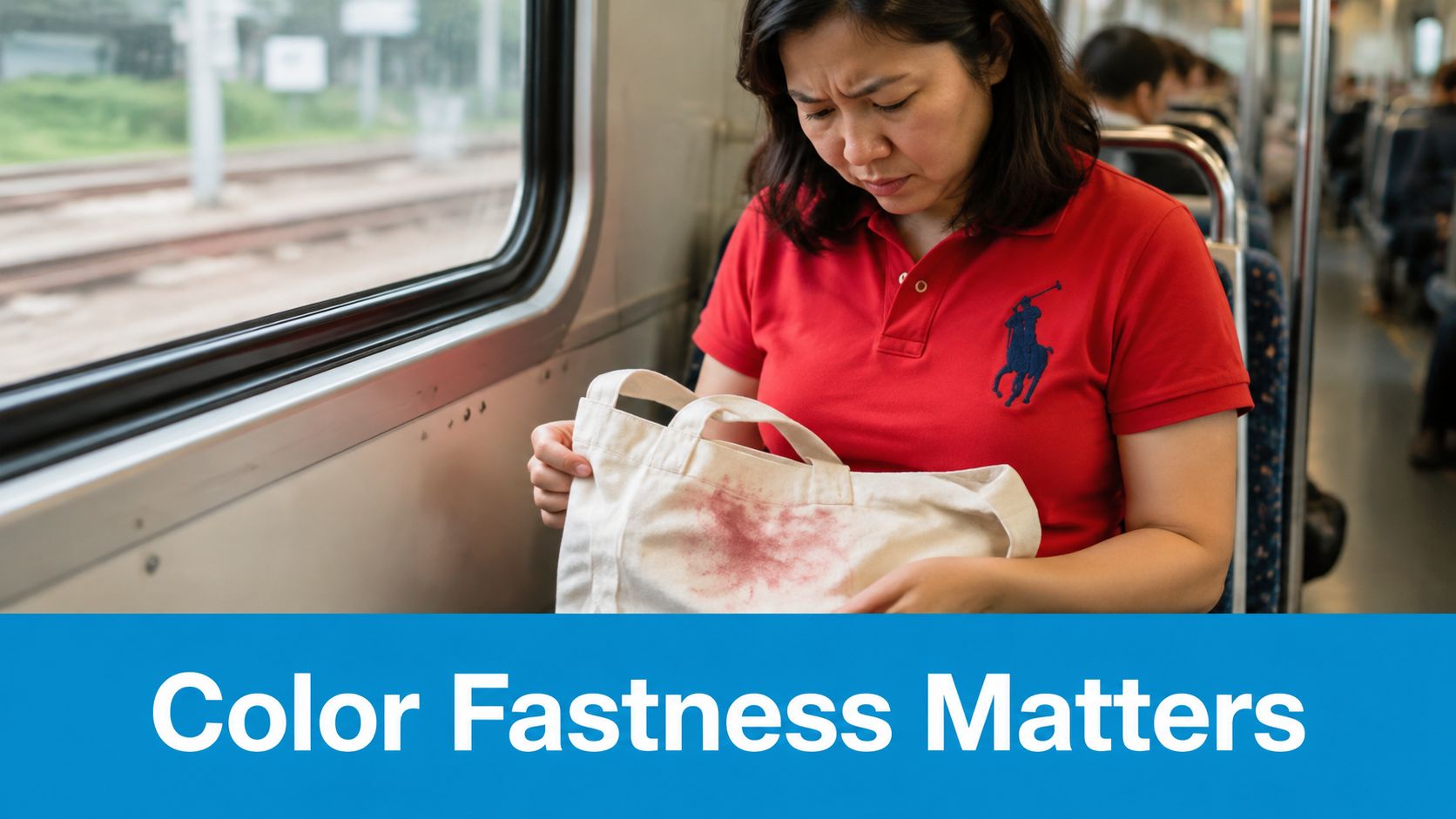
That pink mark was color transfer, not fading. The red color had moved from the polo onto another surface. A different test might have found whether the red shade itself would shift in the wash, but that result alone wouldn't predict what happens when a collar rubs against a bag strap.
Production lesson: A garment doesn't need to look damaged to fail. The customer may notice the problem on another garment, a seat, a tote, or a piece of equipment first.
The consequences extend beyond one shirt. A stained conference giveaway can weaken trust in the brand, create replacement work, and force an uncomfortable conversation with a client who handed the garment to employees or customers. The buyer never specified the relevant stress profile, so the supplier had no clear acceptance target to meet.
The solution is a repeatable specification language. Once you identify how the finished apparel will be worn, washed, exposed to light, and rubbed, you can request the matching methods and ratings from any decorator or testing laboratory.
What Color Fastness Actually Measures
Color fastness describes a textile's resistance to a particular stress. It belongs to a family of standardized methods, not a single quality grade. The ISO 105 standard family has a long standardization history, beginning with the A part first published on 15 December 1978, followed by later revisions and editions. Its scope reflects the central point: textiles need separate methods for rubbing, washing, light, perspiration, sea water, dry cleaning, and other exposures.
Think of each stress as a different enemy. A raincoat that blocks wind well may still leak in heavy rain, and a garment that survives laundering may still transfer color under friction. Different enemies require different tests.
Two failure types appear repeatedly in decorated apparel:
- Color change: The garment's own shade shifts, fades, darkens, or changes tone.
- Color transfer: Loose or migrating color stains an adjacent fabric or object.
Washing can combine water, detergent, heat, and mechanical action. Rubbing applies surface friction, often revealing unfixed color on a print, dyed area, or dark fabric face. Light exposure tests resistance to controlled artificial daylight and heat. Perspiration introduces acidic and alkaline conditions near the skin. Bleach and chlorine create another chemical challenge.
The AATCC testing standards and ISO 105 methods provide aligned test families used across major textile markets. Common pairings include AATCC TM8 with ISO 105-X12 for crocking, AATCC TM15 with ISO 105-E04 for perspiration, AATCC TM16 with ISO 105-B02 for light, and AATCC TM61 with ISO 105-C06 for accelerated laundering.
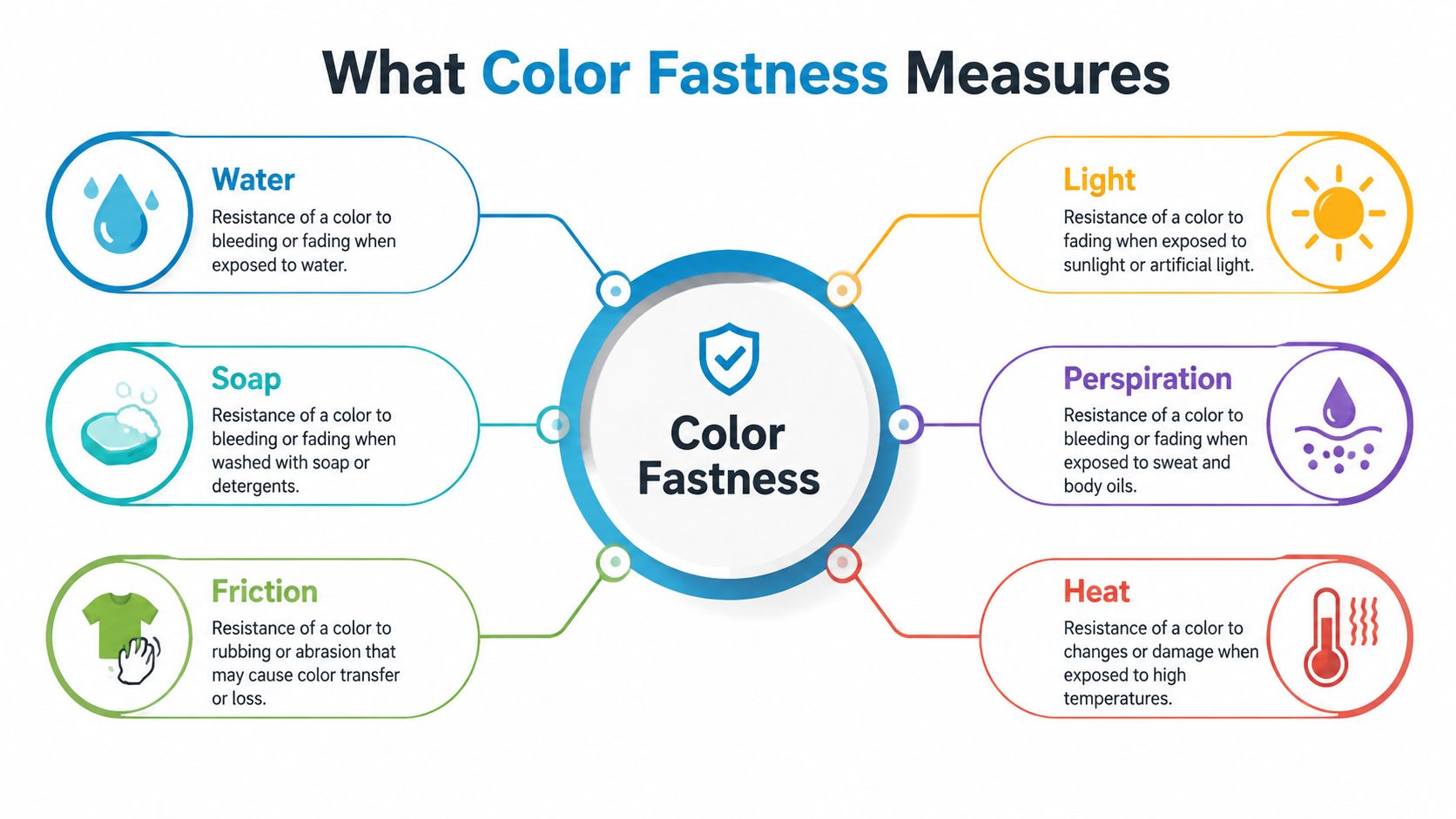
Reports usually express results through standardized gray scales. The number only becomes useful when you know which stress was tested, which property was graded, and what threshold the buyer required.
The Five Stress Tests Every Buyer Should Know
A buyer can make a color fastness request much more useful by naming the stress, the method, and the intended garment use. These five tests cover many decorated-apparel decisions.
Washing and laundering
AATCC TM61 and ISO 105-C06 evaluate resistance to laundering. ISO describes C06 as a method for textiles of all kinds and forms, using a reference detergent to assess resistance to domestic and commercial washing. The test looks at both shade change and staining on adjacent multifiber material.
This matters for uniforms, event shirts, retail garments, and any item expected to survive repeated cleaning. A wash result can reveal dye loss, print degradation, or staining that a dry visual inspection won't show. Buyers should state the required grade and the laundering method rather than accepting a vague “wash tested” statement.
Crocking and rubbing
AATCC TM8 and ISO 105-X12 assess whether color rubs off onto another material. ISO 105-X12 applies to dyed and printed textiles, including textile floor coverings and pile fabrics. The ISO rubbing method also has an extension, ISO 105-X16, for small colored areas that don't fit the standard apparatus.
A crockmeter rubs a dry or wet white cloth against the decorated or dyed area. That directly mirrors the red collar and white bag strap problem. It's especially important for dark garments, high-friction placements, shoulder areas, collars, cuffs, and prints that contact light fabrics.
Light exposure
AATCC TM16 and ISO 105-B02 expose samples to artificial light. ISO 105-B02 uses a xenon-arc fading lamp, while ISO 105-B06 evaluates color fastness and ageing under an artificial light source representative of natural daylight, D65, with simultaneous heat.
Use this test for outdoor uniforms, retail merchandise displayed near windows, branded awnings, and garments that will spend long periods in daylight. A shirt can pass washing and still fade in a storefront or outdoor work environment.
Perspiration
AATCC TM15 and ISO 105-E04 expose samples to acidic and alkaline artificial perspiration. The purpose is to mimic contact with sweat, especially in athletic wear, workwear, uniforms, and garments worn close to the skin.
Perspiration testing separates a common false assumption: good wash performance doesn't guarantee good sweat performance. Sweat creates a different chemical environment, so the buyer should request this test when the garment will be worn during physical work, exercise, heat, or long shifts.
Chlorine and oxidative bleach
AATCC TM172 and ISO 105-N03 address chlorine or oxidative bleach exposure. These methods matter for pool and spa apparel, hospitality garments, healthcare uniforms, and industrial laundering programs where bleach may be part of the cleaning routine.
| Stress Test | AATCC Method | ISO Method | What It Simulates | Typical Use Case |
|---|---|---|---|---|
| Washing | TM61 | 105-C06 | Domestic or commercial laundering | Uniforms, retail apparel, event shirts |
| Crocking | TM8 | 105-X12 | Dry and wet surface rubbing | Dark polos, bags, collars, high-friction prints |
| Light | TM16 | 105-B02 | Artificial daylight exposure | Outdoor uniforms, window displays, retail goods |
| Perspiration | TM15 | 105-E04 | Acidic and alkaline sweat contact | Sportswear, workwear, close-to-skin garments |
| Chlorine or bleach | TM172 | 105-N03 | Pool, spa, and oxidative laundering exposure | Swim programs, healthcare, industrial uniforms |
Reading the Numbers Without Getting Misled
A color fastness report often separates color change from color transfer. Gray-scale ratings commonly run from 1 to 5, where 5 means negligible change or staining and 1 means severe change or staining. The AATCC Gray Scales for Change and Staining correspond broadly with ISO 105-A02 and ISO 105-A03 evaluation practices.
Color change answers, “Did the garment's shade move?” Color transfer answers, “Did the color stain another material?” Those are different questions, so one score can't replace the other.
| Rating | Color Change | Color Transfer or Staining | Buyer Takeaway |
|---|---|---|---|
| 5 | Negligible shade change | Negligible staining | Strong result for the tested stress |
| 4 | Small, often acceptable change | Light staining | Suitable for many general apparel uses |
| 3 | Noticeable change | Noticeable staining | Review the use case and contrast risk |
| 2 | Significant change | Significant staining | High field risk |
| 1 | Severe change | Severe staining | Unacceptable for most branded apparel |
Common apparel programs often use targets around change ≥4 and staining ≥3–4 for wash fastness, dry rubbing ≥4 and wet rubbing ≥3, and light fastness around 4–5 for apparel and 6+ for outdoor use, as summarized in this color fastness testing standards guide. Treat those as program benchmarks, not universal guarantees.
A shirt rated 4 for crocking and 2 for perspiration may look fine in a dry office but transfer color when worn under a uniform during hot, sweaty work. The rating predicts field behavior only when the test reproduces the field stress.
A passing number without a named method is incomplete information.
Half-grade results can matter as well. A small numerical shift may represent a visible difference on a high-contrast garment, particularly when a light bag, cream overshirt, or adjacent fabric is involved. If you're also managing brand shade consistency, document the approved visual reference alongside the fastness report. A PMS color matching reference can help separate shade approval from durability approval.
In-House Checks Versus Accredited Lab Testing
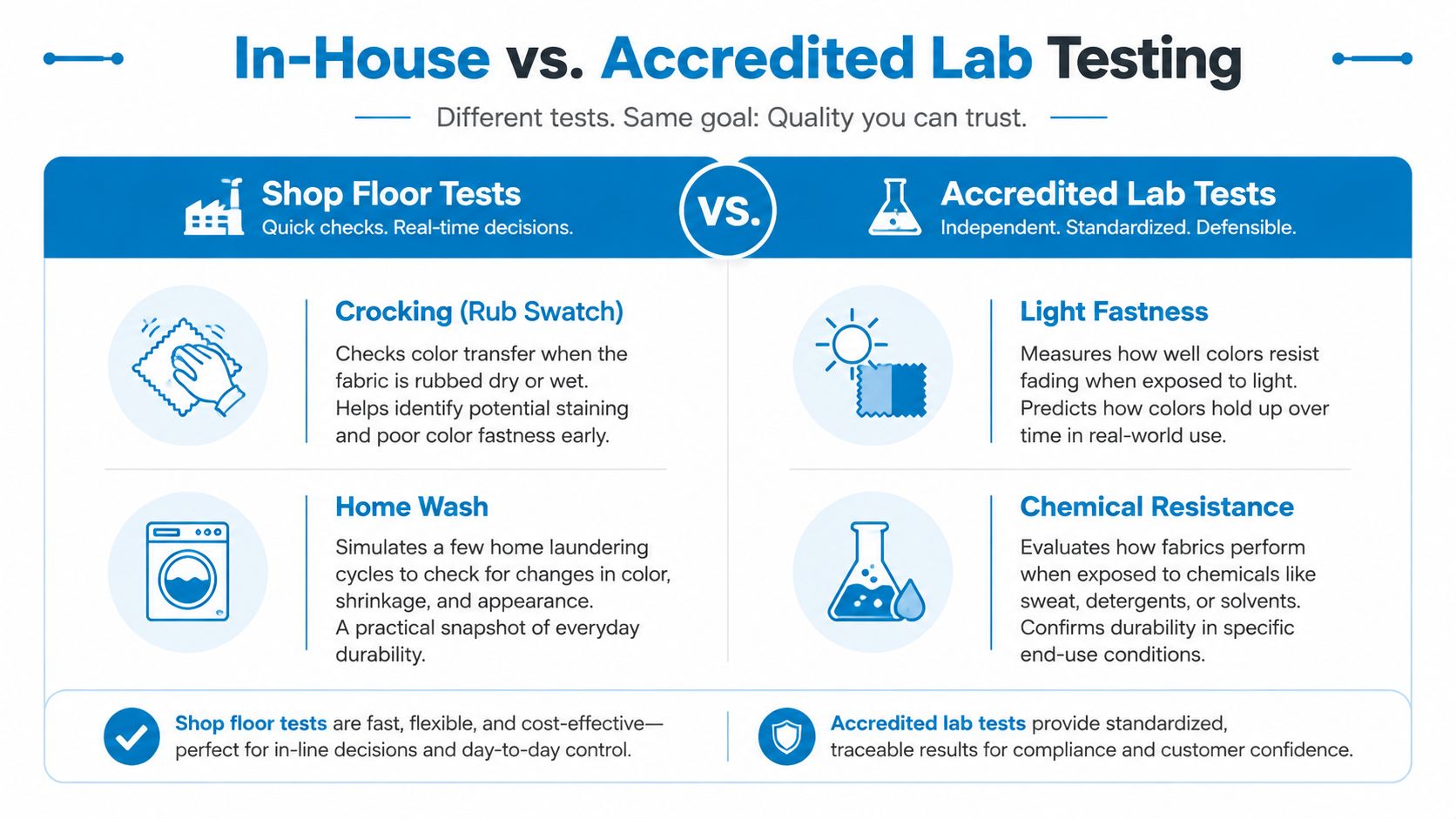
The choice between shop-floor checks and laboratory testing isn't a quality ladder. It's a trade-off between speed, cost, control, and defensibility.
A decorator can catch many obvious problems without sending every sample away. A crockmeter or a controlled hand-rub simulation can reveal surface color transfer. A home or industrial machine wash with adjacent white fabric can expose staining and shade loss. Visual inspection under standard D65 lighting can show an obvious mismatch or shift.
Those checks work well for prototypes, repeat orders, and process troubleshooting. They're fast, inexpensive compared with formal testing, and useful when the same garment, decoration file, ink, film, thread, and settings are already established.
What the shop floor can't prove
An in-house check won't replicate controlled xenon-arc light exposure. It also won't provide a precise perspiration solution, calibrated gray-scale verification, or the traceability expected from an accredited report.
A shop-floor wash can tell you that a sample looks worse after laundering. It can't automatically establish equivalence to AATCC TM61 or ISO 105-C06. Likewise, a hand rub can identify a serious crocking problem, but it isn't a substitute for a documented AATCC TM8 or ISO 105-X12 procedure.
When a lab report earns its place
Accredited laboratories can run methods such as AATCC 8, 16, 15, 61, and 135, or relevant ISO 105 procedures including B02 and C06. They provide controlled conditions, recorded methods, formal ratings, and traceable certificates.
Use third-party testing for first production runs, retail merchandise, safety uniforms, and government contracts. These orders carry a greater need to prove that the finished garment met a defined requirement, especially when several suppliers or decoration locations are involved.
Decision rule: Use the shop floor to catch problems early. Use an accredited lab when the result must withstand a customer dispute, procurement review, or compliance audit.
Budgeting depends on the laboratory, test combination, sample preparation, and turnaround requirement. Don't invent a cost range in the purchase order. Ask the lab for a written quotation that names each method, specimen requirement, reporting format, and delivery date.
For process-specific heat checks, a documented heat press temperature guide can support repeatable settings. It won't replace lab testing, but it can help operators avoid preventable variation between samples and production pieces.
Preventing Failures by Decoration Method
Each decoration method creates a different path to failure. The right prevention habit starts with the material and process, then checks the finished decoration against its real stress.
Screen printing
Screen printing failures often appear as wash loss, cracking, or crocking when plastisol hasn't cured correctly. Operators should cure plastisol to 320°F with a calibrated probe, then use pull tests before each run. Record the cure settings, inspect the first article, and hold the order if the print remains tacky or lifts during testing.
The difference between screen printing and heat transfer also matters when choosing a process for a particular garment and durability requirement.
Direct to film
DTF requires attention to powder melt and adhesive bonding. Check the powder coverage, confirm the press temperature and dwell setting, and pre-test polyester blends for dye migration with a heat-press bleed check. A first-article inspection should include stretch, edge adhesion, and a wash check.
Sublimation
Sublimation works best when the transfer is paired with a suitable polymer-coated polyester surface. Confirm transfer temperature and time, inspect the first piece for even color, and keep the transfer settings with the job record. Outdoor apparel deserves a separate light-fastness discussion because UV exposure can fade the result even when the transfer looks strong immediately after pressing.
Buyers comparing sublimation supplies can use this resource to find infusible ink materials and review material compatibility before production.
Embroidery
Embroidery can fail through thread fading, shrinkage, or abrasion around dense logo edges. Pre-wash garments when the program allows it, use colorfast threads, and add suitable backing to stabilize the design. Inspect the first article for puckering, exposed thread tension, and rubbing at the logo perimeter.
| Method | Primary Failure Risk | Top Prevention Habit | Secondary Check |
|---|---|---|---|
| Screen printing | Wash loss or crocking | Verify cure temperature with a calibrated probe | Pull test and first-article wash |
| DTF | Dye migration or weak adhesion | Check powder melt and polyester blend compatibility | Heat-press bleed check |
| Sublimation | UV fading or uneven transfer | Match coated polyester with recorded transfer settings | Light-exposure review for outdoor use |
| Embroidery | Thread fading or surface abrasion | Use colorfast thread and stable backing | Inspect edges, tension, and puckering |
Building a QA Workflow That Catches Problems Early
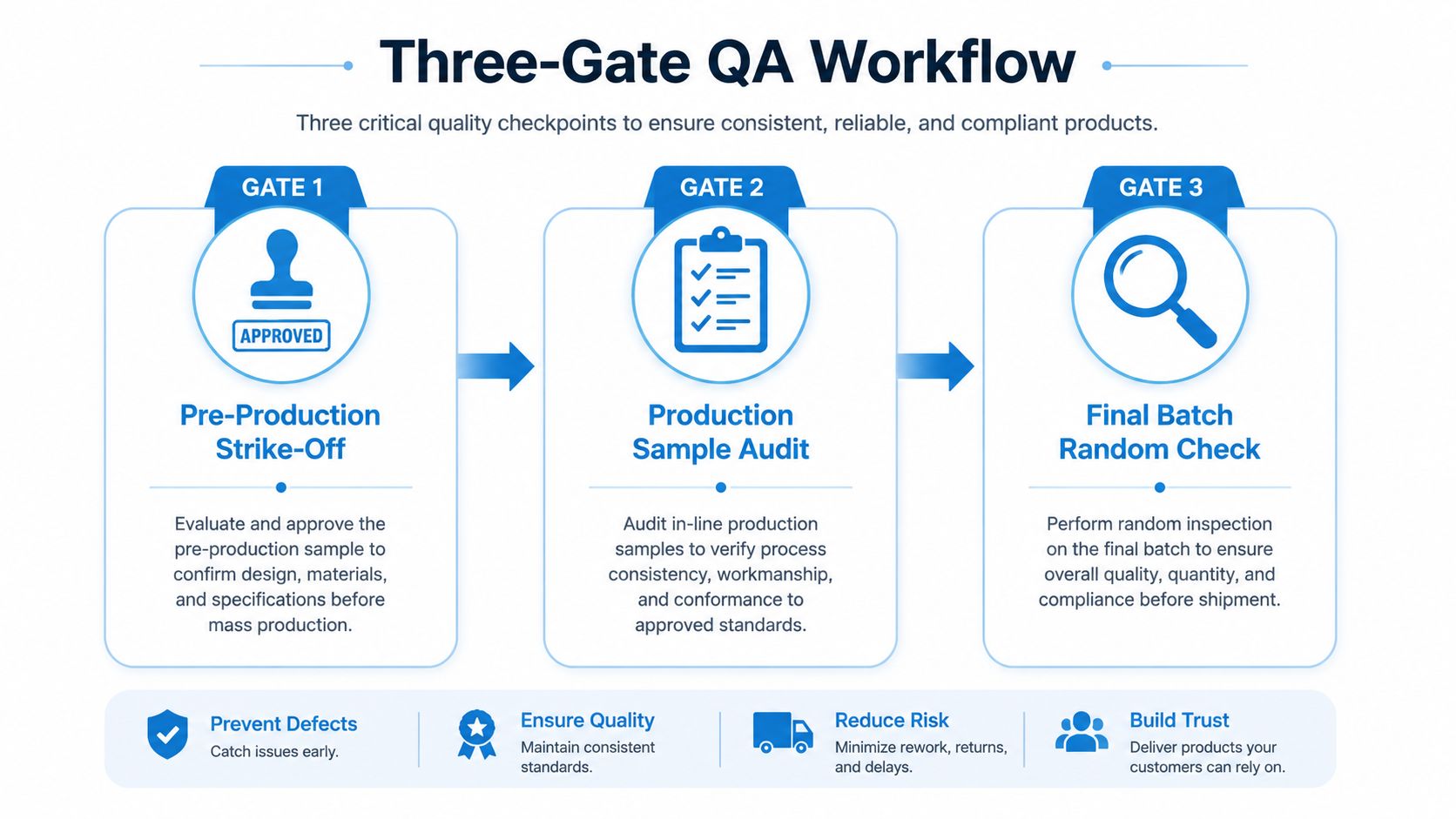
A practical QA system uses three gates. Each gate has a specific owner, timing, and hold condition, so color decisions don't depend on memory or a last-minute visual glance.
Gate one, pre-production strike-off
The decorator produces one garment using the planned ink, film, dye-sublimation transfer, or thread. That sample is washed and rubbed once before the full press run. The production manager compares it with the approved artwork and retained reference, then places the order on hold if the shade shifts, transfers, lifts, or shows unexpected abrasion.
Gate two, first-article inspection
The operator checks the first production garment on the floor. Review registration, cure temperature, decoration placement, and hand feel. Run a single accelerated wash cycle to expose miscured plastisol or under-cured DTF adhesive before the team makes the rest of the batch.
Gate three, batch sampling
Pull one shirt per 50, or per dye-sublimation lot, and grade it against the retained reference under D65 lighting. Record the method, observed gray-scale ratings, operator, date, garment lot, and decoration settings. A mismatch, failed rub, or unexplained shade shift triggers a hold and a review of the affected batch.
Assigning owners and storing approvals in a workflow system can prevent lost samples and undocumented changes. Teams evaluating production recordkeeping can compare fashion brand workflow tools as part of that process.
A Client Specification Checklist for Branded Apparel
A purchase order should name the garment use, stress, method, and minimum result. This copy-ready format gives the decorator something testable instead of a general request for “good color fastness.”
- Corporate uniforms: Crocking, AATCC 8 or ISO 105-X12, Grade 4 or higher dry and Grade 3 or higher wet. Wash, AATCC 135 or ISO 105-C06, Grade 4 after five cycles. Perspiration, AATCC 15 or ISO 105-E04, with the agreed gray-scale threshold.
- Retail merchandise: Light, AATCC 16 or ISO 105-B02, Grade 4 or higher for outdoor wear and Grade 3 or higher for indoor use. Wash, AATCC 135 or ISO 105-C06, with the approved change and staining grades. Add crocking for dark colors and high-friction placements.
- Promotional giveaways: Minimum wash Grade 3 using AATCC 135 or ISO 105-C06. No light requirement unless the item will be displayed or used outdoors. Add AATCC 8 or ISO 105-X12 when the decoration contacts light bags, jackets, furniture, or other surfaces.
| Use Case | Wash, Method / Minimum Grade | Crocking, Method / Minimum Grade | Light, Method / Minimum Grade | Notes |
|---|---|---|---|---|
| Corporate uniforms | AATCC 135 or ISO 105-C06, Grade 4 after five cycles | AATCC 8 or ISO 105-X12, dry 4+, wet 3+ | Specify when outdoor use applies | Add AATCC 15 for close-to-skin wear |
| Retail merchandise | AATCC 135 or ISO 105-C06, approved grade | Add for dark or high-friction designs | AATCC 16 or ISO 105-B02, outdoor 4+, indoor 3+ | Match test to display and wear conditions |
| Promotional giveaways | AATCC 135 or ISO 105-C06, minimum Grade 3 | Add where transfer could affect adjacent items | No requirement unless outdoor exposure matters | Retain a reference sample |
Write the decoration-specific requirements into the same document. Screen printing needs cure settings, DTF needs powder and adhesion controls, sublimation needs transfer conditions and compatible polyester, and embroidery needs thread and backing specifications. Retain a reference sample and require a test report from the decorator or an independent lab for any order above your internal threshold.
Dirt Cheap Product, Inc. provides screen printing, embroidery, DTF, sublimation, custom patches, and branded apparel for uniforms, retail merchandise, events, and promotional programs. Visit Dirt Cheap Product, Inc. to upload your logo, review decoration options, and request support for an order with clear color and durability requirements.