
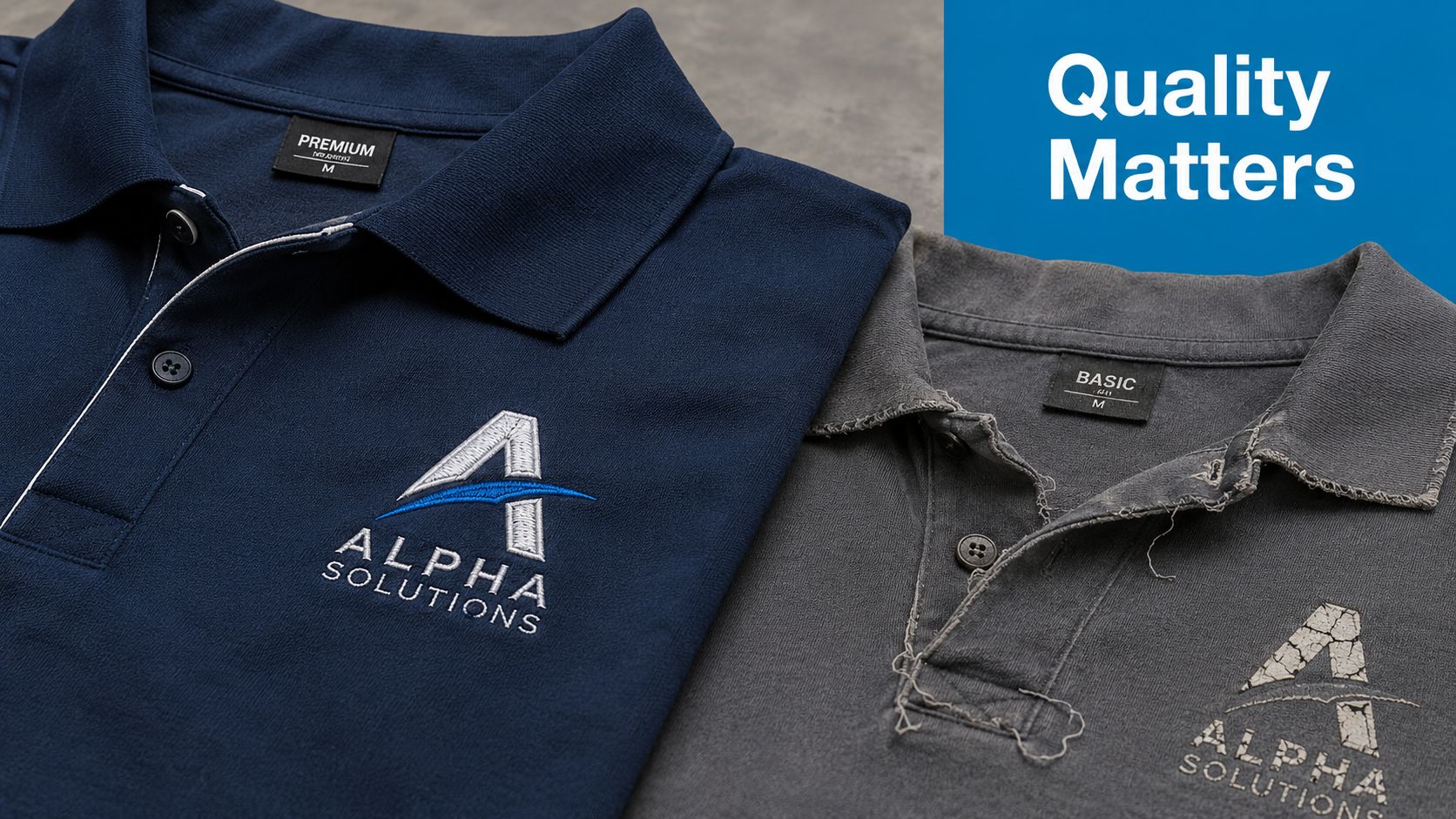
The cheapest quote usually looks smart on day one. Then the polos show up, the logo starts to fade after a wash or two, the stitching looks uneven under conference lights, and the whole order becomes a reminder that price and value are not the same thing.
That's the practical meaning of quality without compromise in branded apparel. It isn't a slogan, it's the discipline of defining what good looks like before production starts, then holding every stage to that standard. For buyers managing uniforms, event merch, or retail goods, that discipline protects the brand long after the invoice is paid.
Table of Contents
- Why Quality Without Compromise Matters for Branded Apparel
- Defining Quality Without Compromise in Apparel Production
- Key Quality Dimensions in Custom Apparel and Decoration
- How to Evaluate Apparel Suppliers for True Quality
- Actionable Steps and Checklists for Apparel Buyers
- Real Outcomes from Dirt Cheap Product, Inc.
- Common Buyer Questions About Quality and Turnaround
Why Quality Without Compromise Matters for Branded Apparel
A buyer orders custom polos for a company event, picks the lowest quote, and gets a box of shirts that look fine at first glance. By the time staff wears them under bright lights, the logo placement varies, the stitching wobbles, and after a few washes the print doesn't look as crisp as the proof. That's not a small miss. It turns a branded purchase into a trust problem.
The reason this keeps happening is simple. In apparel, quality is not just “looks good.” It has to survive wear, washing, packing, shipping, and repeat ordering. The earlier benchmark that still matters is the logic of Six Sigma, which set 3.4 defects per million opportunities (DPMO) as a gold standard for near-perfection in manufacturing, while many U.S. manufacturers sit around 3 Sigma to 4 Sigma, or roughly 6,210 to 66,807 defects per million opportunities. That gap explains why brands care so much about process discipline, not just inspection at the end, as discussed in the manufacturing quality statistics summary.
Quality is a brand decision, not just a production decision
Branded apparel sits in public. A uniform, a polo, a cap, or a retail tee carries your name into meetings, job sites, events, and photos. Buyers feel that pressure because customers do, too. Market data on buying behavior shows that 88% of buyers prioritize quality over price, 72% say quality matters more than brand reputation, and 63% are willing to pay more for a high-quality product, as summarized in this quality statistics report.
Practical rule: If the garment won't look consistent on the second reorder, it isn't truly cost-effective on the first one.
There's also the hidden cost side. Poor quality can consume 10% to 30% of annual revenue for typical manufacturers, while world-class facilities keep it below 5%, according to the manufacturing benchmark above. In apparel buying, that shows up as remakes, returns, delayed launches, and damaged internal confidence. If you're trying to build a dependable brand program, a stronger starting point is to review print-ready presentation materials like MyImageUpscaler print-ready images, because image clarity affects how well artwork survives proofing and decoration.
Defining Quality Without Compromise in Apparel Production
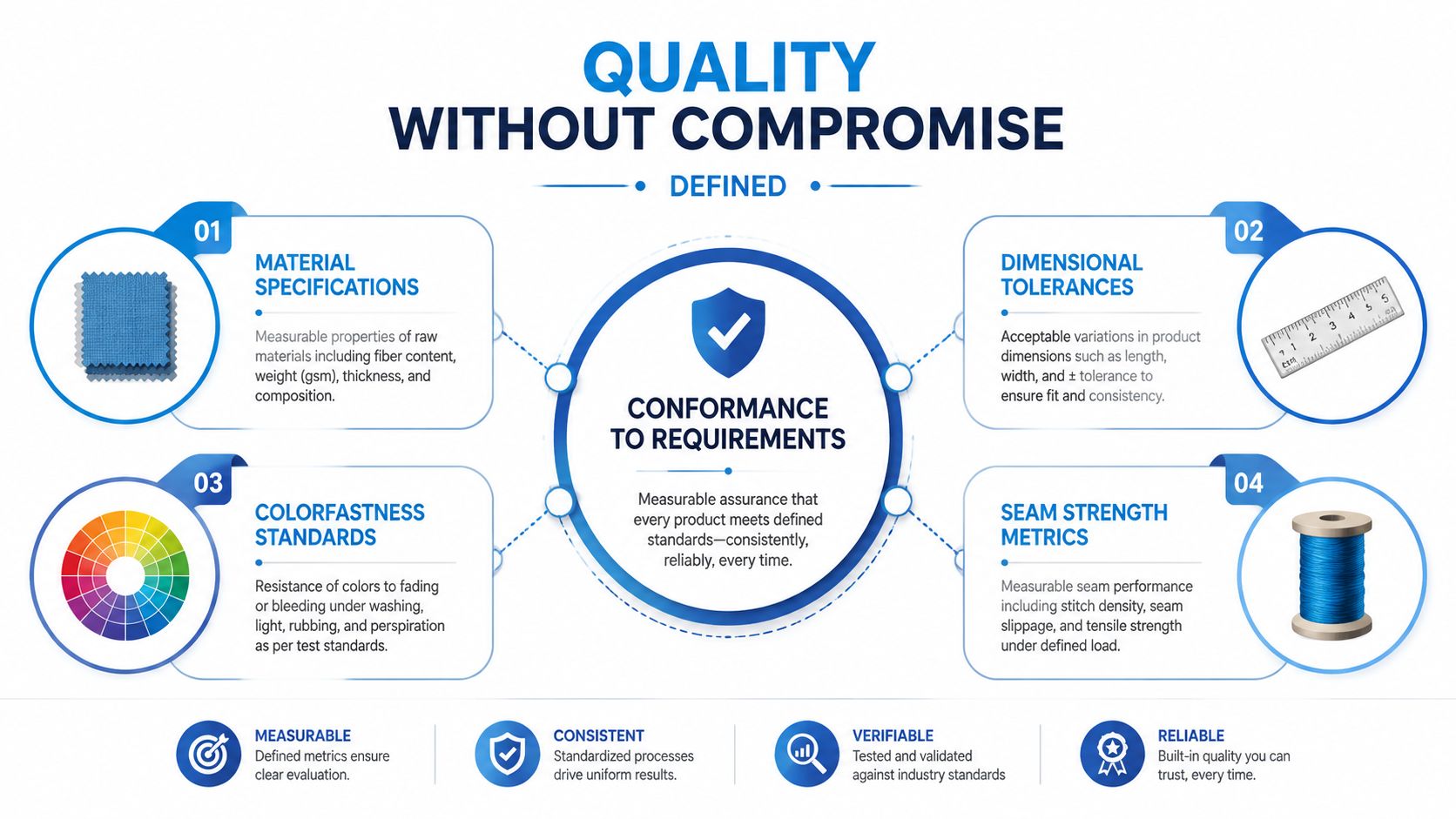
Quality becomes useful only when it's measurable. In ASQ-derived terms, quality means the degree of conformance to requirements and, more broadly, meeting or exceeding customer expectations, according to the cited excerpt from Wiley. For apparel, that means a shirt can't just “feel nice.” It has to match the agreed fabric, decoration method, placement, color tolerance, and finishing standard.
The problem with vague language is that it hides disagreement. One buyer thinks “premium” means heavier fabric, another expects smoother hand-feel, and a supplier may assume either one is acceptable as long as the order ships. Quality without compromise removes that ambiguity by making requirements explicit before production starts. In branded apparel, that usually means defining the garment, the decoration, the acceptable defect threshold, and what gets checked at each stage.
What measurable quality looks like in practice
A solid spec sheet isn't fancy. It's just clear. It says what the garment is, what decoration method is allowed, where the logo sits, how much variation is acceptable, and what must be rejected. That is where the quality conversation should begin, not with a promise that the order will “come out great.”
Practical rule: If you can't point to a spec, you can't defend the approval.
The reason this matters is that early decisions are cheaper than late corrections. ISO's quality guidance on quality assurance makes the preventive point clearly, QA builds quality into the process by asking whether the process is being done right, while QC checks whether the output meets specifications. In apparel, that difference determines whether a problem is caught during proofing, during production, or only after the cartons arrive.
The historical benchmark of Six Sigma still matters because it reframes quality as a system. It's not about one skilled operator or one careful inspection table. It's about building a process where the same result can be repeated reliably. That's why serious buyers push for written specs, approved samples, and documented sign-off. When those pieces are in place, quality stops being a guess and becomes a controlled outcome.
A professional source on process-driven presentation can be reinforced by the embedded video below, which is useful for visualizing how expectations become production standards.
Key Quality Dimensions in Custom Apparel and Decoration
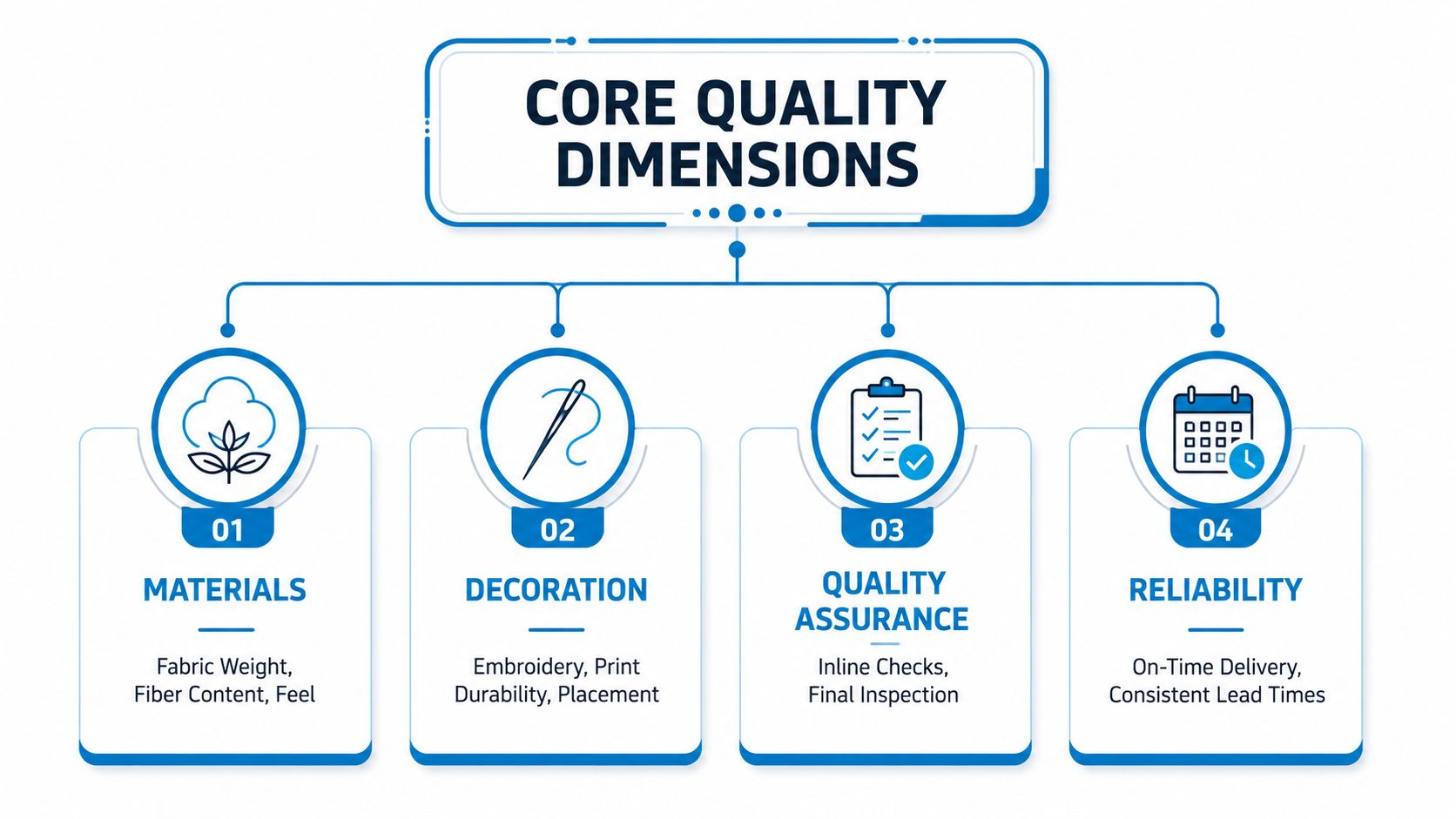
The fastest way to lose quality is to treat every product like the same product. A heavyweight fleece hoodie, a soft cotton tee, and a performance polo all behave differently in production and wear differently after delivery. Buyers who want quality without compromise need to look at the garment, the decoration method, the QA process, and the reliability of the timeline as separate levers, not one blended promise.
Materials and decoration carry different risks
Fabric weight, fiber content, and construction affect hand-feel and durability first. A shirt can be perfectly printed and still disappoint if the base fabric feels flimsy or shrinks in a way the buyer didn't expect. Decoration method matters just as much. Screen printing, embroidery, DTF, and sublimation each have their own strengths and failure points, especially around detail, placement, stretch, texture, and color appearance.
Some buyers try to solve decoration questions with one shortcut, usually price. That's where problems begin. A method that looks great on one fabric can look wrong on another, and the print process has to match the garment's behavior. For a practical look at decoration method trade-offs, the guide on water-based ink printing is a useful companion resource because it focuses attention on how ink choice affects the final hand and visual result.
QA and QC are not the same job
QA prevents defects. QC finds them. That distinction sounds small, but it changes how an order is managed. If the only safeguard is a final inspection, the supplier is already paying for mistakes in labor, time, or waste. ISO's quality guidance makes this cause-and-effect clear, and it's one of the main reasons stronger suppliers put proofing, pre-production checks, and in-process reviews ahead of bulk completion.
Reliability belongs in the same conversation. A shirt that arrives on time but doesn't match the approved proof still fails the order. The same is true for rushed timelines that force a decoration method mismatch or reduce the time available for sample review. Buyers who want consistency should ask whether the supplier can maintain proof accuracy and lead-time stability when a schedule gets tight. For buyers who work with artwork measurements, the reminder to use measurements instead of labels matters because sizing and placement decisions are stronger when they're based on actual dimensions, not loose descriptions.
| Criterion | What to Look For | Red Flags |
|---|---|---|
| Material | Clear fiber content, feel, and garment construction details | Vague fabric descriptions, no sample context |
| Decoration | Method matched to the garment and use case | One-method-fits-all selling |
| QA | Proofs, in-line checks, documented approvals | Final inspection only |
| Reliability | Stable lead times and clear communication | Last-minute changes, unclear delivery windows |
How to Evaluate Apparel Suppliers for True Quality
A supplier interview should feel like a working session, not a sales pitch. Good vendors talk in terms of proofing, placement, material suitability, and repeatability. Weak vendors lean on price and generic promises. If you want quality without compromise, you need to compare suppliers on how they handle the order before production, not just how fast they can quote it.
One useful test is the sample conversation. Ask what happens when artwork needs adjustment, who reviews the proof, and how many sign-offs happen before bulk production starts. Then ask the same questions about a reorder. A supplier that cares about quality can describe the process without hedging. A supplier that relies on end-stage inspection tends to sound confident until the details get specific.
Compare the workflow, not just the quote
The best comparison is rarely the lowest number on the page. It's the clearest workflow. Some suppliers can source many brands and decorate multiple item types, but if their proof turnaround is slow or the sample quality changes from order to order, the catalog depth doesn't matter much. Buyers should also look for wholesale pricing access, since budget-friendly doesn't have to mean careless if the product line is broad and the process is disciplined.
Watch for this: vague specs at the quoting stage usually become vague accountability after approval.
| Criterion | What to Look For | Red Flags |
|---|---|---|
| Decoration capabilities | Screen printing, embroidery, DTF, sublimation, and clear method guidance | One decoration method pushed for every order |
| Proofing process | Fast, accurate proofs with artwork refinement | Slow replies, unclear mockups |
| Communication | Responsive sales support and direct answers | Long gaps, generic responses |
| Sample quality | Consistency between sample and bulk order | “Close enough” sample approval |
| Catalog breadth | Multiple brands, styles, and color options | Narrow selection with no alternatives |
| Reviews | Verified feedback about service and delivery | No meaningful review history |
For a useful contrast in shopping behavior, buyers often compare an apparel supplier against a general print vendor when searching for screen printing online, but the difference is whether the vendor can manage both quality and repeatability when the order isn't simple.
Actionable Steps and Checklists for Apparel Buyers
The easiest quality failures are the ones that start with weak input. If the artwork is unclear, the garment selection is vague, or the decoration method is chosen too late, the rest of the process is forced to compensate. Buyers protect themselves by locking down requirements early, then checking them again before bulk production starts.
Use a four-step approval process
- Define specifications. Write down garment style, fabric details, decoration method, artwork placement, and packaging expectations.
- Request samples or first articles. Review the pre-production version before the full run begins.
- Measure against the approved standard. Check color, size, placement, and stitch or print detail against the agreed sample.
- Approve bulk only after sign-off. No bulk run should move ahead on assumptions.
That workflow sounds basic because it is. The value comes from discipline. Buyers who skip the proof stage often discover that a tiny variation across dozens or hundreds of units becomes an expensive problem once everything is packed and shipped.
Build a buyer checklist that catches avoidable mistakes
- Garment choice: confirm the exact style, color, and size range before artwork is finalized.
- Decoration placement: verify logo position with measurements, not rough descriptions.
- Proof accuracy: compare the mockup to the original artwork, especially for spacing and alignment.
- Defect threshold: decide in advance what is acceptable and what gets rejected.
- Packaging details: check folding, tagging, and any retail presentation needs.
- Reorder consistency: ask how the supplier will match the next run to the first one.
Practical rule: prevention is cheaper than correction because correction usually touches labor, time, shipping, and customer trust at once.
That's especially true when lead times shrink. A rushed order often leaves less room for back-and-forth, which means the buyer's own checklist becomes more important, not less. The best suppliers welcome that discipline because it reduces ambiguity before production starts.
Real Outcomes from Dirt Cheap Product, Inc.
Good apparel programs don't feel lucky. They feel controlled. The strongest orders usually come from simple habits, clear artwork handoff, responsive proofing, and a supplier that treats details like business risks instead of creative preferences.
The proof is in the order process. On the photo gallery, recent work shows the range buyers care about most, from staff uniforms to retail-ready merch to promotional campaigns. That matters because quality gets judged in context. A logo that looks fine on a screen can still fail once it's stitched, printed, packed, and worn in public.
The practical pattern is consistent. Buyers send artwork, the team refines the proof, and the order moves forward with clearer expectations about colors, placement, and stitching detail. That kind of workflow is what keeps branded apparel from drifting into “close enough” territory, especially when a campaign needs the same look across multiple items or reorder cycles.
For companies that need promotional items or closeouts to stretch a marketing budget, the key isn't cutting corners. It's keeping the standard visible even when the line item changes. That's the difference between a cheap order and a smart one.
Common Buyer Questions About Quality and Turnaround
Fast turnaround and high quality can work together, but only when the supplier protects the steps that catch problems early. What usually gets sacrificed first is proof time, placement review, or decoration-method matching. That's why buyers should ask what still gets checked when the schedule gets tight, not just whether the date can be met.
Smaller buyers often worry they'll have to accept weaker quality to get attention. They shouldn't. The better question is whether the supplier's process scales down cleanly, with the same proofing discipline and the same spec control for a small run as for a larger one. That's where access and equity matter, because quality should be usable for buyers with tighter deadlines or smaller budgets, not reserved only for the easiest orders.
If there's one habit that prevents most surprises, it's this. Ask for the proof, compare it to the written specs, and make sure the decoration method fits the garment before approving bulk. That's how you avoid color drift, inconsistent stitch detail, and placement issues that don't show up until the box is opened.
If you need branded apparel that's built around clear specs, fast proofing, and reliable decoration choices, Dirt Cheap Product, Inc. is set up for exactly that kind of work. Their team helps buyers turn requirements into finished garments without treating quality like a trade-off, and they're a strong fit for uniforms, merch, and promo programs that need to look consistent from the first unit to the reorder.