You're probably staring at a sample board or an online catalog right now, trying to decide whether a hat with pom is a smart buy or a cute mistake. That's the right question to ask before you place an order, because the pom changes how the hat looks, how it wears, and how much value you get from the decoration. In custom apparel, the expensive errors usually start with a bad reason for buying.
Table of Contents
- Understanding Why Your Hat Needs a Pom
- Choosing the Right Hat Style and Material
- Selecting Your Decoration Method
- Getting the Fit and Sizing Right
- Placing Your Order and Approving Samples
- Understanding Pricing and Planning Reorders
Understanding Why Your Hat Needs a Pom
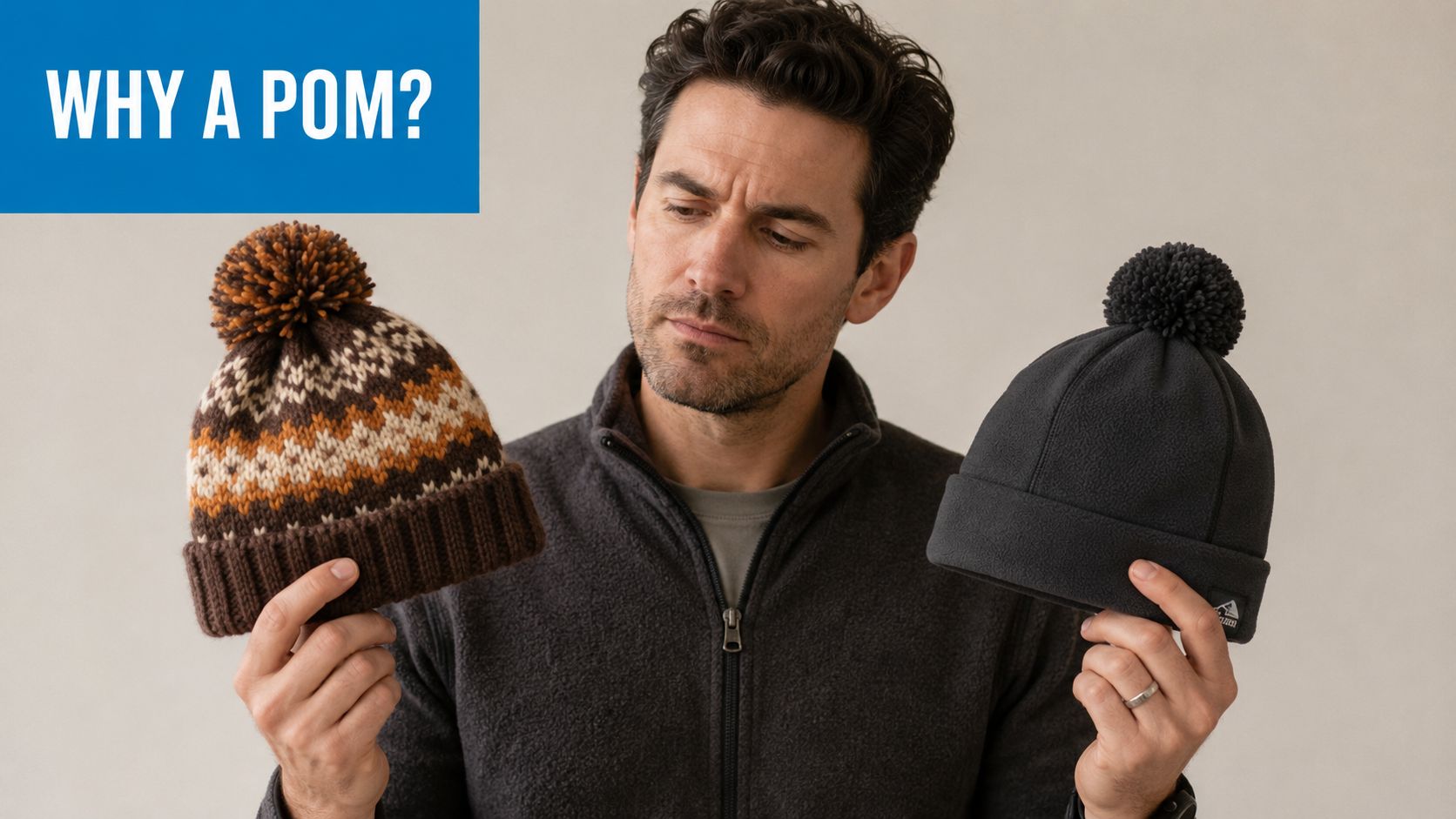
The most common mistake is buying a hat with pom because it looks festive, then discovering the pom fights the brand, the uniform, or the use case. Before you compare prices, decide whether the pom is there for function, visibility, or just style. That single choice changes everything from material selection to decoration placement.
Function first, decoration second
Pom-poms have a deeper history than most product pages admit. One source traces the tradition back to 790 AD in Scandinavia during the Viking era, and the word pom-pom is generally traced to the French pompon, meaning a small decorative tuft or ball, which gives the topper both a linguistic origin and a specific historical path history of bobble hats. There's also the familiar sailor story about bobbles helping crew members avoid low ship ceilings, but that account is often treated as a myth or misconception in modern coverage why do they put pom-poms on hats.
What matters for buyers is the practical role that still shows up in real use. On winter hats, the pom can act as a grab point so someone can pull the hat off while wearing gloves, which is useful for outdoor staff, event crews, and any team that's in and out of cold weather all day why do winter hats have pom-poms. That's a real utility, not a marketing flourish.
Practical rule: if the wearer needs to keep gloves on, the pom can be a small but real convenience. If the hat lives indoors, or the team won't care about that detail, the pom is mostly visual.
Brand fit is the real filter
Most generic listings treat the pom as a cute add-on. Buyers should treat it as a design decision that changes the silhouette. A large pom can look great on a winter market booth or holiday activation, but it can also look out of place on a cleaner corporate uniform line where the logo needs to carry the visual load.
That's where the brand context matters. If the outfit is already busy, the pom can compete with the logo instead of supporting it. If the outfit is plain and the hat is the main branded item, the pom can add enough personality to make the piece feel intentional. If you need a visual reference point for styling, luxury faux fur beanies show how a topper can push a hat toward a more premium, fashion-driven look without changing the core beanie structure.
Choosing the Right Hat Style and Material
Once you've decided the pom belongs on the hat, the next choice is the base construction. That's where most buyers save or waste money. A knit beanie and a structured cap behave very differently in production, and they don't create the same look once the pom is attached.
Knit, structured, and everything in between
For events, giveaways, and casual branding, a stretch-knit beanie is usually the cleanest starting point. It gives you that easy one-size feel, which matters when you're ordering for mixed groups and don't want to get trapped in size splits. A commercial pom hat example shows adult one-size construction at 12 in height with a 3 in cuff and 100% acrylic knit, which is a useful benchmark for the standard retail look pom hat sizing guide video.
Structured caps with pom toppers can work, but they need more careful planning. The pom can feel bolted on if the crown is too rigid or the proportions are off. That usually makes sense only when the hat is part of a very specific seasonal campaign or a fashion-driven retail line.
If you need a quick product-planning reference for finishing details and trim choices, custom hat finishing tips is a useful way to think through construction before you commit to a supplier spec.
Material changes the whole buying decision
Acrylic knit remains the practical default because it holds shape well and is easy to move through production. Wool blends feel better in hand and usually read as more premium, but they make more sense for winter festivals, paid staff uniforms, or retail pieces where the buyer can justify the cost of a nicer base.
A few buying cues help narrow it down fast:
- Acrylic knit: good for broad distribution, seasonal giveaways, and repeat use.
- Wool blend: better for premium winter programs and workwear that needs a warmer, richer feel.
- Structured crown: only choose this when the pom placement and branding need a more deliberate, fashion-forward profile.
- Stretch beanie: safest option when you're ordering for a mixed audience and want the fewest sizing headaches.
If you're comparing broader business-ready options, the internal reference at https://dirtcheapproduct.com/custom-hats-for-business/ is useful context for how branded headwear fits into a wider apparel program.
A hat with pom works best when the topper supports the rest of the silhouette, not when it tries to rescue a weak base style.
Selecting Your Decoration Method
Decoration is where a lot of buyers make expensive assumptions. A logo can look strong on a mockup and still fail on a knit hat if the method doesn't match the surface, the detail level, or the wear pattern. The right choice depends on whether you care most about durability, color range, or low-cost speed.
Embroidery, DTF, and patches each solve a different problem
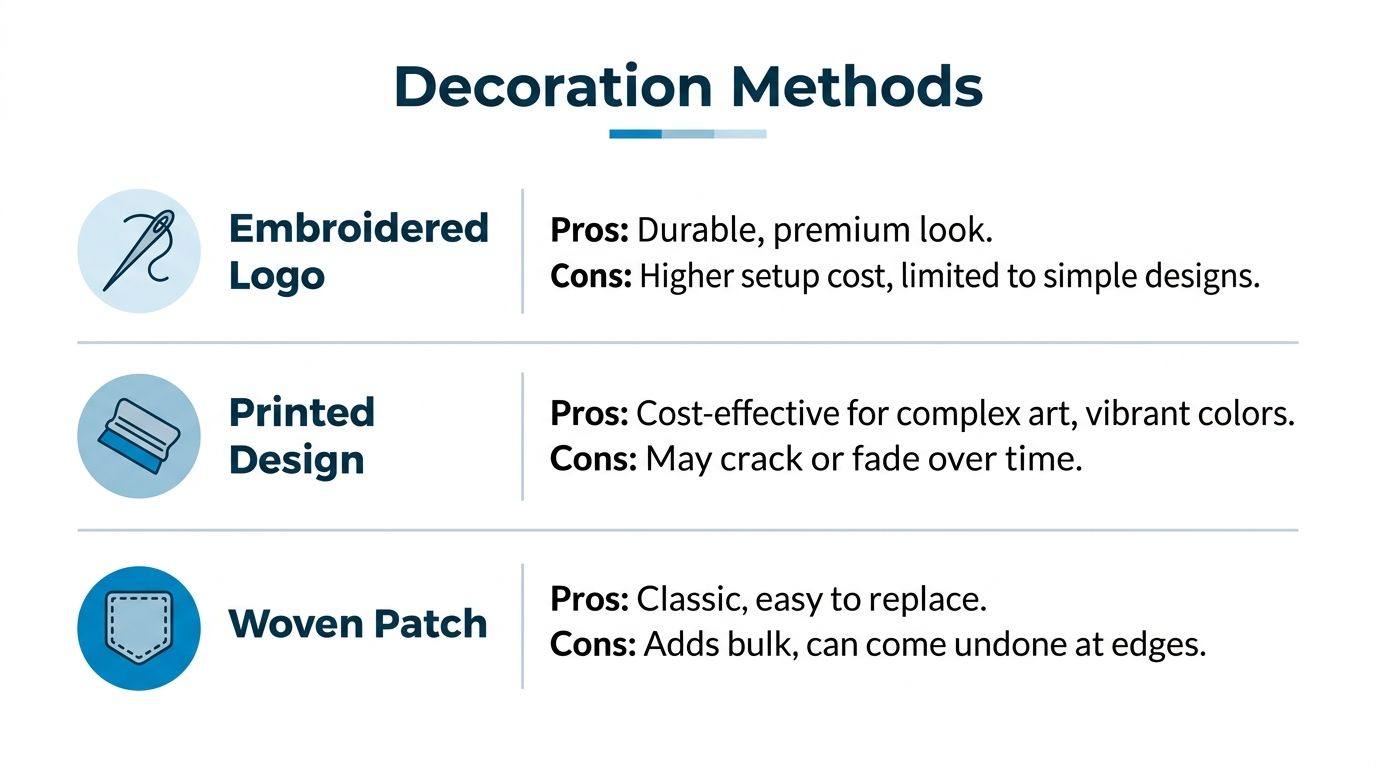
Embroidery is the default for a reason. Stitched logos sit well on curved hat surfaces and hold up through repeated wear without the cracking you get from some printed methods. It works on knit beanies and structured caps, but very fine details can get muddy if the stitch count is too low.
DTF, or direct-to-film transfer, is the better option when the art needs full color or photographic precision. It can go on textured knit surfaces, which makes it versatile for a hat with pom, especially when the design has gradients or small text. The trade-off is longevity, since repeated washing can be harder on the transfer than on embroidery.
Patches sit in the middle. They add dimension and can look sharp on chunkier knits, but the extra thickness changes how the hat drapes. If the patch sits too close to the pom or too high on the crown, the whole hat can start to feel crowded.
Practical rule: if the hat is meant to live outdoors and be worn hard, embroidery is usually the safest production choice. If the run is short and the art is colorful, DTF can make more sense.
Match the method to the job
A winter promotional order for staff who'll wear the hat should lean toward embroidery. You want the decoration to survive repeated use and still look clean after the first cold-weather season. A one-off event giveaway, on the other hand, can justify DTF if the artwork has too much color for clean stitching.
For buyers who want to see how a logo should sit before production starts, the placement examples in the internal guide at https://dirtcheapproduct.com/placement-guide-for-embroidery/ are a helpful planning reference.
Dirt Cheap Product, Inc. is one option when you need hats, embroidery, DTF, or patches handled through a single vendor workflow, especially if your order also needs fast proofing and consistent placement control.
Getting the Fit and Sizing Right
Sizing problems are where hat orders fall apart. T-shirts can absorb a bad size run. Hats usually can't. If a pom hat sits wrong on the head, the whole order starts to feel like dead stock, even if the logo work is perfect.
One-size stretch knits solve more problems than they create
For mixed-gender events and broad giveaway programs, the safest answer is a stretch-knit beanie in one size. The acrylic knit gives you enough forgiveness that one style can work across most adult heads without forcing a size split that adds cost and confusion. That is why so many retail and promo orders stay close to that format.
If you need a baseline before you place an order, use a practical hat sizing guide like the one at https://dirtcheapproduct.com/hat-sizing-guide/ and compare it against the sample in hand. A sewing guide video also shows how much the band has to give and how far the fit can drift before the hat starts to feel wrong. That matters because once you move into a structured or close-fit style, guessing no longer works.
Tech packs keep the order from drifting
A production-grade pom hat should be documented like other headwear in a tech pack. A complete pack should cover the point-of-measure details that matter in production, such as head circumference, crown height, brim length, brim curvature, and closure details. A solid cap tech pack also keeps the buyer and factory aligned on the BOM, so the vendor is not filling in gaps from memory or habit cap tech pack.
That matters more than many buyers expect. If the spec is vague, the vendor fills in the blanks. If the vendor fills in the blanks, the sample arrives looking close enough instead of right, and close enough is usually where money gets wasted.
Don't ignore gender-neutral fit preferences
Search behavior shows buyers look for mens pom-pom hats and for general hats with pom poms, but the market is still full of generic listings that do not explain who a style fits well. Some buyers want a deeper crown. Others want a slimmer profile that sits closer to the head. Those are not minor preferences, because a fit that reads well on one group can look sloppy on another.
For that reason, ask for samples in more than one fit direction before you approve a full run. A deeper crown can work better for broader adult groups, while a slimmer profile may suit a more fashion-forward order. The trade-off is simple, a tighter fit can look cleaner, but it gives you less forgiveness across a mixed audience.
The internal sizing reference at https://dirtcheapproduct.com/hat-sizing-guide/ is worth checking before you lock the quantity. It is easier to solve fit on the front end than to explain fit complaints after boxes start shipping.
If the order needs to work on a lot of different heads, stretch knit beats precision sizing almost every time.
Placing Your Order and Approving Samples
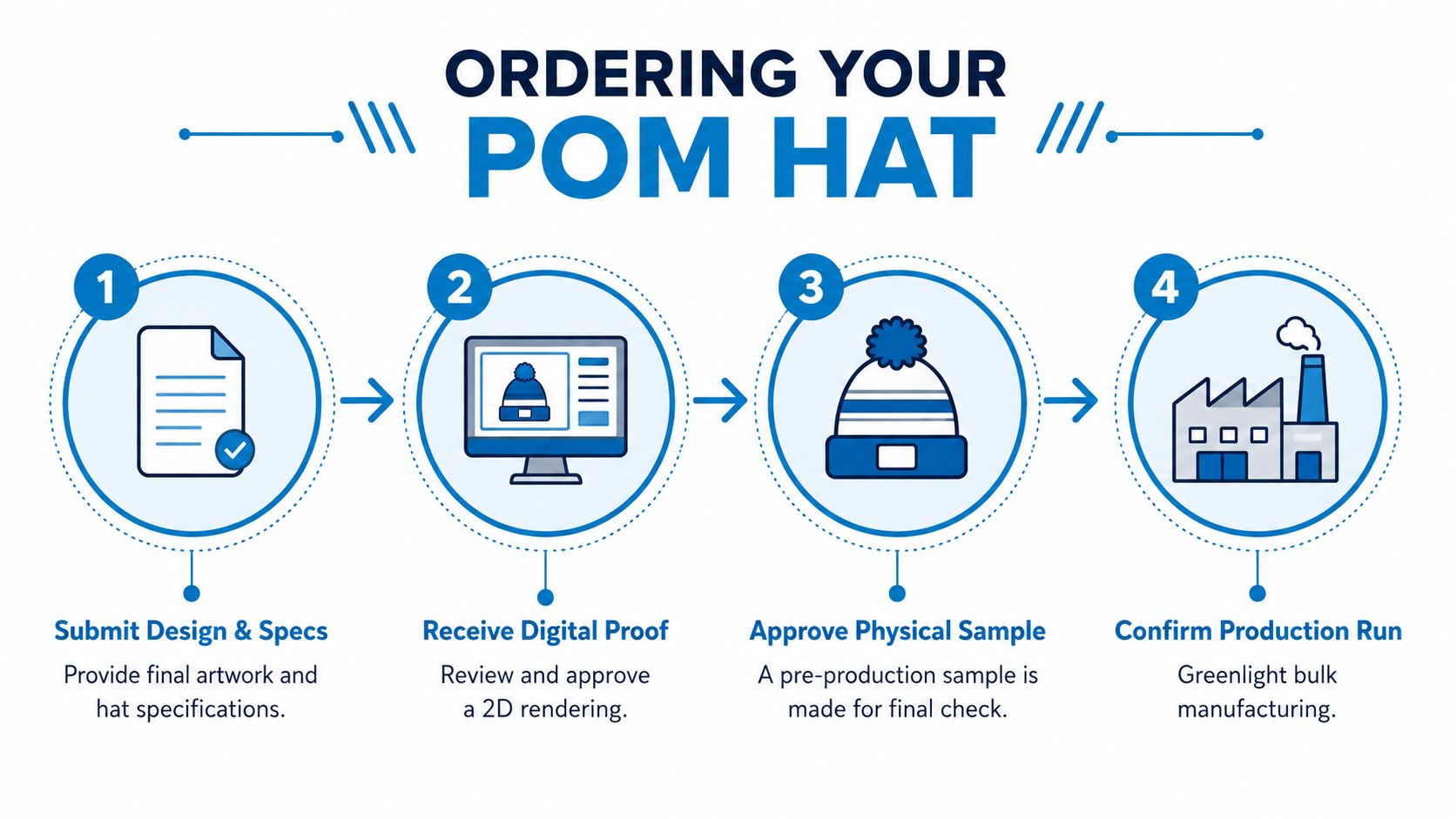
Ordering a hat with pom should be a controlled process, not a guessing game. A supplier that knows what they are doing asks for artwork, specs, and timing up front, then sends a proof before anything goes into production. Buyers get burned when they skip that step because the mockup looked acceptable on a screen but the finished hat does not hold up in hand.
Proof first, sample second, production last
Start with final artwork and ask for a digital proof. The proof should come back quickly so you can check logo size, placement, and whether the thread or print will read cleanly on the knit. That first review saves time because it is easier to correct a proof than to fix a full shipment.
Then order a physical sample. Screens do not show how the pom sits, how the embroidery thread compares against the knit, or whether the decoration changes the balance of the hat. One sample costs far less than reworking a full run after the fact.
A practical workflow looks like this:
- Submit design and specs. Send final art, color references, and hat construction details together.
- Review the digital proof. Check placement, color, and scale on the render.
- Approve the sample. Confirm fit, decoration, and pom attachment in hand.
- Release the bulk run. Move ahead only after the sample matches the plan.
Watch the details that usually slip
The checks that matter most are brand color accuracy, logo placement, and pom attachment security. If any one of those is off, the batch reads as less professional. That matters most for event wear, where one small flaw shows up across every photo.
Lead times depend on the decoration method and the size of the run. Embroidery usually moves on a standard production schedule, while DTF and patch applications can add extra days depending on rush availability. Use those windows as planning guidance when your launch date is fixed cap tech pack.
If you are trying to create demand before the order closes, the product page matters too. Clean hat specs and clear merchandising help drive high-intent traffic with SEO, which is relevant for anyone selling or promoting pom hats online.
Understanding Pricing and Planning Reorders
A hat with pom costs more than the unit price on the quote. Construction, decoration method, order size, and the amount of handwork all affect the final number. Buyers who read the quote this way stop chasing the lowest sticker price and start comparing the landed cost.
Setup cost and speed move in opposite directions
Embroidery usually carries a higher setup cost, but it becomes more economical as the quantity goes up. DTF has a lighter setup and can make more sense on small runs or on art with a lot of detail and full color. Patches sit in the middle because they add moderate setup plus separate application labor.
| Decoration Method Cost and Speed Comparison | Setup Cost | Best For | Lead Time |
|---|---|---|---|
| Embroidery | Higher | Larger runs, durable branding, simple logos | Standard production timing |
| DTF | Lower | Small runs, full-color art, detailed graphics | Often a bit longer than embroidery |
| Patch | Moderate | Chunky knits, dimensional branding, classic looks | Varies with attachment method |
Minimums vary by supplier, but many custom decoration vendors set floors between 24 and 50 pieces for most hat styles. That is a normal constraint, not a red flag. It just means the first order should be sized around how many hats you can use, not how many you wish were cheap.
Reorders are where smart buyers win
Reorders get easier when the art file, tech pack, and vendor contact details stay in one place. With that organized, some reorders can move on a single email and come back in 5 to 7 business days for in-stock styles cap tech pack. That kind of speed matters when you are replacing damaged units or restocking for another event.
Pricing breaks can also shift the math. Some suppliers use progressive pricing at 100, 250, and 500-unit thresholds, so moving from one quantity band to the next can change your per-unit cost. If the first order worked at 100 and the next one needs 200, ask where the next break starts before you approve the run.
For brands that need product-page visibility as well as production support, the mechanics covered in SEO for product pages can help drive high-intent traffic with SEO before the reorder conversation even starts.