
You're probably in one of three situations right now. Your staff needs branded headwear that looks consistent on the job. Your event team wants something more visible than another forgettable giveaway. Or you're trying to build merchandise people might choose to wear after they leave.
That's where custom hats for business usually move from “nice idea” to practical tool. A hat gives your logo a visible home, but it also has to work as an object people want on their head. If the shape is wrong, the fabric feels cheap, or the logo application fights the material, the order won't do its job no matter how good the artwork looked on screen.
The buying process gets easier when you stop treating hats as a single product category. A trucker hat for a summer event, a structured cap for a field team, and a beanie for seasonal staff all solve different branding problems. The core decision is the combination of use case, hat style, decoration method, design execution, and ordering logistics.
A good place to sharpen the brand side of that thinking is Wand Websites for brand building tips, especially if you're trying to connect apparel choices to broader visibility goals.
Table of Contents
- Introduction Turning Your Brand Into a Walking Billboard
- Why Custom Hats Are a Smart Branding Move
- Step 1 Selecting the Perfect Hat Style and Fabric
- Step 2 Choosing the Right Decoration Method
- Step 3 Designing for Maximum Brand Impact
- Step 4 Navigating the Ordering and Production Process
- Conclusion From Plan to Product Your Custom Hat Journey
Introduction Turning Your Brand Into a Walking Billboard
A business owner ordering hats for the first time usually starts with the logo. That makes sense, but it's rarely the first problem to solve. The first problem is fit between the hat and the moment where it will be worn. A roofing crew needs something different from a brewery merch table. A trade show giveaway needs something different from a winter employee gift.
That's why strong custom hats for business are usually built backward from use. Start with who will wear them, where they'll wear them, and whether the hat needs to feel like a uniform, a souvenir, or a retail item. Once that's clear, the rest of the choices get cleaner.
Hats solve branding and behavior at the same time
A hat works because it's functional. People wear it for sun, weather, comfort, or style. Your logo just rides along with that behavior. That's better than putting your mark on an item that lives in a desk drawer.
The practical challenge is that hats have less forgiveness than T-shirts. Curved surfaces distort artwork. Structured fronts behave differently than soft crowns. Mesh, twill, acrylic knit, and polyester all react differently to stitching and heat-applied graphics.
A good hat order doesn't start with “What's cheapest?” It starts with “What will people actually keep wearing?”
The framework that keeps first orders on track
Use this sequence when evaluating options:
- Use case first: Staff uniforms, retail merchandise, and event giveaways each need a different balance of cost, style, and durability.
- Choose the hat blank second: Shape, closure, crown structure, and fabric all affect comfort and branding.
- Match the decoration method to the logo: A detailed logo may need a patch or transfer. A bold logo may look best embroidered directly.
- Approve carefully: Mockups and proofs aren't paperwork. They're quality control.
Businesses that get this right end up with something more useful than generic swag. They get wearable brand consistency.
Why Custom Hats Are a Smart Branding Move
Custom hats earned their place in business branding because they solve a visibility problem cleanly. People can wear them in public, on the job, at an event, or during travel without needing to change their whole outfit. That makes hats more flexible than a lot of promotional gear.
The category itself has matured beyond one-off novelty orders. The custom hat market has evolved from small-batch decoration to a scalable business service, and branded headwear is now treated as part of a broader corporate identity system for staff, retail, and event environments, with suppliers serving customers globally, as noted by Custom Ink's hats category overview.
Hats stay visible in real working environments
The most useful branded product is often the one that fits into someone's normal routine. Hats do that well because they aren't just promotional. They're practical.
For employee use, a hat can standardize appearance fast. If your team works outdoors, in transit, at a booth, or in a casual customer-facing setting, a matching cap creates visual consistency without requiring full uniform complexity. That matters for landscaping crews, brewery staff, warehouse teams, food service concepts, volunteer groups, and pop-up retail teams.
For customers, hats can carry your brand in a less forced way than logo-heavy apparel. People are often more selective about shirts because fit is personal. Hats are easier to distribute, easier to wear, and easier to reorder when one style catches on.
Three business uses that make sense
Here's where custom hats for business usually perform best:
| Use case | What works | What fails |
|---|---|---|
| Staff uniforms | Durable materials, readable front logo, consistent color matching | Trendy styles that don't fit the work environment |
| Retail merchandise | Strong silhouette, subtle branding, style aligned to audience taste | Generic caps with oversized corporate logos |
| Event giveaways | Broad appeal, fast recognition, simple decoration choices | Overcomplicated artwork and hard-to-wear colors |
A lot of first-time buyers make the same mistake. They try to force one hat to do every job. That usually waters down the result.
Practical rule: If you need hats for both staff and customers, treat them as two separate products even if they share the same brand.
A uniform hat should prioritize readability, comfort, and repeat wear under working conditions. A retail hat has to compete with everything else in a customer's closet. Those are different briefs.
If you're planning one order only, choose the use case that matters most operationally. If the team needs them next month for an outdoor activation, build for that. If the goal is margin at a merch table, style and perceived value should lead the decision.
Step 1 Selecting the Perfect Hat Style and Fabric
A first-time buyer usually starts with the logo. The better approach is to start with the person wearing the hat, the setting, and how often it will be used. Style and fabric set the ceiling for the final result. They affect fit, comfort, logo clarity, perceived value, and whether people keep the hat in rotation after the event or work shift ends.
Start with the use case, then narrow the silhouette
The fastest way to choose well is to match the hat to the job.
A service team that wears hats daily needs comfort, easy replacement, and a shape that looks appropriate with the uniform. A retail program needs a silhouette people would buy even without knowing your company. An event giveaway needs broad fit and low friction. It has to look good on many head shapes and feel easy to wear right away.
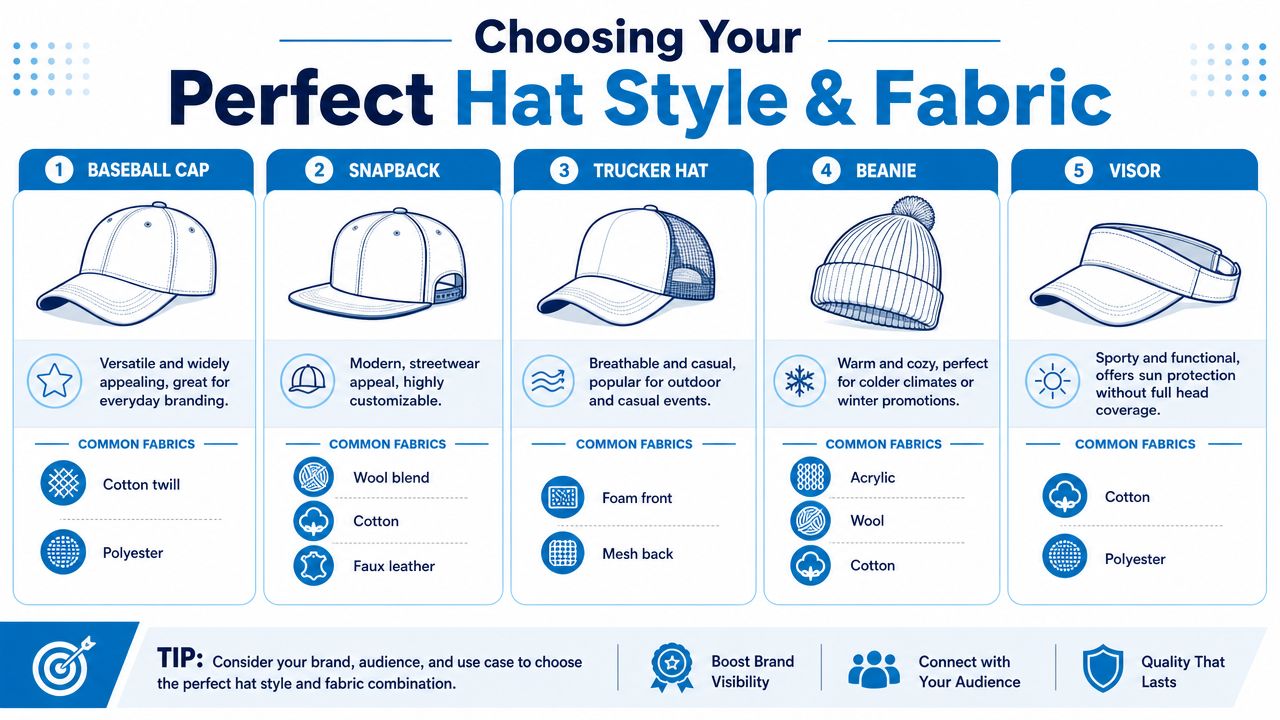
Here is the practical breakdown:
- Baseball cap: Broadest fit for staff programs, customer gifts, and general brand use. Structured versions look cleaner and usually hold front logos better. Relaxed versions feel more casual and broken-in.
- Snapback: Better for streetwear-influenced merch, brewery apparel, music events, and younger retail audiences. The profile is more noticeable, which helps on a merch wall and can feel too styled for some uniform programs.
- Trucker hat: A strong choice for outdoor crews, summer promotions, and casual lifestyle brands. The mesh back helps with airflow, but the look is less universal in formal or polished settings.
- Beanie: Practical for cold-weather crews and seasonal merchandise. Beanies carry branding well, but they solve a specific weather problem and should not be treated as an all-season default.
- Visor: Best reserved for golf outings, resort programs, and sports-adjacent events. For general business branding, the audience is usually too narrow.
Crown construction matters too. If your team wants a familiar, versatile profile, a 6-panel hat with a standard front panel shape is often the safest starting point. It gives decorators a dependable area for front placement and gives buyers a shape they already understand.
Fabric changes both appearance and performance
Fabric is where the order either feels inexpensive or intentional.
Many buyers treat fabric as a comfort decision only. In practice, it also affects structure, color hold, heat retention, stain visibility, and how clean the decoration looks. A logo that reads well on a firm twill front can look less defined on a soft, unstructured cap. A hat that feels great indoors can become a bad choice for a crew working outside in July.
| Fabric | What it feels like | Best fit |
|---|---|---|
| Cotton twill | Familiar, soft, classic | Everyday uniforms, general giveaways |
| Polyester | Smoother, performance-oriented | Outdoor teams, active use, modern sports feel |
| Mesh | Breathable, casual | Trucker hats, warm-weather events |
| Wool blend | More substantial, more structured | Snapbacks, retail-oriented styles |
| Acrylic or knit materials | Warm, flexible | Beanies and cold-weather use |
Cotton twill is usually the safest place to start for uniforms because it wears in well and feels familiar to a broad group of employees. Polyester works better where heat, sweat, or repeated washing are part of the job. Wool blends can look sharper at retail, but they may feel too warm or too heavy for long shifts. Mesh improves airflow, though it also commits you to a more casual look.
That trade-off matters.
A premium fabric is not automatically the right one. If hats will be tossed into vans, worn on job sites, or handed out at a festival, durability and comfort usually matter more than a heavier hand feel. If the hats will sit on a shelf with a price tag, structure and perceived quality often deserve more weight.
The blank hat is the product. The logo is one layer of the product. If the base hat is wrong for the use case, decoration will not fix it.
Before approving a style, check four points together: who will wear it, where they will wear it, how long they will wear it, and how you plan to decorate it later. That integrated approach avoids the most common first-order mistake, choosing a hat shape for looks alone and finding out too late that the fabric, fit, or front panel does not support the actual business goal.
Step 2 Choosing the Right Decoration Method
Decoration method is where many hat orders either level up or fall apart. Two hats can use the same logo and the same color palette, but one looks sharp and one looks compromised because the application method doesn't match the artwork or the material.
Hat customization usually falls into distinct process routes such as commercial embroidery, heat-transfer vinyl, sublimation, and white-toner or transfer printing, and those methods require different equipment and material compatibility. Industry guidance also notes that cap decoration typically needs a cap press for transfer methods and a professional hat embroidery machine for stitched decoration, with sublimation limited to compatible polyester surfaces, as explained by ColDesi's comparison of four ways to customize hats.
Embroidery when you want texture and permanence
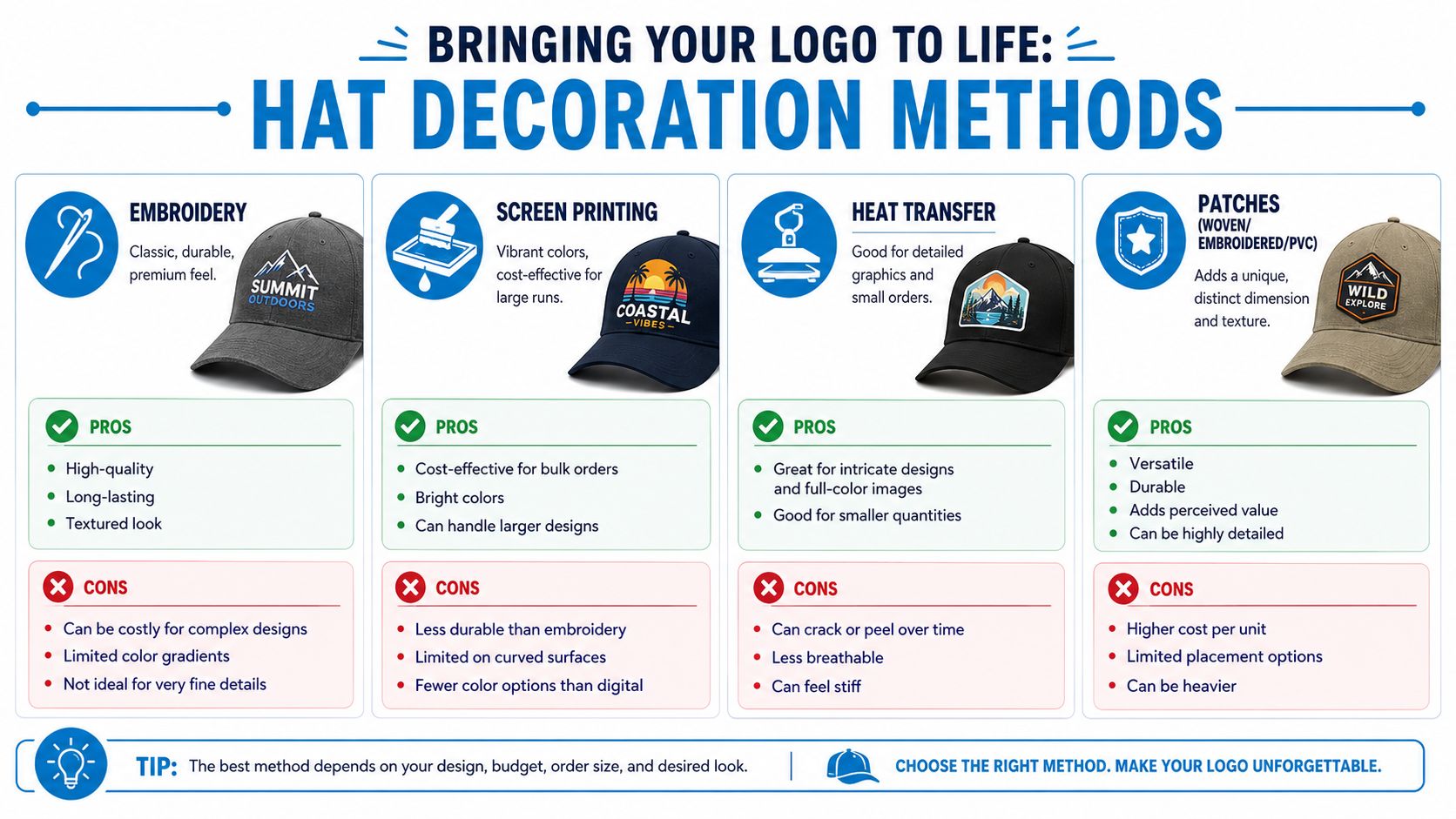
Embroidery remains the default for a reason. It feels integrated into the cap rather than applied onto it. It also carries the strongest “uniform” signal for many businesses.
Threadbird notes that for business branding, embroidery is a dominant decoration method and can also be paired with woven patches or 3D puff effects. The trade-off is production reality. Stitch count, digitizing quality, and crown material affect readability, so logos often need simplification before stitching to keep edges crisp, as described by Threadbird's custom hats service page.
That leads to a simple decision rule:
- Choose embroidery for bold logos, text-first marks, badges, and symbols with clean shapes.
- Avoid direct embroidery for tiny text, thin outlines, photo-style detail, and artwork that depends on gradients.
If you're deciding between methods and need a practical side-by-side reference, this guide on how to choose a logo decoration method is a useful starting point.
Patches transfers and sublimation in practical terms
Patches work well when you want dimension without forcing every detail into stitches on the hat itself. They're especially useful for logos that need sharper edges, a heritage look, or a more merch-driven feel.
Transfers are useful when the art is more complex than embroidery can handle cleanly. Full-color logos, small detail, and graphic-heavy designs often land here. The trade-off is feel and long-term wear characteristics. On some hats, a transfer can feel less premium than stitching, but that may not matter if the program is built for event distribution rather than years of use.
Sublimation sits in a narrower lane. It can produce vibrant full-color results, but only on compatible polyester surfaces. If the hat blank isn't right, sublimation isn't really an option.
Here's the practical comparison:
| Method | Best for | Watch out for |
|---|---|---|
| Embroidery | Clean logos, uniforms, classic branding | Fine detail can close up or distort |
| Woven or embroidered patch | Detailed badge-style art, merch feel | Added thickness and limited placement flexibility |
| Heat transfer or similar print route | Full-color graphics, smaller runs, complex art | Surface feel and long-term wear vary by material |
| Sublimation | Polyester-compatible full-color applications | Not suitable across all hat fabrics |
One point gets overlooked in a lot of buying guides. The “best-looking” method on a sample table isn't always the best business choice. A premium patch may be right for retail. A simpler transfer may make more sense for a wide event handout. The method should serve the use case, not win a beauty contest.
Step 3 Designing for Maximum Brand Impact
Good hat design is less about adding more and more about removing what won't survive production. A logo that works on a website header may not work on a curved front panel. That's not a branding failure. It's a production reality.
Simplify first then place carefully
The most common design mistake is trying to force a complete brand system into a small decoration area. On hats, restraint usually looks more professional.
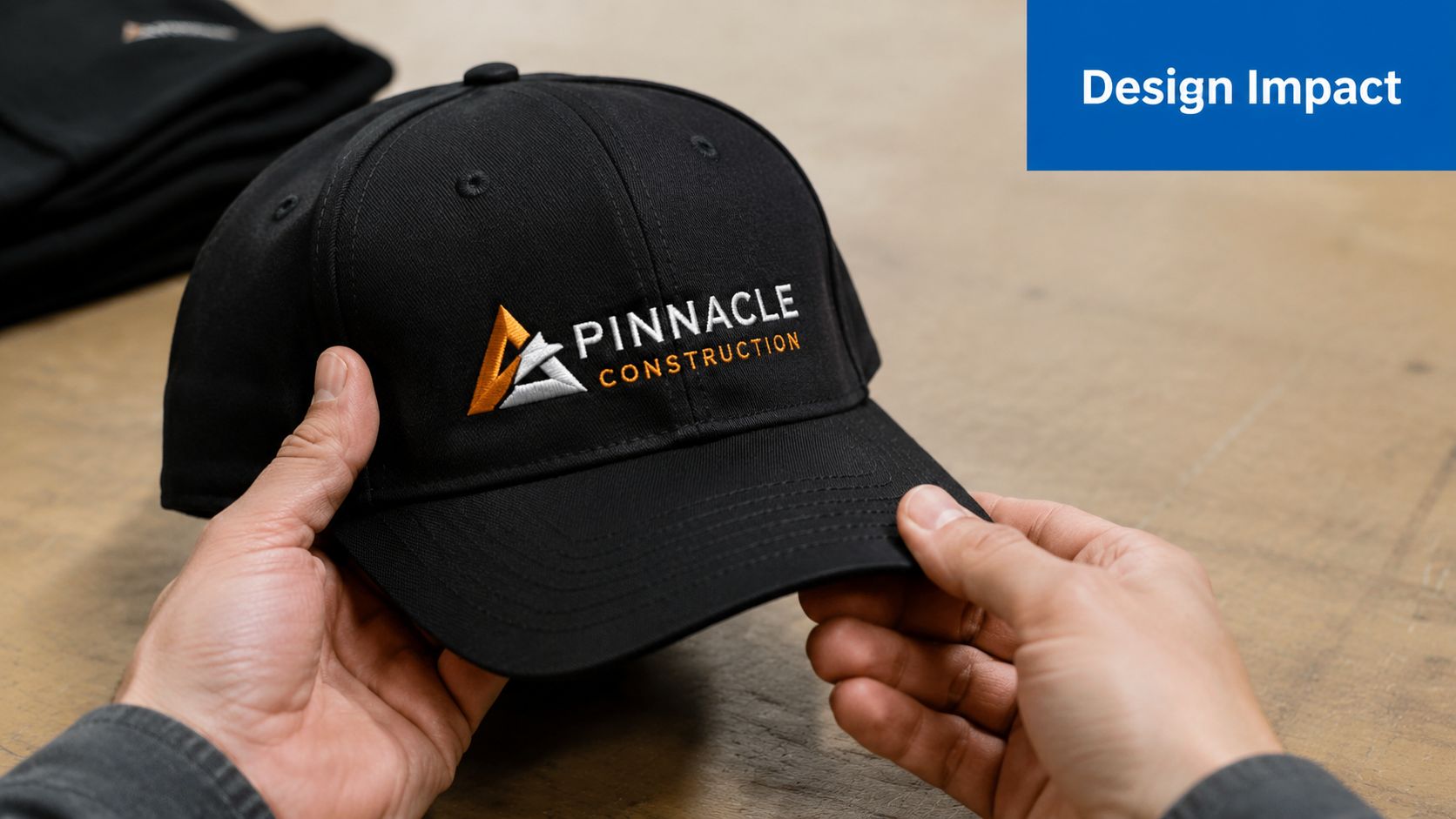
Start by editing the logo for the method you chose. If the decoration is embroidery, simplify aggressively. Remove tiny taglines, reduce the number of competing elements, and make sure the silhouette reads from a few steps away.
Use these checks before approving art:
- Text size: If the smallest text is there for legal completeness rather than visibility, it probably shouldn't be on the hat.
- Color count: Fewer colors usually produce a cleaner result on headwear.
- Edge clarity: Thin outlines and narrow gaps can disappear once stitched or pressed.
- Placement logic: Front center is the workhorse placement. Side and back placements work best for secondary marks, short text, or names.
A front logo should carry the main branding load. Side embroidery can add personality, but it shouldn't rescue a weak front design.
Small text is the fastest way to make a custom hat look homemade.
Proofs mockups and display context matter
Mockups are useful, but they can hide production issues because they're flat and clean. A real proof process should help you catch placement, scale, thread interpretation, and color contrast before the order runs.
One useful habit is to view the design in context. Will these hats live on staff heads, folded in boxes, or displayed at retail? Presentation changes what size and placement feel right. For merch displays, visual spacing matters. If you're setting hats out in-store or at an event table, this advice from Display Guru is a helpful reminder that display setup can change how premium the same hat looks.
A short product video can also help buyers understand how embroidery sits on the crown and why some logos need adjustment before production.
If you're working with a decorator, ask for a proof that shows actual placement relative to seams and crown shape, not just centered artwork floating on a template. Dirt Cheap Product, Inc. provides proofs for logo placement, color, and stitching review as part of its custom apparel workflow, which is the kind of production checkpoint worth looking for in any vendor process.
Step 4 Navigating the Ordering and Production Process
A common first-order mistake looks like this: the hat style is approved, the logo looks good on the mockup, the event date is on the calendar, and nobody has pinned down quantities, delivery date, or revision time. That is how a straightforward hat order turns into rush fees, split shipments, or boxes arriving the day after they are needed.
At this stage, the hat is no longer just a design choice. It is a production plan. The right plan depends on the job the hats need to do. Staff uniform orders usually need consistent sizing, repeatability, and a reorder path. Retail programs need tighter quality control because customers will compare the hat to other products on the shelf. Event giveaway orders usually put more pressure on unit cost and delivery timing.
Cost usually moves with four decisions working together: the blank, the decoration method, the stitch or print complexity, and the quantity. A basic cap with one clean logo application is easier to price and produce than a premium retail silhouette with multiple hit locations or detailed embroidery. Higher volumes usually improve unit economics, but only if the quantity is realistic. Ordering too many to chase a lower unit price can leave a business sitting on dead inventory.
For teams ordering headwear alongside shirts, jackets, or event apparel, this bulk order custom apparel planning guide is a useful reference for setting quantities, approval steps, and production timing.
What to lock down before production starts
Get alignment on these points before final approval:
In-hand date, not ship date
If the hats need to be worn at a trade show, onboarding day, or store launch, build the schedule backward from the day they must arrive.Final quantity by use case
Separate staff wear, retail stock, and giveaway volume. Those buckets often deserve different reorder assumptions.Exact color callouts
“Black hat with white logo” sounds simple until one team expects a faded washed black and another expects a clean jet black.Packaging and distribution plan
One bulk shipment to a single office is very different from packing by employee, store, or event kit.Allowance for extras
A small overage can prevent expensive short-run reorders later.
This part decides whether the order stays on budget.
How to review a proof like a buyer, not just a designer
A proof is the last checkpoint before money turns into inventory. Review it with the use case in mind, not just whether the artwork looks centered on screen.
Check these items in order:
Hat style matches the job
A structured trucker may work for merch and look out of place in a polished hospitality setting. A lightweight performance cap may be right for outdoor crews and wrong for retail resale.Logo scale fits the panel shape
Front panels vary. A design that reads well on a high-profile cap can feel cramped on a lower-profile style.Decoration method still suits the art at production size
Fine details, thin outlines, and small text often need simplification once they are translated to stitches or print.Color contrast holds up in real use
Indoor office lighting, outdoor sun, and event environments all change readability.Revision time is built into the calendar
Even well-prepared art often needs one practical adjustment after the first proof.
Approving a proof because it looks “close enough” usually leads to one of two outcomes: a hat people do not wear, or a reorder that should have been avoided.
One more trade-off matters here. Rush production can solve a deadline problem, but it narrows your margin for corrections. If the order supports a campaign, a uniform rollout, or a resale launch, extra review time is usually a better investment than shaving a few days off the schedule.
Conclusion From Plan to Product Your Custom Hat Journey
The cleanest way to approach custom hats for business is to stop treating them as a single purchase and start treating them as a decision chain.
First, lock the use case. Staff uniform hats, retail hats, and event hats shouldn't be judged by the same standard. Then choose the style and fabric that fit the audience and wear conditions. After that, pick the decoration method that supports the logo instead of fighting it. Refine the design so it reads clearly on an actual cap. Finally, handle the order process with discipline by checking proofs, timing, and quantities carefully.
That sequence prevents most of the problems businesses run into on first orders. It also makes budgeting easier because you're deciding what the hat needs to do before you decide how polished or premium it needs to feel.
A good hat program doesn't have to be flashy. It has to be wearable, readable, and appropriate for the people receiving it. When those pieces line up, branded headwear stops feeling like swag and starts working as part of your brand system.
If you're ready to move forward, start with one clear question. Who is going to wear this hat, and why would they keep reaching for it? That answer will shape every good decision after it.
If you're planning a hat order and want help matching the right style, decoration method, and budget to your use case, Dirt Cheap Product, Inc. offers custom headwear and branded apparel support for businesses, events, retailers, and team programs.