You’re probably here because you need merch that won’t get tossed in a drawer after one event. Maybe you’re ordering for a staff uniform rollout, a nonprofit fundraiser, a company anniversary, or a retail merch table. The challenge is always the same. You need something people will wear, something that carries your logo without looking cheap.
That’s where the 6 panel hat keeps winning.
It’s familiar, easy to size for a broad audience, and strong enough to handle real decoration without falling apart visually. It also carries a long track record. The modern six-panel baseball cap traces back to the mid-19th century, and the shift to the six-panel construction happened in the 1940s, with New Era refining the format in 1954 with the 59FIFTY model, as noted in this history of the cap’s evolution. That history matters because it explains why the style still reads as trustworthy, usable, and mainstream.
If you’re planning a launch, don’t overlook presentation either. Before the hats ever ship, strong mockups and product photos help buyers and internal teams approve faster. A practical guide on how to create images that convert can help you show your logo, stitching, and color choices clearly before production starts.
Table of Contents
- Your Brand's Most Wearable Ambassador
- Deconstructing the 6 Panel Hat
- Comparing Hat Styles for Your Brand
- Your Guide to Custom Decoration Methods
- How to Place Your Custom Hat Order
- The Go-To Choice for Your Brand
Your Brand's Most Wearable Ambassador
A good branded hat does two jobs at once. It gives your team something practical to wear, and it keeps your logo in public without feeling like an ad. That second part is where many promo products fail. If the item looks disposable, people treat it that way.
The 6 panel hat avoids that problem because it already belongs in everyday life. People wear it to work, on weekends, at trade shows, on job sites, and while traveling. Your logo gets attached to a familiar product instead of fighting for attention on something awkward or overly promotional.
Why businesses keep coming back to this style
For business buyers, the value isn’t just style. It’s versatility.
A 6 panel hat can work for:
- Employee uniforms where you need a polished, repeatable look
- Event merch that fits a wide range of ages and dress styles
- Retail programs where a hat has to stand on its own as a product
- Outdoor promotions where sun coverage and comfort matter
That range is hard to beat. A beanie is seasonal. A bucket hat can feel trend-specific. A flat-front fashion cap can be perfect for some brands and wrong for others. The classic six-panel shape lands in the middle and stays useful.
Practical rule: If you need one hat style that can serve staff, clients, and giveaway recipients without much debate, start with a 6 panel hat.
The shape also gives a brand room to look established. A clean front logo, balanced crown, and familiar brim make even a simple mark look more intentional. That’s a major reason businesses choose this style when they don’t have time for fashion risk.
Deconstructing the 6 Panel Hat
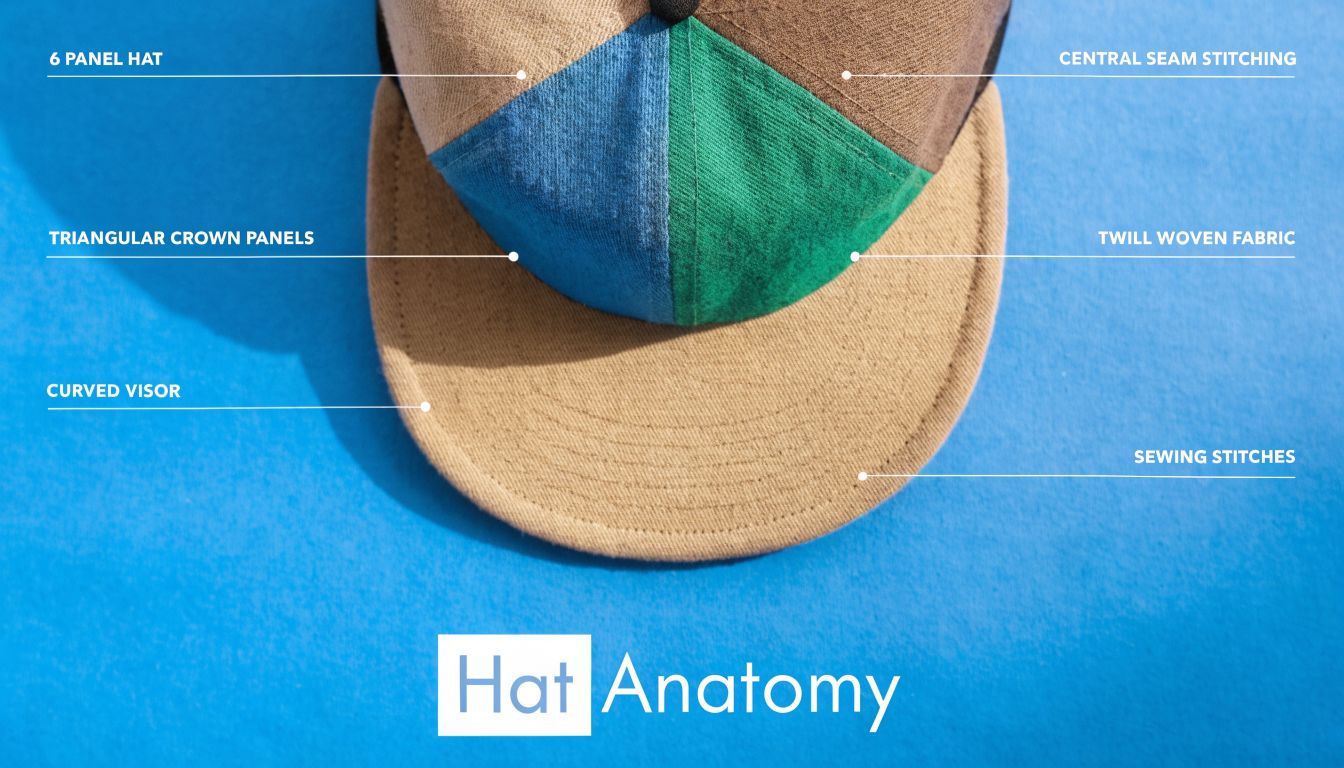
A 6 panel hat is built from six triangular fabric panels stitched together into a rounded crown. The design calls to mind orange slices meeting at the top. That construction is what gives the cap its dome shape, and it’s the reason the style fits and behaves differently from flatter alternatives.
Why the panel layout matters
For branding, the key detail is the front center seam. Some buyers see that seam and assume it’s a limitation. In practice, it often helps more than it hurts.
The 6-panel geometry creates stronger structure at the front, which helps prevent fabric sag under embroidery or patches. Printful specifically notes that this construction supports a crisp, professional logo display because the crown holds its shape better under decoration weight, as explained in its guide to 5-panel vs 6-panel hat construction.
That matters most when you’re decorating hats for:
- Standard left-chest logo equivalents on headwear, such as centered company marks
- Small to medium embroidery designs that need clean edges
- Patch applications that look bad if the crown collapses
- Repeat orders where consistency matters across production runs
A floppy front panel can make a logo look uneven before anyone even puts the hat on. A firmer six-panel front usually gives you a cleaner result.
A hat can have excellent stitching and still look wrong if the crown buckles under the artwork.
Structured, unstructured, and profile choices
Not every 6 panel hat feels the same. Buyers usually need to decide three things: structure, profile, and closure.
Structured hats have support in the front panels, so the crown holds its shape when the hat is off the head. These are usually the safest option for embroidered company logos, especially if you want a sharper retail-style look.
Unstructured hats skip that stiff support. They feel softer, more relaxed, and often more casual. They can work well for lifestyle brands, coffee shops, creative teams, and vintage-inspired merch, but they’re less forgiving if the artwork is heavy or rigid.
Profile changes the visual stance:
- High profile sits taller and looks more assertive
- Mid profile is the broadest middle ground
- Low profile feels closer to the head and more casual
A simple way to choose is this:
- If your logo is formal or geometric, go structured.
- If your brand leans relaxed or vintage, consider unstructured.
- If your audience is broad and you need the least risky option, pick a mid-profile structured cap.
The anatomy affects the final brand impression more than many first-time buyers expect.
Comparing Hat Styles for Your Brand
A 6 panel hat is the benchmark because most buyers already understand it at a glance. The question isn’t whether it’s good. The question is whether it’s the best match for your logo, audience, and intended use.
How each style signals something different
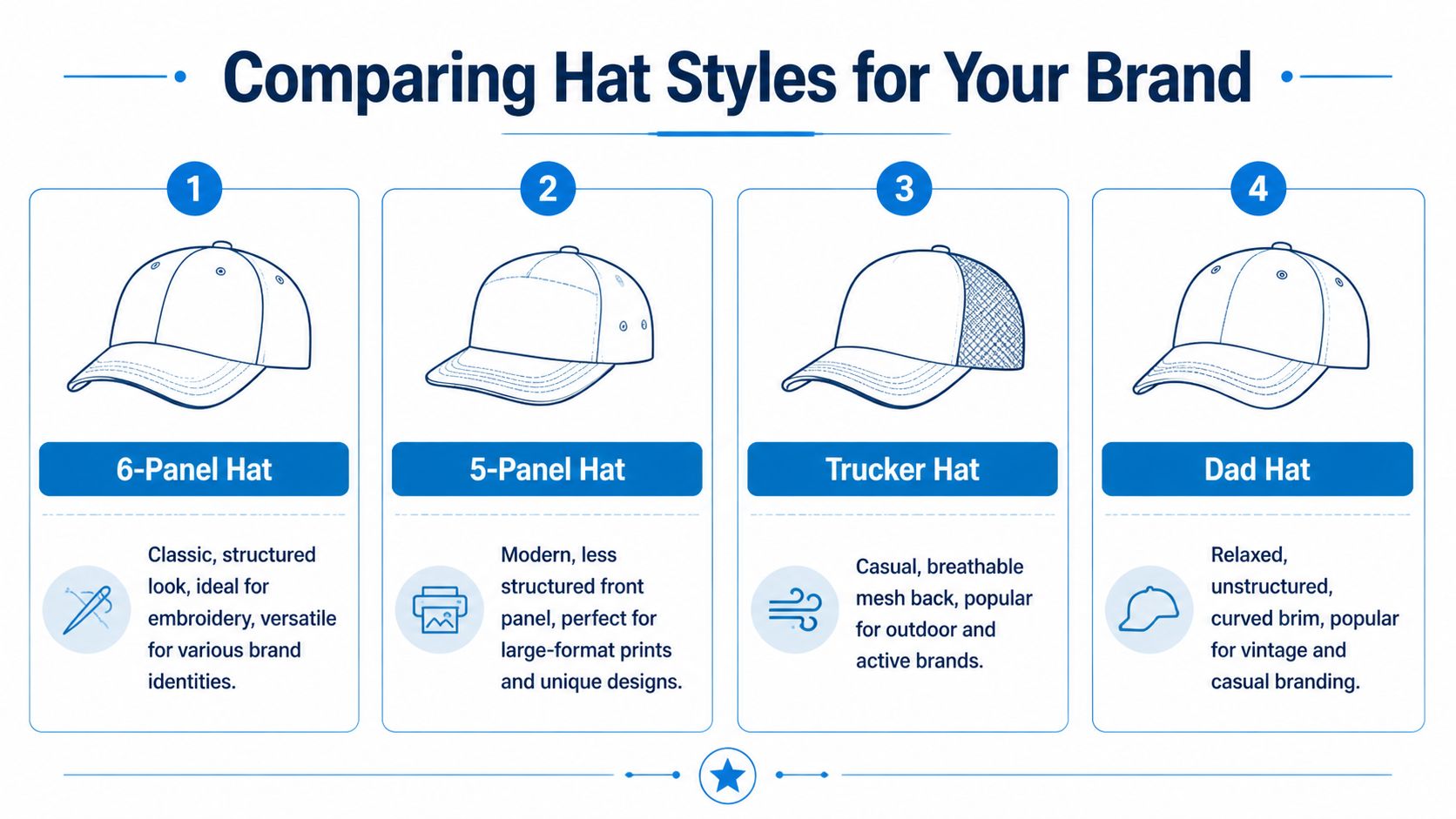
A 6 panel hat usually reads as classic, reliable, and broadly wearable. That makes it strong for service businesses, schools, real estate teams, sports programs, and companies that want their merch to feel mainstream rather than niche.
A 5-panel hat gives you one large uninterrupted front panel. That’s helpful when the artwork is wide, graphic-heavy, or designed as a bold print. If your brand lives in skate, streetwear, creative retail, or youth-focused campaigns, the 5-panel may fit better visually.
A trucker hat changes the conversation because the mesh back becomes part of the product story. It feels more casual and outdoorsy. It’s a smart fit for construction crews, fishing tournaments, breweries, outdoor events, and summer promotions. If that’s your lane, a product like this distressed trucker hat option shows the kind of rugged direction many brands want.
A dad hat is usually softer and more relaxed. It can be a six-panel cap too, but the mood is different. It’s less about crisp presentation and more about casual wearability.
If fit confidence is a concern, especially for a mixed audience, digital previews can help before you buy. Tools like TryThisFit virtual try on are useful for checking how different silhouettes look on different faces and head shapes.
The premium argument for the 6-panel is still strong. Crafted Hats states that the symmetrical structure improves logo alignment and contributes to 20% higher perceived quality in branded merchandise compared to less structured styles in its discussion of 6-panel hats for premium branding.
Hat Style Comparison
| Style | Front Panel | Structure | Best For |
|---|---|---|---|
| 6-panel | Split front with center seam | Usually structured or semi-structured | Embroidery, classic company merch, uniforms |
| 5-panel | One broad front panel | Often flatter and more fashion-led | Large graphics, streetwear-inspired branding |
| Trucker | Front panel plus mesh back | Varies, often structured front | Outdoor brands, active events, warm-weather use |
| Dad hat | Softer front, curved brim | Usually unstructured | Casual branding, vintage feel, relaxed merch |
If your brand has to please the widest possible audience, the safe decision is usually the style people already know how to wear.
Your Guide to Custom Decoration Methods
The hat style is only half the decision. The decoration method determines whether the final product looks clean, lasts through repeated wear, and makes sense for your budget.
Embroidery, patches, and DTF in real use
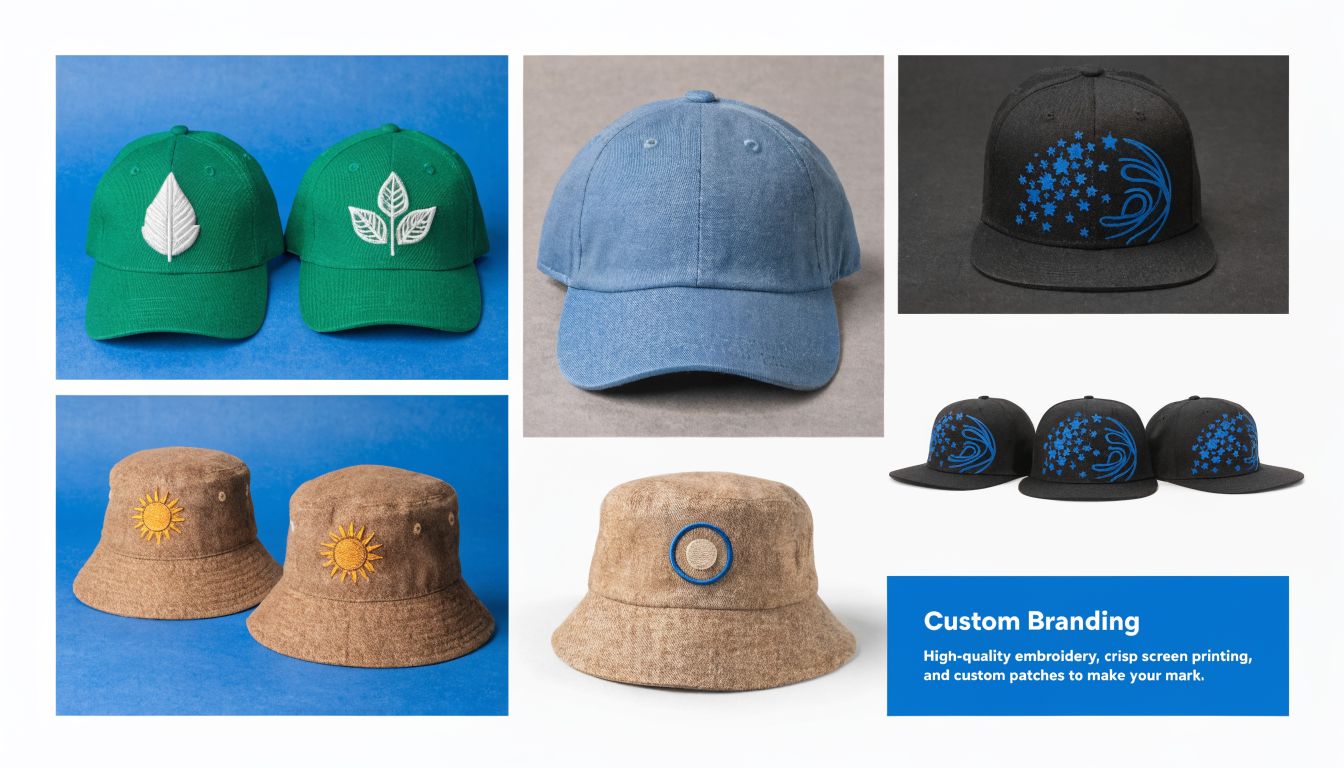
Embroidery is the default choice for most custom 6 panel hats, and for good reason. It gives dimension, texture, and a finished look that buyers tend to associate with quality. Small logos, initials, wordmarks, and icon marks usually translate well here.
There are trade-offs. Very fine details can close up. Tight gradients don’t convert cleanly into thread. Large filled-in areas can get heavy. But for simple logos, embroidery is still the most dependable option. If you’re comparing suppliers or decoration formats, it helps to understand how professional custom embroidery changes the appearance of a hat versus a flat print.
Patches are a good middle path when the logo is too detailed for direct embroidery or when the brand wants a tactile, retail-style finish. Embroidered patches feel classic. Woven patches allow finer detail. Faux leather or leather-style patches can look strong on outdoor, workwear, and heritage-inspired designs.
DTF, or direct-to-film, brings color flexibility. If your logo uses gradients, multiple colors, or artwork that would become too dense in thread, DTF can solve that. It can also be useful when exact color matching matters more than stitched texture.
What holds up best in bulk orders
For larger runs, durability matters as much as appearance. One fact is especially useful here. Checkmate Embroidery notes that embroidery on structured 6-panel crowns withstands 50+ washes, while DTF delivers strong color vibrancy but may have longevity concerns on flexed panels, especially with softer hat styles, in its overview of 6-panel hat decoration durability.
That leads to a practical buying rule:
- Choose embroidery for staff hats, long-term uniforms, and evergreen branded merch
- Choose patches when you want texture and a more designed retail feel
- Choose DTF when color complexity is the main requirement and the hat style supports it well
A structured crown usually gives all three methods a better chance of looking right.
Here’s a helpful visual overview of how hat decoration works in practice:
The biggest mistake in high-volume ordering is treating every logo the same. A one-color icon on a structured 6 panel hat should not be decorated the same way as a multicolor illustration on a soft pigment-dyed cap.
Shop-floor advice: Match the decoration method to the artwork first, then confirm the hat style supports it. Doing that in reverse creates expensive compromises.
How to Place Your Custom Hat Order
Ordering custom hats gets easier when you make decisions in the right order. Most problems come from rushing to color selection before the artwork and decoration method are settled.
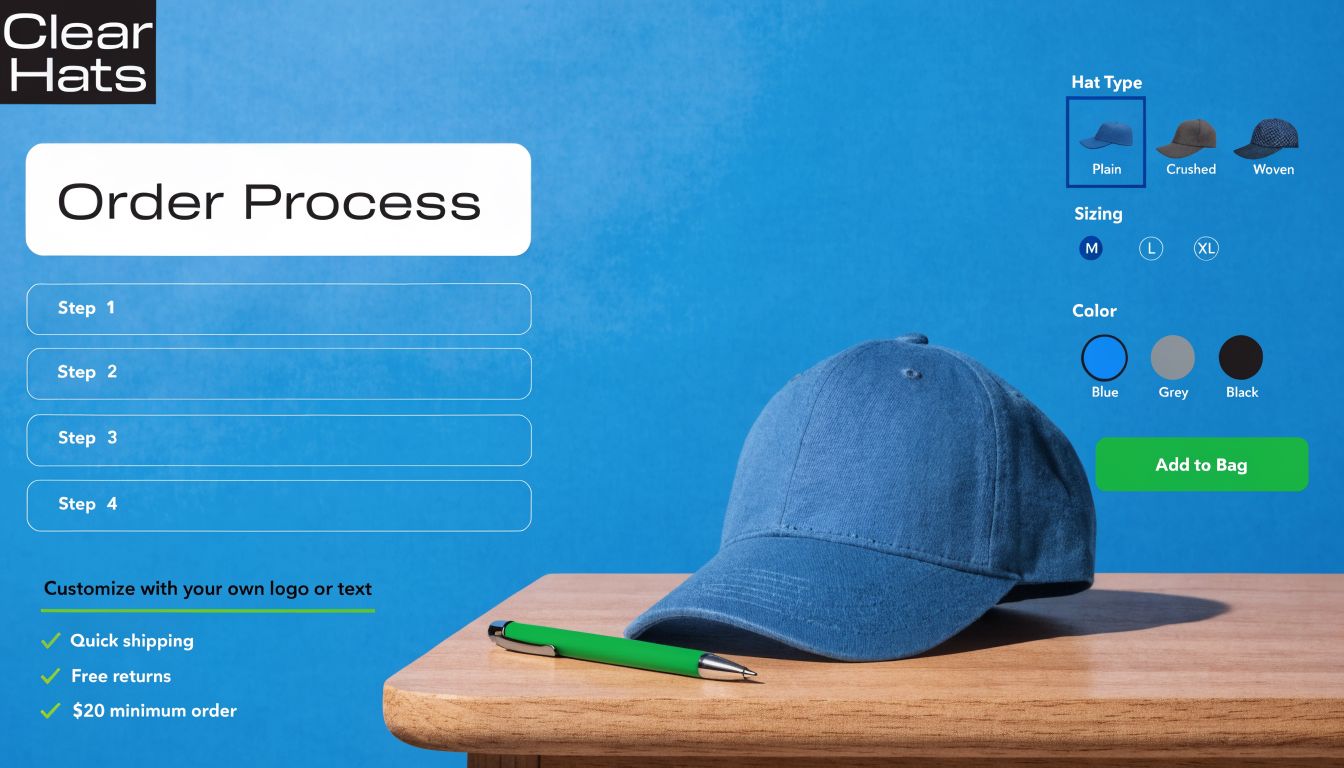
Start with the logo, not the hat color
Begin with the artwork file you have, not the product you want. Ask these questions first:
Is the logo simple or detailed?
A simple mark gives you more freedom. A dense logo may push you toward a patch or print-based method.Does the logo need exact color accuracy?
If yes, thread conversion may change the look. That doesn’t mean embroidery is wrong, but it does mean you should review a proof carefully.Will the logo sit centered, side-positioned, or on the back?
Placement changes scale. A logo that works on the front may feel too small or too tall on the side.Will this hat be a giveaway, part of a uniform, or sold at retail?
Giveaways often prioritize broad appeal. Uniform hats need consistency. Retail hats need finish and perceived value.
This is also the point where you should decide whether you need fitted, snapback, buckle, or hook-and-loop closure. For broad event distribution, adjustable styles usually reduce sizing headaches.
If you’re ordering at volume, looking through examples of custom logo hats for wholesale bulk orders can help you compare crown shapes, closure types, and logo placement approaches before you finalize your spec.
What to approve before production
A proof is where buyers either save the order or create avoidable problems. Don’t approve a mockup just because the logo is spelled correctly.
Check these items:
- Logo size so it doesn’t look undersized on the crown
- Placement height because a logo that sits too high can look awkward once worn
- Thread or print color against the actual hat color
- Crown structure so the decoration method matches the hat body
- Closure and profile because they affect how premium the finished product feels
You should also ask how the supplier handles artwork cleanup. Many business logos weren’t originally built for hats. Thin outlines, tiny taglines, and stacked details often need simplification.
A hat proof should answer one question clearly: will this still look good when a real person wears it, not just when it sits flat on a screen?
Two terms buyers should expect to hear are MOQ and lead time. MOQ means the minimum quantity required for a given style or decoration setup. Lead time means the production window after approval. Those details vary by program, so the smart move is to confirm them before your event date is locked into invitations or campaign materials.
The best orders are boring in the best way. Clean artwork, a realistic timeline, one approved decoration method, and a hat silhouette that fits the audience.
The Go-To Choice for Your Brand
A 6 panel hat keeps earning its place because it solves more problems than it creates. It’s wearable, familiar, decoration-friendly, and broad enough in style range to work for uniforms, giveaways, retail merch, and event programs.
The smartest business choice usually isn’t the most fashionable option. It’s the option that still looks right after repeat wear, fits most recipients without drama, and presents your logo with consistency. That’s where the 6 panel format stands out. It gives structure where it matters and enough flexibility to support different brand personalities.
Once the hats are produced, presentation still matters. If you’re listing them online, sending pre-launch previews, or building internal sales sheets, strong visuals will help the product do its job. This guide to improving your product photography is worth using so the stitching, color, and fit read clearly in photos.
A good hat doesn’t need to be flashy. It needs to be worn. For most brands, the 6 panel hat is still the most dependable way to make that happen.
If you’re ready to turn your logo into custom headwear people will wear, Dirt Cheap Product, Inc. can help with hats, embroidery, DTF, patches, and bulk branded apparel programs built for businesses, events, and retail merch.