
You're choosing merchandise for a launch, team, event, or retail shelf, and the hat listings all seem to use the same language. Then you notice one cap has a visor that points straight out while another bends toward the face. That small difference changes the look, the decoration area, the fit, and what the hat can realistically do outdoors.
Flat bill hats are a strong choice when you want a crisp, structured profile and a visible logo. They're not automatically the right choice for every wearer or use case, though. A confident bulk order starts by separating the style decision from the practical decisions about materials, sizing, decoration, and sun coverage.
Table of Contents
- What Are Flat Bill Hats
- Flat Bill vs Curved Bill Differences
- Materials, Construction, and Sizing
- Branding and Decoration Options
- Ordering Custom Flat Bill Hats
- Common Misconceptions About Flat Bills
What Are Flat Bill Hats
A flat bill hat is a cap with a straight, unrolled visor. Unlike a traditional curved baseball cap, its bill keeps a level, squared-off profile when worn. That straight visor is the defining structural feature, not just a fashion detail, and it's what separates the category in product descriptions and apparel catalogs. Wholesale Hats' explanation of custom flat bill hats is useful when you need precise language for a product page or purchasing request.
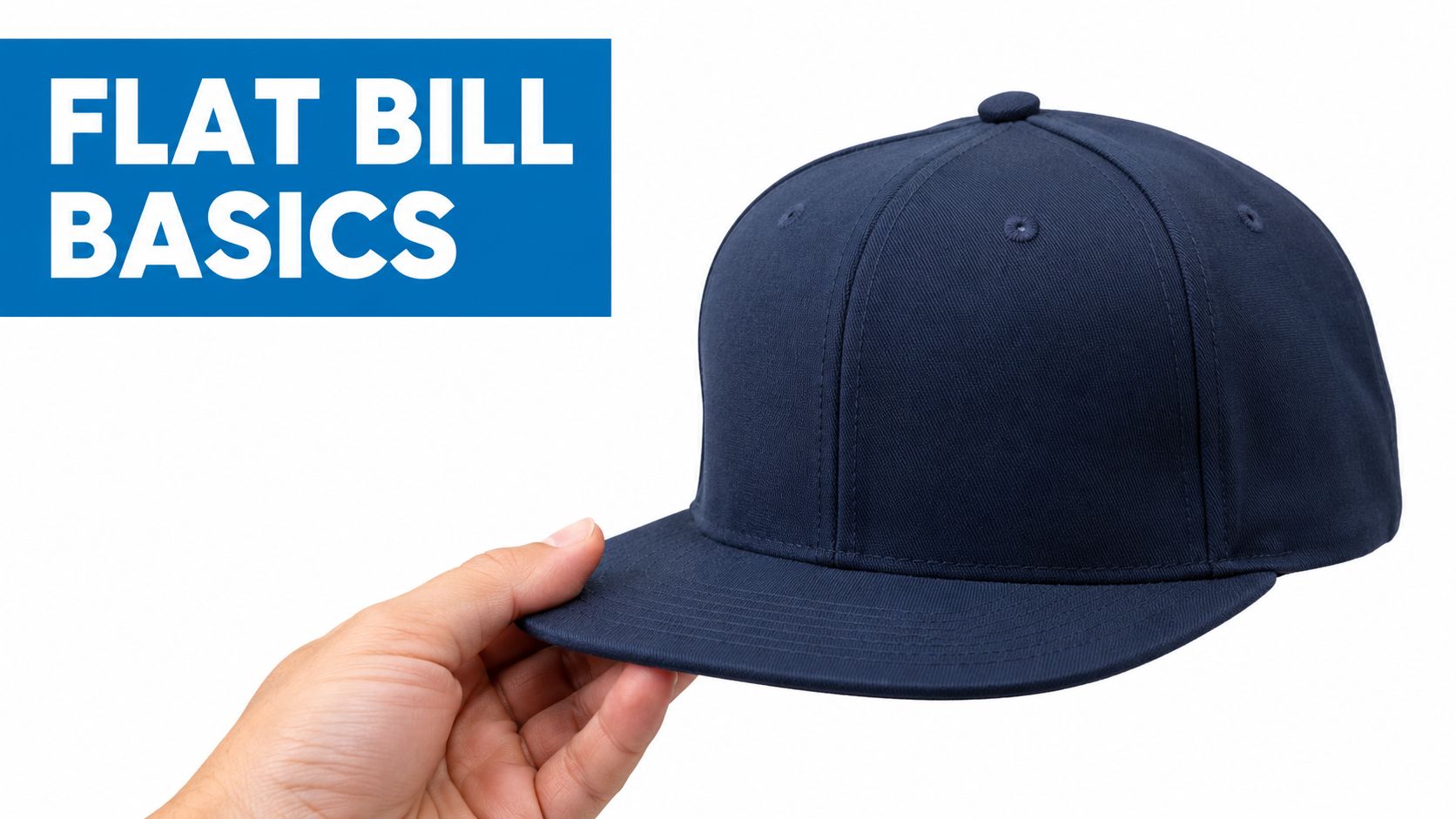
Most flat bill hats, particularly snapbacks, use a structured six-panel construction. The front crown is commonly reinforced with buckram, which helps it stand upright, while a rigid insert inside the visor helps maintain the flat shape. Those two support areas do different jobs. The crown gives embroidery a stable surface, and the stiffened bill preserves the sharp front profile.
Why the silhouette matters for branding
A straight visor gives a decorated cap a more deliberate retail appearance. The front panels sit as a firm visual field, so a simple wordmark, mascot, or emblem can look prominent without relying on a large decoration area. That makes the style appealing for streetwear labels, sports-related programs, music events, fitness businesses, and teams that want a modern rather than traditional baseball look.
The visor can stay factory-flat, or the wearer can bend it later. This gives a brand one consistent starting profile while allowing individual customers to personalize the way the hat sits.
Practical rule: Choose the flat bill because you want its structure and front profile, not because the name alone sounds current.
The category also has a long history. Historical images from the late 1850s already show caps with a bill extending in one direction. In 1908, the sturdier “Philadelphia style” brim appeared and was quickly adopted by major-league teams. New Era's 59FIFTY prototype followed in 1947, and the model officially launched in 1954 with a tall crown, flat brim, and buckram-reinforced front panel, helping establish the modern structured fitted-cap and snapback silhouette. MLB's baseball-cap history and timeline provides that development in context.
If you're planning a first branded order, details such as logo size, hat profile, closure, and wearer expectations deserve attention alongside color. These custom hat ordering tips can help you organize those choices before requesting a quote.
Flat Bill vs Curved Bill Differences
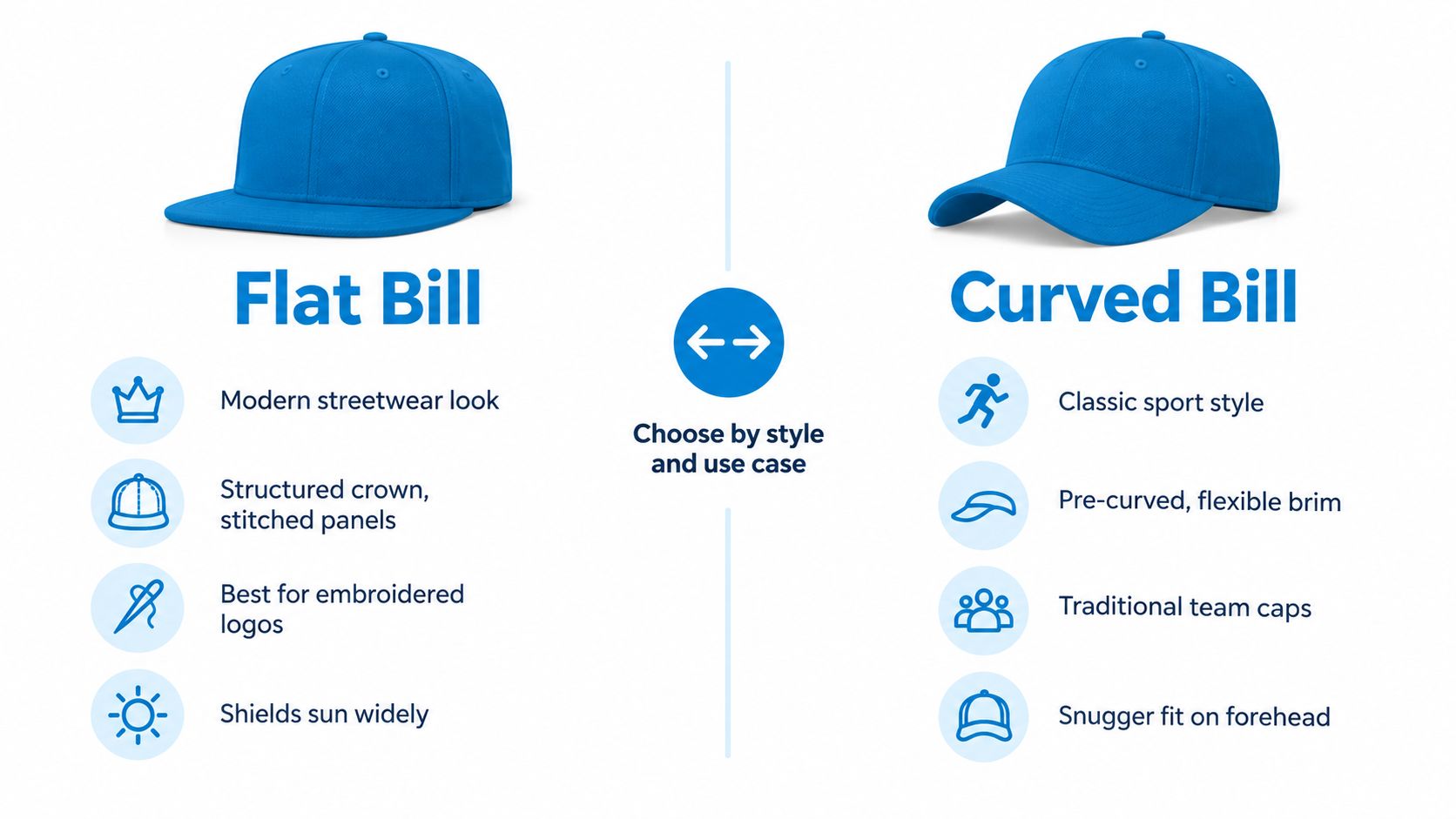
The clearest difference is the visor. Flat bill hats have a straight, unrolled bill, while curved bill caps use a pre-shaped bend that brings the visor closer to the forehead and face. That change affects the visual language immediately. Flat bills look squared, crisp, and streetwear-oriented. Curved bills look familiar, athletic, and closer to classic team headwear.
The crown often reinforces that distinction. A flat bill snapback commonly uses a structured front with buckram and a stiff visor insert. A curved cap may also have a structured crown, but its flexible or pre-curved visor is designed to follow the wearer's head more closely. The two styles can share fabrics and panel layouts, yet they don't present a logo in exactly the same way.
Compare the choice by use case
| Decision point | Flat bill | Curved bill |
|---|---|---|
| Front profile | Straight, squared, structured | Rounded, traditional, sport-oriented |
| Logo presentation | Strong front-facing display | More familiar team-cap appearance |
| Visor feel | Broad, level projection | Closer bend around the face |
| Typical closure | Often snapback or fitted | Snapback, strapback, or fitted options |
| Best starting question | Does the brand need a modern statement? | Does the group need a classic athletic look? |
The cultural background matters for brand alignment. The flat brim gained traction as a streetwear signal during the late twentieth and early twenty-first centuries. One account connects the 1980s hip-hop era with caps that kept their flat brims and visible tags as style statements, while another identifies the 2010s as the period when an unscrunched flat brim became a defining part of fitted-cap revival culture. The story behind the crown also notes that average brim length decreased by 37% between 1900 and 1920, reflecting a shift from broad sun protection toward a cleaner athletic shape.
Decoration and wearability are connected
The flat front can make embroidered lettering and patches read clearly, especially when the design needs a firm base. A curved visor can feel more natural for everyday sport, especially for people who prefer the bill to follow the forehead. Neither choice is universally better. The right answer depends on whether your order prioritizes a strong front graphic, traditional team identity, casual comfort, or active movement.
Fit deserves its own check before you place a group order. If you're comparing wearability across different head shapes, this guide to a perfect fit for cat hats offers useful perspective on how a snapback should sit and adjust.
Materials, Construction, and Sizing
A hat's fabric affects how it looks after repeated wear, how it handles moisture, and how well the color supports your brand palette. Common flat bill materials include cotton twill, wool blends, acrylic, polyester, spandex, nylon, corduroy, and mesh. High polyester or acrylic content generally supports colorfastness, shape retention, and moisture management better than pure cotton, while small amounts of spandex or elastane help a crown or closure recover after stretching. Team Sunday's snapback glossary outlines these material differences.
The typical build is a structured six-panel cap with a reinforced front and a stiffened visor. That construction gives the hat its stable retail silhouette, but it also raises a fit question that product photos often hide: how tall and wide is the crown on the wearer?
Match the build to the job
| Material | Best For | Key Feature |
|---|---|---|
| Cotton twill | Casual branded merchandise | Familiar hand feel and natural appearance |
| Polyester | Outdoor, fitness, and active use | Shape retention and moisture management |
| Acrylic | Structured promotional and streetwear caps | Color and form retention |
| Wool blend | Premium, traditional, or heritage styling | Distinctive texture and polished appearance |
| Nylon | Lightweight performance-oriented designs | Light feel and practical durability |
| Corduroy | Fashion and seasonal retail collections | Ribbed texture with a stronger visual statement |
| Mesh | Trucker and warm-weather formats | Ventilated back construction |
| Spandex blend | Flexible fit options | Recovery after stretch |
Sizing is more than circumference
Available product specifications show distinct bands such as S/M and L/XL, including head-size ranges of 21 5/8 to 22 3/4 inches and 22 3/4 to 23 7/8 inches. Dirt Cheap Product's hat sizing guide can help you organize measurements before ordering. For a mixed team or public event, don't assume one adjustable cap will look identical on everyone.
Crown height changes the apparent scale of the hat. A tall crown can look balanced on a larger or longer head shape, but it may appear oversized on a smaller head. Front-panel width affects how much of the wearer's forehead the cap covers, and bill length changes both the visual balance and the amount of shade in front of the face.
Sizing check: Order or inspect a sample before committing to a large branded run. A cap that looks sharp on one model can sit too tall, too wide, or too shallow on another.
For women, youth groups, larger heads, and teams with varied preferences, compare S/M, L/XL, OSFM, and fitted options where available. A snapback can simplify distribution, but adjustable does not mean universally comfortable. The closure may solve circumference differences while the crown shape still determines whether the hat feels natural.
Branding and Decoration Options
Flat bill hats give decorators a stable front, but the decoration method still determines the final look, feel, and production fit. A small embroidered mark can look refined on a structured crown. A large, detailed image may need a patch or film-based application instead. Screen printing can work for specific fabric and artwork combinations, but the decoration area and visor construction require careful review before approval.
Compare the main decoration methods
| Method | Strengths | Limitations | Good fit for |
|---|---|---|---|
| Screen printing | Direct, bold color application | Less suited to some structured or textured surfaces | Simple graphics and promotional designs |
| Embroidery | Durable, dimensional, and traditional | Fine details can become crowded; stitch count affects the result | Wordmarks, mascots, initials, and simple logos |
| Custom patches | Strong retail presence and flexible visual texture | Adds a separate layer and may change the hand feel | Detailed emblems, woven artwork, and premium branding |
| Direct-to-film | Handles colorful and complex artwork | The final feel differs from thread or a sewn patch | Illustrations, gradients, and detailed full-color marks |
Embroidery is often the first option businesses consider because the buckram-reinforced front panel provides stability. It suits clean logos, short names, and designs that benefit from raised texture. Before sending artwork, review embroidery placement guidance so the design sits within the usable front-panel area rather than crowding the seams or rising too close to the crown's edge.
Patches can make a flat bill hat feel more like a retail product. A woven patch preserves small visual details more effectively than heavy thread in some designs, while a leather-look or printed patch can create a different brand mood. Ask how the patch will be attached and whether its shape works with the panel's structure.
Put the artwork before the method
Use the logo itself as the starting point:
- Simple wordmark: Choose embroidery when you want a recognizable, tactile finish.
- Detailed emblem: Compare a patch with DTF before approving thread-based artwork.
- Large color field: Review screen printing or DTF with a decorator who can confirm surface compatibility.
- Small badge or initials: Embroidery usually keeps the design direct and easy to read.
- Retail statement piece: Consider a custom patch, especially when texture is part of the product identity.
Decoration placement deserves more attention on flat bills than many buyers expect. A front-center logo is the obvious choice, but the structured crown can also support side embroidery, rear branding, or a small patch. The visor itself is not just extra advertising space. Its straight profile affects how the wearer sees the logo and how the hat photographs from above, below, and at an angle.
Protect the visual hierarchy
A flat bill already creates a strong horizontal line. If the front logo is too wide, it can compete with the visor. If it's too small, the tall crown may make the mark look lost. Choose the decoration size after confirming the crown height, panel seams, logo proportions, and whether the hat will be worn flat or adjusted by the customer.
For a corporate event, a restrained embroidered logo may feel more appropriate than a large patch. For a clothing label, a woven patch or detailed DTF graphic may create stronger shelf appeal. For a team, the most useful question is whether every wearer can recognize the mark from a reasonable distance without sacrificing comfort.
Ordering Custom Flat Bill Hats
A smooth order starts before you choose a color. First decide what the hats need to accomplish. Staff uniforms, event giveaways, retail merchandise, and team identity each call for different compromises in material, sizing, decoration, and finish.

1. Define the quantity
Estimate the people who need hats, then separate guaranteed recipients from optional extras. A business outfitting staff may need consistent sizing and a reorderable style. An event organizer may need a broader adjustable range because attendees will choose their own fit. A retailer should think about whether the silhouette, material, and decoration belong in the permanent assortment or are tied to a limited campaign.
If you're considering custom hats in a bulk order, ask how reorders are handled. The same blank style, color, artwork file, and decoration method make future replenishment easier to manage.
2. Select sizes before decoration
Review the available size bands and decide whether a single snapback, OSFM option, S/M and L/XL combination, or fitted range makes sense. For a mixed group, collect head measurements when possible instead of relying on guesses. Crown height and front-panel width still matter after the circumference is correct, so inspect a physical sample if the order represents a large team or customer-facing brand.
3. Match color and fabric to use
A dark cotton twill may create a classic look, while polyester or mesh may suit outdoor and fitness settings better. Confirm that the chosen decoration method works with the fabric, especially if the cap includes a textured surface, a mesh back, or a contrasting front panel.
4. Prepare clean artwork
Send a high-quality logo and identify the intended placement. Tell the decorator whether the mark should appear centered, on the side, above the rear closure, or on a patch. Include brand colors and any limits on thread, print, or patch colors. A decorator can then flag details that may disappear at the selected size.
Approval rule: Never approve a proof based only on the logo file. Review the logo on the actual hat color, crown shape, panel layout, and proposed decoration method.
5. Approve the proof and confirm delivery
A proof should show placement and scale clearly. Check spelling, color contrast, artwork orientation, stitch or print detail, and the delivery date before production begins. Responsive support matters here because a quick correction is easier before the order enters production than after the hats arrive.
A professional workflow also clarifies what happens if the selected blank becomes unavailable, whether samples can be reviewed, and how artwork revisions are handled. Those questions protect the schedule as much as they protect the appearance.
For cross-border orders, labeling deserves separate attention. U.S. country-of-origin rules generally identify the origin of most textile and apparel products by where the components are wholly assembled, while fabric origin follows where the fabric is woven, knitted, needled, tufted, felted, entangled, or otherwise created. Minor attachments such as buttons, beads, embroidery, or small subassemblies don't change that rule. Consumer NZ's sun-protection clothing guide summarizes these origin mechanics, which are relevant when the cap body, panels, and decoration come from different places.
Common Misconceptions About Flat Bills
The first misconception is that a flat bill is automatically a sun-protection hat. It isn't. A straight visor may provide useful shade across the front of the face, but it doesn't create the all-around coverage associated with a broad-brim or legionnaire design.
Sun-protection guidance states that caps and sun visors can't claim or display a UPF rating because they don't adequately cover the face, ears, and neck. Recognized hat UPF ratings include UPF 15, UPF 30, UPF 50, and UPF 50+. A UPF 30 fabric allows about 1/30th, or 3.3%, of UV, to pass through and blocks 96.7% when evaluated under that standard, but a flat bill alone doesn't make the whole hat a UPF-rated sun-protective product. The SunSmart hat guidance explains the distinction.
A broader sun-protection reference recommends a brim of at least 3 inches for shading the face, scalp, neck, shoulders, upper back, tops of the ears, and back of the neck. It also notes that “wide” has no single standard definition, with a practical guideline of 2 to 3 inches extending around the crown. MD Anderson's sun-hat guidance makes clear that coverage and fabric performance are separate questions.
The style isn't limited to one audience
Another misconception says flat bill hats belong only to hip-hop, skate, or streetwear communities. Those roots matter, but the format has moved into broader lifestyle and promotional settings. Rope caps, five-panel snapbacks, and unconstructed flat-brim designs now appear alongside classic structured models in golf, outdoor recreation, corporate programs, and fitness branding.
That doesn't mean every substyle suits every buyer. A rigid high-profile snapback can feel too fashion-forward for a conservative uniform, while a softer unconstructed cap may work better for a lifestyle collection. The useful decision is not whether flat bills are “in” or “out.” It's which profile fits the audience, activity, logo, and distribution model.
Choose honestly for the wearer
For a brand launch or event, use the flat bill when the squared profile strengthens the identity. For sustained outdoor exposure, pair the hat with realistic protection messaging and don't imply all-around shade. For a diverse group, prioritize samples and size options over a one-style-fits-everyone assumption.
Dirt Cheap Product, Inc. offers blank and custom-decorated hats, including flat bill styles, with embroidery, screen printing, DTF, sublimation, and custom patches for businesses, events, retailers, and teams. Upload your logo, review the proof and placement, and visit Dirt Cheap Product, Inc. to discuss a hat order that fits your audience and use case.