
Your inbox is probably full of hat mockups, shipping questions, and someone asking whether the logo can be “a little bigger.” That's normal. A custom hats bulk order gets messy fast when the spec is vague, the sample never gets signed off, and everybody assumes the factory “knows what we mean.”
The fix is simple. Lock the order spec, approve the sample, control the production checkpoints, and build a reorder process you can repeat. Done right, bulk hats give you cleaner team branding, sharper event visibility, and a product line that can support retail sales without turning your calendar into a fire drill.
Table of Contents
- Why Bulk Custom Hats Matter for Your Brand
- Choosing Hat Styles Materials and Decoration Methods
- Finalizing Artwork Proofs and Ordering Samples
- Navigating Minimums Pricing and Production Timelines
- Implementing Quality Control and Inspection Tips
- Optimizing Shipping Fulfillment and Cost Saving Strategies
- Planning Next Orders and Streamlining Reorder Workflows
Why Bulk Custom Hats Matter for Your Brand
A client usually comes to us after the same problem shows up three times. Staff hats look inconsistent, the event table doesn't stand out, and the merch shelf has nothing people want to wear. A bulk hat order solves all three if you treat it like a brand asset, not a throwaway giveaway.
The headwear category is large for a reason. The global headwear market was valued at about USD 26.5 billion in 2022 and is projected to reach USD 43.73 billion by 2030, implying a 6.5% CAGR (market statistics). That scale matters for buyers, because you're not betting on a fad, you're buying into a category with real retail, corporate, sports, and event demand.
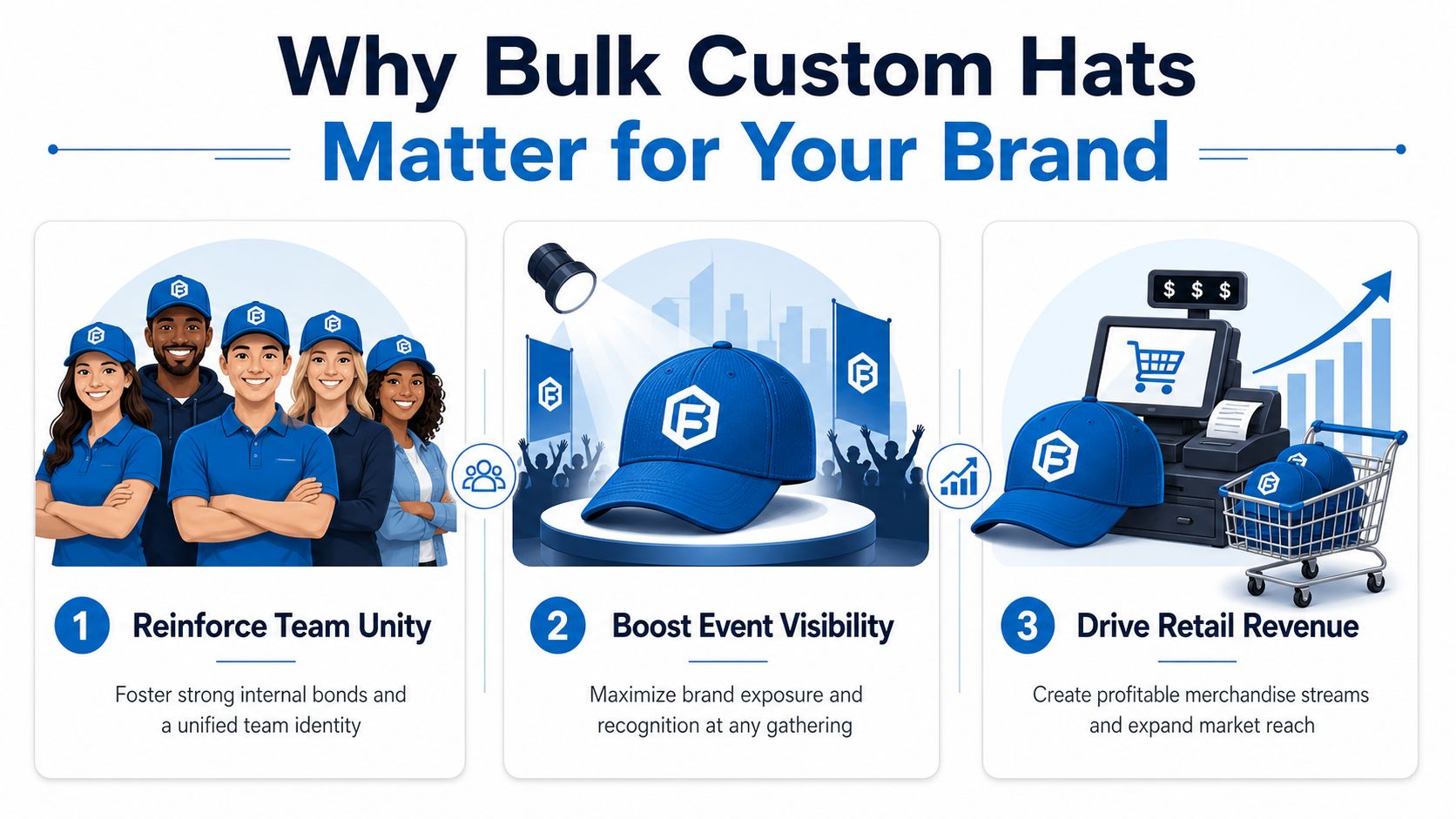
A smart bulk order does more than put a logo on a cap. It can reinforce team unity, sharpen event visibility, and create a product that earns a place in retail displays. If your brand voice is still fuzzy, a useful starting point is this guide to develop brand voice for e-commerce, because hat design should match the same tone customers see online and in person.
Practical rule: if the hat doesn't look like your brand on a busy floor, at a distance, and in photos, it's not done yet.
For small and medium businesses, nonprofits, and retailers, that's where a partner like Dirt Cheap Product, Inc. becomes relevant, because the order has to move from concept to approved product without gaps in color, placement, or finish. If you're ordering over 100 units, you should already be thinking about production control, not just price.
Choosing Hat Styles Materials and Decoration Methods
The wrong blank ruins good artwork. A sharp logo on the wrong crown shape, the wrong fabric, or the wrong decoration method will still look off, even if the factory followed the file correctly. Start with the hat style, then choose material and decoration around the use case, not the other way around.
Style first, decoration second
A snapback usually gives you a more structured retail look. A dad cap reads softer and more casual, which works well for lifestyle brands and staff wear. A performance hat makes more sense when sweat management and lightweight wear matter more than a fashion-forward silhouette.
Use the blank that supports the brand story. A 6-panel shape is a common base for many custom projects, and you can review one example of that format in the 6-panel hat page. The point is not to chase every trend. The point is to match the silhouette to the person who'll wear it.
Decoration methods change the product
A custom-headwear catalog can include multiple decoration methods on hats, such as custom patch hats, leather patch hats, and embroidered caps with your logo (catalog example). That matters because each method creates a different finish, texture, and production path. You're not just choosing artwork, you're choosing how the decoration sits on the hat.
| Method | Durability | Cost per Hat | Best Use Case |
|---|---|---|---|
| Embroidery | Strong for long-term wear | Varies by order size | Staff uniforms, retail caps, classic branding |
| Custom patch | Solid when applied well | Varies by patch type | Bold logo looks, outdoor brands, structured styles |
| Leather patch | Durable and premium-looking | Usually higher than basic decoration | Elevated merch, boutique retail, heritage branding |
That table is the decision filter I recommend. If the logo needs texture and a premium look, patchwork can beat flat stitching. If the art is simple and you want a timeless presentation, embroidery still wins.
Keep the decoration honest. Thin lettering, tiny detail, and busy gradients usually age badly on hats.
If you want a strict internal check, use this rule: the hat blank should support the decoration, not rescue it. That one decision prevents a lot of awkward reorders.
Finalizing Artwork Proofs and Ordering Samples
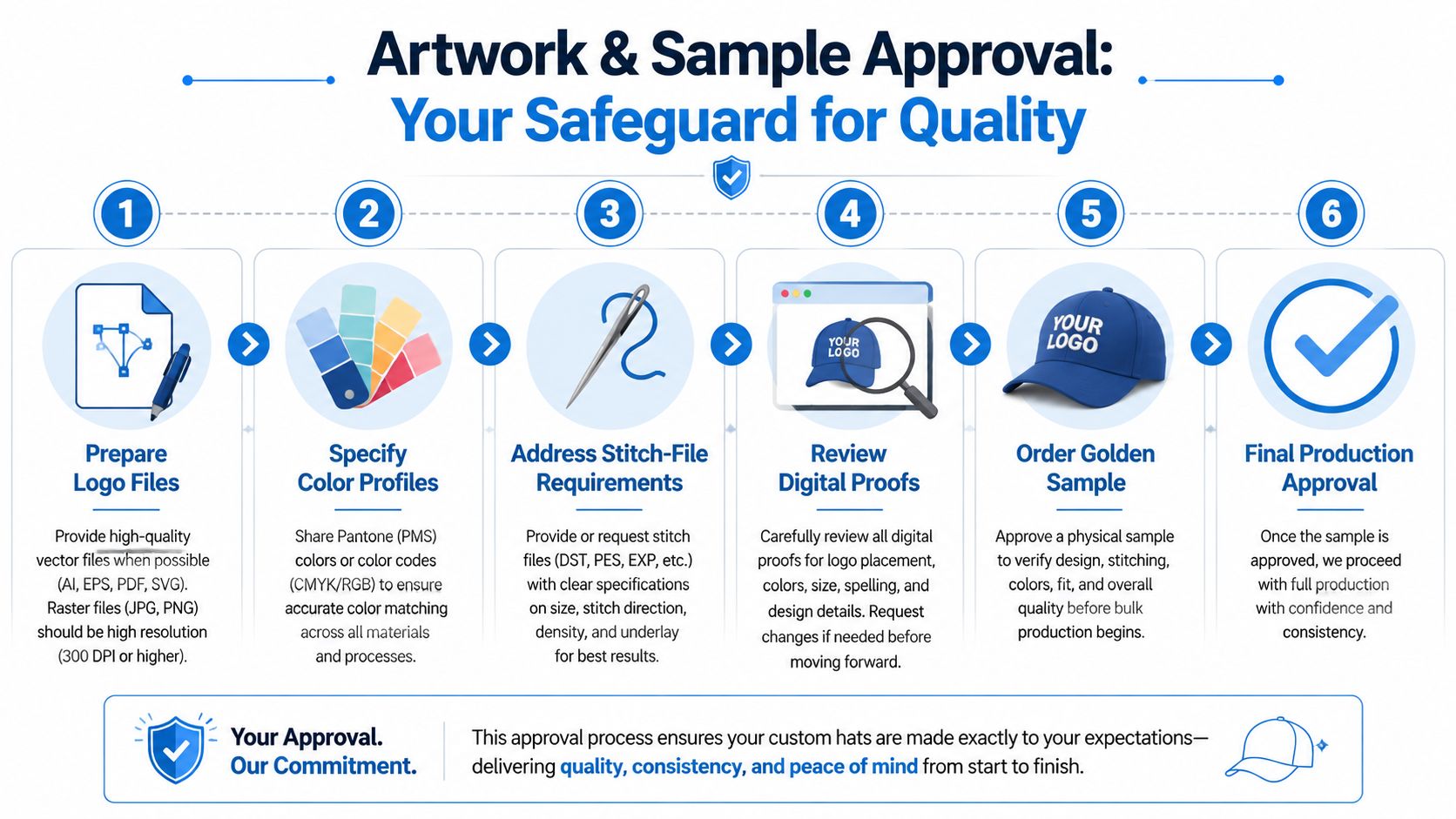
Sloppy buyers often get burned. They approve a file on-screen, skip the sample, and then discover the thread color is flatter than expected or the logo sits too low on the crown. Don't do that. For any meaningful custom hats bulk order, the pre-production proof process is the control point that saves the order.
Get the file right before anyone talks samples
Use clean artwork. Vector files are the safest starting point for logos because the edges stay sharp when scaled, while raster files can get messy if they're low quality. Then lock the color targets, placement, and stitch expectations in writing before production starts. If embroidery is involved, the stitch file matters too, because the factory needs more than a pretty image, it needs a production-ready format.
A practical placement resource is the embroidery placement guide, which is useful when you're deciding whether the logo should sit centered, offset, or higher on the crown. Small placement errors are easy to miss in a digital mockup and obvious on a finished hat.
Treat the golden sample as mandatory
For orders over 100 units, approving a physical pre-production sample adds 5–7 business days and costs about $25–$50, but it's the only real way to verify embroidery quality, color accuracy, fit, and construction before mass production (sample checklist). That isn't a delay, it's insurance.
Approve the sample only after you've checked logo size, crown placement, thread color, and the way the hat sits on a head.
If the sample is off, fix it before the run starts. If it's right, sign it off and treat it as the golden sample. That keeps everyone aligned when the actual order hits the line.
Navigating Minimums Pricing and Production Timelines
Buyers get in trouble when they budget from the wrong number. A quote that looks cheap at ten units is meaningless if the supplier's real bulk mechanics kick in at a much higher threshold. For custom caps, a common wholesale minimum order quantity is 100 pieces per design and color, with sampling available from 1 piece (MOQ reference).
Read the quantity rules the right way
That minimum tells you two things. First, the bulk order threshold is separate from the sample stage. Second, colorways are counted separately, so a mixed-color run can create multiple production lanes instead of one clean batch.
Here's the business logic. If your team wants three hat colors, you're not placing one simple order, you're planning three specs. That affects scheduling, approvals, and how quickly the shop can move from sample to full production.
Price only makes sense at volume
Wholesale custom hats are often sold with volume-based discounts, not a single flat rate. One published example says buyers can expect $9 to $20 per hat, with massive discounts for larger orders (pricing reference). That's the part many buyers miss. The per-unit cost is supposed to move as the quantity goes up.
A smaller order usually lives closer to the upper end of that range. Larger orders generally grant you more favorable terms, especially if you're repeating the same style and decoration. The lesson is straightforward, don't compare only the sticker price, compare how the price behaves as volume rises.
Don't ask for a quote until your design, colorway, and quantity are fixed. Vague requests produce weak pricing and slower replies.
The right move is to decide whether your need is a clean one-design run or a mixed order with separate versions. Then ask for a quantity-based quote that matches the actual production plan. Anything else just creates fake certainty.
Implementing Quality Control and Inspection Tips
A good factory can still miss small defects if nobody checks them. That's why QC needs to be written down, not left to memory. For hats, the issues are usually boring, thread tension, stitch density, color match, fit, seam quality, and label accuracy. Boring problems still cost money.
Check during production, not only at the end
If you wait until the whole order lands, you're already late. Ask for in-line checks while the hats are being made, because that's when thread tension or stitch density problems can still be corrected without touching every finished unit. If the logo color is drifting, you want that caught before the batch is packed.
A useful habit is to document defects as they appear. Keep photos, count the affected units, and note whether the issue is isolated or systemic. That record tells you whether you need a rework batch or a simple correction on the next pass.
Final inspection should be ruthless
At the end of the line, inspect fit, seam integrity, logo placement, and any barcode or label verification tied to your inventory process. If a hat doesn't sit correctly or the seam looks weak, it doesn't belong in a bulk shipment. The standard should be simple, a customer should receive a hat that looks like the approved sample, not a near-miss.
Practical rule: if you wouldn't hand the hat to a buyer on day one, don't ship it as part of the run.
Dirt Cheap Product, Inc. handles this kind of order control through proofing and decoration workflows that keep the order aligned from artwork to final packout. That matters because once the product leaves the factory floor, every missed check becomes a customer-facing problem.
Optimizing Shipping Fulfillment and Cost Saving Strategies
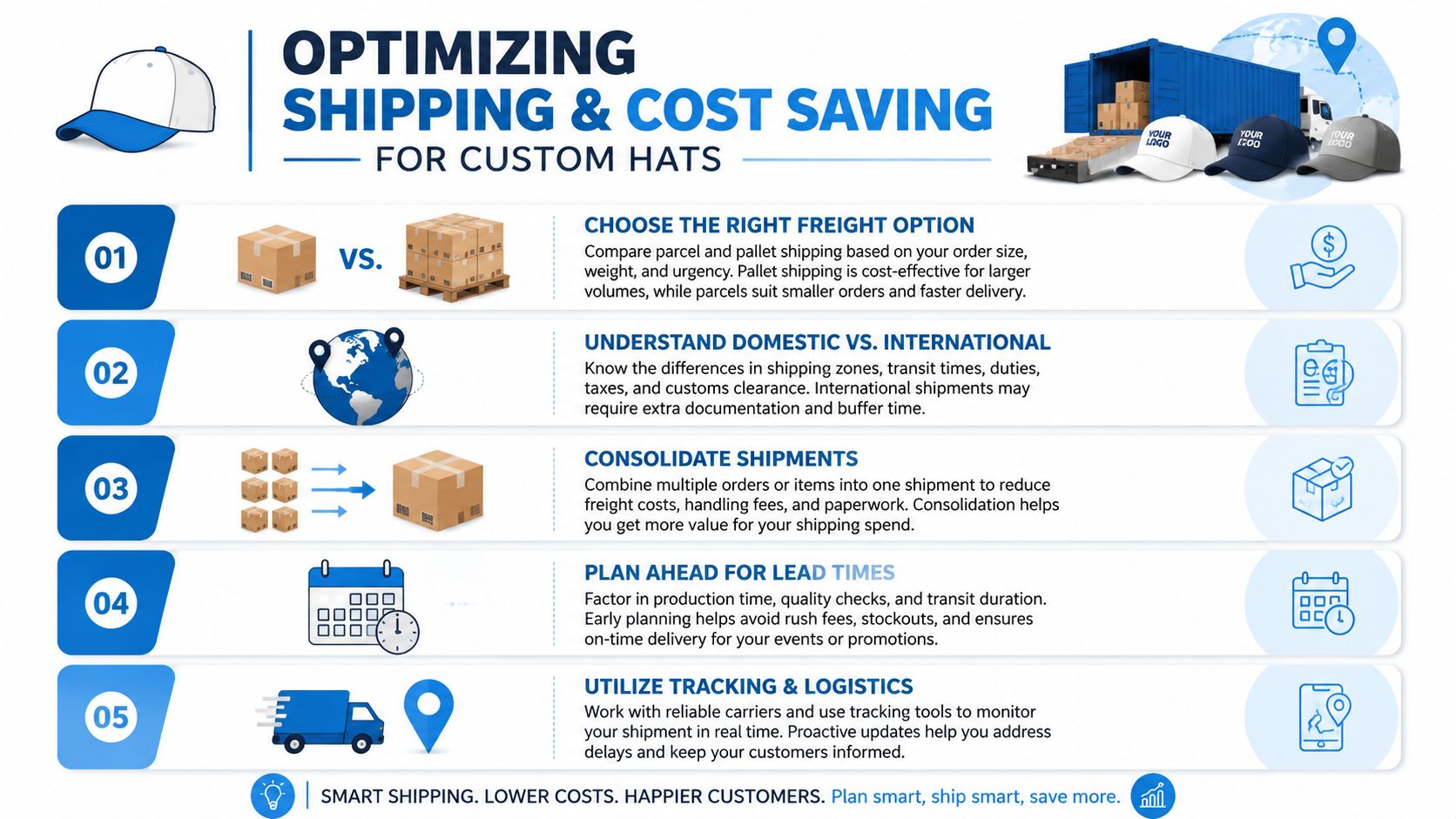
Shipping is where a lot of good orders lose margin. The hats are fine, the pricing is fine, and then freight wipes out the savings because nobody planned the move from production to delivery. If you care about total landed cost, you need to choose the shipping method the same way you choose the hat blank, on purpose.
Match freight to the order shape
Parcel shipping makes sense for smaller, split deliveries. Pallet shipping makes more sense when the order is larger and you want fewer handling steps. Domestic shipments are usually simpler to manage, while international shipments need more attention to routing, transit time, and handoff points.
If you're working across multiple locations, the smartest move is often consolidation. Fewer cartons and fewer transfer points usually mean fewer surprises. That doesn't just save time, it also reduces the odds that one destination gets partial inventory while another waits.
Use logistics partners the practical way
The right logistics setup isn't glamorous. It's tracking numbers that work, shipment status that updates, and delivery plans that match the event date or retail launch. For a deeper shipping operations angle, Peak Transport's Transflo insights are a useful reference point for how terminal-side visibility fits into a freight process.
If you need a regional fulfillment angle, this regional shipping page is worth using as an internal planning reference. It's especially useful when you're trying to keep inventory closer to the end user instead of dragging everything through one central drop.
Buyers can expect $9 to $20 per hat with massive discounts for larger orders, which means freight planning should be part of the savings conversation from the start (pricing reference). If the shipping plan is sloppy, the volume discount gets eaten up fast.
Planning Next Orders and Streamlining Reorder Workflows
The smartest bulk hat buyers don't restart from zero every time. They save the approved artwork, keep the sample record, and build a reorder template that removes guesswork. That's how you stop repeating the same approvals every season.
First, store the final logo files and the approved hat spec in one place. Then tie that spec to a reorder template so the style, placement, and decoration don't drift. If you're coordinating events or inventory, set reminders before stock runs low or before the next campaign hits.
Second, test small changes instead of rebuilding the whole order. A new colorway, a different patch finish, or a refreshed crown style can be useful, but only if you compare it against the approved baseline. The whole point is to keep the process repeatable while still leaving room for updates.
A good reorder system doesn't make decisions for you. It removes the unnecessary ones.
Keep the playbook simple. Approved sample, saved artwork, repeatable specs, and a reminder before the next need date. That's how a custom hats bulk order becomes an operating system instead of a one-time purchase.
A CTA for Dirt Cheap Product, Inc..