A client usually reaches this point after the first pricing sheet lands in their inbox. One hoodie looked straightforward at the start. Then the questions show up fast. Pullover or zip-up. Midweight or heavyweight. Budget blank or retail-style fit. Screen print, embroidery, or transfer.
That confusion makes sense because a hoodie order is a business decision before it is a style decision. The garment affects unit cost, perceived quality, decoration results, and how often people will wear it. A cheap blank can save money upfront and create problems later if the fit is poor, the fabric pills, or the print area is limited.
The hoodie also has a practical origin. The Museum at FIT notes that Champion developed the hooded sweatshirt for workers and athletes, which explains why function still shapes the category today (history of the hooded sweatshirt). Buyers are still balancing warmth, durability, comfort, and appearance. Branding just adds another layer to that choice.
The market gets crowded because small changes in construction create very different outcomes for a custom order. A full zip gives staff an easy uniform layer but interrupts a large front graphic. A heavier fleece feels more premium but raises the cost and can change how ink or embroidery sits on the garment. An oversized fit may sell better as merch, while a standard fit is usually safer for mixed staff sizing and reorders.
Start with the job the hoodie needs to do.
If you are still comparing options, it helps to browse actual Hoodies in a catalog setting so you can see how silhouette, fabric, and finish change the final impression before you approve decoration.
Table of Contents
- The Foundation Pullover vs Zip-Up Hoodies
- Understanding Hoodie Fabric and Weight
- A Guide to Fit and Style Trends
- Matching Decoration Method to Your Hoodie
- Smart Buying Sizing Specs and Ordering
- Conclusion Choosing the Right Hoodie for Your Brand
The Foundation Pullover vs Zip-Up Hoodies
The first business decision is usually the biggest one. Pullover or zip-up changes the feel of the garment, the print strategy, and often the perceived role of the piece.
A pullover is the cleaner branding canvas. A full-zip is the more flexible wear option. That sounds simple, but it has real consequences once artwork enters the conversation.
What changes for branding
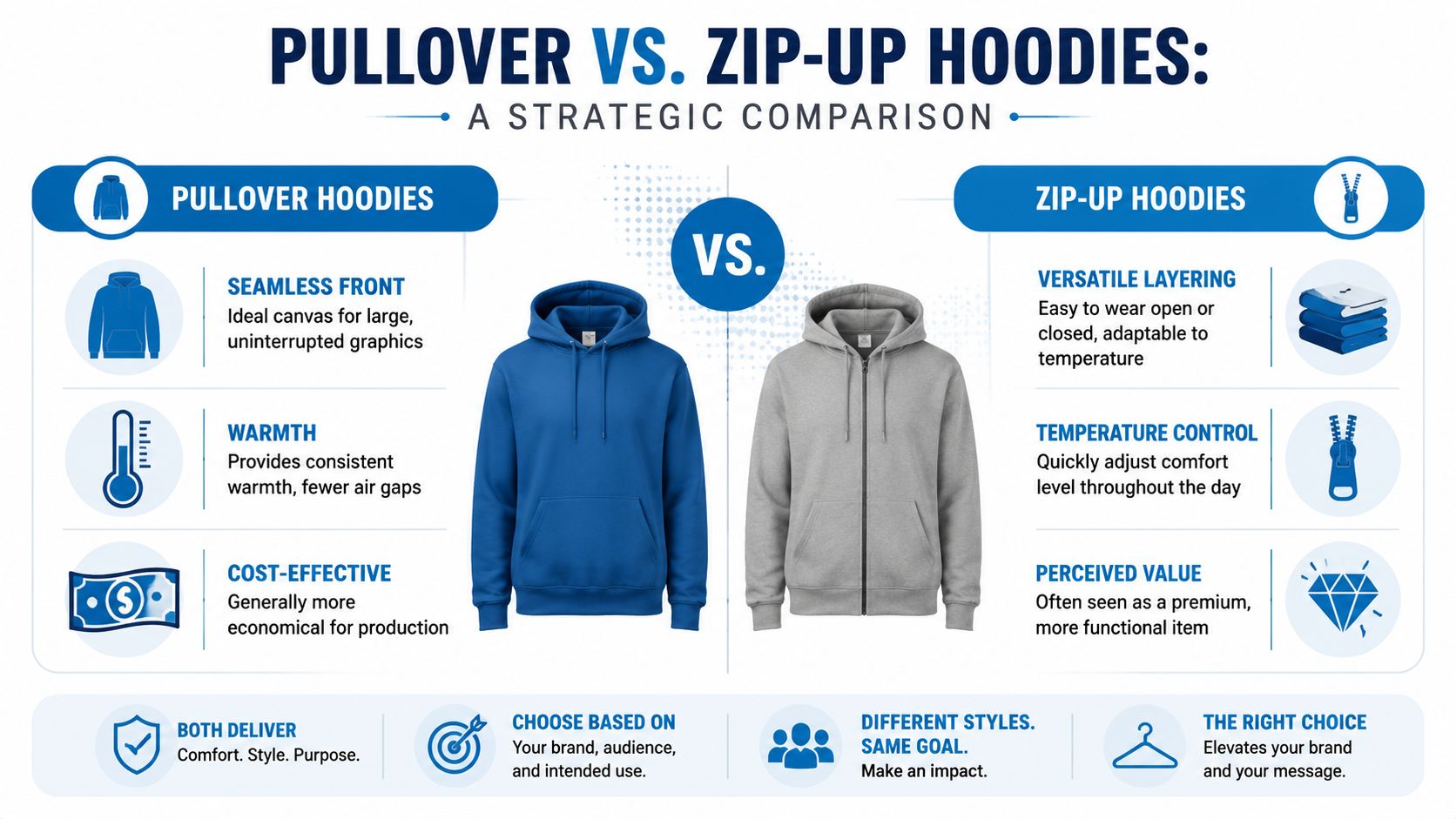
For product selection and decoration planning, the garment's silhouette and closure directly affect use case and print strategy. Pullovers maximize warmth and eliminate zipper interruption across the front panel, while full-zip hoodies improve ventilation and ease of layering but reduce the available uninterrupted print area (print strategy by hoodie style).
That one trade-off drives most recommendations.
| Style | Strongest advantage | Main limitation | Best branding use |
|---|---|---|---|
| Pullover | Large uninterrupted front and back panels | Less adjustable during the day | Big chest prints, bold graphics, event merch |
| Full-zip | Easy layering and ventilation | Zipper splits prime front print area | Left chest embroidery, sleeve print, back logo |
| Half-zip | More polished look with some adjustability | Smaller simple decoration works best | Corporate casual, light teamwear, subtle branding |
If your logo needs to sit large and centered on the chest, pullovers usually make life easier. You avoid awkward design compromises, and the garment reads more like a merch piece or branded statement item.
If the hoodie is for staff moving between indoors and outdoors, zip-ups often win. Employees can wear them open over a tee, close them for warmth, and remove them without messing up hats, headsets, or name badges.
Practical rule: If comfort flexibility matters more than front artwork, choose the zip. If the logo is the hero, choose the pullover.
Which one makes more sense
Pullover hoodies tend to work well for:
- Events and promotions: They give you broad print space for sponsor marks, campaign graphics, or bold back prints.
- Retail-style merch: A pullover often feels more intentional when the hoodie itself is part of the product story.
- Budget-sensitive decoration plans: Simpler placement usually means fewer design complications.
Zip-up hoodies usually fit better for:
- Employee uniforms: Staff can regulate comfort through the day.
- Layered workwear: A zip-up functions more like light outerwear.
- Logo-first programs: Small left-chest embroidery and a clean back print usually look more professional here than forcing a split-front graphic.
Quarter-zips and half-zips sit in the middle. They can look more refined than a standard hoodie, but they narrow your decoration choices. I usually point clients toward them when they want casual comfort without the full streetwear look of a classic pullover.
Understanding Hoodie Fabric and Weight
Fabric is where many custom hoodie orders go right or wrong. Buyers often focus on color and style first, then treat fabric as a spec-sheet detail. That's backward. Fabric determines how the hoodie feels in hand, how warm it runs, how premium it seems, and whether people continue wearing it.
The biggest material differences in the different types of hoodies show up in the fabric system, not in the drawstring or pocket style.
Fleece, French terry, and performance fabrics
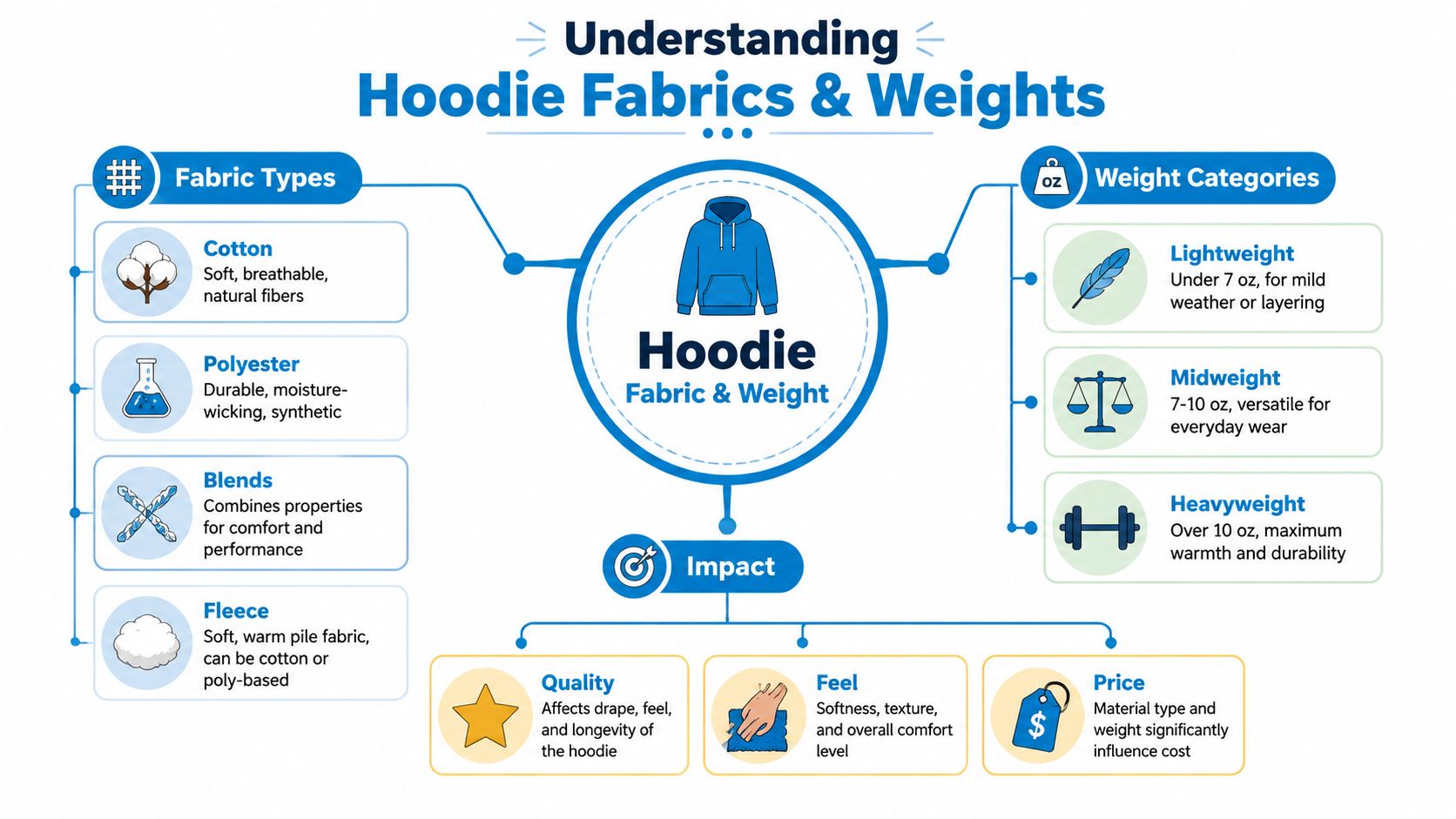
From a garment-engineering standpoint, fleece hoodies use a brushed interior for higher trapped air volume and better insulation, while French terry is loop-backed and typically lighter, more breathable, and better for transitional wear (fabric behavior in hoodies).
That distinction matters a lot in real orders.
- Fleece hoodies: These are the cozy option. The inside feels softer and warmer. They're often the safer pick for colder months, employee outer layers, and comfort-first merch.
- French terry hoodies: These feel cleaner and lighter. They suit mild weather, indoor-heavy use, and brands that want a less bulky silhouette.
- Performance hoodies: These usually lean on polyester or blends for moisture-wicking and stretch. They fit training, teamwear, and active use better than lounge-focused programs.
A common mistake is ordering fleece because it sounds more premium, even when the audience is wearing the hoodie indoors or in a warm climate. That can backfire. A hoodie that's too warm gets tied around the waist or left on a chair.
Buy for the environment the hoodie will actually live in, not the weather you imagine in the sales meeting.
If you need a simple reference point for how garment weight affects hand feel across apparel, this guide to understanding shirt weight helps frame how heavier fabric changes structure, comfort, and perceived value.
Why weight changes the buying decision
Weight isn't automatically a quality score. It's a purpose signal.
A heavier hoodie can feel substantial and retail-ready. It can also feel hot, stiff, or excessive for event wear. A lighter hoodie can feel easy and versatile. It can also feel too thin if you're trying to create a cold-weather uniform piece.
Here's how I usually frame it for clients:
| Weight feel | Usually works best for | Watch out for |
|---|---|---|
| Lightweight | Layering, indoor wear, mild climates, active use | May not feel substantial enough for premium merch |
| Midweight | Broadest all-purpose choice | Can feel ordinary if the brand wants a fashion-forward statement |
| Heavyweight | Streetwear, winter use, premium-feel gifting | More cost, more bulk, less universal wearability |
Fabric also affects decoration behavior. Smooth-faced fabrics generally give cleaner print results. Loftier or thicker garments often support embroidery better because the structure can handle the added texture.
So when clients ask, “What's the best fabric?” the honest answer is that there isn't one. There's only the best fabric for your audience, climate, and decoration plan.
A Guide to Fit and Style Trends
A client can approve the right logo, the right fabric, and the right price, then still end up with a weak hoodie order because the fit sends the wrong signal. Fit shapes perceived value fast. It tells people whether this piece was meant to feel safe, retail-ready, athletic, or trend-driven.
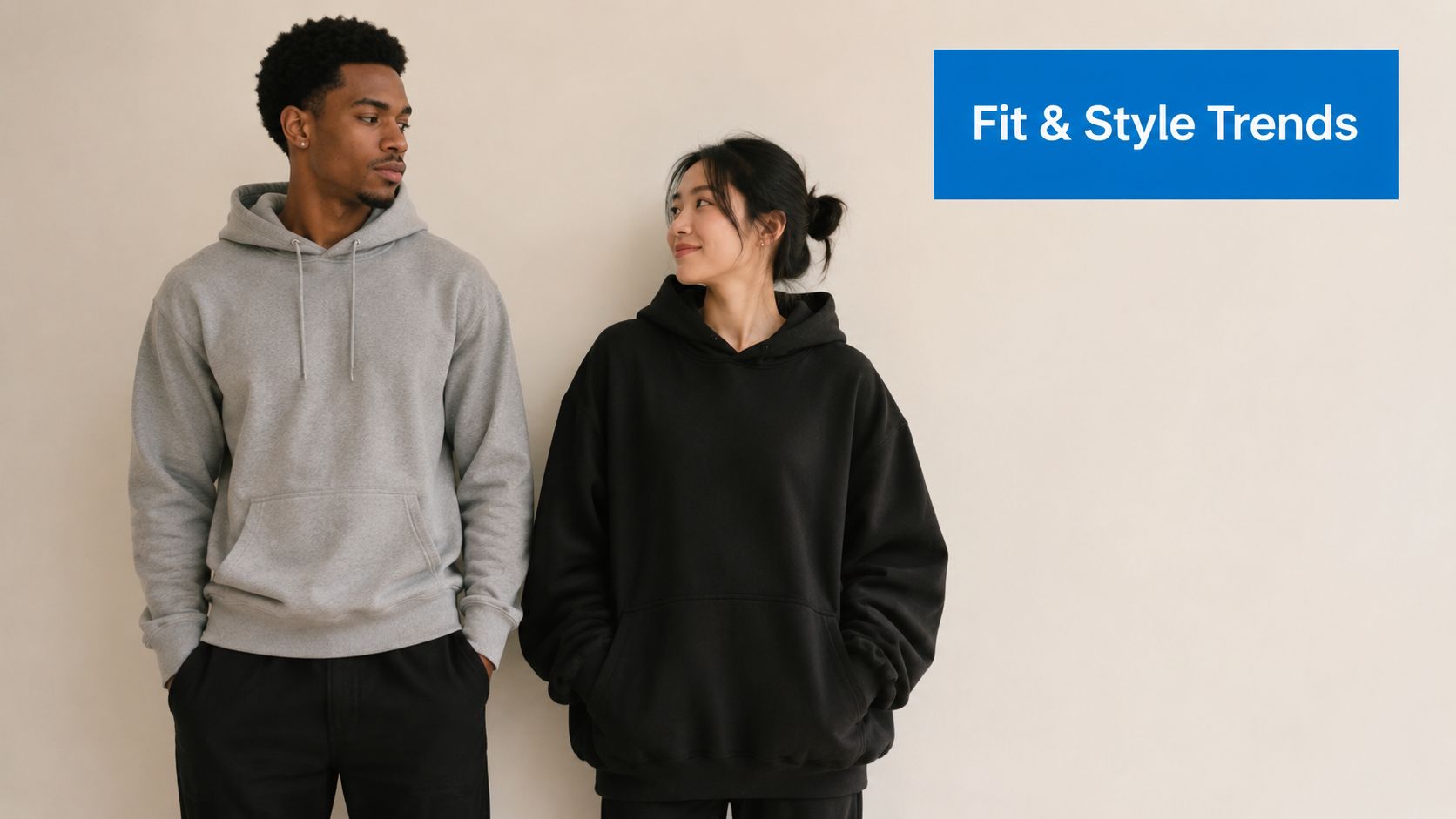
Hoodie fits are usually grouped into familiar categories such as oversized, regular, slim, and cropped, alongside broader style and material choices, as noted earlier. For a brand buyer, that matters because fit is not just a fashion detail. It affects who will wear the garment, how often they will wear it, and whether the order feels like smart spend or leftover promo stock.
Regular, oversized, slim, and cropped
Regular fit is the safest commercial option. It works across broad size ranges, mixed demographics, staff programs, school groups, and event merchandise. If the order needs high adoption and low return-risk, regular fit usually gives the best balance of wearability and cost control.
Oversized fit creates a more current, retail-aware look. It often works well for youth-oriented brands, creator merch, streetwear projects, and premium drops where silhouette matters as much as logo placement. The trade-off is narrower appeal. Some buyers love the extra room and dropped shoulder. Others read it as sloppy, too casual, or not meant for them.
Slim-fit hoodies project a cleaner, more athletic look. They can suit fitness brands, teamwear, and uniforms where a closer shape feels more polished. The downside is predictability. Slim fits tend to generate more sizing hesitation, especially if your audience includes people who prefer layering or a relaxed feel.
Cropped hoodies are a targeted style choice. They can work for fashion-led collections and trend-focused retail programs. For employee apparel, donor merchandise, or general giveaways, they usually limit your audience too much to be the best use of budget.
What each fit says about your brand
Fit communicates brand position before anyone notices the print or embroidery.
- Regular fit says: reliable, broad-appeal, easy to wear, practical
- Oversized says: current, casual, style-aware, merch-first
- Slim-fit says: active, clean, performance-oriented, more fitted
- Cropped says: fashion-specific, curated, selective
The right fit is the one your audience will choose from the closet.
I push clients to separate personal preference from order strategy. Founders often like the fit they wear themselves, but that is rarely the best buying standard for a broader audience. If the hoodie is meant to reach employees, customers, prospects, and partners at the same time, regular fit usually produces better long-term wear rates. If the hoodie is part of a retail line or a limited merch drop, a more directional fit can justify the risk because brand perception is part of the product.
Budget plays into this decision too. A fashion-forward silhouette can improve perceived value, but only if the audience wants that silhouette. If not, the higher cost per piece does nothing for the brand because the garment stays folded, donated, or forgotten.
For broad programs, regular fit remains the lowest-risk choice. For brands trying to create a stronger point of view, fit is often the simplest way to make a hoodie feel intentional without changing the logo, decoration method, or fabric specification.
Matching Decoration Method to Your Hoodie
Most ordering problems don't start with bad artwork. They start with a mismatch between garment and decoration.
A thick logo stitched onto a thin hoodie can feel heavy and awkward. A large print placed across a zipper will always fight the garment. A highly detailed image on the wrong fabric can lose clarity fast. All these elements require style, fabric, and fit to be considered together.
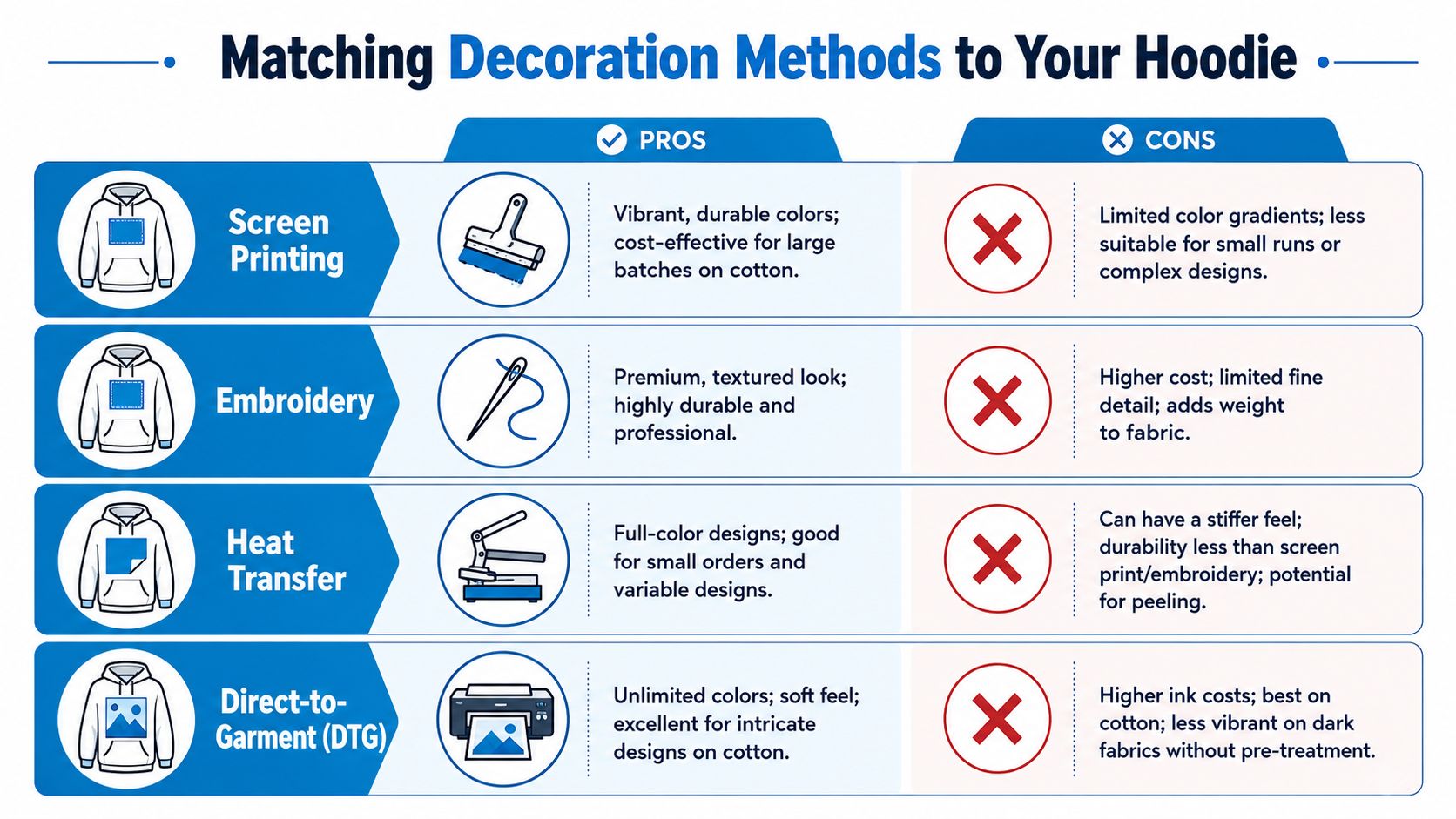
How decoration and garment choice interact
Here's the practical pairing I use most often:
| Decoration method | Usually strongest on | Less ideal when |
|---|---|---|
| Screen printing | Pullovers, smoother cotton-rich faces, larger runs | Artwork crosses zippers or needs small-run flexibility |
| Embroidery | Left chest logos, heavier fleece, premium uniform looks | Fine-detail artwork or lightweight garments |
| DTF | Complex full-color logos, varied fabrics, polyester-heavy items | You want the softest hand possible on very large graphics |
| Custom patches | Retail-inspired merch, outerwear-style hoodies, bold logo marks | The design needs subtlety or fine tonal detail |
Screen printing is often the most efficient choice when the artwork is bold and the order is large enough to justify setup. It shines on pullovers because the front panel stays uninterrupted.
Embroidery creates a textured, durable finish that works especially well for chest logos and corporate branding. It usually feels more polished than a print on uniform-style orders.
DTF solves a lot of real-world problems. If the logo has multiple colors, the garment mix is varied, or performance fabrics are involved, DTF can be the most practical path. It also helps when you need cleaner reproduction without forcing everything into a traditional screen print setup.
Custom patches can push a hoodie toward a retail look. They're useful when the logo shape is simple and the brand wants dimension rather than just ink on fabric.
For a deeper walkthrough of when each process fits, this guide on choosing a logo decoration method is a solid starting point.
A practical way to choose
If you want the shortest path to the right answer, ask these questions in order:
Where will the logo sit?
Center chest, left chest, sleeve, or back changes the method immediately.What fabric are you decorating?
Heavy fleece can support more texture. Technical polyester often pushes you toward transfer-based methods.How detailed is the artwork?
Fine gradients and many colors usually narrow your options.What should the hoodie feel like when worn?
Some methods add texture and weight. Others stay flatter.Is the piece meant to feel promotional or retail-ready?
That answer changes the finish you should chase.
A useful visual reference for premium texture and warmth is this example of effortless sophistication with this sweater. Not because you should copy it, but because it shows how heavy fleece and a more tactile finish can shape perceived value before decoration is even added.
If you need production support, Dirt Cheap Product, Inc. handles hoodie decoration options that include screen printing, embroidery, DTF, sublimation, and custom patches, which makes it possible to match the process to the garment rather than forcing every order into one method.
Smart Buying Sizing Specs and Ordering
The hoodie choice can be correct and the order can still fail. That usually happens in sizing collection, proof approval, or spec review.
Most clients don't need more options at this stage. They need a clean checklist and a few rules that prevent reorders, confusion, and wearable leftovers.
What to confirm before you approve
Start with sizing. If this is staff apparel or event wear, collect sizes from actual wearers whenever possible instead of estimating by department. If you can't get clean responses from everyone, build a buffer around your most common core sizes and make sure leadership understands that fit preference varies as much as body size.
Before final approval, confirm these points:
- Artwork proof: Check the logo version, spelling, scale, and orientation.
- Placement: Confirm exact location on chest, back, sleeve, or hood.
- Color matching: If brand colors matter, approve the exact ink or thread direction before production.
- Garment choice: Make sure the final hoodie style matches the decoration plan.
- Delivery timing: Confirm when proofing ends and when production starts.
Approval errors usually aren't design problems. They're communication problems that showed up too late.
If this is your first larger run, this bulk custom apparel ordering guide gives a useful overview of the approval flow and the details worth locking down early.
How to read the spec sheet without overthinking it
A lot of apparel terminology looks more technical than it is.
An 80/20 cotton/poly blend tells you the hoodie mixes softness with added durability and structure. Rib knit cuffs help the sleeve opening recover shape after wear. Double-needle stitching points to reinforcement at seams that tend to take stress.
You don't need to become a garment developer. You do need to ask what each spec means for daily use.
Use this short filter when reviewing any hoodie spec sheet:
- Will it shrink or hold shape well enough for the use case?
- Will the fabric feel right in the climate where it's worn?
- Does the surface support the decoration method you chose?
- Will the silhouette still make sense after repeated wear and washing?
The best orders come from buyers who slow down before approval, not after delivery.
Conclusion Choosing the Right Hoodie for Your Brand
Choosing among the different types of hoodies gets easier once you stop treating it as a fashion question alone. It's a business decision with four moving parts. Style, fabric, fit, and decoration all have to support the same goal.
A pullover helps when artwork needs room. A zip-up helps when the hoodie functions more like daily outerwear. Fleece suits warmth and softness. French terry makes more sense when breathability and lighter wear matter. Regular fit is usually the safest broad-audience option, while oversized, slim, or cropped fits need a more intentional brand reason. Decoration should follow the garment, not fight it.
That's the shortcut. Don't ask which hoodie is best. Ask which hoodie will get worn, represent your brand well, and support the decoration method without forcing compromises.
If you're ready to turn that decision into a real order, review actual garment options, narrow your use case, and get a proof before you approve production.
Dirt Cheap Product, Inc. can help you source and decorate hoodies for uniforms, merch, events, and retail-style programs. You can browse the company's apparel options and request a quote through Dirt Cheap Product, Inc. if you want help matching the right hoodie style, fabric, and decoration method to your brand.