Your event is tomorrow, the shirt design is still sitting in a shared folder, and someone just asked whether the order can be delivered by morning. That situation is common, but custom t shirts overnight aren't created by selecting a faster shipping option alone. The job must move through artwork approval, blank-shirt allocation, decoration, finishing, packing, and carrier pickup without a missed cutoff.
The custom t-shirt printing market was valued at USD 5.16 billion in 2024 and is projected to reach USD 9.82 billion by 2030, with a projected 2025–2030 CAGR of 11.5%, according to the market and turnaround reference. That scale supports more rush capacity, but it doesn't remove the practical limits that decide whether your shirts can be ready in time.
Table of Contents
- What Custom T-Shirts Overnight Really Means
- How to Prepare Print-Ready Artwork That Avoids Delays
- Choosing In-Stock Blanks and the Fastest Decoration Method
- How to Place and Confirm Your Overnight Order Without Missing the Cutoff
- Pro Tips to Hit Your Deadline and Avoid Rush Mistakes
- Get Your Custom T-Shirts Overnight With Confidence
What Custom T-Shirts Overnight Really Means
At the shop level, “overnight” can describe two very different outcomes. In one case, your shirts are printed during the day, finished, packed, and handed to a carrier that evening. In another, the order ships the next day, which may not mean it arrives the next morning. Cutoff times, time zones, carrier service, and your delivery destination all affect the result.
A rush order usually starts with a quote and artwork approval. The shop then stages the garments, decorates them, checks the finished print, and packs the shipment. Standard custom apparel commonly takes about 5–7 business days after proof approval, while the full path from quoting through shipping often takes roughly two calendar weeks, as described in this custom apparel turnaround guide. Rush programs can compress production to 24–48 hours, but only when the file is ready and the blanks are available.
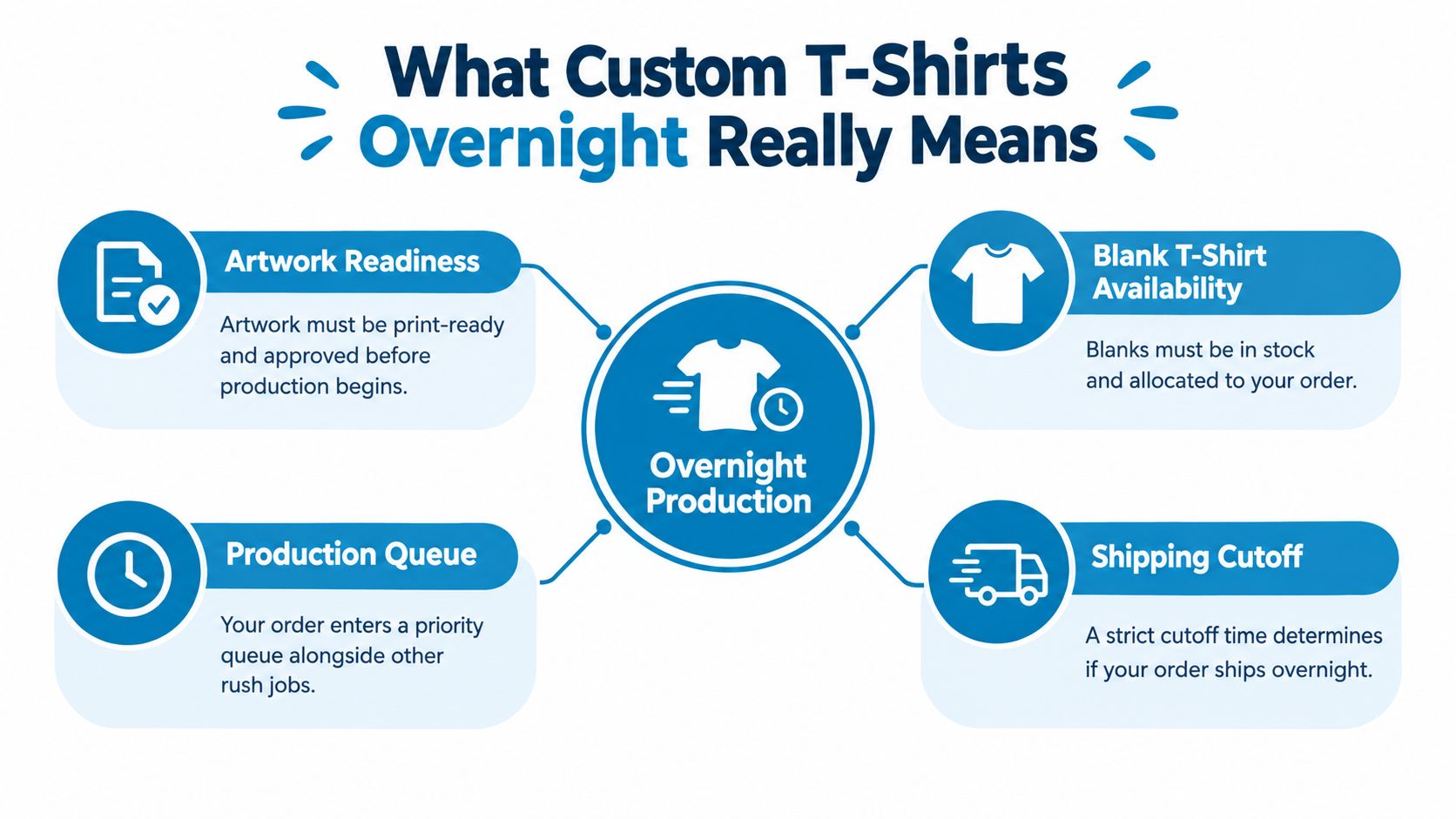
The four deadlines behind one delivery promise
- Artwork readiness: The production team can't print from a blurry screenshot, an unapproved proof, or a file with missing fonts.
- Blank availability: The exact shirt style, color, and size mix must be in stock and allocated to your order.
- Production queue: Rush work enters a priority schedule alongside other urgent jobs. A late approval can move the order to the next available slot.
- Shipping cutoff: The carrier's pickup deadline determines whether finished shirts leave that night or the following day.
Digital decoration and faster logistics changed custom apparel from a process often measured in 5–15 business days to one that can reach 24–48 hours or same-day service in select cases, according to this overview of super-rush custom shirts. The model depends on three capabilities working together, in-stock blanks, an efficient production workflow, and overnight parcel networks.
Overnight is most realistic for a small or straightforward order, a print-ready design, common shirt colors and sizes, and a buyer who can respond during business hours. If any of those pieces is uncertain, ask whether the promise means “printed and shipped tonight” or “shipped tomorrow.” That distinction is the first decision to make before you pay for rush service. For more context on rapid local production, see same-day shirt printing options.
How to Prepare Print-Ready Artwork That Avoids Delays
Artwork causes more missed rush deadlines than the press does. A production artist can often fix a file, but every correction creates another proof, another approval request, and another opportunity to miss the cutoff.
Start with the strongest file available. A vector logo in Adobe Illustrator or EPS format lets the printer scale shapes cleanly, while a properly prepared PDF can preserve layout and type treatment. A transparent PNG can work well for digital printing when it has sufficient resolution and doesn't contain a white box around the design.

Build a file package the printer can use immediately
- Use editable vector artwork: Send an AI, EPS, or PDF file when possible. Vector files preserve clean edges and make color or size adjustments easier.
- Set the color environment correctly: Ask the printer which color process the job requires. A file prepared in the wrong color setup can produce a proof that doesn't match the screen.
- Outline the fonts: Convert type to outlines before export. Otherwise, a missing font can substitute a different letterform and force a correction.
- Keep the background transparent: For a logo printed on a colored garment, remove the unwanted canvas or white rectangle before uploading.
- Check contrast on dark garments: A design that looks strong on a white monitor may lose detail on black, navy, or other dark fabric. Confirm how the light areas will be handled.
- Set placement and size: State whether the design is a left chest, full front, back, sleeve, or another location. Include the intended print width if you already know it.
A low-resolution screenshot from a presentation may look acceptable on a phone, but it gives the production team little room to enlarge or separate the art cleanly. A real vector file or high-quality transparent PNG lets the artist prepare a proof without rebuilding the design from scratch.
Before sending the file, open the exported version yourself. Check spelling, phone numbers, dates, logo proportions, transparency, and the preview on the actual shirt color. You can also compare the intended placement with guidance on t-shirt design size.
Practical rule: A fast printer can't approve artwork for you. Send one clear file, one clear placement instruction, and one person who can approve the proof quickly.
If the design uses a brand logo, sports mark, movie phrase, song lyric, celebrity image, or artwork downloaded from the internet, confirm that you have permission to use it. Speed doesn't remove copyright, trademark, or publicity-rights concerns, and a printer may pause a questionable file rather than put it into production.
Choosing In-Stock Blanks and the Fastest Decoration Method
The fastest garment is the one the shop can physically pull from its shelves. A preferred brand or unusual color won't help if the exact sizes aren't available. For a rush order, give the production team permission to suggest an equivalent blank, or choose from styles they confirm are ready for decoration.
Color flexibility often saves more time than changing the print method. If black, white, gray, or another common option is available while a specialty color is not, switching colors may keep the order moving. Confirm the full size breakdown, not just the total quantity, because one missing size can hold up part of the order or require a split solution.
The decoration method should match the artwork and order size. Direct-to-film, or DTF, is flexible for small urgent runs, while screen printing becomes more efficient as quantity rises but requires more preparation.
For method benchmarking, a screen-printing automatic press can print roughly 10–20 seconds per shirt, but screen preparation adds about 2–5 hours upfront, according to this shirt-printing production comparison. DTF transfer printing takes about 1–2 minutes per design batch, and heat pressing each shirt takes 30–60 seconds at roughly 320–330°F. Those figures describe production components, not a guaranteed delivery promise, because artwork, queue position, garment staging, finishing, and shipping still matter.
Fast decoration method by order size and artwork
| Method | Best For | Overnight Fit | Watch Out |
|---|---|---|---|
| DTF | Small runs, detailed artwork, multiple colors | Strong fit when transfers and blanks are ready | Heat pressing still takes time per garment, and the final finish needs inspection |
| Screen printing | Larger runs with simple, repeatable artwork | Good fit when the shop has capacity and screens can be prepared quickly | Setup, screen preparation, curing, and cleanup add overhead |
| DTG | Detailed full-color designs on suitable garments | Possible for selected small jobs | Garment compatibility and pretreatment can limit rush availability |
| Sublimation | Suitable light garments and compatible synthetic materials | Useful when the garment and artwork match the process | It isn't a universal option for every shirt color or fabric |
For a practical blank-selection reference, review t-shirts suited for printing, then ask the shop to confirm live availability rather than assuming the listed style is ready. A one-color design on a standard blank is easier to rush than a complex print across several placements, even if both orders contain the same number of shirts.
The uncomfortable answer for a 50–100-shirt order is that overnight may be technically possible but operationally fragile. A shop may recommend a slightly longer rush window to allow proper curing, handling, and quality control instead of forcing every stage into a narrow schedule.
How to Place and Confirm Your Overnight Order Without Missing the Cutoff
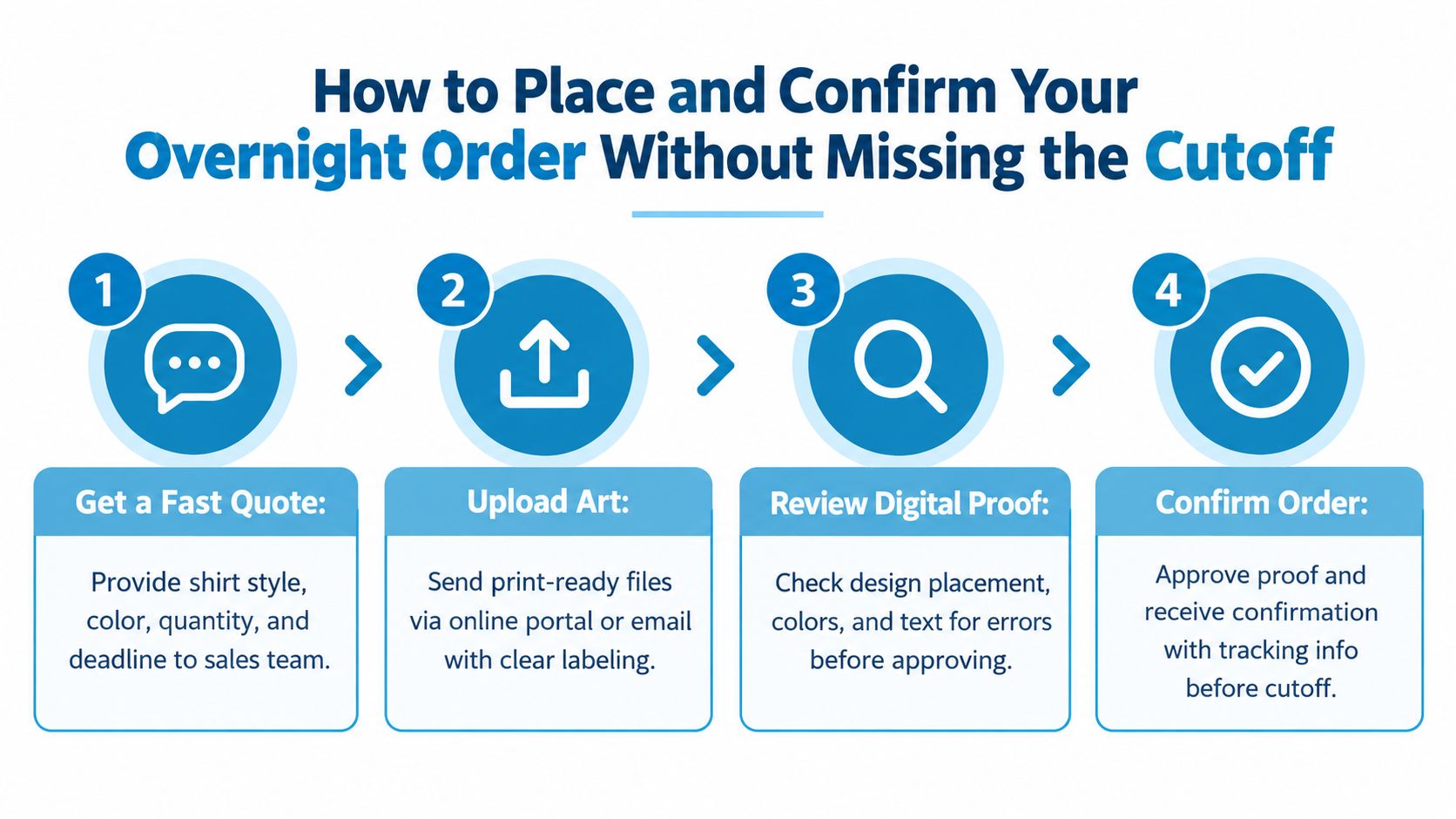
A rush order needs complete information at the first contact. Send the shirt style, garment color, size breakdown, quantity, print locations, artwork, delivery ZIP code, and the exact date and time the shirts must be usable. “Tomorrow” isn't enough. A morning event and an evening event create different production and carrier requirements.
Ask for the production cutoff, the shipping cutoff, and the expected arrival window separately. The shop may be able to print the garments that day but miss the carrier pickup, or it may ship overnight while the carrier's service doesn't guarantee the delivery time you need.
Keep the order moving in one conversation
Request the quote during the shop's staffed hours and identify one decision-maker for approvals. Sales staff can resolve blank substitutions, production questions, and delivery concerns much faster when they aren't waiting on several people to respond.
Upload the art with a clear filename, such as the project name and version. Don't send several conflicting files without explaining which one is final. If the shop asks a question about transparency, print size, or garment color, answer directly instead of reopening the whole design conversation.
The proof is the last easy place to catch a mistake. Check the spelling, artwork version, garment color, print position, approximate scale, and quantity breakdown. A proof approval usually authorizes production, so don't approve it until the details match the order you intend to receive.
Approval matters: The clock doesn't start when you first send a message. For rush production, the meaningful point is often the moment the shop has usable art, confirmed blanks, and your approved proof.
Once you approve, request written confirmation of the production plan and shipping service. If approval slips beyond the cutoff, ask for the new realistic option immediately. That may mean production moves to the next business day, the delivery method changes, or the shop recommends a different blank or decoration process.
Finishing and packing also affect the result. The shirts must be checked, folded or bundled as required, labeled, and transferred to the carrier before pickup. A printer that communicates clearly about those handoffs is more useful than one that only repeats “next day” without explaining what happens before shipment.
Pro Tips to Hit Your Deadline and Avoid Rush Mistakes
Urgent printing rewards disciplined choices, not frantic changes. The most reliable orders have a simple design, a confirmed blank, one responsive approver, and a delivery plan that matches the destination.
Decisions that protect the schedule
- Ask about minimums early: Minimum-order rules vary. One apparel FAQ says many products have no minimum and that some apparel can start at one item, but quantity, ink colors, and print placements can still affect the production plan, as explained in this custom apparel FAQ.
- Use an available substitute: If your exact shirt color or brand isn't staged, ask for a comparable blank rather than waiting for a special choice.
- Match shipping to the ZIP code: A carrier's overnight service is only useful if its delivery window fits your destination and event timing.
- Leave room for inspection: Rushed work still needs curing, handling, and quality checks. Skipping those controls can create defects that are more costly than accepting a little more time.
- Simplify the print: Fewer placements and a less complicated design give the production team fewer variables to manage under pressure.
- Assign one approver: Multiple opinions after the proof arrives can turn a quick approval into a long revision chain.
A one-piece order may be possible, but that doesn't mean every quantity or design can follow the same path. Turnaround depends on the number of garments, the number of ink colors, the number of placements, the blank inventory, and the chosen method.
For larger or more complex work, a 2–3 day rush may be the smarter choice than overnight. Industry listings indicate that medium orders can remain within that range while larger or more complicated jobs may extend toward a week, as shown in this fast small-order printing reference. The practical reason is quality control. More garments and more production variables create more opportunities for drying, curing, alignment, and post-print handling problems.
Key takeaway: Choose overnight when the job is ready to run. Choose a slightly slower rush when the schedule would force the shop to sacrifice inspection or reliable handling.
Get Your Custom T-Shirts Overnight With Confidence
Overnight custom shirts are realistic when three conditions line up: print-ready artwork, in-stock blanks, and proof approval before the cutoff. Faster shipping only handles the final movement of the package. It can't repair a blurry logo, locate an unavailable size, or make a late proof approval disappear.
Push for overnight when the design is simple, the garments are confirmed, the quantity is manageable, and someone can respond quickly during business hours. For 50–100 shirts, several placements, unusual garments, or demanding artwork, ask whether a slightly longer rush window will protect print quality and delivery reliability.
Prepare the artwork package first. Then confirm the shirt style, color, size mix, decoration method, production cutoff, and carrier service before placing the order. That checklist gives the shop a workable job instead of a vague emergency.
Dirt Cheap Product, Inc. provides custom T-shirt decoration through screen printing, DTF, sublimation, and related apparel branding services, with responsive sales support and proof review during business hours. Prepare your artwork and deadline, confirm available blanks, and visit Dirt Cheap Product, Inc. to discuss a rush order that fits your production and delivery window.