
The single most important factor is matching the blank to the decoration method and production volume. For most custom print programs, 100% ring-spun cotton in the 160–180 GSM range is the safest production standard when you care about print clarity, repeat ordering, and durability through wash cycles.
If you're staring at a stack of sample tees and trying to guess which one won't come back as a complaint, the decision usually comes down to fabric composition, construction quality, and print compatibility. Get those three right, and the shirt works harder for you across reorders, relabeling, and seasonal refreshes.
Table of Contents
- Finding the Right Blank for Your First Print Run
- Fabric Composition and Weight Explained
- Knit Structure and Construction Quality
- Color and Dyeing Selection for Print Results
- Matching Print Methods to the Right Blank
- Pre-Treatment and Finishing Considerations
- Budget Versus Premium Trade-Offs
- Actionable Spec Sheets and Decision Checklists
Finding the Right Blank for Your First Print Run
The first time a team orders printed shirts, the easy mistake is chasing softness or price before matching the shirt to the job. I've seen a founder approve a silky, fashion-fit tee for a volunteer event, then watch the print crew struggle because the blank didn't behave well on press and the reorders needed a different shirt anyway. That's how a cheap decision gets expensive.
Start with the use case, not the catalog
A merch buyer should ask three questions before touching brand names, how is it being decorated, how many times will it be reordered, and who is wearing it. A retail-style tee for a boutique launch has different demands than a staff uniform or a giveaway shirt that only needs to look good once. If you want a broader brand-level view of how custom apparel sits inside a fashion program, the Carti for fashion brands resource is a useful starting point.
A good way to narrow the field is to separate day-one appearance from lifecycle cost. A shirt that feels great out of the box can still be a poor buy if it shrinks badly, loses shape, or forces you into a different blank on the next reorder. That's why I always look at the shirt as part of a system, not as an isolated product.
Practical rule: if your decorator can't tell you why the blank matches the print method, keep shopping.
For buyers who want to compare common blank options, this guide to popular shirt brands for custom printing is a useful reference point. The point isn't brand loyalty, it's building a repeatable spec that you can reorder without guessing.
The three dimensions that actually matter
The first dimension is fabric composition and weight, because that decides how the shirt accepts ink and how it wears over time. The second is construction quality, because a tight, stable build holds print details better and survives more laundering. The third is method compatibility, because cotton, polyester, and blends each behave differently under screen printing, DTG, sublimation, and transfers.
If you only remember one buyer habit, make it this. Specify the shirt the way you'd specify packaging or trim, by function, not by vague preference. That one shift saves rework.
Fabric Composition and Weight Explained
A bad blank can pass a quick print check and still cost you money on the second and third reorder. The material choice affects how the shirt takes ink, how it washes, and how often you can reuse the same spec before it starts creating complaints or forcing a rebrand.
Cotton, polyester, and blends do different jobs
100% cotton is still the baseline for a lot of printed apparel because it takes water-based inks in a predictable way, which helps with print clarity and repeat wear. For buyers comparing fabric weights, this guide to T-shirt weight is a useful reference point. Industry guidance commonly places ring-spun cotton in the 160–180 GSM range as a production standard, and one guide notes that properly pre-shrunk blanks in that range can hold print quality through repeated wash cycles when the decoration is done correctly (MFG Merch). That is the kind of spec I trust when the same shirt has to come back into stock without changing how it fits, feels, or prints.
Polyester behaves differently. It is the required substrate for dye sublimation because the process depends on synthetic fibers, which makes it the right choice for some programs and the wrong choice for others, especially if you want a classic cotton hand-feel or straightforward screen print behavior (Printify).
Cotton-poly blends sit between those two extremes. They are often used for corporate and workwear orders because they balance softness, durability, and lower shrink risk. Common blend ratios include 50/50, 60/40, 80/20, and 65/35 (Printify). That flexibility makes blends practical when the buy is more about consistency, durability, and fewer replacement headaches than about the sharpest possible print surface.
Weight changes how a shirt prints and wears
A shirt's weight affects both feel and performance on press. Very light shirts can feel fragile and may show more strike-through, while heavier shirts can hold shape better but sometimes feel stiffer. In practice, medium-weight blanks usually give the best balance for everyday print runs because they are stable enough for production without tying you to a heavy retail hand.
For repeat programs, the question is not whether the tee feels nice on day one. It is whether the blank keeps its shape, size, and print surface after several wash cycles, then still makes sense on the next reorder. That is where a production-friendly weight range protects margin.
Midweight blanks usually cost less over time than bargain tees that shrink, twist, or need replacing after the first reorder.
Knit Structure and Construction Quality
The three dimensions that matter
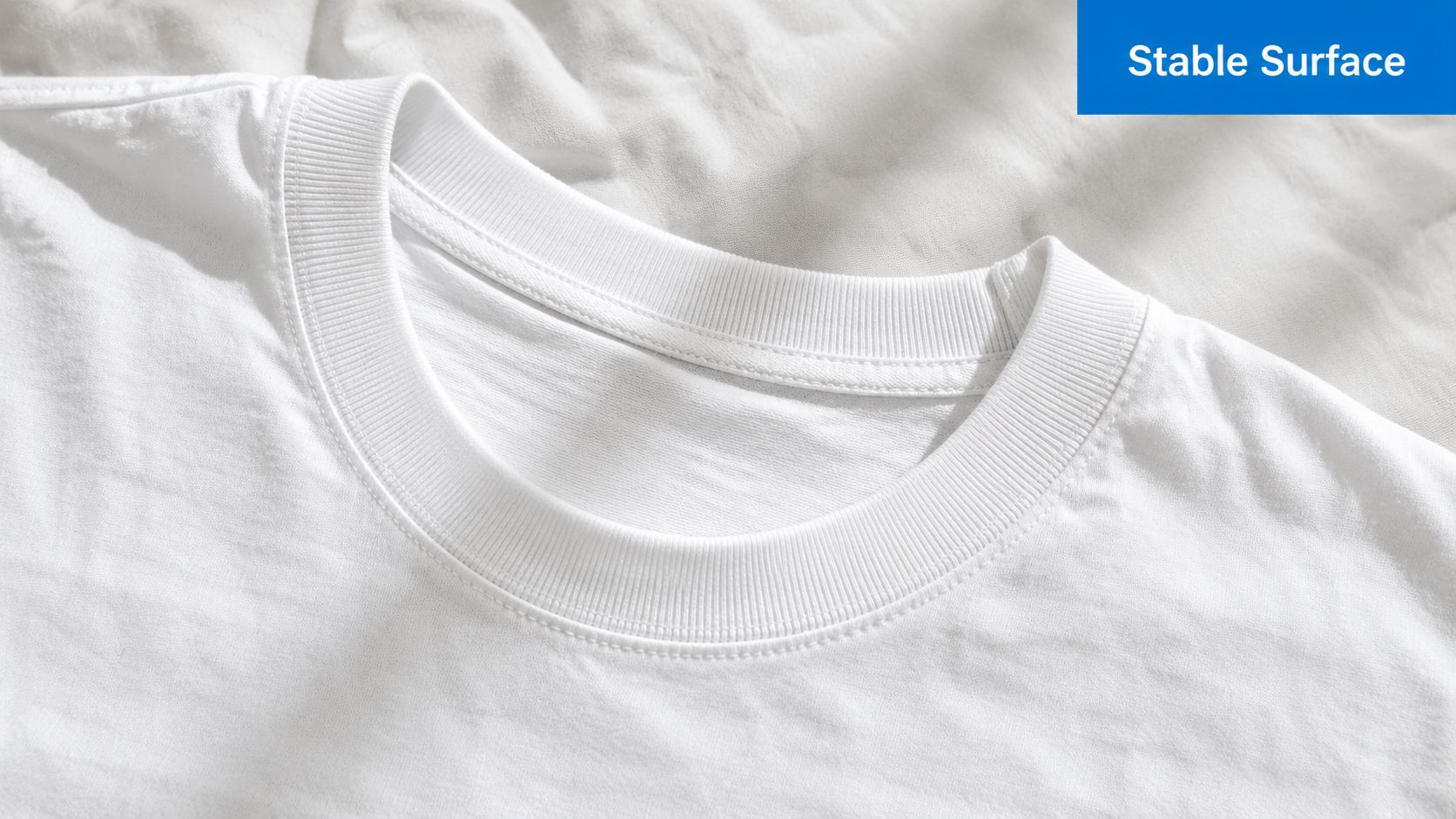
A shirt can match another one on fabric weight and still fail in production for different reasons. Knit structure is one of those reasons. A tight, consistent knit gives the ink a smoother surface, so edges stay cleaner and fine detail holds better. A looser or uneven knit lets ink spread in ways that soften logos, distort small type, and make a design look tired before the first reorder ships.
Ring-spun and combed cotton help because the yarn starts out more uniform. Shorter fibers are removed, the remaining fibers sit more evenly, and the surface usually prints cleaner than open-end cotton at the same weight. That does not just help the artwork on day one. It also helps the shirt keep a more refined hand-feel after repeated wear, which matters if the same blank has to support multiple reprints or a rebrand without forcing you to start over with a new garment profile.
Construction details protect the print investment
The parts buyers ignore most are often the parts that save money later. Side seams usually hold shape better than poorly built tubular bodies, and reinforced hems and shoulder areas help the shirt keep its structure through repeated washing and wear. If the shirt twists after laundering, the print does not just look worse, it can shift out of alignment with the garment itself.
I have had better long-term results standardizing on blanks that stay consistent across reorders, because repeatability matters as much as softness. A shirt that prints well once but comes back slightly different every season creates sizing confusion, replacement headaches, and reapproval work that eats into margin.
Buyer's note: heavier is not automatically better. A well-built midweight shirt often outperforms a heavier, loosely woven alternative for detailed artwork.
That matters most on jobs with small type, line work, or clean geometry. The smoother the canvas, the less the decorator has to fight the garment, and the easier it is to keep the program profitable across later cycles.
Color and Dyeing Selection for Print Results
Blank color changes how the print reads
Color choice isn't just aesthetic, it changes how the ink behaves and how much of the shirt shows through the design. White and light neutral blanks are the most versatile because they work across print methods without fighting the artwork. They're the safest choice when the print process might still change or when the same design has to be used across multiple programs.
Dark blanks can look great, but they raise the stakes. Screen printing often needs an underbase on dark cotton so the color stays vibrant, and DTG can struggle if the pretreatment and curing aren't right. On the other hand, sublimation is tied to polyester, so bright colored polyester blanks introduce their own limitations because the dye process depends on the fiber itself.
| Blank Color | Screen Printing | DTG | Sublimation | DTF |
|---|---|---|---|---|
| White | Strong choice | Strong choice | Works on polyester only | Strong choice |
| Light neutral | Strong choice | Strong choice | Works on polyester only | Strong choice |
| Dark cotton | Needs underbase planning | Needs pretreatment and care | Not suitable | Strong choice |
| Bright polyester | Method-specific | Limited use | Strong choice | Strong choice |
Dye lots matter more than most people think
For recurring orders, color consistency is part of the economics. If one season's navy is slightly different from the next season's navy, you don't just get a mismatch, you get a rebranding problem. That's why dye lot control matters for repeat programs.
Piece-dyed and garment-dyed shirts can both work, but they behave differently when you're trying to keep a program visually consistent. Garment-dyed tees may bring a softer, broken-in look, while piece-dyed shirts usually give you a cleaner baseline for repeat ordering. The right choice depends on whether the shirt is meant to feel fashion-led or standardized.
Matching Print Methods to the Right Blank
Each print method wants a different shirt
A bad match between blank and decoration method is one of the fastest ways to waste inventory, and it usually shows up after the first reorder. Screen printing performs best on mid to heavyweight cotton, especially in the 5.0 to 6.1 oz. range, because the shirt holds steady on the platen and resists strike-through. That weight range also gives better ink coverage on artwork with tighter detail, which is why it stays popular for programs that need repeatability as much as first-run impact (Custom Ink, Next Level Apparel).
DTG needs the smoothest cotton surface you can buy. Practical production guidance usually points to 100% combed or ring-spun cotton, and many branded tees that need detailed digital work land in the 160–180 GSM range (Outfit.fm). That spec helps the print look clean on day one, but it also matters later, because a softer, better-made blank tends to hold up better when the same customer reorders and expects the next batch to match the first.
Sublimation follows the fiber, not the buyer's preference. It requires polyester or a high-polyester blend, so bright polyester blanks can work well only when the garment content supports the dye process. For DTF, a practical buyer reference is this DTF printing t-shirt guide. DTF is more forgiving than DTG or sublimation across fabric types, but the shirt still needs enough surface stability to support clean transfer and a finish that survives repeated wear and wash cycles. That matters in rebranding programs, where the cheapest blank on the quote often becomes expensive once the garment starts failing early or does not hold up to a second production run.
Method to blank specification matrix
| Print Method | Optimal Fabric | Recommended Weight | Key Requirement |
|---|---|---|---|
| Screen Printing | Cotton or cotton-rich blend | 5.0 to 6.1 oz. | Stable platen behavior and good ink hold |
| DTG | 100% combed or ring-spun cotton | 160–180 GSM | Smooth, tightly knit surface |
| Sublimation | Polyester or high-polyester blend | Method-specific | Synthetic fiber compatibility |
| DTF | Cotton, blends, many synthetics | Method-specific | Smooth, stable garment surface |
| Heat Transfer Vinyl | Broad fabric range | Method-specific | Stretch and texture control |
The best blank is the one that lowers friction for the method you are using and holds up across repeat orders. That is where lifecycle cost starts to matter. A shirt that prints well once but pills, distorts, or shifts after a few cycles costs more than a slightly better blank that keeps the same fit and print behavior through the next reorder.
Pre-Treatment and Finishing Considerations
Why dye lot consistency matters for repeat orders
A reorder can go sideways before the ink ever hits the shirt. One dye lot may take print slightly differently from the next, and that difference shows up fast in branded basics, team uniforms, or any program where shirts are replaced over time. The cost is not just the first run, it is the mismatch you create when new stock has to sit beside older stock.
That matters most when a company rebrands, restocks, or adds new sizes later. If the fabric shade shifts, the hand feel changes, or the finish responds differently to decoration, the new shipment can look off even when the artwork is identical. A buyer who treats the blank as a one-time purchase usually pays for that mistake during the next production cycle.
Pre-treatment is where DTG either succeeds or fails
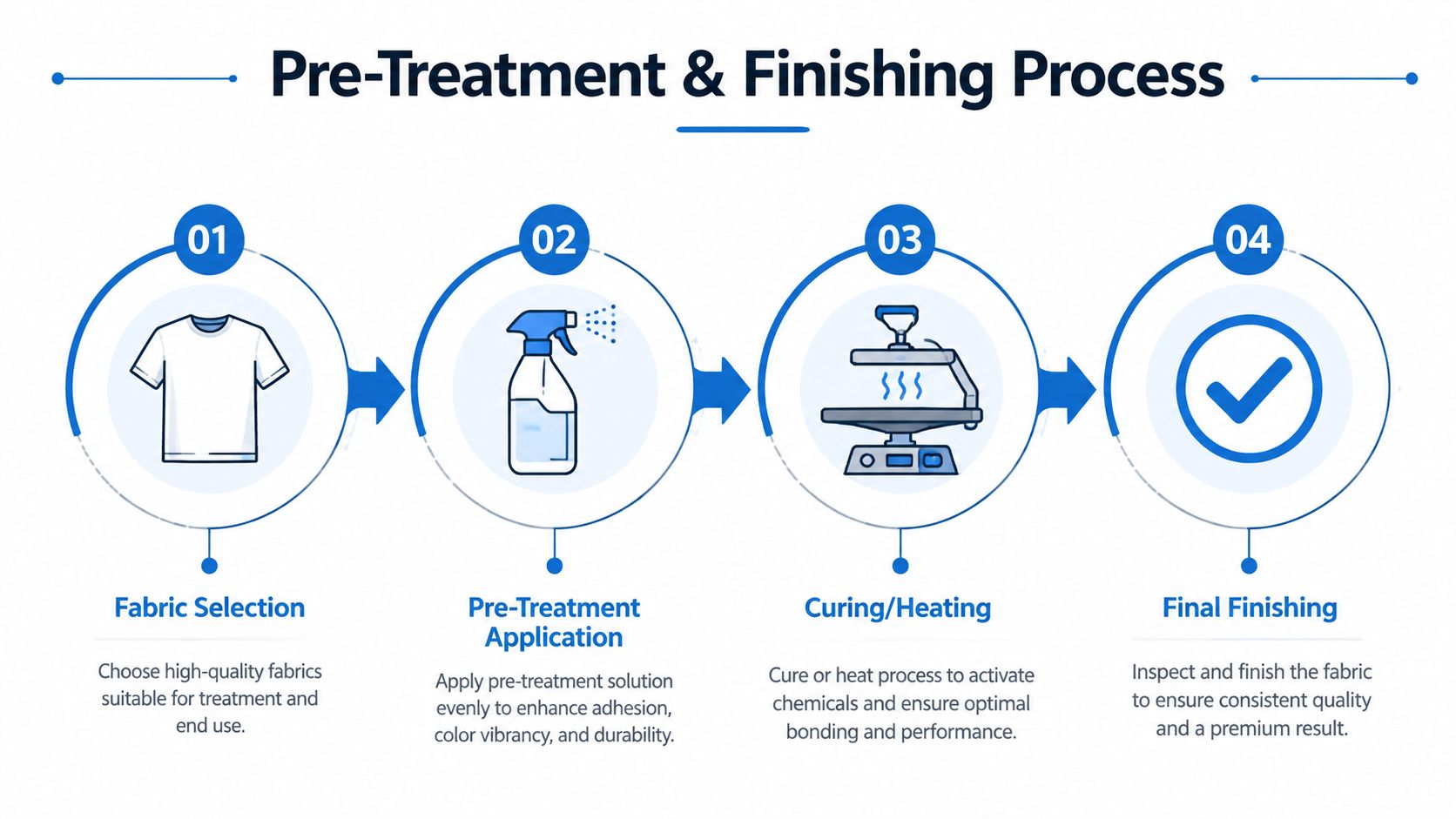
On dark cotton, DTG pre-treatment is required. The liquid creates the surface conditions the ink needs so it sits where it should instead of sinking too far into the fibers. When a decorator skips pretreatment or applies too little, the print can look muted, wash out early, or feel inconsistent from shirt to shirt.
Curing matters just as much. The print has to bond properly, and the heat and time settings need to match the ink and the fabric. If curing is off, the print might look acceptable at pickup but crack, fade, or lose adhesion after a few washes. Shirt and finishing process need to be bought together.
Ask the decorator about the full chain
Ask what ink they use, how they pretreat dark garments, and how they cure the finished piece. That is not nitpicking. It is how you protect a reorder program. A shirt can be the right blank on paper and still fail in production if the finishing step is sloppy.
Some shops handle screen printing, DTF, DTG, and sublimation in-house, while others subcontract part of the workflow. Dirt Cheap Product, Inc. is one option that handles custom screen printing, DTF, and sublimation across apparel, which matters when you need one vendor accountable for the full decoration chain. The value is consistency across process steps, not hype.
Watch for this: if a vendor cannot explain why one curing approach fits one ink system and not another, they are asking your garment to absorb the risk.
A shirt that survives repeated wash cycles usually owes that outcome to all three parts working together, blank, treatment, and finish. When one of those is off, the whole order carries the cost.
Budget Versus Premium Trade-Offs
Cheap up front can be expensive later
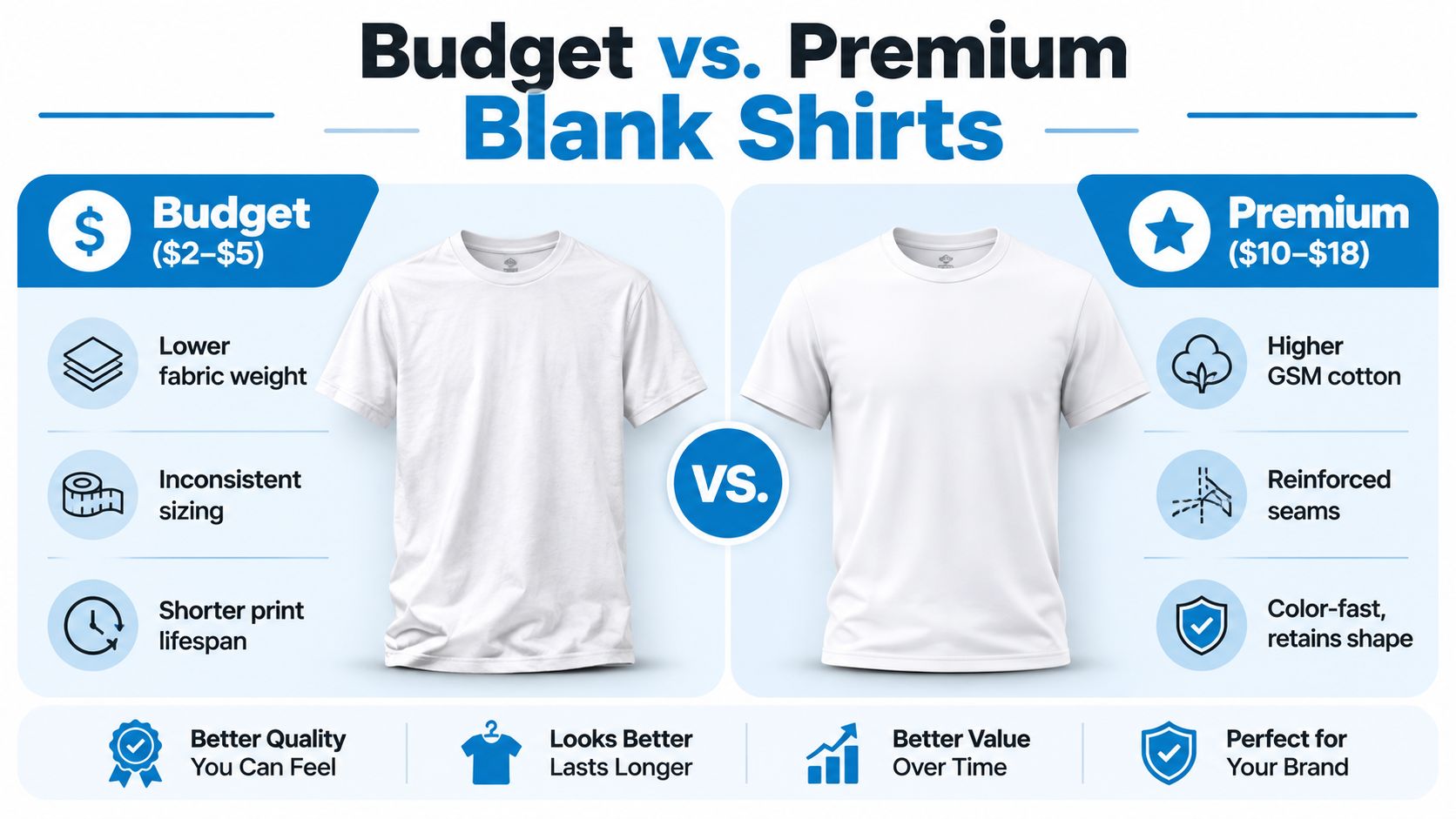
A low-cost blank makes sense when the shirt has a short run and a short life. For giveaway tees, volunteer shirts, or event merch that will not stay in rotation long, a budget blank can keep the first invoice under control without creating a printing headache. The trade-off is that cheaper fabric often gives you less consistency from shirt to shirt, which shows up when you reorder or try to match an earlier run.
A premium blank costs more because the knit is usually tighter, the fibers are better prepared, and the dye tends to behave more evenly. That matters if the shirt will be worn often, washed often, or pulled back into service for a second order with the same artwork. In that situation, the true cost is not the unit price on the PO, it is the cost of replacing shirts sooner, redoing art on a weaker blank, or explaining why the second batch does not match the first.
Match the shirt to the business model
For event merch, a budget or mid-tier blank usually makes sense if the job is high volume and the shirt only needs to hold up for a limited season. For retail or brand merch, a better cotton base is easier to justify because hand feel, print stability, and repeat wear affect whether customers buy again. For employee uniforms, consistency and durability matter more than squeezing a small amount out of the unit cost.
The earlier durability guidance applies here. A properly pre-shrunk ring-spun cotton blank in the 160–180 GSM range can hold print quality through repeated wash cycles when the rest of the process is handled correctly (MFG Merch). That changes the math for teams that reorder the same program over and over, because a shirt that lasts longer usually costs less over its full life than one that has to be replaced early.
The cheapest shirt is rarely the lowest-cost shirt over time. That is the part buyers learn after a few reorder cycles, when the savings from a lower-grade blank get eaten by replacements, complaints, and inconsistent rebranding work.
Actionable Spec Sheets and Decision Checklists
A spec sheet that saves time
If you want fewer mistakes, hand your decorator a clean spec sheet instead of a loose idea. At minimum, include fiber content, weight range, knit construction, blank color, dye lot requirement, print method, placement, pretreatment needs, and durability target. The clearer the brief, the fewer surprises on the first proof and the next reorder.
A usable spec might read like this, 100% ring-spun cotton, 160–180 GSM, tight knit, white blank, screen print, left chest plus back, pre-shrunk, and targeted for recurring wash use. That's enough to keep the conversation practical without drowning anyone in jargon.
Use this decision checklist before you order
- Define the use case: Decide whether the shirt is for events, staff, or retail before you compare blanks.
- Match the print method first: Screen printing, DTG, sublimation, DTF, and vinyl each narrow the field differently.
- Check the fabric: Confirm cotton, polyester, or blend based on method and hand-feel.
- Confirm the weight: Look for the range that matches your durability and printing needs.
- Lock the color strategy: Choose light, dark, or dyed blanks with the print method in mind.
- Ask about finishing: Verify pretreatment, curing, and wash-care expectations.
If you're comparing options with a decorator, ask what they see fail most often on repeat orders. That question surfaces the hidden costs, not just the catalog price.
The best t shirts for printing aren't the flashiest ones in the stack. They're the ones you can reorder, relabel, wash, and trust again without starting the selection process from scratch.
If you need a vendor that can handle custom apparel decoration across screen printing, DTF, and sublimation while keeping the proofing and turnaround process straightforward, visit Dirt Cheap Product, Inc.. They work with T-shirts, uniforms, and merch programs where consistency matters, and that makes them a practical place to start when you're ready to standardize blanks for repeated print runs.