You need five shirts for a small staff onboarding. Or one hoodie as a birthday gift. Or a single sample before you commit to a merch idea. Then you start shopping and hit the same old problem: minimums that make no sense for what you need.
That's where custom apparel no minimum has become useful in a very practical way. You can order the quantity that fits the job instead of padding the cart with extras you didn't want, won't use, and still have to store. For small businesses, events, school groups, internal teams, and one-off gifts, that changes the whole buying decision.
The bigger question isn't whether no-minimum ordering exists. It does. The question is whether it's the right production model for your artwork, garment, timeline, and budget. That's where most buyers get stuck, especially when every shop says “no minimum” but doesn't explain what method will give you the best result.
Table of Contents
- The End of Bulk Orders You Dont Need
- What Does No Minimum Really Mean
- Best Decoration Methods for Small Orders
- Understanding Costs and Turnaround Times
- Your Step by Step Ordering Workflow
- Real World Examples of No Minimum Apparel
- Choosing No Minimum vs Other Options
The End of Bulk Orders You Dont Need
A lot of buyers come in with a very ordinary request. They don't want a big merch launch. They want three polos for a front desk team, two jackets for a trade show, or one test print to see whether the logo looks right on black fabric.
For years, that kind of order ran into a hard stop. Traditional minimums commonly fall between 24 and 144 pieces, so no-minimum programs can cut the required quantity by as much as 96% versus a 24-piece threshold or 99.3% versus a 144-piece threshold, according to this no-minimum custom shirts guide. That's not a minor convenience. It changes whether a project happens at all.
Why this matters in real buying situations
A small order usually means one of four things:
- You're testing something: A new logo lockup, a new garment style, or a first sample for a brand concept.
- You have an exact headcount: Five volunteers, four staff members, one new employee.
- You need personalization: Mixed sizes, different names, or varied garment colors.
- You don't want dead inventory: Extra shirts become wasted spend fast.
Practical rule: If the order only exists because you're being forced to buy extras, the quantity is wrong.
Bulk still has its place. If you're outfitting a large event or ordering standard tees for a broad campaign, higher-volume production can make better financial sense. But for many jobs, bulk minimums solve the printer's production problem, not the buyer's actual need.
No-minimum ordering works best when the goal is precision. Buy the right garment. Decorate the right quantity. Approve the right proof. Reorder later if the program expands.
What buyers usually get wrong
The common mistake is assuming no minimum means “cheap.” It doesn't always. It means flexible. You're trading forced volume for better fit, lower inventory risk, and the ability to make decisions with less waste.
That's often the smarter move.
What Does No Minimum Really Mean
“No minimum” doesn't mean every decoration method suddenly became efficient for one piece. It means production technology changed enough that small-batch orders no longer break the workflow.
The old obstacle was setup. Traditional screen printing depends on prep work that takes time before the first garment is ever decorated. That model works well when a shop can spread setup labor across a larger run. It's much harder to justify when you only need one shirt in medium and one hoodie in extra large.
Why digital production changed the model
No-minimum custom apparel became workable because digital production lowered the friction of short runs. One industry guide notes that digital mockups are typically provided within 24 hours, which helps buyers review artwork quickly and combine exact sizing with mixed colors in one order, as described on RushOrderTees' no-minimum ordering page.
That matters because small orders tend to be less standardized, not more. A buyer might want:
- Mixed garment colors
- Different sizes in the same order
- One staff sample before approval
- A single rush replacement for a missing team item
Digital workflows handle those variables more cleanly than older bulk-first processes.
What no minimum does and does not include
A genuine no-minimum program usually means you can place an order for one decorated item without being forced into a preset quantity. It does not always mean every garment, every stitch-heavy logo, and every decoration style will be equally sensible at one piece.
A no-minimum offer is only useful if the artwork review, proofing, and production method are also built for small orders.
That's the part buyers should pay attention to. The best no-minimum experiences usually include online design tools, straightforward logo upload, visual placement previews, and a proof process that catches errors before production starts.
If you're ordering for a business, that proofing step matters more than the minimum itself. Small orders often move fast, and fast orders can also lock in mistakes fast if nobody checks garment color, print size, or logo placement carefully.
The practical takeaway
When a shop says “no minimum,” read it as an operations claim, not just a sales phrase. It means they have a workflow that can support low-quantity work without relying on large-run economics every time.
That's good news for buyers. It gives you room to order what you need now, then scale later if the program proves out.
Best Decoration Methods for Small Orders
The most important choice in a no-minimum project usually isn't the shirt. It's the decoration method. The same logo can look clean, heavy, soft, textured, or overly stiff depending on how it's applied.
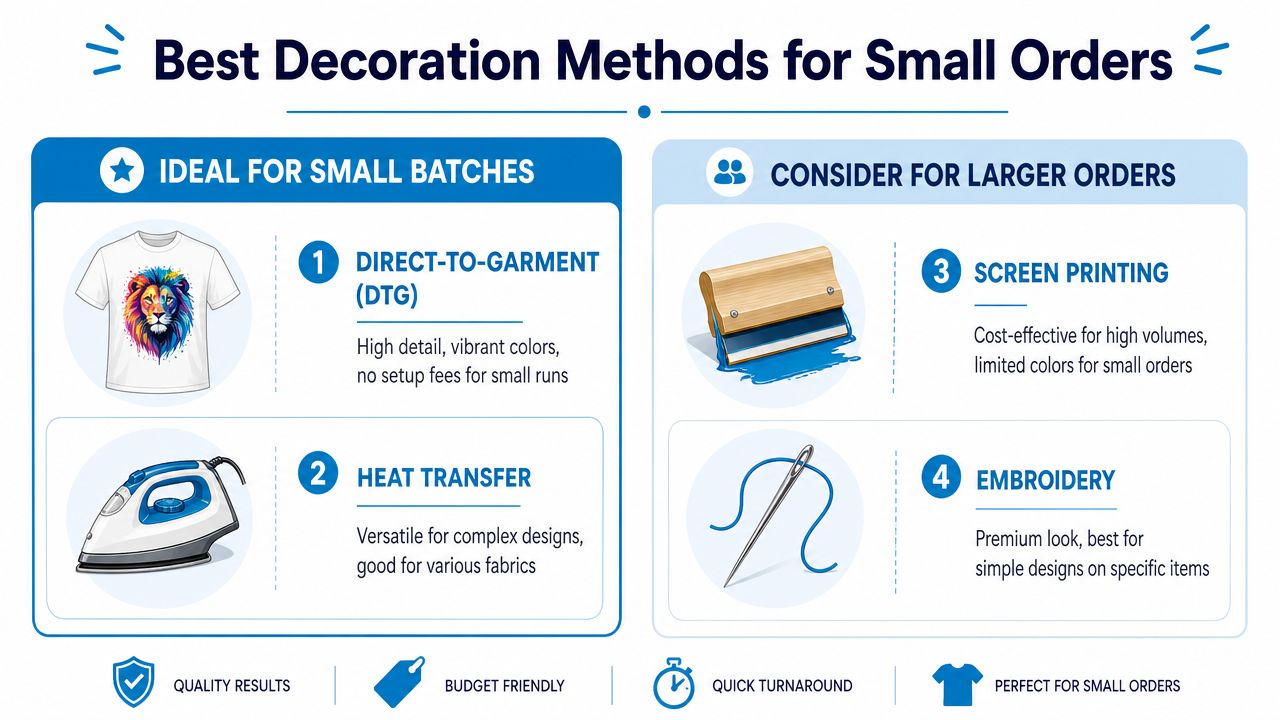
Digital printing made this category far more usable for small runs because digitally printed garments are commonly offered with no minimums, no setup fees, and unlimited ink colors, as noted on UberPrints' no-minimum t-shirt page. That's why full-color art, samples, and one-off orders are much more practical than they used to be.
When digital methods make the most sense
For small orders, the two digital methods buyers ask about most are DTG and DTF.
DTG works well when you want detailed artwork printed directly onto the garment surface, especially on tees where a softer print feel matters. It's a strong fit for photo-style graphics, gradients, and art with a lot of color variation.
DTF is often the more flexible option across fabric types and can be a good answer when the design needs strong color and broad garment compatibility. If you want a plain-language breakdown of how that process works, this guide on what direct-to-film printing is is useful.
Sublimation can also be excellent, but only for the right products. It shines when the garment and artwork are compatible with that process. It's not a universal answer for every cotton tee or every dark garment request.
When embroidery beats print
Embroidery isn't usually the first choice for a full-front illustrated design. It is often the right choice for polos, hats, outerwear, quarter-zips, and business uniforms where the goal is a polished brand mark instead of a large graphic.
Use embroidery when:
- Your logo is simple: Clean shapes and limited small detail usually sew better.
- The garment is structured: Caps, polos, jackets, and workwear often suit stitched decoration.
- You want texture: Embroidery adds dimension that print methods don't.
- The brand look is more corporate than promotional: A left-chest embroidered logo reads differently than a printed chest hit.
Where buyers run into trouble is trying to force embroidery onto artwork that was designed like a poster. Tiny text, soft gradients, and dense photographic effects usually don't translate well into thread.
If your design depends on fades, photo detail, or many tiny transitions, start with print. If it depends on polish, texture, and logo presence, start with embroidery.
A practical comparison
| Method | Best for | Usually works well on | Watch out for |
|---|---|---|---|
| DTG | Photo art, detailed full-color graphics, one-off tees | Cotton-forward shirts | Less ideal when you need the same result across many different fabric types |
| DTF | Variable short runs, colorful logos, mixed garment types | Tees, hoodies, blends, many general apparel items | Print feel can matter depending on design size and placement |
| Sublimation | Specific garment categories and all-over compatible applications | Products designed for sublimation workflows | Not a catch-all method for every fabric or dark garment |
| Embroidery | Polos, hats, jackets, uniforms, simple brand marks | Structured items and professional apparel | Fine detail, tiny text, and gradients can become messy |
A lot of small-batch success comes down to matching the art to the method instead of chasing the cheapest line item. A one-piece order that looks right is more valuable than ten pieces you don't want to reorder.
Understanding Costs and Turnaround Times
No minimum doesn't flatten pricing. A single basic tee with one left-chest mark is a different job from a premium hoodie with a large front print and sleeve art. Buyers get better results when they price the project by its actual variables instead of assuming every garment belongs in the same budget bucket.
Industry coverage notes that direct-to-film and related digital workflows continued gaining share in 2024 because they support short runs and variable designs more efficiently, while trade groups still maintain that screen printing remains more economical at higher quantities, according to this Lands' End Business overview of no-minimum uniforms. That's the cost trade-off in one sentence.
What changes the price
The biggest cost drivers are usually straightforward:
- Garment choice: A lightweight basic tee costs less than a heavyweight hoodie, branded jacket, or performance polo.
- Decoration method: Different methods carry different labor and production requirements.
- Artwork size: A small chest logo and a large full-front print are not the same job.
- Print locations: Front only is simpler than front, back, and sleeve.
- Order quantity: One piece often carries a higher per-piece cost than a coordinated run.
- Shipping speed: Rush production and fast shipping can change the final total.
If you're trying to compare digital versus traditional pricing logic, this article on how much it costs to screen print a shirt gives useful context on why larger runs can shift the economics.
What changes the timeline
Turnaround depends less on the phrase “no minimum” and more on production readiness.
A fast job usually has these traits:
- Clean artwork files
- Clear garment selection
- One decoration method
- Prompt proof approval
- No last-minute placement changes
A slower job usually involves back-and-forth on art cleanup, uncertain garment inventory, multiple print locations, or a logo that needs to be adapted for the chosen method.
Buyers often focus on production speed. In practice, approval speed matters just as much.
That's especially true for team orders. If the organizer hasn't finalized sizes, colors, or names, production can't move cleanly. For small business buyers, the fastest path is usually to settle the garment first, then decoration method, then proof. Changing all three at once creates delays even on a one-piece order.
Budgeting the smart way
For samples, pay attention to decision value, not just unit cost. A single high-quality sample can help you approve the right art, avoid a bad bulk run later, and choose a garment your team will wear. That's often a better use of budget than skipping the sample and guessing.
Your Step by Step Ordering Workflow
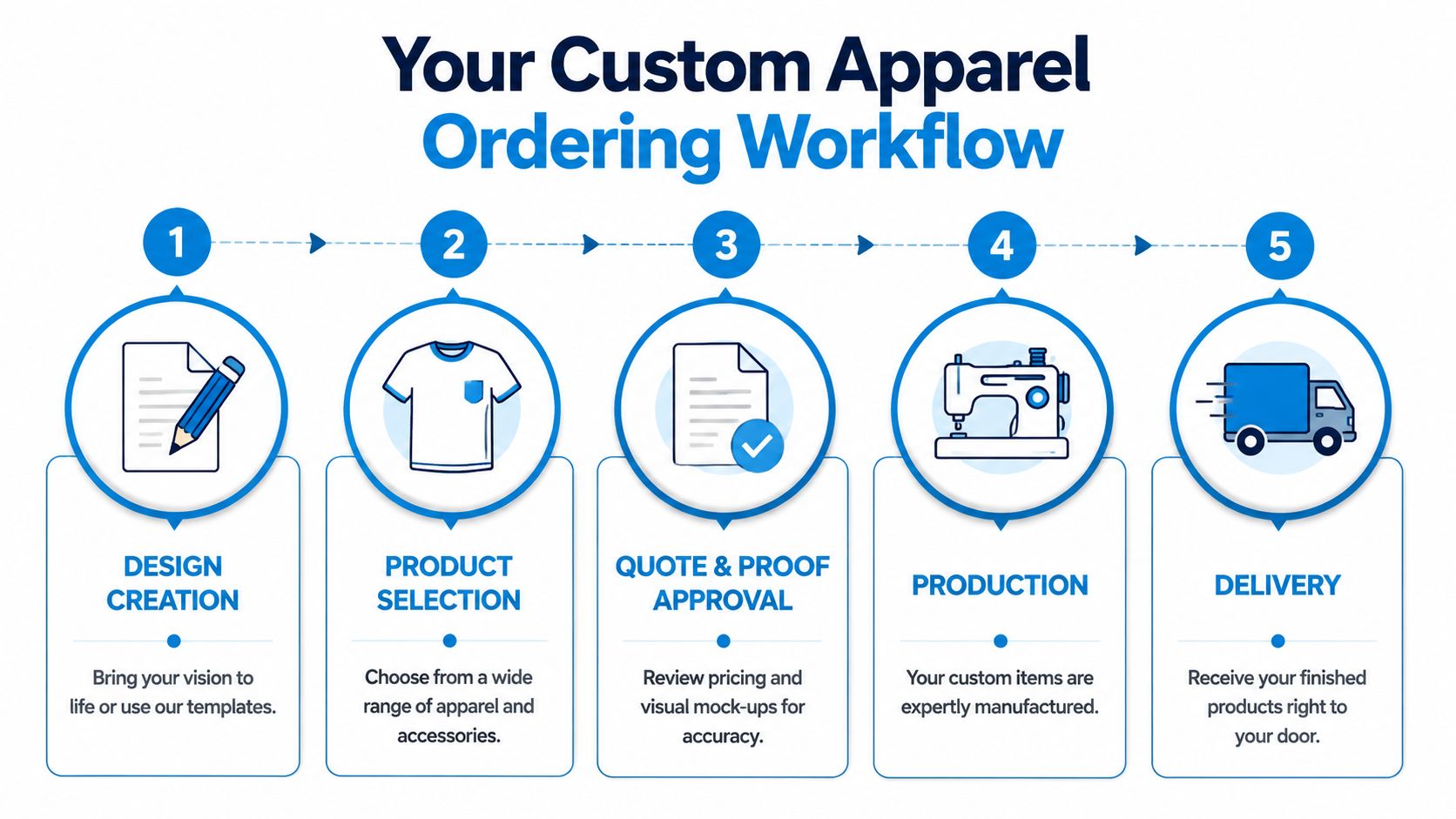
The smoothest no-minimum orders all follow the same basic pattern. Choose the garment. Upload the art. review the proof carefully. Then release it to production.
That sounds simple, but small orders only stay simple if the ordering tools are built for them. No-minimum ordering works best when the workflow includes online design, instant quoting, and proof-at-scale controls, because those systems reduce artwork errors and reorder friction, as described on LogoSportswear's custom apparel workflow page.
How a clean order moves faster
Here's the usual order path:
Pick the product
Start with the garment category that fits the use case. Staff polos, retail tees, event hoodies, jackets, hats. Don't upload art first and hope it works on every item.Add the artwork
Upload your logo, graphic, or text. If you're still deciding between print methods, a good art file gives the production team more options.Set placement and quantity
Front chest, full front, full back, sleeve, hat front, left chest. Then choose sizes and colors. If you only need one, order one.Review the proof
Mistakes get caught during this stage. Color contrast, sizing, placement, and logo proportions all need a real look.Approve and release
Once approved, the order moves into production and delivery timing becomes more predictable.
Some buyers also use mockups earlier in the process for internal approval. If your team is building product pages or campaign assets before the apparel is photographed, this overview of how AI transforms e-commerce content creation gives useful context on how visual workflows are changing.
What to check before approval
Before you click approve, slow down and verify:
- Logo size: Not just “looks fine.” Check whether it's appropriate for the garment.
- Placement: A left chest mark that sits too low will bother you every time you see it.
- Garment color contrast: Dark logo on dark shirt is still a common avoidable error.
- Spelling and punctuation: Especially on event apparel and personalized names.
- Method fit: A detailed logo may need print on one product and embroidery on another.
If you need a practical starter on preparing artwork, this guide on how to print a design on a shirt covers the basics clearly.
One operational note matters here. Dirt Cheap Product, Inc. offers apparel decoration services that include screen printing, embroidery, DTF, sublimation, and custom patches, with proofs provided quickly after logo upload. That kind of proof-first workflow is what buyers should look for in any vendor when the order is small and accuracy matters.
Real World Examples of No Minimum Apparel
The easiest way to judge whether no-minimum ordering fits your project is to look at the reason you're ordering in the first place.
Sample first then scale
A startup founder wants to launch a shirt design online but doesn't want boxes of unsold inventory. Ordering one sample solves a few problems at once. You can check fabric feel, print appearance, fit, and whether the artwork lands the way it looked on screen.
If the sample works, then you can decide whether to reorder in small batches, move into a larger run, or use a fulfillment model.
Small team uniform needs
A local service business hires a new employee and needs one matching polo right away. This is one of the most practical no-minimum use cases because the buyer isn't trying to build a whole seasonal uniform program in one shot. They're filling a gap.
That same logic applies to:
- Replacement pieces for staff
- A few jackets for a sales team
- One embroidered cap for a manager
- Small onboarding packs
The best no-minimum orders solve immediate operational needs without creating extra inventory.
One-off gifts and niche events
Some jobs are personal. One custom hoodie with an inside joke. Two shirts for a family trip. Four tees for a podcast recording. A handful of volunteer shirts for a neighborhood event.
These orders don't need wholesale logic. They need clean execution and the right decoration choice.
For gift orders, comfort and appearance usually matter more than squeezing the lowest possible unit cost. For event orders, clarity and deadline matter more. For internal business use, consistency with prior branding matters most.
That's why no-minimum apparel works across very different situations. The common thread isn't industry. It's the need for exact quantity without waste.
Choosing No Minimum vs Other Options
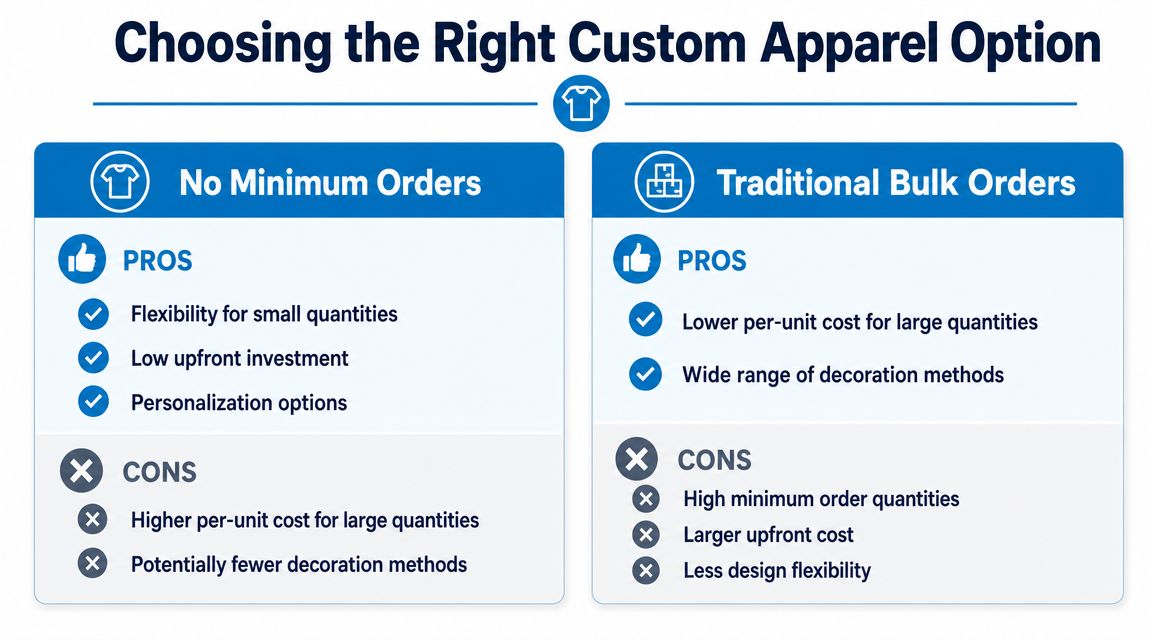
No minimum is useful, but it isn't the only model worth considering. The right choice depends on whether you're optimizing for flexibility, hands-off fulfillment, or the lowest cost per piece at scale.
A simple decision framework
Choose no-minimum ordering when you need samples, exact quantities, replacements, gifts, or a small team kit. It's a strong fit when you want control over the garment and decoration but don't want to overbuy.
Choose print on demand when you're running an online store and want someone else to handle one-off fulfillment order by order. If you're building that kind of storefront, this guide to optimizing your Shopify apparel store is a useful resource because the storefront setup and merchandising side matter as much as the garment itself.
Choose bulk ordering when the design is locked, the headcount is stable, and your top priority is lower per-piece cost on a larger run. That's often the better route for school programs, large events, and broad promotional distributions.
A quick way to decide:
- Need one to a few pieces now: no minimum
- Need ongoing e-commerce fulfillment: print on demand
- Need a larger run at better scale economics: bulk
The mistake is treating these as competing ideologies. They're just tools. Many buyers use all three at different stages. Sample with no minimum. Sell with POD. Move proven designs into bulk once demand is clear.
If you need branded apparel without forcing a bulk order, Dirt Cheap Product, Inc. can help you choose the right garment and decoration method for the quantity you need, from a single sample to a small team order. Upload your logo, review the proof carefully, and build the project around fit, finish, and real use instead of unnecessary extras.