
You have a logo file, a rough headcount, and a date circled on the calendar. Quotes start coming back and every printer asked the same three things before naming a price: how many shirts, what fabric, and how many colors are in the artwork. Nobody explained why those questions decide the number, so you guessed, and now one quote looks too high and another looks too good to trust.
The different types of T-shirt printing available today solve very different problems. Screen printing, direct-to-garment, direct-to-film, dye sublimation, embroidery and heat transfer vinyl each fit a particular combination of quantity, fabric and wear, and each one fails in a predictable way when you push it outside that combination. What follows sorts them by the job they're built for, and points to where the evidence says each one struggles.
Table of Contents
- Which Printing Method Fits Your Order at a Glance
- Screen Printing for Large, Repeat Orders
- Direct-to-Garment and Direct-to-Film for Detailed Designs
- Dye Sublimation for Polyester and All-Over Prints
- Embroidery and Heat Transfer Vinyl for Small Details
- Durability and Wash Performance by Method
- Confirm the Method and Proof Before You Order
Which Printing Method Fits Your Order at a Glance
A running club needs 200 identical shirts for a race: one logo, two colors, one size run. A bakery three blocks away needs 12 shirts with a full-color photo of its storefront across the back. Both buyers ask the same question, both hear "yes, we can do that," and the two quotes come back structured so differently that comparing them feels like guesswork.
The gap isn't the printer's skill. It's the shape of the job. Three questions settle almost everything about which method fits, and you can answer all three before you email anyone.
- How many shirts? Setup work is charged once and spread across the run. Spread it over 200 shirts and it disappears into the unit price. Spread it over 12 and it dominates.
- What fabric? Cotton, polyester and blends don't accept the same inks. Some methods physically bond only to certain fibers, and no amount of skill fixes a fiber mismatch.
- How detailed is the design? Flat shapes in a few solid colors behave very differently from a photograph with gradients, shadows and hundreds of colors.
The table below sorts the six methods you're most likely to be quoted on. Find your order size first, check the fabric column second, then read the Main limit column as the first warning for that method before you go any further.
T-shirt printing methods compared by order size and fabric
| Method | Best order size | Best fabric | Main strength | Main limit |
|---|---|---|---|---|
| Screen printing | Medium to large runs | Cotton and blends | Bold colors and accurate spot-color matching | Separate screen and setup for each color |
| Direct-to-garment (DTG) | Single pieces to small runs | Cotton | Full-color detail with no screens | Slower per shirt and weaker on polyester after many washes |
| Direct-to-film (DTF) | Small to medium runs | Cotton, polyester and blends | Multicolor designs on dark garments with a white underbase | Transfer film must be cured correctly |
| Dye sublimation | Small to large runs | White or light polyester | Soft feel and all-over prints | Does not work on 100% cotton |
| Embroidery | Small to medium runs | Polos, hats and thick knits | Stitched, premium look that lasts | Limited fine detail and higher cost per design |
| Heat transfer vinyl | One-off to small runs | Cotton and blends | Names, numbers and simple shapes | Edges can lift after many washes |
Two rules of thumb will help teams get the right first quote. Under 50 shirts with detailed or full-color artwork points to DTG or DTF. Fifty shirts or more with one to four flat colors points to screen printing.
Three mistakes account for most of the disappointing orders we hear about.
- Sublimation on cotton. The dye needs polyester fibers to soak into. On 100% cotton it has nowhere to go, and the print comes out faded and washes out fast.
- DTG for a large identical run. It works, but you're paying per shirt for a process built for flexibility. A 500-shirt run with two flat colors is screen printing territory.
- Skipping a wash test on dark blends. Dark shirts hide a weak bond until the third or fourth wash, which is usually after the event.
Branded merch rarely travels alone. If the same order includes drinkware, the order-size logic still applies, and this guide to choosing bottles for corporate giveaways covers how decoration works on that side of the package.
Treat every rule above as a starting point. Fabric and wash conditions always get the final say.
Screen Printing for Large, Repeat Orders
Think of a can of spray paint and a paper stencil. One stencil gives you one shape in one color. Want a second color and you cut a second stencil, line it up with the first, and spray again. Screen printing works the same way, except the stencil is bonded to a fine mesh and the spray is ink pushed through with a squeegee.
Here's the sequence on a real order.
- Artwork is separated. Each color in the design becomes its own stencil. A three-color logo means three stencils, and a photograph would need far more than any shop wants to burn.
- Screens are prepared. A mesh screen is coated with light-sensitive emulsion, the artwork is burned onto it, and the unexposed areas wash out to leave open mesh where ink will pass.
- Ink is pushed through. A squeegee drags ink across the screen and forces it through the open areas onto the shirt.
- Each color is registered. The next screen is aligned to the first with a registration step so the layers land where the artwork says they should.
- The shirt is cured. The printed garment runs through a dryer so the ink film sets and becomes washable.
Here's the whole flow in one view.

Why Spot Colors Beat Process Color
Screen printing can use premixed spot-color inks, which means the printer mixes a specific color and prints it directly instead of simulating it from four process inks. That matters for uniforms and corporate logos, where "close" isn't good enough.
An independent study comparing screen printing, direct-to-garment and dye sublimation found screen printing produced the most accurate and consistent color against brand specifications, while the digital processes showed larger color differences, with reported ΔE values of roughly 14 to 28 in the color accuracy comparison published through the Imaging Society. Premixed inks cut out the fabric-dependent mixing variables that digital CMYK relies on.
Practical rule: Ask for a physical or digitally verified proof when exact brand color matters. Fabric color, ink deposit, curing and substrate texture all shift the final look, so a screen name on a monitor proves less than a printed sample.
Cure Is a Step, Not an Afterthought
Plastisol ink only becomes washable when the entire ink film, not just the surface, reaches its cure temperature. The Specialty Graphic Imaging Association's guidance on textile washfastness puts typical plastisol flashing temperatures at 180°F to 250°F and notes that the PVC resin has to absorb the available plasticizer for a proper cure.
That's why a print can feel dry, stack without marking, and still fail early. Ask which cure temperature your printer runs for the ink on your order.
Screen printing is the right call when you have 50 or more identical shirts, one to four flat colors, and artwork that won't change mid-run. Below that, the per-color setup eats the savings.
Direct-to-Garment and Direct-to-Film for Detailed Designs
A photograph has thousands of colors and no clean edges. There's no sensible stencil to cut, so screen printing it becomes a battle of halftones and extra passes. Digital methods read the file directly instead, the way your office printer does.

Direct-to-garment (DTG) is an inkjet printer built for fabric. It sprays water-based pigment ink onto the shirt from a computer file, with no screen and no per-color setup. On dark cotton it usually needs a pretreatment spray first, which gives the ink something to bond to and keeps white ink from sinking into the fibers.
DTG's sweet spot is detailed cotton shirts in single pieces up to small runs: a memorial shirt for one person, 30 shirts for a small team, a photograph or gradient design that has no business on a screen. Its weak spot is polyester and blends, where a print can look sharp at first and then fade after repeated laundering.
Digital printing is not a niche anymore, either. Grand View Research's digital textile printing analysis valued the market at USD 9.3 billion in 2025, with apparel at 54.3% of application revenue and cotton at 52.1% by material. Cotton's lead is exactly why DTG sits where it does in the market.
Here's how a digital file becomes a finished shirt.
DTF Handles Dark and Mixed Fabric
Direct-to-film (DTF) flips the order of operations. The design is printed onto a coated film, a powder adhesive is applied while the ink is still wet, and the film is heat-pressed onto the garment. The adhesive bonds the ink to the fabric, and a white underbase layer sits underneath the color so the design stays opaque on a black or navy shirt.
A study of DTF wash performance in Advances in Materials Science and Engineering tested prints on cotton and polyester and found the DTF prints retained complete QR-code scannability, with recognition taking about one second after five wash cycles, while color fastness was rated Grade 4 to 5, described as good to excellent. The process in that test dried samples for five minutes at 85°C, then cured for five minutes at 150°C to set the binder and secure pigment to the textile.
Set the two side by side on the questions that decide an order and the split is clean.
- Fabric: DTG is a cotton tool. DTF covers cotton, polyester and blends.
- Dark shirts: DTF wins, because the white underbase does the work. DTG needs pretreatment and careful handling to get there.
- Wash results: DTF's film-based bond held up well in testing. DTG on polyester is the shakier combination over time.
If you're weighing a film transfer against a multi-color screen setup, this comparison of DTF versus screen printing covers where the cost per shirt crosses over.
Verdict: DTG for detailed light-colored cotton in small numbers, DTF for dark or mixed-fiber shirts where the design has to stay vivid.
Dye Sublimation for Polyester and All-Over Prints
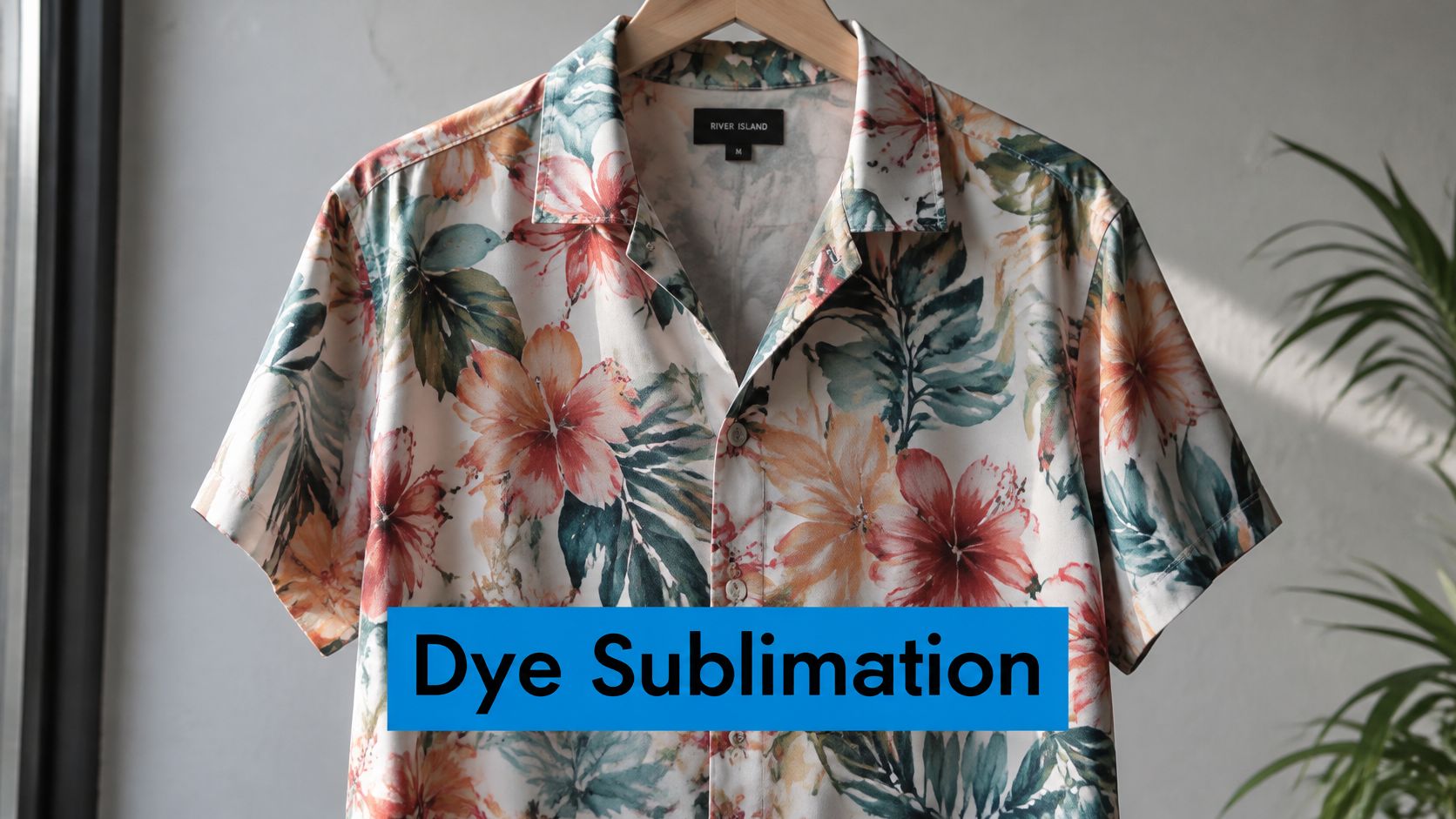
A white polyester jersey with a photo wrapping from the chest around the side seam stays flat under your hand because the color sits inside the fiber. Sublimation works like steam moving through cloth, not like ink painted on the surface. Heat turns the dye into gas, the gas soaks into polyester, and cooling locks it in the yarn. There is no raised layer, no film edge to lift, and nothing that can crack the way a surface print can.
The fabric rule decides the order before the artwork does. Sublimation needs polyester or a high-polyester blend. On 100% cotton the dye cannot bond reliably, so the image stays weak. On a dark shirt the dye is transparent, so it cannot produce a light image without a base layer that changes the finish. White or light performance shirts, sportswear, and all-over graphics that wrap the body are the jobs it is built for. A cotton tee, or a navy staff shirt, is where it fails even when the file looks perfect on screen.
That fit shows up in the market mix. Dye sublimation accounted for 42.4% of the digital textile printing market in 2024, according to SNS Insider's market analysis.
Heat and Speed Have to Match
Color only holds when heat and time stay paired. A peer-reviewed experiment in Scientific Reports tested polyester at transfer temperatures of 170°C, 190°C and 210°C, with dwell times of 30 and 60 seconds, and found the strongest color release at 210°C for 60 seconds. Cut either setting and the same file can look pale on the next batch, because the dye never fully enters the fiber.
A continuous press adds speed to that pair. A 2024 study in the Journal of Print and Media Technology Research4_web_2413.pdf) tested transfer speeds of 18, 24 and 32 meters per hour against temperatures of 200°C, 215°C and 240°C, and reported its best optical density at a process temperature of 215°C.
Ask what temperature and what speed the printer runs, not only whether the shop offers sublimation. A repeat order stays consistent only when both settings stay matched. Choices for polyester tees are laid out in this guide to sublimation printing on T-shirts.
Embroidery and Heat Transfer Vinyl for Small Details
Embroidery is thread stitched into the garment, so the decoration sits in the fabric rather than on it. You get a raised, textured surface that reads as premium in the hand and survives repeated washing without peeling, because there's no film or ink layer to break down.
It also solves problems printing can't touch. Structured caps, thick knits, jackets and heavyweight polos don't take ink cleanly, but a needle goes straight through them. Left-chest logos, sleeve marks and hat fronts are its home turf. The trade-off is resolution: embroidery can't reproduce a photograph or a fine gradient, and text that's too small turns into a solid block once the thread density fills in.
Heat transfer vinyl works the opposite way. A colored film is cut to shape, positioned on the shirt and pressed with heat, like applying a sticker with an iron. There's almost no setup, so names, numbers and simple shapes for a sports team or a one-off gift are quick and cheap. Durability is where it gives ground: edges can lift and the film can crack after many washes, especially on stretchy fabric. Turn those shirts inside out, wash cold, and skip the dryer.

Compared on the same four points:
- Look: embroidery is textured and dimensional. Vinyl is flat and graphic.
- Durability: stitched thread outlasts a heat-bonded film, which eventually cracks or lifts.
- Detail: vinyl handles crisp lettering and numbers. Embroidery handles bold shapes and blocks, not 8-point type.
- Best use: embroidery for logos on polos, jackets and hats. Vinyl for a roster of names and numbers on team shirts.
If you want to see how far the stitched route can go beyond a left-chest logo, this overview of custom embroidery clothing shows the range of garments and placements.
Durability and Wash Performance by Method
A shirt can come out of the wash with its color intact while the print feels stiff, cracks, or loses fine detail. Durability is not one score: it depends on the printing method, the fabric, how the garment is washed, and what kind of wear it gets.
| Method | Wash performance | Hand feel | Fine detail | Watch for |
|---|---|---|---|---|
| Screen printing | Durable when the ink is fully cured; results depend on ink and garment | Can have a thick ink layer on the surface | Strong for flat, bold shapes | The full ink film needs to cure |
| Direct-to-garment (DTG) | Results depend on fabric and care; repeated washing can affect the print | Soft on cotton, especially after the first wash | Full-color photo detail | Dark cotton usually needs pretreatment |
| Direct-to-film (DTF) | Results depend on film application, garment, and care | Slight film feel | Multicolor detail | The film must be cured correctly |
| Dye sublimation | Strong color fastness on polyester in the cited study; rubbing fastness may be weaker | Little surface feel | Suitable for all-over prints | Best suited to polyester |
| Embroidery | Stitched thread holds up to repeated washing | Textured | Limited fine detail and tiny text | Dense stitching can affect how the garment feels |
| Heat transfer vinyl | Edges can lift and film can crack after many washes | Visible film with a slight edge | Names, numbers, and simple shapes | Wash inside out in cold water |
What the Numbers Actually Say
A textile printing study indexed by KCI reported grade 5 washing fastness for sublimation-printed polyester on its fastness scale. The study also found that rubbing fastness could be weaker, which shows why wash performance alone does not describe every kind of wear.
The fabric-method pairing matters. Sublimation suits polyester, while a screen print depends on the ink being fully cured. Think of curing like letting paint set all the way through: a dry-feeling surface does not necessarily mean the whole layer is ready to withstand washing.
For a clearer picture of how color retention is assessed, this guide to color fastness testing explains the testing methods. Ask for a wash test on the same fabric and under the care conditions the shirts will face, such as hot water, bleach, or tumble drying.
Substrate and handling affect printed products beyond apparel, too. The Mylarmen cannabis label printing guide addresses those considerations for product labels.
Confirm the Method and Proof Before You Order
You don't need to memorize ink chemistry. You need five answers in writing before you pay a deposit, and the order matters.
- The fabric. Is the shirt 100% cotton, polyester, or a blend? Ask for the exact style number, not "a soft tee." Every method decision downstream depends on this answer.
- The order size and design count. Are you ordering one design or six? A run of 200 split across six designs is six setups, not one.
- The color count and brand requirements. How many colors are in the artwork, and does the brand color have to match exactly? If yes, you need a spot color and a proof, not a process simulation.
- The wash conditions. Will these shirts go home with employees, through a commercial laundry, or into retail with a hangtag? Heat, chemicals and tumble drying all shorten a print's life.
- The proof. Is there a physical or digitally verified proof before production? Fabric color and ink deposit change how artwork looks, and curing is what makes a print last.
Once those five are settled, ask the printer to confirm the method, its cure or heat settings, and any wash test run on the same fabric you're buying. A short email covers it.
You can send your logo by filling out the form on the website and uploading the file, and a sales rep replies Monday to Friday, 9am to 5pm Eastern Standard Time. You can also place custom orders through the Custom Order Form on the website.
One action for today: write down your order size, your fabric and your design type in three lines, then send them to your printer and ask for the recommended method plus a proof, in writing, before production starts.
Dirt Cheap Product, Inc. runs screen printing, embroidery, direct-to-film and sublimation on T-shirts, polos, hats and bags, with apparel catalogs at wholesale pricing and proofs provided before anything goes to press. If you're still deciding between methods, send your logo through the upload form and we'll match the decoration to your fabric and quantity. Visit Dirt Cheap Product, Inc. to start your order.