
You're probably sorting through the same questions most apparel buyers hit when a shirt order starts to matter. The team needs uniforms for an event. Marketing wants retail-quality merch. Sales wants something lightweight enough for long expo days. Then the decoration choices pile up fast, and the wrong one can leave you with shirts that feel heavy, fade early, or don't suit the fabric.
Sublimation printing t-shirts solves a specific business problem well. When you need full-color graphics, all-over coverage, and a print that becomes part of the garment instead of sitting on top of it, sublimation is often the right call. It isn't universal, though. It has hard material limits, artwork requirements, and clear cases where another method makes more sense.
Table of Contents
- Choosing the Right Print for Your Brand
- What Is Sublimation and How Does It Work
- Material and Artwork Requirements for Sublimation
- Sublimation vs Other T-Shirt Printing Methods
- When to Choose Sublimation for Your Brand
- Practical Tips for a Perfect Sublimation Order
- Frequently Asked Questions About Sublimation Printing
Choosing the Right Print for Your Brand
A common order starts with good intentions and bad assumptions. A company picks a moisture-wicking performance tee because the staff will be on their feet all day, then sends over a bright gradient logo and expects it to print well with any method. That's where decoration choice stops being cosmetic and starts affecting comfort, durability, and how polished the brand looks in public.
Sublimation earns attention when the garment itself is part of the design strategy. If your brand wants edge-to-edge graphics, photo-like detail, or a print with no heavy hand feel, this method gives you something screen printing and embroidery can't match on polyester performance apparel. For trade show teams, race shirts, resort merchandise, and retail-style activewear, that matters.
The decision starts before production
Before placing an order, smart buyers usually narrow three things first:
- The garment purpose: Staff uniform, promotional giveaway, premium merch, or resale item.
- The fabric type: Polyester-rich performance wear behaves very differently from cotton.
- The artwork complexity: Solid spot colors are one thing. Gradients, textures, and photographic imagery are another.
A mockup helps a lot at this stage because it reveals whether the design belongs on a polo, a tri-blend tee, or a full-performance shirt. For that early visual check, PhotoMaxi's mockup generator is useful when you want to preview placement and overall presentation before production decisions lock in.
Practical rule: Don't choose the decoration method first. Choose the garment, the use case, and the visual goal first.
If your team is still comparing decoration options across garments, this guide to choosing a logo decoration method is a practical way to frame the decision. The best print method for your brand usually isn't the most popular one. It's the one that matches the shirt, the artwork, and the job the apparel has to do.
What Is Sublimation and How Does It Work
Sublimation isn't ink sitting on top of a shirt. It behaves more like a dye infusion. Once it's done correctly, the design becomes part of the fabric surface, which is why the finished print feels smooth instead of raised.
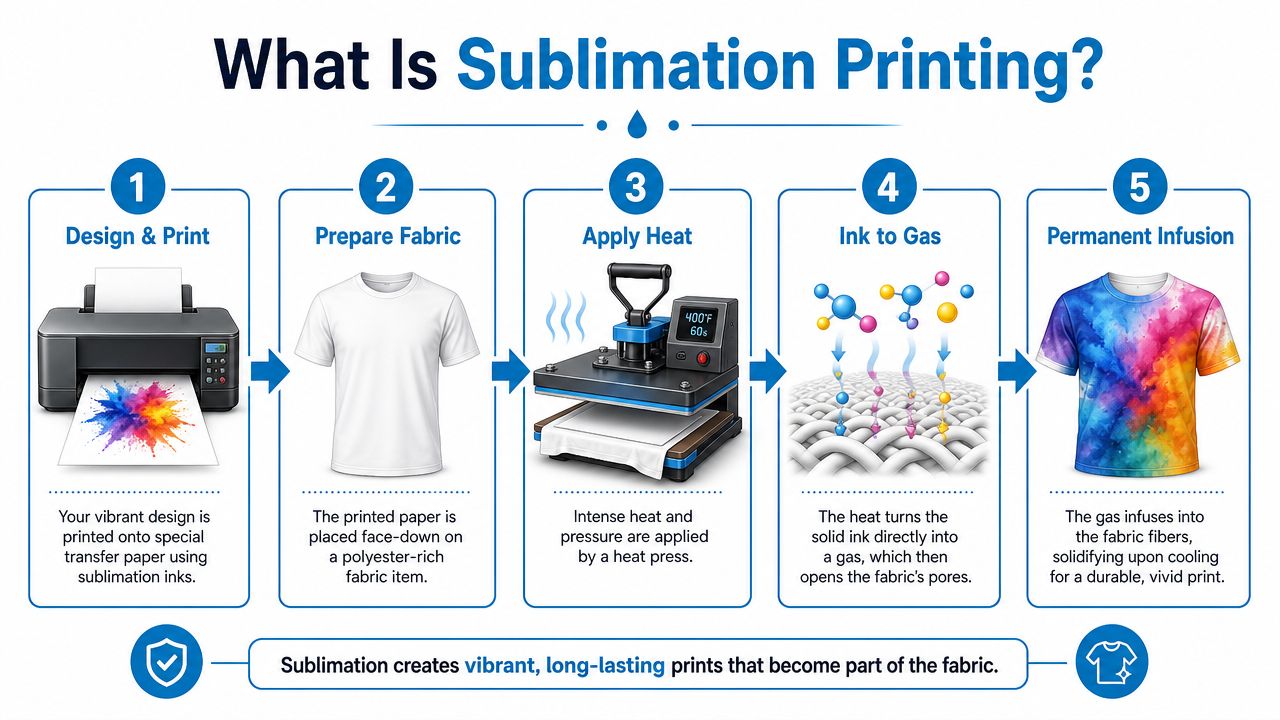
The basic workflow is straightforward. The design is printed onto special transfer paper with sublimation ink. That paper is positioned on a polyester-rich shirt, then a heat press applies temperature, pressure, and time so the image transfers into the fabric.
Why the print feels different
The key science is the phase change. The sublimation process relies on a thermodynamic phase transition where solid ink converts directly into a gas at temperatures between 385°F and 400°F (196°C–204°C) without passing through a liquid state, allowing the gas to permeate the fabric fibers and permanently bond upon cooling according to this explanation of sublimation t-shirt printing.
That direct gas conversion is what sets sublimation apart. There isn't a separate layer left sitting on the shirt face. On the right material, the result is a print with strong color, soft feel, and long wear.
If your team also works with image-based garment projects outside standard apparel runs, DIY photo printing on fabric gives helpful context on how photo transfer approaches differ depending on material and method.
What happens during pressing
Production success depends on holding the press in the right operating range. A common benchmark is 400°F for 45–60 seconds so the transfer completes cleanly, and paper movement as small as 1/16 inch can create ghosting or a double image, as noted in this practical sublimation shirt guide.
Here's the process in plain terms:
- Print the transfer on sublimation paper using the final mirrored artwork.
- Position the sheet on the shirt so placement is exact before heat is applied.
- Press at production settings so the ink changes from solid to gas.
- Let the shirt cool so the dye sets inside the fibers.
- Inspect the result for full transfer, sharp edges, and clean color.
A short visual walkthrough helps if you want to see that sequence in action.
Material and Artwork Requirements for Sublimation
Most failed sublimation orders don't fail because the press was broken. They fail because the shirt choice or art file wasn't right for the process. The material and the artwork do most of the heavy lifting before production even starts.
The fabric rules that decide the outcome
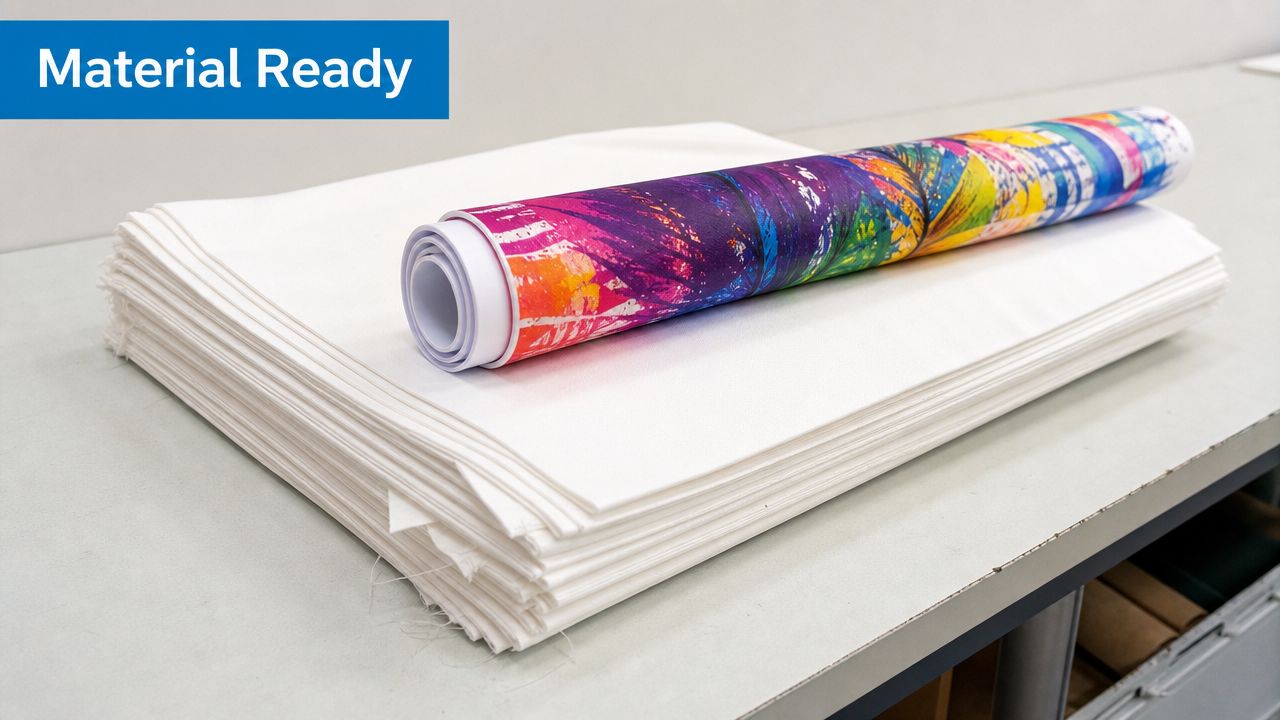
The biggest rule is simple. For successful sublimation on T-shirts, the fabric must contain at least 65% polyester content, as lower percentages prevent the dye from bonding properly; if cotton is used, a sublimation coating spray or a heat transfer vinyl base must be used as an intermediary layer, according to this walkthrough on sublimation shirt requirements.
In practice, that means:
- High-poly shirts produce the intended look: Color stays stronger and more consistent.
- Lower-poly blends shift the result: The image can take on a faded or vintage appearance.
- Cotton isn't a direct sublimation fabric: It needs an added workaround, which changes the process and often the feel.
That's why the blank matters as much as the art. If you want a premium athletic finish, choose a polyester-rich shirt from the start instead of trying to force sublimation onto the wrong garment.
A buyer who chooses fabric first and decoration second usually gets a better result than a buyer who falls in love with a shirt style and tries to make every print method fit it.
There's also a color limitation tied to the chemistry. Sublimation works best on white or very light polyester because the dyes are transparent and rely on the base fabric for brightness.
Artwork files that produce clean results
Sublimation handles detailed visuals well. With this method, gradients, layered color transitions, textured backgrounds, and photo-style images shine. A simple one-color logo will work, but sublimation really pays off when the design would be awkward or expensive to build in multiple screens.
File prep still matters. Send artwork that's production-ready, not something pulled from a website header or screenshot.
- Use large original files: High-resolution PNG, AI, PSD, or print-ready PDF files are the safest options.
- Keep edges clean: Soft pixels become obvious on sharp logos and type.
- Build in the correct color mode: If you're preparing art for print, this RGB to CMYK conversion guide helps prevent avoidable color surprises.
- Include placement intent: Full front, left chest, sleeve, or all-over layouts should be clearly marked.
For brands using photography in apparel graphics, how to put a photo on clothes is a useful reference for thinking through image suitability and garment presentation.
A good art file doesn't just print cleaner. It shortens proofing, reduces revision loops, and makes the final order more predictable.
Sublimation vs Other T-Shirt Printing Methods
Most business buyers aren't asking whether sublimation is good. They're asking whether it's better than the alternatives for this order. That's the right question.
Screen printing, DTF, and sublimation all solve different problems. If you use them interchangeably, you'll overpay, underdeliver, or end up with a shirt that looks right on day one and wrong after real use.
Side-by-side comparison
| Feature | Sublimation Printing | Screen Printing | Direct-to-Film (DTF) |
|---|---|---|---|
| Best fabric match | Polyester-rich garments and polymer-coated items | Commonly chosen for cotton and many standard tees | Broad fabric compatibility, including cotton, blends, and polyester |
| Print feel | No added surface layer when done correctly | Varies by ink load and design coverage | Usually leaves a transfer layer on the garment |
| Color capability | Strong for full-color graphics, gradients, and all-over layouts on light polyester | Excellent for simpler graphics and controlled spot-color jobs | Handles detailed full-color artwork well |
| Dark garment use | Poor fit for direct application | Good option depending on artwork and ink setup | Common choice for dark garments |
| Large solid fills | Very effective on suitable performance fabric | Strong option, especially for standard placements | Works well, though feel may be heavier |
| Small order flexibility | Useful when artwork is complex and fabric is right | Often less practical when setup is significant | Often chosen for short runs and mixed designs |
| Retail athletic look | Excellent fit | Depends on garment and ink style | Depends on film feel and artwork coverage |
| Cotton compatibility | Not a direct fit without workaround | Strong fit | Strong fit |
The fastest way to think about it is this. Sublimation is a fabric-matched method. Screen printing is often a volume and simplicity method. DTF is a versatility method.
How buyers usually decide
If the order is for staff tees on cotton, with a clean logo on the chest and back, screen printing or DTF usually enters the conversation first. Sublimation would be forcing a process onto the wrong base.
If the order is for polyester jerseys, branded race shirts, fishing shirts, or performance uniforms with gradients and sponsor logos, sublimation jumps ahead quickly. It gives you color range without adding weight to the shirt.
For mixed-fabric programs, some buyers compare DTF against sublimation directly. This DTF vs sublimation printing guide is useful if you're choosing between broad fabric flexibility and the soft integrated feel that sublimation delivers on polyester.
Buyer's shortcut: Choose screen printing for straightforward graphics on standard shirts. Choose DTF when fabric flexibility matters. Choose sublimation when the garment is polyester-rich and the design needs to live inside the fabric, not on top of it.
Real trade-offs matter here:
- Sublimation wins on feel when the shirt and color conditions are right.
- Screen printing wins on classic cotton programs and straightforward branding.
- DTF wins on versatility when you need one method across different garment types.
There's no single universal winner. There is only the method that fits the order in front of you.
When to Choose Sublimation for Your Brand
A buyer is planning apparel for a 5K series, a field sales team, or a branded activewear launch. The shirts need to stay light, hold sharp color, and still look right after repeated wear and washing. That is usually the point where sublimation moves from an interesting option to the correct production method.
Business cases where sublimation fits
Sublimation makes the most business sense when the garment and the graphic strategy support it. Performance shirts, team jerseys, fishing shirts, training apparel, and promotional activewear are strong candidates because the print becomes part of the fabric instead of adding a layer on top. For companies ordering at scale, that matters. Staff and customers notice comfort fast, especially on shirts worn for hours at events or in the heat.
It is also a strong choice for artwork that would be expensive or awkward in other methods. Full-front gradients, edge-to-edge graphics, multicolor sponsor layouts, and variable elements like names or numbers are common examples. If the visual impact of the shirt is part of the campaign, product launch, or merchandise margin, sublimation often gives better value than forcing a simpler print method onto a complex design.
Retail and destination merchandise is another good fit. Tourism brands, gyms, outdoor brands, and event operators often want shirts that look fully designed rather than lightly decorated. Sublimation supports that goal well on the right polyester blanks.
Where it supports brand value
For business buyers, the question is not whether sublimation looks impressive on a sample. The question is whether it matches the job the shirt needs to do.
If the apparel has to carry a brand identity, stay breathable, and keep its visual quality through repeat use, sublimation is often worth the extra planning. That is especially true for programs where the shirt itself is part of the customer experience, such as races, branded uniforms, resort merchandise, or sponsor-heavy event apparel.
Analysts at Printful's t-shirt industry statistics point to continued growth in custom apparel and demand for personalized products. For buyers, that matters because the market keeps rewarding shirts that look distinctive and feel good enough to wear again, not just once.
Sublimation is a poor fit for every brand program. If your order is built around cotton basics, simple chest prints, or the lowest possible unit cost on standard tees, another method will usually be more practical. Choose sublimation when the return comes from comfort, color range, and a premium finished look on polyester apparel.
Practical Tips for a Perfect Sublimation Order
A clean sublimation order is usually the result of disciplined prep, not luck. Buyers who confirm the technical details early avoid the expensive version of the same project later.

Production details that prevent avoidable mistakes
One of the most common failures is ghosting. That's the faint double image you get when the transfer paper shifts during pressing or when moisture interferes with the transfer. The "ghosting and moisture" problem is a frequent issue, as moisture content can vary by 15–20% between 65% polyester and 100% polyester, requiring different pre-press durations (e.g., "pre-press 100% polyester for 15s at 380°F") to prevent blurry transfers, based on this sublimation t-shirt guide.
That matters for business orders because the same artwork can perform differently across shirt styles. A lightweight performance tee and a different polyester blend may not behave the same way under press conditions.
What to confirm before approval
Use this checklist before production starts:
- Confirm the blank fabric: If the shirt isn't polyester-rich, the design outcome changes.
- Ask for a proof on the actual garment color: Sublimation depends heavily on the base color showing through.
- Check placement and scale carefully: A design that looks balanced on screen can feel oversized or undersized on the body.
- Secure transfer positioning in production: Even slight paper movement can ruin a run.
- Discuss moisture handling: Pre-pressing isn't a minor step. It affects clarity.
Don't treat sublimation like a forgiving process. It rewards precision and exposes shortcuts.
Care also affects the finished result over time. Proper handling helps maintain the look of sublimated garments. The process is commonly paired with care steps like washing inside out in cold water and avoiding bleach or fabric softeners, as described in this overview of sublimation printing and care.
The best buyers ask technical questions early. That doesn't slow the order down. It keeps the order from drifting off spec.
Frequently Asked Questions About Sublimation Printing
Can you print on black shirts
Not with direct sublimation. Direct sublimation on dark fabrics is chemically impossible because the gaseous ink bonds to white polymer fibers, making the image invisible; the solution is not a special ink but using heat-transfer vinyl overlays, as discussed in this community explanation of dark-fabric sublimation problems.
That's one of the most misunderstood parts of sublimation printing t-shirts. If your brand requires black or dark garments, choose a different decoration route or use an intermediary layer instead of trying to force direct sublimation.
Can you use cotton and how should shirts be cared for
Pure cotton isn't the native environment for sublimation. If you try to print directly without a workaround, the dye won't bond the way it should. For cotton programs, buyers usually move to another print method or use an intermediary product only when that trade-off makes sense.
For care, keep it simple:
- Wash in cold water
- Turn the shirt inside out
- Skip bleach
- Avoid fabric softener when possible
What about turnaround time
Turnaround depends on garment availability, artwork readiness, and order complexity. Sublimation can move quickly when the files are clean and the blank is correct, but custom all-over layouts, variable names, or proof revisions add time. The practical move is to finalize artwork early and approve placement carefully so production doesn't stall.
If you're planning a branded apparel order and want help deciding whether sublimation fits your garment, artwork, and budget, Dirt Cheap Product, Inc. can review the project, compare decoration options, and provide a clear path to production.