
Most advice about the types of polo t shirts starts with a short list of fits, colors, and sleeve lengths. That's the wrong starting point for a uniform or retail order. A polo succeeds because its fabric, knit structure, collar, placket, decoration method, and intended use work together. Choose the wrong combination and your team gets hot, the collar loses its shape, or the logo looks like an afterthought.
The modern polo is a family of garments, not one generic blank. A classic cotton piqué may be right for a front-office uniform, while a moisture-managing blend makes more sense for outdoor staff. A soft jersey polo can sell well as casual merchandise, but an interlock construction may deliver the denser hand-feel a premium retail customer expects.
Table of Contents
- The Modern Polo Shirt Landscape
- Decoding Polo Fabrics and Knit Structures
- Collar Styles and Placket Details That Matter
- Choosing the Right Polo for Staff Uniforms
- Selecting Polos for Retail Merch and Promotional Events
- Navigating Fabric and Function Tradeoffs
- Planning Your Custom Polo Order
The Modern Polo Shirt Landscape
The polo shirt moved from sportswear into everyday apparel because it solved a practical problem. In the 1920s, French tennis player René Lacoste developed a shirt modeled on the heavy cotton tops worn by polo players. That design became the basis of the polo now used across casual, business-casual, and uniform markets, as outlined in this history and construction guide to the polo shirt.
That history matters for buyers. The garment still carries a sporty identity, but its modern applications are much broader. A retailer may want a soft, textured item with a fashion-led collar. A hotel may need a structured shirt that supports embroidery and stays presentable after repeated laundering. A field team may care more about drying behavior and airflow than traditional cotton character.
Fashion editors and trend reports identify the polo as a major comeback item for 2026, with texture, softness, and collar innovation replacing the old preppy-basic framing, according to 2026 polo trend coverage. That shift gives business owners a useful signal. Buyers shouldn't judge a polo only by whether it has a classic or slim fit. They should ask what the shirt needs to communicate and withstand.
A large category with distinct buying decisions
The category is also sold at substantial global scale. One industry report estimates that more than 1.2 billion polo units were manufactured globally in 2023, including roughly 650 million men's styles, 370 million women's styles, and 180 million kids' styles. The same source values the market at USD 6,251.2 million in 2025, while another estimate places the broader 2025 market at USD 25 billion and projects USD 36.3 billion by 2032, at a 5.60% CAGR, as reported in this polo shirt market analysis.
Those estimates point to a crowded category where differentiation matters. The right polo isn't just the one with the lowest blank price. It's the garment whose construction supports the job, the climate, the brand image, and the decoration.
Decoding Polo Fabrics and Knit Structures
Choose the knit before choosing the color. Knit structure determines surface texture, body, airflow, stretch, collar support, and how cleanly the shirt handles embroidery. Fiber content then affects how that structure performs through wear and laundering. For a business uniform or retail product, fabric function matters more than a basic style label.
Piqué cotton remains a reliable business-polo choice because its raised, honeycomb-like surface provides more body than jersey. Typical piqué weights sit around 180–220 GSM, while jersey polos are lighter at roughly 150–180 GSM, according to this polo fabric comparison. That difference is practical. Piqué usually frames a chest logo cleanly and gives the shirt a more structured appearance. Jersey feels smoother and more relaxed, but its softer body can leave the collar or a large decoration looking less controlled.
The textured geometry of piqué forms small air channels. This increases surface area, supports airflow, and gives the fabric more dimensional stability than a flat jersey knit. The shirt generally keeps a sharper appearance after packing, washing, and repeated wear, which suits workwear and uniform programs. Buyers comparing breathable polo shirts should ask what construction delivers that breathability. Piqué, jersey, mesh, and performance knits behave differently, so match the structure to the job and climate.
Compare the main polo knit structures
| Knit Type | Typical Weight (GSM) | Key Characteristics | Best Business Use |
|---|---|---|---|
| Piqué | 180–220 | Textured surface, structured hand, breathable channels, strong collar and embroidery support | Staff uniforms, hospitality, office-casual teams |
| Jersey | 150–180 | Smooth, soft, lightweight, more relaxed drape | Retail basics, casual merchandise, warm-weather wear |
| Interlock | Not specified in the verified data | Two jersey layers knitted together, dense, smooth on both sides, better body and shape retention | Premium retail products and premium branded apparel |
| Performance knit | Not specified in the verified data | Moisture-managing behavior, lighter on-body feel, often blended with polyester | Outdoor crews, event staff, active teams |
Interlock merits separate consideration. It uses two layers of jersey knitted together, giving both sides a smooth feel and providing more density and body than single jersey. That construction gives premium retail items a more substantial hand-feel and better shape retention, as explained in this interlock polo fabric guide.
Read GSM as a decision tool
Fabric weight cannot predict every performance detail, but it helps prevent obvious mismatches. Industry guidance places standard polos around 200–220 GSM, lightweight or tropical polos around 180 GSM, and heavier structured or rugby-style polos at 240 GSM or more, according to polo knit fabric guidance. Use lighter constructions where heat and mobility dominate. Choose denser knits when structure, durability, and a stronger retail impression matter more.
Heavier is not automatically better. A dense polo may look impressive on a hanger but feel excessive for an outdoor team. A lightweight jersey may feel comfortable yet lack the stability needed for embroidered decoration. Specify the knit, weight, decoration method, and working conditions together. That combination determines whether the polo performs as intended.
Collar Styles and Placket Details That Matter
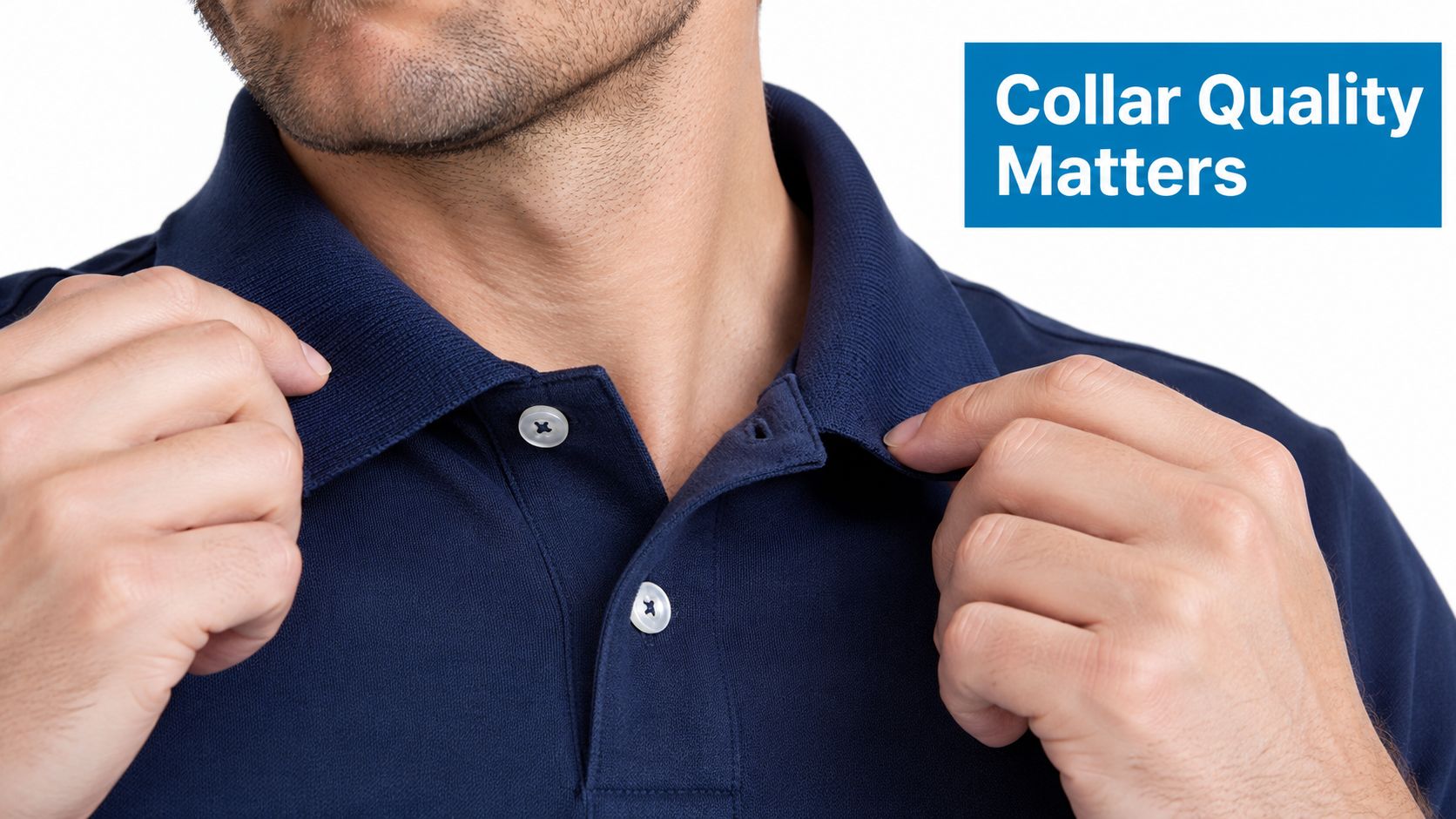
The collar sits next to the face, so customers notice its quality quickly. A weak collar makes even a good fabric look inexpensive, while a stable collar gives the shirt a deliberate, finished appearance.
A standard polo collar commonly measures 5–7 cm in height. Taller collars, around 7–9 cm, read as more formal or premium. Standard plackets typically measure 3–4 cm wide and 18–22 cm long, according to this polo shirt manufacturing guide.
Match the collar to the brand setting
For a conventional uniform, choose a collar with enough stand to remain neat during a shift. Piqué normally helps because its fabric body supports the collar and placket. If the shirt will carry embroidery, avoid a collar and front opening that look flimsy beside the logo.
For an upscale retail line, a taller collar can create a more premium frame, but proportion matters. A very tall collar on a thin, soft jersey can look disconnected. Pair stronger collar architecture with piqué, interlock, or another fabric that has enough body to support it.
The 2026 direction is broader than the traditional two-button polo. Johnny collars, open V-necks, and zip-front plackets are becoming useful design choices for retail and modern corporate apparel. These details make the shirt feel less like a standard giveaway and more like a designed product.
Check the placket before approving samples
A placket should lie flat and align cleanly with the collar. Look for consistent topstitching, even button spacing, and enough reinforcement to prevent the opening from twisting. A zip-front version needs a smooth zipper track and a finish that won't irritate the wearer's neck.
Decoration placement also depends on this area. Keep the primary chest logo clear of the placket so it doesn't compete with the opening. If the design is wide, review the actual garment proof rather than approving artwork in isolation. The logo may look balanced on a screen but crowd the collar on a narrow chest panel.
Practical rule: A polo's perceived quality comes from proportion. Fabric body, collar height, placket length, and logo scale must look intentional together.
Choosing the Right Polo for Staff Uniforms
Uniforms expose weak garment choices quickly. Staff wear them repeatedly, move in them, wash them often, and judge them by comfort during the working day. The best fabric depends on the job, not on a blanket preference for cotton or polyester.
Cotton piqué is the dependable choice for office teams, hospitality, reception staff, and customer-facing roles that need a structured appearance. Its textured knit creates micro-air channels for breathability and gives the fabric more dimensional stability than flat jersey. That stability helps the polo keep a sharper appearance after repeated wear and washing, as described in this polo guide for work uniforms.
Cotton-rich fabric also gives a familiar hand-feel that many employees prefer. It looks natural and substantial, and it works especially well with embroidered logos. The tradeoff is moisture. Cotton-rich polos absorb and hold perspiration, so they can feel heavier during hot, active work.
Use performance blends for active jobs
For event crews, field teams, warehouse staff, grounds crews, and other outdoor roles, a polyester-blend performance polo is usually the stronger decision. Polyester-blend constructions dry faster and keep the shirt lighter on-body than cotton-rich alternatives. That difference matters when employees move continuously or work in warm conditions.
A cotton-poly blend can sit between the two extremes. It offers some of cotton's softness while adding easier-care performance and greater resistance to everyday wear. This is a sensible default for mixed-use teams whose jobs involve movement but still require a conventional business appearance.
Make the uniform decision by work pattern
Ask three questions before selecting the blank:
- How active is the role? Customer-service staff at a counter can use a structured cotton piqué. A mobile event team needs faster drying behavior.
- How hot is the environment? Indoor air conditioning, outdoor heat, and kitchen conditions create different comfort requirements.
- How often will the garment be washed? Frequent laundering makes shape retention, color stability, and care instructions central to the purchase.
Embroidery favors a stable surface, so piqué and balanced blends are strong options for standard left-chest branding. For highly active programs, choose a performance knit that can support the intended decoration without becoming overly heavy or stiff.
Don't order one fabric for every department just to simplify purchasing. Use a consistent brand color and decoration system, but assign the construction by job. That approach gives the team a cohesive appearance without forcing an outdoor worker into a fabric designed for a quiet office.
Selecting Polos for Retail Merch and Promotional Events
A retail polo and a promotional event polo have different jobs. Retail merchandise must feel desirable before the customer knows the brand. Event apparel must remain comfortable, visible, and practical while carrying the logo clearly. Treating both as the same blank usually produces a product that is acceptable for neither purpose.
For retail, prioritize hand-feel, fit, silhouette, and shelf appeal. Jersey can work when the product should feel soft and casual. Interlock makes a stronger impression when the line needs a denser, smoother surface with more body and shape retention. A fashion-led collar, relaxed proportion, textured knit, or carefully selected color can make the item feel designed rather than sourced from a uniform catalog.
Decoration should reinforce that positioning. Small embroidery can support a premium, understated product, especially on piqué or interlock. DTF can handle more detailed artwork and broader visual treatments, but review the print's hand-feel on the actual fabric. A decoration that feels too heavy or plastic can undermine an otherwise comfortable retail garment.
Retail buyers purchase the whole experience, not just the logo. The blank must feel worth wearing without decoration.
Promotional events need a different hierarchy
For a corporate giveaway, nonprofit event, or campaign team, durability and logo visibility usually outrank fashion detail. A moisture-managing blend can keep volunteers and staff more comfortable during active events. A relaxed fit accommodates a wider range of wearers, while a straightforward piqué or performance construction simplifies repeat ordering.
Large logos, sleeve marks, and back prints require a decoration plan that respects seams, collar lines, and fabric stretch. Screen printing may suit bold, economical artwork. DTF can support detailed designs and variable branding. Custom patches offer a distinct tactile identity, but they add weight and can change how the garment drapes.
Build two product briefs
For retail merch, specify:
- Soft or dense hand-feel: Choose jersey for relaxed comfort or interlock for more body.
- Designed silhouette: Test the collar, hem, sleeve shape, and fit on a real sample.
- Decoration restraint: Use embroidery, DTF, or a patch only when it supports the product's intended price and character.
For promotional events, specify:
- Active comfort: Choose a performance blend when heat and movement are likely.
- Clear branding: Confirm logo size and placement on the actual garment.
- Operational consistency: Keep the blank, color, and decoration method easy to reorder.
Navigating Fabric and Function Tradeoffs
The best polo is the one that survives its assigned job. Judge each option against four operating pressures: heat, wash frequency, decoration, and the standard of appearance required after repeated wear. A fabric that feels excellent at retail can fail as a daily uniform if it dries slowly or loses shape.
Use this decision guide:
- Hot work and frequent washing: Choose a moisture-managing blend with reliable recovery. It should dry quickly, resist visible creasing, and tolerate repeated laundering without making the logo look distorted.
- Customer-facing work in moderate conditions: Prioritize a clean surface, stable collar, and comfortable hand-feel. A natural-feeling fabric can support a premium impression, provided the care routine is practical.
- Heavy decoration: Check how the fabric supports embroidery, printing, or patches before approving the blank. Stretch, surface texture, and fabric weight affect edge definition, puckering, and how the garment hangs.
- Outdoor exposure: Confirm the fiber composition, finish details, care instructions, and any documented sun-protection claims. Do not accept cooling or UPF language without reviewing the specification.
Match weight to the operating brief
Industry guidance places lightweight polos around 180 GSM, standard polos around 200–220 GSM, and heavier structured or rugby-style polos at 240 GSM or more. Treat these as starting checkpoints, not automatic prescriptions. Lightweight construction suits tropical conditions and long outdoor shifts. A denser build gives cooler-weather uniforms and premium retail products more body.
Decoration can change the result. A very light shirt may feel comfortable in heat but show distortion under a large print or dense embroidery. A heavier shirt can support structure and logo definition, yet feel warmer during active work. Request a decorated sample, then inspect the collar, placket, seams, and logo area after washing.
Check stretch, recovery, and sun exposure
Recycled polyester blends with spandex are increasingly marketed for four-way stretch, cooling, and UPF sun protection in warm-climate and active apparel programs, according to 2026 performance polo trend coverage. Verify each feature against the supplier's specification and test the garment in its actual working conditions.
A strong decision balances comfort on shift with appearance at the end of the wash cycle. Choose the fabric that meets both requirements, then keep that construction consistent for reorders.
Planning Your Custom Polo Order
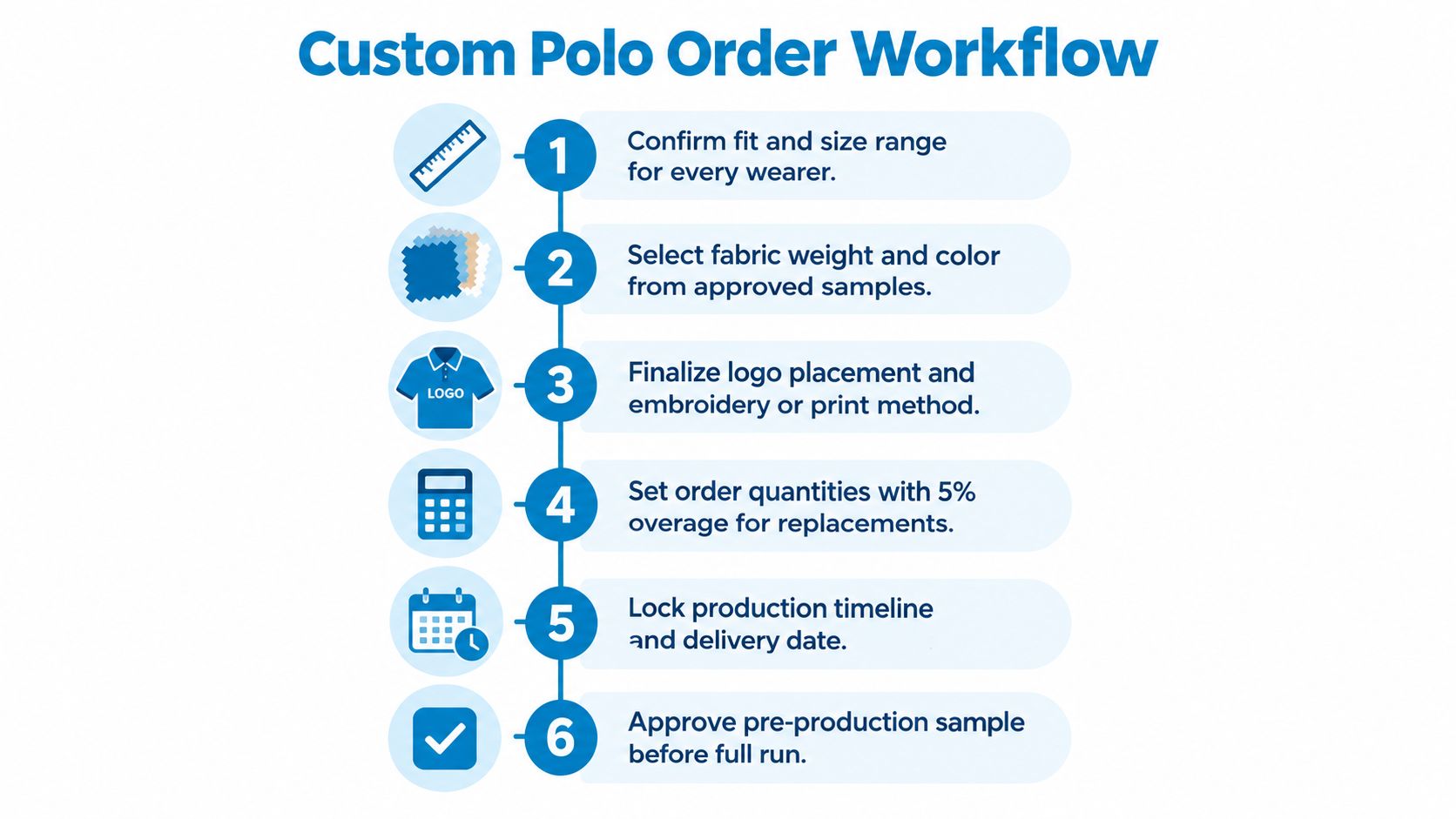
A good custom order starts with a garment decision and ends with an approved decorated sample. Skipping either step creates avoidable problems with sizing, placement, color, or production timing.
Build the specification before requesting prices
Write down the requirements in plain terms:
- Confirm fit and size range. Include every wearer category and decide whether the team needs a standard, fitted, relaxed, or extended-size fit.
- Select fabric and color. Approve physical samples where possible, then record the knit, fiber content, GSM, and color reference.
- Choose decoration. Use embroidery for stable, structured polos and clean chest marks. Consider DTF, screen printing, sublimation, or custom patches when the artwork and fabric call for them.
- Set quantities. Plan the initial distribution, replacements, and future reorders. The supplied workflow calls for a 5% overage for replacements, so include that allowance in the quantity plan.
- Lock production and delivery dates. Confirm the timeline before approving the order, especially for events, launches, or seasonal staffing.
- Approve a pre-production sample. Check the actual garment, logo scale, thread or ink color, placement, collar behavior, and overall finish before authorizing the full run.
Prepare artwork that decorators can use
Upload a clean vector logo whenever possible. Vector artwork lets the decorator refine size, spacing, and stitch paths without degrading the mark. If you only have a raster file, provide the highest-resolution version available and explain the intended decoration method.
Review the proof as a garment, not just as a flat logo. Check left-chest placement against the placket, sleeve marks against the arm seam, and back decoration against the collar. Ask for color matching and stitching detail to be shown clearly before production.
Use wholesale catalogs intelligently
A broad wholesale catalog can help you compare brands, fits, fabrics, colors, and replacement availability. Don't choose from a product photo alone. Request the blank style number, fabric specification, available size range, care label, decoration area, and expected reorder continuity.
Dirt Cheap Product, Inc. provides polo shirts with logo through a workflow that includes logo upload, proofing, decoration, and reorder support. The company also handles screen printing, embroidery, DTF, sublimation, and custom patches across branded apparel programs, so the decoration method can be matched to the garment rather than selected after the blank is already fixed.
Avoid using promotional apparel for unrelated print materials. Dirt Cheap Product, Inc. doesn't create business cards or fliers. Keep the project focused on apparel and promotional items such as polos, shirts, outerwear, hats, bags, and related branded products.
Dirt Cheap Product, Inc. helps businesses, retailers, nonprofits, and event teams select branded polos, upload logos, review proofs, and choose embroidery, DTF, screen printing, sublimation, or custom patches. Visit Dirt Cheap Product, Inc. to compare wholesale apparel options and start a custom polo order built around your fabric, fit, decoration, and delivery requirements.