
The most popular advice about breathable polo shirts is wrong: lighter doesn't automatically mean cooler. A thin shirt can move air well before sweating starts, then feel clammy, transparent, and unprofessional once the wearer is active. For corporate uniforms and event apparel, you need to separate airflow, moisture management, fabric weight, and decoration before approving a bulk order.
That distinction matters because a branded polo has two jobs. It must manage heat and moisture, but it also has to hold its shape, display a logo clearly, survive repeated washing, and look appropriate in front of customers. A supplier's “performance” label isn't enough. Ask for fabric specifications, decoration samples, and testing that reflects the climate and activity your staff will face.
Table of Contents
- Redefining Breathability for Corporate Apparel
- Decoding Fabric Metrics and Weight Standards
- Comparing Cotton, Polyester, and Technical Blends
- Decoration Methods and Ventilation Tradeoffs
- Matching Polos to Specific Event and Uniform Use Cases
- Sourcing, Care, and Longevity Best Practices
- Answers to Common Bulk Ordering Questions
Redefining Breathability for Corporate Apparel
Breathability means more than a loose-looking knit. In apparel terms, it's the ability of fabric to let air and moisture vapor pass through. Moisture-wicking is different. It pulls sweat away from the skin and spreads it across the outer surface so evaporation can happen faster, as explained in this technical guide to breathable polos. A polo can wick effectively and still feel hot if its structure traps warm air against the body.
Corporate buyers should therefore stop evaluating shirts by hand feel alone. A fabric can feel light in a showroom but perform poorly during a humid outdoor event. Conversely, a more substantial piqué may offer better opacity, collar stability, and logo coverage while still providing useful airflow.
Why the polo's history still matters
The modern breathable polo traces back to 1926, when René Lacoste wore a short-sleeved, soft-collared cotton piqué shirt at the US Championships. By 1933, Lacoste was producing the shirt commercially, creating the prototype for the modern polo. The shirt lasted because piqué's waffle-like knit creates thousands of small air pockets that support airflow and heat escape compared with plain-woven fabrics. This account of the polo's development is documented in the history of the polo shirt and tennis apparel.
The style later moved from tennis into golf, casual wear, and corporate clothing. Ralph Lauren's 1972 polo line helped establish the garment as a global menswear staple, reinforcing a useful point for buyers: breathable polos aren't a recent novelty. They combine nearly a century of athletic textile development with the visual polish businesses expect from uniforms.
Buyer's rule: Treat “breathable” as a performance specification, not a marketing adjective.
Airflow and moisture management serve different climates
Dry climates often reward airflow first. A shirt that lets air move through the body panels can feel comfortable before the wearer starts sweating. Humid climates and active jobs place more pressure on moisture transport and drying speed, because a damp garment can quickly become heavy and cling to the skin.
That's why the right corporate uniform depends on use. A conference team standing indoors may need a structured cotton piqué with subtle embroidery. Outdoor event staff may need a synthetic blend with stronger moisture management. Warehouse staff may benefit from a durable blend that balances ventilation with opacity and wash resistance.
Standardized testing gives you a more reliable basis for comparison. Supplier claims should identify the test method, the fabric zone tested, and the result. If they can't provide that information, compare the garment through physical samples and controlled wear testing rather than assuming the lightest option will win.
Decoding Fabric Metrics and Weight Standards
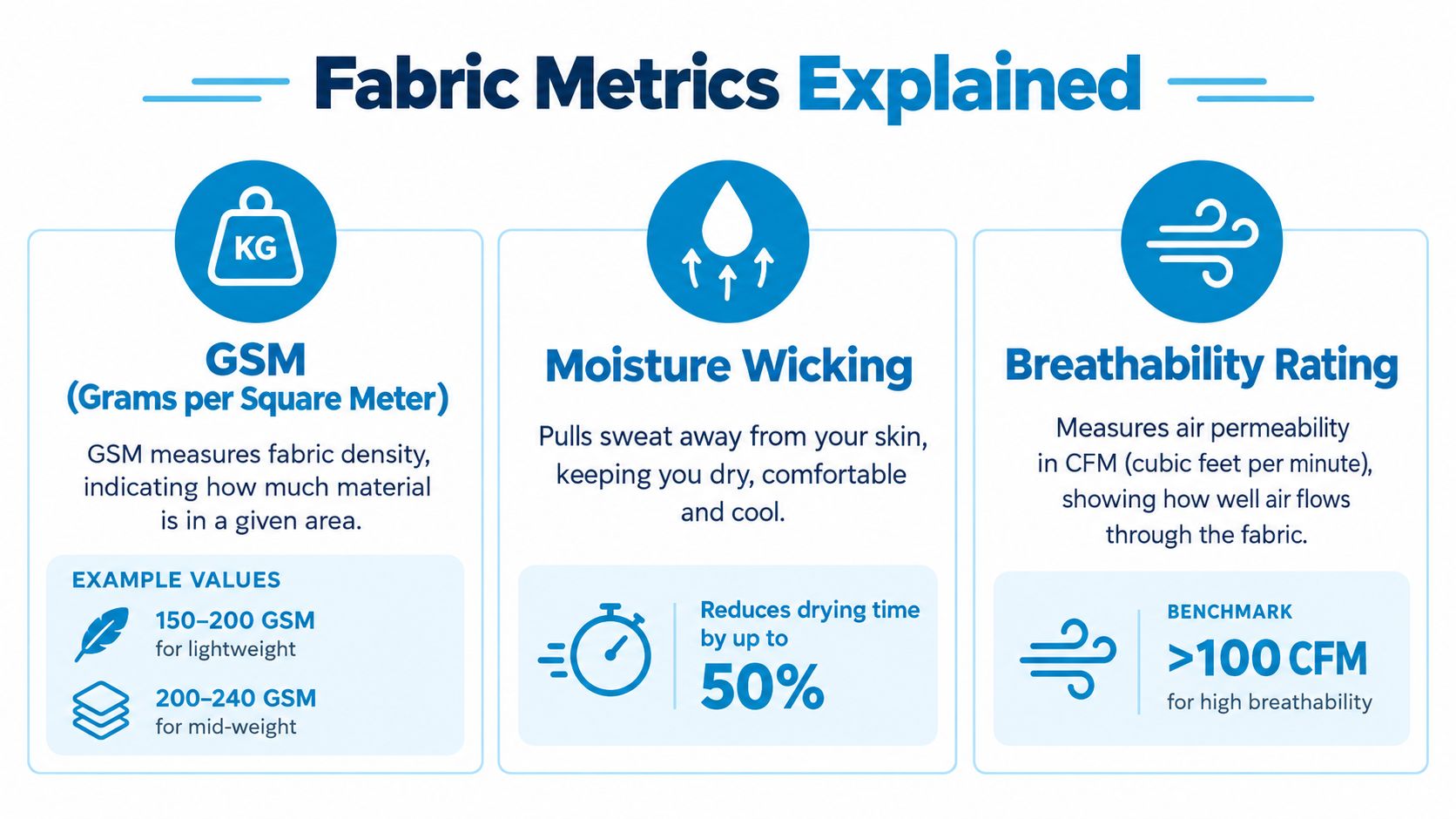
Supplier spec sheets often bury the useful information beneath terms such as “cool touch,” “performance knit,” and “advanced wicking.” Corporate buyers need a shorter list of measurable criteria: Moisture Vapor Transmission Rate, evaporative resistance, air permeability, and GSM.
Read MVTR and Ret together
MVTR, or Moisture Vapor Transmission Rate, measures how much water vapor passes through a fabric over time. It's reported in g/m²/24h, using standards such as ASTM E96 and ISO 11092. High-performance breathable fabrics commonly reach 5,000 to 15,000 g/m²/24h, according to this performance polo testing guide.
For moderate activity in warm conditions, an MVTR above roughly 5,000 g/m²/24h is a useful benchmark for reducing heat buildup. It won't guarantee comfort by itself. Garment fit, knit structure, finishing, and decoration still affect how the shirt feels on the body.
Ret, or evaporative resistance, measures how much the fabric resists evaporative cooling. Lower is better. A Ret value below 6 m²·Pa/W is considered very breathable for activewear. Ask suppliers whether the result applies to the finished fabric or the completed garment, because a heavy print, lining, or tightly fitted design can change real-world performance.
GSM controls more than cooling
GSM means grams per square meter, or fabric weight and density. Buyers often rush toward the lowest GSM because it sounds cooler. That's a mistake for branded apparel. Fabrics around 130 to 150 GSM feel airy and can dry quickly, but they may become translucent and less durable. Workwear guidance commonly places 150 to 170 GSM closer to the practical balance between opacity, structure, and quick-dry performance, as discussed in this moisture-wicking polo manufacturing guide.
A lightweight shirt can also create decoration problems. Large logos may show through pale fabric, embroidery can pucker a thin knit, and repeated washing can make a low-weight garment lose its polished appearance. For most corporate orders, choose the lightest fabric that still passes an opacity check, supports the decoration method, and holds its collar and side seams.
Practical rule: Approve GSM only after checking the shirt in the actual brand color, with the actual logo applied.
Use a supplier scorecard that records MVTR, Ret, air permeability, GSM, fiber content, shrinkage behavior, and decoration results. If a vendor supplies only a broad “breathable” claim, keep the garment in the sample stage.
For buyers evaluating moisture transport separately from airflow, this moisture-wicking fabric explanation provides useful terminology before you compare polo samples.
Comparing Cotton, Polyester, and Technical Blends
Fiber choice changes the way a polo handles heat, sweat, drying, odor, decoration, and repeated washing. There isn't one universal winner. Cotton often feels airier in dry conditions, while polyester and blends usually manage wet wear more effectively.
Piqué construction also matters. Its raised tuck-stitch geometry creates micro-channels that support circulation and capillary pathways. Typical air permeability for piqué is around 120 to 180 cm³/cm²/s, compared with roughly 60 to 90 cm³/cm²/s for plain jersey, according to this textile breathability reference. A 65/35 cotton-polyester blend can dry about 40% faster than 100% cotton piqué while retaining less moisture, which makes it a strong general-purpose choice for intermittent activity.
The dry-heat exception
Polyester isn't automatically more breathable. Under ASTM D737 testing, one cited comparison measured cotton at 159.58 cc/s/cm² and polyester at 139.85 cc/s/cm², giving cotton a 14% advantage in that test, as reported in this comparison of breathable polo fabrics.
That result makes practical sense. Cotton may feel cooler and airier before sweating begins, especially in dry heat. Polyester absorbs very little water, typically less than 0.4% of its own weight, which helps explain why it dries faster after the wearer sweats, as described in this overview of moisture-wicking materials.
| Fabric Type | Best Climate | Drying Speed | Decoration Compatibility |
|---|---|---|---|
| 100% cotton piqué | Dry, warm settings and polished indoor uniforms | Slower after heavy sweating | Excellent for embroidery and screen printing, provided the fabric has enough structure |
| Moisture-wicking polyester | Humid weather, outdoor events, and active uniforms | Fast, because the fiber holds little water | Good for lightweight transfers and sublimation, with testing for heat and dye interaction |
| Cotton-polyester blend | Mixed climates and daily workwear | Faster than cotton while retaining a familiar hand feel | Strong all-round option for embroidery, screen printing, and transfer decoration |
Cotton remains the safer choice when softness, natural hand feel, and classic corporate presentation matter most. It can become heavy when saturated, though, and untreated cotton takes longer to dry.
Polyester is the better operational choice for staff who sweat repeatedly, move between indoor and outdoor areas, or need the shirt to recover quickly between wears. Its trade-offs include a more synthetic hand feel and a greater need to test odor management and decoration adhesion.
For most bulk programs, I recommend a cotton-polyester piqué blend unless the use case clearly points to one fiber. It offers a credible balance of airflow, drying speed, opacity, shape retention, and decoration flexibility.
Decoration Methods and Ventilation Tradeoffs
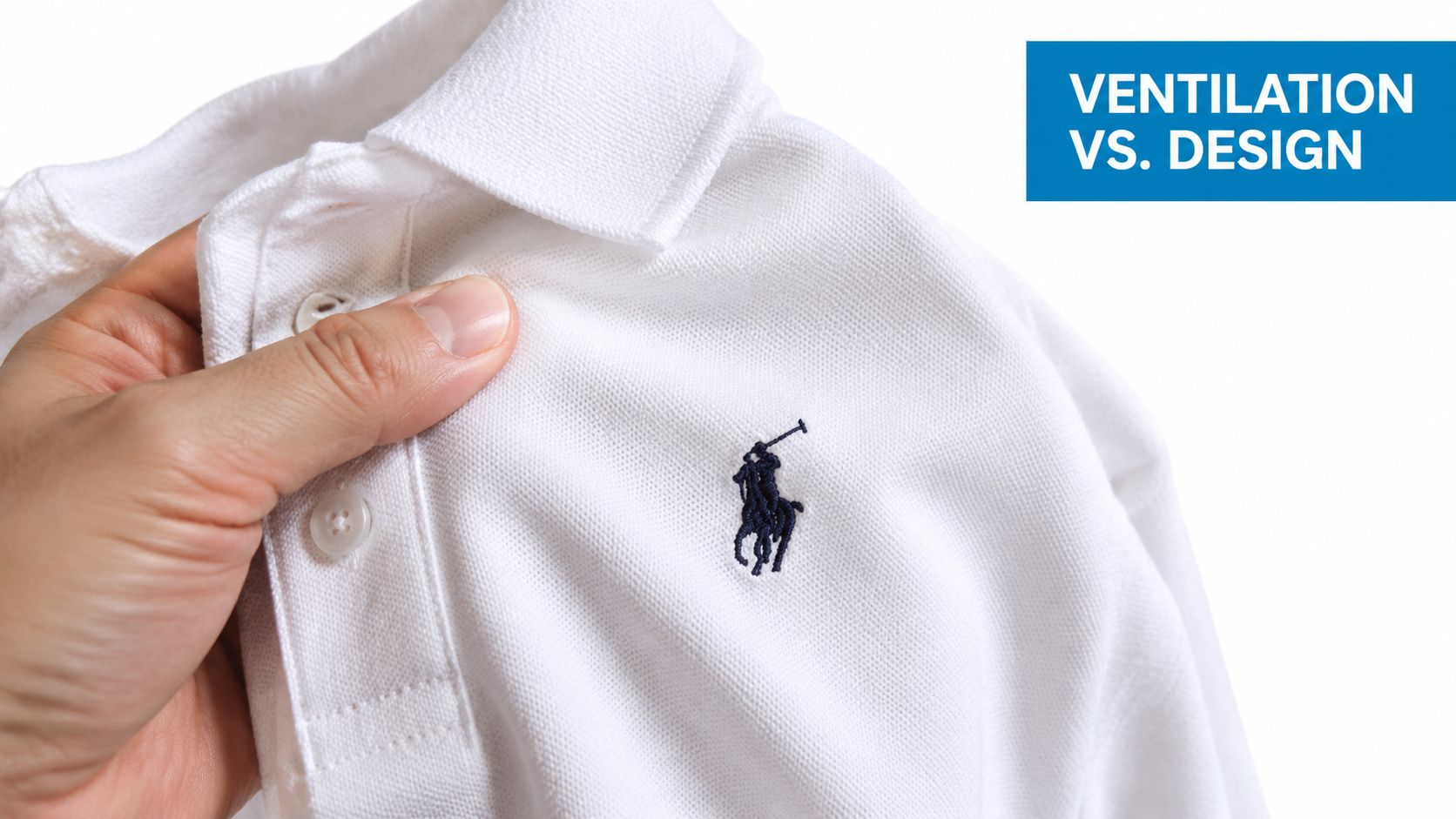
A breathable polo can lose much of its performance when the logo creates a dense, non-breathable panel. The decoration method, print size, ink deposit, backing, and placement all matter.
Choose decoration by fabric behavior
Embroidery gives a corporate polo a conventional, premium appearance and works especially well on structured cotton or cotton-polyester piqué. The risk is mechanical. Dense stitching adds weight, can pucker lightweight fabric, and may reduce comfort across a large chest area. Use a stable backing, control stitch density, and keep the design compact.
Screen printing works well for bold event graphics and larger logos. It becomes less suitable when a heavy plastisol deposit covers a large section of the chest or back. That printed area can act like a barrier against vapor movement, particularly on a lightweight performance knit.
Direct-to-film, or DTF, handles detailed artwork and smaller runs efficiently. A lightweight transfer can preserve more of the garment's flexibility than a thick print, but the film still creates a coated area. Test stretch, wash durability, edge feel, and heat exposure on the exact fabric.
Sublimation is strongest on polyester garments, where the design becomes part of the printed surface rather than sitting as a heavy layer on top. It can preserve the fabric's hand feel and airflow, but it requires compatible fiber content and careful color control.
Keep the logo out of the hottest zones
Place a chest logo where it communicates the brand without covering the area that needs maximum ventilation. Underarm panels, center-back vents, and engineered mesh zones should remain clear unless the decoration partner has specifically tested the combination.
Use this polo logo placement guide to establish a consistent position before sampling. Then request a decorated sample in the final fabric color, not just a blank garment or artwork proof.
Decoration decision: A smaller, lighter logo usually protects comfort better than a large, dense mark that turns the shirt into a coated bib.
Approve the decorated garment, not the blank shirt
Your approval process should include four checks:
- Airflow: Compare the decorated area with the surrounding fabric by touch and, where possible, by testing.
- Appearance: Inspect logo edges, color, registration, stitch tension, and visibility under normal lighting.
- Comfort: Have a wearer move, bend, and raise their arms. Look for stiff or hot areas.
- Durability: Wash the decorated sample according to the planned care instructions and inspect cracking, peeling, puckering, and color change.
Sublimation is often the best technical choice for all-over polyester event apparel. For corporate uniforms, restrained embroidery or a lightweight DTF mark is usually the better visual compromise. Don't apply the same branding method to every polo because the logo file is identical.
Matching Polos to Specific Event and Uniform Use Cases
A warehouse uniform, a golf tournament shirt, and a conference polo should not share the same specification by default. Their exposure, movement, washing frequency, and decoration needs differ too much.

Match the garment to the work
Warehouse staff need durability, practical opacity, and decoration that can withstand regular handling. A heavier cotton or cotton-polyester piqué may outperform an ultra-light performance shirt because the team needs a stable uniform that doesn't look worn after routine washing. Machine embroidery can suit this use when the fabric and backing support it.
Outdoor golf or field events call for stronger moisture management and airflow during movement. Choose a polyester blend, targeted ventilation, or open piqué structure, then use a print method that doesn't cover the key vent zones. Confirm colorfastness and logo visibility in direct sunlight.
Conference staff usually need a cleaner, more conventional appearance. A classic cotton piqué with subtle chest embroidery can look more appropriate than a highly technical mesh shirt, especially when the team spends most of the day indoors.
Segment the order instead of forcing one solution
A single shirt for every employee simplifies purchasing but can create unnecessary trade-offs. Front-facing event staff may need a lighter technical blend, while daily operations staff may need a more durable blend with stronger structure. Segmenting by role can improve comfort and presentation without requiring an entirely different brand identity.
A useful staff polo uniform design guide can help teams think through collar shape, color, logo position, and role-specific presentation before they finalize a uniform range.
| Use Case | Recommended Direction | Decoration Approach | Main Risk |
|---|---|---|---|
| Warehouse or operations | Structured cotton-polyester piqué | Compact embroidery or controlled screen print | Excess weight and abrasion |
| Outdoor golf tournament | Polyester blend with ventilation zones | Lightweight screen print, DTF, or sublimation | Sweat retention, glare, and blocked vents |
| Corporate conference | Classic cotton piqué or refined blend | Subtle chest embroidery | Overly sporty appearance |
Budget and lead time still matter. More panels, special finishes, and mixed fabrics usually require more sampling and more production controls. If the event date is fixed, approve the fabric, decoration, and size set early enough to allow corrections.
Planning principle: Use one brand system across roles, but don't force one fabric specification across different working conditions.
Sourcing, Care, and Longevity Best Practices
The most expensive polo mistake happens before production. Buyers approve a supplier photo, skip the decorated sample, and discover too late that the collar, color, logo, or fabric weight doesn't work in the final application.
Start with a complete supplier brief. Include the intended climate, activity level, preferred fiber range, GSM target, logo dimensions, decoration method, delivery date, and acceptable substitutions. Ask for a wholesale catalog and physical samples in the final colors. A polished digital swatch doesn't reveal transparency, sheen, recovery, or how the fabric accepts thread and ink.
Use a disciplined approval sequence
- Approve the blank garment. Check fit, collar structure, opacity, hand feel, seams, and movement.
- Approve artwork placement. Confirm the decoration location against buttons, seams, vents, and pocket lines.
- Approve the decorated sample. Inspect embroidery density, print hand, color matching, and logo scale.
- Confirm production controls. Record the approved garment, thread or ink references, placement measurements, and size grading.
- Keep a signed-off reference. The sample should remain the standard for future reorders.
Color matching deserves extra attention on technical fabrics. Polyester can reflect light differently from cotton, and a logo that looks accurate on a screen may appear too bright or too dull against a performance knit. Review the logo in daylight and indoor lighting before production.
Protect the performance during care
Follow the garment's care label, but give staff clear operating rules. Wash performance polos with a suitable detergent, avoid excessive heat, and don't use fabric softener unless the manufacturer specifically permits it. Fabric softener can coat fibers and interfere with moisture transport. High heat can also affect synthetic blends, printed transfers, elastane recovery, and collar structure.
Separate heavily soiled workwear from conference apparel when possible. Store clean polos fully dry, and avoid leaving damp garments compressed in bags or vehicles. These steps protect odor control, fabric hand feel, and decoration integrity.
Plan inventory around the event, not the order date
Bulk apparel needs time for artwork approval, garment sourcing, decoration, quality control, packing, and delivery. Build a schedule with room for a rejected sample or a size correction. Don't wait until the event is close to place the order, especially when you need special colors, mixed sizes, or multiple decoration methods.
A reliable branding partner should provide responsive communication, proofs, color and placement review, and a clear production timeline. Those service details matter as much as the polo catalog because the final result depends on coordination between garment selection and decoration.
Answers to Common Bulk Ordering Questions
Is breathable the same as moisture-wicking?
No. Breathability moves air and moisture vapor through the garment. Moisture-wicking moves sweat away from the skin and spreads it across the outer surface. A polo can do one well without doing the other, so specify both when staff will work in heat or humidity.
Should we choose the lightest GSM available?
No. Lightweight fabrics around 130 to 150 GSM can feel airy but may create transparency and durability problems. For many workwear programs, 150 to 170 GSM provides a more useful balance of opacity, structure, and drying performance, as outlined in the bulk custom apparel ordering guide.
Is cotton or polyester more breathable?
Cotton can feel airier in dry conditions, and standardized testing can favor it for air permeability. Polyester usually dries faster because it absorbs very little water. Choose cotton for classic comfort and presentation, polyester for active moisture management, and a blend when you need a practical middle ground.
Are bamboo fiber and recycled polyester worth considering?
They can support a sustainability program, but don't approve them solely from the fiber name. One market estimate reports that bamboo fiber and recycled polyester represented roughly 8% of the polo market, or about 96 million units, while 2023 production included more than 780 million cotton polos and about 320 million polyester-blend units, according to this polo shirt market estimate. Request composition details, performance testing, color samples, and decoration tests before committing.
How should we handle brand sizing differences?
Measure the actual garment, not just the label. Compare chest, body length, shoulder width, and sleeve dimensions across candidate brands, then run a wear test with representative staff. A size chart won't reveal whether a performance polo feels restrictive across the shoulders or hangs too loosely at the waist.
Dirt Cheap Product, Inc. supplies polo shirts and custom decoration options including screen printing, embroidery, DTF, sublimation, and patches for uniforms, events, and branded apparel programs. Upload your logo and review apparel options, proofs, placement, and color details with Dirt Cheap Product, Inc. before approving your next breathable polo order.