
You've already spent money on the booth, the travel, the staff, and the follow-up plan. The last thing you want is a pile of forgettable swag that gets left on a hotel desk, stuffed into a suitcase, or tossed before the attendee gets to the airport. The best trade show giveaway ideas do more than fill a bag, they keep your brand in circulation after the show floor gets loud and crowded.
A smart giveaway turns a quick hello into a real conversation. It also gives your team a cleaner way to qualify interest, because the right item can signal whether someone is a casual passerby, a serious prospect, or a buyer worth a deeper conversation. That's why giveaway planning works best when it's tied to booth goals, inventory discipline, and the kind of follow-up you can measure.
The practical part starts with restraint. Trade show planning guides commonly suggest ordering giveaways for about 25% of attendees at large shows or about 75% at smaller shows, while another guide recommends planning around 30% of total attendance for core coverage, with a split inventory model for premium and general items at a 10,000-visitor event (OSER Communication guide on ordering trade show giveaways). That range is a reminder that the best swag strategy is controlled, not casual.
One more useful benchmark matters here. A giveaway statistics roundup attributes 500% or more ROI to promotional giveaways and says a good engagement rate is usually 2% to 5% (gift statistics roundup citing ASI). Those numbers don't guarantee success, but they do explain why the right item, handed out the right way, can outperform a lot of noisier marketing spend.
Custom Sticker Shop automated decals
Table of Contents
- 1. Custom Branded T-Shirts
- 2. Custom Branded Hats and Caps
- 3. Branded Hoodies and Sweatshirts
- 4. Branded Tote Bags and Carryalls
- 5. Branded Water Bottles and Drinkware
- 6. Branded Polo Shirts and Professional Apparel
- 7. Branded Outerwear and Jackets
- 8. Branded Bags and Backpacks
- 9. Branded Accessories Sets and Bundles
- 10. Branded Socks and Novelty Legwear
- Top 10 Trade Show Giveaway Comparison
- Choosing the Right Giveaway for Your Brand
1. Custom Branded T-Shirts
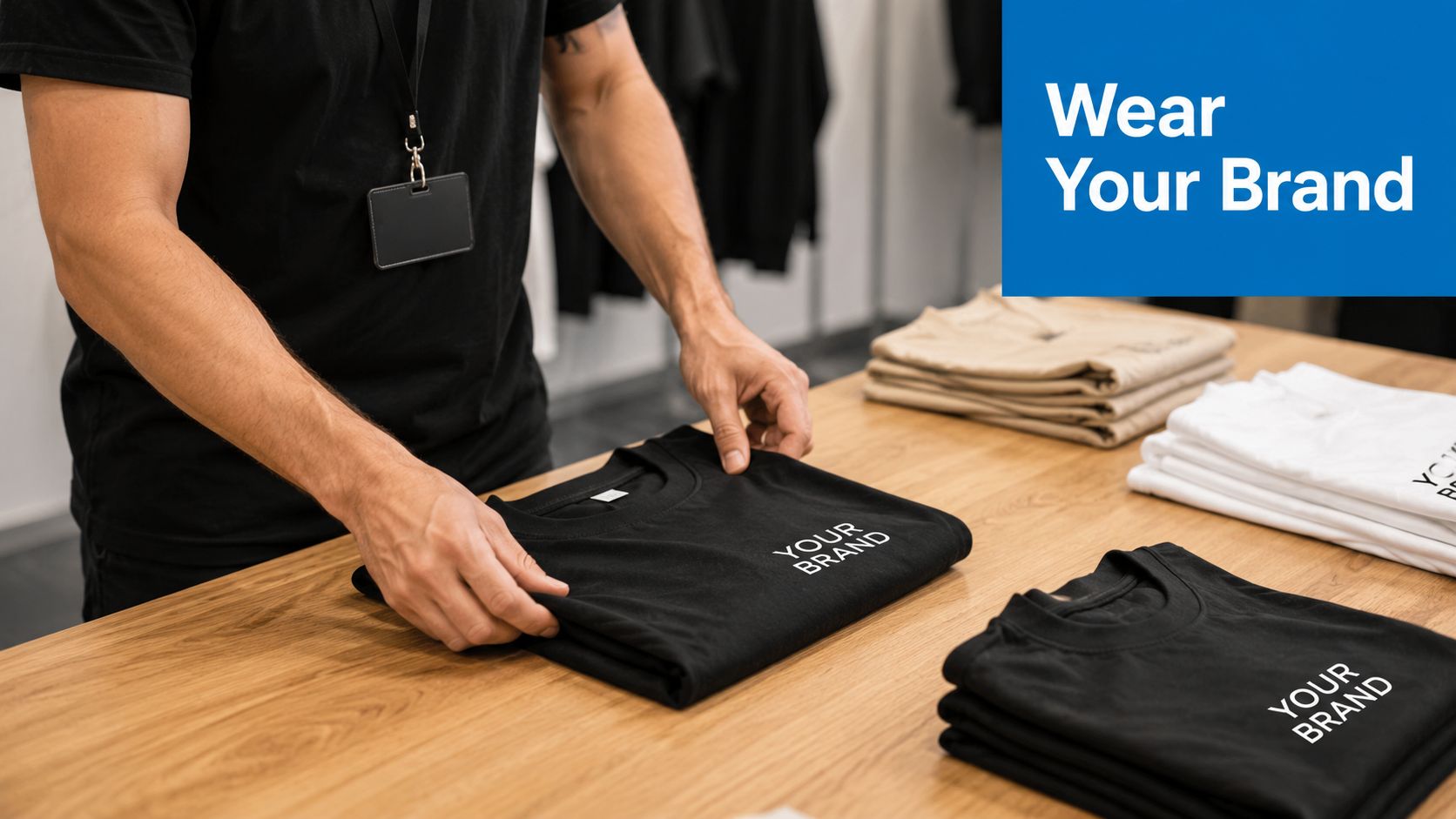
A good T-shirt still carries real weight at a trade show. People wear it during the event, then keep wearing it if the fit feels right and the fabric does not feel flimsy. That gives your logo repeated exposure without asking the attendee to do anything extra.
Make the shirt worth keeping
The shirt needs to feel like something people chose, not something they accepted out of politeness. Neutral colors usually fit more wardrobes, and a small chest print or sleeve mark usually travels farther visually than a huge front graphic that only works at a distance.
Practical rule: If the shirt feels cheap on the rack, it'll feel promotional after one wash.
Use better fabric blends when the audience expects a premium touch, especially for tech conferences, partner events, or retail launches where the shirt reflects the brand's overall polish. Order a full size range early, because nothing slows booth flow faster than handing a visitor an item that does not fit.
A plain shirt can still feel special if the decoration is clean and the handout process is organized. For production ideas and decoration methods, use the guide on how to print a design on a shirt as a reference point when you are deciding between screen printing, embroidery, or another finish.
Use shirts as part of a tiered handout
Shirts work best when they are not treated as a free-for-all. Give them to booked meetings, product demo attendees, or qualified prospects, and keep smaller handouts for general foot traffic so your best inventory does not disappear by noon.
- Choose neutral base colors: Black, white, navy, and gray are easier for people to wear after the show.
- Use a smaller logo placement: Chest or sleeve branding usually feels more wearable than oversized artwork.
- Stock multiple sizes early: Waiting until the last minute often leads to uneven size runs and awkward handoffs.
- Reserve premium fabric for qualified leads: The better the shirt, the more appropriate it is for a serious contact.
A shirt can be a walking ad, but only if it feels like regular apparel first. If it feels like clutter, it will not leave the booth.
2. Custom Branded Hats and Caps
A cap is one of the easiest trade show items to hand out because it is light, wearable, and visible the moment someone puts it on. It also gives your staff a clean, coordinated look, which helps the booth feel organized without creating much extra work at the table.
A hat works best when the style matches the audience and the setting. A baseball cap feels natural for sports, fitness, lifestyle, and outdoor brands. Beanies fit colder seasons and audiences that prefer a more casual, design-forward look. Trucker hats usually work well with younger attendees or laid-back crowds who already wear them outside the show.
Match the hat to the audience
Decoration choice matters just as much as the style. Embroidery usually gives caps the right finish because it feels durable and more polished than a printed logo, and that matters when the hat is meant to stay in regular rotation after the event.
There is also a practical side to hat distribution. Adjustable closures reduce booth friction because staff do not have to sort out sizing on the spot, which keeps the line moving and avoids awkward handoffs. That small detail can make a giveaway feel easier to manage and more valuable to the recipient.
A hat has to look normal in public. If it only works as an event prop, it won't travel far.
Use headwear to shape booth identity
Matching caps on staff can do as much for booth presence as the giveaway itself. Coordinated headwear makes it easier for visitors to identify who can help them, and it gives the space a more deliberate, team-oriented look instead of a scattered one.
That is where the trade-off shows up. Bold branding may get more visibility from across the aisle, while a cleaner front panel or a subtle secondary mark can make the cap more wearable later. If the goal is repeat use, keep the design restrained. If the goal is fast booth recognition, put the logo where people will see it first.
- Choose embroidery over flat print: It usually holds up better and gives the cap a more finished look.
- Keep colors versatile: Neutral caps pair with more outfits and are more likely to be worn again.
- Use seasonal styles strategically: Beanies make sense for winter shows, caps for warmer events.
- Place the logo for public visibility: Front panels draw the most attention, while a smaller back mark can work for a cleaner finish.
For business use cases and decoration ideas, the custom hats for business collection is a useful starting point when you are deciding how far to push the branding.
3. Branded Hoodies and Sweatshirts
Hoodies and sweatshirts are premium giveaway pieces because people usually keep them for comfort, not just because they got them for free. That makes them ideal when you want the item to carry more perceived value than a typical promo product.
The strongest hoodie programs usually show up at tech conferences, campus events, and lifestyle-heavy shows where attendees already dress casually. In those settings, a soft sweatshirt with clean branding feels like useful apparel, not a sales tactic.
Treat the garment like retail, not swag
Fabric quality matters more here than it does with a low-cost item. If the material pills quickly or the fit feels boxy, the hoodie stops being a reward and starts being a reminder that someone cut corners.
Choose either a pullover or full-zip style depending on your audience and budget. Pullovers usually feel more universal, while zip styles can read more polished for mixed business and casual settings.
Size planning matters more than people expect
A hoodie is harder to hand out casually if your size run is narrow. Stocking a broader range from XS to XXL, or wider if your audience needs it, avoids awkward substitutions and helps the piece feel like a real apparel decision rather than a leftover giveaway.
- Pick a color that fits the brand palette: A strong neutral often outlasts trendier shades.
- Put the logo where it'll be seen naturally: Chest and back placements both work, depending on the garment style.
- Use a decoration method that lasts: Embroidery or high-quality print usually outperforms low-end decoration on heavy fabric.
- Save them for better leads: A hoodie feels most valuable when it's tied to a meaningful conversation, not a random handoff.
A sweatshirt can do a lot of quiet branding work after the event ends. It just has to feel like something people would have bought on purpose.
4. Branded Tote Bags and Carryalls
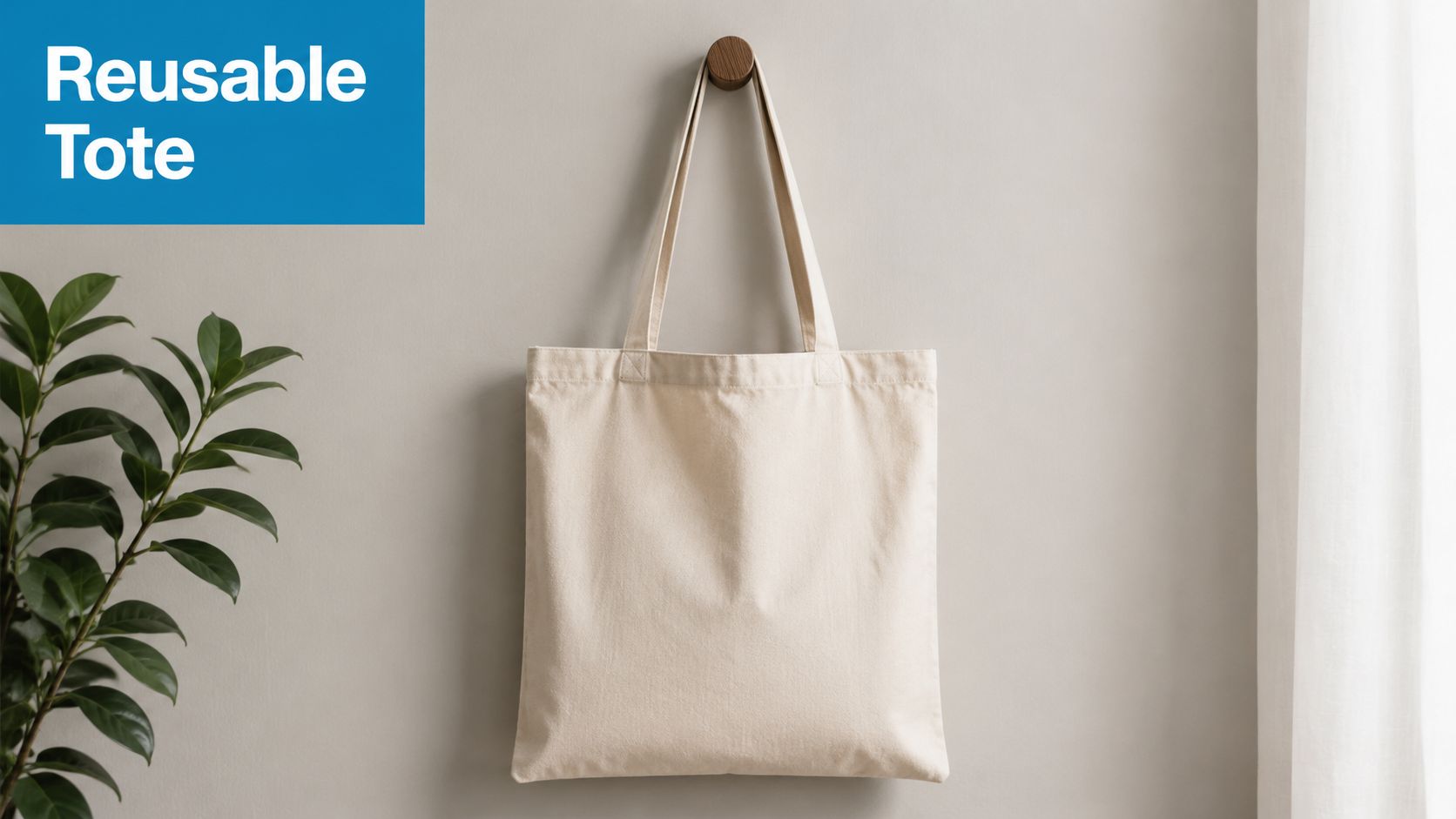
A tote bag earns its place at a trade show fast. Attendees need a place for brochures, samples, notebooks, and the loose materials they pick up from booth to booth, so the bag starts doing useful work before the event is even over.
Build the bag for repeated use
Heavyweight canvas or cotton gives a tote a better hand feel than a thin giveaway bag. That heavier build signals reuse, and reuse is what turns a handout into something people carry to grocery stores, offices, and weekend errands after the show.
Natural and neutral colors usually hold up better because they sit easily with whatever else the attendee already owns. Interior pockets or small compartments add real utility, which helps the bag feel planned instead of generic.
Sustainability messaging works here only if the bag can support it. Reusable materials and a clear replacement for disposable bags make sense. A weak eco claim on a flimsy tote does not.
Make the tote carry more of the story
A tote can do more than hold brochures. It can serve as the base for a small bundle, which is useful for booth organization and for making a modest giveaway feel more complete. Add a bottle, a notebook, or a small apparel item, and the bag becomes part of the gift instead of just the wrapper.
A tote works best when it carries something first, then keeps carrying things long after the event.
Logo placement matters here because the bag moves in public. Put branding on both sides if you want visibility whether the bag is slung over a shoulder or set on a chair. A clear mark in the right place usually does more than crowding the surface with extra artwork.
Keep distribution broad, but intentional
Totes suit wide distribution because attendees already have a use for them. The trade-off is that they can feel ordinary if the fabric, print, and color choices look cheap. The goal is to hand out something people will keep using, not something they tuck away after the show.
- Use stronger fabrics: Canvas and cotton hold up better than thin synthetics.
- Choose a simple color story: Natural, black, and off-white usually age better visually.
- Add compartments for professional audiences: Extra structure makes the bag useful at work.
- Pair it with a second item: A tote with a bottle or notebook inside feels more deliberate.
If you want a giveaway that can do double duty as packaging and brand visibility, a tote is hard to beat. The best versions feel like a practical purchase, not a promo piece with handles.
5. Branded Water Bottles and Drinkware
Drinkware stays relevant because people use it at work, in the car, at the gym, and on the road. That gives a branded bottle or tumbler more chances to be seen than most items that only live in a desk drawer.
Make the item feel good in daily life
Insulated stainless steel usually has a stronger premium feel than cheaper plastic options. It also fits wellness, fitness, and outdoor messaging well, because it suggests durability and regular use instead of novelty.
Neutral colors like black, white, and navy are safer if you want broad appeal. Loud colors can work for younger or more playful brands, but they're easier to overdo.
The item should survive regular washing and handling without the logo peeling or fading quickly. If the decoration doesn't hold up, the bottle becomes a bad reminder every time someone refills it.
Use drinkware as a practical brand touchpoint
A bottle can support more than just a logo. It can reinforce a wellness message, a sustainability angle, or a “keep going” brand tone without needing a long explanation.
If you're comparing bottle types, the Tritan water bottle option is useful when you need a lighter, everyday-use alternative. That can make sense for general foot traffic where perceived utility matters more than a premium metal finish.
- Choose capacity based on use case: Smaller sizes can suit desk use, while larger ones fit travel or fitness better.
- Keep the decoration simple: Clean branding tends to look more premium on curved surfaces.
- Add a secondary item when it helps: Reusable straws or a small carry pouch can raise perceived value.
- Think about retention: The item should feel useful enough to stay in a bag or on a desk.
The best drinkware handout is one people reach for without thinking. If the item becomes part of the routine, your logo keeps showing up.
6. Branded Polo Shirts and Professional Apparel
A booth staffed in polos sends a different signal than one dressed in T-shirts. The look is more structured, more polished, and better suited to corporate settings where management-level visitors or serious buyers are paying attention to the details.
That fit matters for consulting firms, financial services teams, and business events where presentation affects how credible the brand feels. A well-chosen polo suggests the company cares about fit, finish, and consistency, which can help the booth feel more trustworthy without trying too hard.
Build for the business-casual setting
Performance fabrics usually work better than heavier cotton in this category because they keep their shape and feel appropriate in warm exhibit halls. They also help the shirt stay presentable through a long show day, which matters if staff wears the same piece from setup through closing conversations.
Classic colors usually fit the category best. Black, navy, gray, and white pair easily with trousers or jeans, and they keep attention on the person wearing the shirt instead of pulling focus with a loud design.
Fit is part of the value. If the shirt hangs awkwardly or feels stiff, it reads as giveaway merchandise rather than apparel someone would wear again.
Use embroidery to raise the finish
Embroidery is the right decoration choice for most polos because it gives the item the feel of professional apparel rather than a promo shirt. It also tends to hold up well if the garment becomes part of a regular work wardrobe, which improves retention after the event.
Practical rule: If the item is supposed to signal trust, make the decoration look like it belongs in an office, not just at an event.
Stock a full size range so staff and selected attendees can get the right fit. A polished polo loses value fast if people have to guess their size or settle for something close enough, and that kind of compromise can make the item sit unworn in a closet.
Polos work best when the giveaway matches how the company already dresses. That alignment makes the piece feel intentional, which helps it get worn beyond the show floor.
7. Branded Outerwear and Jackets
Outerwear is one of the strongest premium giveaway categories because it's worn in public and usually kept for a long time. A jacket has real utility, which makes it feel less like swag and more like a genuine gift.
This works especially well for outdoor brands, major corporate events, and VIP programs where the recipient list is smaller and more selective. A well-made jacket signals that the relationship matters.
Reserve jackets for high-value moments
Jackets should usually be handed out selectively. They make the most sense for top prospects, key clients, or attendees who've earned a more personal touch through meetings or direct engagement.
Choose lightweight, packable styles when the event requires portability. That keeps the piece practical for travel and makes it easier for recipients to bring it home without hassle.
Focus on wearability and finish
Neutral technical colors usually pair well with both casual and business wardrobes. If the jacket can move from a conference center to an airport or dinner reservation, it's more likely to stay in use.
Quality embroidery or subtle decorative accents can make the branding feel refined without overpowering the garment. The goal is for people to keep wearing it, not to turn it into a billboard they stop using.
- Use windproof or water-resistant fabrics: Practical features increase real-world value.
- Keep the branding tasteful: Smaller marks often look better on outerwear.
- Limit distribution: Exclusivity can make the item feel more meaningful.
- Verify construction quality early: Jackets are expensive enough that sample review matters.
A jacket is a strong statement piece when the brand wants to look serious and generous at the same time.
8. Branded Bags and Backpacks
A bag giveaway works best when it solves a real carry problem. Backpacks and messenger bags move off the trade show floor and into commutes, classrooms, airports, and client meetings, which gives the brand repeated visibility in places that matter.
A good bag only earns its keep if it fits the audience. Tech attendees usually want laptop protection and interior organization. Students may care more about weight and pocket layout, while travelers often care most about comfort and size.
Match the bag to daily use
The right spec sheet depends on how the recipient will carry it after the event. A bag for a sales team does not need the same features as one for a student group or a frequent flyer. If the compartments, straps, and overall shape match the routine, the giveaway feels useful instead of generic.
That is the trade-off. More features can make the bag more attractive, but they can also push up cost and create clutter that some users never need. A clean, well-chosen layout usually works better than packing in every possible option.
Build for comfort and wear
Materials matter because bags take a beating. Ballistic nylon, heavy-duty canvas, and other durable fabrics usually make sense when the giveaway is meant to last through regular use.
Padded shoulder straps, secure closures, and protective compartments improve the feel of the bag and reduce the risk of failure after a few trips. Those details also make the brand look more considered, because the item feels like something chosen for use, not just for imprint space.
If the bag will not survive a commute, it probably will not survive the conference floor either.
Branding should be clear, but restrained. A strong logo on a clean panel usually performs better than decoration scattered across the bag, especially when the item needs to work in professional settings.
Keep the bag easy to keep
One obvious branded element is often enough. When the bag also has one or two useful compartments, recipients are more likely to hold onto it and use it often, which helps both utility and recall.
If the goal is to stretch budget, a simpler bag with solid construction is usually smarter than a more complex style that looks impressive in a sample but weakens in use. Reserve higher-end bags for prospects, clients, or event guests who had a real conversation with the team.
- Use durable construction: This is not the place to save a little and lose a lot.
- Choose a neutral color palette: Black, gray, and navy usually age best.
- Test the bag before ordering large volumes: Straps, zippers, and seams should hold up.
- Reserve higher-end bags for valuable contacts: A backpack makes a stronger impression when it is tied to a real interaction.
9. Branded Accessories Sets and Bundles
Bundles work because they feel more complete than a single item. A hat plus T-shirt, or a bottle plus socks, tells the recipient that the brand thought beyond the minimum and built something worth opening.
That presentation can matter as much as the products themselves. A coordinated set feels intentional, and intentional usually reads as more premium.
Bundle items that belong together
The strongest sets combine items that make sense functionally and visually. A tote with a bottle and a small apparel piece can work because each item supports the other, and the color story can stay consistent across the whole package.
The handoff also gets easier when the items are coordinated. Instead of giving someone one object, you're giving them a small branded experience.
Make the presentation feel finished
Packaging is part of the giveaway. A simple presentation box or a branded pouch can make a modest set feel significantly more thoughtful, especially at VIP meetings or private demo sessions.
- Keep the branding consistent: Matching colors and decoration styles make the set feel planned.
- Use the bundle to tell a story: Lifestyle, professionalism, or playfulness should show up across the whole package.
- Control the timing: Have all items ready together so you don't delay production or delivery.
- Limit high-cost bundles to key contacts: That keeps the program manageable.
The point isn't to stack random products together. It's to build an item group that feels more useful and more memorable than the sum of its parts.
10. Branded Socks and Novelty Legwear
Socks are a strong move when you want something a little different without drifting into throwaway gimmick territory. They're easy to wear, easy to pack, and often more fun than people expect from a trade show handout.
This works especially well for tech startups, creative agencies, and brands with a little personality. A colorful pair of socks can start a conversation faster than a lot of safer, more boring choices.
Make the design carry the message
Patterns, themes, and color choices should reflect the brand's tone. If the company feels playful, the socks can be bold. If the brand wants a cleaner look, the design can stay subtle and still feel interesting.
Full-color sublimation helps when the design needs detail, while quality materials make the item comfortable enough to wear repeatedly. Comfort is important here, because novelty only works if the item still feels good later.
Use socks as a secondary gift or a photo moment
Socks often work best when they're paired with something more practical, like a tote, bottle, or shirt. That makes the whole handout feel more complete and helps the socks feel like part of a thoughtful set instead of a random add-on.
Practical rule: If the socks make people smile and still get worn, they've done their job.
Packaging can raise the perceived value quickly. A branded box or bag makes the item feel closer to retail, and a simple photo prompt can encourage recipients to share the design without making the booth feel forced.
Socks are especially useful when the brand wants memorability more than mass utility. They're a small item, but they can still leave a strong impression.
Top 10 Trade Show Giveaway Comparison
| Item | 🔄 Implementation Complexity | ⚡ Resource & Logistics | ⭐ Key Advantages / Quality | 📊 Expected Outcomes / Impact | 💡 Ideal Use Cases & Tips |
|---|---|---|---|---|---|
| Custom Branded T-Shirts | Moderate, screen/DTF/embroidery options | Low per-unit cost; sizing inventory required | Broad appeal; wearable advertising | Wide reach; long-term impressions | Mass giveaways; stock varied sizes; choose neutral colors |
| Custom Branded Hats and Caps | Low–Moderate, mostly embroidery/DTF | Low cost; adjustable sizing reduces SKUs | High visibility; complements apparel programs | Immediate recognition; moderate longevity | Outdoor/sports events; use adjustable fits and neutral tones |
| Branded Hoodies and Sweatshirts | Moderate–High, larger prints/embroidery | Higher cost; bulky shipping; sizing critical | Premium perceived value; large branding real estate | Strong engagement; frequent wear in cooler climates | Target tech/younger audiences; stock full size range; choose durable fabric |
| Branded Tote Bags and Carryalls | Low, straightforward printing options | Low–Medium cost; lightweight and easy to ship | Functional utility; eco-friendly options boost appeal | Immediate use at event; repeated exposure | Retail/events; pick heavyweight canvas and interior pockets |
| Branded Water Bottles and Drinkware | Moderate, material/finish-specific processes | Medium cost; careful packaging for fragility | Daily-use item; premium when insulated | High repeat exposure; durable brand lifespan | Use insulated stainless steel; ensure logo withstands washing |
| Branded Polo Shirts & Professional Apparel | Moderate, requires quality finishes/embroidery | Higher cost; accurate sizing and quality expectations | Elevates brand perception; professional appearance | Targeted reach to corporate/management audiences | Choose performance fabrics; test fit before large runs |
| Branded Outerwear and Jackets | High, technical fabrics and construction | Very high cost; bulky shipping; extensive sizing | Very premium; strong seasonal visibility | Significant long-term exposure; brand differentiation | Reserve for VIPs/top prospects; choose packable, weatherproof options |
| Branded Bags and Backpacks | Moderate–High, multiple compartments/features | High cost; storage and shipping complexity | High utility; professional perception | Frequent public visibility across settings | Include laptop protection; select durable materials and test durability |
| Branded Accessories Sets & Bundles | High, multi-SKU coordination and packaging | High per-unit cost; complex inventory and timing | Perceived high value; memorable unboxing | Strong engagement with select recipients | Bundle complementary items; use premium packaging; limit to VIPs if budget-tight |
| Branded Socks & Novelty Legwear | Low, sublimation/full-color printing | Low cost; easy storage and shipping | Unique, memorable, conversation-starting | Good for social buzz; moderate wear longevity | Use full-color designs; include sizing guidance; pair with practical items |
Choosing the Right Giveaway for Your Brand
The best giveaway isn't the one that looks flashiest in a catalog, it's the one that fits your booth goal and your audience. If your goal is broad traffic, then a practical item that moves quickly and gets used often makes sense. If your goal is qualified conversations, then a better item reserved for the right people usually delivers more value.
That's where the trade-offs matter. A T-shirt, hoodie, or jacket can create long-term visibility, but only if the quality is good enough that people wear it. A tote, bottle, or backpack can carry your brand into daily routines, but only if the design feels clean and the utility is obvious. Socks, hats, and bundles can create a memorable moment, but they work best when the handout feels matched to the audience instead of random.
Budget discipline matters too. Trade show planning works best when it's tied to expected attendance, not hope. The common planning range of 25% to 30% of attendance for core giveaway coverage, with the higher 75% planning level for smaller shows, gives you a grounded way to avoid overbuying or running out early (OSER Communication guide on giveaway quantities). That's the kind of thinking that keeps booth logistics under control.
Measurement should stay just as disciplined. Tracking unique QR codes, product-specific landing pages, and separate handout tiers gives you a cleaner read on which item drove the interaction. A 2026 trade-show guide recommends using unique QR codes on each item tier with product-specific landing pages so engagement can be tied back to the exact giveaway, not treated as generic swag traffic (teamsunday's trade-show giveaway guidance). That approach is more useful than guessing which piece moved people forward.
The safest strategy is simple. Choose one item for reach, one item for qualification, and one premium item for your best prospects. Then make sure each piece is branded clearly, packaged cleanly, and handed out by a team that knows when to use it.
Dirt Cheap Product, Inc. helps you source and decorate trade show giveaways that people keep, from apparel and hats to bags, outerwear, and premium bundles. If you want practical branding support, fast turnaround, and a team that can help you match the right item to the right audience, visit Dirt Cheap Product, Inc. and start planning your next giveaway with a partner that understands event marketing.