You're probably choosing between a cheaper bottle that fits the budget today and a better bottle that people will keep using. That decision has greater significance than often realized. A promotional bottle isn't just a giveaway. It's a physical stand-in for your brand the moment someone clips it to a backpack, sets it on a desk, or carries it into a client meeting.
The material sends a message before your logo does. If the bottle feels flimsy, scuffs quickly, or looks cloudy after regular use, the branding rides along with that impression. If it feels solid, looks clean, and fits daily routines, your brand gets associated with usefulness instead of clutter. That's where a Tritan water bottle enters the conversation. It sits in a practical middle ground that many companies need. It looks more refined than bargain plastic, but it's lighter and less fragile than glass.
Table of Contents
- Your Brand Is in Their Hands What Message Are You Sending
- What Exactly Is Tritan Plastic
- Why Tritan Bottles Elevate Your Promotional Strategy
- Bringing Your Vision to Life Branding on Tritan
- The Pros and Cons A Balanced View of Tritan
- Your Ordering Checklist for Custom Tritan Bottles
- Frequently Asked Questions About Tritan Water Bottles
Your Brand Is in Their Hands What Message Are You Sending
A branded bottle often gets handed out in moments that already carry meaning. Trade shows. Sales meetings. Employee welcome kits. Charity runs. School events. In each setting, the object becomes a shortcut for how people read your company.
A thin bottle with a generic lid says one thing. A well-made bottle with a clean imprint says something else entirely. People may not talk about material science, but they absolutely notice whether a bottle feels trustworthy, useful, and worth keeping.
Utility shapes brand memory
Promotional products work best when they solve a real daily need. Water bottles do that naturally because they travel. They sit on desks, in cup holders, at gyms, in conference rooms, and beside laptops. That gives your logo repeated visibility without asking the user to do anything special.
What matters is whether the item survives normal life.
If the bottle cracks after a drop or starts looking tired too early, your branding loses value fast. If it holds up, your campaign keeps working long after the event table is gone.
A promo item doesn't need to feel luxurious. It needs to feel dependable.
Material is part of the message
Frequently, many buying decisions begin to go astray. Teams focus on color, bottle shape, and imprint size first. Those details matter, but the substrate carries the bigger story. A clear bottle with a solid feel usually reads as more deliberate than a low-cost opaque plastic piece, even before the logo is printed.
For companies that want to signal wellness, reliability, or modern design, a Tritan water bottle often aligns better than entry-level alternatives.
Consider what each bottle choice implies:
- Cheap plastic: Budget-first, short-term, easy to replace.
- Glass: Premium look, but higher breakage risk in active settings.
- Stainless steel: Strong and high-perceived value, though heavier and often less transparent.
- Tritan: Clear, lightweight, durable, and built for repeated use.
That combination is why material selection should sit near the top of the branding discussion, not near the end.
What Exactly Is Tritan Plastic
A buyer usually asks about Tritan after the first sample lands on the table. It looks clearer than cheap plastic, feels lighter than glass, and gives off a more considered impression before anyone tests the lid or sees the imprint. That matters because material choice shapes brand perception before your logo does.
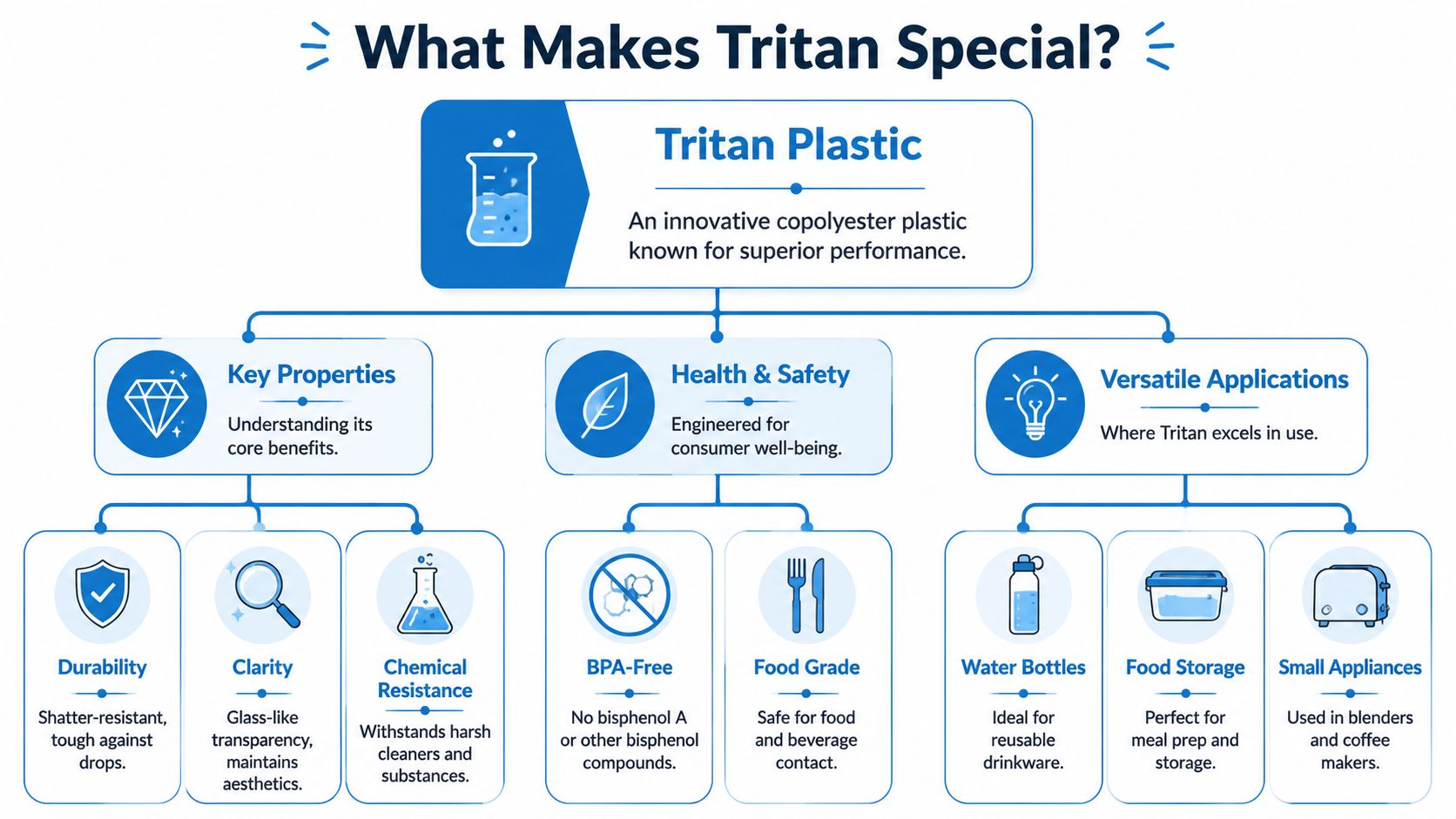
Tritan is a copolyester developed for reusable food-contact products. Eastman positions it as a replacement for polycarbonate in hydration applications and markets it as BPA-free, food-contact safe, and shatter resistant for bottles that need to handle regular drops and daily use Eastman Tritan hydration applications.
The definition that matters to a promotional buyer
Chemical names rarely close a drinkware order. Performance does.
For a branded bottle program, Tritan gives buyers a specific mix of traits that affects campaign results:
- Clear appearance: The bottle looks clean, modern, and closer to retail-grade drinkware than many entry-level plastics. That helps a branded piece feel chosen, not leftover.
- Impact resistance: It stands up better to travel, events, campus use, and field work than brittle alternatives. Fewer breakages usually means fewer wasted units and fewer complaints after distribution.
- Reusable positioning: Because it is marketed for repeated food-contact use, it supports wellness, sustainability, and daily-use messaging more comfortably than plastics that feel disposable.
Those are material specs, but they also translate into business outcomes. A bottle that still looks good after a month keeps representing your brand. A bottle that clouds, cracks, or feels flimsy lowers perceived value fast.
Why Tritan shows up in serious sourcing conversations
Buying decisions often go astray when teams focus on color and shape first. Experienced buyers start with the substrate because the material sets the ceiling for perceived quality, print presentation, and usable life.
Tritan earns attention because it solves a branding problem as much as a product problem. Clear walls make decoration look sharper. The bottle feels appropriate in more settings, from employee onboarding kits to client gifting to event giveaways where breakage risk matters. If your team is comparing options across budget, durability, and imprint performance, a promotional product sourcing guide for bulk buyers helps frame those trade-offs early.
I usually describe Tritan as one of the safer middle positions in custom drinkware. It does not carry the premium heft of stainless steel. It also avoids the fragility and shipping headaches that come with glass. For brands building strategic promotional items, that middle ground is often where return on investment improves.
Practical rule: Choose Tritan when you need a bottle that presents well, survives normal use, and supports a brand message that feels current rather than disposable.
Why Tritan Bottles Elevate Your Promotional Strategy
Promotional drinkware performs best when people keep it within reach. That's the primary standard. Not unit cost alone. Not how it looked in the catalog. A Tritan water bottle supports that goal because it fits regular routines without feeling disposable.
Longer use means stronger brand exposure
A bottle that survives commute bags, office desks, and gym sessions has a better chance of becoming part of someone's week. That matters because repeated use is where promotional value compounds qualitatively. A durable bottle creates more chances for your logo to be seen, handled, and associated with daily utility.
Independent testing described in consumer-facing material says Tritan is made without BPA, BPS, or other similar bisphenols, which helped it gain traction as a reusable bottle material. The same source notes that 18% of Americans only drink bottled water, showing how many consumers pay close attention to what their bottle is made from what Tritan water bottles are made without.
That point changes the promotional conversation. Material safety isn't a side note anymore. For many recipients, it's part of whether the item feels usable or questionable.
The safety story affects perception
Brands don't need to print a chemistry lesson on a bottle. They do need to avoid creating doubt. If a recipient wonders whether the bottle is cheap in the wrong way, your giveaway starts working against you. Tritan helps reduce that friction because the material story aligns with what people already look for in reusable hydration products.
That makes it especially strong for:
- Employee onboarding kits: A better bottle suggests the company cares about useful, long-term gear.
- Health and wellness campaigns: The material aligns with routines built around hydration and portability.
- Trade show giveaways: Clear, attractive drinkware stands out more than another low-cost desk item.
- Client gifts with practical intent: The bottle feels usable, not ornamental.
When teams map campaigns around retention, it helps to look at drinkware as one category inside a broader mix of strategic promotional items rather than as a standalone impulse order. That usually leads to smarter choices about audience, setting, and expected use.
For bulk buyers, it also helps to pressure-test budget, decoration, and shipping assumptions early with a promotional product sourcing guide for bulk buyers. Better planning usually protects brand quality more than shaving a little off the bottle cost.
Bringing Your Vision to Life Branding on Tritan
A good bottle blank can still produce a weak result if the decoration method is wrong. That's where many otherwise solid campaigns lose polish. The bottle itself may be durable and attractive, but the imprint has to match the logo style, the handling conditions, and the audience.
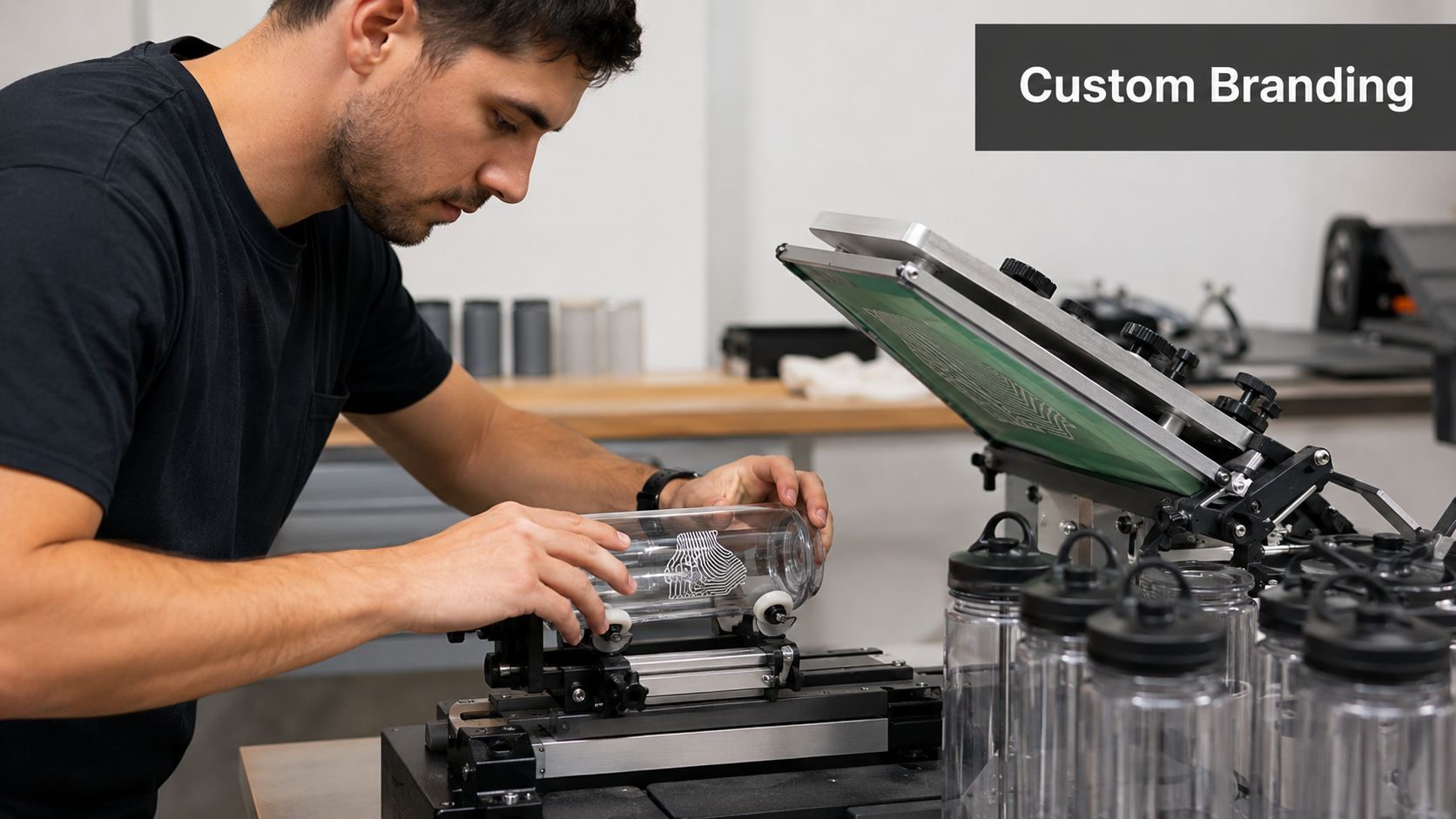
Near the start of the process, it helps to look at how branding is physically applied to drinkware.
Choose decoration based on logo behavior
The first question isn't “What's the fanciest print option?” It's “How does your logo behave on a curved, handled surface?”
A simple one-color mark often looks strongest with screen printing. It's clean, readable, and cost-conscious for campaigns that need a bold logo instead of a detailed illustration. If your brand relies on high contrast and simple shapes, screen printing usually gives the clearest result.
For artwork with gradients, multiple tones, or more visual detail, full-color digital decoration can make more sense. This approach is better when the design itself is part of the campaign, not just the logo. Think event graphics, lifestyle artwork, or a bottle tied to a themed launch.
Then there's laser-style premium marking on compatible components or select finishes. This is usually the quietest branding move. It works well when you want a subtle, executive look rather than a loud giveaway feel.
A few practical guidelines help:
| Decoration method | Best fit | Watch for |
|---|---|---|
| Screen print | Bold logos, simple branding, larger runs | Fine detail may not reproduce cleanly |
| Full-color print | Detailed art, multi-color campaigns, visual storytelling | Needs disciplined file prep |
| Premium etched look | Minimal branding, upscale kits, understated presentation | Less visible from a distance |
What works best for different campaign goals
If the bottle is meant for fast distribution at an event, readability wins. If it's for a leadership retreat or client welcome package, subtle branding may feel more premium. Neither is universally better. The best option is the one that matches the setting.
The logo should feel like it belongs on the bottle, not like it was forced onto it.
That's also why art preparation matters. Vector files, clear placement notes, and realistic expectations for imprint size save time and disappointment. A curved surface changes how small type and thin strokes appear.
If you're comparing print approaches on multiple product types, a practical overview of how to choose a logo decoration method can make approval easier across teams.
Packaging and companion items can also influence the final look. For campaign bundles that include labels, seals, or event handouts, it's useful to understand where branded adhesive elements fit in. A quick look at Camelot Print & Copy stickers gives a good sense of how sticker applications support kits and short-run event packaging without changing the bottle imprint itself.
Here's a useful production visual before finalizing art direction:
The Pros and Cons A Balanced View of Tritan
Tritan has a lot going for it, but it isn't the right answer for every campaign. Good buyers know the difference between a strong fit and an automatic choice.
Where Tritan performs well
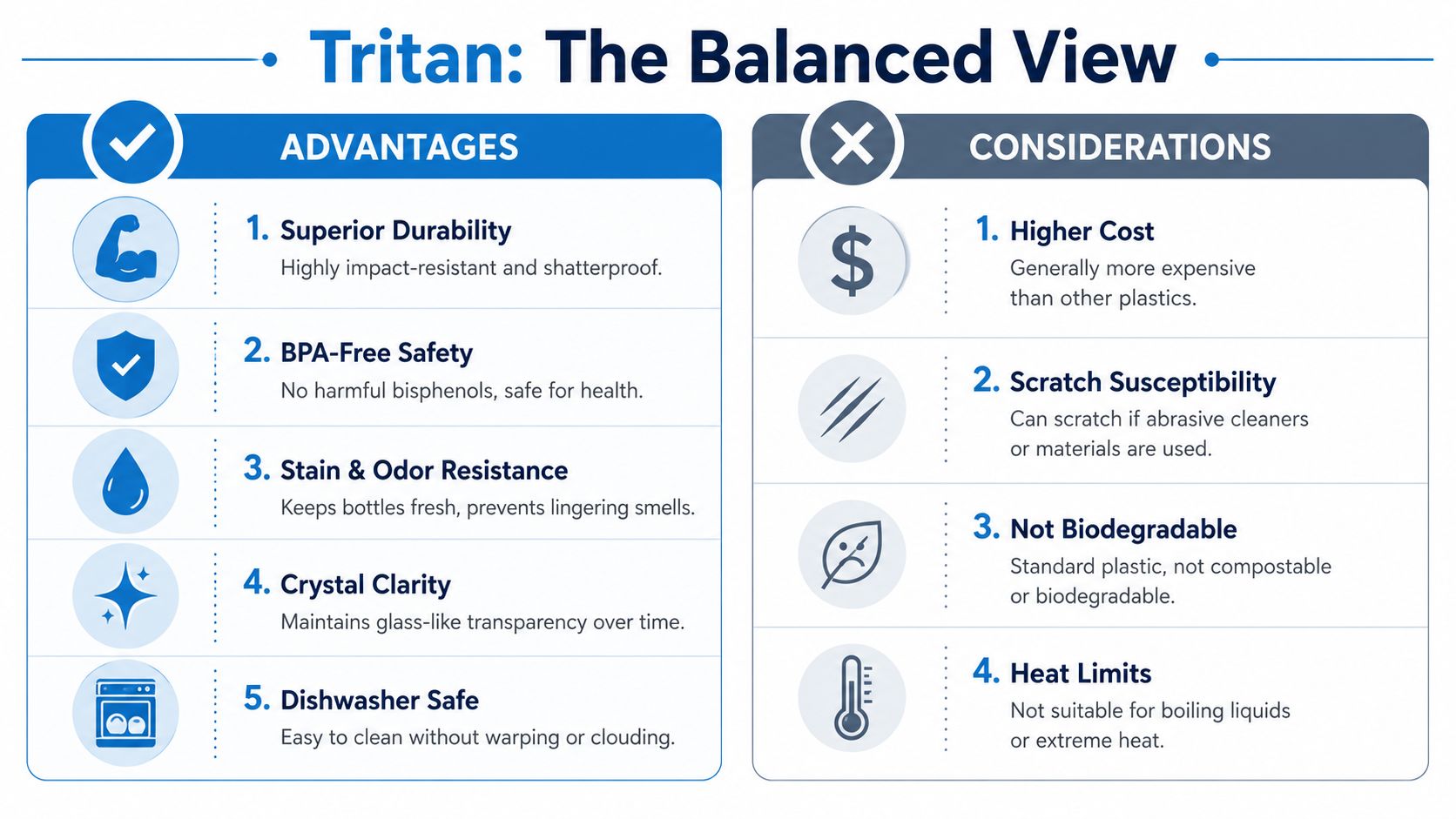
The biggest advantage is balance. Tritan gives you clarity, portability, and better impact handling than brittle alternatives. That's why it works well for school groups, commuting audiences, corporate kits, and general event distribution.
It also supports a more refined look than many low-end plastic bottles. If your logo depends on a cleaner presentation, that matters. A clear bottle with a tidy lid and strong imprint can feel noticeably more considered than a basic squeeze bottle.
Other practical strengths stand out in daily use:
- Lighter carry: Easier to hand out in quantity and easier for recipients to keep with them.
- Better breakage profile than glass: A safer fit for active environments and mixed-age audiences.
- Strong everyday usability: Works well for desks, backpacks, cars, and casual travel.
One more reason buyers keep returning to Tritan is that the sustainability discussion has become more nuanced. Product pages often stop at “reusable,” but that's only part of the environmental picture. Some brands now highlight Tritan Renew, showing movement toward recycled-content formulations instead of relying only on virgin material positioning Nalgene Tritan collection.
Where Tritan is the wrong choice
Heat is the clearest operational limit. Tritan can handle temperatures up to about 100°C / 212°F, but it's not microwave-safe and isn't generally recommended for direct use with boiling water because that can shorten service life and increase warping risk Tritan heat tolerance guidance.
That means Tritan isn't the best choice for:
- Hot beverage programs: Tea and coffee applications usually call for a different material strategy.
- Microwave routines: If users are likely to reheat, this isn't the right vessel.
- Harsh handling with abrasives: Clear surfaces can show wear if cleaned carelessly.
Buy Tritan for everyday hydration. Don't buy it for boiling liquids, microwave use, or as a substitute for insulated drinkware.
Price can also be higher than entry-level plastic options, so it makes the most sense when campaign quality matters more than chasing the lowest possible unit cost.
Your Ordering Checklist for Custom Tritan Bottles
A custom Tritan bottle can make your brand look organized and premium, or careless and cheap. The difference usually comes down to decisions made before production starts.
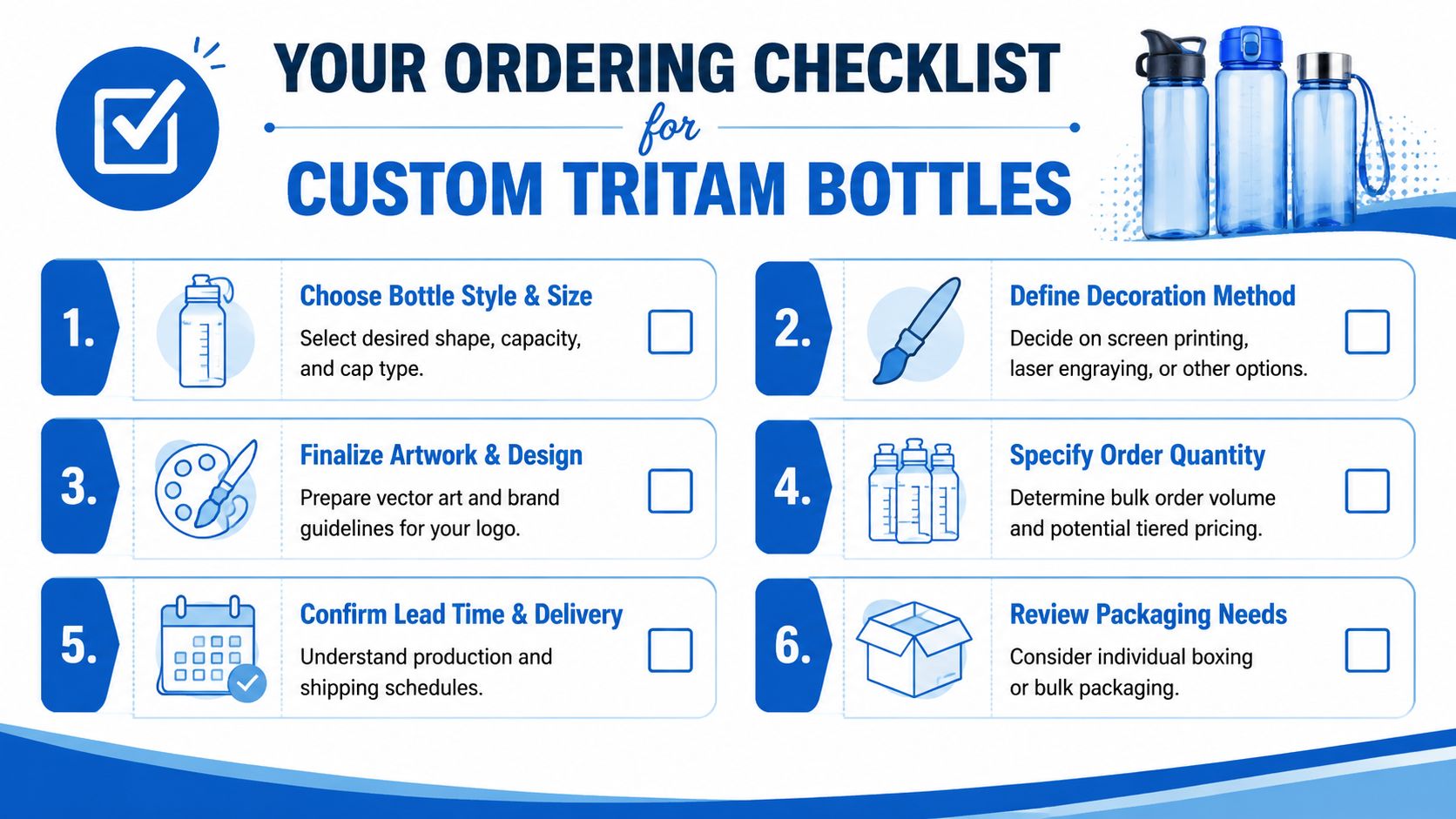
Teams often spend too much time comparing bottle shapes and not enough time defining the job the bottle needs to do. That is where budget gets wasted. A good-looking bottle with the wrong lid, weak imprint placement, or poor packaging will still miss the mark in the recipient's hands.
Start with the campaign outcome. If the goal is daily office use, prioritize clean branding, easy cleaning, and a form that fits cup holders and desks. If the bottle is for student programs or active giveaways, focus more on carry loops, flip tops, and drop resistance. If it is an executive kit or client gift, packaging and print finish carry more brand weight than shaving a little off unit cost.
Details to lock before production
Before approving a quote or proof, confirm these points:
Bottle style and cap type
Choose the bottle around the user routine, not just the silhouette. Screw tops feel simple and dependable. Straw lids and flip spouts feel more convenient for workouts, commuting, and events, but they also add cleaning complexity and more parts to manage.Imprint method
Match the decoration method to the artwork and the brand standard. Large, simple logos usually print well with fewer issues. Fine lines, small text, metallic effects, or wrap graphics need closer review because the wrong method can make a polished brand look compromised.Artwork format
Vector files reduce production problems and help keep edges clean. If the design includes small type or precise spacing, ask for a proof sized to the actual imprint area, not an enlarged mockup that hides readability issues.Brand color control
Provide Pantone references or clear brand standards early. Tritan bottles often come in clear, tinted, or frosted bodies, and the bottle color can change how the imprint reads. A logo that looks sharp on white paper may lose contrast on smoke gray or blue plastic.Packaging and presentation
Decide how the bottle will arrive before the order is placed. Bulk packing lowers cost, but individual boxes improve presentation and protect the impression if the bottle is part of a welcome kit, mailer, or client gift.Production timing
Build approval time into the schedule. Delays rarely start on the factory floor. They usually come from revised artwork, late stakeholder feedback, or cap changes after proofs are issued.
Mistakes that slow down approval
The costliest ordering mistake is treating the bottle as a commodity. Promotional drinkware is a brand touchpoint. Every visible choice, body color, lid style, print size, packaging, tells the recipient what kind of company sent it.
A few habits prevent rework:
- Approve with the recipient's routine in mind: The best lid on paper is not always the one people will use every day.
- Check imprint placement on the actual bottle shape: Curves, grips, and measurement marks can crowd the logo area.
- Confirm packaging expectations early: Shipping a premium campaign item in bulk can undercut the brand message.
- Get stakeholder sign-off before final proof approval: Late opinions create rush fees, missed dates, or avoidable compromises.
- Verify delivery windows against the event date: A bottle that arrives after the conference or onboarding cycle has little promotional value.
If your team is still comparing quantities, materials, decoration options, and freight trade-offs, this promotional water bottles bulk buying guide gives a practical framework before you issue a PO.
Frequently Asked Questions About Tritan Water Bottles
Daily use questions matter because that's where a promotional bottle either becomes a favorite or gets left behind. Most recipients don't ask about polymer categories. They ask whether the bottle stays fresh, tastes clean, and fits their routine.
How should you clean a Tritan bottle
Regular washing matters more than any marketing claim. For everyday maintenance, warm water, mild soap, and a bottle brush usually do the job. Pay extra attention to threads, lids, straw parts, and seals because that's where residue tends to sit.
If a bottle starts to smell off, deep cleaning is usually about the lid system rather than the body. A soak with simple household cleaning methods can help, followed by a full rinse and complete air drying before reassembly.
Clean bottles with the lid fully separated when possible. Most odor complaints start in hidden gasket and spout areas.
Will it affect taste and how long will it last
A lot of buyers care about taste neutrality, and they should. Beyond the BPA-free discussion, one of the strongest user concerns is whether a bottle retains odor or affects flavor. Product differentiation in the market is also moving toward practical features like flip-up spouts, straw lids, and carrying handles, which tells you people are judging bottles on daily usability, not just on the material label Tritan bottle usability details.
In normal use, a Tritan water bottle is often chosen because people want a lightweight bottle that feels cleaner and more durable than bargain plastic. How long it lasts depends on how it's treated. Careful washing, avoiding near-boiling fills, and not scraping the surface with abrasive tools all help preserve appearance.
For long-term satisfaction, these habits make the biggest difference:
- Use it for cold and warm drinks, not boiling liquids
- Wash lids thoroughly
- Replace badly worn components if the bottle design allows
- Choose the lid style that matches the user's habits from the start
A bottle that fits someone's routine gets used. A bottle that fights their routine ends up in a drawer.
If you're planning a custom drinkware order and want help choosing the right bottle style, imprint method, and production path, Dirt Cheap Product, Inc. can help you turn a simple Tritan bottle into a branded item people keep and use.