You've re-ordered event shirts before. The artwork is approved, the sizes are set, and then the quote comes back with a decoration method you don't recognize: sublimation. Before you approve it, check the garment, the artwork, and the intended use. Custom sublimation shirts can produce excellent full-color apparel, but only when polyester, color, and production method line up.
This guide is for buyers who need a practical answer, not a generic promise about vivid prints. We do not create business cards or fliers. The focus here is decorated apparel, including what to send to a printer, what to reject, and when screen printing, DTF, or embroidery will produce a better result.
Table of Contents
- What Custom Sublimation Shirts Actually Are
- How Dye Sublimation Printing Works on Apparel
- Sublimation vs Screen Printing, DTF, and Embroidery
- Fabric and Color Requirements for Best Results
- Design and File Specs Your Printer Will Ask For
- Order Workflow From Quote to Delivery
- Pricing Factors for Business Orders
- When Sublimation Is and Is Not the Right Call
What Custom Sublimation Shirts Actually Are
Custom sublimation shirts are polyester garments decorated through heat-and-pressure dye transfer. A printer places a specially prepared design against the fabric, then applies controlled heat. The solid dye turns into gas and migrates into suitable synthetic fibers, so the design becomes part of the textile instead of forming a separate film on top.
That distinction controls the shirt's appearance and feel. You don't get a thick raised rectangle over the garment. You get continuous-tone artwork integrated into the polyester, which is why the method suits gradients, photographs, complex illustrations, team graphics, and all-over layouts.
The technology is mature
Sublimation isn't a one-off craft technique. Historical research traces an early sublimation-transfer process to approximately 1929 to 1930, while an industrialized melt-transfer approach using coated paper was documented in Milan around 1950. The major milestone came in 1957, when Noël de Plasse of the French textile company Lainière de Roubaix was credited with inventing dye-sublimation printing. The technical history of transfer printing from the Printing Industries of America records how the process developed into commercially significant textile production.
The important buying point is simple. Sublimation has moved from industrial transfer equipment to computer-controlled and inkjet workflows used for short-run, personalized, and full-color apparel. Commercial printers use it for sports teams, corporate events, event merchandise, retail collections, and performance wear.
What you're actually paying for
A sublimation quote usually reflects more than ink on a blank T-shirt. You're paying for:
- Full-color coverage: Photographic detail, gradients, and multiple colors can occupy a broad printable area.
- Edge-to-edge potential: Cut-and-sew production can support designs that continue across garment panels.
- Soft hand feel: Because the dye enters the fiber, there's no heavy surface layer to distract from the fabric.
- No screen setup: The artwork moves through a digital workflow rather than requiring a separate screen for every spot color.
- Personalization: Names, numbers, and individual variations can fit naturally into a digitally managed production file.
Don't treat sublimation as the default choice for every custom shirt. It's the right tool when the design needs full-color polyester decoration and a nearly invisible print surface. If your audience wants heavyweight cotton, a dark garment, or a raised logo, another method may serve the order better.
How Dye Sublimation Printing Works on Apparel
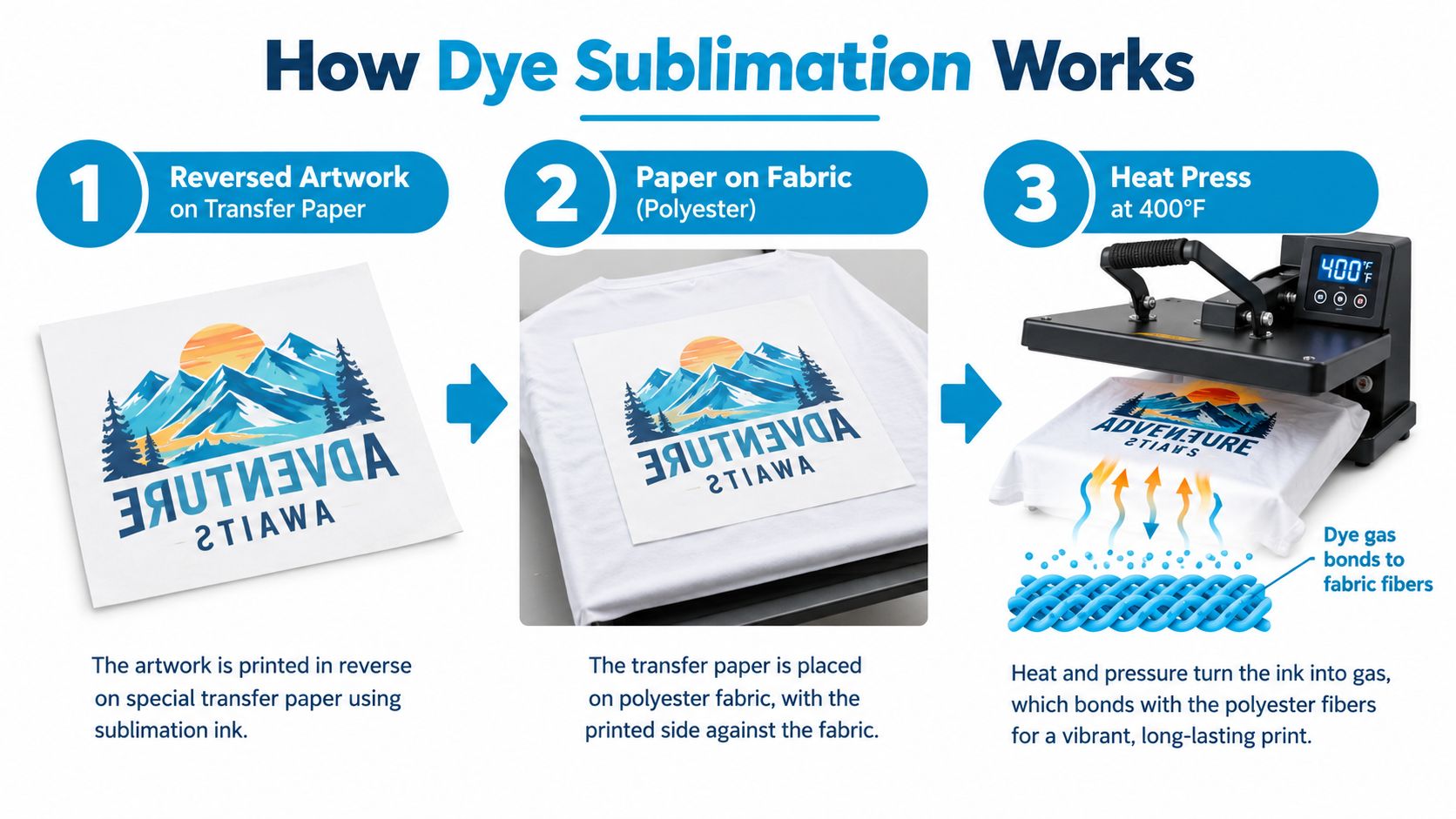
The process is easier to understand when you follow the garment through production. First, the artwork is prepared in production software and mirrored. The printer outputs that reversed artwork onto transfer paper using sublimation inks. The paper is then positioned against the polyester shirt, secured so it can't move, and placed under a heat press.
During pressing, heat converts the solid disperse dye into gas. The gas moves into the suitable synthetic fibers and returns to a solid state inside the textile. The dye doesn't sit as a separate coating, which explains the smooth surface and the method's resistance to cracking or peeling.
What happens at the press
A production operator typically follows this sequence:
- Preflight: The team checks the file, print size, garment template, colors, and placement.
- RIP preparation: RIP software interprets the artwork for the printer, manages the ink channels, and prepares the mirrored output.
- Paper printing: The design is printed onto transfer paper. It may look muted before pressing. That's normal for sublimation output.
- Positioning: The paper is aligned with the shirt or pre-cut garment panel. Heat-resistant tape helps keep the artwork from shifting.
- Heat transfer: The press applies controlled temperature, pressure, and dwell time. Controlled textile experiments evaluated 170 to 210°C for 30 to 60 seconds, with color strength increasing as temperature and dwell time increased. The textile experiment on sublimation transfer conditions also shows why a printer must balance dye release against fabric risk and color shifts.
- Cooling and inspection: The shirt leaves the press warm. The operator checks registration, edges, seams, color, and any signs of ghosting or transfer movement.
The commonly quoted press setting of roughly 400°F is an approximate production reference, not a universal instruction. The correct setting depends on the ink, paper, press, garment construction, and supplier specification. Ask the printer to confirm the actual settings instead of copying a generic number from a tutorial.
Practical rule: Approve a physical proof when color, placement, or repeat-order consistency matters. A screen preview can't show how translucent dye will interact with a particular fabric.
For a visual explanation of the stages, review the dye sublimation process guide.
The final garment has continuous-tone color, no raised print surface, and a finish that doesn't behave like a surface sticker. That doesn't make every sublimated shirt indestructible. Fabric quality, pressing conditions, laundering, artwork coverage, and construction still affect the result.
Here's a short visual walkthrough of the production logic:
Sublimation vs Screen Printing, DTF, and Embroidery
The right decoration method depends on the garment and the artwork, not on which process sounds most advanced. Compare the methods against the decisions that affect your order: fabric compatibility, color count, quantity, durability, hand feel, and cost per unit.
| Method | Best Fabric | Color Range | Ideal Quantity | Durability | Hand Feel |
|---|---|---|---|---|---|
| Sublimation | Polyester and polyester-rich garments | Full color, gradients, photographs, all-over artwork | Small to large polyester runs | Dye integrated into suitable fibers, with no surface film | Very soft, nearly no raised print |
| Screen printing | Cotton, blends, and selected polyester garments | Strong spot colors, specialty inks, bold logos | Larger runs with repeated artwork | Strong when properly produced and cared for | Noticeable ink layer, especially with heavy coverage |
| DTF | Cotton, blends, polyester, and many other textiles | Full color and detailed artwork | Small and medium runs, including variations | Durable transfer with a distinct film character | Soft to slightly film-like, depending on coverage |
| Embroidery | Polos, hats, jackets, fleece, and structured garments | Thread-based color and texture | Small to large branded apparel programs | Strong for suitable garments and designs | Raised, tactile, premium texture |
Choose sublimation for the garment first
Sublimation wins when you need full-color polyester decoration, especially across a broad surface. It handles photographic artwork, gradients, athletic graphics, and designs that would become complicated or expensive if separated into many screen colors.
Screen printing is the better economic choice for high-volume simple logos. It works well on cotton and supports opaque inks, specialty finishes, and strong contrast on dark garments. The trade-off is setup by color and a print layer that you can feel.
DTF is the practical alternative when the shirt is cotton or a blend but the artwork still needs digital full color. Buyers comparing transfer suppliers can review DTF Printing from Printed DTF Transfers to understand how a film-based transfer differs from fiber-level dye integration.
Embroidery is the clear choice for polos, hats, jackets, and small chest logos where texture communicates quality. It isn't suited to photorealistic art or large, densely covered print areas. Fine details can become difficult to read, and the stitching adds weight and dimension.
The decision pattern
Use sublimation for polyester teamwear, all-over graphics, detailed full-color artwork, and a soft finish. Use screen printing for high-volume cotton orders with a simple logo or a limited color palette. Use DTF for small runs on cotton and mixed fabrics, particularly when each garment needs a different design. Use embroidery for polos and hats where a raised logo is part of the intended look.
Don't approve a method from the artwork alone. A colorful design on a cotton shirt is not automatically a sublimation job. The fabric has the final say.
Fabric and Color Requirements for Best Results
Sublimation dye needs suitable synthetic fiber. Polyester is the safe default, especially when you want bright, edge-to-edge artwork and a soft finish. Polyester's structure accepts the gaseous dye during heat transfer, while cotton, rayon, linen, and wool don't readily accept sublimation dyes without surface modification.
A polyester-rich blend can work, but it usually produces less saturated results than a predominantly polyester garment. For brand-critical artwork, request the exact fiber composition instead of relying on a product name such as “performance tee.”
Make the fabric decision before artwork approval
Start with the garment specification sheet. Confirm the fiber blend, fabric weight, color, construction, and whether the shirt is pre-shrunk. Inspect seams, collars, side panels, and other areas that may affect how a large design sits across the garment.
A useful rule is to treat 100% polyester as the safest choice for vivid output. A garment with at least 65% polyester may be workable for sublimation, but lower synthetic content can reduce color strength and consistency. Cotton-rich garments are the wrong starting point when the design must remain saturated after laundering.
| Fabric or Color | Compatibility | Notes |
|---|---|---|
| White polyester | Excellent | Gives the most predictable base for bright full-color artwork |
| Light gray polyester | Good | Can shift colors slightly and reduce saturation |
| Pastel polyester | Usable with caution | The garment color influences the final print |
| Polyester-rich blend | Conditional | The design may appear softer or less saturated |
| Cotton-rich blend | Poor for standard sublimation | Dye uptake is inconsistent without a modified surface |
| Cotton, rayon, linen, or wool | Not suitable for standard sublimation | Choose screen printing or DTF instead |
| Dark polyester | Poor for standard heat-press sublimation | Translucent ink can't cover the garment like an opaque underbase |
Color is the second hard constraint. Sublimation ink is translucent, not opaque. White and very light garments give the closest match to the artwork. A colored base shifts the finished hue, while a dark base can make the design nearly invisible unless the production method includes a different construction approach.
Before sending a purchase order, request a fabric swatch or printed strike-off on the exact shirt. The sublimation printing blanks guide can help you compare blank styles, but the final approval should still use the garment selected for production.
A shirt that feels perfect in a catalog can print differently from the sample you approved. Verify the fabric before you finalize the design.
Performance polyester remains useful for sports and event apparel because it supports lightweight construction, moisture-management features, and quick-drying performance. That benefit matters in active settings, but it doesn't erase the comfort concerns of buyers who prefer natural fibers.
Design and File Specs Your Printer Will Ask For
A production team can't fix an incomplete artwork package without slowing the order. Send files that identify the intended size, placement, colors, and version. If the printer has to guess, the proof becomes a design session instead of a production approval.
Build the artwork package correctly
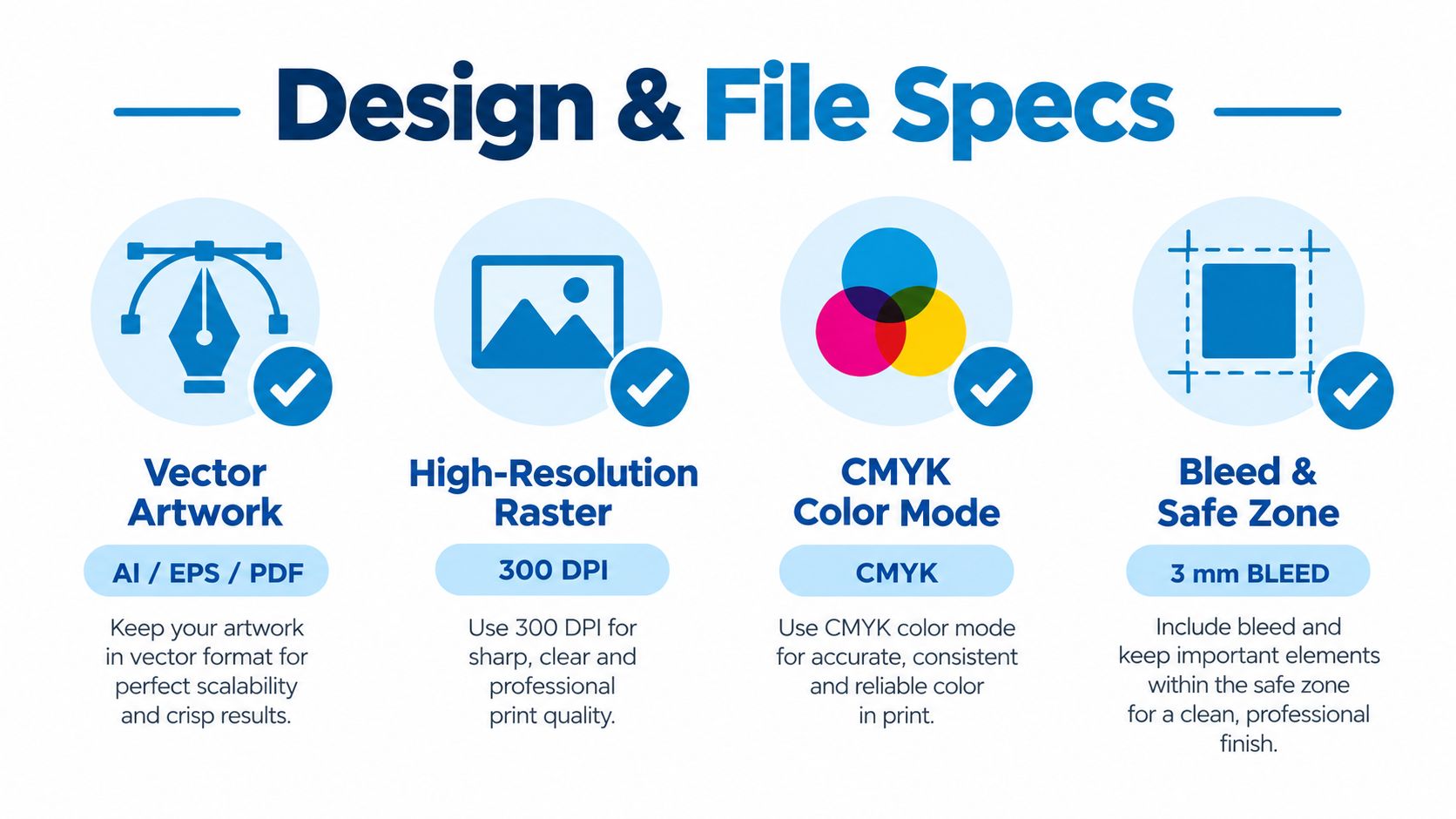
For logos, type, and clean graphic shapes, provide vector artwork in AI, EPS, or PDF format. Vector files allow the production team to scale artwork without introducing pixelation or jagged edges. Make sure fonts are outlined or include the correct font files, and remove unused elements before exporting.
For photographs and textured raster artwork, provide a high-resolution file at 300 DPI at the final print size. A small image enlarged to cover a shirt will look soft regardless of the printer's equipment.
Use sRGB when the design was built for screen-based approval and the printer has requested that workflow. Use CMYK or a named Pantone reference when brand-color control matters, but understand that the printer will convert the file into the sublimation ink gamut before output. A screen color and a printed color are different targets.
Define placement by garment size
Don't send one universal print rectangle and assume it fits every shirt. Printable areas change with garment size, cut, neckline, sleeve shape, seams, and panel construction. Ask for the printer's actual garment template and keep critical text, faces, logos, and numbers away from collars and seams.
Bleed beyond the intended edge gives the operator room to trim and align the transfer. A safe zone protects important details from being lost near the collar, side seam, armhole, or hem. Minimum line weights and text sizes should be confirmed against the printer's equipment and the garment's texture, particularly for lightweight fabrics.
For teams using a brand palette, ask for a physical proof of the most sensitive colors. Controlled testing found measurable color shifts, including a blue shift under tested conditions, so a digital approval alone isn't enough for demanding brand work.
Use the RGB to CMYK conversion guide as background for color preparation, then ask the printer which profile and proofing workflow they use.
Do:
- Send editable vectors: Include AI, EPS, or PDF files for logos and type.
- Send full-size raster art: Use 300 DPI at the final print dimensions for photographs.
- Include two views: Provide a flattened mockup and a separate transparent artwork file.
- Mark placement: Identify front, back, sleeve, panel, and size-specific changes.
Don't:
- Send screenshots: They rarely contain enough resolution or color information.
- Rely on low-resolution JPEGs: Enlarged files produce soft edges and missing detail.
- Leave hidden layers: Unused elements can appear in the output if the file is exported incorrectly.
- Approve from a monitor alone: Request a physical strike-off when color accuracy matters.
Order Workflow From Quote to Delivery
A clean order starts with a complete quote request. Send the garment style, color, quantity by size, artwork files, decoration locations, and target delivery date in one message. If you only write “custom sublimation shirts,” the supplier still has to ask the questions that determine capacity, pricing, and feasibility.
The production path
Quote: The supplier confirms the shirt, artwork scope, quantities, delivery requirements, and whether the order is suitable for sublimation. Ask whether the quote includes proofing, setup, packing, and shipping.
Prepress: The art team checks the file, adapts it to the garment template, and prepares a digital proof. Review placement at the collar, side seams, sleeve openings, and hem. Approve the proof in writing, and keep the approved version with the purchase order.
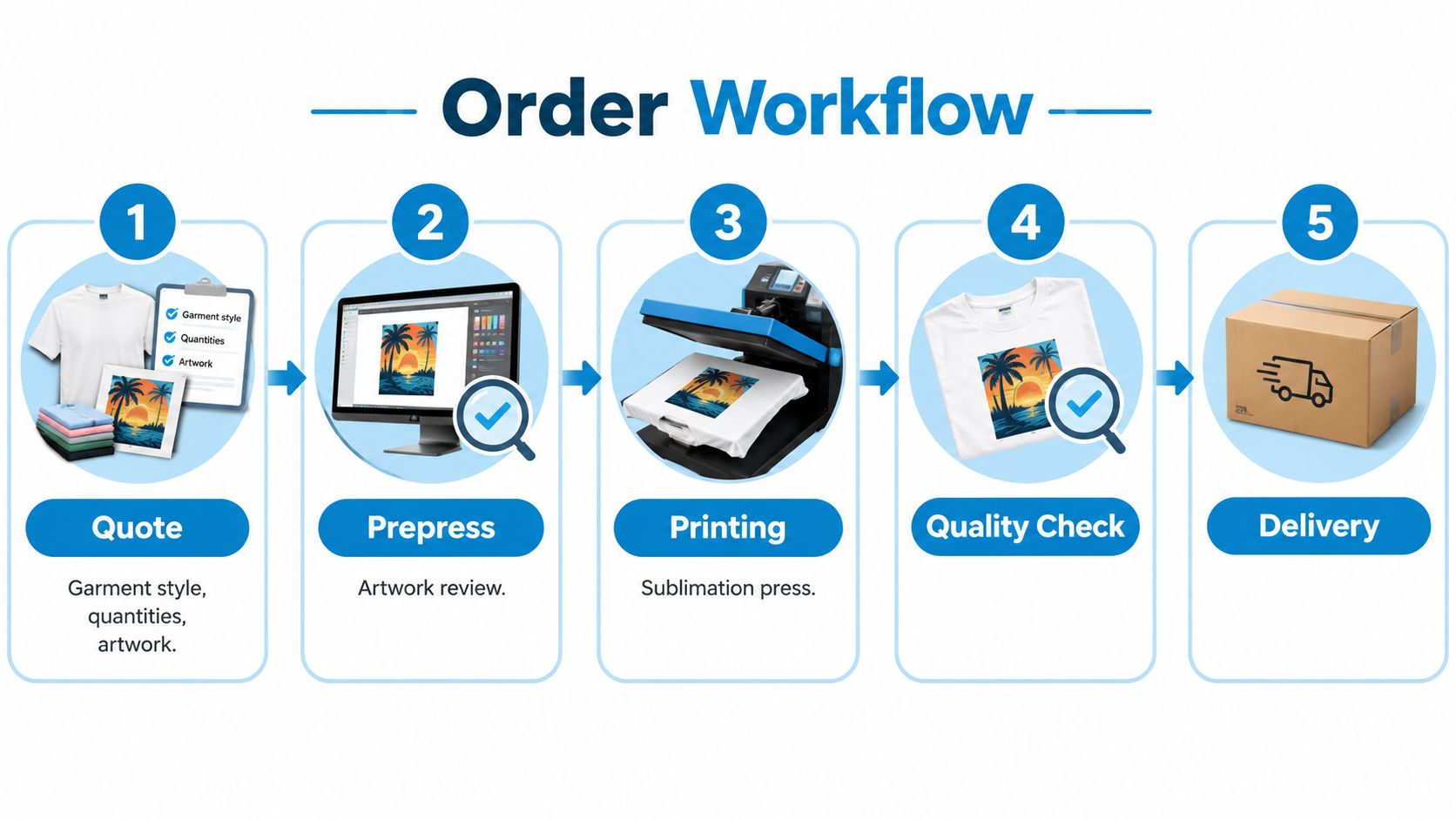
Production: The shop prints, cuts when required, transfers, heat-presses, inspects, and folds the garments. For stock items, a production window of two to five business days after art approval is a useful planning benchmark, but capacity, garment availability, and proof revisions can change it.
Quality control: The operator checks the approved artwork against the finished shirt. Look for color consistency, registration, seam alignment, ghosting, blank spots, press marks, and size sorting before the shipment leaves.
Delivery: Depending on the supplier, shipping may include ground service, expedited delivery, or will-call pickup. Some shops can drop-ship to multiple addresses for an added fee, but that arrangement should appear on the quote before approval.
Plan the calendar backward
A stock garment order may fit within one to two weeks from approval to delivery, while custom-dyed or imported blanks usually require more time. Those are planning benchmarks, not guarantees. Add time for artwork revisions, sample approval, size changes, carrier delays, and internal sign-off.
A 48-hour turnaround is only realistic when the blank is stocked, the artwork is ready, the supplier confirms capacity, and the order avoids complex proofing. Don't promise an event date to your own team until the printer confirms the production schedule in writing.
Approval rule: No production should begin until one person with authority has approved the exact proof. Verbal approval scattered across email, chat, and phone calls creates avoidable disputes.
Pricing Factors for Business Orders
A sublimation quote should be easy to audit. If the supplier gives you one unexplained total, ask for the components. You need to know whether the price reflects the garment, the print area, the number of locations, the order quantity, setup work, packing, and delivery.
Read the quote line by line
The blank garment is the first driver. A basic polyester tee, a performance shirt, a women's cut, and a specialty all-over garment won't carry the same cost. Fabric weight, construction, brand, and availability also affect the quote.
Print area matters next. Some shops price by square inch, while others price by location or package. A small left-chest design and a full-front print consume very different production resources even when they use the same artwork.
Quantity changes the economics. Sublimation doesn't need a screen for every color, but the shop still spends time on file preparation, garment handling, printing, pressing, inspection, and packing. Small runs may carry an under-12-piece upcharge, while larger orders may receive quantity breaks. Don't assume the lowest per-unit price applies to every size mix or print location.
| Cost Driver | How It Scales | What to Ask |
|---|---|---|
| Polyester blank | Changes by brand, weight, cut, and availability | Is the exact garment style included in the quote? |
| Print area | Increases with larger coverage and multiple locations | Is pricing based on area, location, or the whole garment? |
| Quantity | Per-unit cost can change across order tiers | What quantity break applies to this exact size mix? |
| Artwork preparation | Depends on file condition and revision needs | Are mockups, color adjustments, and proof revisions included? |
| Setup or digitizing | May apply to preparation or special production work | Is there a one-time fee, and what does it cover? |
| Packing | Changes with folded, bundled, or individual packing | Are size sorting and individual bags included? |
| Shipping | Depends on carton count, destination, and speed | Is the quote ground, expedited, pickup, or multi-address delivery? |
| Rush service | Adds cost when production is moved ahead of scheduled work | What deadline does the rush fee actually secure? |
Mockups may be bundled into the order or billed separately. Rush charges can apply when the supplier has to rearrange production. Roll packing, folded packing, individual bags, and multi-address shipping also change the final total.
Calculate total delivered cost divided by usable units, then compare that figure with a screen-print or DTF quote on the same garment. “Usable units” means shirts that meet your approved standard, not pieces that need rework or replacement. Ask for a proof and a clear quality standard before treating a low quote as a saving.
When Sublimation Is and Is Not the Right Call
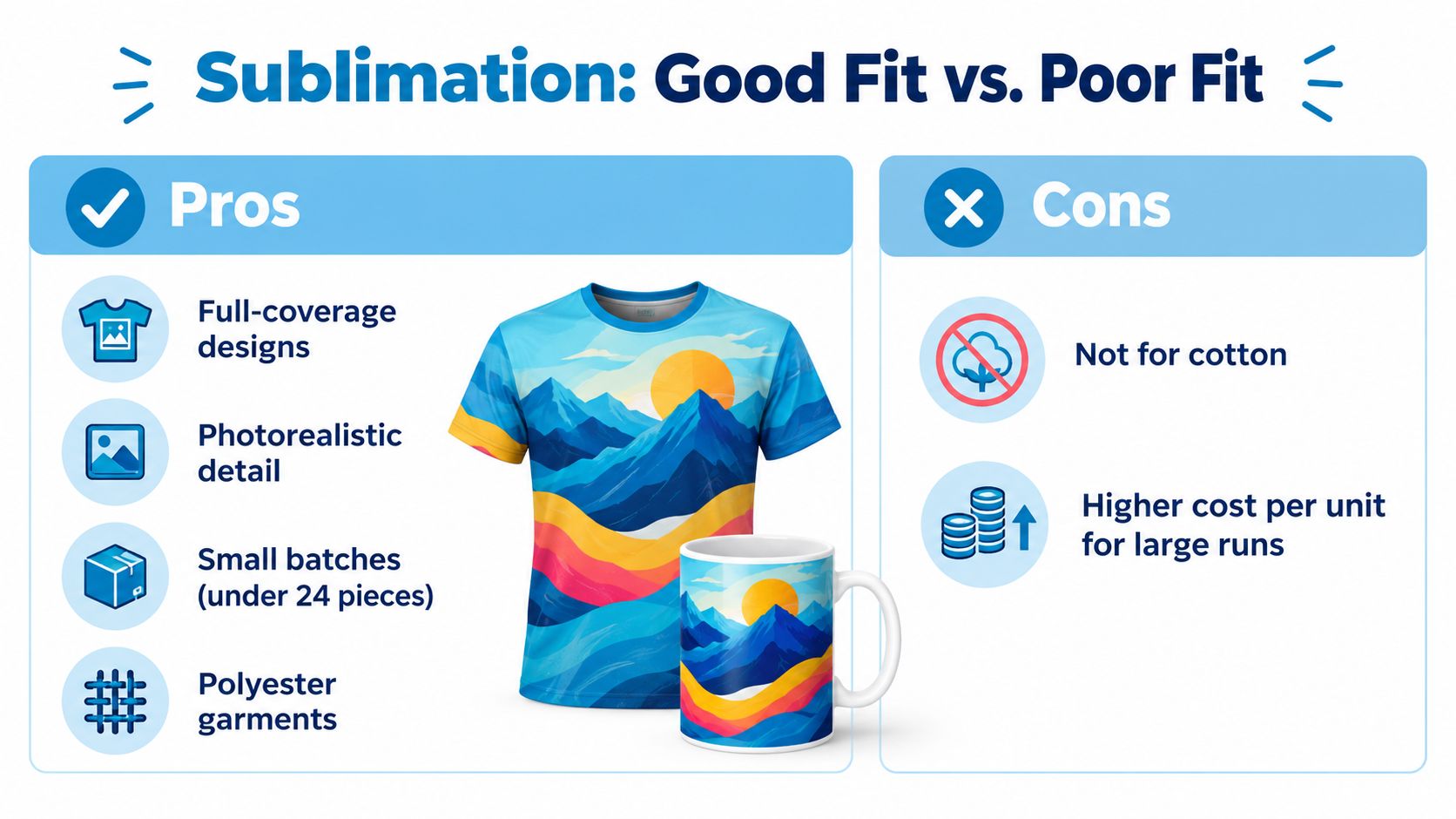
Sublimation is a strong fit for full-coverage designs, photographic artwork, gradients, athletic graphics, and polyester garments. It's especially useful when softness matters and you don't want a raised print surface. Small batches, including projects under 24 pieces, can make sense when the artwork is complex and the alternative would require costly setup or multiple decoration steps.
Choose another method for 100% cotton, cotton-rich garments, dark heathers, raised logos, or textured branding. Screen printing is usually more practical for a simple one-color logo on a larger run, especially when the garment is cotton. DTF is more flexible for cotton and mixed fabrics in small quantities. Embroidery belongs on polos, hats, jackets, and other garments where a tactile logo is the point.
Sustainability also needs a full-lifecycle view. Sublimation can reduce some wet-processing steps and water use, but it depends on synthetic fiber. Polyester's color retention may extend garment use, while fiber recovery, recycling, washing frequency, shipping, and disposal remain separate concerns. Specify recycled polyester where suitable, avoid overproduction, order durable garments, disclose fiber content, and provide care instructions instead of calling the shirt sustainable. A recent environmental review of sublimation and textile sustainability supports that more careful evaluation.
Confirm the fiber content, confirm the artwork specifications, and request a printed proof on the exact garment before production. That short checklist prevents most expensive sublimation mistakes.
Dirt Cheap Product, Inc. offers custom sublimation T-shirt printing alongside screen printing, embroidery, DTF, and custom patches, with polyester shirts, full-color artwork, and all-over options for business, event, retail, and uniform orders. Upload your logo and visit Dirt Cheap Product, Inc. to discuss the garment, decoration method, proof, and delivery schedule before you place the order.