
More than 120 million service employees worldwide wear company uniforms every day, and the best staff wear uniform is the one employees will wear comfortably. A successful program combines clear brand identity with functional fabric choices, inclusive sizing, and enough flexibility for different roles.
You may be dealing with the familiar version of the problem right now. The logo looks correct, the colors match the brand guide, and the supplier delivered on time. Yet reception staff avoid the blazer, warehouse employees wear personal layers, and field teams keep asking whether they can use a different shirt. The issue usually isn't employee attitude. It's that the uniform was designed as a visual statement instead of a working system.
A useful staff wear uniform has to survive movement, laundering, weather, different body shapes, and the practical demands of each role. It also needs to make the wearer instantly recognizable without making employees feel uncomfortable or over-managed. A uniform rollout succeeds when brand consistency and day-to-day usability reinforce each other.
This guide focuses on that balance. It also keeps the scope clear: we do not create business cards or fliers, and we do not post links to competitor websites. The subject here is apparel procurement, decoration, fit, policy, and long-term adoption.
Table of Contents
- The Professional Impact of Staff Wear Uniforms
- The Evolution and Scale of Modern Workwear
- Choosing High-Performance Fabrics for Your Team
- Branding Techniques and Personalization
- Adopting a Modular Approach to Uniform Systems
- Budgeting, Sizing, and Sourcing Your Uniforms
The Professional Impact of Staff Wear Uniforms
A customer walks into a hotel and sees one receptionist in a navy polo, another in a patterned blouse, and a third in a personal cardigan. None of them looks unprofessional as an individual. Together, however, the team is difficult to identify. A visitor has to guess who can check them in, who handles guest questions, and who belongs to the business at all.
A coordinated staff wear uniform removes that hesitation. It gives customers an immediate visual signal and gives employees a shared standard to work from. Occupational uniforms have served this recognition function for centuries, evolving from court livery into clothing for postal workers, police officers, firefighters, nurses, airlines, hospitality teams, and retail staff. The documented history of occupational uniforms shows that recognizable clothing has long supported authority, hygiene, professionalism, and role identification.

Recognition must work for employees too
A uniform isn't effective if only customers can understand it. Staff need to know which garments suit their duties, how to layer them, and what happens when an item is damaged or being cleaned. A receptionist may need a polished top that remains comfortable while seated for long periods. A maintenance employee may need room for bending, reaching, and protective layers. A delivery team may move between indoor and outdoor conditions during the same shift.
That difference matters for morale. Employees read the quality, fit, and flexibility of a uniform as signals about how carefully management has considered their working day. A garment that restricts movement or excludes common body shapes creates resistance, even when the branding is attractive.
Practical rule: If employees keep finding reasons not to wear a uniform, inspect the garment before escalating the policy.
The most reliable programs define a visible core, such as a branded polo or shirt, while allowing approved choices around trousers, layers, footwear, or climate-specific pieces. Managers should also wear the standard when their role requires it. A policy loses credibility when leaders enforce a look they don't follow themselves.
A uniform can't create trust by itself. It can, however, make the organization easier to understand, help teams appear coordinated, and give employees a consistent professional baseline. Those outcomes depend on making the clothing functional before making it decorative.
The Evolution and Scale of Modern Workwear
Work uniforms didn't begin with modern logo placement. Early examples were liveries worn by servants in European courts during the early modern period, from 1500 to 1800. In 1785, Prussian king Frederick II issued one of the earliest compulsory profession-specific rules, requiring postal servants to wear uniforms. The practice later extended into public services, healthcare, transport, hospitality, retail, and industrial work.
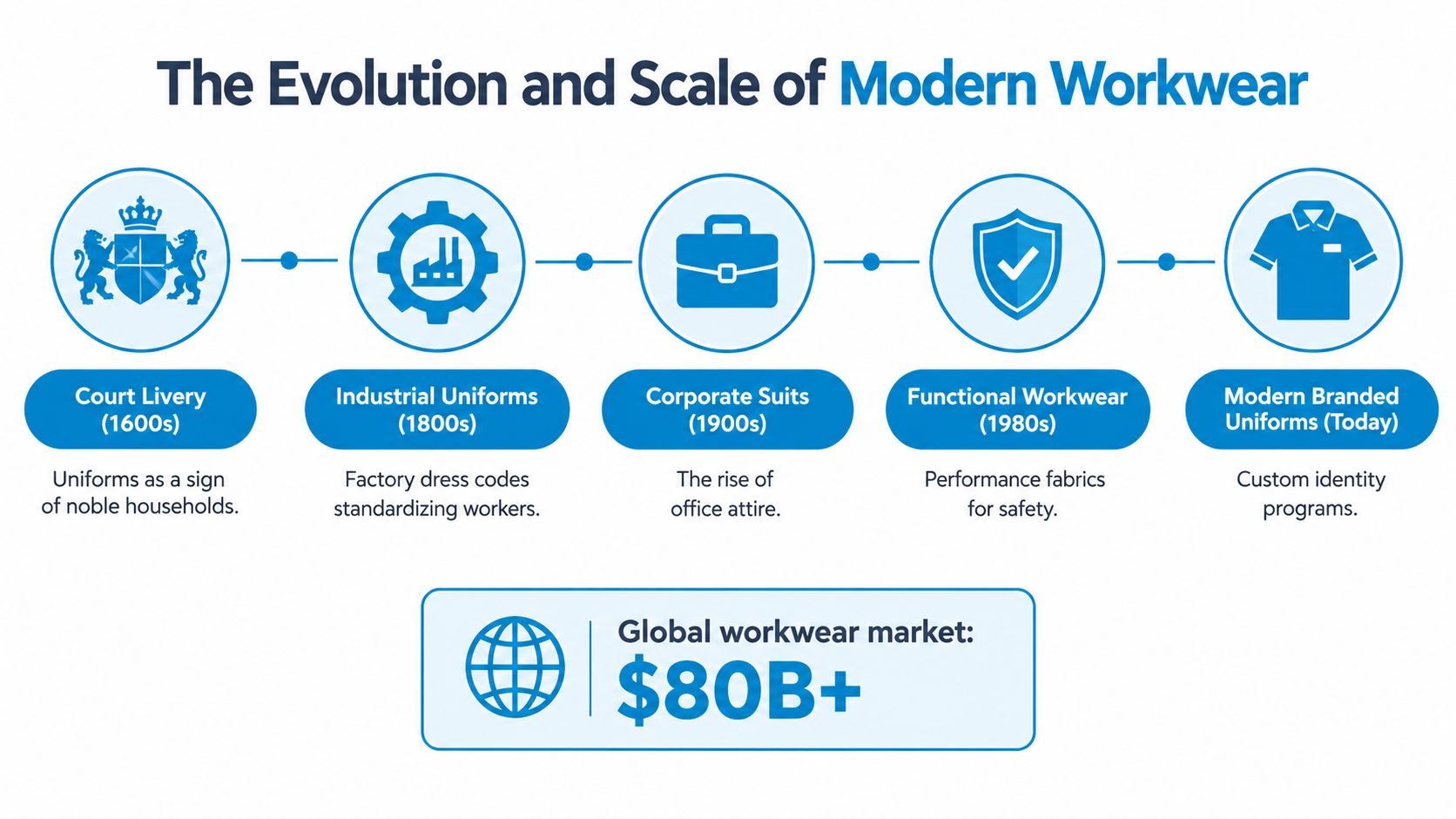
That history explains why a uniform carries more meaning than a color palette. It identifies a role, signals organizational membership, and standardizes appearance across locations. In a hotel, a uniform helps a guest find assistance. In healthcare, it separates functions and supports a professional environment. In retail, it tells shoppers whom to approach.
A global operating system for appearance
The industry's scale reflects how standardised clothing is embedded in business operations. One 2026 industry report estimates that more than 120 million service employees worldwide wear company uniforms daily, including healthcare workers, hotel employees, and airline personnel. The same market research field includes very different estimates because reports define uniforms and workwear differently. One summary values the global uniforms market at $205 billion in 2023, while another places the global workwear market at USD 33.52 billion in 2023. These figures are reported in the global workwear and uniforms market overview, and they shouldn't be treated as interchangeable measurements.
A separate forecast projects the workwear and uniform market rising from USD 98.61 billion in 2026 to USD 173.29 billion by 2036. Because that is a projection, procurement teams should use it as an indication of sustained demand rather than as a guaranteed outcome.
The practical lesson is straightforward. Staff uniforms are not a passing branding trend or a small promotional purchase. They sit at the intersection of labor, safety, customer experience, and identity. That makes the initial design decision important, but it also makes repeat ordering, garment durability, and policy ownership part of the same operational system.
What history doesn't solve
A centuries-old practice doesn't automatically produce a good modern uniform. Court livery was designed for visual distinction, not necessarily for hot kitchens, warehouse lifting, clinical hygiene, or long-distance travel. Today's buyers have to preserve the recognition benefit while adding mobility, wash resistance, thermal comfort, inclusive sizing, and role-specific flexibility.
That is why a modern program should start with the work itself. Ask where employees move, what temperatures they face, how often garments are washed, and which tasks require visibility or protection. The logo comes later.
Choosing High-Performance Fabrics for Your Team
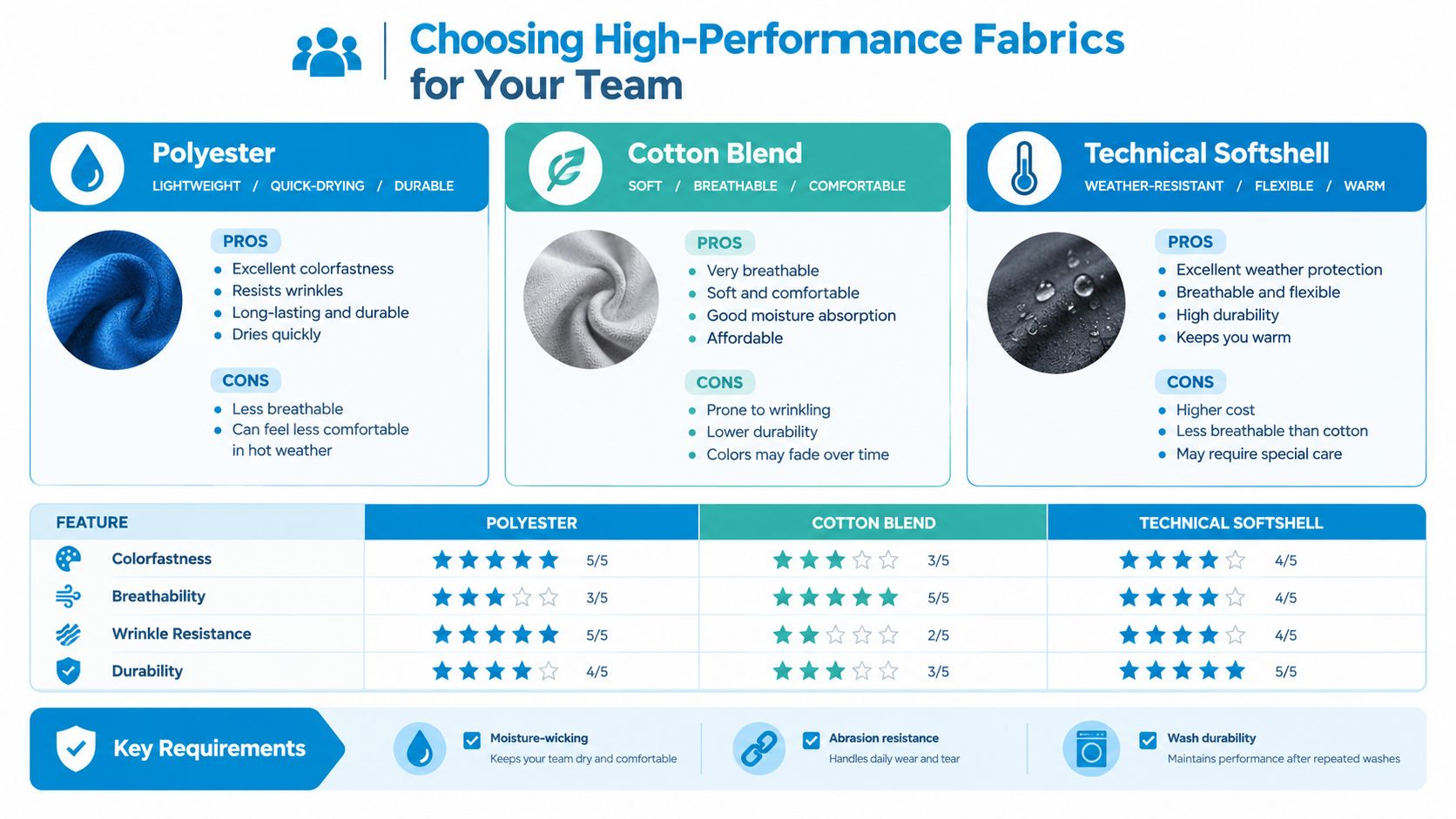
Fabric selection should begin with the work environment, not with whichever swatch looks best under showroom lighting. A polished polyester polo may perform well at a busy front desk, while a cotton blend may feel more comfortable in a climate-controlled office. An outdoor service team may need a technical outer layer with abrasion resistance and space for additional garments.
Commercial hospitality and healthcare fabrics are often specified to retain ISO 105 colorfastness at grade 4 to 5 and to keep dimensional shrinkage within 3% after five industrial washes at 60°C. These requirements matter because repeated hot laundering is a major source of fading and fit loss in staff clothing. The commercial uniform fabric guidance gives buyers a useful benchmark for discussing wash performance with suppliers.
Match the fabric to the task
Polyester usually makes sense where color retention, wrinkle resistance, and repeated laundering matter most. It can be a practical choice for customer-facing shirts that need to look consistent throughout a shift, but the hand feel and breathability need testing before a large order.
Cotton blends can offer a softer, more familiar feel and may suit indoor roles or environments where comfort against the skin is the priority. They may require more attention to shrinkage, creasing, and color stability, especially when the garment enters an industrial laundry cycle.
Technical softshell fabrics are more useful for outer layers, mobile teams, and variable weather. They can provide a durable branded layer, but they shouldn't replace a breathable base garment when employees work in heat.
For buyers comparing moisture management options, this moisture-wicking fabric guide can help explain how fabric construction affects sweat handling. Don't rely on the phrase “moisture-wicking” alone. Request a sample, have employees wear it during a normal shift, and ask whether the fabric feels clammy, noisy, restrictive, or difficult to layer.
Design changes thermal comfort
Climate changes the decision. Thermal-comfort testing in hot, humid conditions found that adding armpit openings increased heat transfer during dynamic activity, reduced the thermal insulation index by 11.8%, lowered mean skin temperature by 0.92°C, and improved subjective comfort ratings. The uniform thermal-comfort research supports a practical conclusion: ventilation details can matter as much as the fabric label.
Use mesh or ventilation panels where they won't interfere with branding, equipment, or modesty requirements. Test sleeve length, collar height, pocket placement, and side openings with the people who perform the work. A breathable fabric won't compensate for a cut that traps heat or restricts the shoulders.
Procurement test: Wash the sample using the intended care process, then inspect color, seams, shape, and logo placement before approving the production garment.
The lowest purchase price often becomes expensive when staff need replacements, managers handle complaints, or the team stops wearing the item. Compare the full service life, not just the invoice total.
Branding Techniques and Personalization
Brand decoration should support the garment rather than fight it. A dense embroidered logo can make a lightweight polo feel stiff. A large printed design can reduce the professional appearance of a front-desk uniform. A decoration method that looks excellent on a cotton T-shirt may perform poorly on stretch fabric or a softshell jacket.
Start by defining the job of the logo. A small left-chest mark usually identifies the wearer without overwhelming the garment. A larger back print may help field staff remain recognizable from a distance. Department names, role labels, or individual names can improve navigation, but every added decoration increases production variables and replacement complexity.
Select the method by garment
Embroidery suits polos, structured shirts, jackets, hats, and other garments that can support stitched detail. It creates a raised, durable finish and works particularly well for simple logos, but very fine lettering and large dense designs can add weight or distort lightweight fabric. Review a stitch proof before production. The custom logo embroidery service provides a useful reference point when comparing stitch-based decoration.
Screen printing works well for larger graphic areas on T-shirts, sweatshirts, and other relatively flat garments. It can produce strong color and a clean visual system across a large team, but the ink, print size, and curing process must suit the fabric. A heavy print on a breathable shirt can make the decorated area feel less comfortable.
Direct-to-film printing can handle detailed artwork and smaller runs without the same setup demands as traditional screen printing. It can be useful when the design includes gradients, fine detail, or multiple approved variants. Test adhesion and stretch recovery on the exact garment, especially for performance fabrics.
Sublimation is most suitable for compatible light-colored synthetic garments where the design becomes part of the fabric surface. It isn't a universal solution for dark polos, cotton-heavy shirts, or every outerwear material.
Custom patches can help teams distinguish departments or create replaceable identity elements. They add another layer, however, so check whether the patch catches on equipment, feels uncomfortable under straps, or complicates laundering.
A good supplier will show physical samples, not only digital mockups. Ask to see the actual thread colors, print edges, placement, and reverse side of the decoration. Confirm how the logo behaves after laundering and whether a replacement order will use the same artwork files and placement specifications.
This short visual example can help stakeholders compare embroidery with other decoration approaches before signing off on production.
Keep the decoration system disciplined. Use one approved logo file, document placement from measurable garment landmarks, define color references, and separate essential role identification from optional personalization. Consistency is what makes a uniform look intentional.
Adopting a Modular Approach to Uniform Systems
The single prescribed outfit sounds simple until a business has mixed roles. A hotel receptionist, banquet employee, gardener, maintenance technician, and manager may share a brand but not a working environment. Giving all of them the same blazer, shirt, or trouser combination creates predictable problems: overheating, restricted movement, unsuitable pockets, and garments that employees reserve for inspection days.
A modular capsule uniform solves that problem by defining a small collection of compatible pieces. Employees receive approved combinations rather than one rigid costume. The brand remains consistent through shared colors, logo placement, trims, and silhouettes, while the wearer chooses the pieces that match the task.
Build the capsule around a core
Start with the garments most roles can use. That might be a branded polo, a long-sleeve shirt, and a lightweight layer. Add role-specific pieces only where the work justifies them. An outdoor team may need a weather-resistant overshirt. A warehouse role may require a more durable trouser. A customer-facing role may use a refined cardigan or structured jacket.
The point isn't to offer every employee every possible garment. That creates excess inventory and makes reordering harder. The point is to create controlled choice.
A practical structure looks like this:
- Shared identity pieces: Use a consistent logo, approved color family, and standard placement across departments.
- Role-based garments: Assign only the pieces required for the work, such as durable overshirts for field teams or polished layers for reception.
- Climate options: Provide lighter and warmer versions where employees move between different temperatures.
- Fit options: Offer cuts that accommodate different body shapes without labeling one as the default and another as an exception.
- Replacement logic: Keep a defined list of reorderable styles instead of allowing every season's fashion item into the program.
Recent uniform-program coverage describes a move toward coordinated collections and capsule wardrobes, with layering, stretch fabrics, breathable panels, and ergonomic cuts becoming more common. The modern employee uniform program trends are useful context, but the procurement question is more demanding than whether a capsule looks current.
Control SKU growth before it starts
Every additional color, cut, sleeve length, size range, and decoration variation creates another SKU or ordering condition. Before approving a collection, map each proposed item against a real role and environment. If two garments perform the same job and only differ cosmetically, keep the one that is easier to source and reorder.
Use a sample group from different departments. Have them try combinations while performing normal tasks, not just standing in a meeting room. Ask which pieces layer comfortably, which pockets work, and which garments employees would choose without being reminded.
The right capsule gives people enough choice to work comfortably, but not so much choice that the buyer loses control of stock.
Document approved combinations with simple photographs or a digital uniform guide. State what is required, what is optional, and which pieces can substitute for one another. This prevents supervisors from creating local variations that gradually weaken the brand.
A modular system isn't less disciplined than a single outfit. It's more disciplined because every variation has a reason. The buyer controls the range, employees gain practical flexibility, and managers can reorder known garments instead of starting from scratch each time.
Budgeting, Sizing, and Sourcing Your Uniforms
A uniform budget should include more than the first shipment. Account for samples, decoration setup, size exchanges, replacements, laundering, storage, delivery, and the cost of keeping core garments available for new hires. A cheap shirt that fades or shrinks quickly can cost more operationally than a better garment with a stable reorder path.
Inclusivity belongs in the initial budget, not in a later correction. Current workwear guidance highlights extended size ranges, gender-neutral designs, eco-friendly uniforms, and styles that respect different body types and cultural preferences. The workwear trends guidance from Lands' End Business also points to the need for testing whether uniforms let staff work safely and effectively, rather than judging success only by branding.
Arrange a fitting session with representative employees. Record measurements, preferred cuts, mobility concerns, and layering needs. Use a custom apparel sizing guide as a starting point, then validate the actual garments because nominal sizes vary between manufacturers.
Put ownership in writing
A uniform policy should specify the required garments, what the employer provides, where and when employees may wear them, and who maintains and cleans them. The New Zealand workplace policy guide recommends addressing those points directly, including whether a clothing allowance helps cover costs.
Don't confuse a uniform with PPE. Federal guidance defines a uniform as clothing or items required to create a distinctive, easily identifiable appearance. It also states that a uniform allowance helps defray costs and cannot be used to purchase personal protective equipment, which falls under separate safety requirements. For U.S. Executive agencies, the maximum annual uniform allowance or cost of uniforms furnished to an employee is $1,500, with a possible supplier service-charge payment of up to 4%, provided the combined cost remains within that cap. These rules are detailed in the federal uniform allowance FAQs and uniform allowance fact sheet. Local rules and employment agreements may differ.
Some organizations also define quantity limits and protective-clothing requirements. Riverside, California's policy allows up to 12 uniforms per employee when garments are protective clothing for jobs subject to excessive wear or damage, and it specifies fabric and shirt-color requirements where safety is involved. Review the Riverside work-uniform policy for an example of how precise those rules can become.
| Consideration | Best Practice |
|---|---|
| Garment range | Approve a small modular collection tied to real roles and working conditions. |
| Sizing | Fit-test samples across body types, cuts, and extended sizes before ordering. |
| Decoration | Approve physical samples and document logo placement, thread, ink, and artwork files. |
| Washing | Test the intended laundering process for color, shrinkage, seams, and decoration. |
| Policy | State requirements, employer-provided items, permitted wear, cleaning duties, and allowances. |
| PPE | Separate protective equipment from branded appearance garments and safety compliance. |
| Reorders | Keep core styles available and define a minimum supplier response standard. |
| Supplier support | Confirm proofs, sample handling, delivery communication, size exchanges, and repeat-order consistency. |
For teams that need a more specialized example of role-based appearance and safety considerations, this professional uniform guide for security provides useful context.
Run a small pilot before a full rollout. Collect feedback on comfort, movement, laundering, sizing, decoration, and actual wear. Then lock the approved range, policy, and reorder process. Dirt Cheap Product, Inc. offers logo-ready apparel and decoration options including screen printing, embroidery, direct-to-film, sublimation, and custom patches, with proofs for reviewing color, placement, and stitching detail.
Dirt Cheap Product, Inc. can help compare uniform-ready garments and decoration methods for staff teams, from polos and outerwear to hats and bags. Visit Dirt Cheap Product, Inc. to upload your logo, review apparel options, and request a proof before placing your order.