Your team is ready for branded apparel. You've picked the polos, the hats, maybe a jacket for field staff or event crews. Then the questions start. Will the logo sew cleanly? Why does one file work and another need to be redone? Why does one cap cost more than another when the logo looks almost the same?
That's where most first orders slow down. Custom logo embroidery looks simple from the outside, but the result depends on a chain of decisions: logo style, file quality, fabric, placement, stitch count, proofing, and care. Get those right, and your apparel looks polished for a long time. Get them wrong, and even a strong brand mark can come out stiff, crowded, or hard to read.
Table of Contents
- Your Guide to Professional Custom Logo Embroidery
- Choosing Your Embroidery Style
- Preparing Your Logo File for Stitching
- Choosing the Right Fabric and Placement
- Understanding Embroidery Pricing and Timelines
- How to Order Your Custom Apparel
- Frequently Asked Questions About Embroidery
Your Guide to Professional Custom Logo Embroidery
A lot of business buyers assume embroidery is a niche add-on. It isn't. The U.S. commercial embroidery services industry was valued at $987.4 million in 2026 and included 943 businesses, according to IBISWorld's commercial embroidery services industry data. That matters because you're not buying from an experimental process. You're buying from an established production category with repeatable workflows.
For a first-time buyer, that stability shows up in practical ways. Shops know how to digitize logos for polos, caps, jackets, and bags. They know which fabrics hold detail and which ones fight it. They also know that the same logo may need one version for a left chest and another for a structured hat.
Practical rule: Embroidery isn't just “put logo on shirt.” It's translating your brand into thread, fabric tension, stitch direction, and garment placement.
That's why embroidery often feels more premium than many other decoration methods. The logo sits on the garment as texture, not just color. It has edge definition, thread sheen, and a built-in sense of permanence that works especially well for uniforms, hospitality apparel, corporate giveaways, golf polos, and branded headwear.
If you're ordering for the first time, keep your focus on three business outcomes:
- Brand clarity: Can people read and recognize the logo at the size you need?
- Wear durability: Will the stitching hold its shape after repeated use and washing?
- Budget control: Does the design fit the garment and decoration method without adding avoidable complexity?
Those three questions will steer almost every choice that follows.
Choosing Your Embroidery Style
Embroidery isn't one look. The style you choose changes how people read your brand from a few feet away. One industry analysis reported that embroidery made up over 40% of global custom apparel revenues in 2023, tied largely to its premium appearance and durable finish, as noted in this custom logo embroidery market overview.
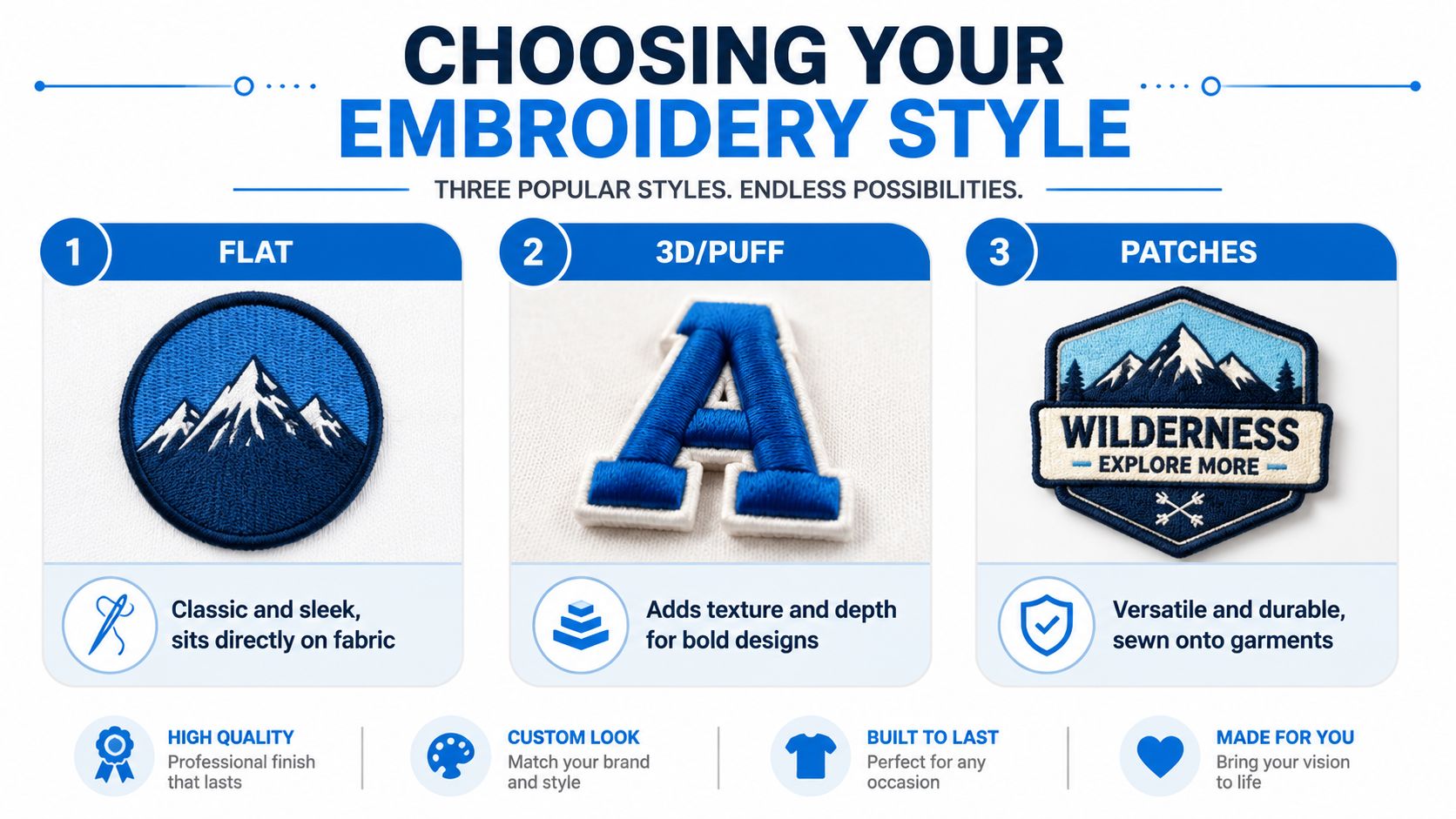
Flat embroidery for everyday uniforms
Flat embroidery is the standard choice for most business apparel. The stitches sit directly on the garment, so the logo looks clean, sharp, and professional without extra bulk. If you're decorating polos, quarter-zips, button-down work shirts, fleece, or soft shell outerwear, this is usually the safest place to start.
It works well for logos with:
- Simple shapes
- Readable text
- Clear color blocks
- Modest detail
Think of flat embroidery as the business suit of decoration methods. It isn't trying to shout. It's trying to look reliable.
3D puff for bold headwear
3D puff embroidery raises part of the design off the fabric by stitching over foam. The easiest way to picture it is sculpting with thread. Instead of a logo sitting flat on a cap, part of it stands up and catches light from the side.
This style fits:
- Structured caps
- Large initials
- Block lettering
- Simple icons with thick borders
It's not ideal for tiny text or delicate linework. Fine detail tends to lose clarity when the design is built upward instead of kept flat. If your logo includes a long company name under a symbol, a mixed approach often works better, such as puff for the main mark and flat stitching for smaller text.
Patches for flexibility
Custom patches are separate embroidered pieces attached to the garment. That changes both the look and the workflow. A patch can have a distinct border, a different base texture, and a badge-like feel that suits jackets, workwear, bags, uniforms, and merchandise lines.
Patches make sense when you want:
- A classic emblem look
- Consistency across different garment types
- An easy way to decorate heavier outerwear or accessories
- A style that feels more like a badge than direct stitching
If you're still comparing decoration approaches, it helps to understand where embroidery sits beside printing. A useful outside reference is Skup's print-on-demand methods, which gives a broad view of how different apparel decoration styles create different visual results.
Choose the style based on where the logo will live. A cap front, left chest polo, and retail patch hat don't ask the same thing from the same artwork.
Preparing Your Logo File for Stitching
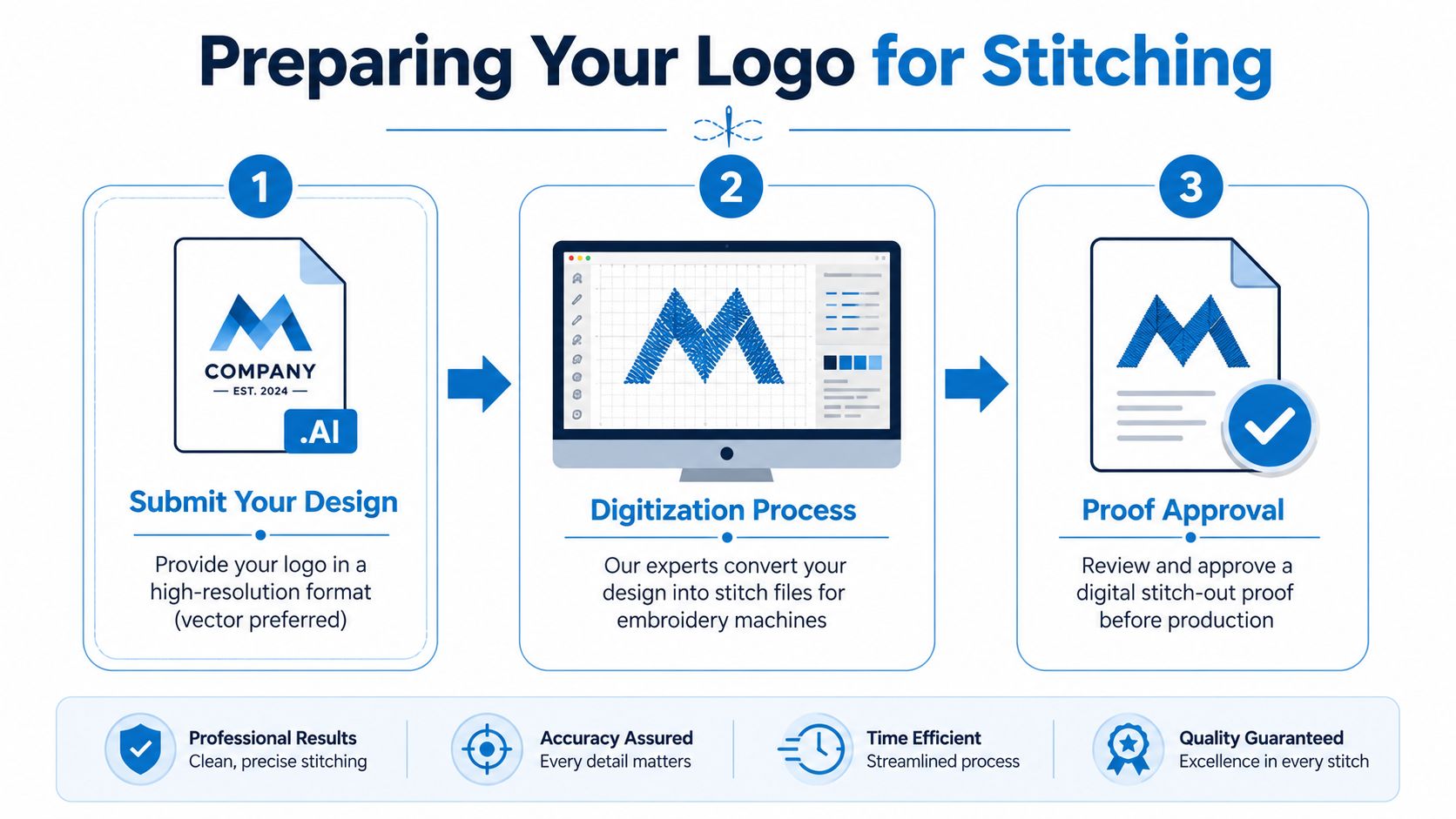
The embroidery machine doesn't read your logo the way a printer reads an image. It needs instructions. Those instructions come from digitizing, which turns artwork into a stitch file that tells the machine where to start, where to stop, how dense to sew, and which direction the stitches should run.
What digitizing really does
A good digitizer is a bit like a composer arranging music for an orchestra. The logo is the melody. The stitch file is the arrangement that tells each part what to do.
Two logos can look similar on screen and behave very differently in thread. A thin border may need to be thickened. Tiny gaps may need to be opened up. Lettering may need to be simplified so it doesn't fill in while sewing.
That's why “just use the JPEG from our website” often leads to trouble. The file may show the logo, but it doesn't tell the machine how to build it physically on fabric.
What file to send
The cleanest starting point is vector art. Expert guidance recommends vector source files such as AI, EPS, or PDF because they provide cleaner paths for stitch planning. If you only have a raster file, the guidance is to use at least 300 DPI, and for hat logos, roughly 1200 × 675 pixels helps preserve detail and reduce stitch distortion, according to this embroidery digitization guidance.
Here's the short version:
- Best option: AI, EPS, or PDF
- Usable fallback: High-resolution PNG or JPG at 300 DPI
- Hat artwork: Aim for roughly 1200 × 675 pixels if you're sending raster art
- Worst option: A small screenshot pulled from email, social media, or a website header
For thread selection, it helps to review realistic shades before production. A practical reference is this embroidery thread colors guide, especially if your brand uses close shades of blue, gray, or red that need careful matching.
Color choices and thread reality
Embroidery uses physical thread spools, not printed ink blends. That means gradients, fades, and very subtle color transitions usually need to be simplified. A logo that looks smooth on a screen may need to become a cleaner, more graphic version in thread.
Clean art gives the digitizer room to solve the right problem. Poor art forces them to solve the wrong one first.
If your logo has shadows, textures, or glow effects, ask early whether those details should be removed, reduced, or converted into simple stitch shapes. That conversation saves time, controls cost, and usually improves the final result.
Choosing the Right Fabric and Placement
A logo doesn't stitch in a vacuum. It stitches into a garment that stretches, folds, drapes, and moves. The same file can look crisp on one fabric and uneven on another.
Fabric changes the result
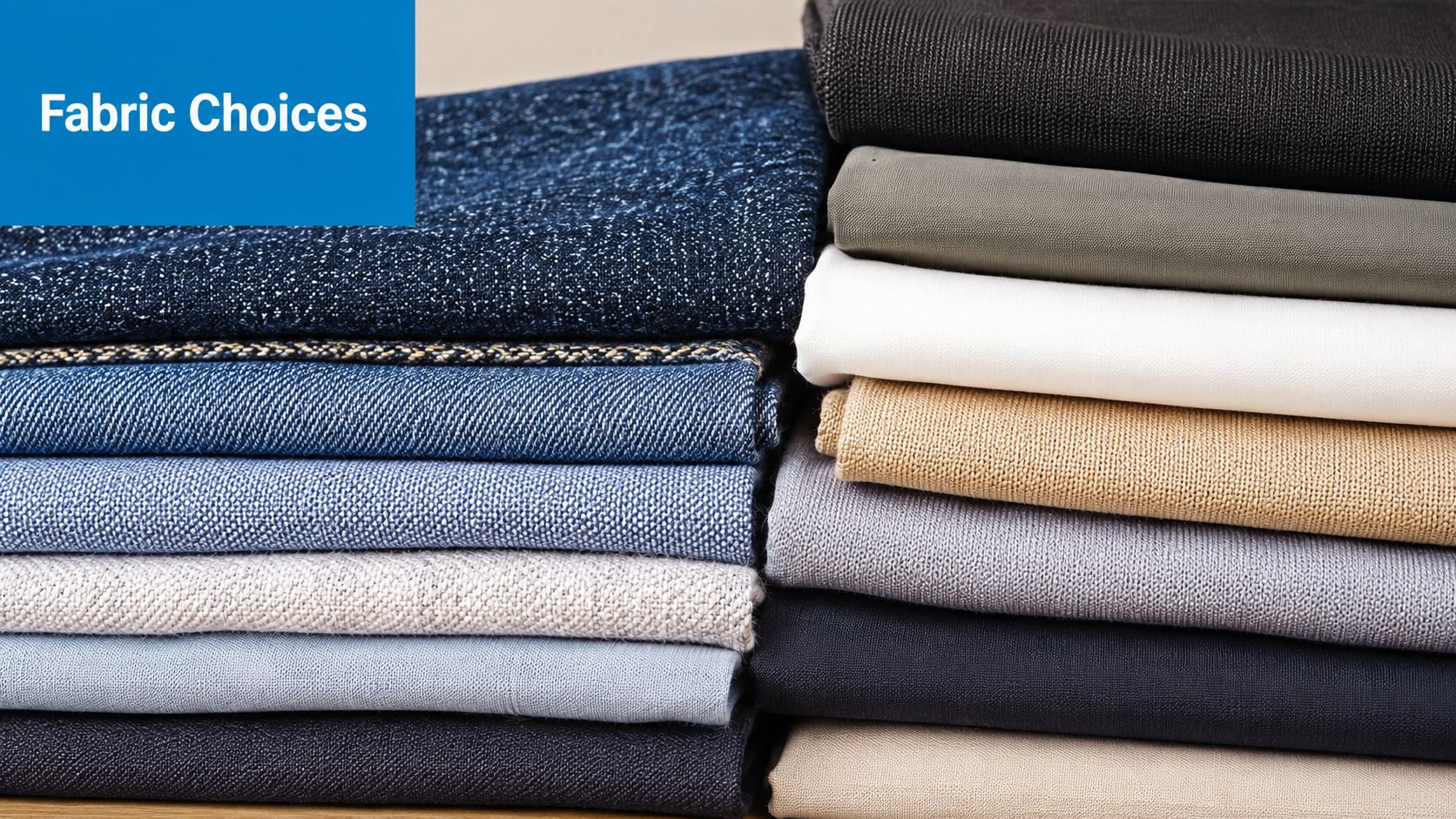
Stable fabrics usually give the cleanest embroidery. Polos with a firmer knit, woven work shirts, twill, fleece, canvas bags, and many jackets give the stitches a solid base. Thin or stretchy garments can still be embroidered, but they need more care because the fabric may shift or pucker under dense stitching.
A simple way to understand this:
| Fabric type | What usually happens |
|---|---|
| Structured polos and woven shirts | Logos tend to hold shape well |
| Caps and outerwear | Great for bold branding if the design is sized correctly |
| Thin tees and stretchy knits | More likely to show pulling or distortion |
| Bags and heavier materials | Often handle embroidery very well |
The garment also changes how the logo feels in use. A dense design on a lightweight shirt can make the area feel stiff. The same design on a jacket may feel completely normal.
Placement should match the garment
Placement affects professionalism as much as the stitching itself. On business apparel, the most common placements are left chest, right chest, sleeve, cap front, and upper back areas such as the yoke. The right choice depends on the garment and how the wearer will be seen.
A few practical examples help:
- Left chest: The default for staff uniforms, office polos, and trade show apparel.
- Cap front: Best for simpler marks that need to read from a distance.
- Sleeve: Useful for secondary branding, departments, or event names.
- Back yoke or upper back: Better for short words or compact marks than long, detailed logos.
If you're unsure whether a logo is too high, too wide, or too close to seams, this embroidery placement guide is a useful visual reference before you approve a proof.
A well-placed small logo usually looks more expensive than a large logo that crowds seams, plackets, pockets, or cap panels.
Understanding Embroidery Pricing and Timelines
Embroidery quotes confuse first-time buyers because they don't always connect visible design choices to production cost. The biggest driver is usually stitch count. More stitches mean more machine time, more thread, and more chances for fine detail to slow the run.
Why stitch count drives cost
Industry guidance from a wholesale embroidery provider notes a rough estimate of 1,000 stitches per square inch. The same guidance says small letters around 0.25 inches tall can require about 100 stitches each, and effects like drop shadows can materially raise stitch totals, as explained in this embroidery pricing breakdown.
That explains a lot of pricing surprises.
A compact logo with clean shapes may sew efficiently. Another logo of the same physical size may include tiny text, a border, shadowing, and separate outlined elements. On screen, they may look equally simple. On the machine, they are not equal jobs.
Here are the design choices that often raise cost:
- Small text: Tiny letters need careful stitch planning and can add more stitching than buyers expect.
- Layered effects: Shadows, outlines, and stacked elements build stitch count fast.
- Filled areas: Large solid sections take more thread than open linework.
- Fine detail: Small islands, narrow gaps, and sharp corners often require cleanup in digitizing.
What happens before production starts
Timelines depend on artwork readiness, garment availability, proof approval, sewing time, and shipping. That's why the fastest way to shorten a project isn't rushing the machine. It's sending clean art and approving a proof quickly.
Before full production, most embroidery orders go through a proofing step. That may be a digital proof, a stitch simulation, or a sample sew-out depending on the job. This step protects both sides. You confirm size, thread colors, placement, and readability before the order runs at scale.
If you want a deeper look at what shops typically include in the quote, this embroidery cost guide helps connect setup, stitch complexity, and garment choice.
A good proof review should answer these questions:
- Is the logo still readable at the chosen size?
- Do the thread colors look right on the actual garment color?
- Is the placement balanced relative to seams, pockets, or cap panels?
- Has any part of the art been simplified, and if so, do you approve that change?
How to Order Your Custom Apparel
A common first-order mistake looks small at the start. A company picks a polo everyone likes, emails over a logo pulled from a website, approves a proof quickly, and expects the result to match the brand guide perfectly. Then the shirts arrive and the logo feels too small, the thread color gets lost against the fabric, or the cap version looks more crowded than the polo version.
That usually happens because embroidery orders work like a production plan, not a simple online checkout. Each choice affects the next one. The garment affects placement. Placement affects size. Size affects how much detail the logo can keep. For a business buyer, getting that sequence right protects budget, avoids rework, and helps the finished apparel look intentional instead of improvised.
A practical ordering path
A reliable order usually follows this sequence:
Choose the garment first
Start with how the apparel will be used. Office polos, trade show caps, field jackets, fleece, bags, and work shirts all hold embroidery differently. A structured cap front can handle a logo in a different way than a soft performance polo, so the product choice shapes the decoration plan.Build the order details around the job
Confirm colors, sizes, quantities, and who will wear each item. This sounds administrative, but it affects the result. A thread color that reads clearly on a light jacket may disappear on a dark bag, and mixed garment types may require more than one logo setup.Send the best logo file you have
Vector art is the cleanest starting point because it gives the shop clear edges and scalable shapes. If you do not have that, send the highest-quality file available and include any brand color notes. That reduces guesswork during digitizing and helps the first proof get closer to approval.Review the proof like a buyer, not just a designer
Ask whether the logo looks balanced on the garment, whether the text is still readable at the chosen size, and whether the thread colors support the brand on the actual fabric color. This is the point where small adjustments save real money. Fixing a proof is easy. Fixing finished garments means replacement, delay, or living with a result that weakens the brand.Approve production only when the details match the use case
Once approved, the job moves into sewing and fulfillment. At that stage, changes become slower and more expensive, so the approval should reflect how the apparel will be worn in actual use, not just whether the mockup looks acceptable on a screen.
Many businesses use a supplier such as Dirt Cheap Product, Inc. for this workflow. What matters most is not the company name. It is whether the shop confirms artwork, placement, garment details, and approval steps before production begins.
Some teams also need branded items beyond shirts, hats, or jackets. If your project includes metal goods, drinkware, or hard-wearing accessories for staff kits or events, industrial laser engraving solutions can help you separate what belongs on fabric from what should be marked on a more durable surface.
Before approving, it helps to see how a finished embroidered piece should look in motion and close-up.
How to care for embroidered apparel
Care instructions matter because embroidery usually outlasts poor garment handling. In many cases, what buyers describe as logo wear starts with heat, abrasion, or rough washing.
Use these habits:
- Wash gently: Cold or mild washing is easier on both thread and fabric.
- Turn garments inside out: This reduces surface abrasion in the wash.
- Avoid high heat: Excessive dryer heat is hard on shirts, especially lighter knits.
- Skip harsh treatment: Don't scrub directly over stitched areas.
If you are ordering uniforms, include simple care notes for staff. That small step helps the garments last longer, keeps the logo cleaner, and protects the value of the order over time.
Frequently Asked Questions About Embroidery
Some questions come up right before approval. Others show up after the first reorder. These are the ones buyers ask most often when they want a logo to look professional without wasting time or budget.
| Question | Answer |
|---|---|
| Can any logo be embroidered? | Most logos can be adapted, but not every version should be stitched as-is. Very small text, gradients, and thin lines often need simplification. |
| Why does my printed logo look different in thread? | Ink can create fades and tiny detail that thread can't reproduce the same way. Embroidery usually works best with cleaner shapes and stronger contrast. |
| Do I need a different file for hats and polos? | Often, yes. A logo that works on a left chest may need a simpler version for a cap front. Curved seams, panel structure, and viewing distance all matter. |
| Why are small letters a problem? | Small letters can fill in, lose spacing, or become hard to read once stitched. That's why shops sometimes recommend enlarging text or removing a tagline. |
| Should I approve a proof if I'm unsure about size? | No. Ask for clarification before approving. Size and placement are easier to fix before sewing than after garments are decorated. |
| Is embroidery always the right choice for apparel? | No. It's often ideal for uniforms, polos, hats, bags, and outerwear. For large artwork, soft hand feel, or full-front graphics, another decoration method may fit better. |
One final shop-floor note. The best embroidery orders aren't the ones with the fanciest artwork. They're the ones where the logo, garment, placement, and stitch plan all agree with each other.
If you're ready to turn your logo into wearable branded apparel, Dirt Cheap Product, Inc. can help you order embroidered polos, hats, jackets, bags, and more with proof-based review before production, so you can make decisions clearly and avoid common first-order mistakes.