You're probably staring at a short list of giveaway ideas from a clinic manager, HR lead, or event coordinator and thinking the same thing many healthcare marketers think: “Which of these can we hand out without creating a compliance problem?”
That question matters more in healthcare than in almost any other industry. A branded item can support patient education, help staff feel recognized, or draw attention at a community event. It can also be the wrong material for a clinical setting, the wrong message for a regulated audience, or the wrong value level for a Medicare or Medicaid beneficiary. In healthcare, a good promotional product isn't just attractive and affordable. It has to be useful, appropriate, and defensible.
The strongest promotional items healthcare programs start with a filter, not a catalog. Before anyone picks colors or imprint methods, the smarter move is to ask four questions. Who is receiving this? What job does it need to do? Is it safe in the environment where it will be used? Can compliance sign off on it without hesitation? That discipline saves time, avoids waste, and protects your organization.
Table of Contents
- Why Healthcare Promotional Items Are Different
- Choosing the Right Items for Every Healthcare Goal
- Navigating Compliance and Safety Regulations
- Designing and Sourcing Your Products Effectively
- Mastering Distribution and Logistics
- Measuring the ROI of Your Healthcare Swag
Why Healthcare Promotional Items Are Different
A bank can hand out mugs. A gym can hand out towels. A healthcare organization has to think harder.
In this environment, the item isn't separate from the brand experience. It may be given in a waiting room, at discharge, during a screening event, at a board meeting, or during an employee appreciation program. That means the object has to fit the audience, the setting, and the message without undermining trust.
What counts as a healthcare promotional product
A clear working definition helps teams avoid loose thinking. Promotional products in healthcare are defined as any item carrying a healthcare organization's logo, name, tagline, or contact details, serving as a tangible extension of the brand that enhances visibility and trust among patients and staff, as described in this overview of promotional products in healthcare.
That definition is broader than many teams expect. It includes apparel, bags, personal care accessories, event handouts, and internal recognition items. It also means your decision process can't be “What's cheap and available?” It has to be “What supports the relationship we're trying to build?”
Here's where many healthcare teams go wrong:
- They choose by popularity: A product may sell well in general promo markets and still be awkward in a clinic or hospital setting.
- They ignore use conditions: Items used around patients should feel hygienic, practical, and easy to handle.
- They overvalue branding space: Large imprint areas are nice, but healthcare audiences usually respond better to usefulness than to oversized logos.
Practical rule: In healthcare, the best branded item rarely feels like swag first. It feels like something helpful that happens to be branded.
Why timing matters more than most teams expect
Healthcare campaigns often orbit scheduled awareness periods, staff recognition moments, screenings, and community events. The planning window matters. The U.S. promotional products industry is projected to reach $27.8 billion in 2025, and healthcare remains one of its largest end-user markets. That same industry view notes that suppliers often need campaigns planned three to four months ahead to align with healthcare-specific holidays and national weeks such as appreciation and screening events, according to these 2025 promotional product statistics.
That lead time isn't just about shipping. It gives teams room to do the work that healthcare requires:
- Audience review for patients, staff, families, or community attendees.
- Compliance review for value, messaging, and intended use.
- Proof approval so branding is legible and appropriate.
- Distribution planning so items arrive where they're needed, not where they're easiest to drop off.
If your event is tied to a date, late planning usually narrows your options to whatever can be rushed. In healthcare, rushed choices are often the least safe and least strategic.
Choosing the Right Items for Every Healthcare Goal
The best product choice starts with the use case. Not the budget. Not the trend. Not what another organization handed out last month.
When teams ask for “some promotional items healthcare can use,” I usually translate that into three separate questions: what helps patients, what supports staff, and what works in public-facing outreach.
Patient-facing items that support care
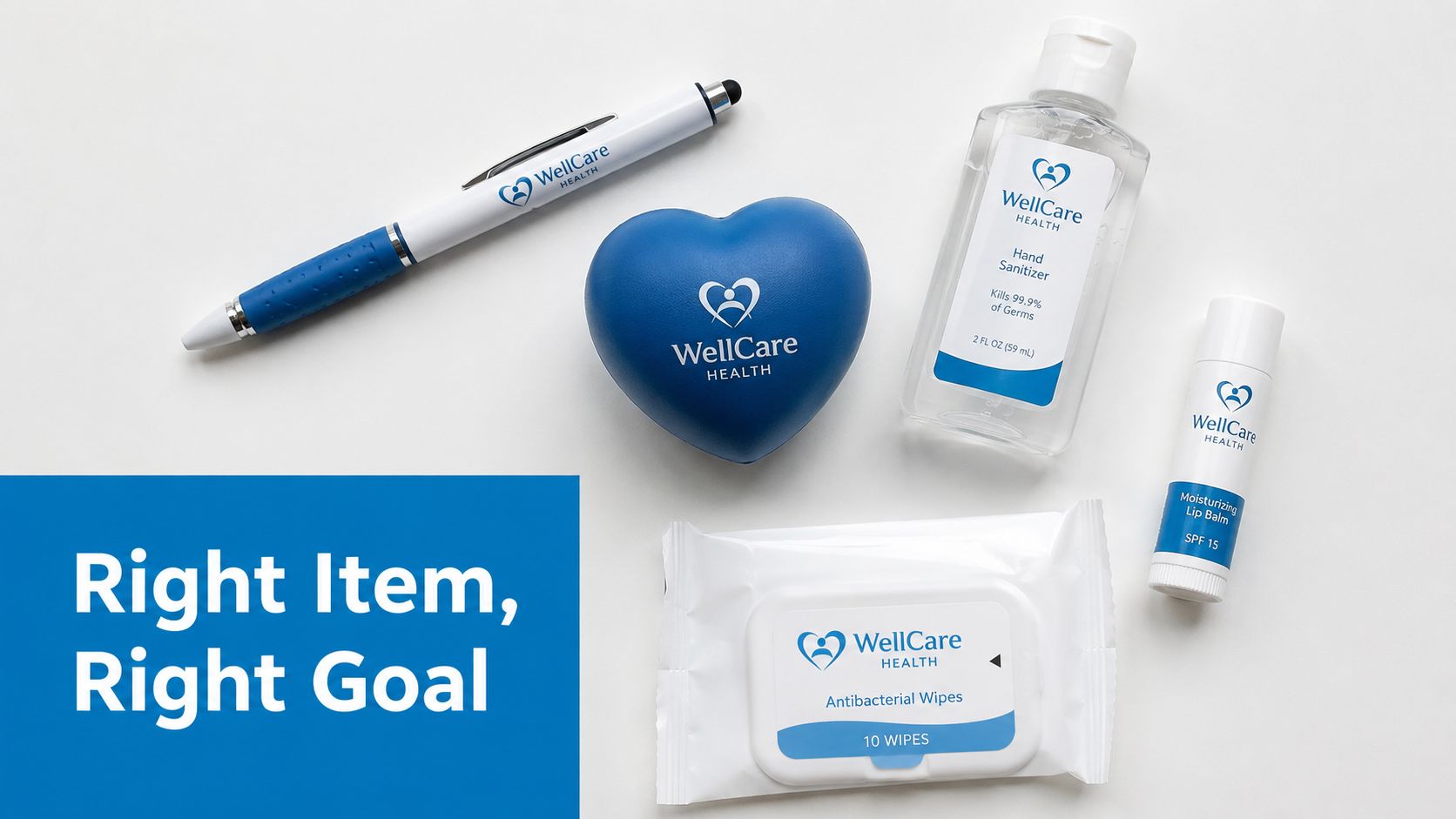
Patient-facing products should reduce friction, not create clutter. Good examples include pill boxes, badge-style emergency contact cards, hand sanitizer, wet wipes, and simple take-home kits tied to a discharge or wellness message.
The key is relevance. If the product helps someone remember a routine, carry essentials, or feel cared for after an interaction, it has a place. If it exists only to flash a logo, it usually doesn't.
A useful review filter is simple:
| Question | Good sign | Warning sign |
|---|---|---|
| Does it support a care journey? | Reinforces a routine or instruction | Feels unrelated to care |
| Is it easy to carry home? | Compact and tidy | Bulky or awkward |
| Does it suit a clinical tone? | Calm, practical, clean | Gimmicky or noisy |
Staff items that people will actually use
Internal programs deserve more discipline than they often get. Staff appreciation items should respect the work environment and the people doing the job. Polos, T-shirts, scrub-adjacent outerwear, hats for nonclinical roles, badge reels, pens, and hydration-focused drinkware usually make sense when selected carefully.
What matters is fit, comfort, and repeated use. Staff will wear and carry items that feel professional and durable. They won't keep low-quality apparel just because it has the organization's name on it.
A few patterns hold up well:
- Uniform-adjacent apparel: Best for team identity, onboarding, and recognition.
- Desk or pocket utility items: Better for practical daily use than novelty products.
- Wellness-oriented items: Stronger when tied to an internal initiative, not handed out randomly.
Staff gifts work best when they solve a small daily annoyance or support a real routine.
Event giveaways that earn attention
Community health fairs and outreach booths are a different game. The item has to compete for attention fast, but it still needs to feel relevant. Industry guidance notes that healthcare promotional booths featuring practical giveaways like reusable water bottles or health trackers experience traffic increases exceeding 50% compared to booths without such items, based on health fair engagement metrics in these best practices for hospitals and clinics.
That doesn't mean every booth should order the same thing. It means practicality draws people in better than random trinkets.
For event selection, I'd separate products this way:
Best fit for general health fairs
- Reusable water bottles: Easy to understand, useful on the spot, wellness-aligned.
- Wipes or sanitizer: Functional and consistent with health messaging.
- Pens with appointment or contact info: Small, easy to distribute, familiar.
Better for focused wellness campaigns
- Pill boxes: Useful when medication adherence is part of the conversation.
- Hydration tools: Strong for preventive health or fitness themes.
- Simple care kits: Effective when the event has an education component.
Usually poor choices
- Bulky products: They crowd the table and are harder for attendees to carry.
- Pure novelty items: They can attract a quick glance but don't reinforce credibility.
A practical booth also matters. Clear service banners, pamphlets on specific health topics, and an interactive element such as screenings make the giveaway more effective. The item shouldn't do all the work. It should support the interaction.
Navigating Compliance and Safety Regulations
Healthcare buyers either protect the organization or expose it.
Many promotional mistakes don't come from bad intent. They come from treating healthcare like a normal branded merchandise category. It isn't. A giveaway can cross a legal line, create an inducement concern, or fail an ethical code review even when the product itself seems harmless.

The legal lines you cannot blur
In the United States, the most important baseline is the Office of Inspector General standard for gifts to Medicare or Medicaid beneficiaries. Under the HHS OIG policy statement updated in 2016, a nominal value gift must have a retail value of no more than $15 per item or $75 in the aggregate per patient annually, and it cannot be cash or cash equivalents, as outlined in this healthcare gift-giving compliance summary.
That threshold matters because intent matters. If any reason for giving the item is to induce referrals, Anti-Kickback Statute risk enters the picture. Another related enforcement point is that the Civil Monetary Penalties Law can impose a civil fine of up to $15,024 per item or service for violations involving gifts to Medicare or Medicaid beneficiaries, according to this guide to sweepstakes and contests laws in healthcare.
Those numbers should change how teams think. “It's just a giveaway” isn't a defense. If the item is offered to a regulated audience and the purpose is even partly referral-driven, legal review isn't optional.
Items that create avoidable risk
Some products are risky because of value. Others are risky because they function only as reminder promotions.
The IFPMA Code of Practice explicitly prohibits offering promotional items to healthcare professionals in relation to prescription-only medicines, and it specifically identifies calendars, mouse pads, and sticky notes as prohibited reminder promotions. The same framework also clarifies there are no exceptions beyond pens and notepads used specifically to take notes during meetings, as detailed in the IFPMA Code of Practice 21st Edition.
That's a useful practical standard even for teams that aren't operating globally. If an item has no patient or practice benefit and exists mainly to keep a brand name visible, it deserves extra scrutiny.
A related issue is messaging. Healthcare promotional materials must meet fair balance expectations. Risk information must appear alongside benefits, and objective claims need adequate substantiation before distribution. That standard makes generic health-claim handouts a problem, especially when they can't support the promises they imply, as explained in this medical trade show compliance guide.
For that reason, we do not create business cards or fliers. In healthcare settings, both can become compliance trouble quickly when they function as pure brand reminders or make claims that aren't properly supported.
If the item doesn't help the recipient, the practice, or the patient, it probably doesn't belong in a healthcare campaign.
One more practical note. Portable tech can look attractive in general marketing, but healthcare teams should be cautious with anything that may exceed nominal-value limits or feel disconnected from care goals. If you're evaluating categories that tend to push into that territory, review them against your compliance standards before considering products such as branded power banks.
A simple approval test before production
Before any order moves forward, ask five questions in writing:
- Who receives it? Patients, staff, HCPs, or public attendees.
- Why this item? Education, utility, recognition, or event support.
- What setting will it enter? Clinic, hospital, home, conference, or outdoor event.
- Does the wording imply a health claim? If yes, legal and clinical review should happen first.
- Could anyone see this as an inducement? If yes, stop and escalate.
Compliance slows down bad ideas. That's a feature, not a flaw.
Designing and Sourcing Your Products Effectively
Even a compliant product can fail once the design process starts. The usual problem isn't dramatic. It's small, avoidable, and expensive. A logo is too tiny. Copy gets squeezed onto a curved surface. The product color fights the brand color. Someone approves a proof without checking legibility.
Expert benchmarks indicate that 70% of healthcare promotional failures stem from four pitfalls: using novelty items incompatible with serious clinical settings, embedding tiny logos on limited imprint areas, making unverified medical claims on products, and selecting items too large for health fair distribution, according to this healthcare promotional products guide.
Start with the imprint area, not the mockup
Most buyers start by asking what they want the item to say. A better first question is what the item can realistically hold.
A badge reel can handle a logo mark or short name. A pen can usually handle a simplified imprint. A polo can support embroidery on the chest, but not a paragraph of messaging. When teams ignore the physical limits of the product, the result looks cluttered and cheap.
Use this decision sequence:
Match the decoration method to the product
- Embroidery fits polos, jackets, caps, and sturdier textiles.
- Screen printing works well for T-shirts and event apparel.
- DTF or sublimation can help with artwork that needs flexibility or detail on suitable materials.
Reduce before you add
- Start with the logo.
- Add only the most necessary supporting text.
- Remove anything that makes the imprint hard to read at a glance.
Respect the environment
- Clean marks, strong contrast, and restrained wording usually fit healthcare better than loud graphics.
How a clean proof process prevents expensive mistakes
A solid sourcing workflow is less glamorous than product selection, but it's where quality gets protected. Good teams move through the same checkpoints every time.
- Submit usable artwork. Vector files are best when available. If not, ask for cleanup before production.
- Share brand rules. Include color targets, approved logo versions, and any limits on taglines or department naming.
- Review the digital proof carefully. Check size, placement, spelling, thread or ink color, and how the logo sits on the actual item color.
- Have the right reviewer approve it. Marketing should not approve regulated language alone. Compliance should not approve decoration placement alone.
- Confirm production timing early. Proof delays are one of the easiest ways to miss event dates.
A buyer who wants fewer surprises should also understand how bulk sourcing affects consistency, substitutions, and lead times. This promotional product sourcing guide for bulk buyers is a useful reference for the operational side of that process.
A proof is not a formality. It's the moment where brand quality, readability, and risk control meet.
Mastering Distribution and Logistics
A well-chosen item still fails if it reaches the wrong person, arrives late, or is handed out in a way that feels sloppy.
Healthcare distribution works best when it follows the workflow of the setting. The same box of branded items can feel helpful in one context and careless in another. Packaging, timing, storage, and handoff all matter.
Scenario one discharge and take-home items
A hospital team preparing take-home materials for new parents handles distribution very differently from an events team working a community race. In the discharge setting, the item should be packed with the patient's materials, stored cleanly, and handed over at the point when instructions are already being reviewed.
That setup reduces confusion. It also ties the item to the care experience instead of making it feel like a separate giveaway. If the product is a wipe pack, pill box, or other small support item, the handoff should be brief and purposeful. Staff should know what the item is for and when to mention it.
A few habits make this smoother:
- Pack by use case: Build kits for discharge, onboarding, screenings, or appreciation events separately.
- Store with controls in mind: Keep patient-facing items in clean, organized inventory areas.
- Assign ownership: One team should count, restock, and reconcile event or department quantities.
Scenario two staff events and community outreach
Staff appreciation events need fast, orderly distribution. Size breaks for apparel, pick-up tables by department, and backup inventory for common sizes keep lines moving. If you've ever seen a recognition event stall because every medium disappeared first, you know logistics can overshadow goodwill.
Community events have a different pressure point. Space is limited, and the booth has to work visually. Teams planning those environments often benefit from studying strong expo booth design examples because layout affects how items are displayed, how lines form, and whether attendees can engage without crowding the table.
For outdoor outreach such as a hospital-sponsored 5K, I'd keep the process simple. Bring fewer product types, label cartons clearly, and designate one person to monitor inventory rather than letting everyone grab from mixed boxes. The more moving pieces you add, the more waste and confusion you create.
Measuring the ROI of Your Healthcare Swag
Healthcare teams often track the easiest metric first: how many items were distributed. That's a starting point, not a return.
The stronger question is what changed because the item existed. Did more people stop at the booth? Did staff participate in the wellness initiative? Did a discharge support item improve follow-through? Did a practical branded tool reinforce a behavior leadership cares about?
Track behavior, not just impressions
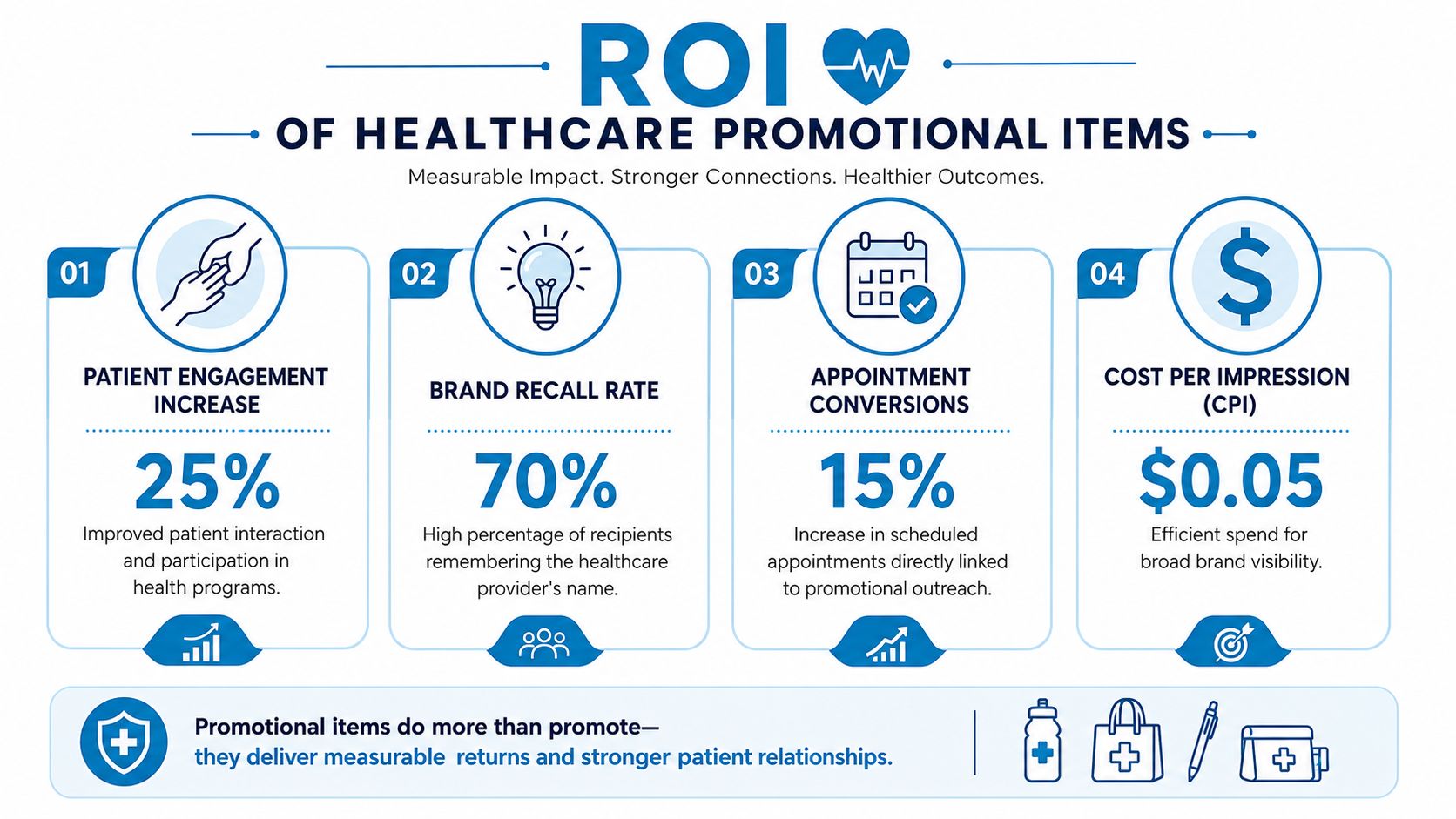
One of the more useful facts in this space is also a reminder of how thin most reporting still is. Existing content often fails to quantify ROI on patient retention and behavioral compliance, yet it omits evidence that branded safety tools can increase hygiene compliance by 23% in clinical settings, a gap highlighted in this healthcare strategy guide on promotional product ROI.
That matters because it shifts the conversation from visibility to outcomes. In healthcare, some of the best promotional items are really behavior-support tools with branding attached.
Measure based on the job of the item:
| Goal | Better metric | Weak metric |
|---|---|---|
| Event outreach | Booth conversations, screenings completed, follow-up interest | Number of items handed out |
| Patient support | Participation, recall, adherence-related behavior | General “brand awareness” alone |
| Staff engagement | Program enrollment, internal usage, repeat requests | Total units ordered |
This is also where broader marketing discipline helps. If your team needs a clean framework for assigning costs and outcomes, this guide to measuring marketing ROI is a practical reference for building a more credible reporting model.
Build a reporting model leadership will accept
Leadership usually doesn't want a swag recap. They want a reason to fund the next round.
A simple reporting structure works well:
- State the objective clearly: Was the item meant to drive event engagement, support hygiene behavior, improve onboarding, or recognize staff?
- Tie it to one measurable action: Sign-ups, attendance, participation, or compliance-related behavior.
- Add qualitative feedback: Recipient comments and staff observations can explain why an item worked or didn't.
- Compare item utility to distribution friction: Products that are useful and easy to hand out usually outperform products that look impressive but create operational drag.
If you're evaluating event-focused options, a practical comparison of best giveaways at trade shows can help frame what tends to carry over well into healthcare outreach and what usually doesn't.
The bottom line is simple. Promotional items healthcare teams buy should earn their place twice. First by fitting compliance and safety expectations. Then by producing a visible outcome that someone can defend in a budget conversation.
If you need a custom branding partner that can help you turn approved ideas into polished apparel and promotional products, Dirt Cheap Product, Inc. handles fast-turnaround decoration, proofing, and production for teams that need clean execution without unnecessary back-and-forth. Upload your logo, review the proof carefully, and move forward with items that fit your program, your timeline, and your brand.