
You're probably here because you've ordered giveaways before and watched too many of them disappear into desk drawers, swag bags, or the trash. Pens run out. Cheap phone accessories break. Novelty items get a quick smile and then vanish from memory.
Branded power banks solve a different problem. People use them when they need help, on a commute, at a conference, in an airport, or between meetings. That changes how your logo is perceived. Instead of looking like filler, it shows up on something practical, portable, and easy to keep.
The catch is that not all branded power banks are equal. Capacity, ports, battery quality, certification, shell material, print method, and packaging all affect whether the final piece feels useful or forgettable. A good order creates a product people keep. A sloppy order creates support issues, dead inventory, and a branded item nobody trusts.
Table of Contents
- Why Branded Power Banks Are Your Next Best Giveaway
- Choosing the Right Specs for Your Audience
- From Plastic to Premium Materials and Form Factors
- Your Logo on the Go Branding and Customization
- Creating a Complete Gift Experience with Packaging
- How Businesses Win with Branded Power Banks
- Best Practices for Ordering from a Custom Partner
- Frequently Asked Questions About Branded Power Banks
Why Branded Power Banks Are Your Next Best Giveaway
A weak giveaway usually fails in one of two ways. It's either too disposable to matter, or too gimmicky to get used. Branded power banks avoid both problems because they solve a real daily need.
That matters more than novelty. If someone keeps your item in a backpack, laptop bag, glove compartment, or carry-on, your brand stays close to moments of real utility. That's a much better position than being printed on something that never leaves a conference tote.
There's also a bigger market signal behind this category. The global power bank market was valued at USD 13.48 billion in 2022 and is projected to reach USD 31.06 billion by 2030, according to Grand View Research's power bank market analysis. That tells you this isn't a short-lived promo fad. It sits inside a large consumer electronics category with ongoing demand.
Practical rule: If a giveaway has to earn a higher unit cost, it should provide repeated use, not a one-time impression.
That's why power banks work so well for conferences, sales kits, onboarding boxes, travel programs, and premium direct-mail campaigns. They feel current, and above all, useful. Buyers looking through ideas for best giveaways at trade shows often end up in the same place: utility beats novelty when you want people to remember who gave the item to them.
A branded charger also carries a subtle message. It suggests your company thought beyond the logo and chose something recipients can rely on. That's a better brand impression than “we had budget left and needed a handout.”
Choosing the Right Specs for Your Audience
The biggest mistake new buyers make is choosing a power bank by appearance first. Start with the internal specs. If the device doesn't fit the audience's habits and hardware, the branding won't save it.
Start with capacity, not color
Think of mAh as the size of the fuel tank. A bigger number means the power bank stores more energy, but it also means more size, more weight, and usually a different price point. For promo use, the decision isn't “highest capacity wins.” The decision is “what will people carry?”
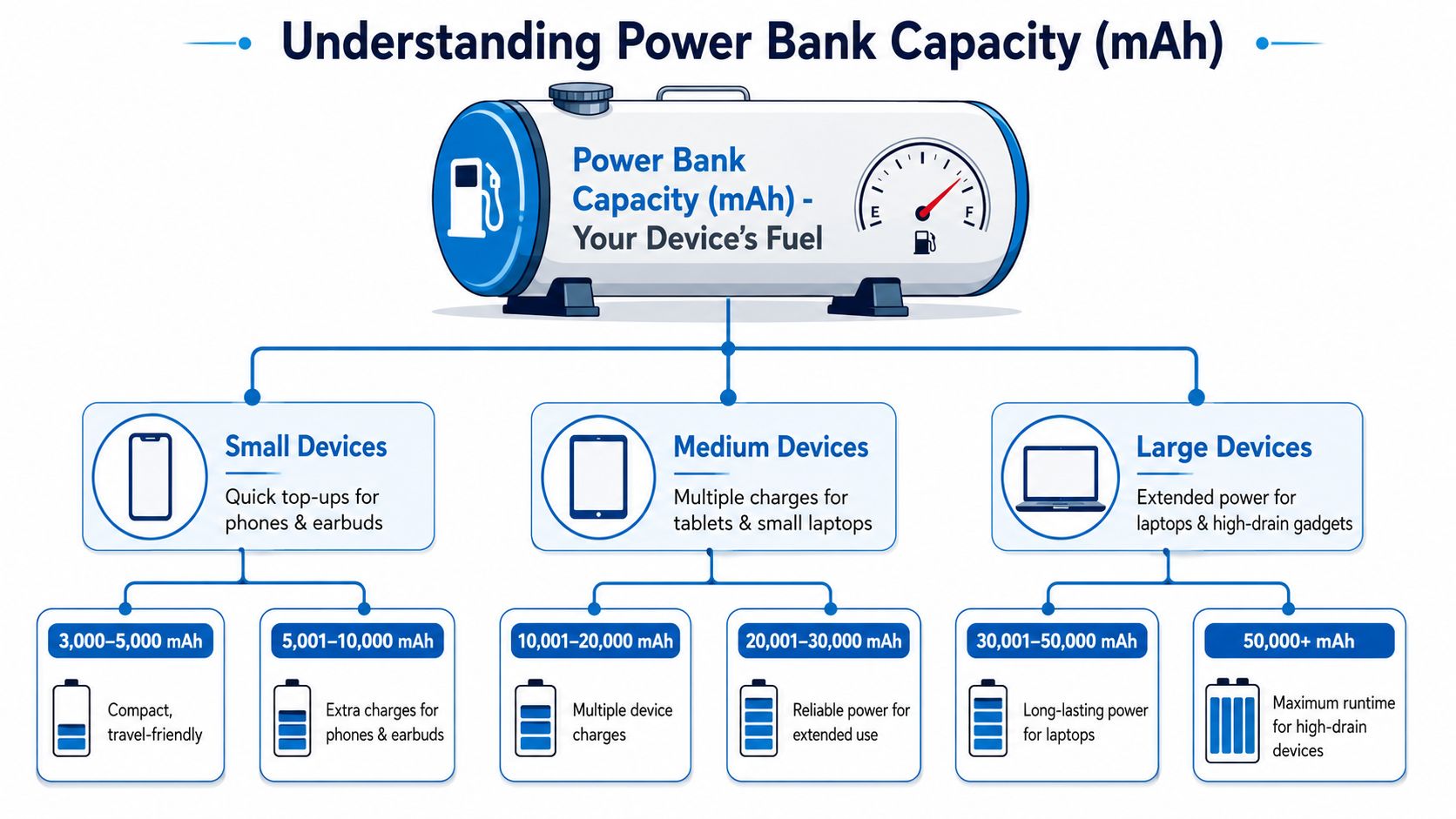
A simple way to frame it:
- Smaller capacities fit the quick-top-up use case. These are easy to carry and work well for trade shows, welcome kits, and lighter gifting.
- Mid-range capacities usually give you the best balance of portability and perceived value.
- Larger capacities feel more substantial and useful for travel, field teams, and higher-consideration gifts, but they're bulkier and need stronger packaging and clearer shipping planning.
The common decision point for corporate buyers is often 10,000 mAh vs. 20,000+ mAh, along with port type and certification. As noted on Positive Promotions' power bank and charger category page, those choices affect safety, airline acceptance, and whether the item works well with modern devices.
Ports decide who can actually use it
Port selection changes the usefulness of the product more than many buyers expect. A power bank can look great in a mockup and still disappoint recipients if the connection setup feels outdated.
Here's the practical breakdown:
| Feature | Good fit | Watch-out |
|---|---|---|
| USB-A output | Broad compatibility with older cables and accessories | Can feel dated if it's the only option |
| USB-C input | Easier recharging of the power bank itself | Better than older charging-only setups |
| USB-C input/output | Stronger fit for newer phones, tablets, and accessories | Worth prioritizing for mixed-device audiences |
| Wireless charging | Premium feel and cleaner look | Adds convenience, but alignment and speed expectations matter |
If your audience includes newer phones, tablets, and everyday USB-C users, don't treat USB-C as a bonus. Treat it as a core compatibility choice. If you're reviewing options for unique tech merch for teams, this is the kind of feature set worth checking before you fall in love with the look.
Safety is part of the branding
A power bank isn't just branded merchandise. It's a battery product people will plug into their phones. That raises the bar.
What works:
- UL-certified models
- Clear port labeling
- Simple instructions in the box
- Models designed for current charging habits
What doesn't:
- Unclear specs in a product listing
- No meaningful certification detail
- Outdated port combinations
- Choosing only on unit price
If a recipient doesn't trust the charger, they won't use it. At that point, your logo is sitting on a liability, not a gift.
From Plastic to Premium Materials and Form Factors
Once the internal specs make sense, the shell decides how the item feels in the hand and how your logo will read at first glance. These aspects often determine if many branded power banks appear promotional in a good way or promotional in a cheap way.

The underlying category already includes recognizable electronics brands. In market coverage from Fortune Business Insights on the power bank market, major players listed include Xiaomi, Koninklijke Philips N.V., Lenovo, Huawei, and Anker. For buyers, that matters because the product class is associated with established hardware companies, not just throwaway accessories.
Material changes perceived value
Plastic housings usually win on budget flexibility and color range. They're practical for broad giveaway programs, especially when you need bright brand colors or a larger print area. The downside is obvious. The wrong plastic finish can make the item feel generic fast.
Aluminum shifts the feel immediately. It tends to look cleaner, wear better in bags and pockets, and pairs well with restrained branding. If your logo is simple and your audience expects something polished, metal often gives you a better result.
Other shell choices sit in the middle:
- Soft-touch finishes feel more tactile and less commodity-like.
- Rubberized shells help with grip and durability.
- Natural-look materials can support a greener visual story, especially alongside other eco-friendly promotional products, though you still need to evaluate the battery product on its own merits.
Shape affects both use and decoration
Form factor isn't just aesthetics. It changes where the item gets carried and how much room you have for decoration.
A slim rectangular model usually works best for portability and clean logo placement. A thicker brick style gives you more battery capacity and often more output options, but it feels more technical and less gift-like unless the packaging helps. Rounded compact units can look friendlier, though they sometimes reduce usable imprint space.
A buyer should treat the outer shell like product packaging that never gets thrown away. It keeps representing the brand long after the box is gone.
Your Logo on the Go Branding and Customization
A good logo file can still look poor on the wrong surface with the wrong print method. The shell material, texture, curvature, and finish all shape the result, making practical decisions more important than creative enthusiasm.
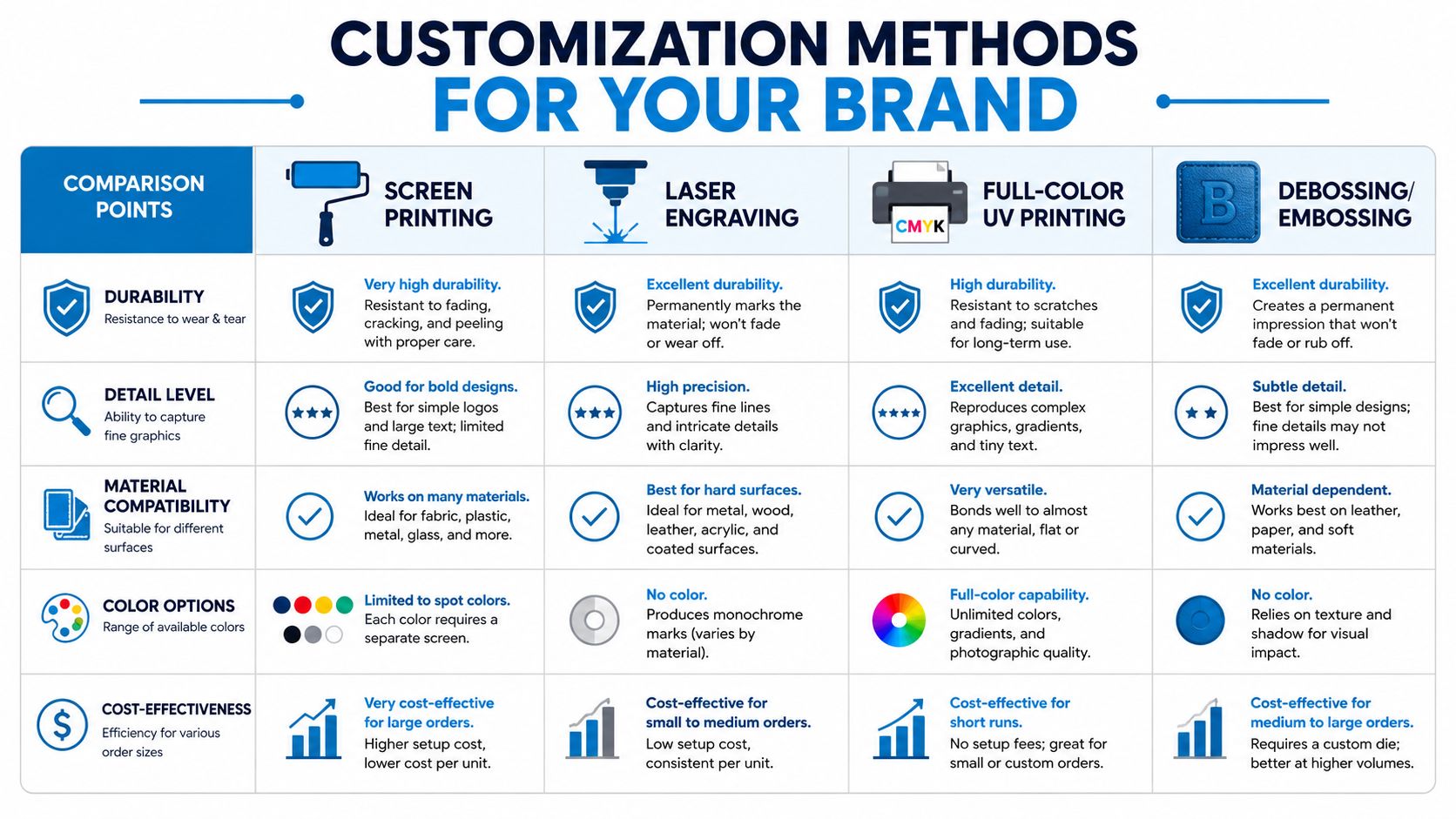
Match the print method to the shell
Here's the simplest way to think about decoration choices:
| Method | Best use | Trade-off |
|---|---|---|
| Screen printing | Bold logos, simple marks, strong contrast on plastic shells | Less ideal for fine gradients or complex artwork |
| Laser engraving | Metal or wood-like surfaces, subtle premium branding | Usually less visible from a distance |
| Full-color UV printing | Detailed artwork, multicolor logos, photo-style graphics | Surface quality and print placement matter a lot |
| Debossing or embossing | Select premium materials and presentation-led designs | Not a fit for every shell type |
Screen printing is still a solid answer when the logo is simple and the goal is clarity. It's especially useful when your brand mark needs to read quickly from a short distance. Laser engraving works when you want the product to feel more like a personal device and less like event swag.
Full-color UV printing helps when a logo includes gradients, multiple colors, or finer detail that would be lost in a simpler process. It can look excellent, but only when the shell has the right flatness and finish.
What usually works best
A few combinations tend to be reliable:
- Plastic shell plus screen print for broad distribution and clear logos
- Aluminum shell plus laser engraving for executive gifting and cleaner visual tone
- Smooth shell plus UV print when color accuracy matters
- Premium boxed set plus restrained logo size when the item should feel like a gift, not an ad
One overlooked issue is brand consistency. The logo that works on a shirt or banner may not translate well to a compact tech item. If your team is still tightening that up, a guide on developing effective brand standards can help settle practical rules for color use, logo spacing, and small-format applications.
Keep the imprint simple. On a tech product, one strong mark almost always looks better than trying to force a full campaign layout onto a small shell.
Creating a Complete Gift Experience with Packaging
A power bank in a plain sleeve can still be useful. It just won't feel memorable. Packaging changes the handoff from “promo item” to “considered gift.”
Presentation changes the perceived value
The difference is easy to see in person. A loose unit in a poly bag feels like inventory. A branded box with a fitted insert feels like a product. Same category, very different reaction.
Good packaging usually does three jobs at once:
- Protects the item during shipping and event handling
- Explains the product with basic use and charging guidance
- Frames the brand before the recipient even turns the device on
That doesn't mean every order needs a luxury rigid box. Often, a clean custom carton with neat interior presentation is enough. The key is matching the box style to the purpose of the gift.
Packaging also solves practical problems
For larger programs, packaging decisions affect operations just as much as appearance. If you're sending kits to remote staff, clients, or multiple event locations, custom inserts help keep cords, instructions, and the unit itself organized. That reduces confusion when boxes are opened in different places by different teams.
If you add printed inserts, choose materials that hold up well in transit. Durable stock matters, especially for instructional cards and branded sleeves. Teams comparing options for heavier printed components can use references like this overview of heavy cardstock paper to think through sturdier packaging elements.
The strongest packaging choices feel intentional without overcomplicating the project. Clean box. Clear message. Right cable. Short instructions. That's usually enough.
How Businesses Win with Branded Power Banks
The easiest way to judge branded power banks is to stop thinking about them as a generic promo category and start matching them to real business moments.
Trade shows and field events
A software company exhibiting at a busy conference doesn't need another forgettable handout. It needs something attendees will keep in a shoulder bag and use before the event is over. A compact branded power bank fits that job well, especially when the booth team hands it to high-value prospects instead of everyone walking by.
That strategy gets even stronger when the event setup is polished. Companies investing in stronger face-to-face presentation often pair useful giveaways with better booth environments, including custom exhibition stands that make the giveaway feel like part of a coherent brand experience rather than random swag.
Employee gifting and client moments
For new-hire kits, power banks work because they're practical on day one. Remote employees, field staff, and commuters all understand the value immediately. The product doesn't need a complicated explanation, and it fits naturally with notebooks, bags, apparel, and welcome materials.
For client gifting, the context changes. A real estate agent can include a premium-looking charger in a closing gift. A consulting firm can use one in a travel-oriented thank-you package. A lifestyle brand can retail a nicely designed version as merchandise because the item already feels like a consumer product, not just a giveaway.
Here are four use cases that tend to work well:
- Trade show follow-up gift: Reserve better spec models for qualified leads.
- Onboarding kit: Include a charger employees can use during travel and meetings.
- Customer appreciation pack: Pair the power bank with a note and useful accessories.
- Retail merch add-on: Choose a finish and decoration style that looks product-grade.
What all four have in common is simple. The item earns its place because someone can use it right away.
Best Practices for Ordering from a Custom Partner
A rushed power bank order usually fails in predictable ways. The logo ends up too close to the ports, the printed color shifts on the shell, the sample shown in sales emails is not the exact port layout you approved, or the 10,000 mAh model you picked for perceived value pushes the unit size and freight cost higher than expected.
Good custom partners help catch those problems, but buyers still need to set the order up correctly. The strongest results come from matching the technical build to the branding goal before quotes start. A slim 5,000 mAh unit with USB-C can support a cleaner, more giftable presentation. A larger battery with multiple outputs may look more impressive on paper, but it also changes weight, packaging, shipping, and how much room is left for decoration.
What to prepare before asking for quotes
Bring direction, not just a logo.
A partner can quote faster and more accurately if you provide:
- A vector logo file: AI or EPS gives the printer a clean file for screen print, UV print, or laser engraving.
- A real use case: Trade show handout, employee onboarding, client gift, direct mail, or resale item.
- A quantity range: Even a rough range helps identify models that fit the budget.
- A target spec level: Capacity, USB-C or multi-port setup, wireless charging or not, and any certification requirement your team needs.
- A finish preference: Plastic, aluminum, soft-touch, slim profile, or a larger high-capacity body.
This saves time because the spec and the branding method are tied together. Aluminum bodies often support engraving well and tend to feel more premium in hand. Plastic can lower cost and allow bold color printing, but the product may read more like a volume giveaway than a client gift. Neither is wrong. The right choice depends on who will receive it and what you need the item to communicate.
If you compare suppliers, ask each one for the same information. Capacity, input and output ports, shell material, certification details, decoration method, packaging style, lead time, and freight assumptions should all be listed clearly. That is how you avoid choosing a lower quote that turns out to be a different product.
What to check before production starts
Proof approval is where expensive mistakes get prevented. Treat it like a product review, not a quick branding sign-off.
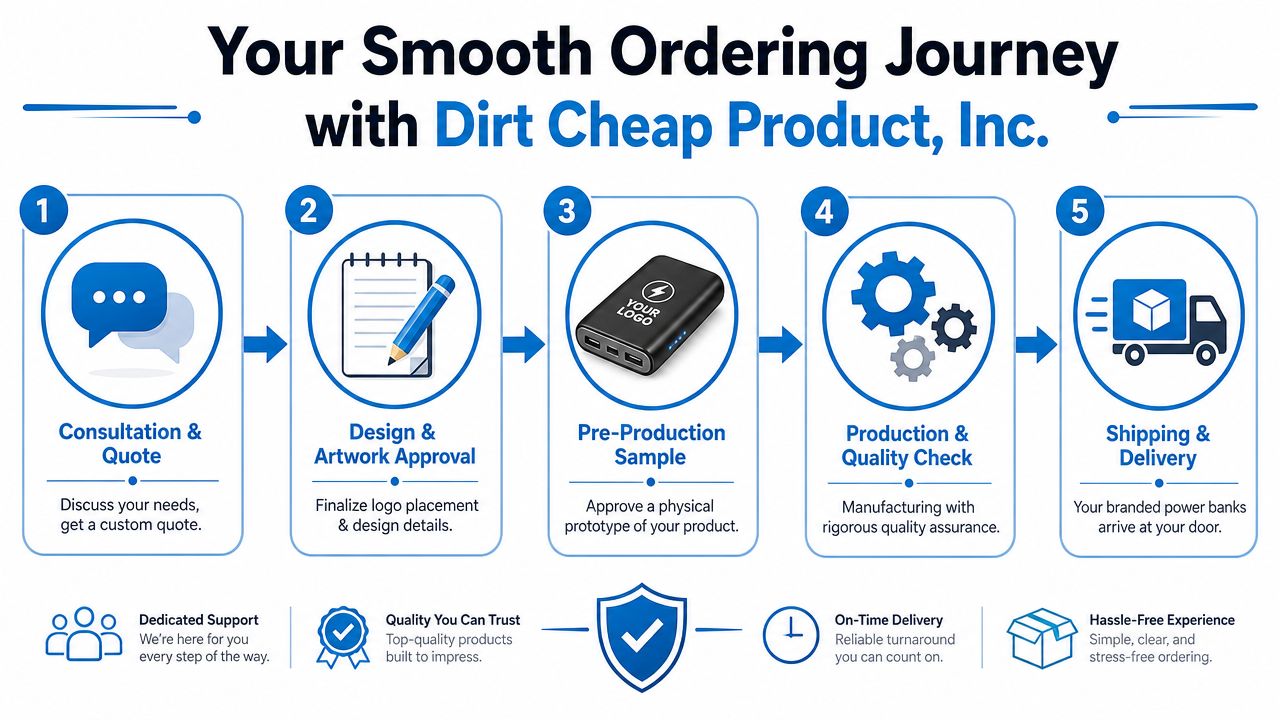
Review these points carefully:
Logo placement
Confirm centering, scale, orientation, and clearance from seams, buttons, indicator lights, and ports.Color expectations
Ink on a power bank shell can look different from the same brand color on paper, fabric, or coated packaging. Ask what the decoration method can reproduce.Spec confirmation
Verify the exact capacity, port configuration, charging cable inclusion, and certification status. Do not approve based on a generic mockup.Packaging contents
Check every included item: cable type, instruction card, retail box, insert, and any compliance labeling.Production timing
Build in time for proof revisions, pre-production samples if needed, production, and freight. Custom packaging usually adds steps.
Dirt Cheap Product, Inc. handles custom branding projects with proofing support and a broad promotional product offering. The same review process applies with any vendor.
Approve the proof like the recipient who will use the product, not the buyer trying to hit a deadline. If the ports are outdated, the body feels too bulky for the audience, or the imprint area looks cramped, fix it before production starts.
Frequently Asked Questions About Branded Power Banks
Can people take branded power banks on airplanes
Air travel rules can vary by carrier and route, so it's smart to confirm the current requirements before ordering for a travel-heavy audience. This is one reason capacity and certification choices matter. Buyers often focus on imprint area first, but travel acceptance affects whether recipients carry the item.
What's the safest default spec for a mixed audience
A practical middle ground is usually better than chasing extremes. Buyers tend to do well with a modern port setup, clear labeling, and a capacity that balances usefulness with portability. UL-listed options deserve serious attention because safety and confidence drive usage.
Should I choose wireless charging
Wireless charging can raise the perceived value, especially for executive gifts or premium kits. It isn't always the right default for large-volume giveaways, though. The feature adds convenience, but recipients still need the rest of the product to be reliable and easy to understand.
What branding method lasts the longest
That depends on the shell material and how the item will be used. Laser engraving often holds up very well on metal surfaces. Screen and UV printing can also perform well when matched properly to the product and finish.
Do I need custom packaging
Not always. If the item is part of a higher-touch gift or shipped individually, custom packaging usually improves the experience. For simple event distribution, a cleaner standard package may be enough.
What causes disappointment after delivery
Most problems trace back to one of three issues: weak compatibility, underwhelming shell quality, or a logo method that didn't suit the product. That's why the best orders are built from the inside out. Specs first, shell second, branding third.
If you're planning your first order of branded power banks and want help narrowing the options, Dirt Cheap Product, Inc. is one place to start. Bring your logo, quantity range, deadline, and intended audience, and you'll have a much easier time choosing a product people will keep and use.