
You're ready to order hang tags for a new apparel drop, backing cards for accessories, or inserts for a premium box. The artwork is done. The logo looks right. Then the paper choices show up and everything gets muddy fast. 100 lb cover, 270 gsm, 16 pt. Same material, different labels, and no clear answer to the question you care about, which is simple: what will look professional, hold up in handling, and run without production problems?
That confusion costs businesses money all the time. A tag can feel too flimsy for the product it represents. A folded insert can crack because the sheet wasn't scored. A stock that seemed “premium” on a product page can turn into jams if someone tries to print it on the wrong equipment.
For branded merch, heavy cardstock paper isn't a craft supply decision. It's a production decision and a brand decision. The right sheet helps your tags stay crisp on a retail rack, gives product cards enough structure to support packaging, and makes inserts feel intentional instead of disposable.
Table of Contents
- Choosing Paper for Branded Merch Should Be Simple
- Decoding Cardstock Weights GSM Lb and Pt
- Matching Paper Weight to Your Project
- Printing and Finishing Considerations
- Why Heavier Stock Elevates Your Brand
- Your Heavy Cardstock Ordering Checklist
Choosing Paper for Branded Merch Should Be Simple
A common order starts like this. A boutique owner needs hang tags for a new line. A coffee brand wants product cards tucked into gift boxes. An event team needs table signs that don't curl by the middle of the day. They already know the look they want. What slows them down is the paper language.
Most suppliers lead with weight labels and broad use cases. They'll say something is good for invitations, crafts, or cards. That doesn't help much if you're choosing between a branded apparel tag with a punched hole, a rigid backing card for patches, or a printed insert that has to slide neatly into a carton without catching at the edges.
The practical question isn't “What paper is popular?” It's “What paper fits the job without creating trouble later?”
Heavy cardstock paper should be chosen by use first, weight second.
For business applications, the job usually falls into one of a few buckets:
- Handled items: Hang tags, product cards, and packaging inserts need enough stiffness to resist dog-ears and bending.
- Display pieces: Counter cards and event signage need to stand straight and keep a clean edge.
- Folded pieces: Box wraps, folded cards, and certain packaging components need a stock that can fold cleanly after scoring.
- Punch or die-cut jobs: Tags and shaped cards need a sheet that holds form without becoming difficult to convert.
If you start with the use, the weight discussion gets easier. If you start with jargon, it often goes sideways. A business owner doesn't need a paper theory lecture. They need to know what works, what tends to fail, and what to ask before approving a run.
Decoding Cardstock Weights GSM Lb and Pt
A lot of ordering mistakes happen here. A buyer approves a stock because the number sounds heavy, then the finished hang tag feels thin, the backing card bends too easily, or the insert fits poorly in the carton. The problem is usually not the paper itself. It is the measurement system.
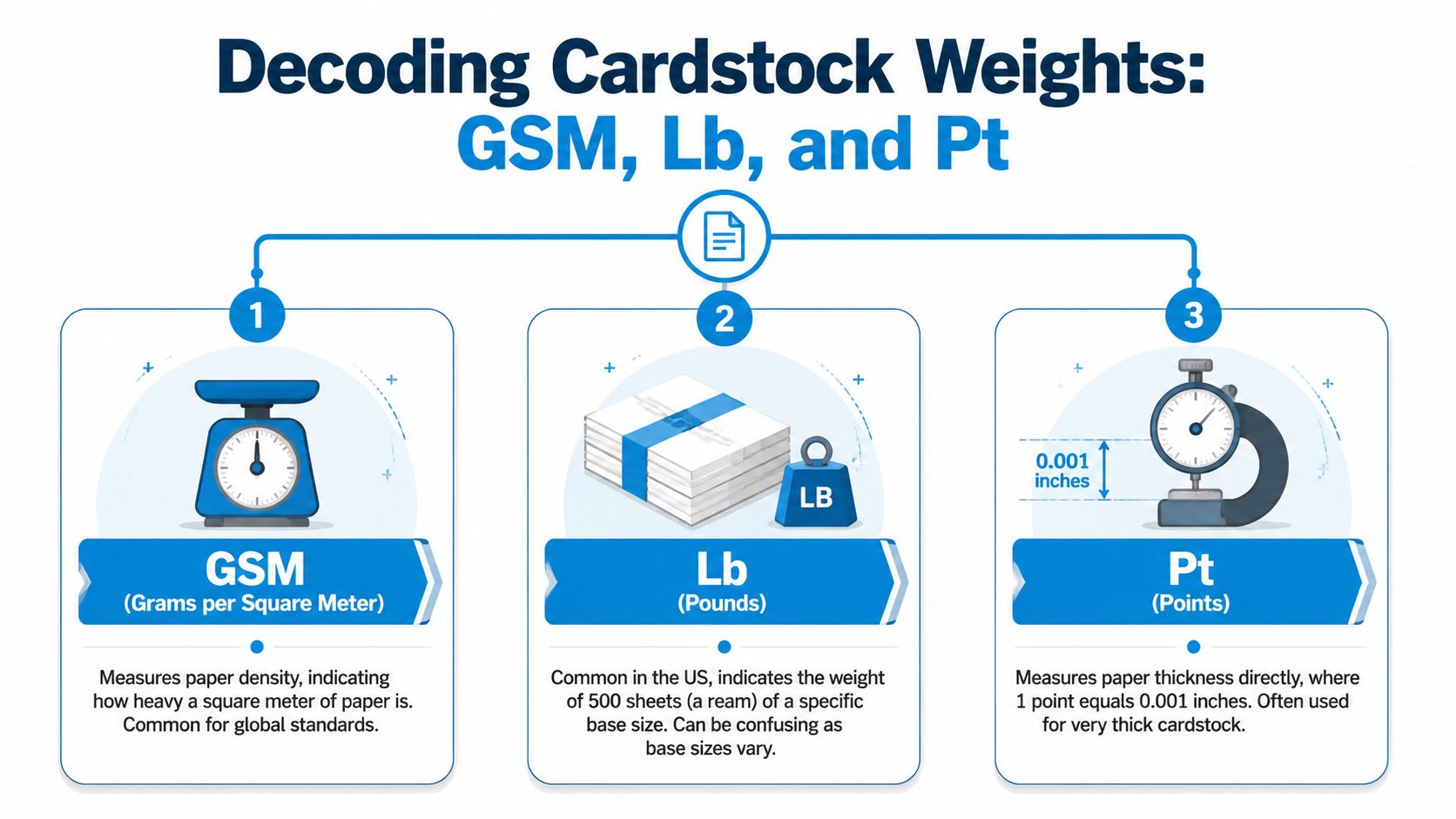
GSM is the clearest way to compare stock
GSM means grams per square meter. It measures the sheet by area, so it gives buyers a cleaner apples-to-apples comparison across mills, merchants, and international suppliers.
For branded merchandise work, that matters. If one supplier quotes 210 gsm for an apparel tag and another quotes 300 gsm for a product backing card, the second stock is plainly heavier. You are not stuck decoding an old US paper category first.
A useful benchmark from this cardstock paper guide is that heavy cardstock commonly sits in the 65 lb cover to 110 lb cover range, or roughly 176 gsm to 300 gsm. That range covers many business uses, from standard branded tags to sturdier packaging components.
Lb can be useful, but only if the grade is clear
Lb, or pounds, is still common in US quoting. It also causes a lot of confusion because the number depends on the paper category and base sheet size, not just on how thick the stock feels in your hand.
The biggest mistake is mixing up text and cover weights. A 100 lb text sheet and a 100 lb cover sheet are different materials with different stiffness. For hang tags, backing cards, and other merch components, suppliers usually mean cover stock. If they do not say so, ask.
That one question can prevent an expensive rerun.
If your team also orders other printed brand pieces, the same naming issue shows up in printing business cards, where thickness, stiffness, and finish often matter more than the headline weight number.
Pt tells you thickness
Pt, or points, measures caliper. In plain terms, it tells you the sheet thickness.
For business packaging and tag work, pt is often the missing detail. Two sheets can sit in a similar weight range but feel different in use because bulk, coating, and fiber makeup affect stiffness and hand feel. That difference shows up fast on products customers touch. A hang tag with more caliper usually feels more substantial at the rack. A backing card with too little caliper can look fine on paper and still sag once the product is mounted.
Use all three measurements together when the piece has to perform, not just print well.
| Term | What it tells you | Why it matters |
|---|---|---|
| GSM | Sheet weight by area | Best for clean comparison across suppliers |
| Lb | US paper weight category | Useful only if text vs cover is specified |
| Pt | Actual thickness | Helps judge feel, stiffness, and pack fit |
For heavy cardstock paper orders, ask the vendor for GSM, cover weight, and point thickness on the exact sheet being quoted. That gives you a better read on how the stock will behave in a branded tag, product card, or packaging job before it reaches press.
Matching Paper Weight to Your Project
Buying paper by weight alone is where a lot of business orders go wrong. Buyers usually need application guidance first, especially because naming shifts between US pounds and global GSM and because the wrong sheet can crack, jam, or feel off for the product. That mismatch is described clearly in LCI Paper's cardstock overview.
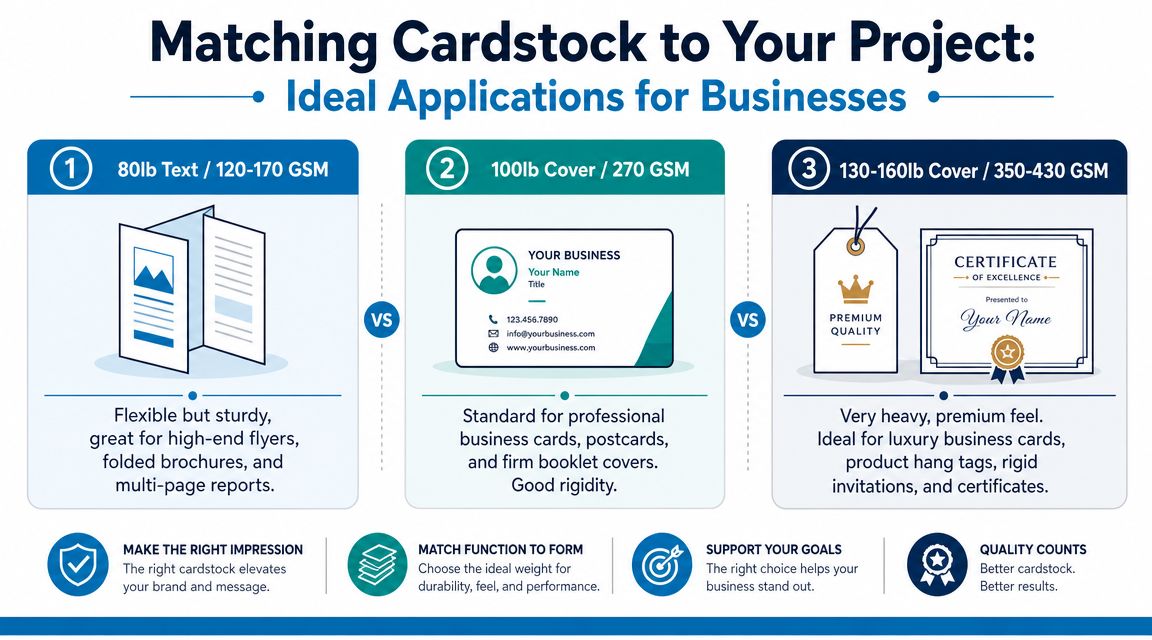
What works for common branded pieces
For box inserts and product information cards, a lighter heavy stock often makes sense. You want enough body to feel intentional, but not so much thickness that the piece becomes awkward to pack, stack, or slide into a carton.
For apparel hang tags, many buyers prefer a more substantial sheet. Tags are touched, turned, and read at arm's length. They also need to survive punching, stringing, and repeated handling without curling at the corners too quickly.
For backing cards behind pins, patches, jewelry, or accessories, stiffness matters more. The card has to support the product visually and physically. If it feels weak, the whole package feels cheaper.
For premium tabletop signs or rigid promotional cards, you'll usually lean heavier still, but only if the production method supports it.
If the piece has to carry a product, survive handling, or signal quality before anyone reads a word, move up in stiffness.
Common Cardstock Weights and Business Uses
| Weight Range (Cover / GSM / Point) | Feel and Durability | Best For |
|---|---|---|
| 65 lb cover / about 176 gsm / lighter cardstock caliper | Flexible with some body | Box inserts, product info cards, lightweight tags |
| 80 lb cover / about 216 gsm / around 8 to 10 pt | Noticeably sturdier and easier to handle cleanly | Standard hang tags, branded merchandise cards, packaging inserts with a better feel |
| 100 lb cover / about 270 gsm / firm cardstock | Strong rigidity and more premium hand feel | Apparel hang tags, backing cards for accessories, higher-end product cards |
| 110 lb cover / about 300 gsm / heavy, rigid stock | Very sturdy, more demanding in print and finishing | Premium tags, rigid promotional pieces, packaging components that need extra body |
| 14 pt, 16 pt, 18 pt | Thickness-focused selection for premium applications | Heavier branded cards, menus, premium postcards, extra-thick presentation pieces |
A few notes make the table more useful in practice:
- For hang tags: Start by looking at 80 lb cover to 110 lb cover depending on the product price point and how much handling the tag will see.
- For backing cards: Favor the stiffer end if the card supports a physical item rather than acting as a simple insert.
- For packaging inserts: Don't overbuild. A rigid insert can create packing friction without adding value.
If your project overlaps categories, ask for a sample pack or a side-by-side dummy. That matters more than paper marketing language. It's also why teams comparing cardstock for branded collateral sometimes review adjacent categories such as printing business cards to understand how different thickness levels feel in the hand, even if the final order is for tags, packaging cards, or inserts instead.
Printing and Finishing Considerations
The sheet you choose still has to run through real equipment. That's where many otherwise good decisions fall apart.
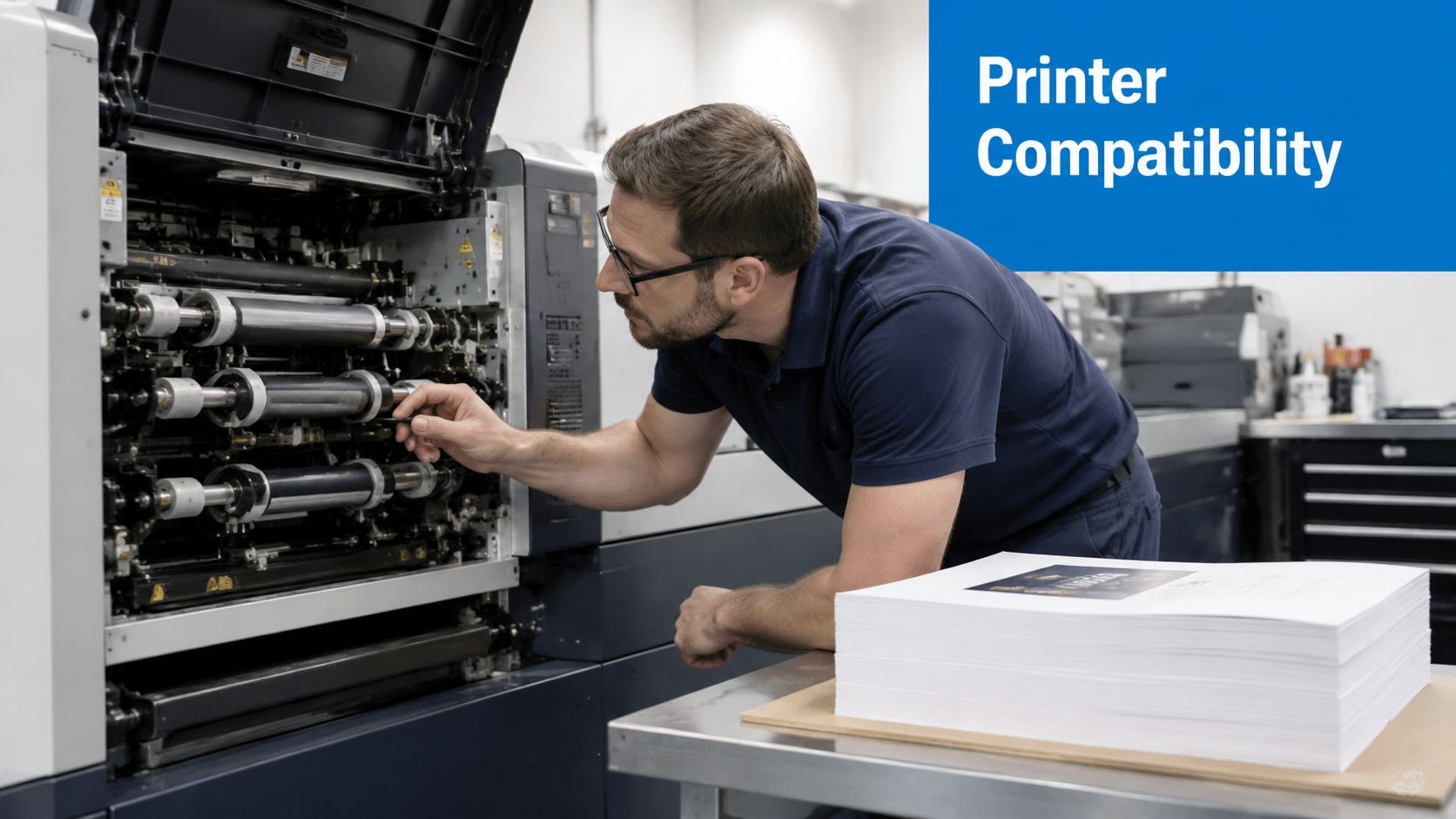
Once heavy cardstock paper gets too stiff, the challenge shifts from design to handling. As weight rises above roughly 110 lb / 300 gsm, many home and office printers struggle to bend the sheet through their rollers, and scoring becomes essential to avoid cracking. The same print guidance also notes that 14 pt stock is common for rack cards, 16 pt for premium postcards, and 18 pt for high-end applications, and that checking supported media weight helps avoid jams and misfeeds in Vistaprint's paper weight chart.
What to ask before you print
If you're ordering tags, folded inserts, or rigid cards, ask your printer these questions before you release the file:
- Can the press handle this stock? Ask for the supported media range, not just “yes, we print cardstock.”
- Will folded pieces be scored first? On heavy stock, that's not an optional nice-to-have.
- How will hole punching or die-cutting affect edge quality? This matters on hang tags and shaped packaging cards.
- What finish suits the job? Matte, gloss, and laminated finishes all change appearance, feel, and mark resistance.
- Will the ink set and hold correctly on this surface? Coated and uncoated sheets behave differently in production.
A folded neck tag, a product wrap, and a backing card may all start with “heavy cardstock paper,” but they don't behave the same way on press or at the finishing table.
Finishing changes the result more than many buyers expect
Surface finish is where brand intent becomes physical. Matte usually feels quieter and more refined. Gloss pushes color and contrast. Soft-touch style finishes can make a branded piece feel more tactile and premium, though they also add another layer to production planning.
For teams thinking beyond simple flat sheets, Marquis Book Printing's guide is a useful example of how finish and construction choices affect the way printed materials are perceived, even though the application there is book covers rather than merch packaging.
If you're sourcing printed brand collateral alongside decorated products, a provider such as custom printing services can be one option to compare when you need coordinated output across merchandise, inserts, and supporting print pieces.
Here's a quick visual on how cardstock handling works in production:
Why Heavier Stock Elevates Your Brand
Customers read quality with their hands before they read it with their eyes. A thin tag on a premium garment creates friction immediately. The product may be well made, but the printed piece attached to it says something else.
That's why paper choice belongs in brand planning, not just purchasing. A substantial hang tag, a firm accessory card, or a well-made insert tells the buyer that someone paid attention to the details. It supports the product story without saying a word.
Touch, durability, and perceived value
Heavier stock does two jobs at once. First, it improves durability during handling, packing, and display. Second, it changes how the product is perceived at the moment of contact.
For retail brands, that matters on the rack. For mailed kits, it matters at unboxing. For event materials, it matters when someone picks up a card from a table and decides whether it belongs in the trash or in their bag.
A flimsy printed piece can undercut a strong product. A substantial one helps the product feel finished.
This same logic shows up in adjacent print decisions. If you want a simple comparison of how physical format influences perceived quality, this practical guide for KDP authors offers a useful parallel. Different format choices shape expectations before the content is even judged.
For trade show kits and branded handouts, paper weight also affects whether supporting materials feel like part of a polished system or like an afterthought. That's one reason businesses planning trade show giveaways should think about printed cards and tags as part of the same brand experience as the merch itself.
Your Heavy Cardstock Ordering Checklist
Most ordering mistakes happen before production starts. The file may be fine. The artwork may be approved. The problem is that nobody asked the short list of practical questions that would have prevented the mismatch.
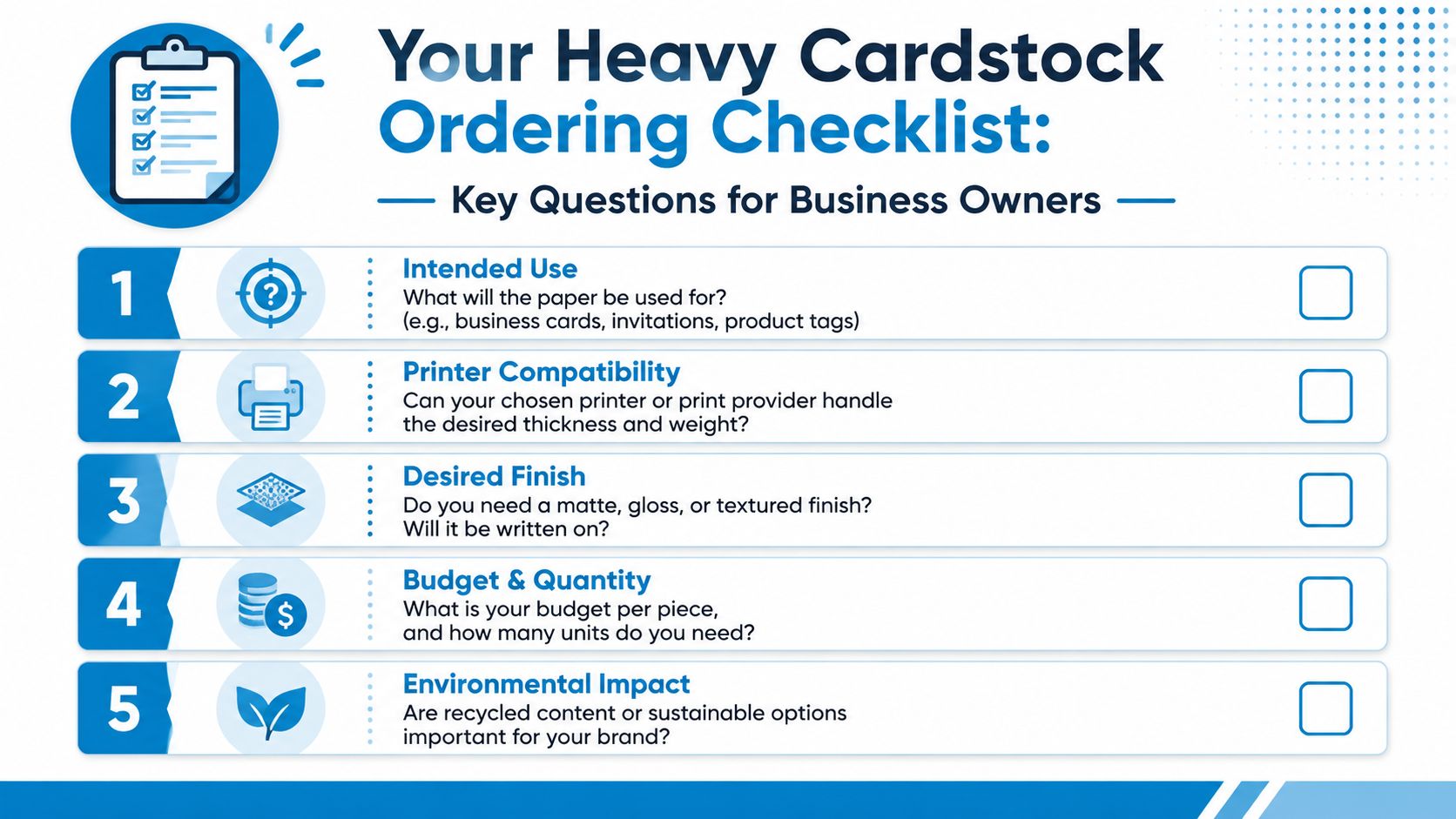
The checklist to use before you place the order
Define the job clearly
Is this a hang tag, a backing card, a box insert, a folded piece, or a display card? If the purpose is fuzzy, the stock choice usually ends up generic.Decide what the piece must survive
Will it be handled on a retail floor, shipped inside a carton, hole-punched, or attached to apparel? Durability requirements should drive stiffness.Check whether the piece folds or converts
If it folds, ask about scoring. If it's die-cut or punched, ask how the stock behaves on edges and corners.Match the stock to the print equipment
Don't assume a desktop machine or office printer can handle the same sheets a commercial shop can. Ask for the supported media range and whether the chosen stock has been run successfully before.Choose the finish based on use, not trend
A matte tag that needs handwriting behaves differently from a glossy coated piece made for display. Think through smudge resistance, reflectivity, and the intended feel.Request a sample or dummy when the feel matters
For premium branding pieces, the hand feel is part of the product. A sample often answers the question faster than a spec sheet.
Quick FAQ for business buyers
Is heavy cardstock paper eco-friendly
It can be, depending on the sheet you choose. Ask suppliers whether recycled content or FSC-certified options are available. Those details vary by mill and stock line, so the safest approach is to ask for specific paper options rather than assuming every cardstock is the same.
Can desktop cutting machines handle it
Sometimes, but compatibility depends on the machine, blade setup, mat grip, and the exact stock. Heavier sheets are more likely to need testing before a full run. If your job involves precise cuts for tags or shaped cards, run a sample first.
Is cardstock the same as cover stock
In business printing conversations, people often use those terms interchangeably. In ordering, the important part is less the label and more whether the supplier is specifying cover weight, actual thickness, and intended application.
What should I send to my printer or vendor
Keep it simple and specific:
- The product use: apparel hang tag, insert card, backing card, event sign
- The target feel: flexible, sturdy, rigid, premium
- Any converting needs: fold, score, die-cut, punch, drill
- The finish preference: matte, gloss, textured, writable
- A request for confirmation: ask them to confirm the stock and equipment match
If a vendor can't explain why a specific sheet fits your use case, keep asking questions.
For teams managing broader sourcing decisions across merchandise and printed support materials, this bulk buying guide for custom promotional products is helpful for aligning material choices, quantities, and ordering decisions across an entire campaign.
The smartest heavy cardstock paper order usually isn't the thickest one. It's the one that fits the product, the print method, and the brand signal you want the customer to feel.
If you need branded apparel, promotional products, and supporting print pieces to feel consistent across the full customer experience, Dirt Cheap Product, Inc. can be part of that conversation. Share the item type, intended use, and desired feel, and the team can help you sort through practical production options before you commit to a run.