You need branded merch that people will wear. Not something that gets stuffed in a drawer after one event, and not something so fashion-specific that only a small slice of your audience wants it.
That's why plain snapback hats keep coming up in real buying conversations. They sit in a useful middle ground. They feel current, they fit a wide range of people, and they give your logo a clean surface that can work for staff uniforms, retail merch, team gear, or giveaways.
For small businesses, that matters. A hat isn't just apparel. It's part of how people recognize your brand in public. If you're still dialing in that bigger picture, ZenChange Marketing's branding guide is a helpful resource for thinking through what your brand should communicate before you put it on a product.
Table of Contents
- Why Plain Snapback Hats Are a Smart Branding Tool
- Anatomy of a Modern Snapback Hat
- Matching Hat Materials to Your Brand's Needs
- Bringing Your Logo to Life on a Snapback
- Tips for Flawless Custom Hat Designs
- Navigating Bulk Orders and Maximizing Your Budget
- How Businesses Use Custom Snapbacks to Grow
- Common Questions About Custom Snapback Hats
Why Plain Snapback Hats Are a Smart Branding Tool
A lot of branded products ask the customer to do too much. The fit is picky, the style feels dated, or the decoration area is too small to carry a logo well. Plain snapback hats solve a lot of that at once.
The first reason is simple. The adjustable snap closure makes sizing easier for group orders, staff programs, and event distribution. You don't have to sort through a long list of fitted sizes, and your team doesn't have to guess who needs what. That reduces friction before the hats are even decorated.
The second reason is visual. A snapback has a defined front profile, and that gives your logo a stage instead of a compromise. If you're trying to build repeat visibility, that shape matters more than people think.
A practical fit for several business goals
Different businesses buy hats for very different reasons, but snapbacks can serve all of these well:
- Staff uniforms: They help a crew look coordinated without forcing exact head sizes.
- Retail merch: The structured look feels intentional enough to sell, not just give away.
- Promotional use: They're easy to hand out because sizing is less complicated.
- Brand collaborations: The silhouette already feels familiar to sports, streetwear, and event audiences.
Practical rule: If you need one headwear style that can work for employees, customers, and giveaway recipients, a snapback is usually the safest starting point.
A plain hat also gives you room to decide where the value should go. Sometimes that means premium embroidery for resale. Other times it means a simpler patch or transfer for a fast event run. The blank itself stays versatile.
Anatomy of a Modern Snapback Hat
You approve a hat online, the sample arrives, and something feels off. The logo area looks smaller than expected, the crown sits lower than your mockup suggested, or the bill shape reads more casual than retail. That usually comes back to construction details, not decoration mistakes.
What makes a snapback a snapback
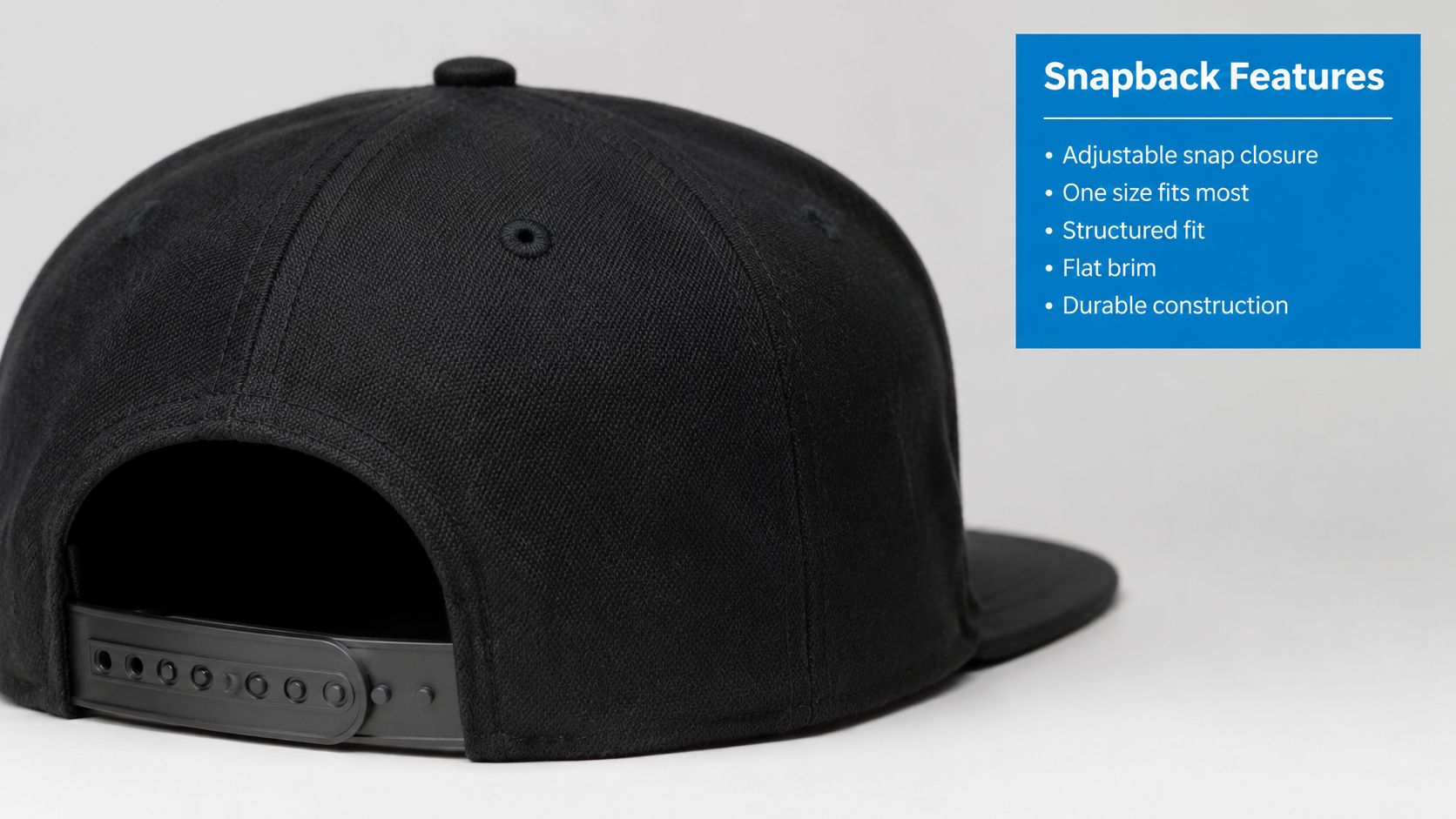
A snapback is defined by its plastic snap closure. That adjustable back is what separates it from a fitted cap and makes it practical for staff issue, merch tables, and event handouts.
The style also carries a specific visual language. A structured crown gives the front panels a firm face for decoration, and a flatter bill pushes the look closer to teamwear and streetwear than to a soft dad cap. Those two features matter because buyers judge the hat before they ever inspect the stitching.
Snapbacks also sit inside the broader baseball-cap lineage. As noted in MLB's baseball cap history and timeline, the structured cap shape developed over decades of on-field use and manufacturing changes. For a business buyer, the takeaway is simple. Today's snapback keeps that recognizable structure, then adds easier sizing on the back.
Panel count matters too. Many snapbacks use a six-panel build, which affects seam placement, front profile, and logo space. If you need a quick visual on that construction, this 6-panel snapback hat layout guide is a useful reference.
Why the construction matters for branding
Construction decides how the hat performs once your logo goes on it. A good blank makes decoration easier, keeps the branding consistent across a run, and reduces surprises on reorders.
Pay attention to these parts:
- Front panels: Structured panels support embroidery better and keep larger logos from puckering as easily.
- Crown height: A higher crown creates a bigger, more upright logo area. A lower crown can look cleaner on some wearers but gives decorators less room.
- Buckram or front support: Stiffer support holds the shape longer, which helps retail displays and uniform programs where hats need to keep a crisp profile.
- Bill shape: Flat bills read more current and branded. Slightly curved bills feel more approachable for general use.
- Snap closure quality: Cheap snaps can feel flimsy and shorten the perceived value of the whole piece.
- Panel seams: Seam placement affects patch size, embroidery positioning, and whether a design can sit comfortably on the front without distortion.
Here is the practical trade-off. The more structure a hat has, the better it usually presents a front logo and the more “finished” it looks on a shelf. That same structure can feel stiffer out of the box, which is fine for retail merch and many uniforms but less ideal if your goal is a soft, broken-in giveaway.
When a buyer says a hat looks clean, they are usually reacting to crown shape, panel support, and bill profile. Color matters. Construction usually matters more.
That is why experienced buyers spec the blank before they debate thread colors. If the silhouette is right, the finished hat has a much better chance of doing its job, whether that job is selling at full retail, holding up on a work crew, or making a giveaway feel worth keeping.
Matching Hat Materials to Your Brand's Needs
A restaurant group ordering staff hats has different priorities than a brewery planning retail merch or a sponsor handing out caps at a 5K. The right material choice affects comfort, decoration quality, replacement rate, and whether people keep wearing the hat after the event.
How material changes the finished look
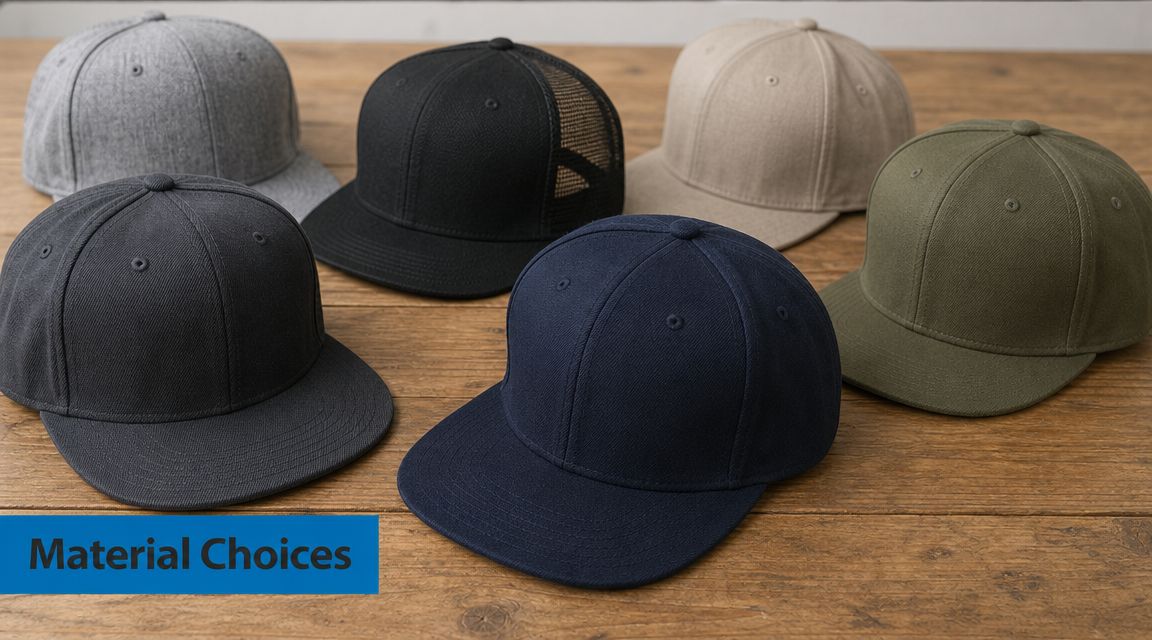
Plain snapback hats are usually built in acrylic, wool blends, cotton twill, polyester, or mesh-back combinations. Those fabrics do more than change texture. They affect heat retention, shape memory, cleaning tolerance, and how cleanly a logo can be applied, as explained in Capiche Caps' guide to snapback styles and materials.
Acrylic and wool blends are the usual choice for a classic retail snapback profile. They hold structure well, feel weightier in hand, and support the kind of front-facing embroidery buyers expect in streetwear, team merch, and brand resale programs. The trade-off is comfort in hot conditions. They can feel warmer and less forgiving during long outdoor wear.
Cotton twill sits in the middle. It usually feels more familiar to general audiences, costs less than many premium blends, and works well for everyday branded hats that need broad appeal. For event use or casual staff wear, twill often gives the best balance between price and perceived quality.
Polyester performance fabric is a workwear and active-use decision. It dries faster, feels lighter, and makes more sense for golf events, outdoor crews, and promotions tied to fitness or travel. The trade-off is visual. Some performance hats read more athletic than premium, so they are not always the strongest choice for fashion-led merch walls.
Mesh-back snapbacks solve a different problem. They improve airflow and help a hat feel easier to wear in heat, which is why they show up in landscaping crews, beer brands, and summer promotions. Front panel material still matters because that is where the logo usually lives. A mesh back does not fix a weak front panel.
Best material choices by use case
Start with the business goal, then pick the fabric.
| Use Case | Material Direction | Why it works |
|---|---|---|
| Retail merch | Acrylic or wool blend | Holds shape, feels substantial, supports premium shelf presentation |
| Outdoor staff wear | Performance polyester or mesh-back build | Lighter feel, better airflow, easier for long shifts |
| Brand promo runs | Cotton twill or acrylic blend | Keeps cost under control without looking disposable |
| Fashion-forward capsule | Premium structured blend | Better shape retention and stronger perceived value |
One example helps. A structured wool-blend snapback with raised embroidery can support a higher resale price because the hat itself feels like merchandise, not swag. A cotton twill version of that same design may lower your unit cost and still work well for giveaways, but it usually will not carry the same margin at retail. A product like the Mr Green Marketing white baseball snapback hat shows how material and silhouette shape the finished impression before anyone even looks closely at the logo.
A few checks prevent expensive mistakes:
- Ask how the fabric handles sweat and cleaning. Staff uniforms need easier maintenance than limited-run merch.
- Match the fabric to the decoration method early. Dense embroidery, patches, and heat-applied graphics all behave differently across twill, polyester, and wool blends. A good hat embroidery placement guide helps set those constraints before art approval.
- Request a physical sample if the order is large. Material feel and crown response are hard to judge from product photos alone.
- Watch for perceived value gaps. A low-cost fabric can erase the premium effect of a strong logo.
Material and use case have to line up. If the hat is for resale, choose for structure and shelf appeal. If it is for crews or event wear, choose for comfort, cleanup, and repeat use.
Bringing Your Logo to Life on a Snapback
A buyer approves a hat because the mockup looks sharp. Then the finished run arrives, the logo feels too small, the stitching fills in the fine detail, and the hat reads like cheap promo gear instead of branded merchandise. That problem usually starts with the decoration choice, not the logo itself.
Choose the decoration method based on the artwork
The right question is simple. What decoration method fits the logo, the hat surface, and the job the hat needs to do?
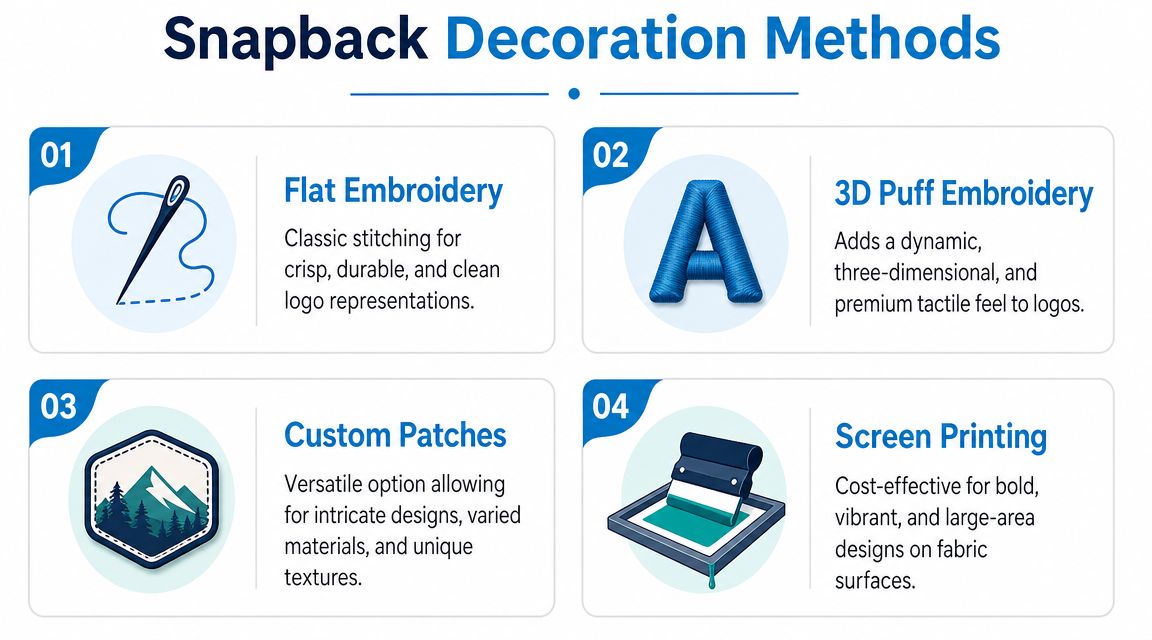
BLVNK Headwear's guidance on blank snapbacks notes that these hats are commonly built from cotton twill, wool blends, acrylic, polyester, and mesh-back constructions, and each surface changes how embroidery, patches, and heat-applied graphics perform on the front panel. That matters because decoration is tied directly to the business result. Embroidery usually gives the strongest premium signal and holds up well for uniforms or retail resale. Patches help when the brand style calls for texture or badge styling. Heat-applied methods can reproduce more detailed artwork and speed up short-turn projects, but they often give up some long-term wear and premium hand feel in the process.
Logo shape should drive the method.
A bold icon or simple wordmark usually runs cleanest in flat embroidery. Thick block letters can work well in 3D puff, but only if the art has enough open space to keep the raised areas readable. A patch is often the safer choice for outdoor brands, breweries, workwear-inspired labels, or any logo that needs borders, fine line illustration, or a more layered retail look. DTF or other heat-applied graphics make sense when the artwork includes gradients, small shapes, or details that stitching would close up.
Placement matters too. Before approving art, review a practical hat embroidery placement guide so the logo size and position match the actual front panel shape instead of an idealized flat mockup.
For visual benchmarking, the Mr Green Marketing white baseball snapback hat is a useful example of how a clean front treatment changes the finished impression. It reads as a finished product, not a leftover giveaway. That is the standard brands should aim for when the goal is resale, team presentation, or stronger recall after an event.
Decoration Method Comparison for Snapback Hats
| Method | Best For | Look & Feel | Durability |
|---|---|---|---|
| Flat embroidery | Bold logos, text, simple marks | Clean, stitched, classic | Strong for long-term wear |
| 3D puff embroidery | Thick lettering, simple shapes | Raised, tactile, premium | Strong when artwork is suitable |
| Custom patches | Detailed branding, mixed textures, badge-style looks | Layered and versatile | Good when patch type matches use |
| Screen printing | Simpler cap applications where fabric and placement allow it | Smooth ink surface | Can work well, but depends on hat surface |
| DTF or heat-applied graphics | Fine detail, gradients, small elements, fast-turn projects | More graphic, less stitched | Useful, with tradeoffs in feel and long-term wear |
What usually works:
- Flat embroidery for company logos with solid shapes and readable text.
- 3D puff for streetwear-style branding with thicker letterforms.
- Patches for heritage brands, outdoor brands, breweries, and badge-driven visuals.
- DTF when the art has small details that stitching would muddy.
What usually does not work:
- Dense embroidery on tiny text.
- Puff embroidery on artwork with thin lines.
- Heat-applied graphics on a hat expected to feel premium and hold up to repeated wear.
- Generic patch choices that do not match the hat's style.
Clean art tends to look more expensive on a snapback.
Screen printing is the exception in many cap programs. It can work, but the front seam, crown curve, and structured shape give printers less margin for error than a flat tee or tote. For that reason, embroidery and patches remain the safer choices for brands that care about consistency, durability, and perceived value.
Tips for Flawless Custom Hat Designs
A brand signs off on 100 snapbacks for a staff rollout or merch drop. The art looked sharp on a laptop, but the finished hats arrive with text that disappears at arm's length, thread colors that blend into the crown, or a front logo that sits awkwardly against the panel seam. Those mistakes are expensive because hats have less room for error than shirts, and every bad choice shows up fast in wearability, sell-through, and brand perception.
Good custom hat design starts with the job the hat needs to do. A staff uniform hat should read clearly across a room. A retail snapback should feel clean enough to justify a higher price. An event giveaway should stay simple enough to reproduce consistently without wasting budget on decoration that the audience will not notice.
Keep the front logo focused
The front panel gives you a defined branding zone, not unlimited space. Strong hat designs usually use one clear mark, one hierarchy, and enough contrast to stay readable on a curved, structured surface.
Use this pre-production check before you send art:
- Cut fine detail first: Small taglines, thin outlines, and busy icons often break down on caps even if they look fine in a brand guide.
- Design for distance: The logo should still read from a few steps away, not only in a proof at full size on screen.
- Choose contrast that survives real wear: Navy on black, charcoal on dark heather, and other low-contrast pairings can disappear outdoors.
- Place around the hat's structure: Centering the art file is not enough if a seam, crown shape, or button changes how the logo reads once worn.
If you have multiple logo versions, use the one built for small-format application. In practice, that is often the icon, monogram, or shortened wordmark rather than the full lockup with supporting text.
Review the proof like the customer will see it
A proof is not just a spelling check. It is where you catch problems that affect whether the hat looks professional on a person.
Review the proof at realistic scale and ask:
- Can the main mark be understood quickly?
- Does the decoration size fit the crown without looking cramped or undersized?
- Do the thread, patch, or transfer colors create enough separation from the hat color?
- Does every extra location, back hit, side hit, underbill detail, add value?
Extra decoration is a common place where new buyers overspend. For retail, a subtle side mark or back logo can help. For staff uniforms or giveaway hats, those additions often raise cost without improving the result.
Approve the proof based on how the hat will look on someone's head, not how the artwork looks enlarged on a monitor.
That habit prevents a lot of weak orders.
Build the design around the use case
The cleanest design is not always the right design. The right design is the one that fits the business goal.
For employee hats, prioritize readability, easy reordering, and decoration methods that hold up to repeated wear. For retail merch, focus on style, texture, and a logo treatment that feels intentional enough to support margin. For promotions and events, keep art simple, limit locations, and avoid details that add setup cost without improving recall.
If you are pricing larger runs and need to compare decoration choices against budget, this guide to custom logo hats in wholesale bulk orders helps frame the decisions suppliers usually need before they can quote accurately.
Clean art usually wins on snapbacks because it produces fewer surprises in production and a stronger result in actual use.
Navigating Bulk Orders and Maximizing Your Budget
A bad bulk hat order usually starts with a simple mistake. A buyer prices one snapback style, assumes every option will wear about the same, and approves a run before checking how the hat fits the people who will use it.
That is how brands end up with retail hats that sit on the shelf, staff hats employees avoid wearing, or event giveaways that feel cheap the moment someone puts one on. Budget problems usually come from poor matching, not from the quoted unit price alone.
The strongest bulk orders tie product specs to a business goal. A structured, higher-profile snapback with a firm front panel can make sense for streetwear-style merch because it gives patches and bold embroidery more presence. That same hat can be the wrong choice for a service team that wants lighter, easier daily wear. General retail assortments such as ShirtSpace's snapback category guide show how much variation exists inside one product category, and that variation affects sell-through, comfort, and decoration results.
If you are pricing a larger run, this page on custom logo hats in wholesale bulk orders is useful for organizing the details suppliers need before they can quote the right blank and decoration method.
Ask better questions before you request pricing
Start with the outcome, then work backward to the hat.
For retail, ask whether the style supports margin. A slightly better blank often earns its cost back if the shape, hand feel, and decoration look like real merchandise instead of leftover promo stock.
For staff uniforms, ask how the hat will hold up after repeated wear, sweat, sun, and basic cleaning. The cheapest option often costs more later if the shape collapses, the closure fails, or the logo starts looking tired halfway through the season.
For events, ask what people need to remember. A clean front logo on a decent blank usually performs better than paying for extra decoration locations that do not improve recall.
Use this pre-quote checklist:
- Who is wearing it? Staff, customers, fans, donors, or event attendees.
- What job is the hat doing? Retail merch, uniform use, resale add-on, or giveaway.
- What matters more here? Margin, durability, comfort, or lowest landed cost.
- Which decoration method fits the blank? Embroidery, patches, and transfers do not perform the same on every crown shape and fabric.
- How many versions are you ordering? Extra colorways and size splits can complicate production and reorders.
Where buyers usually lose money
Overspending rarely comes from one dramatic mistake. It shows up in small decisions that push cost up without improving the result.
A premium blank for a short-term giveaway is a common one. So is choosing a bargain blank for retail and expecting customers to pay merch pricing for it. Another expensive habit is adding side hits, back logos, or specialty applications before the front logo is working hard enough to carry the design.
Sampling also matters. One pre-production sample or wear test costs far less than finding out after delivery that the crown sits too high, the patch feels oversized, or the closure does not suit your audience.
If the budget is tight, reduce variables first. Cut extra colorways. Keep decoration to the locations that people will notice. Standardize one blank for the whole run unless the use cases are significantly different.
Teams that tie merch to a broader customer acquisition plan should also look at how branded apparel fits the rest of their outreach. This guide to choosing a marketing agency is a helpful reference if you are deciding how uniforms, retail merch, and event gear support the larger brand strategy.
How Businesses Use Custom Snapbacks to Grow
The value of a snapback is easier to see in actual business use. Different teams use the same product in very different ways, but the thread running through all of them is visibility with a purpose.

Retail merch and team identity
A startup at a trade show might use snapbacks to make the booth staff look coordinated without putting everyone in the same full uniform. The hat gives the team a shared visual anchor, and people tend to keep wearing hats after the event if the design feels clean enough.
A local brewery might use a structured snapback with a bold front patch as part of its retail shelf. That works because the hat doesn't feel like leftover promo. It feels like merchandise.
A construction or service company might choose a tougher-looking structured cap with direct embroidery for crew wear. In that case, the goal isn't trendiness. The goal is consistency, clear branding, and a hat that still looks presentable after repeat use.
For businesses thinking more broadly about how branded gear fits into customer acquisition and retention, this guide to choosing a marketing agency is useful because merch works best when it supports a larger marketing plan.
Events and giveaways that feel worth keeping
Nonprofits and event organizers often need giveaways people won't toss aside. A snapback works when the event identity is strong enough to stand on its own and the hat style feels wearable outside the event.
This kind of visual example helps when you're planning a cap program for brand visibility:
The pattern is consistent across industries. The best custom snapbacks don't just carry a logo. They fit the situation. Staff need comfort and consistency. Retail buyers want shape and perceived value. Event guests want something they'd wear again on a normal day.
Common Questions About Custom Snapback Hats
Are snapbacks the same as trucker hats
No. A snapback refers to the adjustable snap closure and the general structured cap style. A trucker hat usually includes mesh panels in the back. Some trucker hats also have snap closures, so the categories can overlap, but they aren't identical.
Are plain snapback hats still in style
Yes. They continue to work because the silhouette is established and easy to brand. The key is choosing the right profile, material, and decoration so the hat matches your audience instead of chasing a trend.
Are they really one size fits all
Not exactly. They are one-size-fits-most because the snap closure allows adjustment. But crown depth, front panel stiffness, and brim shape still affect how the hat feels on different people.
What logo type works best on a snapback
Simple, bold artwork usually performs best. If your logo has very fine detail, gradients, or tiny text, a patch or heat-applied method may reproduce it better than direct embroidery.
If you're planning custom snapbacks for staff uniforms, retail merch, or an event run, Dirt Cheap Product, Inc. offers decoration services across hats and apparel, including embroidery, DTF, screen printing, sublimation, and custom patches, with proofing support to help buyers refine artwork before production.