You're probably in the exact spot most first-time hat buyers hit. The logo is ready, the team wants something useful, and now you have to pick one cap style that won't look great on five people and awkward on everyone else.
That's where most branded headwear orders get stuck. A cap can look clean on a product page and still feel too shallow, too tall, too stiff, or just plain off once it lands on real people with different head shapes, hairstyles, and preferences. If the fit misses, the hats end up in desk drawers, back seats, and giveaway bins.
For most group orders, a mid profile cap is the safest smart choice. It usually gives you enough structure for a logo, enough room for a broad range of wearers, and a shape that doesn't push too casual or too fashion-forward. If you've been comparing hat styles and second-guessing yourself, this is the profile worth understanding first.
Table of Contents
- The Search for the Perfect Team Hat
- What Defines a Mid Profile Cap
- Mid Profile vs Low and High Profile Caps
- Finding the Right Fit for Different Head Shapes
- Best Decoration Methods for Mid Profile Caps
- How to Order Custom Caps for Your Business
The Search for the Perfect Team Hat
A manager orders polos and hats for a staff event. The polos are easy. The hats are not. One person wants a classic baseball cap, another hates tall crowns, and someone else already knows shallow hats never sit right over thick hair. That's a normal order, not an unusual one.
The hard part isn't finding a hat. It's finding a hat people will wear after the event ends. For branded gear, that's the standard. If the cap feels off, the logo doesn't matter.
I've seen buyers spend too much time comparing fabric blends and closure styles before they settle the biggest question first, which is profile. The profile changes the way the hat sits, how much shape it has from the front, and whether the cap feels easy to wear for a wide mix of people. If you get that wrong, every later choice is working uphill.
Practical rule: For a mixed group, start with profile before you start with decoration, color, or closure.
A mid profile cap usually lands in the sweet spot. It looks more polished than a very soft, shallow cap, but it doesn't carry the strong streetwear shape of a taller crown. That balance is why it shows up so often in staff uniforms, event merch, and team orders.
If your group includes golfers, tournament staff, or clients who want a more sport-forward look, this guide to golf hats for your game is also useful for seeing how hat style affects appearance and function in a real wearing context.
The real buying question
Most buyers don't need the trendiest cap. They need a cap that checks four boxes:
- Looks on-brand: Clean enough for staff, retail, or sponsor use.
- Fits a broad group: Not too shallow, not too tall.
- Decorates well: Enough front area for embroidery or patches.
- Stays wearable: Comfortable enough that people reach for it again.
That's why the mid profile category keeps coming up. It solves more practical problems than it creates.
What Defines a Mid Profile Cap
A mid profile cap is defined mainly by its crown height, which is the height of the front of the cap. Industry references commonly place that crown height at around 3 to 4 inches according to Upper Park's hat profile guide. That sounds technical, but the effect is simple. It controls how close the cap sits to the head and how much shape it has from the front.
Similar to a regular fit in jeans, it's not skinny, not oversized. This middle fit suits many wearers without forcing a strong style statement.
Why crown height matters
That moderate crown changes two things buyers care about right away.
First, it changes appearance. A lower crown can look very relaxed and close to the scalp. A taller crown can look bold, upright, and more pronounced. A mid profile cap gives you enough lift to look intentional without looking oversized.
Second, it changes branding space. The crown geometry isn't just cosmetic. It affects how much usable front-panel area you have for embroidery, patches, or other decoration. That's one reason mid profile caps are a common default for branded headwear. They give logos room to read clearly without pushing into a tall, boxy silhouette.
A cap profile isn't a style detail buyers can ignore. It changes both fit and logo presentation at the same time.
What buyers usually notice first
Most first-time buyers don't look at a product page and say, “I need a 3 to 4 inch crown.” They say things like:
- “I don't want it too flat.”
- “I don't want that tall trucker look.”
- “I need enough front space for the logo.”
- “It has to work for different people.”
Those are all profile questions.
A mid profile cap tends to answer them well because it sits between the extremes. It has enough structure to keep the front from collapsing, but not so much height that the hat wears the person.
The practical takeaway
If you're buying for a company, school, event, or merch table, don't treat “mid profile” like a vague style label. Treat it like a fit category. It often becomes the default because it reduces risk. You get a familiar baseball cap shape, useful decoration space, and a look that feels appropriate in more settings than either a very low or very high crown.
That's why it's often the first profile I'd put in front of a new client who wants one hat style to cover the most ground.
Mid Profile vs Low and High Profile Caps
A lot of hat confusion disappears once you compare the three profiles side by side. The terms sound minor. On the head, they aren't.
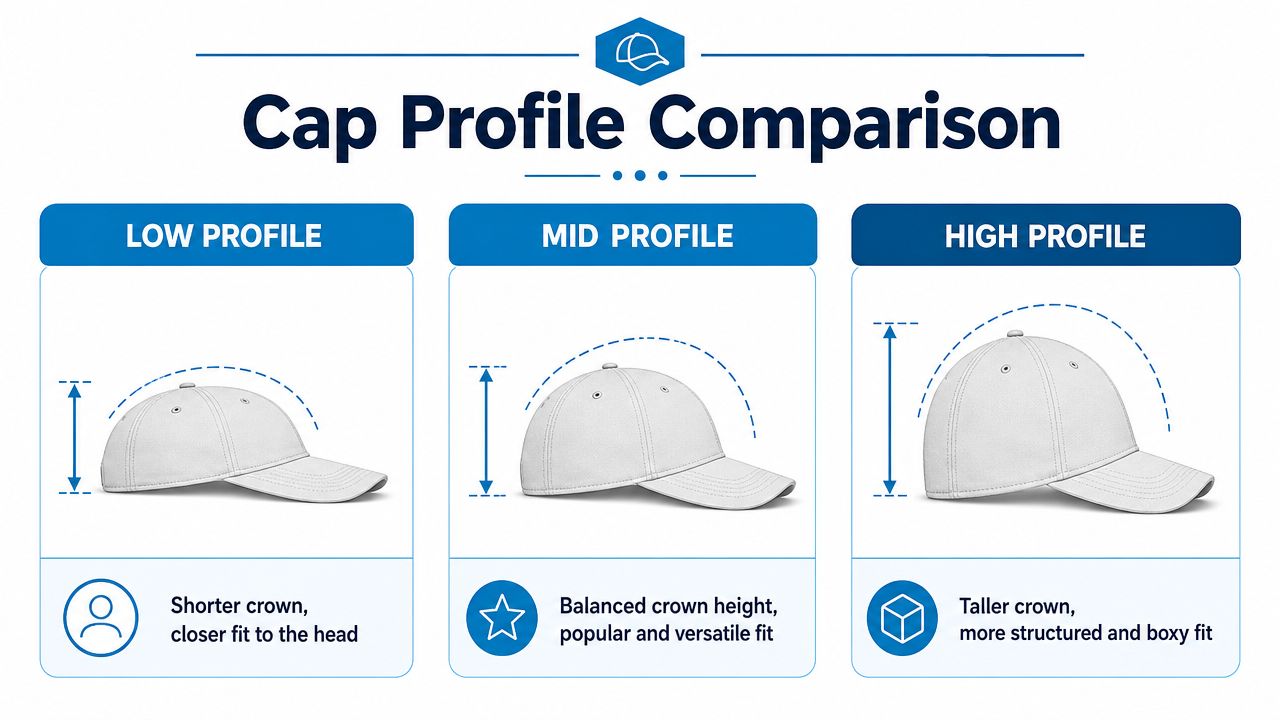
According to Monterey Company's explanation of hat profiles, mid profile caps offer a balanced silhouette. Low-profile caps sit closer to the head with minimal crown height, while high-profile caps have a taller crown that stands up more prominently. In custom apparel, mid-profile hats are often treated as the middle-ground option because they combine visual structure with broad wearability.
How each profile looks on the head
Here's the plain-English version.
| Profile | How it usually looks | Common reaction from wearers | Branding effect |
|---|---|---|---|
| Low profile | Closer to the head, shallower front | Feels casual and understated | Less vertical room on the front |
| Mid profile | Balanced height and moderate structure | Feels familiar to most people | Good room for standard front logos |
| High profile | Taller crown, more upright face | Feels bold or boxy depending on wearer | More presence and more visual impact |
Low profile works well when you want a softer, more laid-back cap. Many people associate that look with relaxed everyday wear. The trade-off is that some wearers find shallow caps too close-fitting, especially if they have a larger head, fuller hair, or just prefer a little more room.
High profile goes the other direction. It creates a taller front and a stronger silhouette. That can be the right choice for trend-driven merch, some snapback looks, or logos that need extra vertical space. But in mixed groups, it can feel like a commitment. Some people love it. Some won't wear it twice.
Which profile is easiest for group orders
The mid profile cap usually wins.
It doesn't hug the head as tightly as a low profile cap, and it doesn't stand up as prominently as a high profile cap. It gives a cleaner front for decoration while still feeling familiar to people who just want “a normal baseball cap.”
For buyers comparing panel construction, this also matters when you're looking at styles like a 6-panel hat, where the profile and the way the front is built work together to create the final look.
If the order is for a broad audience and nobody is asking for a fashion-specific shape, mid profile is usually the lower-risk pick.
That doesn't mean it's always the right answer. If your brand has a very relaxed lifestyle look, low profile may fit better. If you're building a stronger streetwear presentation, high profile may be the point. But for uniforms, company merch, tournaments, onboarding kits, and event apparel, mid profile usually creates fewer complaints and fewer unworn hats.
Finding the Right Fit for Different Head Shapes
This is the part most hat guides skip. They tell you crown height, then stop. Buyers still want the answer to the question that matters most. Will this cap feel good on real people?
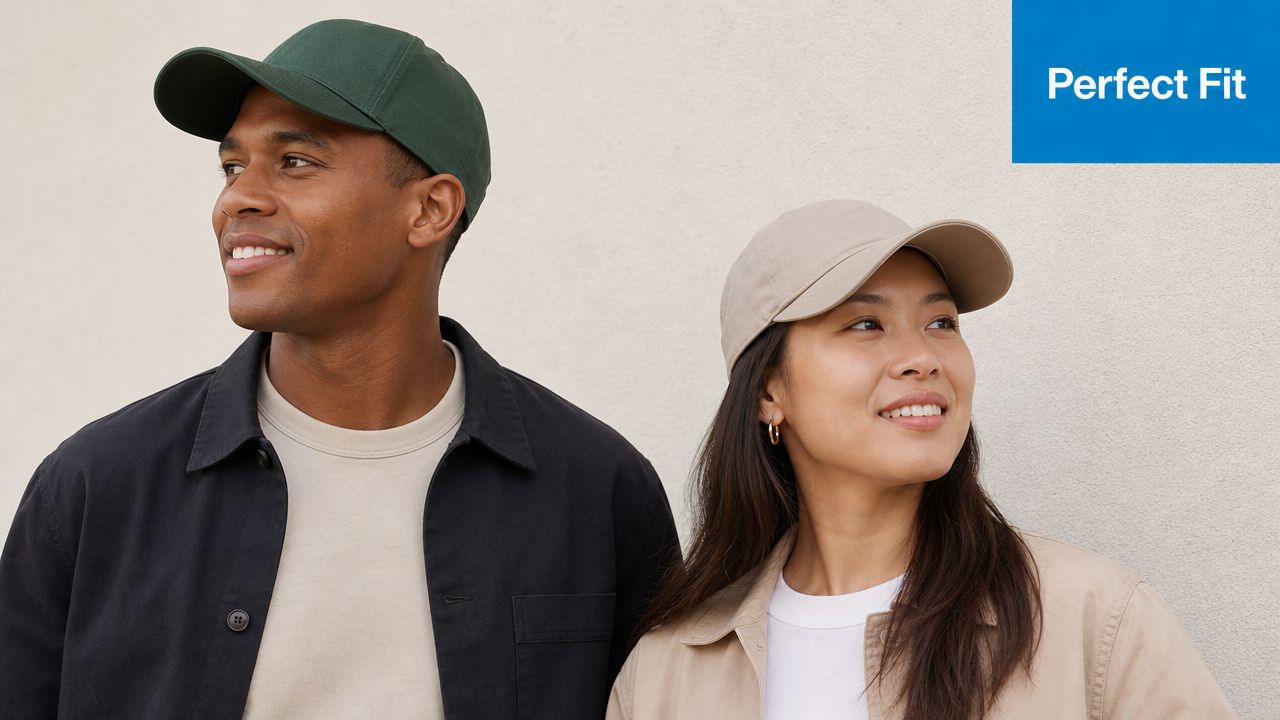
A useful way to think about fit is this. “One size fits most” only refers to adjustment range. It doesn't guarantee comfort, shape, or appearance. A source discussing cap fit points out that a key issue is whether a cap accommodates different head shapes and hair volumes, including hairstyles like braids or curls, while avoiding pressure points on larger or longer head shapes, especially in group orders where comfort decides whether the hat gets worn again, as noted in this discussion on practical cap fit considerations.
Why one size fits most still needs judgment
A cap can technically close around someone's head and still fit poorly.
That usually shows up in a few ways:
- Pressure at the front band: Common when the cap is too shallow or too rigid for the wearer.
- Lift at the sides: The cap sits up instead of settling naturally.
- Overly flat appearance on the front: The logo area can look stretched or distorted.
- Instability: The cap rides high and shifts around instead of feeling planted.
These problems don't affect every head shape equally. A rounder face may look better in a cap with a little structure so the hat doesn't disappear into the face. A longer face often benefits from a profile that doesn't add too much vertical height. Someone with fuller curls, braids, locs, or more hair volume often needs enough interior space without jumping all the way to a tall, boxy cap.
What tends to work for real teams
Mid profile caps help because they split the difference in a useful way.
For wearers with larger heads, they often avoid the “painted on” look that a shallow cap can create. For wearers with thicker hair or more volume, they usually provide more breathing room than low-profile shapes. For people who dislike tall crowns, they still feel more controlled and less dramatic than high-profile caps.
Here's how I'd break it down in practice:
- Round or fuller faces: A mid profile cap usually adds enough definition to keep the hat from looking too compressed.
- Longer or narrower faces: Mid profile often works better than high profile because it doesn't add as much height above the forehead.
- Thick hair, curls, braids, or locs: Look for some room in the crown and be careful with overly rigid fronts that can create hot spots.
- Mixed-gender teams: Mid profile usually gives the broadest overlap in acceptable fit, which matters more than finding a perfect style for one subgroup.
Comfort issues don't always show up in the sample photo. They show up after two hours of wear.
Another variable is closure style. Adjustable caps help, but adjustment only solves circumference. It doesn't change crown shape. That's why a poorly chosen profile still underperforms even when the back closure has plenty of range.
If you're ordering for a diverse staff or event group, ask for a profile that feels neutral and wearable. In most cases, that points back to the mid profile cap.
Best Decoration Methods for Mid Profile Caps
A mid profile cap can fit a wider range of people, but the decoration still has to work with the shape of the hat and the people wearing it. That is where many first-time buyers get tripped up. A logo that looks fine on screen can stitch too small, sit too high, or feel stiff on a cap that will be worn by staff with different hair volume and head shapes.
Why the front panel matters
On a mid profile cap, the front panel gives you useful decorating space without the extra height of a taller crown. That balance helps logos read clearly, but it also sets limits. If the art is too detailed, the curved surface and moderate crown height can make it feel crowded fast.
Structured fronts usually pair well with embroidery because the fabric has enough support to hold clean stitching. Text stays sharper. Simple marks hold their shape better. The result tends to look more like finished branded merch and less like a rushed promo cap.
Comfort matters here too. Heavy stitch counts, thick backing, or oversized patches can make the front panel feel hotter and stiffer, especially for team members with thicker hair, curls, braids, or anyone already using more of the cap's interior space. If the hat needs to work across a mixed group, decoration should look good and wear comfortably for a full shift or event.
What works best for different logo styles
The right method depends on the artwork, the budget, and how polished you want the cap to feel in person.
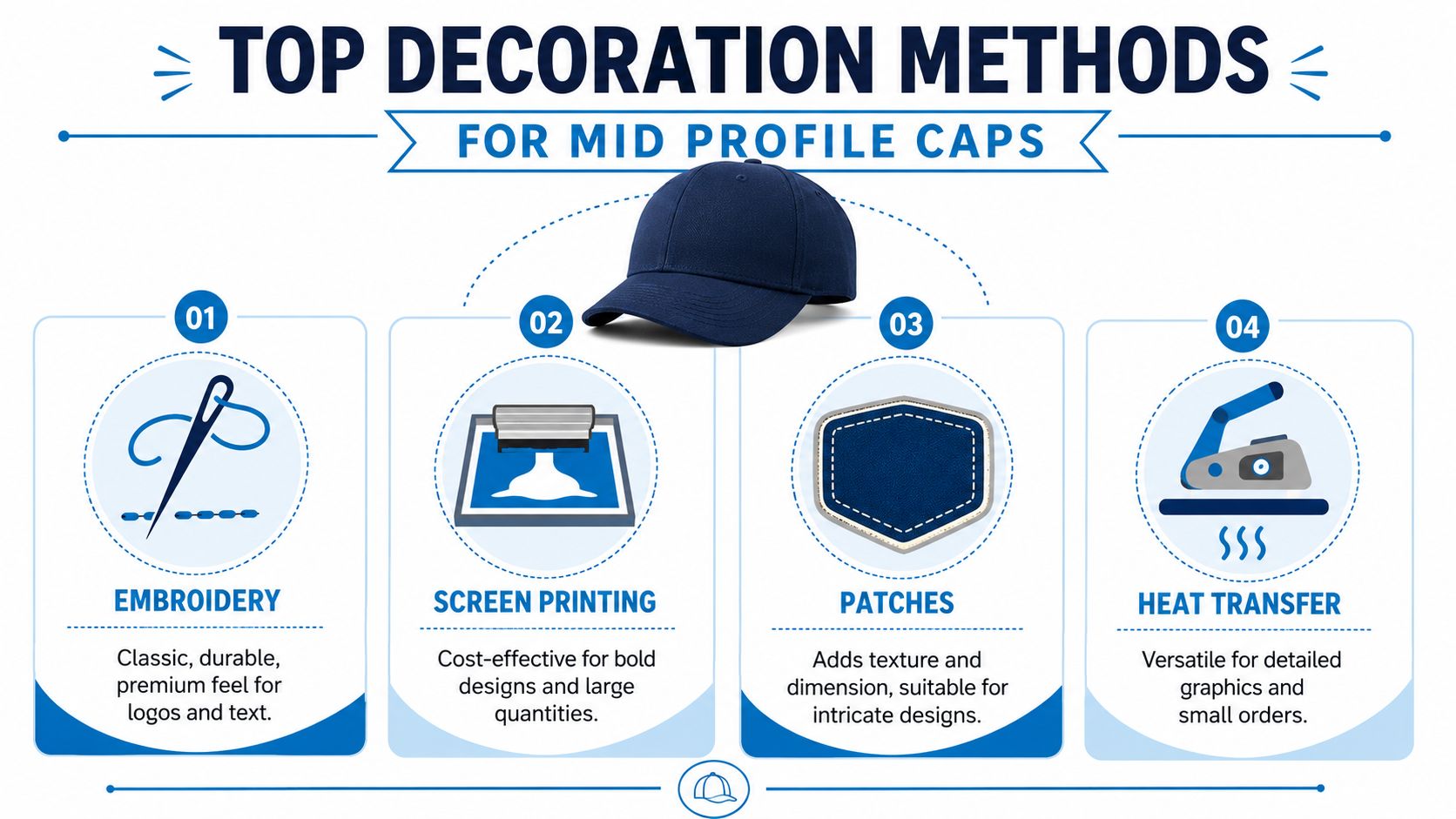
- Embroidery: Usually the safest choice for company logos. It holds up well, looks professional, and suits simple text, icons, and badge-style marks.
- 3D puff embroidery: Best for bold shapes with enough open space. It adds dimension, but small details usually get lost.
- Patches: A smart option when direct embroidery would be too dense or too small. Patches also help when you want texture without loading the front panel with stitches.
- Heat transfer or DTF-style application: Useful for artwork with fine detail, gradients, or multiple colors that embroidery would simplify too much.
- Screen printing: Less common on caps, but still workable for simple graphics in the right setup.
Here's the practical version:
| Logo type | Usually a strong fit | Watch out for |
|---|---|---|
| Simple text or icon | Embroidery | Small letters may still need cleanup |
| Bold badge mark | 3D puff embroidery or patch | Fine detail can disappear |
| Detailed illustration | Heat transfer | Placement on curved fronts takes care |
| Vintage emblem | Patch | Patch size has to match the crown |
I usually tell buyers to choose the decoration method after they look at the actual logo size on the actual cap style. Habit leads people the wrong way here. A company may always use embroidery on polos, but that same logo can read better as a woven patch on a cap.
If you need a practical reference for logo sizing and stitch position, this placement guide for embroidery helps set expectations before production.
For teams ordering hats alongside uniforms or merch bundles, the same decoration decisions often show up in broader apparel programs, especially when comparing UK teamwear options across mixed-size groups.
Providers such as Dirt Cheap Product, Inc. offer embroidery, DTF, patches, and other apparel decoration services across hats and garments. That kind of menu matters because it lets you match the artwork to the cap instead of forcing one method onto every order.
The best cap decoration is the one that looks clear at a glance and still feels good after hours of wear.
How to Order Custom Caps for Your Business
The ordering part gets much easier once you stop treating hats like a side item. Caps need the same planning discipline as uniforms or retail merch. If you decide the fit, decoration, and artwork details up front, the order usually goes smoothly. If you guess, revisions pile up.
One reason buyers often land on this profile is simple practicality. Mid profile hats are a strategic choice for bulk orders because they accommodate a range of head sizes, and that kind of broad appeal matters in a baseball cap market estimated at USD 19.0 billion in 2024, with projections to USD 35.0 billion by 2034 and a 6.3% CAGR from 2025 to 2034, as described in DICK'S Sporting Goods' overview of mid-profile baseball hats.
If you're coordinating hats alongside broader apparel for clubs, schools, or travel teams, it can also help to look at related buying categories such as UK teamwear options, because the same issues show up there too. One item has to work across a lot of different bodies and preferences.
Here's a helpful visual before you place the order:
The ordering mistakes that cause rework
Most cap problems start before production.
Buyers choose a style without thinking about who will wear it. They approve artwork that's too detailed for the decoration method. Or they focus only on unit price and miss the bigger issue, which is whether the finished cap will feel worth wearing.
The most common preventable mistakes are:
- Picking by photo only: A good catalog shot doesn't tell you how the crown feels on different wearers.
- Skipping art cleanup: Tiny taglines and thin lines often need simplification on hats.
- Ignoring closure preference: Adjustable styles are safer when the group has mixed sizing.
- Approving too fast: A proof should be checked for scale, placement, thread color, and readability.
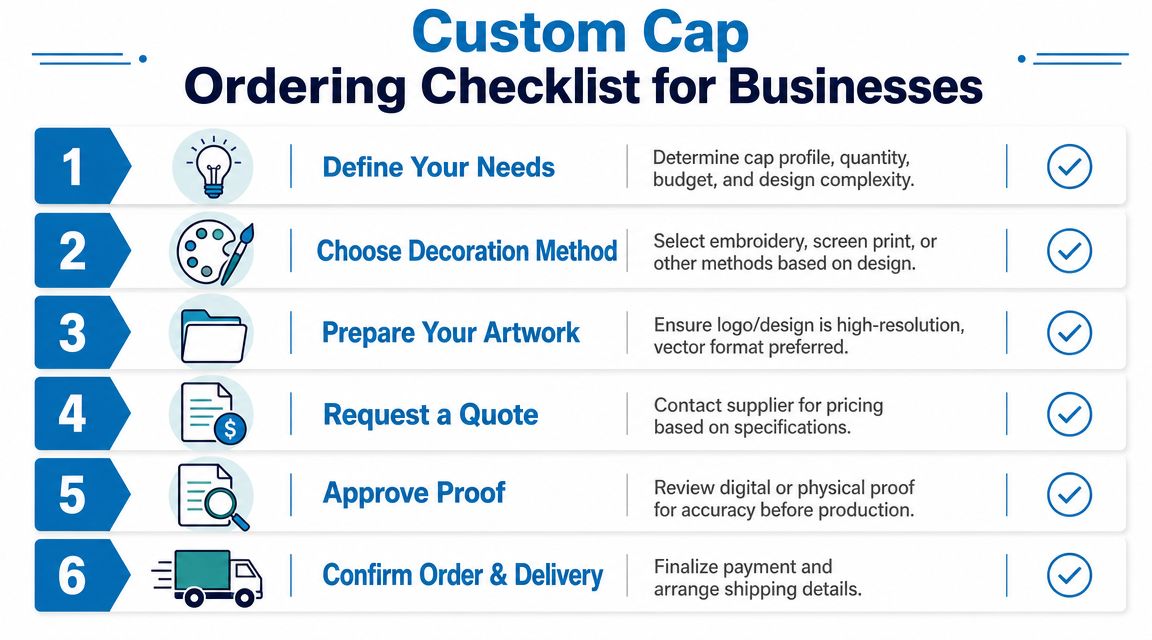
A practical ordering checklist
Use this sequence and you'll avoid most of the usual trouble.
- Define the use case first. Staff uniform, retail merch, tournament giveaway, and sponsor gift hats don't all need the same finish.
- Choose the profile before the logo treatment. That decision affects both fit and decoration space.
- Match the decoration to the artwork. Don't force detailed art into a method that can't hold the detail cleanly.
- Request and review a proof carefully. Focus on size, placement, color, and stitch interpretation.
- Think about repeat wear. The right cap isn't the one that looks acceptable in a box. It's the one people keep pulling back out.
- Order from a supplier set up for bulk custom headwear. If you're comparing options, a custom logo hats wholesale and bulk orders page is the kind of reference that helps you confirm available styles, order flow, and decoration options before you commit.
For first-time buyers, the smartest move is usually the least flashy one. Pick the cap profile with the broadest chance of success, keep the front decoration clean, and make comfort part of the approval process instead of an afterthought. That's why the mid profile cap keeps showing up in successful business orders. It makes fewer people say no.
If you're ready to source branded hats that fit your team and your artwork, Dirt Cheap Product, Inc. can help you compare cap styles, decoration methods, and bulk-order options so you can place the order with fewer surprises.