
You're standing over a stack of cap samples, trying to decide which one your team, event, or customers will want to wear. One feels too flimsy, another has a crown that makes the logo look awkward, and a third looks great until you start wondering whether the patch will survive sweat, washing, and repeated use.
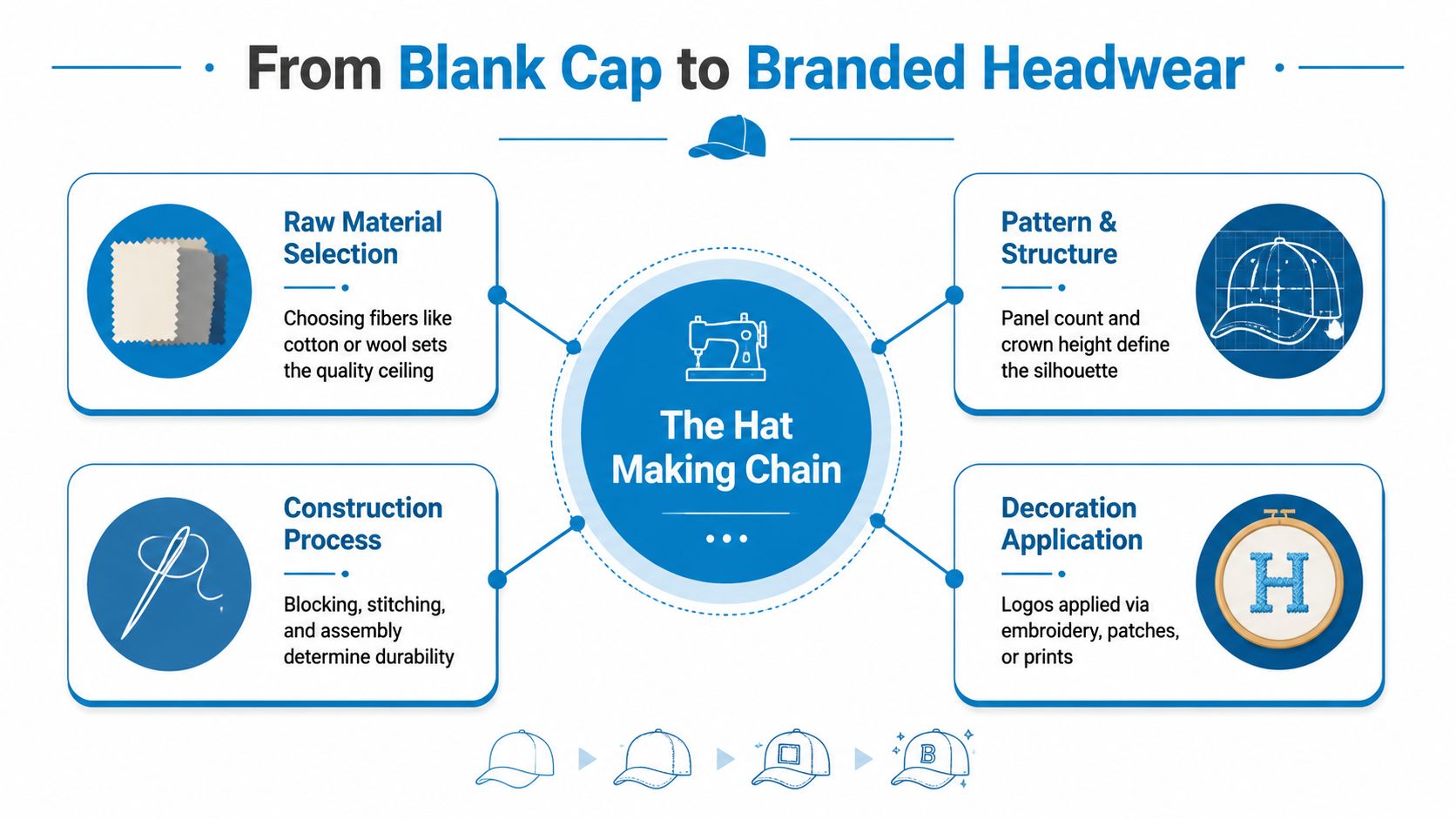
That decision becomes easier when you understand the making of hats as a chain rather than a single factory task. Material selection affects decoration. Pattern design affects fit and logo placement. Construction affects shape retention. Care instructions and sourcing affect what happens after the order leaves the production floor.
This guide follows that chain in plain language. You'll see which choices belong to you as the buyer, which questions to ask a supplier, and why a polished finished cap depends on much more than the artwork applied at the end.
Table of Contents
- From Blank Cap to Branded Headwear
- Raw Materials and Pattern Choices
- Blocking, Stitching, and Construction Methods
- Decoration Techniques and When to Use Each
- Production Timelines, MOQs, and Cost Drivers
- Quality-Control Checkpoints Worth Asking For
- Sustainability, Care Labels, and Smart Recommendations
From Blank Cap to Branded Headwear
A branded hat starts long before an embroidery machine runs the first stitch. The supplier first chooses or sources a blank, decides how the panels and crown will be formed, selects the bill and closure, and checks whether the material can support the requested decoration. Only then does the logo become part of the product.
Hat making has a long industrial history. Felt hat making as it's understood today is believed to have started around 1500, while London's Company of Feltmakers was established in 1604. Royal letters patent from 1501 formally united the Hattermerchants with the Company of Hatters and Hurers, and historical research says a 1604 charter recognized the “seaven thousand persons” of the trade, showing how significant hat production had already become in early modern Europe. The Feltmakers' historical research paper provides that background.
Today's branded cap still follows the same basic logic, even when machinery replaces hand tools. A business ordering headwear controls several important decisions:
- The blank: cotton, wool felt, polyester, acrylic, performance fabric, straw, or a blend.
- The silhouette: low or high crown, structured or unstructured front, five or six panels, curved or flat bill.
- The decoration: embroidery, transfer, direct-to-film, or a sewn or heat-applied patch.
- The wearing environment: office uniform, outdoor work, retail merchandise, charity event, sports program, or promotional giveaway.
- The repeat plan: a one-time order needs a different sourcing strategy from a style you'll reorder throughout the year.
Practical rule: Choose the hat for the wearer first, then choose the decoration that works with that hat.
A premium logo can't rescue a blank that loses its shape, feels uncomfortable, or places the artwork on a curved surface it wasn't designed for. The production floor connects each choice to a physical result, so a good supplier should be able to explain not only what a hat costs, but also why its material, construction, and decoration suit your use.
Raw Materials and Pattern Choices
Material determines how a hat feels, holds its shape, looks in use, and accepts decoration. The blank cap functions as the foundation. The logo and trim depend on what lies beneath, much as a building's finishes rely on a stable base. For a business placing a branded order, this choice affects wearer comfort, appearance, reorder consistency, and cost.
Cotton twill feels familiar because it is common in everyday caps. Its woven surface provides a clean background for embroidery and suits staff uniforms, casual retail merchandise, and outdoor branding. An unstructured cotton cap folds more easily and gives a relaxed appearance. A structured cap has reinforcement behind the front panels, creating a firmer presentation for a logo.
Wool felt has a denser, more molded character. It suits shaped hats better than lightweight baseball caps, and it can give branded headwear a refined, tactile appearance. Makers who want more context on this material family can consult boiled wool for sewists, which explains how processed wool behaves as fabric. Decoration still needs careful planning because the surface and shape may limit the available methods.
Acrylic and polyester offer consistent color and easy-care handling. Polyester performance fabrics can suit active teams and outdoor programs when breathability, moisture handling, and repeat wear matter. They may also support a practical care routine, but a synthetic fiber alone does not guarantee protection from rain. Compare finishes, seam construction, and care requirements when reviewing water-resistant hats. Straw suits warm-weather programs, resort and hospitality settings, or summer events, although its weave and curved surface can narrow decoration choices.
Pattern decisions shape the logo area
A five-panel cap often provides a broad, uninterrupted front panel. That layout can give a centered logo a clean streetwear or promotional appearance. A six-panel cap divides the front with seams, which can restrict artwork size and affect where the needle crosses the material.
Crown height changes the relationship between the wearer's face and the logo. On a high-profile crown, a small mark may look lost above the brim. On a low-profile crown, the same artwork may need reduction so it does not crowd the seams or become difficult to read.
Brim shape changes the viewing angle. A curved bill requires embroidery digitized for its surface, while a flat bill presents the artwork differently. Before approving production, request a visual proof on the exact cap style, not just a logo placed on a flat page. That proof can reveal spacing, scale, and readability issues before they affect the order.
Blocking, Stitching, and Construction Methods
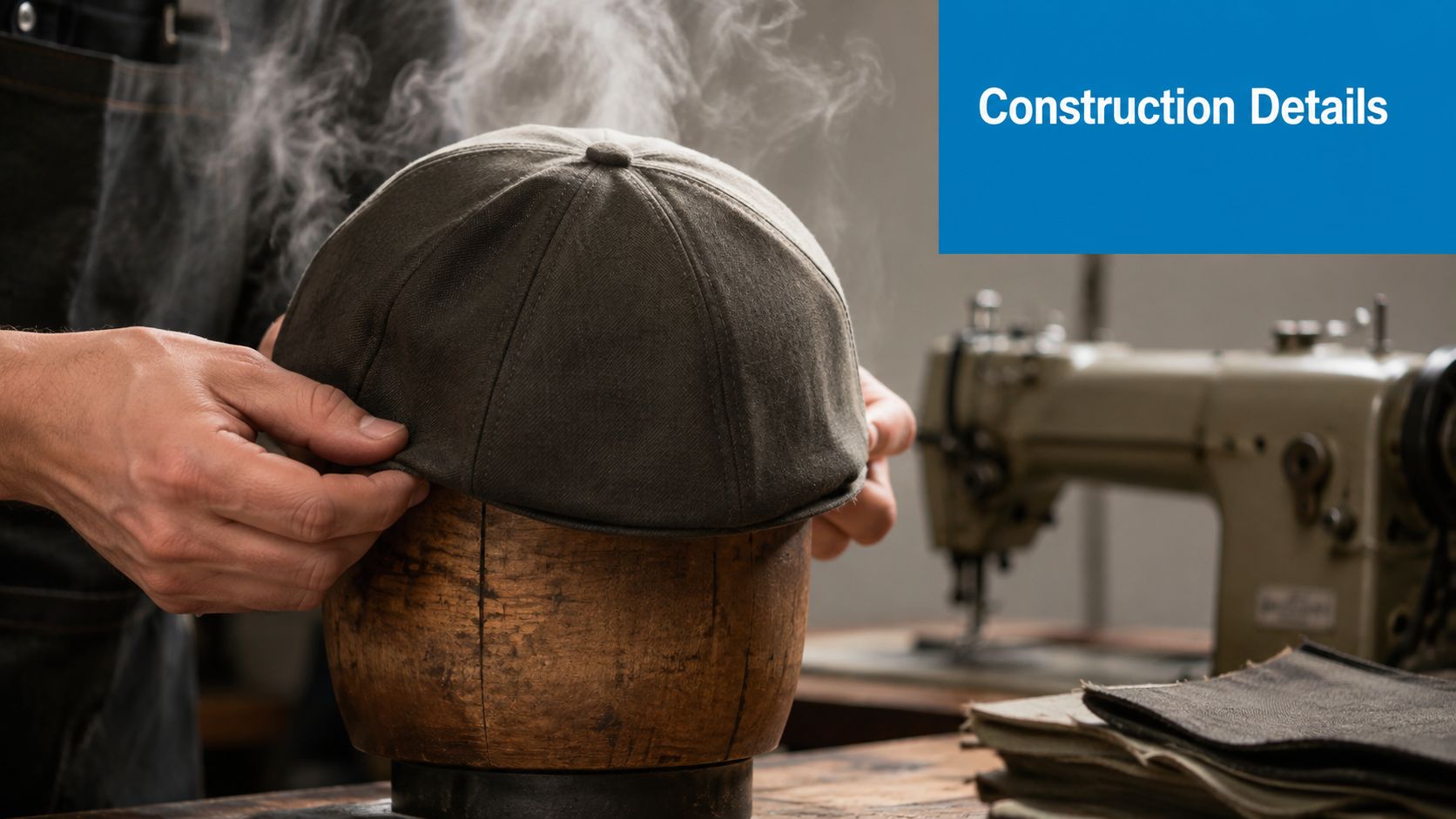
A hat becomes a hat through controlled shaping and assembly. In traditional felt or straw production, the body is wetted or steamed, stretched over a wooden or aluminum block, and held with pins, cords, or machine pressure until it dries or cools. The moisture and heat relax the fibers, allowing the maker to reform the material without immediate springback. Heritage Crafts' explanation of hat making describes this blocking process and its role in stabilizing the final silhouette.
The same principle helps explain why construction quality can be difficult to judge from a product photograph. A crown may look correct at first but lose its dimensions if the material wasn't shaped and stabilized properly. Drying, cooling, or a secondary heat-set step gives the crown and brim a better chance of holding their intended geometry.
What happens after shaping
Once the material is prepared, production moves through several connected operations:
- Cutting: The supplier cuts panels, crown pieces, bill covers, sweatbands, and other components according to the approved pattern.
- Panel joining: Sewing operators align the panels and stitch the crown. Uneven seam allowances can distort the front and make logo placement look off-center.
- Bill attachment: The bill is attached and shaped. Its curve or flat profile affects how the finished cap sits and how the decoration is viewed.
- Closure installation: Buckles, snaps, hook-and-loop tabs, or fitted construction determine adjustability and fit.
- Lining and finishing: Linings, sweatbands, labels, thread ends, and pressing complete the interior and exterior.
Premium felt production offers a useful quality benchmark. After initial blocking, a second blocking or decatising pass can gently reheat the hat and improve dimensional permanence, helping the crown and brim maintain their geometry over time. Production notes from Optimo's description of its hat-making approach also explain why sewn linings can outperform glued linings under wear and humidity. A buyer ordering structured or premium headwear can ask whether the supplier uses a comparable stabilization step and whether the lining is stitched rather than bonded.
Ask the floor manager: “What keeps this crown and brim stable after repeated wear, humidity, and handling?”
Inspect the sample from the inside out. Look for balanced seams, clean transitions around the bill, secure closure attachment, and a lining that doesn't pull away at the edges. Construction defects often appear first at stress points, not on the broad front panel where the logo gets the most attention.
Decoration Techniques and When to Use Each
The decoration method should match the logo, blank, quantity, and wearing conditions. A detailed mark that looks excellent on a flat proof may need to be simplified for a curved crown, a stretchy performance fabric, or a thick patch base.
Embroidery
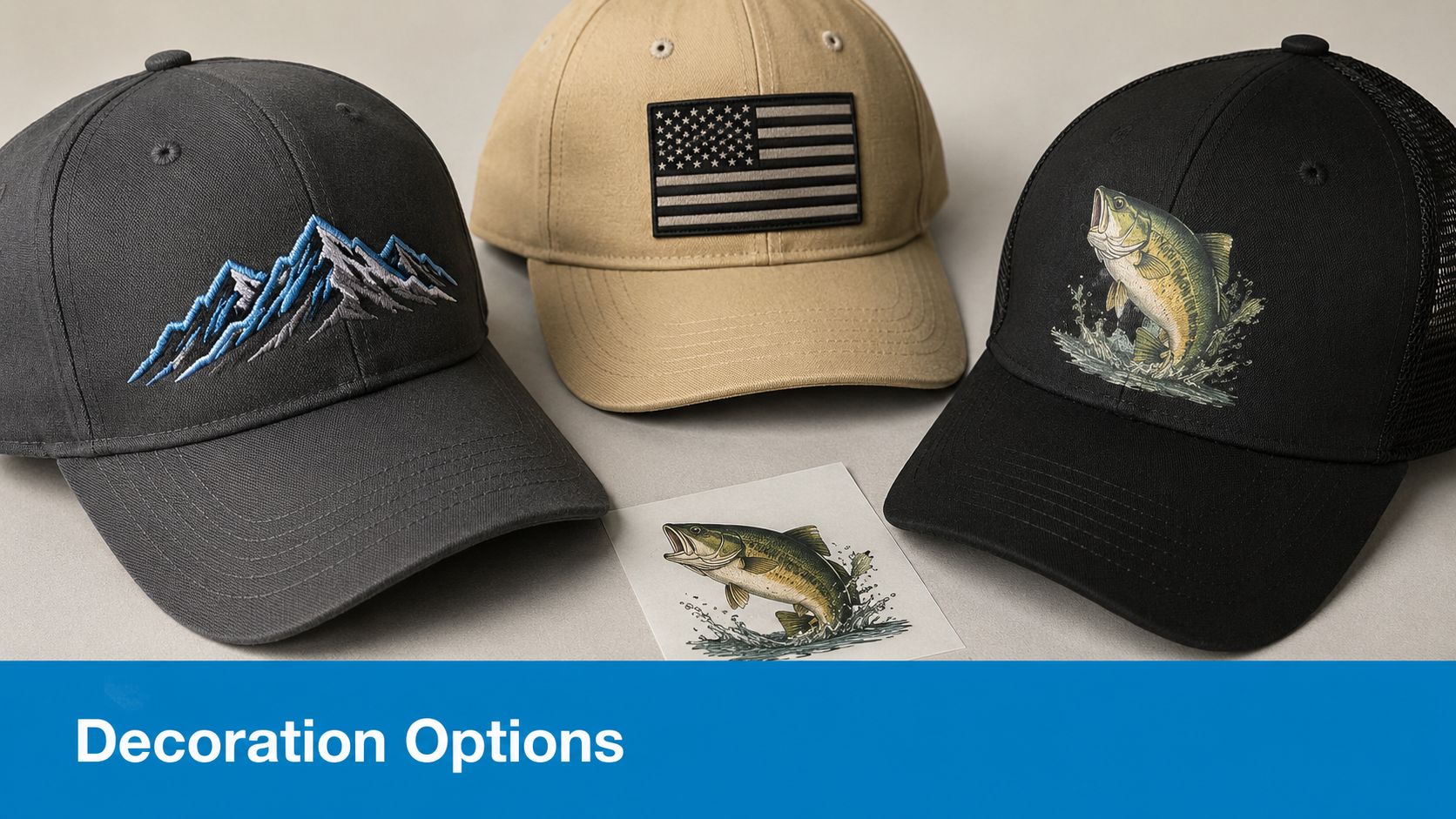
Embroidery uses thread to build the design directly into the hat. It suits company marks, initials, simple symbols, and retail-style branding where texture is part of the appeal. The artwork must be digitized, meaning a specialist converts the logo into stitch instructions that control density, direction, underlay, and thread changes.
Dense stitching can add weight or cause puckering on lightweight fabric. Very small lettering may also lose clarity. Ask for a proof that shows the design on the selected cap, and check whether the supplier recommends reducing detail rather than forcing every element into a tiny embroidery area. Raised 3D puff embroidery can add height to suitable bold artwork, but it isn't a universal solution for fine lines or delicate type.
Heat transfers and DTF
Heat transfers apply printed artwork using pressure and heat. Direct-to-film, or DTF, prints the design onto film before transferring it to the fabric. These options can reproduce gradients, multi-color art, and visual detail that would be difficult to express with thread.
They work well for event graphics, campaign artwork, and logos with complex color transitions. The supplier still needs to test the transfer against the hat's fabric and curvature. A transfer placed across a seam or on a highly textured surface may not sit as cleanly as one applied to a smooth front panel.
Custom patches
Patches create a separate decorated piece that is then attached to the hat. They can be embroidered, woven, printed, or made with other surface treatments. A patch gives a logo a defined edge and can suit outdoor programs, workwear, club merchandise, and designs that benefit from a badge-like appearance.
The attachment method matters. Sewing generally creates a different service profile from heat application, especially when the hat will see repeated handling or washing. Patches can also conceal minor variation in the underlying fabric, but they add thickness and weight.
| Decoration Method | Best For | Typical MOQ Friendliness | Durability Notes |
|---|---|---|---|
| Embroidery | Simple logos, uniforms, premium retail branding | Often practical for repeat programs, subject to setup requirements | Strong when stitch density and backing suit the fabric |
| Heat transfer | Bold graphics, event marks, smooth fabric surfaces | Can suit smaller, artwork-led orders | Performance depends on heat, pressure, fabric, and care |
| DTF | Detailed, multi-color, or gradient artwork | Useful when printed detail matters more than thread texture | Needs testing on the chosen substrate and curved area |
| Custom patch | Outdoor branding, badges, rugged visual identity | Useful when a separate emblem simplifies production | Attachment quality determines how well it handles wear |
The best method is the one that survives actual use. A logo for a short event may prioritize color detail and speed. A uniform cap worn repeatedly may need restrained embroidery and a blank chosen for stable construction.
Production Timelines, MOQs, and Cost Drivers
Buyers often ask for a production timeline before they've finalized the variables that control it. A supplier can't give a meaningful schedule until the blank, artwork, decoration method, sample approval, quantity, and delivery location are clear.
Minimum order quantities exist because production has setup work. Embroidery requires digitization and machine preparation. Transfers and DTF require artwork preparation, film or transfer handling, and heat application. Patches add their own design, manufacturing, and attachment steps. A small order can still involve many of the same preparation tasks as a larger one, so the supplier may set a minimum that makes the run practical.
The quote moves with a few decisions
A small business might compare two caps that appear similar in a catalog. One uses a standard cotton blank, a straightforward embroidered mark, and a commonly stocked color. The other uses a specialized performance fabric, a woven patch, a custom closure, and a rush schedule. The second order can cost more because the buyer has changed several production inputs, not because the supplier has added an unexplained surcharge.
Ask for the quote to separate the main drivers:
- Blank origin and construction: Stocked, standard blanks are usually easier to source than specialized styles.
- Decoration method: Stitch count, transfer preparation, patch construction, and application labor all affect the production plan.
- Accessories: Premium closures, custom labels, special bills, and lining upgrades add components.
- Turnaround: Rush production can restrict material availability and compress approval time.
- Quantity: Larger runs can distribute setup work across more units, while smaller runs may face minimums or setup charges.
Budgeting question: “Which single change would lower the quote without making the hat unsuitable for its intended use?”
For buyers comparing options, a custom hats bulk order page can help frame the conversation around quantities, available styles, and decoration choices. Still, request a written breakdown rather than comparing only the unit price.
A reliable schedule should identify artwork approval, sample approval, production, inspection, packing, and shipping as separate stages. If a supplier gives only one delivery date, ask what happens if the proof changes or the selected blank goes out of stock.
Quality-Control Checkpoints Worth Asking For
Quality control works best when you turn it into specific questions. You don't need factory vocabulary to protect the order. You need checkpoints that connect directly to what the wearer will see and feel.
Start with the pre-production proof. Ask the supplier to confirm the cap style, logo dimensions, placement, thread or print colors, and decoration method in writing. A proof should show how the artwork sits on the actual front panel or patch, not just how it looks on a white digital background.
Use a buyer-side inspection sequence
- Approve one physical sample: Check crown shape, bill profile, closure, fabric hand, and logo placement together.
- Confirm color references: If color consistency matters, provide approved artwork and a defined color reference. Don't rely on memory or a screen viewed under changing light.
- Review inline construction: Ask how operators check seams, panel alignment, bill attachment, closure installation, and loose threads during production.
- Inspect decoration placement: Compare the center of the design with the cap's actual center, not merely the panel edges. Seams can make a visually centered logo appear shifted.
- Check the packed goods: Look for crushed crowns, bent bills, transfer lifting, patch edges that aren't secured, and inconsistent embroidery.
Common decoration problems are easy to describe. Embroidery may show inconsistent stitch density, gaps, thread nests, puckering, or lettering that closes up. A patch may sit at different angles from one cap to the next. A heat transfer may have a visible edge, incomplete adhesion, or a placement change caused by the curve of the crown.
For a broader process reference, Genpire's quality control workflow gives useful context for thinking about inspection as a sequence rather than a final glance. Your supplier should be able to explain who checks the goods, when checks happen, and how defects are handled before packing.
A good approval process catches a design problem before it becomes a production problem.
Ask whether final inspection includes a defined acceptance standard, even if the supplier doesn't use the term AQL. The important point is that everyone agrees what counts as an acceptable variation, a rework issue, or a rejected unit before the cartons leave the facility.
Sustainability, Care Labels, and Smart Recommendations
Sustainable hat buying requires more than choosing a fabric described as eco-friendly. Recycled polyester, organic cotton, hemp blends, cork accents, recycled mesh, and certifications such as GRS and GOTS are appearing more often in industry conversations. Recent custom hat industry coverage also describes recycled polyester as near price-parity with virgin polyester, but buyers still need to verify what a supplier's claim covers.
Ask whether recycled content applies to the entire hat, a specific component, or only the decoration. Request certification details where certification is part of the purchasing requirement. A material with a stronger environmental profile may still be a poor fit if it distorts under embroidery, wears quickly, traps heat, or can't tolerate the cleaning routine your program requires.
Longevity is part of the sustainability decision. A durable hat that remains useful through repeated wear can be more practical for branded headwear than a material chosen only for its marketing language. For a corporate merchandise program, decoration compatibility, repairability, repeat availability, and reorder consistency may matter as much as material purity.
Care labels need market-specific review
In the United States, hats, caps, and other articles used exclusively to cover or protect the head are exempt from the FTC Care Labeling Rule, unlike textile wearing apparel that generally requires a permanent, legible label with at least one accurate cleaning method and necessary warnings. Consumer guidance on U.S. care-label rules explains that distinction.
That exemption doesn't mean care information has no value. Clear instructions can reduce avoidable damage to embroidery, transfers, patches, bills, and shaped crowns. U.S. FTC guidance also says covered textile wearing-apparel labels must be permanently attached, visible or easily found at sale, and supported by outside-package or hang-tag information when packaging hides the label. The FTC regulation summary sets out those requirements.
Australia's mandatory standard is broader. It applies to clothing, apparel, household textiles, furnishings, upholstered furniture, bedding, piece goods, yarns, plastic and plastic-coated fabrics, suede, skins, hides, leathers, and furs, with instructions allowed in English, through the 5 internationally recognised care symbols, or both. Australia's product safety guidance should be checked when selling there.
For a staff uniform, choose a breathable, durable blank with restrained embroidery and written care guidance. For a 50-piece event order, choose a readily available cap and a decoration method suited to the artwork, rather than paying for complex construction that attendees may not use repeatedly. For recurring programs, keep the approved blank, artwork file, thread references, placement measurements, and decoration method on record so reorders don't depend on memory. A specification sheet can protect both your brand and your budget.
Dirt Cheap Product, Inc. helps businesses source blank hats and apply embroidery, DTF, sublimation, screen printing, and custom patches with artwork proofs for color, placement, and stitching review. Visit Dirt Cheap Product, Inc. to compare headwear styles, discuss your decoration needs, and build an order that fits your team, event, or reorder program.