You're probably here because the jacket idea has already moved beyond a vague “that would be nice.” Maybe you need a polished team look for client-facing staff. Maybe you're planning event merch that people will keep. Maybe your company has outgrown cheap giveaway apparel and you want something that feels more like a real brand asset.
That's the right moment to think carefully about jacket customization.
A jacket carries your logo differently than a T-shirt. It's more visible in public, more likely to be worn repeatedly, and more sensitive to fit, fabric, and decoration choices. That also means mistakes cost more. The wrong style can feel off-brand. The wrong decoration can pucker, peel, or disappear into the fabric. The wrong proof approval can lock in a problem across the whole order.
Done well, though, custom jackets solve several business goals at once. They help teams look consistent, give customers something worth wearing, and create a branded item with a longer useful life than most promo pieces.
Table of Contents
- Why Custom Jackets Are a Smart Business Investment
- Choosing Your Jacket Style and Material
- Comparing Decoration Methods for Your Brand
- Perfecting Your Artwork Placement and Sizing
- Navigating Pricing Lead Times and Proofs
- Final Checks Reordering and Jacket Care
- Frequently Asked Questions on Jacket Customization
Why Custom Jackets Are a Smart Business Investment
A custom jacket usually starts as a uniform decision, but it quickly becomes a branding decision.
When staff wear matching outerwear at an event, in the field, or during day-to-day client work, people read that as organization and credibility. The jacket becomes part of how your business presents itself before anyone speaks. That matters even more in roles where teams move around in public, greet customers, or represent a sponsor or nonprofit.
This also isn't a niche purchase anymore. The global custom apparel market was valued at $14.7 billion in 2023 and is projected to reach $31.2 billion by 2032, with a 9.1% CAGR, according to Rawshot's custom apparel industry statistic. For buyers, the practical takeaway is simple. Customized apparel has moved into the mainstream of corporate, promotional, and team purchasing.
Jackets stay in circulation longer
A jacket has a different lifespan than many branded items. People don't treat it like disposable merch. If the fit is good and the branding looks intentional, they keep wearing it to work, on travel days, and outside the office. That gives your brand repeated visibility without asking the wearer to do anything extra.
Practical rule: If the item needs to carry your brand for more than one season, spend more time choosing the right base jacket than choosing the fanciest decoration.
That's why I usually tell first-time buyers to stop thinking only in unit cost. Ask a better question. Will this jacket still feel wearable after the event, onboarding cycle, or seasonal campaign is over?
Good jackets support both culture and perception
Internally, matching jackets can help a team feel like a unit. Externally, they can signal professionalism without looking stiff. That's especially useful when you want staff to look coordinated but not overly formal.
For brands thinking more broadly about how physical items shape perception, Ecuadane's guide to effective corporate gifts is a useful companion read. The core idea applies here too. People remember items that feel considered, useful, and tied to the brand rather than generic.
A cheap jacket can still cost you more in the long run if nobody wants to wear it. A well-chosen one keeps working long after delivery day.
Choosing Your Jacket Style and Material
The jacket style is the first real fork in the road. Most ordering problems start here, not at decoration.
Choose the wrong base garment and you'll spend the rest of the project trying to force the branding to compensate for it. Choose the right one and almost everything else gets easier, from logo placement to team adoption.
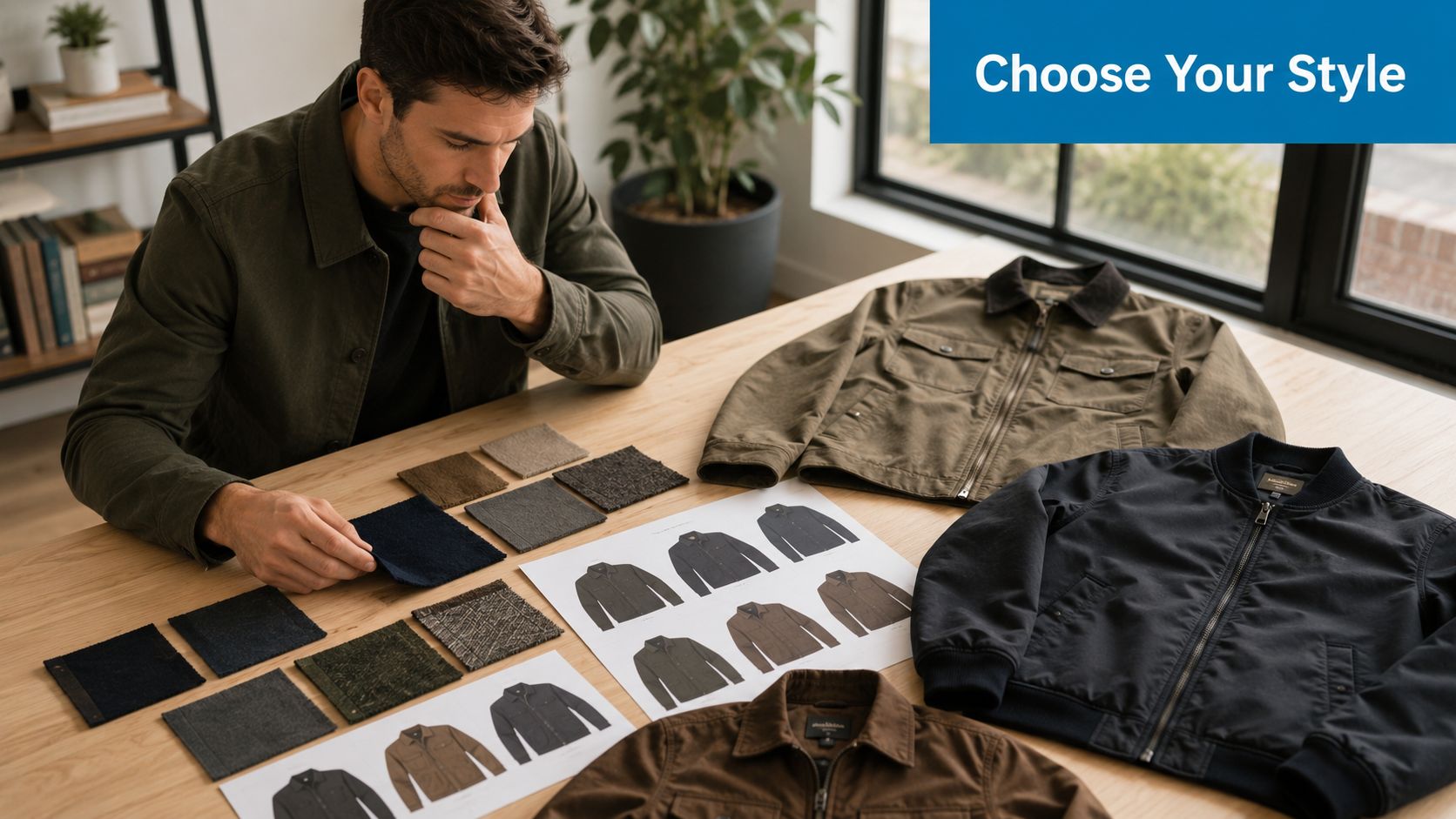
Start with the use case
A softshell works well when your team needs a clean corporate look with weather resistance and easy layering. It tends to suit sales teams, trade show staff, property teams, and service businesses that need a polished but practical uniform.
A bomber or varsity-style jacket says something different. It feels more fashion-forward, more lifestyle-driven, and often works better for retail brands, creative teams, campus programs, and merch drops. If you want inspiration for how pop culture and identity-driven outerwear can shape the overall vibe, these stylish DBZ jackets are a good reminder that silhouette matters as much as artwork.
Then there's the windbreaker. That's the choice when portability, lighter weight, and movement matter more than insulation. For active events, outdoor crews, or promotions in warmer climates, a custom windbreaker jacket option often gives you more flexibility than a heavier outerwear piece.
Match the material to the message
Materials change both perception and performance.
- Polyester and performance blends work well for lightweight outerwear, team jackets, and event use. They're practical, easier to clean, and often friendlier for print-based decoration.
- Nylon gives a sharper technical look. It's common in windbreakers and fashion bombers, but it can be less forgiving for some decoration methods if the surface is slick or heat-sensitive.
- Cotton-heavy fabrics and fleece-backed styles feel softer and more casual. They're approachable, but they won't always project the same structured look as technical outerwear.
- Wool blends, melton, leather, and faux leather push the jacket into premium or heritage territory. They look strong on varsity styles, but they demand more careful planning around patches, stitching, and reinforcement.
The outerwear market itself is large and still expanding. The global down jacket market is projected to grow from $242.9 billion in 2024 to $795.8 billion by 2034, according to Market.us reporting on the global down jacket market. For a business buyer, that matters because jackets remain a visible, desirable apparel category, not an afterthought.
Pick the jacket the wearer would choose even without your logo. That's usually the jacket that delivers the best branding result.
A quick way to decide
If you're stuck between styles, use this filter:
| Priority | Better choice |
|---|---|
| Professional uniform look | Softshell or structured work jacket |
| Lifestyle merch or retail feel | Bomber, varsity, or denim |
| Cold-weather premium gift | Puffer or insulated jacket |
| Lightweight event use | Windbreaker |
| Rugged field use | Heavier workwear outerwear |
The jacket should fit the job first, the logo second. That order saves a lot of headaches.
Comparing Decoration Methods for Your Brand
Most buyers ask which decoration method looks best. The better question is which method fits the jacket, the artwork, and the purpose.
A left-chest logo for a field team has different needs than a fashion back graphic for a retail launch. One calls for durability and restraint. The other may need color depth, fine detail, or a larger visual footprint. If you want a broader breakdown of when to use stitching, transfers, or print, this guide on how to choose a logo decoration method is a useful reference point.
What each method actually does well
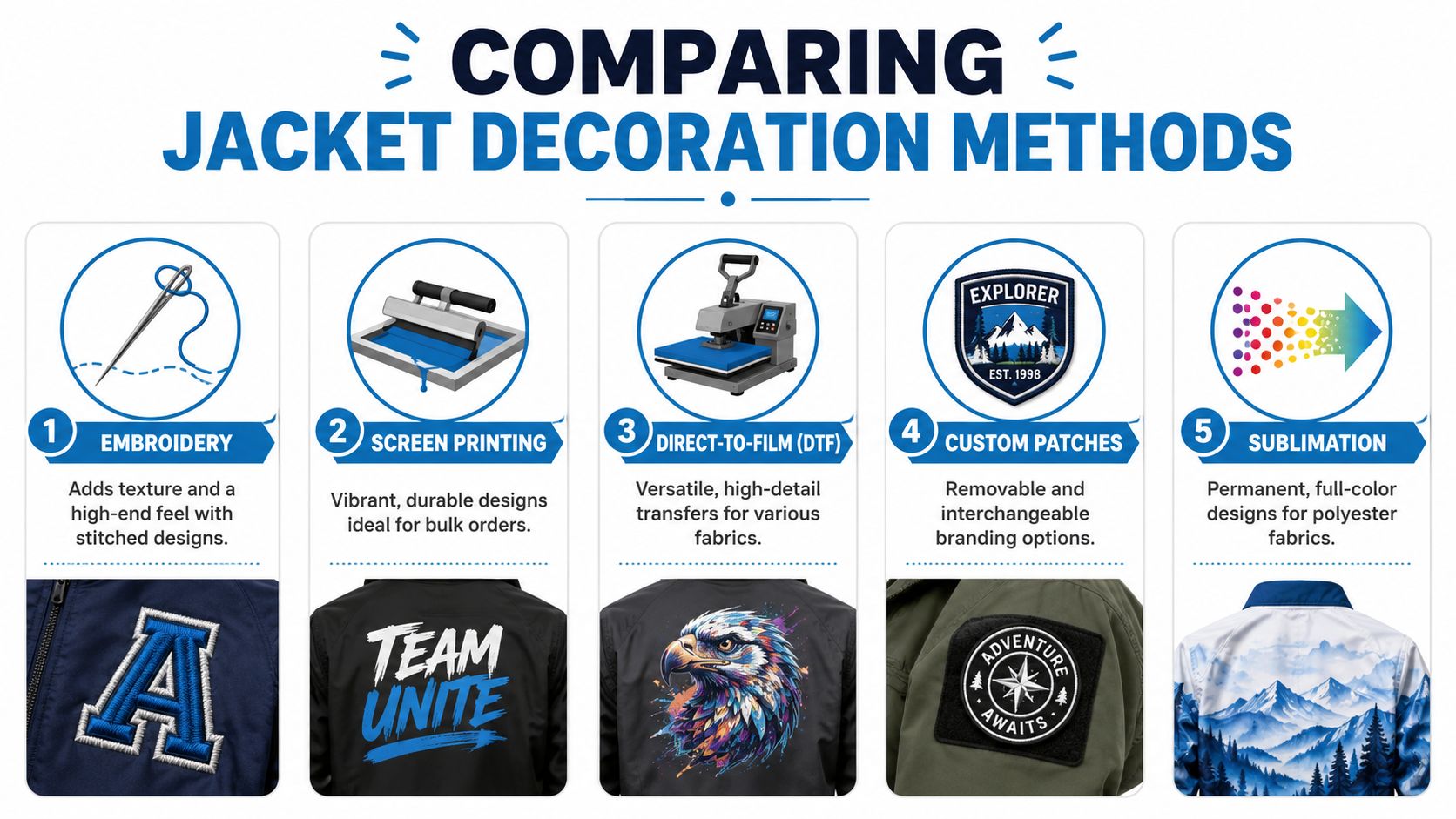
Embroidery is usually the safest choice when you want a premium, durable, classic logo application. It works especially well for left-chest branding, name personalization, and clean marks without too much tiny detail. It adds texture and presence, which is why it's so common on corporate jackets, hospitality uniforms, and teamwear.
Screen printing makes sense when the jacket material allows it and the artwork is bold enough to benefit from ink coverage. It's often stronger on simpler graphics than on tiny, fussy logos. For large runs on the right garment, it can be efficient and visually consistent.
Direct-to-Film, or DTF, is useful when the art has more detail, color transitions, or smaller production needs. It can solve problems that embroidery can't, especially when the logo has gradients or finer elements that would stitch poorly. It's often a better fit for lightweight jackets than buyers expect.
Custom patches give you a different kind of visual language. They're ideal when you want a heritage feel, badge-style branding, or layered identity elements such as mascots, departments, or commemorative editions. They can also make rebranding easier if the patch system is part of the plan.
Sublimation is more specialized. It shines when the jacket is made for it, especially on polyester-based garments intended for all-over or integrated print effects. It's not the universal answer, but when the substrate matches, it creates a very clean finished look.
Jacket Decoration Method Comparison
| Method | Best For | Durability | Cost (Bulk) | Material Compatibility |
|---|---|---|---|---|
| Embroidery | Corporate logos, uniforms, premium left chest branding | High | Moderate | Best on stable fabrics and many midweight jackets |
| Screen Printing | Bold graphics and larger runs | High when matched well to garment | Often efficient for bulk | Better on print-friendly surfaces |
| DTF | Full-color logos, detail-heavy art, smaller runs | Good | Flexible | Useful across many fabrics, but test first |
| Custom Patches | Varsity, heritage, badge-style branding | High when attached properly | Varies by patch type and application | Good on many jackets, but construction matters |
| Sublimation | Polyester garments and integrated full-color designs | High on correct substrate | Project-dependent | Best on polyester-specific products |
The material mismatch problem
The biggest mistake in jacket customization isn't picking a weak design. It's forcing the wrong decoration onto the wrong fabric.
A key production pitfall is mismatching the decoration method with the jacket material. On varsity-style garments, materials like melton wool and polyester satin can react very differently under patch stitching and hardware stress, as noted in this bomber jacket design guide. In plain terms, the same patch that sits perfectly on one body fabric can distort another.
Dense decoration looks impressive on a mockup. On the wrong substrate, it can pull the panel out of shape after wear.
That's why premium-looking isn't always premium-performing. A large chenille patch on a heavy varsity body may work beautifully. The same idea on a light satin shell can become a headache. Likewise, a detailed embroidered crest can look sharp on a structured softshell and become unreadable on a slick lightweight jacket if the art is too small.
One practical note. Dirt Cheap Product, Inc. offers embroidery, DTF, sublimation, and custom patches across branded apparel, which reflects the kind of multi-method capability buyers often need when one decoration method won't fit every jacket style in the order.
Perfecting Your Artwork Placement and Sizing
Good art can still fail on a jacket.
The problem usually isn't creativity. It's translation. A logo that looks perfect on a screen may stitch poorly, sit too low on the chest, or lose detail once it's scaled for outerwear. Jackets have seams, zippers, pockets, linings, ribbing, and bulk. All of that affects placement.
Build the art for the decoration method
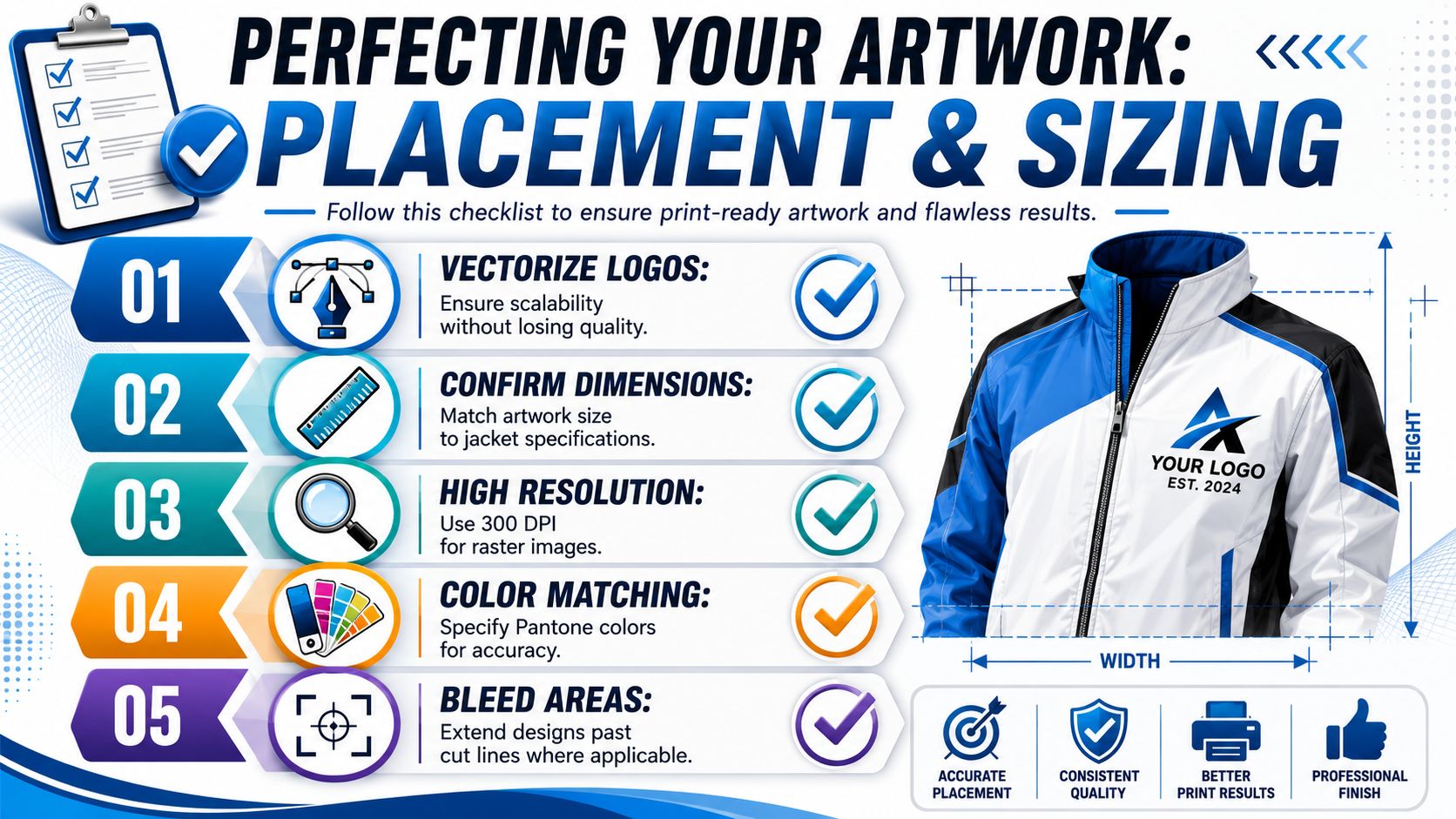
Start with the cleanest file you have. Vector artwork is still the safest route for logos because it scales cleanly and gives decorators a better foundation for output. Raster art can work for some print applications, but low-quality files create guesswork, and guesswork is where distortions begin.
Small details need special scrutiny. For embroidery, tiny lettering often requires techniques such as a bean stitch with multiple repeats to stay visible, and this embroidery-focused video guidance recommends test stitching because specialty garments can be expensive to ruin. That should change how you review your art. Don't ask only whether the logo is correct. Ask whether the smallest element is realistic for the method.
A detailed placement guide for embroidery can help when you're deciding where artwork should land on chest, sleeve, or back panels.
Placement choices that usually work
Left chest remains the safest location for most business orders. It's familiar, balanced, and usually avoids the visual clutter that can happen with aggressive branding. It also works across more settings, from uniforms to executive gifts.
Full back decoration is better when visibility matters more than subtlety. Event staff, street teams, campus programs, and merch collections often benefit from a larger back hit. Just don't assume the back panel is a blank canvas. Seams, vents, hoods, and insulation channels can all interrupt the design.
Sleeves can be strong for secondary branding, but they're less forgiving than buyers think. Curved surfaces and movement make alignment matter more. If you're adding flags, taglines, sponsor marks, or campaign details, keep them simple.
If the jacket has multiple construction lines across the target area, simplify the art before you enlarge it.
A simple artwork approval checklist
Use this before you approve any production file:
- Check the smallest text: If you have tiny wording, initials, or taglines, confirm that the decoration method can hold it cleanly.
- Review placement against seams: A centered logo on a flat mockup may shift visually once it sits near a zipper, placket, or pocket.
- Ask about scaling across sizes: Artwork may need adjustment so it still looks proportionate on the full size range.
- Confirm color intent: If brand colors matter, specify them clearly and check how they'll appear on the jacket fabric.
- Request a stitch-out or sample for riskier projects: This matters most for textured fabrics, specialty garments, and detailed art.
Buyers often obsess over the logo size and ignore the jacket architecture. On outerwear, architecture wins every time.
Navigating Pricing Lead Times and Proofs
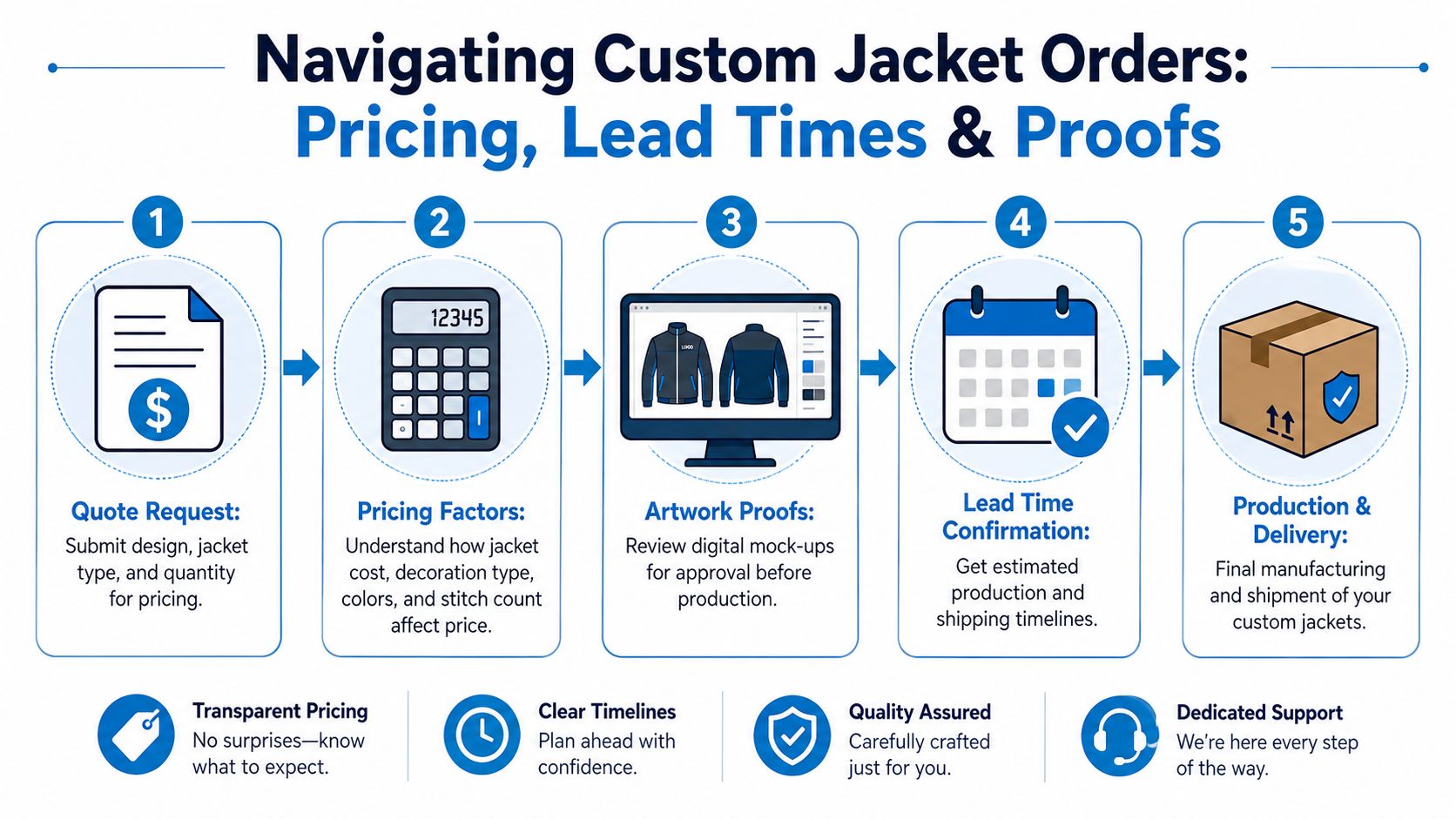
A custom jacket order rarely goes wrong because the first quote was unclear. It goes wrong when the buyer treats the quote, the timeline, and the proof as separate things.
They're connected. Every design choice you make affects production complexity. Every complexity affects timing. Every timing pressure increases the risk of approving something too quickly.
What changes the price
The jacket blank is only one part of the cost. The decoration method matters. So does the artwork itself.
A simple embroidered chest logo on a standard jacket is a very different project from a varsity-style piece with patches, sleeve details, custom lining decisions, and multiple approval rounds. Even when buyers understand that in theory, they often underestimate how much extra handling and revision work the complicated version requires.
Here's the practical way to think about pricing:
- Base garment choice: Lightweight promotional outerwear and premium insulated jackets live in very different price bands.
- Decoration complexity: A clean logo is easier to execute than layered art with multiple placements.
- Number of placements: Chest only is simpler than chest, back, and sleeves.
- Proofing and sampling needs: The more risk in the project, the more important pre-production review becomes.
- Order volume: Larger runs can change the economics, but only if the design is stable enough to produce consistently.
Why timelines stretch
Lead time problems usually start with unrealistic assumptions, not manufacturing failure.
For complex denim jacket projects, typical lead times can range from 30 to 90 days, according to this custom denim jacket production guide. The same guidance also notes that decoration complexity, sample iterations, and order volume all influence timing.
That range makes sense if you think like a producer. First the design gets locked. Then the technical details are clarified. Then the sample is built and reviewed. Then changes are made, if needed. Only after that should bulk production move forward, especially when placement and finishing matter.
The more your project behaves like garment development instead of simple logo decoration, the earlier you need to start.
If the order is tied to a launch date, conference, holiday gifting window, or staff rollout, build your deadline around proof approval, not around wishful thinking.
Proof approval is where orders are won or lost
A digital proof isn't a formality. It's the moment where assumptions become instructions.
Review the proof like the person who'll have to explain mistakes later. Check spelling. Check logo orientation. Check scale. Check whether the art sits too high, too low, or too close to a zipper. If the jacket has unusual paneling, ask how that affects the final position. If the proof feels vague, push for clarification before approving.
For higher-risk orders, a physical sample or pre-production piece is often worth the time. That's especially true when the garment has specialty washes, patches, layered decoration, or nonstandard sizing concerns.
The fastest bad order is still a bad order. A slower order with a careful proof process usually costs less in the end.
Final Checks Reordering and Jacket Care
When the boxes arrive, don't hand everything out immediately. Inspect first.
Even a well-managed order needs a receiving check. Pull samples from multiple cartons and verify the artwork, placement, garment color, sizing labels, and overall finish. Look for puckering around embroidery, crooked patches, uneven print adhesion, or inconsistent logo position across the same style.
Inspect the order right away
A simple receiving checklist helps:
- Count the units: Make sure the shipment matches the approved order breakdown.
- Spot-check size consistency: Confirm the correct mix of sizes and any tall or specialty fits.
- Review decoration quality: Look for loose threads, misalignment, lifting edges, or visible distortion.
- Compare against the approved proof: The proof is your control document. Use it.
- Flag issues quickly: Problems are easier to resolve when identified immediately.
If you're distributing jackets to staff or customers, include care guidance with the handoff. Most wearers won't ask how to wash decorated outerwear, but poor care can shorten the life of the branding. Keep the instructions simple and specific to the garment. When in doubt, tell people to follow the label, avoid aggressive heat, and be cautious with anything heavily decorated.
Make reorders easier on yourself
The first order should create a reorder system, not just a one-time delivery.
Save the final approved artwork, thread or print color notes, placement details, garment style, and size breakdown. Keep a record of what worked and what didn't. Maybe the sleeve hit looked great, but the back design felt too large. Maybe one size ran short in the sleeves. Those notes matter more on reorder day than anyone expects.
A clean reorder process protects brand consistency. It also saves time when you need jackets again for new hires, replacement pieces, seasonal programs, or another event cycle.
Frequently Asked Questions on Jacket Customization
Can I provide my own jackets
Sometimes yes, but don't assume it.
Some suppliers won't decorate jackets purchased elsewhere, while others only handle standard logo decoration rather than full jacket production or advanced customization, as explained by GetCustomized's discussion of supplied jackets and customization limits. Ask this early. It affects liability, decoration options, and whether the vendor is acting as a decorator or a full-service garment producer.
What's the right size strategy for a team order
Don't guess from T-shirt sizing. Jackets are less forgiving.
If the order matters for daily wear, collect sizes directly from the team and confirm whether the fit is unisex, regular, or tall where applicable. Outerwear layering also matters. Someone who wears a medium polo may want more room in a jacket.
What happens if I need a change after approving the proof
Ask immediately, but understand the timing.
If production hasn't started, the change may still be manageable. If the order has moved into production, changes can become expensive or impossible. That's why proof approval deserves real attention the first time.
Is there a normal minimum order quantity
It depends on the garment and the decoration method.
Standard logo decoration on stock jackets is usually more flexible than fully custom construction. If you need specialty materials, custom trims, or multiple decoration layers, expect tighter production requirements and more planning.
Which matters more, jacket quality or decoration quality
If you have to protect one, protect the jacket choice first.
A strong logo on an uncomfortable jacket won't get worn. A simpler decoration on a well-chosen jacket usually creates the better business result.
If you're planning a jacket order and want a practical second opinion before production starts, Dirt Cheap Product, Inc. can help review garment options, decoration methods, artwork placement, and proof details so your order matches the use case, budget, and brand image from the start.