
You're probably here because the shirts suddenly became real.
The trade show is coming up. New hires start next week. A client event needs staff to look coordinated. Someone on the team says, “Let's just order branded shirts,” and then the questions start piling up. What style? What color? What print method? Is the logo file usable? How many do you need? What if the reorder doesn't match the first batch?
That's where most first-time apparel buyers get stuck. Ordering custom shirts sounds simple until you realize every choice affects something bigger than the shirt itself. Your garment choice affects how polished the team looks. Your decoration method affects how premium the brand feels. Your artwork quality affects turnaround time. And if you plan poorly on the first order, reorders become messy fast.
A good shirt order isn't just merch. It's part of how customers see your business.
Table of Contents
- Your Guide to Professional Custom Apparel
- Choosing Your Garment and Decoration Method
- Preparing Perfect Artwork for a Flawless Print
- Finalizing Sizes Quantities and Pricing
- The Proofing Process and Placing Your Order
- Receiving Inspecting and Managing Your Apparel
- Pro Tips for Faster and Cheaper Custom Shirt Orders
Your Guide to Professional Custom Apparel
A first apparel order usually starts with urgency and too many options. A business owner needs polos for a sales team. A restaurant manager needs staff shirts that can handle repeated washing. A marketing coordinator needs event tees that look sharp in photos and still fit the budget. Everyone wants the same thing. They want the company to look organized, credible, and worth doing business with.
The problem is that shirt ordering has hidden business decisions inside it. A soft retail-style tee may look modern and approachable, but it might not hold up like a tougher work shirt. An embroidered polo may feel polished for front-office staff, while the same logo on a giveaway tee could feel too formal or too expensive for the purpose. Good orders come from matching the shirt to the job.
I've seen buyers focus on the logo first and the use case second. That usually leads to rework. Start with where the shirt will be worn, who will wear it, and what impression it needs to create. A field crew, a trade show team, and a boutique retail staff often need completely different apparel even if the brand mark stays the same.
Practical rule: If the shirt has a job to do, choose the garment for the job first and decorate it second.
That same thinking shows up in other branded product categories too. If you've ever looked at how campaign kits and creator outreach are organized, High Country Quilts explores influencer platforms in a way that mirrors apparel planning. The strongest programs don't start with random product picks. They start with audience, presentation, and consistency.
Custom shirts work the same way. When the order is planned well, the result looks easy. When it's rushed, the mistakes show.
Choosing Your Garment and Decoration Method
A shirt and its decoration method work like a vehicle and its finish. You can put the same logo on different garments, but the outcome changes based on the base product and how the design is applied. That's why the first conversation should never be only about price.
Start with the garment
For many businesses, the true choice isn't “Do we want shirts?” It's which category fits the moment.
| Garment type | Best use | Brand effect | Watch for |
|---|---|---|---|
| T-shirts | Events, promotions, casual teams | Approachable, modern | Fit and fabric feel vary a lot |
| Polos | Sales staff, office uniforms, hospitality | Professional, structured | Cheap polos can look stiff or shiny |
| Hoodies and outerwear | Employee gifts, cooler weather, premium merch | Higher perceived value | Decoration placement matters more |
| Performance shirts | Outdoor teams, active work, warm climates | Practical, technical | Some methods work better than others |
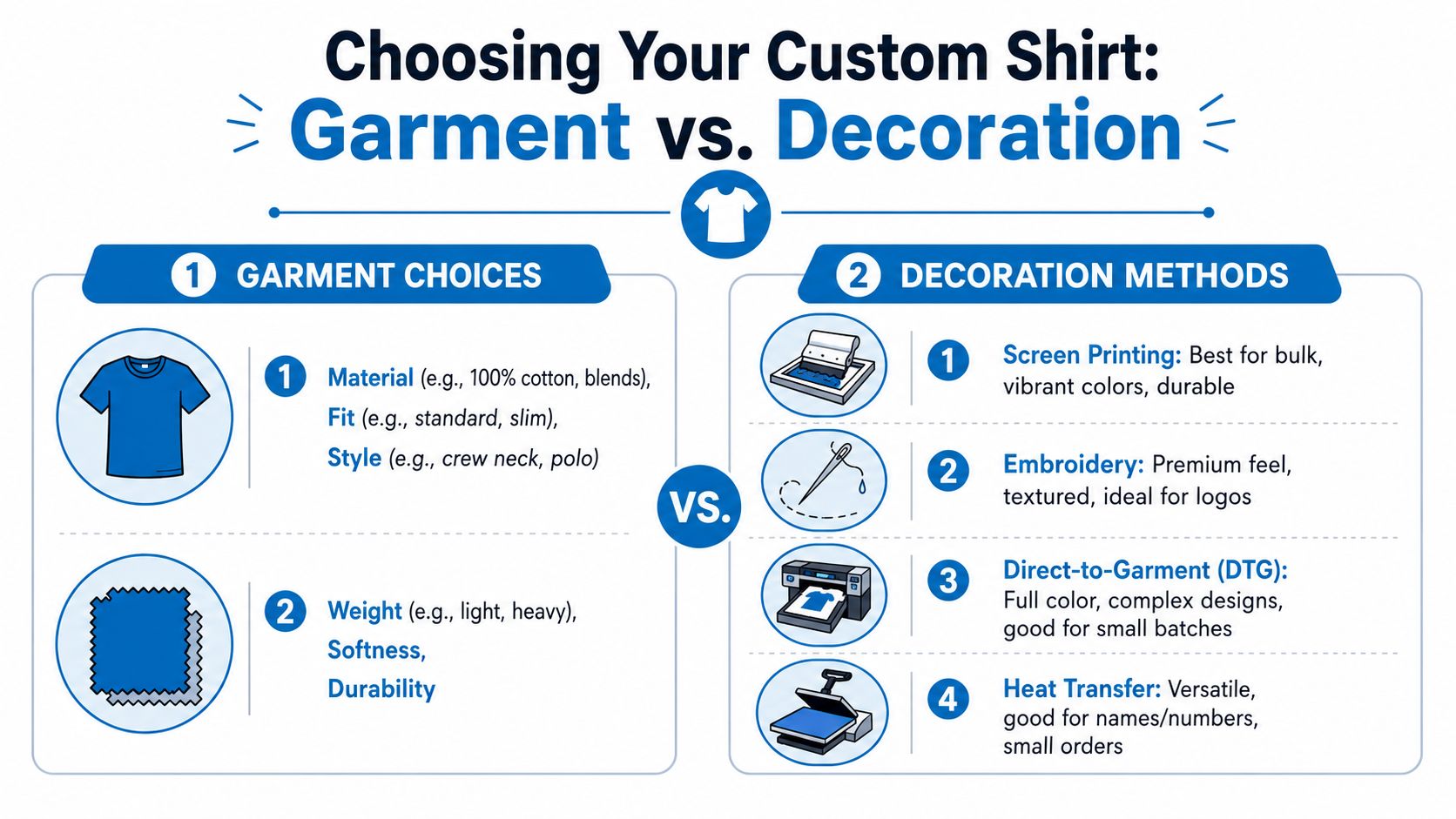
Fabric matters too. Cotton usually feels familiar and prints well. Blends often balance softness and durability. Performance polyester can be the right call for active use, but it changes how ink, heat, and color behave. If your team will wear the shirts all day on the job, comfort isn't a side issue. It affects whether people wear the garment.
Then match the decoration method
Here, brand perception and order economics meet.
- Screen printing works well for bold logos, event shirts, staff tees, and larger runs. It's a strong choice when you want a clean graphic look and consistent repeatability.
- Embroidery is usually the professional standard for polos, hats, quarter-zips, and uniforms where a stitched logo adds authority.
- DTF works well when you need flexibility, multiple garment types, or smaller runs with detailed art.
- Sublimation is best for compatible polyester garments when you want an all-over or dye-based result that becomes part of the fabric.
A lot of buyers also ask about digital methods in general. If you're comparing options and want a simple overview of logo application choices, this breakdown on how to choose a logo decoration method is a helpful reference.
A polished result usually comes from the pairing, not the individual choice. A great logo on the wrong garment still looks wrong.
What tends to work and what doesn't
For a front-facing business, embroidery on polos and hats often reads as established and dependable. For a trade show giveaway, screen printing on a comfortable tee usually makes more sense than overbuilding the piece. For highly detailed artwork on a short run, forcing it into a method that favors simplicity can create frustration.
What doesn't work is choosing a premium decoration on a bargain garment that can't support it well, or choosing a low-cost method when the brand needs a sharper presentation. The best apparel programs feel consistent because each choice supports the role of the item.
Preparing Perfect Artwork for a Flawless Print
Bad artwork slows down more custom shirt orders than almost anything else. Not because the design is bad, but because the file isn't production-ready. If you want a smoother process, get the art right before you ask for a quote.
Know the difference between vector and raster
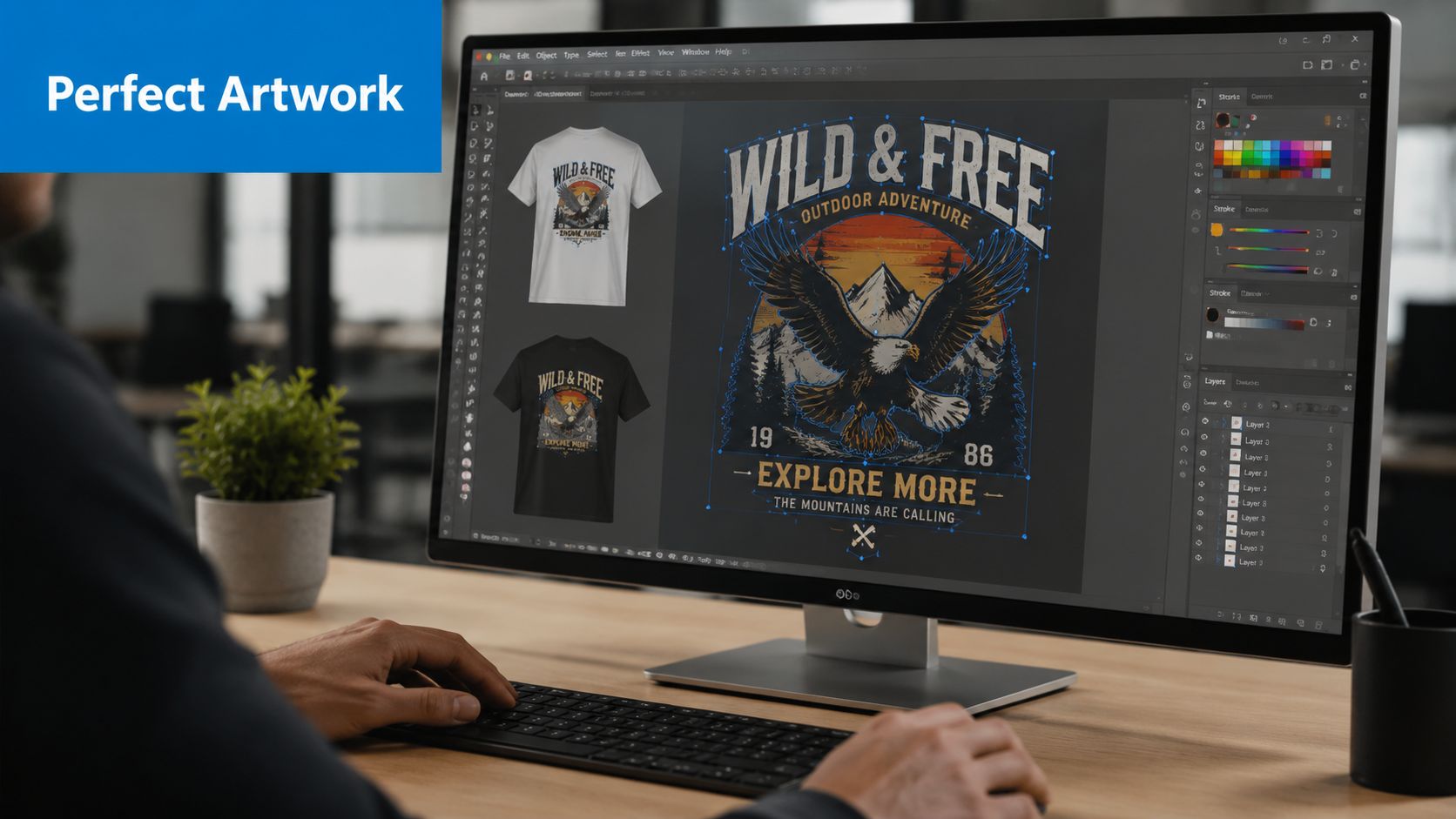
A vector file is usually an AI, EPS, or certain PDF. It's built from paths and shapes, which means it can scale cleanly for a left chest logo, a full back print, or a hat stitch file without getting fuzzy.
A raster file is usually a JPG or PNG. It's made of pixels. That's fine for web use, but once you enlarge it for print, rough edges and blurry detail can show up fast.
A simple way to think about it is this. Vector art behaves like a clean-cut rubber stamp. Raster art behaves more like a photo. One is built for sharp resizing. The other has limits.
If your current logo only exists as a low-resolution website image, expect delays while someone redraws it or simplifies it for production. If you want background reading on file setup and cleaner creative handoff, this overview of beginning graphic design covers the fundamentals in plain language.
Brand color is not a guessing game
If your company has Pantone or PMS colors, provide them. That gives production a target instead of an approximation. “Close to navy” or “kind of a bright red” is where brand inconsistency starts.
If you don't have official brand colors, send the best logo file you have and identify the colors already used in your website, signage, or packaging. Keep all brand references together. Don't send one logo from a website screenshot and another from an old email signature and expect a clean match.
For anyone working through visual setup on other branded surfaces, the same principles apply in projects like designing your own drum head. Clean files, clear color direction, and realistic detail levels make production smoother no matter the product.
Check detail before production checks it for you
Thin lines, tiny text, distressed textures, and soft shadows may look good on a laptop screen. They don't always translate well onto fabric. Embroidery has its own limits because thread has physical thickness. Screen printing gets more complex as art becomes more intricate. DTF can handle detail better in some cases, but that doesn't make every effect worth printing.
Review your art for these common trouble spots:
- Small text: If text is hard to read on screen at actual print size, it won't improve on a shirt.
- Hairline strokes: Very thin lines can break up or disappear.
- Crowded layouts: A chest logo should identify the brand quickly, not force someone to study it.
- Unnecessary color variation: Extra color transitions can complicate method selection.
Here's a useful visual explainer before final file handoff:
A simple artwork checklist
Before you send files, confirm these points:
- You have the highest-quality logo available.
- The file background is removed if the design shouldn't print as a box.
- Brand colors are identified clearly.
- You know where the logo should go on each garment.
- You've separated “must-have” design elements from decorative extras.
This is the step that prevents approval delays, art cleanup charges, and disappointing print results. Strong file prep saves time because it removes guesswork.
Finalizing Sizes Quantities and Pricing
First-time buyers often make expensive decisions without realizing it. They focus on unit price and forget that the order has to work in real life. A cheap order with the wrong size spread isn't a deal. It's leftover inventory.
Build the size mix around the people, not your guess
If you're ordering uniforms for a known team, collect actual sizes whenever possible. Don't rely on one manager estimating what everyone wears. People size differently across brands and garment cuts, and that gap gets wider with fitted polos, fashion tees, and outerwear.
If you're ordering for a mixed group and can't gather every size in advance, use your team makeup as the starting point. Office staff, warehouse crews, volunteers, and event attendees often break differently by size. The safest approach is usually to avoid overcommitting to edge sizes unless you have a real reason.
A practical working method looks like this:
- For staff uniforms: Ask each person directly and note gender-specific or unisex preference where relevant.
- For event giveaways: Lean toward the middle of the range, because those sizes usually move fastest.
- For future hiring: Hold a small buffer in common sizes rather than reordering a tiny batch later.
Quantity changes the economics
The biggest pricing mistake is ordering only for today when you already know you'll need more soon. That's especially true when your design has setup work attached to it or when matching future batches matters.
Think about the order in two layers:
| Decision | Short-term view | Better business view |
|---|---|---|
| Quantity | Order only what's immediately needed | Add a small buffer for onboarding, replacements, or late requests |
| Garment color | Pick an unusual shade because it looks interesting | Choose a core stocked color if speed and repeatability matter |
| Decoration | Build a complex logo version | Use the cleanest approved brand mark that reproduces consistently |
A growing company with around fifty employees might not need every shirt at once, but that doesn't mean a tiny opening order is wise. If the team is expanding, or if wear and tear is likely, a modest reserve usually protects you from rush reorder problems.
Order planning should answer one question first. “Will we regret not having extras before we'll regret owning them?”
If you want a grounded look at the cost variables that shape a quote, this guide on how much it costs to screen print a shirt helps clarify what tends to move pricing up or down.
Get the quote right the first time
Send complete information in one email if you can. Include garment style, color, decoration locations, artwork, estimated sizes, in-hands date, and shipping destination. Fragmented information creates fragmented quotes, and that's where surprises start.
The best quotes are accurate because the buyer gave clear inputs, not because the shop guessed well.
The Proofing Process and Placing Your Order
The proof is the last safe place to catch mistakes. Once production starts, changes get harder, slower, and sometimes impossible. Treat the proof like a contract for appearance.
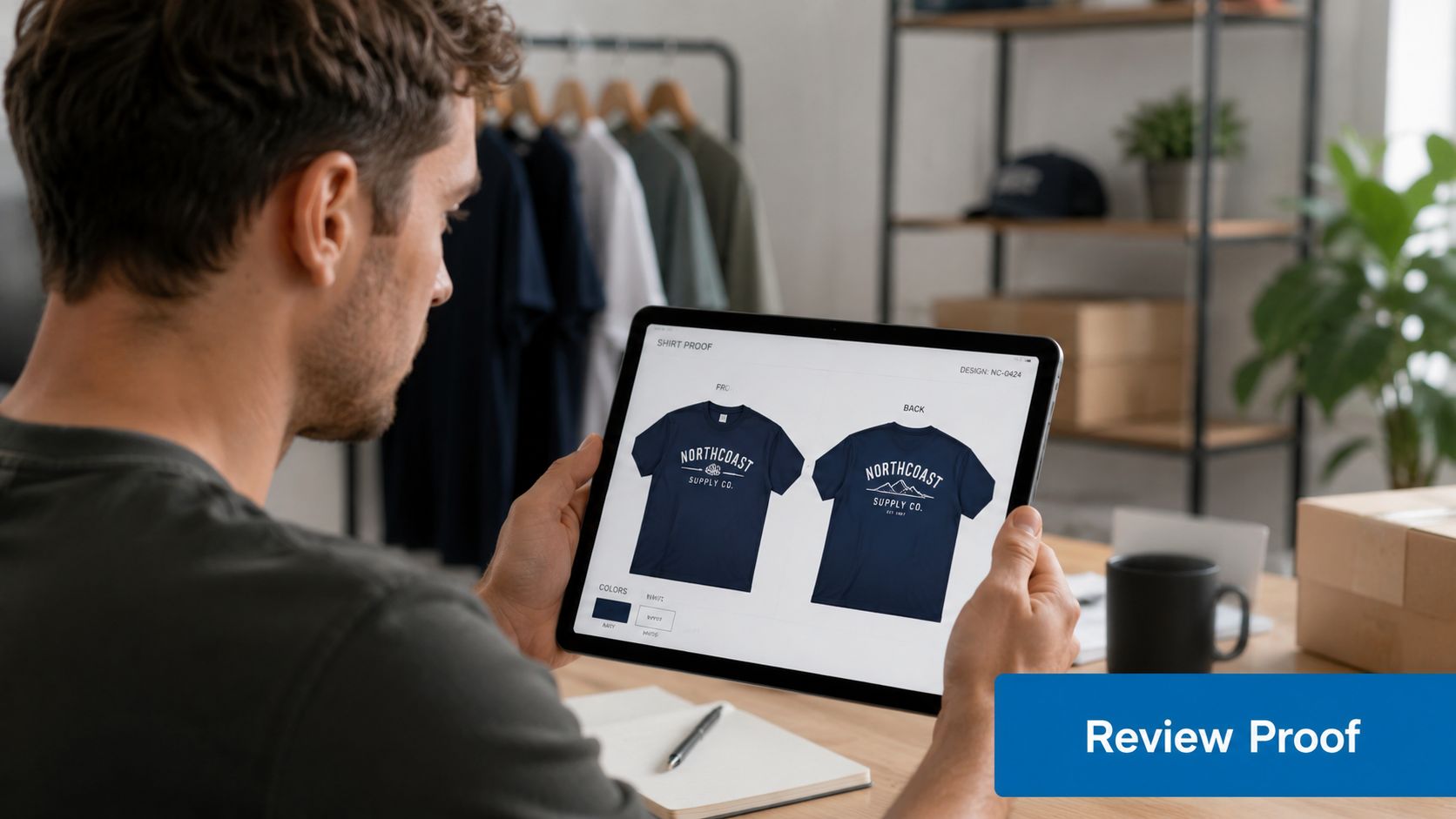
Review the proof like a buyer, not a designer
Many look at a mockup and ask, “Does this look good?” That's not enough. The better question is, “Does this match what we're buying?”
Check the proof line by line:
- Spelling and punctuation: Company names, taglines, event names, and department labels.
- Garment details: Correct style, color, and product type.
- Logo placement: Left chest, full back, sleeve, hat front, or wherever the order specifies.
- Scale: Make sure the art size feels right for the garment.
- Color callouts: Confirm that the intended brand colors are represented clearly in the proof notes.
Pay attention to what the mockup can't tell you
A digital proof is a guide, not a photograph of the finished item. Thread sheen, fabric texture, and exact ink interaction can vary by garment. That doesn't make the proof less important. It means you need to focus on the things it's meant to confirm.
If a detail matters enough to mention in email, it matters enough to verify on the proof.
Watch for common approval misses:
- A logo that's centered differently than requested.
- A small chest design that should've been enlarged.
- A back print that sits too high or too low.
- A shirt color selected from the wrong shade family.
- An old logo version that slipped into the art file.
What happens after approval
Once you approve the proof, the order typically moves into production scheduling. At that point, your job is to confirm final billing, shipping information, and timing. If there's a hard event date, make sure everyone understands it before approval, not after.
Production timelines can shift based on garment availability, art readiness, decoration method, and order complexity. Rush situations are possible in some cases, but they're easier to manage when the order details are locked early and the proof comes back with minimal revisions.
The most reliable buyers are not the ones who approve fastest. They're the ones who approve carefully.
Receiving Inspecting and Managing Your Apparel
When the boxes arrive, don't hand them out immediately. Open them, verify them, and compare the order against the approved proof. This step is quick, but it's where you catch shipping issues, packing errors, or production mismatches while they're still easy to address.
Use a simple receiving checklist
You don't need a complicated system. You need a repeatable one.
- Count the pieces: Match what was delivered against the order summary.
- Spot-check sizes: Pull items from different size groups, not just the top of one box.
- Compare decoration: Look at placement, thread or print appearance, and logo version.
- Confirm garment specs: Make sure the style and color are the ones approved.
- Separate extras: Keep reserve inventory together so it doesn't disappear into daily use.
If you ordered for multiple departments or events, label the inventory before distribution. Once cartons are split and shirts start moving around the office, it gets much harder to track what's missing and what's available.
Protect the life of the apparel
The shirt isn't finished when it's delivered. It's finished when it survives wear and cleaning without making the brand look worn out.
For printed garments, follow the care instructions provided with the order. In general, gentler washing and lower heat help preserve decorated areas. For embroidered items, avoid rough handling that can snag stitching. For uniforms, train staff to care for them correctly instead of assuming everyone already knows.
A shirt that fades, shrinks, or peels too soon becomes a branding problem, not just a laundry problem.
Make reordering easy and consistent
The best time to plan the reorder is right after the first order arrives. Save the approved proof, garment style name, color, decoration method, and size breakdown in one shared folder. Don't rely on old email chains scattered across different employees' inboxes.
For recurring programs, keep a short internal record with:
| Item to save | Why it matters |
|---|---|
| Final approved artwork | Prevents logo version drift |
| Garment style and color | Helps future orders match |
| Decoration method | Preserves the intended look |
| Placement notes | Avoids size and location changes |
| Size history | Improves future forecasts |
That record is what keeps a reorder looking like a continuation of the same brand program instead of a close imitation.
Pro Tips for Faster and Cheaper Custom Shirt Orders
Most smooth apparel orders aren't lucky. They're built on a few habits that remove friction before it starts. If you want to know how to order custom shirts without wasting time or money, these are the practices that consistently help.
Six moves that save the most trouble
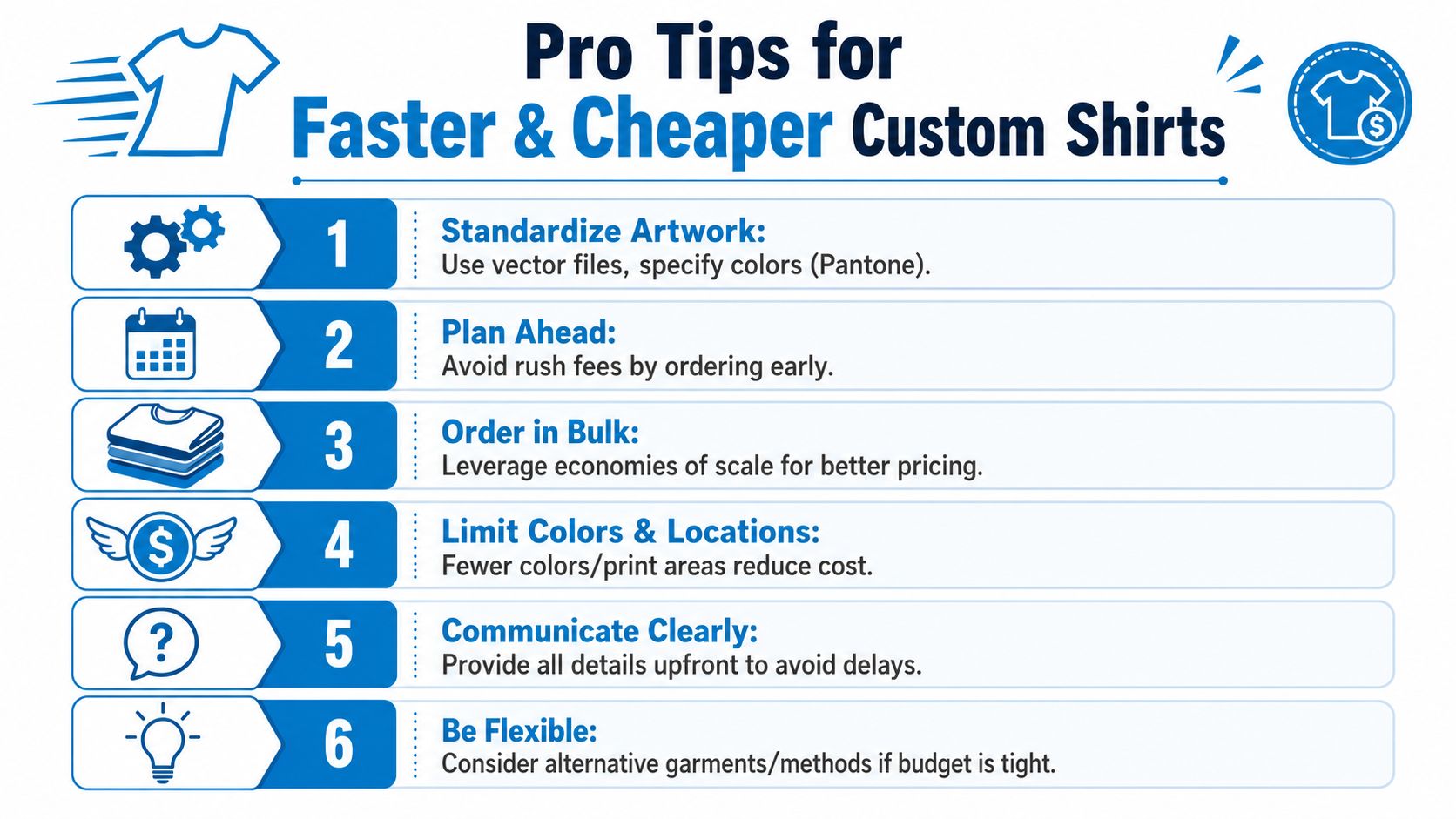
- Bring vector artwork first: Clean art shortens the back-and-forth and reduces the chance that your logo needs repair before production.
- Choose stocked garment colors: Standard colorways are usually easier to source and easier to match later.
- Simplify the design when possible: A cleaner logo application often looks more professional on apparel than an overbuilt graphic.
- Consolidate your information: Send sizes, art, placement, garment choice, and deadline together. Scattered emails slow everything down.
- Order with the next need in mind: A small reserve can be cheaper than a rushed, tiny repeat order.
- Stay open to alternatives: If one garment is unavailable or over budget, a nearby substitute can still protect the look of the program.
What experienced buyers do differently
They don't chase perfection in every variable. They decide what matters most. Sometimes that's fabric softness. Sometimes it's brand consistency across multiple orders. Sometimes it's getting a team dressed quickly in a garment that still looks respectable.
They also understand that not every branded item has the same job. A premium embroidered quarter-zip for leadership and a screen-printed event tee for a public giveaway can both be right if each supports its purpose. That same practical thinking shows up in other outreach materials too. If your team handles creator partnerships or branded submissions, a clean intake process like this influencer application form is a good reminder that clarity upfront prevents problems later.
The fastest path is usually the clearest one
If you remember only a few things, remember these:
- Pick the garment for the use case.
- Match the decoration method to the brand impression.
- Send usable artwork.
- Review the proof carefully.
- Save order details for reorders.
Those five habits do more for cost control and consistency than hunting for the lowest line-item price. Cheap apparel that creates confusion, delays, or mismatched reorders usually costs more in the end.
If you're ready to place an order and want responsive support on apparel, uniforms, merch, or event gear, Dirt Cheap Product, Inc. can help you move from artwork and garment selection to proofing and production with a straightforward process.