
You've ordered the bags, approved the logo, and scheduled delivery. Then the boxes arrive, the event date gets closer, and someone asks the question nobody answered: what will attendees keep?
An event swag bag isn't successful because it feels full. It succeeds when the bag is portable, useful, relevant to the audience, and connected to an action you can measure. Bags have historically worked as high-visibility promotional vehicles because one bag can generate an average of 5,700 impressions, while 49% of people say they've kept promotional products for longer than five years. (IAEE explains the long-tail value of swag bags)
I've packed enough event merchandise to know the difference between a useful kit and a landfill starter pack. The right question isn't “How many items can we fit?” It's “How many items will still be in use after the attendee leaves?”
Table of Contents
- Why Most Event Swag Bags End Up in the Trash
- Set the Budget and Pick the Right Bag Formula
- Match Bag Contents to Your Event Type and Audience
- Source Apparel and Promo Items Without Cutting Corners
- Assemble and Distribute Bags at the Venue
- Measure Real ROI From Your Event Swag Bag
- Swag Bag Checklist Before You Hit Print
Why Most Event Swag Bags End Up in the Trash
Most bad swag bags fail before anyone packs them. The team chooses filler items to hit an item count, adds another logo, and calls the result generous. Attendees experience something different: a heavy bag filled with objects they didn't request, don't need, and can't easily carry home.
Industry summaries report that over 70% of event swag ends up in the bin before attendees leave the venue, while the Advertising Specialty Institute's 2019 Global Ad Impressions Study reports that 23% of promotional products are thrown away, only 21% are kept and used by the original recipient, and more than half are passed to someone else. (Mercha's summary of promotional-product retention and waste data)
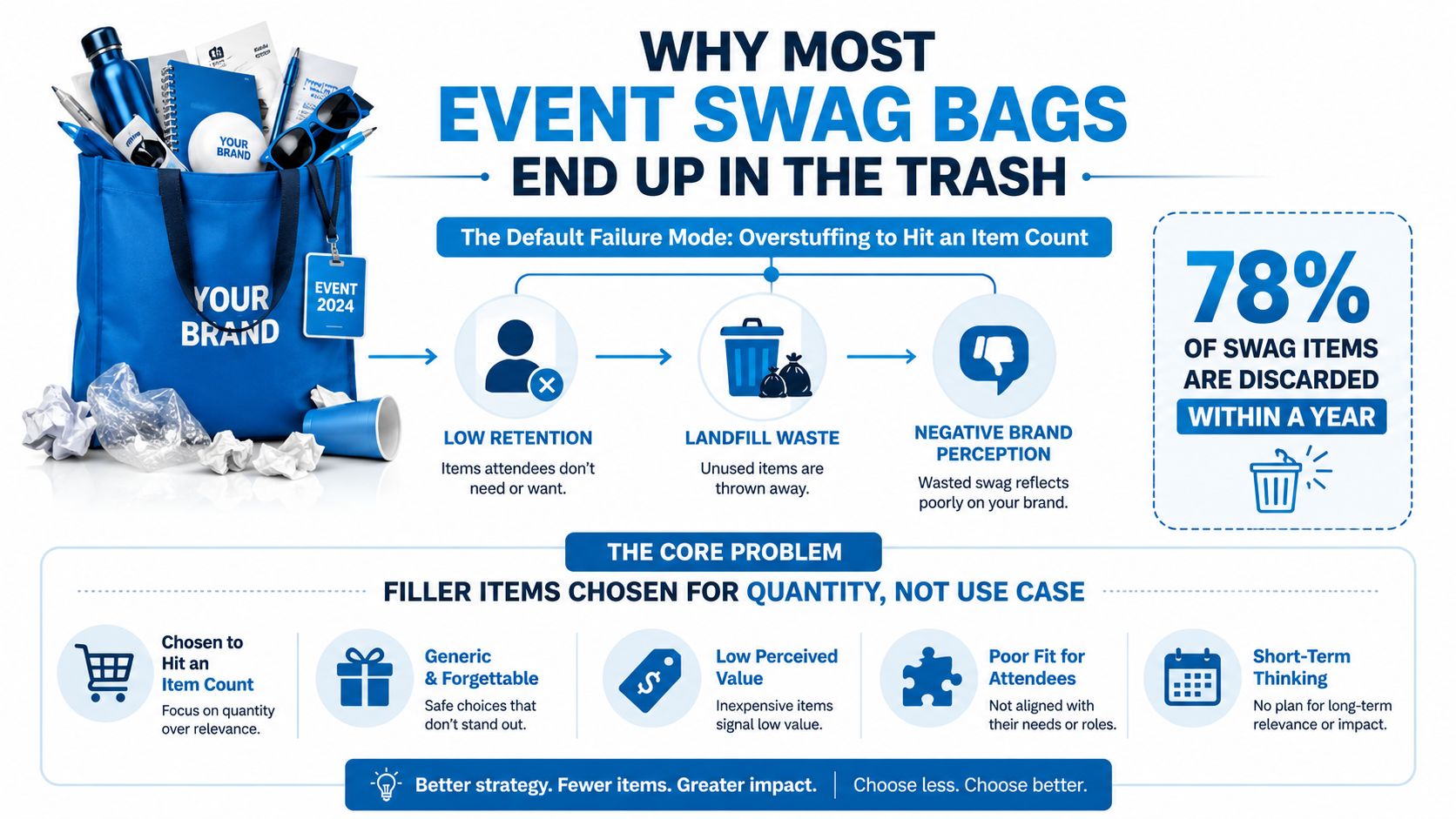
The hidden cost goes beyond discarded merchandise. Extra items increase freight weight, consume storage space, slow down registration, and make the brand experience feel careless. A logoed stress ball may be inexpensive by itself, but it can become the attendee's strongest memory of the brand if everything else feels generic.
Production rule: If an item has no clear use during the event or after it, remove it before requesting a quote.
Retention matters more than fullness. RainFocus reports that 82% of survey respondents keep swag for at least a month, but 56% donate unwanted items or give them away, which supports a practical conclusion: usefulness determines whether an item stays connected to your brand. (Mercha's discussion of RainFocus retention findings)
A more responsible event plan also treats packaging, leftovers, and distribution as waste decisions. Venue Finder's guide to practical ways to reduce event waste is useful when you're building the wider event sustainability plan, not just choosing products.
The formula I use is simple: one hero item, practical utility items, and a measurable insert. That gives the bag a reason to exist without turning it into a pile of branded objects.
Set the Budget and Pick the Right Bag Formula
Start with the total landed bag budget, then divide it by the number of confirmed recipients. Don't divide by the room capacity or an optimistic registration estimate. Your initial figure is the per-attendee ceiling, not permission to spend it all on merchandise.
Next, calculate your likely cost per retained item. A realistic planning benchmark is 25% to 40% retention, so a bag with four meaningful items should be evaluated by how many people keep and use those items, not by the number packed. This is a planning assumption, not a guaranteed outcome. Your post-event survey and follow-up data should replace it over time.
Use a three-part bag structure
- Hero item: Choose one noticeable product with lasting utility, such as apparel, drinkware, or a compact technology accessory.
- Utility items: Add two or three products attendees can use at work, while traveling, or during the event, such as a notebook, charger, or reusable tote.
- Inserts: Use one or two lightweight pieces that drive an action, such as a discount card, event-specific sticker, or QR-enabled landing-page card.
Tier the experience instead of giving everyone an expensive kit. General attendees might receive a durable drawstring bag, notebook, and reusable bottle. Speakers can receive upgraded drinkware or apparel. VIPs may warrant a premium bag with a higher-quality anchor item. The distinction should reflect audience value and use case, not arbitrary status.
| Budget Tier | Hero Item | Utility Items (2-3) | Inserts (1-2) | Bag + Production |
|---|---|---|---|---|
| $25 | Branded drinkware or practical apparel accessory | Notebook, charger, reusable tote | QR offer, event sticker | Keep construction and decoration simple |
| $50 | Better apparel, insulated drinkware, or compact tech | Notebook, power bank, travel utility | Personalized offer, event-specific card | Allocate for stronger bag construction and controlled assembly |
| $100 | Premium apparel, leather goods, or high-value tech | Two or three refined daily-use items | Tailored follow-up experience | Include higher-touch packaging and personalization |
These are working allocation models, not market prices. Every supplier quote must separate the product, decoration, packaging, freight, labor, and storage.
A logo wrap can consume the hero-item budget. Keep decoration visible but restrained. If you need a lightweight bag base for a broad attendee group, compare options such as custom drawstring bags with logos before committing to a heavier format.
Match Bag Contents to Your Event Type and Audience
A trade-show attendee, an employee at an offsite, an outdoor-event guest, and a VIP speaker don't have the same day. They shouldn't receive the same bag.
At a trade show, the bag has to work immediately. Attendees are walking, collecting materials, charging phones, and deciding what can fit in their luggage. A lanyard, durable notepad, slim charger, or reusable water bottle earns its space because it solves a problem during the show. A thick catalog, oversized novelty item, or fragile glass bottle usually fails the carry-home test.
Company offsites need a different tone. Private-label apparel, branded socks, a compact blanket, or carefully chosen snacks can reinforce culture because employees use them in a shared setting and afterward. The item should feel like part of the experience, not a sales handout with an employee logo added.
Compare the use case before buying
| Event Type | Best-Fit Hero Item | Recommended Utility Items | Avoid |
|---|---|---|---|
| Trade show | Lightweight branded tote, polo, or reusable bottle | Notepad, charger, lanyard | Paper-heavy inserts, bulky objects, fragile goods |
| Company offsite | Branded sweatshirt, jacket, or comfort item | Socks, snacks, notebook, travel accessory | Generic desk clutter and products unrelated to team life |
| Outdoor event | Compact tote, weather-ready outer layer, or reusable bottle | Sunscreen, poncho, travel pouch | Unprotected paper materials, glass, items that fail in rain |
| VIP experience | Premium apparel, leather goods, or refined tech accessory | High-quality notebook, drinkware, personalized materials | Cheap fillers that undermine the premium setting |
Outdoor events require weather judgment. Sunscreen, ponchos, compact totes, and reusable containers are more useful than paper inserts that curl in rain. Check packaging, allergies, and venue rules before adding food or liquids.
VIP upgrades should feel selective, not merely more expensive. Leather goods, noise-canceling earbuds, or signed materials can fit when they reflect the relationship and the event purpose. They don't belong in a general attendee bag if they create a visible divide that the event hasn't planned for.
Ask one final question for every item: Will this person use it during the event, on the journey home, or in their normal routine afterward? If the answer is no, the product needs a stronger reason to stay.
Source Apparel and Promo Items Without Cutting Corners
Start sourcing with a worksheet, not a logo file. Record the product specification, available colors, decoration area, lead time, case quantity, carton size, and unit cost before you ask vendors for final pricing. Compare at least two wholesale suppliers and one custom decorator so you can separate product quality from decoration capability.
The quote must show the full landed cost. Base goods are only one line. Add decoration, setup, packaging, freight, duties, storage, assembly, and replacement-stock charges. A low unit price can become expensive after minimums, setup fees, or expedited shipping enter the order.
Apparel needs a physical inspection
For shirts, polos, sweaters, jackets, and hats, confirm fabric weight, size range, cut, expected shrinkage, and decoration compatibility. Direct-to-film, screen printing, embroidery, sublimation, and custom patches don't produce the same result on every material.
Order samples before approving production. Inspect seams, closures, color, print alignment, stitching detail, odor, and wash performance. Compare the final production proof against the approved logo, including placement and color. A digital proof can't reveal a rough seam or an uncomfortable cut.
Approval rule: Never approve an apparel run from a screen image alone. Put the sample on a person, wash it, and inspect it under event lighting.
Promotional products require their own checks. Confirm food-safe materials for drinkware, battery certifications where relevant, accurate product claims, and compliance with restricted-substance or privacy rules. Ask vendors to state production tolerances and delivery dates in writing. Also confirm who owns tooling, how damaged units are credited, and what happens to personal data used for personalization.
| Cost Field | What to Record | Approval Check |
|---|---|---|
| Base product | Style, material, color, size, case quantity | Does it meet the use case and quality requirement? |
| Decoration | Method, imprint area, setup, proof details | Is the logo readable and correctly positioned? |
| Packaging | Individual wrapping, labels, carton configuration | Does packaging protect the item without unnecessary waste? |
| Freight and duties | Shipping method, destination, customs charges | Can delivery meet the venue receiving schedule? |
| Assembly and storage | Packing labor, storage period, replacement stock | Are labor and reserve costs included in the budget? |
| Damage and tooling | Credit terms, mold or screen ownership | Are responsibilities documented before production? |
Use a landed-cost worksheet for every quote. For packing identification, printed sticker rolls for packing labels can help staff distinguish attendee groups and carton contents without adding bulky paper materials.
For a deeper purchasing framework, use this promotional product sourcing guide for bulk buyers. The goal is not the cheapest product. It's a predictable product that arrives on time, matches the approved proof, and survives the event.
Assemble and Distribute Bags at the Venue
Packing at the venue should look like a controlled assembly line, not a volunteer free-for-all. Choose a clean room near the entrance but away from public traffic. Keep food, liquids, batteries, adhesives, and personalized materials organized according to venue requirements.
Set up separate stations for the bag base, hero item, practical items, inserts, personalization, quality control, and sealing. Place a one-page packing standard at every station with the exact contents and placement order. One person must own version control, otherwise a late sponsor change can produce several incompatible bag versions.
Use numbered cartons for general attendees, speakers, sponsors, and VIPs. Keep a replacement reserve in a locked area, with access limited to the packing lead. Your inventory record should show what arrived, what was packed, what was handed out, and what remained.
Build checkpoints into the line
A quality-control station should inspect:
- Correct recipient tier: Confirm the bag matches the attendee, speaker, sponsor, or VIP category.
- Product condition: Check for damaged goods, stains, broken closures, and poor decoration.
- Personalization: Verify names, sizes, and any custom materials.
- Contents: Confirm inserts and event-specific items are present.
- Presentation: Check visible branding, placement, and closure.
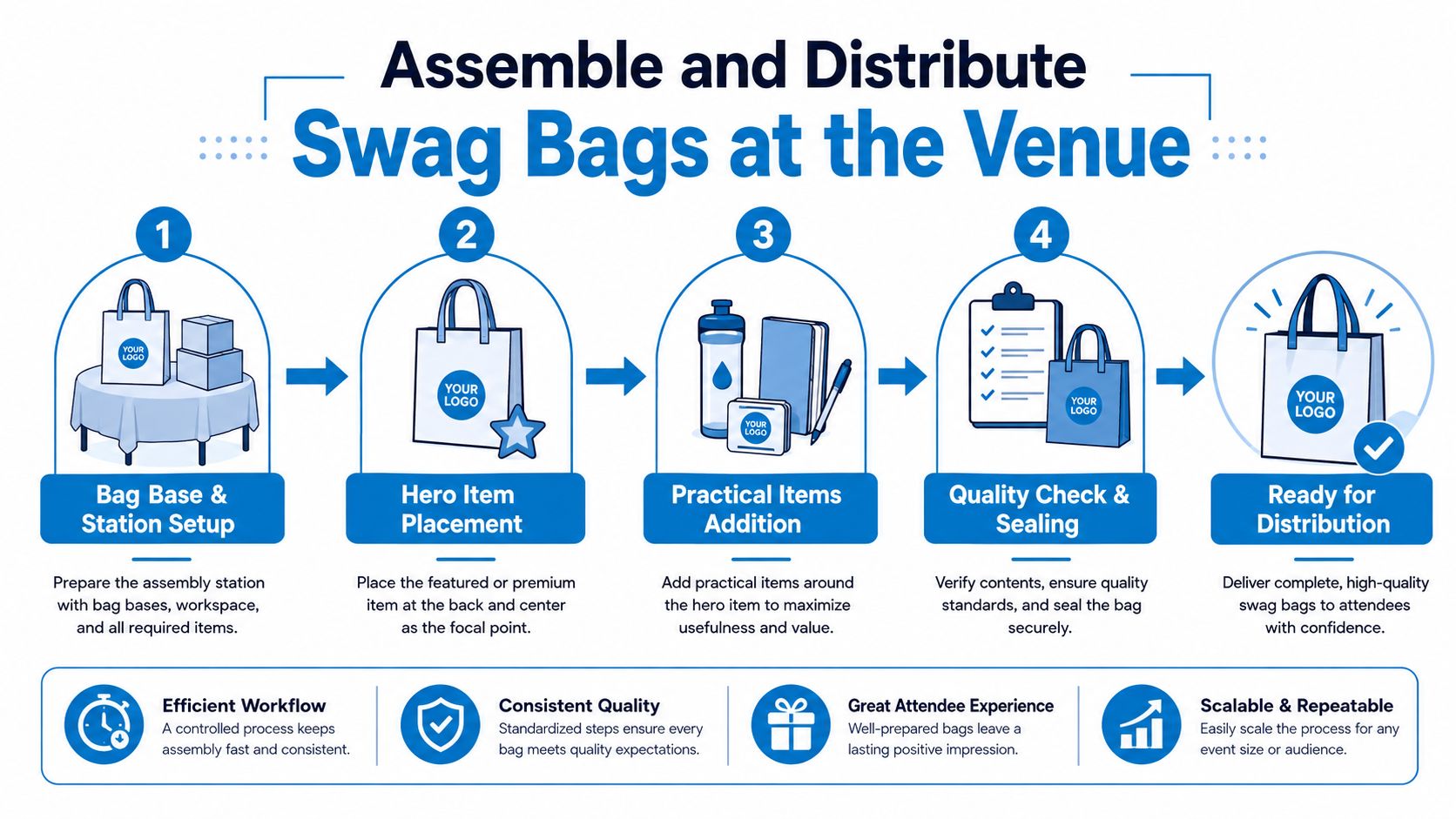
Before cartons leave the room, use a scan checkpoint or double count. Photograph the final packed kit and a sample from each carton. Log seal numbers, handoff counts, and leftovers so the distribution record can support the ROI review.
Don't automatically place bags on seats. Define the handoff point, eligibility rules, and staff script. Registration, session exits, and timed pickup windows can reduce congestion and prevent ineligible distribution. Keep an issue bag at each station with replacements, tape, labels, and inventory sheets.
Check venue restrictions on adhesives, food allergens, batteries, liquids, open flames, and oversized products before the truck arrives. At close, separate viable extras for donation or reuse. A usable leftover is inventory, not rubbish.
Measure Real ROI From Your Event Swag Bag
Treat every event swag bag as a media unit with a cost, retention period, and follow-up opportunity. The bag has a physical audience, a delivery moment, a set of brand exposures, and a measurable next action. That makes it more useful to evaluate than a generic line item called “giveaways.”
Record the fully landed spend before distribution. Include products, decoration, bag, assembly, venue labor, storage, freight, and a proportional share of event overhead. Divide that total by the number of bags distributed, not the number ordered. The result is your true cost per recipient.
Track action without making the bag feel like an ad
Use one clear attribution mechanism:
- Unique QR code: Send each audience tier to a distinct landing page.
- Personalized landing page: Connect the page to the event or recipient group.
- Short survey: Ask what the attendee used, kept, donated, or discarded.
- Event-specific offer: Use a code that identifies the event without cluttering the product.
Track scans, landing-page visits, qualified leads, meetings booked, redemptions, social mentions, brand recall, and reported unused items. Gather permission before collecting personal information. Reconcile the recipient list so people who didn't receive a bag aren't mistakenly counted in the campaign.
A 30-day review should assess early attention and usage. A 90-day review should examine retention, qualified follow-up, and conversion. The industry methodology also recommends tracking redemption or follow-on purchase within 30 to 90 days and comparing cost per impression against digital channels. (Promotional-product ROI and measurement benchmarks)
| Metric | Calculation or Evidence | Review Window |
|---|---|---|
| True cost per bag | Fully landed spend divided by bags distributed | Before distribution |
| Retention | Surveyed kept and used items compared with recipients | 30 and 90 days |
| Engagement | QR scans, landing visits, survey responses | First 30 days |
| Commercial response | Leads, meetings, redemptions, follow-on purchases | 30 to 90 days |
| Brand response | Recall and reported usage | 30 days, then longer-term review |
| Waste signal | Reported unused, donated, or discarded items | 30 and 90 days |
A $28 bag that creates six meaningful conversations may outperform a $9 bag that produces only scans. That comparison matters because attention isn't the same as commercial value.
For broader event measurement context, this corporate event ROI guide can help connect swag performance to the rest of the event scorecard. For trade-show planning, pair the measurement process with a focused guide to the best giveaways at trade shows, then test one change at a time.
Swag Bag Checklist Before You Hit Print
Before procurement, filter every item through three tests: usefulness, portability, and brand fit. An item can be inexpensive and attractive yet still fail because attendees can't carry it, don't need it, or associate it with waste.
Start with the bag itself. Check capacity, closure, handle comfort, seam strength, decoration clarity, and whether the finished size works for the venue and the journey home. A bag that tears or becomes awkward after two items damages the entire kit.
Review the contents
- Usefulness: Will the attendee reach for it after the event?
- Portability: Can they carry it through registration, transport, and travel?
- Brand fit: Does it reflect the organization's values and audience?
- Compliance: Are allergen notes, battery requirements, material claims, and venue rules documented?
- Sustainability: Can the product be reused, recycled, donated, or avoided?
- Inventory: Do counts cover each attendee tier, staff needs, and a 10% overage buffer?
Flag heavy glass bottles, perishable snacks without allergen labels, single-use plastic, products requiring assembly, low-contrast logos, and anything likely to trigger TSA or venue restrictions. Cheap plastic giveaways are increasingly being rejected in favor of useful, reusable goods, and sustainability is becoming an expectation rather than a decorative claim. (2026 event swag trend coverage on reusable and relevant merchandise)
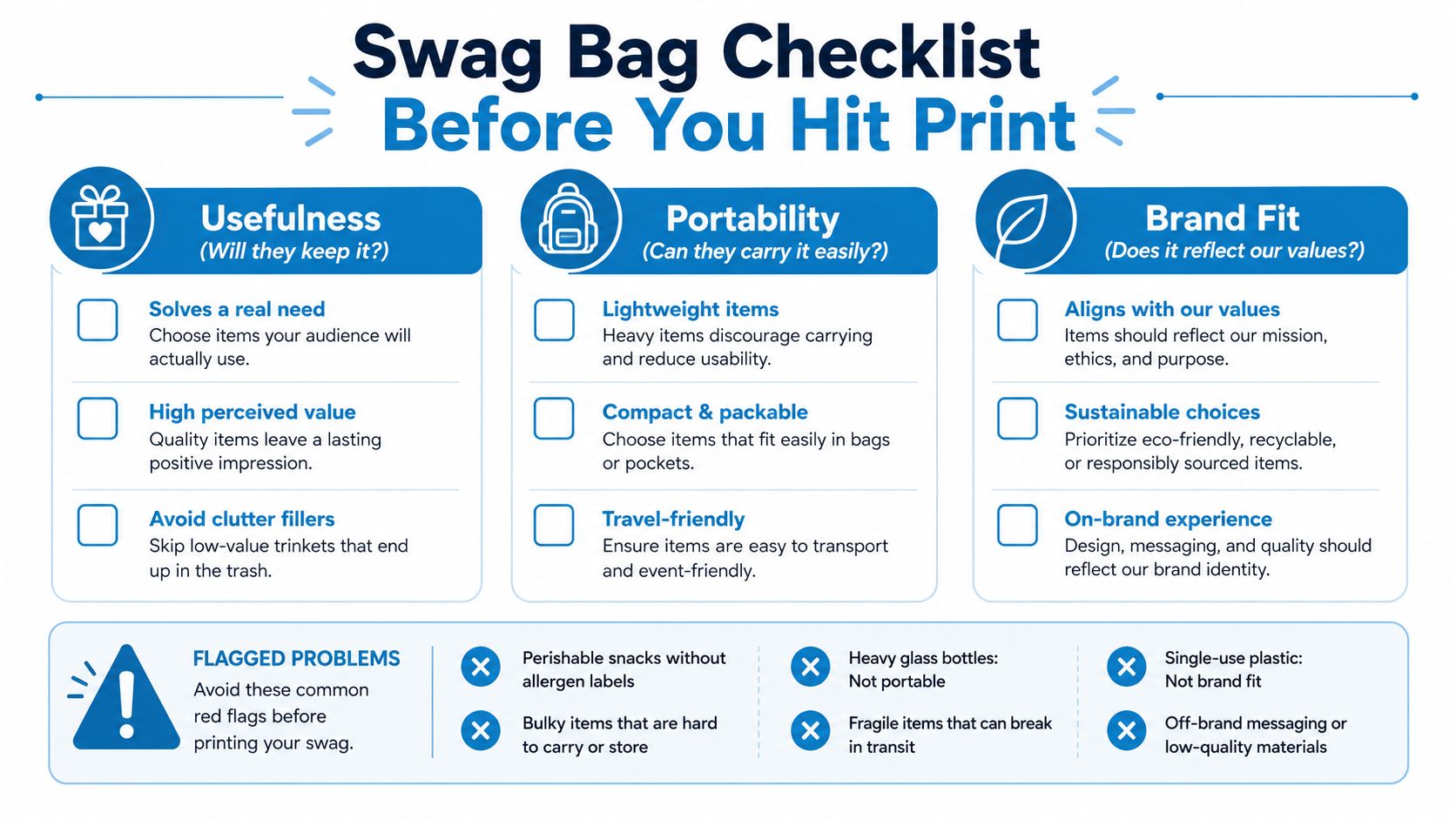
Put the checklist into the purchase-order approval process. Add sign-off rows for budget, legal, brand, allergens, sustainability claims, inventory, and final artwork. Don't let a supplier ship until each row has an owner and approval date.
We don't create business cards or flyers. An event swag bag should carry useful products and one measurable action, not become another stack of printed material that attendees must sort through.
Check distribution rules before you move any promotional material outside the controlled event space. Blackpool Council says free printed promotional material requires council consent, while Torbay requires a leaflet distribution application at least 14 days before the planned start date and lists a £149 fee for single-event consent. (Blackpool Council's leaflet distribution requirements) North Sydney Council restricts distribution to permitted times and areas, prohibits roaming, requires pedestrian access, bans amplification, and requires distributors to remove litter. (North Sydney Council's print distribution rules)
Some organizers prohibit promotional materials outside exhibitor stands or approved spaces. BuildNZ, for example, restricts unauthorized canvassing and promotional displays, while Gen Con's discussed rules limit flyers to tightly defined locations and prohibit leaving materials on event tables after scheduled events unless the space was rented directly. (BuildNZ registration terms, Gen Con discussion of distribution restrictions)
Make the final decision simple. If the item isn't useful, portable, compliant, and recognizably yours, leave it out.
Dirt Cheap Product, Inc. offers custom apparel and promotional items for event giveaways, including screen printing, embroidery, direct-to-film, sublimation, custom patches, bags, hats, and more. Upload your logo for proofing and production support, then visit Dirt Cheap Product, Inc. to plan a cohesive event swag bag without paying for filler.