Your team's cap order often starts with a simple goal: put the logo on something people will actually wear. Then the outdoor event arrives. The cotton caps feel damp, the front panels lose their shape, and the decoration looks less polished than it did at approval. By the end of the day, the giveaway has become a uniform problem.
Dri-FIT caps can solve part of that problem, but only when you buy them as a complete uniform system. Fabric, crown shape, ventilation, brim, closure, decoration, care, and reorder consistency all affect whether the cap remains comfortable and presentable. This guide gives you the decisions to make before approving a branded run.
Table of Contents
- Why Your Team Needs More Than a Cotton Cap
- How Moisture-Wicking Fabric Actually Works
- Choosing the Right Cap Construction
- Matching Cap Styles to Staff, Events, and Retail
- Decoration and Branding Options That Last
- Sun Protection and UPF Claims Without the Hype
- Ordering, Logistics, and Pricing Basics
- Care, Reorders, and a Buyer FAQ
Why Your Team Needs More Than a Cotton Cap
An event coordinator rarely notices a cap's limitations at the product-catalog stage. The sample looks clean on a desk. The color matches the brand. The logo sits neatly on the front. Problems appear later, when staff spend an afternoon outside, volunteers move between stations, or customers wear the cap repeatedly after the event.
Cotton can feel familiar, but a damp sweatband changes the experience quickly. A cap that absorbs moisture without moving it across the fabric may feel heavy and clammy. Fading, distortion, and poor recovery can also make a promotional item look disposable, even when the original artwork and decoration were strong.
The buyer's real target is a moisture-managing cap that supports repeated wear and reliable branding. That means checking more than the logo area.
Buyer's rule: Approve the cap your team will wear for hours, not the cap that looks best for a few minutes on a sample table.
A useful way to judge the order is to ask four questions:
- Comfort: Will the sweatband and crown remain tolerable during outdoor work or activity?
- Brand perception: Does the construction make the logo look intentional and professional?
- Operational fit: Can staff share the sizing system without creating unnecessary inventory?
- Reorder reliability: Can you reproduce the color, decoration, and overall profile later?
Caps have become part of a broad headwear economy. Market research estimates that the global headwear market was approximately $37.0 billion in 2025 and projects $62.8 billion by 2033, with caps identified as the fastest-growing product category at a projected 7.4% CAGR, according to Grand View Research's headwear market analysis. Those figures place performance caps in a wider business context. They're used for uniforms, sporting events, retail merchandise, nonprofit campaigns, and outdoor occupations.
If you're documenting a race, tournament, or club event, a sports event photo gallery app can help collect participant images while the caps create a consistent visual identity. The cap still needs to perform, but it also becomes part of the event experience and the photographs people share afterward.
How Moisture-Wicking Fabric Actually Works
Moisture-wicking fabric works through capillary action. Think of the fibers as a network of extremely small channels. Sweat reaches the skin-facing side, the fibers pull liquid into those channels, and the moisture spreads across a wider surface where it can evaporate more readily.
That process matters most in two areas of a cap:
- The sweatband, where moisture first accumulates around the forehead.
- The crown, where fabric coverage and airflow determine how quickly dampness can disperse.
The mechanism is similar to how a paper towel draws water away from a spill, but performance textiles use engineered synthetic fibers rather than absorbent paper. Contemporary textile descriptions explain that synthetic fibers distribute liquid through microscopic pathways, increasing the area available for evaporation and helping remove heat as moisture leaves the fabric.
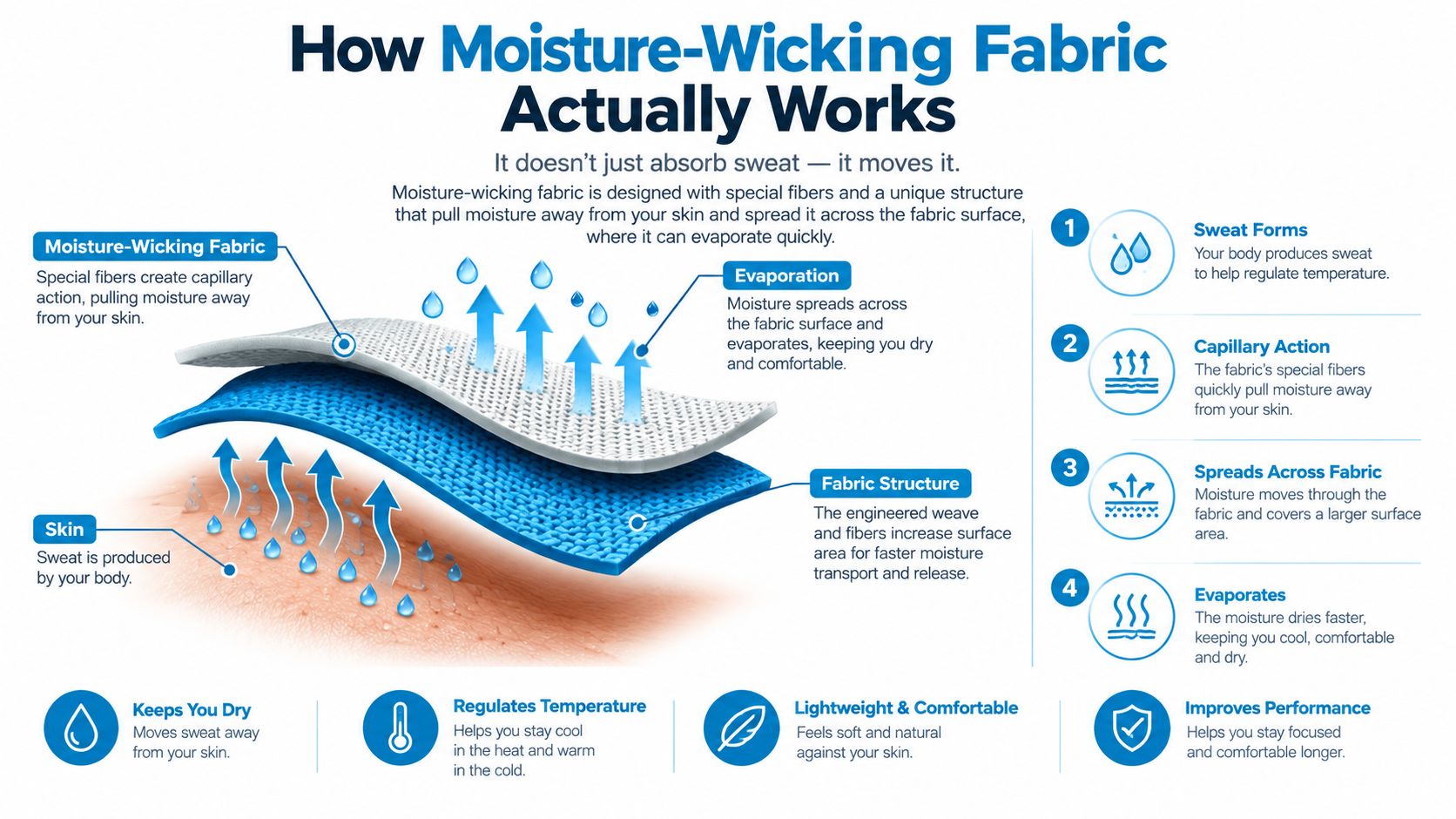
Nike launched its proprietary Dri-FIT technology in 1991. The system uses polyester microfiber fabric designed to move perspiration away from the skin, spread moisture across the fabric surface, and support faster evaporation, as described in this overview of Dri-FIT technology and moisture management. The name matters because Dri-FIT is a Nike brand name, not a generic term for every polyester cap.
For comparison shopping, use moisture-wicking as the category term. A supplier may describe a non-Nike cap as moisture-wicking, but that label still needs a meaningful specification behind it.
What to request on the spec sheet
Don't approve a cap just because the product page says “polyester.” Ask whether the fabric uses microdenier polyester, which contains finer fibers and more capillary channels. Textile research reports that microdenier polyester generally achieves better water absorption, wicking height, and evaporation behavior than spun polyester, polyester-cotton blends, and cotton fabrics, as detailed in this study of moisture-management performance in polyester textiles.
Request these details before placing a bulk order:
- Fiber type and fabric composition.
- Fabric weight.
- Moisture-management treatment.
- Available test data.
- Crown and sweatband construction.
A moisture-management finish can improve vertical wicking, drying behavior, air permeability, and water-vapor permeability. That doesn't mean every treated cap will feel identical in hot, humid conditions. It means you have a stronger basis for comparing products than the phrase “dri fit” alone.
Choosing the Right Cap Construction
The cap's silhouette determines how it behaves on a person's head and how well it carries your decoration. Start with the crown, then choose the brim and closure around the actual work or event environment.
A structured crown includes internal support that helps the front panel hold its shape. It's the safer choice for a clean embroidered logo, especially when the cap represents a company uniform or retail product. An unstructured crown feels softer and more relaxed, but its front panel may fold or conform more easily during storage and wear.
The brim creates another clear choice. A curved brim gives a familiar athletic appearance and suits staff uniforms, golf-related events, and outdoor programs. A flat brim creates a more fashion-led profile and can work for retail merchandise, but it may feel less appropriate for a conservative workplace.
Closure and ventilation choices
A snapback closure provides adjustability and a recognizable casual look. A stretch closure can reduce sizing complications when an event includes many participants, since fewer individual size decisions are required. A fitted closure gives the cleanest profile, but it creates a more demanding inventory task because each size must be planned and reordered.
The back construction affects comfort:
- Solid back panels provide a consistent branded surface and a more uniform appearance.
- Mesh panels improve ventilation for outdoor crews, sports staff, and summer events.
- Hybrid designs balance decoration space with airflow.
A five-panel cap offers a broad, uninterrupted front area that suits modern promotional and retail styling. A six-panel cap uses more conventional panel shaping and remains a strong choice for embroidered uniforms. For a deeper look at six-panel construction, review this six-panel hat buying reference.
Approve weight with the structure
A thicker cap may hold its shape and resist handling better, but it can feel warmer and heavier under direct sun. A lightweight cap may ventilate better, yet feel less substantial or provide less support for dense decoration.
Practical rule: Specify fabric weight alongside crown, closure, and panel count. Construction alone doesn't tell you how the cap will feel during a long shift.
Keep the decision tied to use. Outdoor crews usually need airflow and an adjustable fit. Retail merchandise may justify a stronger silhouette and more distinctive brim. A staff uniform benefits from repeatable sizing, restrained branding, and a shape that still looks organized after storage and washing.
Matching Cap Styles to Staff, Events, and Retail
The best cap is the one that matches the buyer's operating conditions. Staff uniforms need consistency across shifts. Outdoor events need comfort and flexibility. Retail merchandise needs shelf appeal. Giveaways need broad usability and controlled decoration costs.
Use this matrix to narrow the order before looking at colors and logo treatments.
| Scenario | Best Crown | Brim & Closure | Decoration |
|---|---|---|---|
| Staff uniforms | Structured six-panel or stable hybrid crown | Curved brim, adjustable or stretch closure | Moderate front embroidery, restrained side branding |
| Outdoor events and races | Lightweight crown with breathable panels | Curved brim, adjustable closure | Lightweight front mark, minimal decoration near ventilation |
| Retail merchandise | Structured or fashion-led five-panel crown | Flat or curved brim, style-specific closure | High-visibility front treatment, coordinated side or back detail |
| Giveaways and volunteer kits | Unstructured or lightweight structured crown | Curved brim, flexible adjustable closure | Simple front logo, efficient decoration sized to the panel |
Staff uniforms
Choose comfort and repeatability over novelty. A structured six-panel cap with a curved brim usually gives employees a recognizable uniform profile while leaving enough front support for embroidery. If several people share inventory, an adjustable or stretch closure is easier to manage than a fully fitted program.
Outdoor events and races
Prioritize airflow, low weight, and a sweatband that won't become distracting during movement. Mesh can help, but don't assume every mesh panel provides meaningful sun coverage. The finished cap still needs to be assessed by panel, color, and documented protection if sun performance is part of the product claim.
Retail merchandise
Retail buyers can take more design risk. A five-panel cap, flat brim, unusual colorway, or patch can create a stronger shelf identity than a standard uniform cap. The trade-off is that a fashion profile may have a narrower audience, so test the style with the intended customer rather than selecting it only because it looks distinctive in a catalog.
Giveaways and volunteer kits
Make the cap easy to wear and easy to decorate. A curved brim and adjustable closure are practical choices for mixed groups. Keep the logo readable without covering ventilation zones or making the cap feel stiff.
A short product video can help your team compare shape, brim profile, and closure movement before approval.
The buyer should pick a row first, then refine the cap. Starting with an attractive blank and forcing it into a uniform role usually creates avoidable compromises.
Decoration and Branding Options That Last
Decoration should follow the cap's fabric behavior, not the other way around. The front panel may support embroidery, while a perforated side panel should remain open for airflow. A back strap may accept a small mark, but it's a poor location for a large, dense graphic.
Embroidery is the default for structured caps because thread creates a durable, dimensional finish. It works well on front panels and can add a small side or back detail. Dense stitching, however, adds weight and stiffness. On a lightweight performance cap, oversized embroidery can reduce local air exchange and make the panel less comfortable.
Direct-to-film, or DTF, transfers suit artwork with multiple colors, gradients, or fine visual detail. They can work on selected cap zones, but heat and pressure matter. Don't place a transfer over perforations, ventilation openings, or a flexible sweatband area without checking the construction first.
Woven or embroidered patches create a distinct retail or lifestyle look. A patch can be a strong option for a five-panel cap or a structured front, but its base and attachment method add material. Confirm that the patch won't create an uncomfortable rigid spot where the wearer's forehead meets the cap.

Match the artwork to the panel
The artwork file is not the decoration size. A logo that looks balanced on a shirt may overwhelm a cap front. Use these placement rules:
- Front panel: Best for the primary mark and strongest brand recognition.
- Side panel: Suitable for a small secondary symbol, provided the panel remains breathable.
- Back strap or closure area: Useful for a short wordmark or subtle identifier.
- Sweatband and perforations: Keep them clear unless the supplier confirms compatibility.
Decoration should be sized to the cap panel, not scaled from a larger garment application.
Before production, upload the logo and request a proof showing placement, dimensions, thread or ink colors, and the selected decoration method. Revise the proof until the logo looks balanced on the actual cap profile. If your brand uses sewn-in labels or garment identification, this school label buying advice offers useful context on label choices and presentation.
For embroidery-specific planning, compare the available custom logo embroidery options with the cap's crown structure and intended wear. The key question isn't whether a method is popular. It's whether the method preserves comfort, airflow, readability, and wash performance on this particular cap.
Sun Protection and UPF Claims Without the Hype
Moisture-wicking and ultraviolet protection are separate specifications. A cap can move sweat effectively without having a documented UPF rating. Don't let a supplier use “Dri-FIT” or “moisture-wicking” as a substitute for evidence about sun protection.
A standard peaked baseball cap mainly protects the forehead and nose while leaving the cheeks, ears, and neck exposed. Public-health guidance identifies a brim of at least 7.5 cm as necessary for more reasonable facial coverage, according to this evidence brief on hats and heat protection.
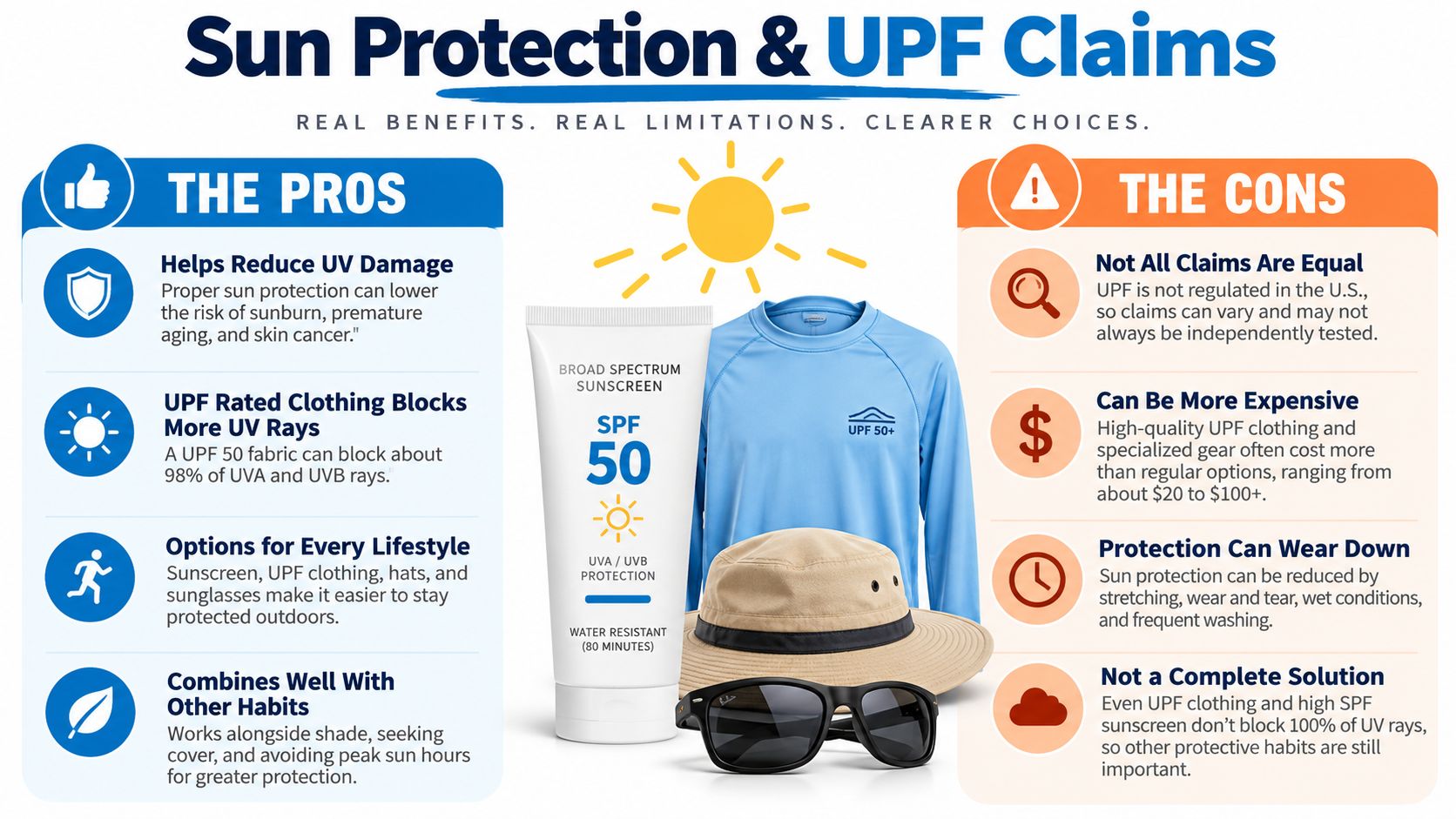
There's also a ventilation trade-off. The same evidence brief reports that baseball caps can reduce radiant heat by about 80% while impeding forced convective heat loss by up to 60%. In practical terms, a cap may shade the face while reducing airflow over the head. Outdoor staff may need a design that balances brim coverage, breathable panels, and the duration of the shift.
What a defensible UPF specification includes
UPF depends on fabric construction, color, coverage, and testing. Polyester and tightly constructed fabrics generally attenuate ultraviolet radiation more effectively than lightweight, loosely constructed materials. Darker colors often provide higher UPF values than light colors, but appearance alone isn't enough to support a product claim.
Ask for:
- A documented UPF rating for the finished cap.
- The testing framework, such as EN 13758 or AATCC TM183.
- Separate identification of solid panels and mesh zones.
- Information about color, stretching, wetting, and laundering conditions.
- The minimum coverage the cap is designed to provide.
International textile classifications commonly treat UPF above 40 as excellent protection, while values below 15 are considered insufficient, according to this technical discussion of UPF performance in textiles. Don't turn those classifications into a guarantee for a cap unless the actual finished product has been evaluated.
The FTC requires advertising to be truthful, non-deceptive, and supported by evidence across media, including online publications and outdoor advertising, as explained in its small-business advertising guidance. The FTC also says advertisers should possess substantiation before distributing objective claims, as stated in its advertising substantiation policy. Write “documented UPF rating” only when documentation exists. Write “moisture-wicking polyester” only when the product specification supports it.
If you publish product content, avoid adding competitor website links only to create a web connection. Google describes links created primarily to manipulate rankings as link spam and identifies paid links, excessive exchanges, and automated link building among its examples in its Search spam policies. A useful product page needs accurate specifications, not irrelevant outbound links.
Ordering, Logistics, and Pricing Basics
A successful cap order starts with operational questions, not the logo file. Ask the sales representative what's available now, what must be custom-made, and what can be reproduced later.
Questions to ask before approval
- Minimum quantity: What is the minimum order for this blank style, decoration method, and color?
- Inventory: Are the blanks currently in stock, or will the supplier source them after approval?
- Lead time: How long does production take from proof approval to shipment?
- Sample: Can you inspect one decorated sample before committing to the full run?
- Color matching: Can the supplier record the cap color and decoration references for a future reorder?
- Shipping: Is freight included, and is local pickup available?
- Sizing: Will the selected closure work across the full staff or event group?
Wholesale blank pricing on popular styles helps make budget-conscious uniform programs possible, but the lowest unit price isn't always the best value. A cheap cap that can't be reordered in the same color creates a fragmented uniform. A slightly better-specified cap may protect the brand across seasons.
Save the approved proof, cap style, color, decoration method, and supplier reference in one internal file. Reorders should begin from that record, not from memory or a screenshot of the original product page.
Care, Reorders, and a Buyer FAQ
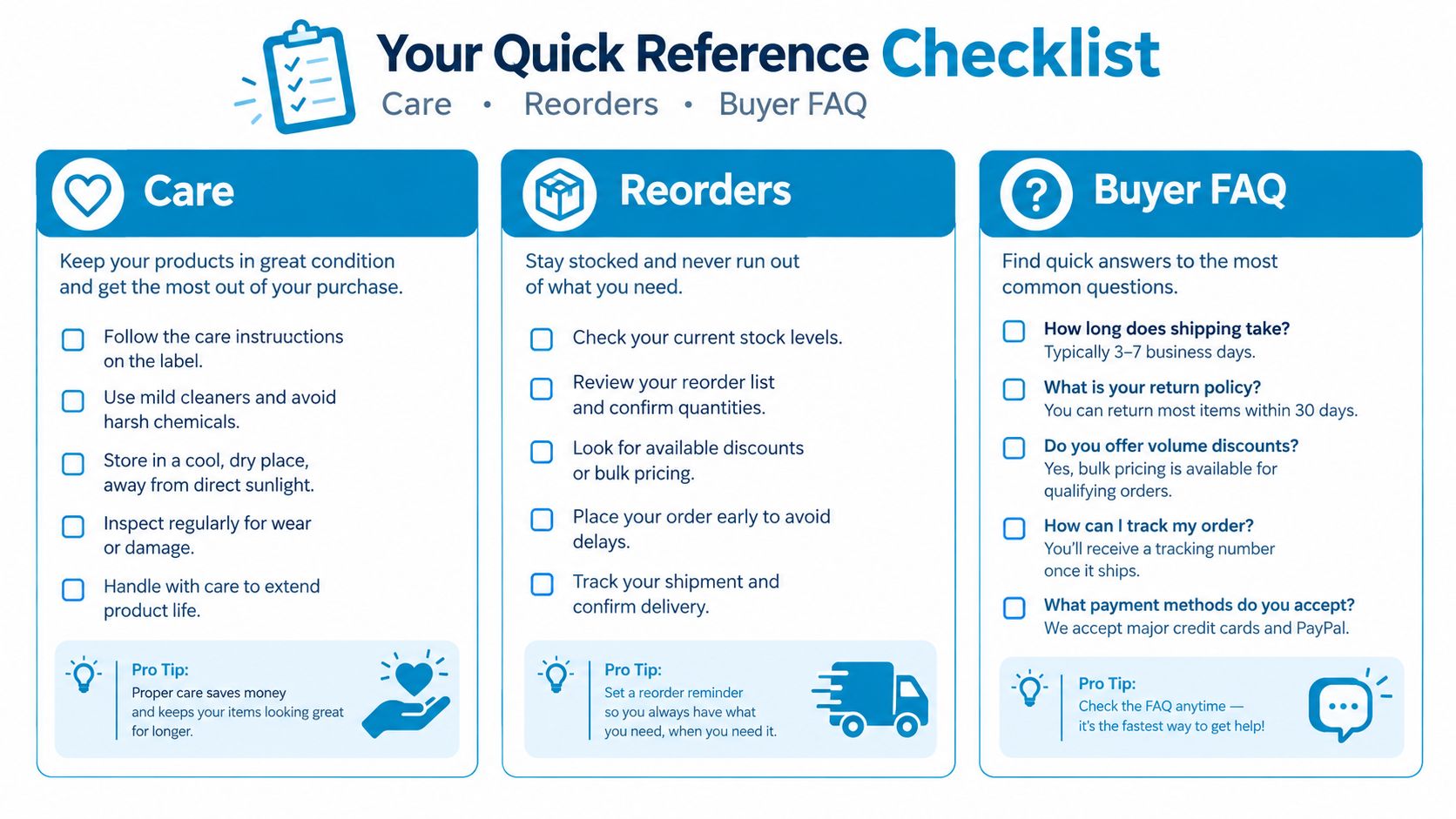
Give staff a simple care card with every uniform order. Common care specifications for performance caps recommend cold hand washing, avoiding wringing, bleach, ironing, and dry cleaning, followed by line drying, as shown in these Dri-FIT cap care specifications.
Heat, abrasion, harsh detergents, and incorrect drying can change fit, finish, and moisture-management behavior. Before launching a full program, wash one decorated sample using the intended care routine. Check the logo, seams, sweatband, crown shape, and overall comfort after drying.
FAQ
How can I verify a Dri-FIT-style claim before ordering?
Confirm whether the cap is Nike Dri-FIT or a different moisture-wicking product. Request the fiber composition, fabric weight, treatment details, and available test documentation. Don't treat “dri fit” as a universal performance standard.
What brim length works for sun-exposed staff?
A brim of at least 7.5 cm provides more reasonable facial coverage than a short standard brim, but cheeks, ears, and neck may remain exposed. Pair brim length with documented UPF information and appropriate staff sun-protection practices.
How should I plan a reorder?
Keep the original proof, style reference, color, decoration dimensions, and closure details. Request confirmation that the same blank and color are available before promising a visual match. Approve a new sample when the supplier changes the cap, fabric, or decoration method.
Dirt Cheap Product, Inc. offers branded caps, embroidery, DTF transfers, sublimation, patches, and other promotional apparel for uniforms, events, retail merchandise, and campaigns. Upload your logo, review a proof for placement and color, and visit Dirt Cheap Product, Inc. to start a cap order built for comfort, consistent branding, and dependable reorders.