You're staring at a quote for 24 promotional hoodies. The artwork has a photo-quality graphic, two ink colors, and a small left-chest logo. The decorator has listed screen printing, DTG, and DTF, and you need to know which choice protects the budget without making the hoodies look like an afterthought.
For most small and mid-size apparel orders, direct to film printing services are the practical default. DTF handles detailed color, cotton blends, polyester, fleece, and other fabrics without the setup burden associated with screens. It also fits the awkward middle ground where screen printing setup costs hurt and DTG production can slow the order down.
That doesn't make DTF the winner for every job. Screen printing can pull ahead on large, repeat-heavy runs, DTG can produce the softest feel on cotton fashion garments, and sublimation remains the right tool for suitable polyester products. The buying decision depends on your garments, artwork, quantity, delivery date, and tolerance for process trade-offs.
Table of Contents
- Why DTF Keeps Showing Up on Your Quote
- How the Direct to Film Process Actually Works
- DTF vs Screen Printing, DTG, and Sublimation
- Best Garments and Substrates for DTF
- Pricing, Turnaround, and Where DTF Wins on Cost
- Artwork Prep and Proofing That Saves a Reprint
- The Market Signal Behind DTF's Growth
- Vetting a DTF Supplier and Asking the Right Questions
Why DTF Keeps Showing Up on Your Quote
The decorator keeps putting DTF on the quote because it solves several problems at once. A 24-piece hoodie order is too small for many screen-printing economics, especially when the artwork includes several colors, gradients, or photographic detail. DTG can handle that artwork, but it requires printing directly onto each garment, which can make production less flexible when the order includes fleece, blends, or different garment colors.
DTF prints the design onto film first, then transfers it to the garment. That separation gives the shop more control over production. A provider can prepare finished transfers in batches, store them, and press them onto garments as orders are approved. Many shops now keep finished DTF transfers available for fast fulfillment, which helps when a campaign has a tight launch date or a buyer needs a reorder without rebuilding the entire job.
The small-run advantage
DTF makes sense when you have 12 to 50 pieces, multiple garment styles, or several designs sharing one order. It handles 100% cotton, cotton-poly blends, tri-blends, fleece hoodies, and many performance fabrics. The white ink underbase helps preserve color on dark garments, while the film transfer keeps detailed artwork consistent across heathered and blended materials. The basic history of the technology, including its development from inkjet advances and its broader commercial readiness in the late 2010s, is outlined in this history of DTF transfers.
Production rule: If your order has modest quantity, mixed fabrics, and artwork more complicated than a simple logo, ask for a DTF quote first.
The method is especially useful for branded apparel, event merchandise, staff uniforms, and retail tests. You can run a small design launch without committing to a large inventory, then reorder the same transfer when demand becomes clearer.
Why the 24-hoodie example fits
For those 24 hoodies, screen printing may introduce setup charges and separate screen preparation for the artwork's color layers. DTG gives excellent image detail, but the garment mix and production queue may work against you. DTF gives the decorator a full-color transfer, a manageable press operation, and flexibility across hoodie colors and fabric compositions.
That's why DTF appears so often beside screen and DTG. It isn't merely a new technical option. It's a practical answer for buyers whose orders are too complex for efficient screen printing and too varied for a clean DTG workflow.
How the Direct to Film Process Actually Works
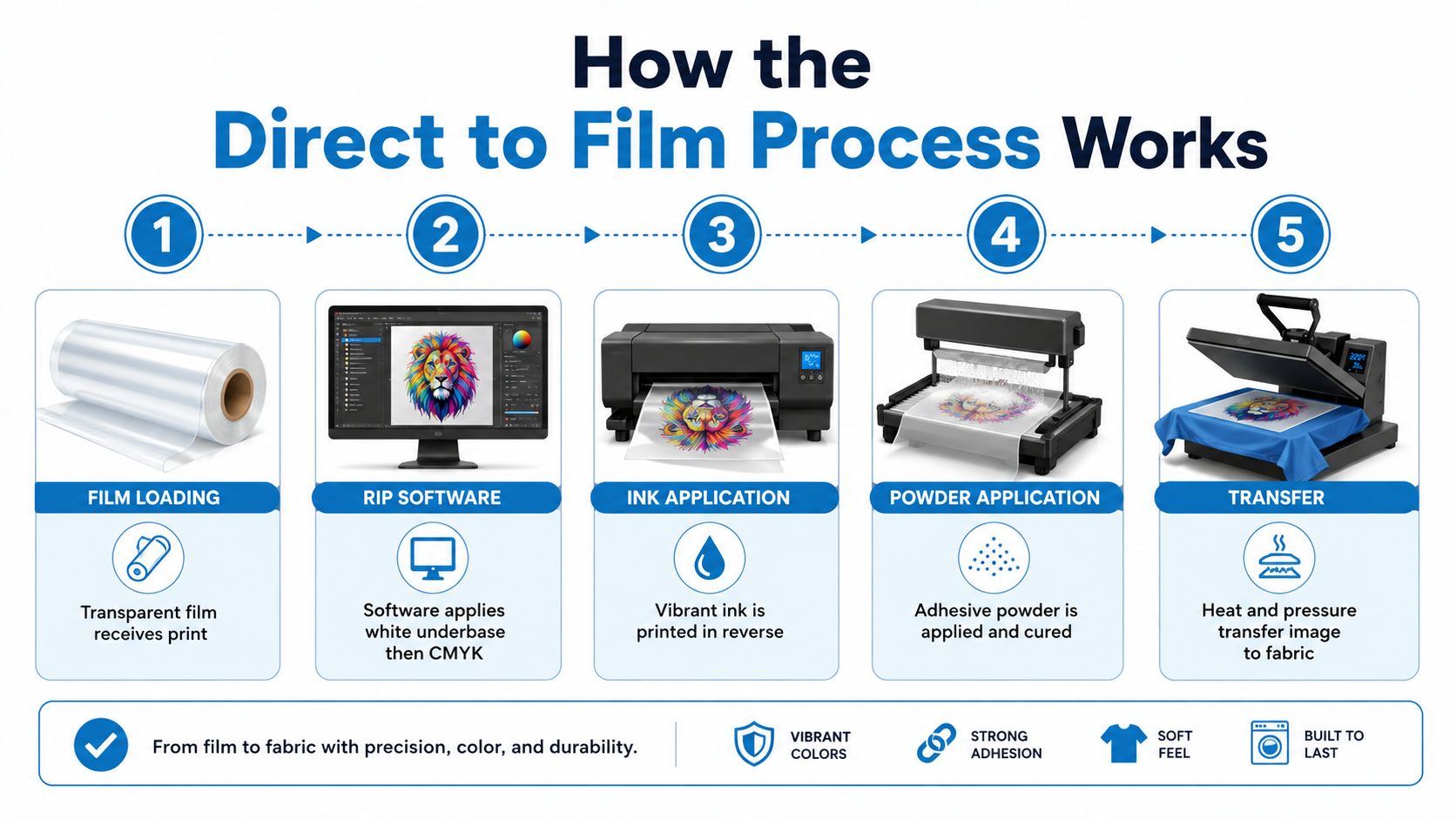
DTF is easier to evaluate once you understand the production line. The printer doesn't apply the finished image directly to the shirt. It prints a mirrored design on PET film, builds the color and white layers, adds adhesive powder, cures that adhesive, and uses heat and pressure to bond the image to fabric.
The five production stages
Film loading: The shop loads PET film into the DTF printer. The artwork is mirrored because the printed side will face the garment during pressing. The film acts as a temporary carrier, not part of the finished design.
RIP preparation: RIP software manages the image layers and print behavior. A typical workflow prepares artwork at 300 DPI, uses RGB artwork as the starting design space, and prints CMYK plus white ink. The white layer provides opacity, particularly on dark garments. The general workflow is described in this DTF process guide.
Ink application: A modified inkjet printer lays down the mirrored CMYK image and white underbase on the film. The image is printed in reverse so it reads correctly after transfer. Print settings affect detail, banding, speed, and ink coverage.
Powder and curing: Hot-melt adhesive powder is applied to the wet print, then cured so it becomes a bonding layer. Commercial guidance commonly places curing around 160 to 170°C, with the exact dwell time controlled by the equipment and powder system. A shop must distribute powder evenly. Too little adhesive can weaken the transfer, while inconsistent coverage can affect edges and wash performance.
Heat pressing: The cured transfer is placed against the garment and pressed at roughly 160 to 170°C for about 10 to 20 seconds, depending on the garment, film, and supplier specification. Peel behavior can be hot or cold. The film specification determines whether the operator removes it immediately or waits for the transfer to cool.
A commercial production platform illustrates the throughput trade-off clearly. One published operating window lists 720 × 1800 DPI at six-pass for 90 linear feet per hour, or 720 × 2400 DPI at eight-pass for 60 linear feet per hour, with working humidity of 40% to 60% and temperature of 15.6 to 26.7°C. The specifications are available in this DTF transfer printing system overview. Higher-pass printing can improve tonal detail and reduce banding, but it slows the line, so the shop should match the setting to your artwork and service deadline.
Finished transfers can be stored and pressed later. That's why gang-sheet production works well for mixed designs, repeat orders, and staged apparel fulfillment. If you want to see how a provider presents the finished apparel workflow, review this DTF printing T-shirt service.
Here's a short visual explanation of the process:
Ask your supplier what film width they run, how they control powder coverage, which peel method they use, and how they verify curing. Those answers tell you far more about production consistency than a low headline price.
DTF vs Screen Printing, DTG, and Sublimation
The fastest way to choose a decoration method is to match it to the order, not to the method's marketing language. DTF is strong for mixed fabrics, detailed graphics, and short-to-mid-size runs. Screen printing is strong when the same simple design repeats across a larger quantity. DTG is a cotton-focused choice when hand feel matters most, while sublimation is restricted by fabric and garment color.
| Criteria | DTF | Screen Printing | DTG | Sublimation |
|---|---|---|---|---|
| Setup cost | Low setup burden for detailed designs | Screen preparation and color setup add cost | Requires garment-by-garment preparation and printing | Low transfer setup, but suitable products are limited |
| Minimum order | Works for short runs and individual designs | More economical as quantity rises | Works for small runs | Works for small runs on suitable products |
| Fabric range | Cotton, polyester, blends, fleece, and many other heat-safe substrates | Broad fabric range, depending on ink and process | Best suited to cotton-heavy garments | Polyester or poly-blends, usually on white or light substrates |
| Hand feel | Flexible transfer feel, with more presence on large solid areas | Depends on ink deposit and artwork coverage | Softest option for many cotton fashion applications | Ink becomes part of the polyester surface |
| Durability | Depends on curing, pressing, garment, and wash care | Strong when properly applied | Depends on pretreatment, ink, curing, and garment | Highly integrated on compatible polyester products |
| Color complexity | Excellent for gradients, photos, and multicolor art | More colors increase setup and registration demands | Excellent for photo artwork | Excellent on compatible white polyester |
| Price breakpoint | Usually strongest for short runs and mixed designs | Often pulls ahead above roughly 75 to 100 units with simple color counts, as outlined in this DTF versus screen printing comparison | Competitive for very small, complex full-color cotton runs | Competitive when the product and fabric are already suitable |
When screen printing wins
Choose screen printing for a larger run with one repeated design, limited colors, and a stable garment program. Once the quantity rises above roughly 75 to 100 units and the artwork uses a simple color count, the screen setup can be spread across more garments. Screen printing also gives buyers a familiar finish and strong economics for repeat-heavy production.
It loses its advantage when you have many small designs, frequent artwork changes, or blended and performance garments that complicate ink selection and curing.
When DTG wins
DTG is the better choice when your priority is an exceptionally soft hand on cotton and the artwork is a detailed, full-color image. Buyers comparing photo artwork can use this resource on DTG printing for photo tees to understand why direct garment printing remains attractive for cotton-focused apparel.
DTG becomes less convenient when the order includes polyester, tri-blends, fleece, or several garment types. DTF transfers give the shop more substrate flexibility without forcing the buyer into one cotton garment program.
Where sublimation fits
Sublimation works when the garment is polyester or a compatible poly-blend and the base is white or light enough for the process. It's a poor choice for dark cotton hoodies, black tees, and most mixed-fabric orders. DTF covers those cases, but it isn't automatically cheaper for every polyester product.
For a buyer with 24 hoodies, DTF is the clear first quote. For 300 identical cotton tees with a simple two-color logo, ask for screen printing. For a small cotton photo-tee drop where softness outranks fabric flexibility, ask for DTG. For white polyester teamwear, evaluate sublimation before DTF.
Best Garments and Substrates for DTF
DTF performs best when the garment can tolerate controlled heat and pressure. The workhorse choices are 100% cotton tees, cotton-poly blends, tri-blends, fleece hoodies, sweatshirts, canvas totes, and many uniform garments. Cotton garments commonly use a press window around 300 to 325°F for 10 to 15 seconds with medium-firm pressure, as shown in this DTF temperature and time chart.
Cotton is straightforward because dye migration is less of a concern than it is on some dark polyester garments. Blends and heathers are also strong candidates because DTF doesn't require the print surface to be entirely cotton. That makes it useful for retail apparel where the garment choice matters as much as the logo.
The garments that need extra control
100% polyester performance tees can create a familiar problem. Heat can encourage dye migration, which may ghost through a light design or shift the appearance of the white underbase. Request a blocking underbase when the garment color and brand color are critical, and ask the decorator to test the exact blank before approving the run.
Nylon jackets, bags, and lightweight outerwear need lower heat and shorter dwell time. Published guidance lists nylon applications as low as 130°C, or 265°F, for 10 to 12 seconds, while polyester is commonly pressed around 270 to 285°F for 10 to 12 seconds, followed by a cool-down before peeling. The fabric-specific pressing guide also warns that excessive heat can cause dye migration on dark polyester and scorching on thin garments.
Substrate rule: If the item can survive a heat press without scorching, melting, or distorting, DTF is probably worth testing. “Probably” is not approval for a full production run.
Moisture-wicking athleisure, canvas totes, aprons, and teamwear often fit DTF well. Non-apparel items such as leather patches and wood signs may require a product-specific transfer system or surface treatment, so don't assume that every DTF supplier uses the same adhesive for every substrate.
Request a substrate swatch test before committing the full order. Send the exact garment style, color, and fabric composition. A sample on a generic white tee proves very little about how the transfer will behave on a black polyester performance shirt or a coated nylon bag.
Pricing, Turnaround, and Where DTF Wins on Cost
A DTF quote has more moving parts than the per-shirt number suggests. You're paying for artwork handling, film area, ink coverage, adhesive powder, transfer preparation, pressing labor, garments, packing, and delivery. The supplier's quote should show enough detail for you to identify what changes if you adjust the design size, quantity, or delivery date.
The cost levers buyers can control
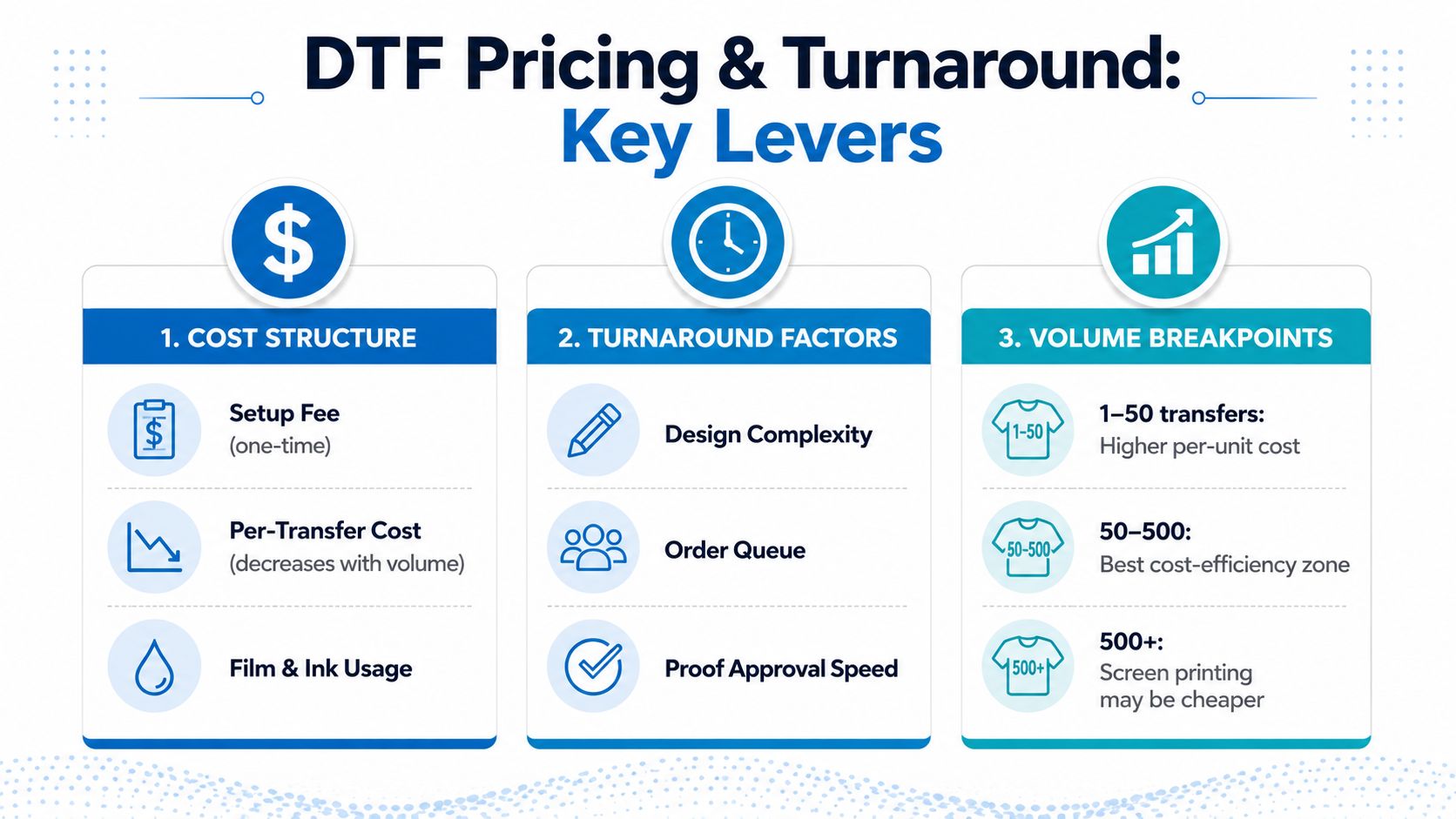
- Setup fees: DTF usually avoids the screen-building burden of traditional screen printing, but artwork cleanup, file conversion, and proofing may still appear as service charges.
- Design dimensions: A large front print consumes more film and ink than a compact left-chest logo. Oversized artwork can also reduce how efficiently multiple designs fit together.
- Gang-sheet layout: Placing multiple transfers on one sheet improves film yield. This is why several small logos, sleeve marks, or different SKU designs can price better together than as separate print jobs.
- White underbase coverage: Dark garments need opacity, and broad white coverage increases material use. Ask how the supplier handles white ink and whether the design has unnecessary solid areas.
- Press labor: DTF transfers still need to be positioned and pressed. Multiple placements per garment increase labor even when the artwork itself is inexpensive.
DTF usually wins under roughly 24 to 50 pieces per design, especially when the artwork is full-color or the garments vary. Screen printing generally wins above that range when the design uses few colors and repeats consistently. DTG competes on very small, complex full-color cotton orders, particularly when the buyer values a soft print feel over substrate flexibility.
Turnaround is a production question
Stocked transfers can support same-week fulfillment. Gang-sheet orders commonly fall into a 2 to 5 business day production window, depending on proof approval, queue, garment availability, and shipping. Rush premiums may reach 25% to 50%, so ask for standard and rush pricing before your deadline becomes an emergency.
The fastest way to damage a quote is to submit oversized artwork, waste film with poor layout, or request one-off placements that prevent ganging. Send final dimensions, garment counts by style and color, and your required in-hand date. A good supplier can then recommend whether to gang the designs, split production, or switch methods for part of the order.
Artwork Prep and Proofing That Saves a Reprint
Your artwork should arrive production-ready. The safest default is a PNG with a transparent background at 300 DPI. Vector AI or PDF files are preferable when the design contains logos, fine typography, or crisp geometric edges.
Before production, confirm the final transfer dimensions rather than relying on a designer's mockup. Fine lines need enough weight to survive printing and pressing. As a practical starting point, keep delicate strokes around 1.5 pt or heavier, then ask the supplier whether the specific artwork needs adjustment.
Give the decorator a usable file
- Transparent background: Remove unwanted rectangles, halos, and hidden background layers.
- Final dimensions: State the exact width and height for each placement.
- Color expectations: DTF uses CMYK plus a white underbase. Spot colors are approximated, and neon or metallic effects need a separate production conversation.
- Placement information: Identify left chest, full front, sleeve, back, or another location with a garment mockup.
- Safe spacing: Keep important artwork away from sheet edges and avoid crowding adjacent transfers on a gang sheet.
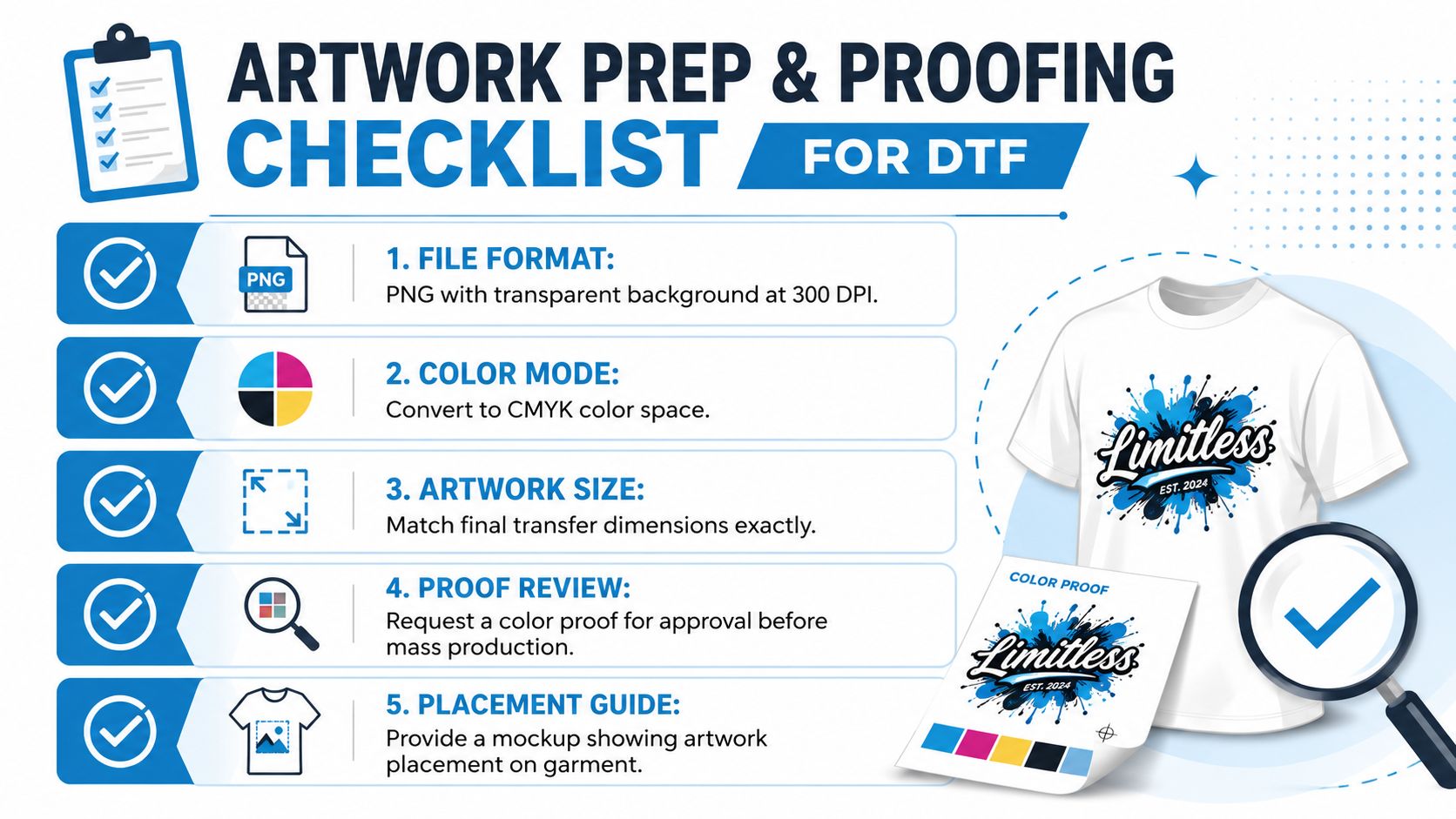
Demand a digital mockup on the actual garment color, not a generic white shirt. For a first order or a color-critical brand program, request a physical strike-off on a blank garment. If your brand colors are essential, compare the strike-off beside the approved Pantone reference and decide what level of CMYK approximation you'll accept.
Most reprints trace back to three preventable failures: low-resolution source files, mockups that ignore the garment color, and skipped strike-offs. Fix those before the transfer reaches the printer, not after the finished hoodies arrive.
The Market Signal Behind DTF's Growth
DTF's growth matches what procurement teams already see in their order mix. Buyers want shorter production runs, more designs in one purchase order, rapid reorders, and decoration that works across cotton, polyester, blends, and fleece. That combination favors a transfer process that separates image production from garment pressing.
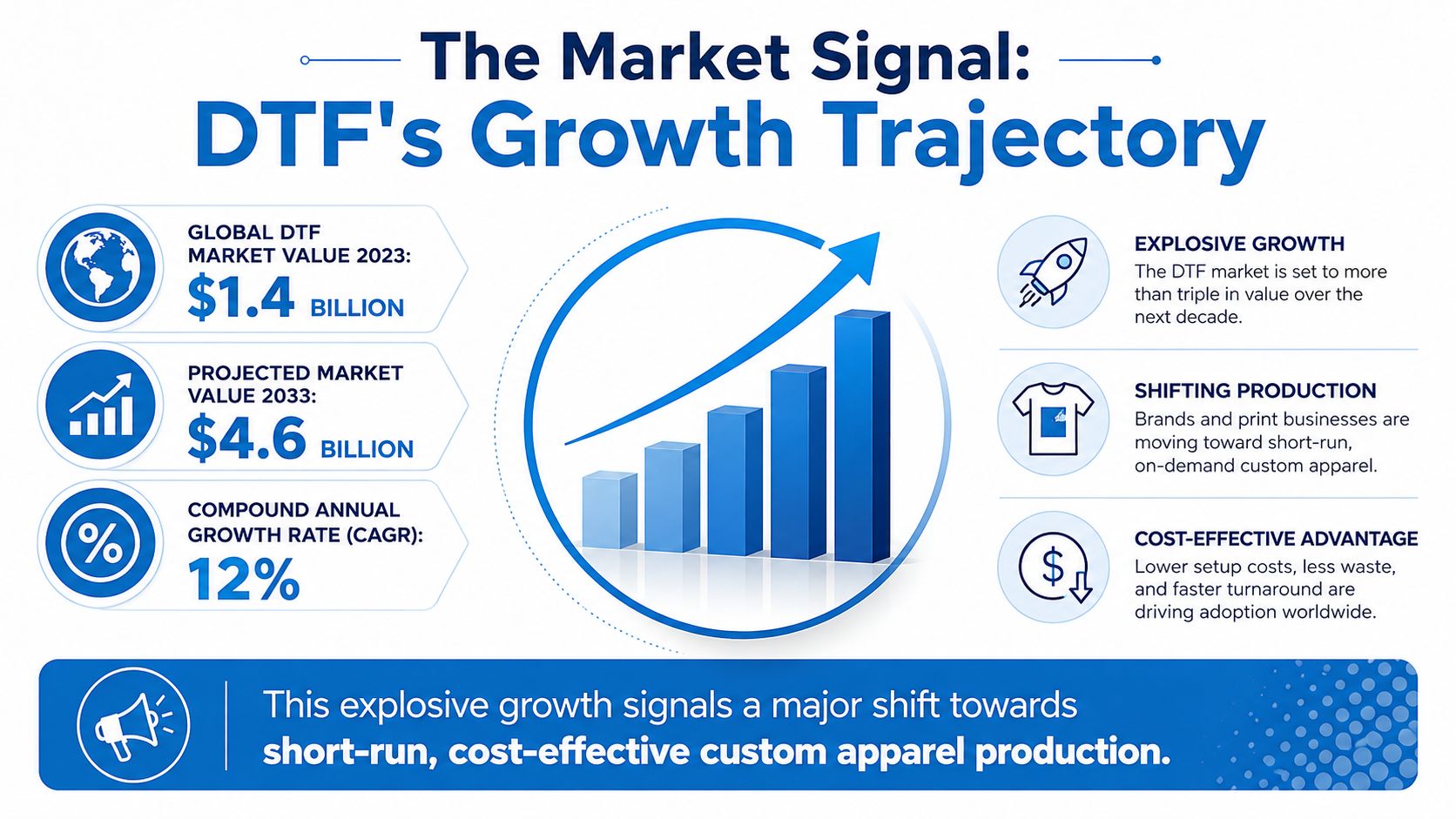
Recent market estimates place the global DTF printing market at USD 2.72 billion in 2024, rising to USD 2.93 billion in 2025 and reaching a projected USD 3.92 billion by 2030, with a 6.0% CAGR from 2025 to 2030, according to this DTF printing market report. Another outlook estimates USD 2.05 billion in 2025 and a projected USD 4.94 billion by 2031, implying a 15.8% CAGR over 2026 to 2031, so the exact forecast varies by market definition and methodology.
What the signal means for a buyer
The important point isn't choosing one forecast as gospel. Multiple market estimates describe a rapidly expanding production category, driven by customized apparel, on-demand merchandise, and flexible decoration. The market evidence supports what a buyer with 25 to 200 pieces already experiences: DTF fits orders that are too varied for efficient screen production and too fabric-diverse for a clean DTG workflow.
Ecommerce print-on-demand sellers benefit from the same structure. They can hold blank garments, prepare transfers by design, and press only what has sold. Event organizers can combine several logos or dates in one production plan. Retailers can test a design without committing to a large screen-printing run.
The market signal isn't a reason to use DTF blindly. It is a reason to treat DTF as a durable procurement option rather than a passing novelty. If your order mix centers on short runs, mixed garments, and frequent reorders, betting against DTF over the next 24 months would leave a strong production tool off your shortlist.
Vetting a DTF Supplier and Asking the Right Questions
The cheapest quote is rarely the safest quote. Reprints and missed ship dates usually begin with an underspecified process, not bad luck. A supplier who can't explain the film, powder, ink, press settings, and proofing routine hasn't given you a complete production proposal.
Ask for a 4 × 6 inch printed sample on the exact garment you plan to use. A sample on a stock shirt won't reveal how the transfer behaves on your black polyester performance tee, heather hoodie, nylon jacket, or canvas bag. Ask which film, powder, and ink set the shop runs, and whether those materials change by substrate.
Questions that protect the order
- What wash testing do you perform? Ask for a wash-test report at 40 or more cycles, and ask whether the report applies to the same garment and transfer type.
- How do you handle reorders? Color-critical reorders should be matched against an approved reference, not treated as a new interpretation of the file.
- How fresh are the consumables? Ask about film and powder turnover. Old or poorly stored materials can affect consistency.
- Which peel method applies? Hot-peel and cold-peel films require different operator timing.
- How do you approve the substrate? The supplier should be willing to test the exact garment before mass production.
- What happens if the proof changes? Confirm whether revised artwork, altered dimensions, or a different garment color changes the quote or schedule.
Sustainability deserves a direct question too. DTF may reduce water use compared with pretreatment-heavy workflows, but it still uses single-use PET film and adhesive powder. Independent commentary also raises concerns about film disposal, powder handling, VOC-related issues, and ink chemistry when the process isn't managed responsibly. Ask whether the provider has a film recycling path, how powder waste is handled, and what controls apply to inks and adhesives. This environmental perspective on DTF printing is useful background for that conversation.
Dirt Cheap Product, Inc. describes its approach to quality, artwork review, and decoration services in its quality without compromise overview. Use that kind of supplier information as a starting point, then confirm the exact sample, substrate, schedule, and testing details for your order.
Dirt Cheap Product, Inc. offers direct to film printing services for high-resolution, full-color apparel on cotton, polyester, blends, and other suitable garments, along with screen printing, embroidery, sublimation, and custom patches. Visit Dirt Cheap Product, Inc. with your artwork, garment details, quantity, and deadline to request a proof and a production recommendation before placing the full order.