You're standing at a table in a packed venue, smoothing a runner with one hand while a rep asks if the logo is centered. The table looks close to ready, but the wrong width, too much overhang, or a fabric that wrinkles the second it leaves the box can make the whole setup feel off. That's why custom table runners need to be ordered like a production piece, not a casual décor add-on.
Table of Contents
- Why Custom Table Runners Matter for Events and Brands
- Getting the Sizing and Proportions Right
- Choosing the Right Fabric for Real Event Use
- Printing and Decoration Methods Explained
- Preparing Your Artwork and Approving the Proof
- Lead Times, Pricing, and What Actually Drives Cost
- Ordering Checklist and Common Pitfalls to Avoid
Why Custom Table Runners Matter for Events and Brands
At a trade show, the table is rarely just a table. It's a landing zone for conversations, product samples, handouts, and first impressions, and a branded runner is often the fastest way to turn that surface into part of the display. When the runner fits cleanly, stays flat, and reads clearly from a few steps away, the booth feels intentional. When it's too narrow, too long, or printed on the wrong fabric, it looks improvised.
The category is bigger than a home décor accessory. The global table runner market was estimated at US$1.4 billion in 2022 and is projected to reach US$2.3 billion by 2031, according to Transparency Market Research. That same source says cotton was the largest material segment in 2022, and North America is a leading demand region in the forecast period. For branded events, that matters because the product sits inside a real commercial market with established supply chains, not a one-off novelty trend.
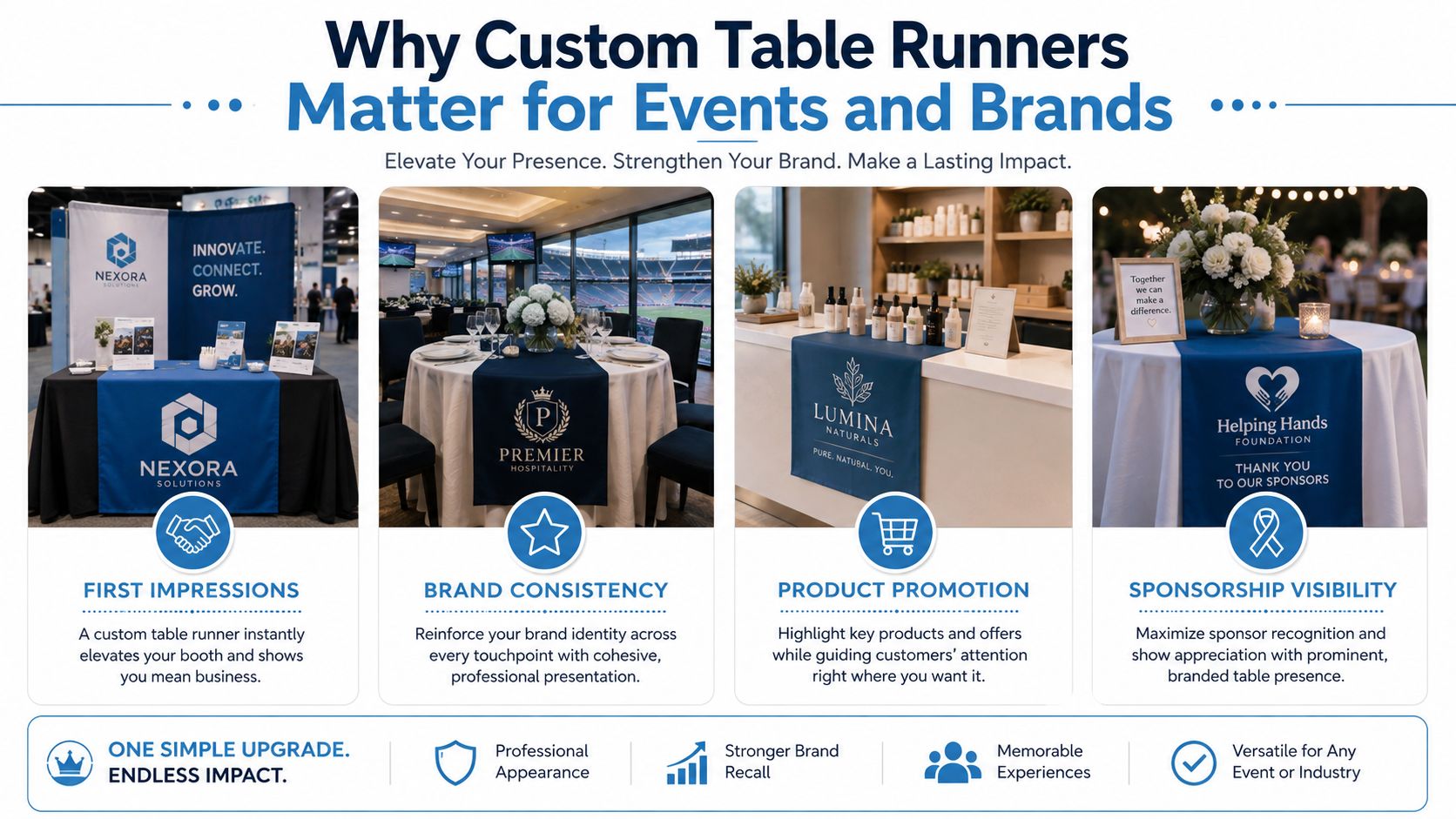
A good runner does three jobs at once. It identifies the brand, it helps the table look finished, and it keeps the setup flexible enough for different venues and table sizes. That's why event teams often compare it with other branding pieces, including banners, tabletop signage, and giveaway items. If you're thinking about the broader booth mix, unforgettable event branding ideas is a useful resource, and pairing the runner with the right small-format item can matter just as much as the print itself. For teams planning the surrounding table setup, this trade show giveaways guide can help shape the full presentation.
Practical rule: the runner should support the table, not fight it. If people notice the fit before they notice the logo, the sizing is off.
Getting the Sizing and Proportions Right
The most common ordering mistake is treating every table like it wants the same runner. A 4-foot demo table, a 6-foot registration table, and an 8-foot banquet table all need different visual treatment, even when the logo artwork is identical. The right runner isn't just about length, it's about whether the width leaves room for the display items on top and whether the overhang looks balanced from the aisle.
Start with width, then check the drape
Industry guidance commonly places runner width around 14 to 18 inches for balanced coverage, with lengths often targeting 72 to 108 inches and 6 to 12 inches of overhang per side for symmetry on standard tables, as noted in the supplier guidance from Alibaba product insights on runner tables. In practice, a wider runner can crowd placemats, bowls, or product samples, while a narrow runner can look accidental on a larger table. If the runner sits on a full tablecloth, the visible proportion changes again, because the fabric is now acting as an accent strip instead of the main surface treatment.
| Table Type | Table Size | Recommended Runner | Overhang Per Side |
|---|---|---|---|
| 4-foot folding table | 48" x 24" typical event format | 24" x 72" or a narrow 14 to 18 inch accent runner | 6 to 12 inches |
| 6-foot folding table | 72" x 30" typical event format | 90" x 30" or 72" x 24" depending on display needs | 6 to 12 inches |
| 8-foot banquet table | 96" x 30" typical event format | 108" x 36" or a longer 84 to 90 inch runner format | 6 to 12 inches |
| Cocktail table | Tall round pedestal style | Narrower branded runner or wrap style, sized to avoid bunching | Minimal to light drape |
| Banquet layout on tablecloth | Covered table with accent layer | Runner centered over base cloth, usually within the 14 to 18 inch band | Visual, not structural |
If you're renting the base linen, the runner should be measured against the actual covered surface, not the bare tabletop. That's where many buyers get burned, because the visible depth changes once the cloth is installed. For teams coordinating with venue linen, how to rent a table cover is a practical reference for thinking about base coverage before the runner is finalized.
A runner that looks perfect on a product page can sit awkwardly on a live table if the table is deeper than expected. Measure the table and the setup together, not just the table alone.
Match the table to the use case
A 4-foot table usually needs a more restrained layout, especially if samples or literature are spread across the top. A 6-foot table is the most forgiving because it gives enough room for branding and merchandise without making the runner feel oversized. An 8-foot table can carry a larger graphic, but only if the runner length and drape are chosen with the aisle view in mind.
For a quick fit check, ask three questions before ordering. Does the runner stay centered with a clean border? Does it leave room for the products or materials that will sit on top? Does it read as a deliberate accent rather than a sheet of fabric trying to cover too much?
Choosing the Right Fabric for Real Event Use
Fabric choice is where event runners go from pretty to practical. A soft textile that photographs beautifully might still be a headache if it creases inside the shipping box, and a sturdy fabric that holds up for months can look too heavy for a light retail counter. For live events, the winner is usually the fabric that keeps its shape, prints cleanly, and survives packing without making your setup crew fight it.
Compare how each fabric behaves on the floor
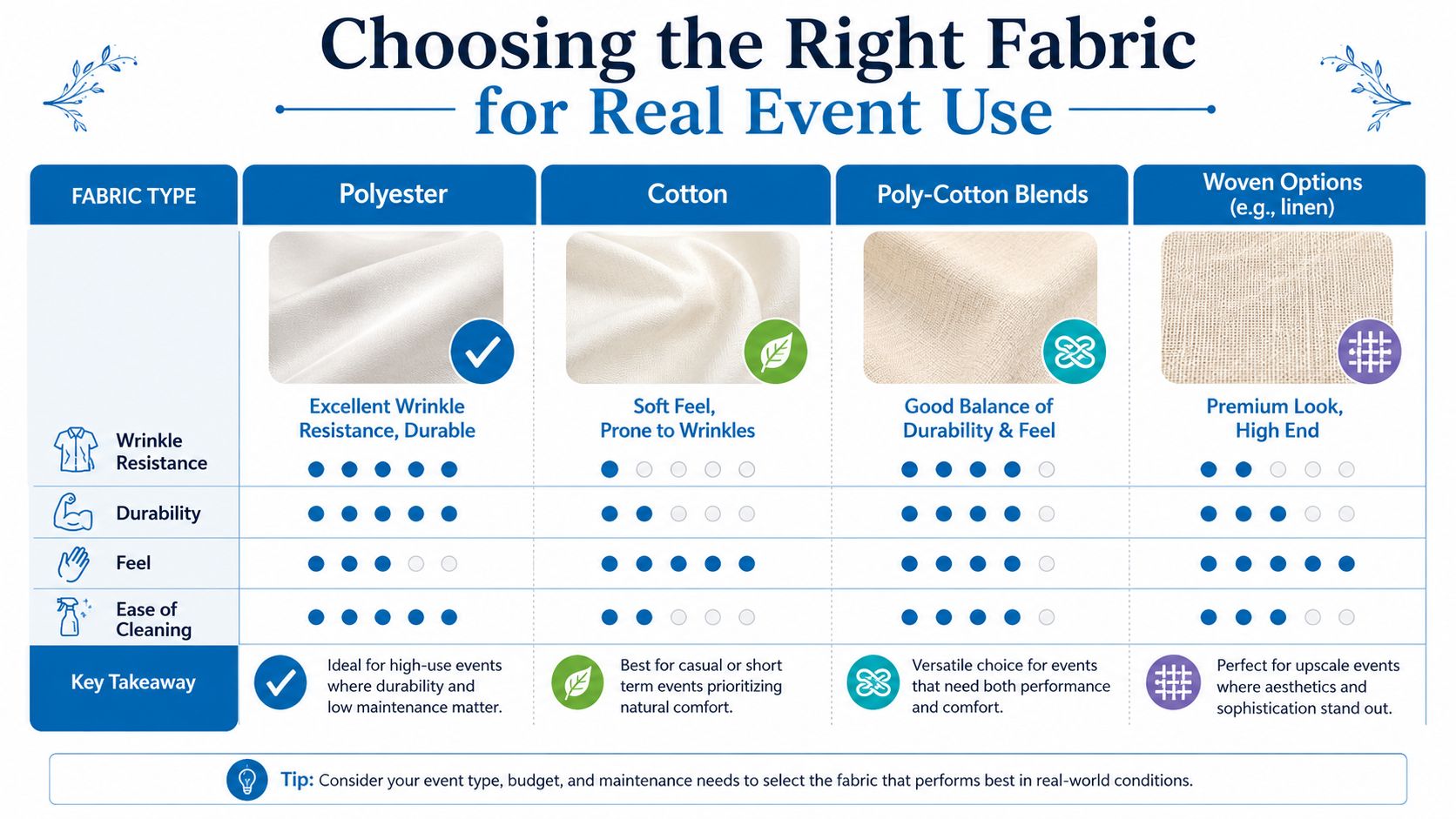
For event-grade custom table runners, polyester with dye-sublimation is the most common production spec because the ink is fused into the fabric rather than sitting on top of it. That's why it works so well for full-color edge-to-edge printing and repeated setup, especially when the same runner has to be packed, unrolled, and reused across a season. If you're evaluating decoration options with textile finish in mind, the fold-and-pack logic behind folded dinner napkins from Simply Hospitality is a useful parallel, because the same visual polish matters when soft goods move from box to table.
Here's the practical comparison:
- Polyester: Best for crisp graphics, stronger wash resilience, and a clean event look. It's the safest choice when the runner needs to behave like a branded production piece rather than a soft home textile.
- Cotton: Better for a relaxed, natural presentation. It can look great, but it's more likely to wrinkle and usually needs more care if the runner is reused often.
- Poly-cotton blends: A middle ground when you want a softer hand without giving up too much structure. They're useful when the runner will appear in mixed settings.
- Woven options, such as linen: Best for a premium, tactile look. They can enhance a tabletop, but they usually demand more attention to pressing, handling, and storage.
The main question isn't which fabric looks nicest in isolation. It's which one matches the job. For a one-day trade show booth, a wrinkle-resistant polyester runner often saves time at setup. For a styled hospitality environment where the runner will be seen up close, a more textured woven option can make sense if the team is ready to manage the care.
Some venues also require fire-related compliance, and one supplier notes an NFPA 701 fire-retardant certification for its 300D polyester version. That doesn't apply to every order, but it matters in spaces with stricter event rules or venue approval processes.
The cleanest result comes from choosing fabric based on actual handling, not just the proof. If the runner will be folded, shipped, and reset several times, durability and wrinkle resistance matter more than a slightly softer hand.
Printing and Decoration Methods Explained
The decoration method should follow the artwork, the fabric, and the number of times the runner will be reused. A logo with gradients, fine type, or full-bleed color needs a different production path than a simple one-color mark on a natural-looking textile. That decision affects finish quality, not just price.
Match the print method to the artwork
Dye-sublimation is the right fit when you want rich color, edge-to-edge branding, and a design that becomes part of the fabric itself. It's the method most event buyers should look at first for polyester runners, because the print won't sit thick on the surface and the image can cover the full panel cleanly. For a production explanation you can hand to a marketing lead, the dye-sublimation process guide is a useful reference point.
Screen printing still makes sense when the logo is simple, the color count is limited, and the runner fabric supports that look. It's a strong choice for straightforward branding on flatter, more traditional textiles, especially when the design doesn't need photo-level detail. The downside is that it's less flexible for complex gradients or highly detailed layouts.
Direct-to-film, or DTF, can work for shorter runs and certain logo applications, especially when the design needs strong color without building a full screened setup. It gives teams more room than traditional print methods in some production contexts, but it's still a different conversation from full-coverage sublimated fabric.
Embroidery is the most tactile option, but it's rarely the first choice for large runner graphics. It's better when the logo is small, the presentation is upscale, and the fabric can support stitch detail without distortion. It doesn't replace print for most event runners, but it can add a premium accent in the right setting.
If the design depends on color gradients or edge-to-edge coverage, the print method needs to support that before anything else gets considered.
The right method also depends on how the runner will be packed and washed. Printed polyester with sublimation tends to hold up better to routine event handling than methods that sit on the surface, while embroidery can stay sharp if the artwork is small and the fabric has enough body. The more detailed the logo, the more important it is to keep expectations tied to the chosen process instead of the mockup.
Preparing Your Artwork and Approving the Proof
Most production problems start before printing, not during it. If the art file is wrong, the final runner can still look “close,” but close isn't good enough when the logo has to read cleanly from an aisle or photo. Good prep means the file is built for textile production, not just for a presentation slide.
Clean files prevent expensive guessing
Start with a vector file whenever possible, because vector art preserves sharp edges and scales cleanly across different runner sizes. That's especially important when the design has a small wordmark, fine linework, or multiple elements that need to hold their spacing. If the artwork is raster-based, low resolution will usually show up once the runner is enlarged.
Color matching matters too. If brand colors are strict, a production team needs to know whether the order is being matched through Pantone or CMYK, because those paths behave differently on fabric. For a practical reference on matching systems, PMS color matching guidance is worth keeping on hand before you approve a proof.
A good proof should show the runner at the correct size, the logo placement, the safe zone, and any border or bleed area that matters to the layout. It should also show how the design sits on the actual runner shape, not just a floating logo on white. Check the proof line by line for spelling, spacing, orientation, and whether any artwork got cropped too close to the edge.
- Check the file type: Confirm that the printer received the correct vector or high-resolution source.
- Check logo placement: Make sure the brand mark sits where the booth team expects it.
- Check the colors: Confirm whether the proof is built to brand standards or a close print approximation.
- Check the edges: Verify that bleed and safe zones won't cut into text or borders.
- Check approval status: Don't assume a revision note was captured unless it appears in writing.
The fastest way to avoid reprints is to keep production questions out of the design stage. If the logo needs cleanup, say so early. If the runner will be photographed straight-on, flag that before approval. The proof isn't a formality, it's the last chance to catch a mistake before fabric gets cut and printed.
Lead Times, Pricing, and What Actually Drives Cost
A quote can look high for reasons that are easy to miss on a product page. Two custom table runners may seem similar on paper, but once you compare fabric, print method, size, finishing, packaging, and shipping, the numbers stop matching. The biggest price differences usually show up when artwork, sizing, or setup details are still unsettled.
What pushes the quote up or down
A heavier fabric or a more complex weave usually costs more than a basic production cloth. Printing method matters too, because full-color sublimation, simple screen print, and specialty decoration all need different setup and handling. Quantity changes the math as well, since larger runs spread the setup work across more pieces.
Finishing details can move the quote as well. Merrowed or surged edges, special folding, custom packaging, and shipping requirements all add handling time. If an order needs rush production, there is usually less room for art revisions or fabric changes, which is why late approvals can create expensive pressure.
A practical budgeting process works better than guessing. Start by locking the size and fabric, then confirm the decoration method, finishing style, and delivery window. After that, ask whether the order includes setup or artwork charges, because those fees often appear when a job needs extra production work instead of a straightforward reprint.
The lowest quote is not always the lowest-cost order. If the runner will be reused across several events, a slightly larger quantity can reduce the need to reorder under time pressure.
That matters for branded textiles that move from one campaign to another. Ordering enough to cover a few extra setups can make more sense than placing a second small rush order a month later.
Ordering Checklist and Common Pitfalls to Avoid
A clean order starts with measurements and ends with approval. The teams that move fastest don't rush the proof, they lock the basics before anyone starts decorating. The mistakes that cause the most delays are predictable, which means they're avoidable with a tight workflow.
Use the same order every time
| Step | Action | Detail to Confirm |
|---|---|---|
| Confirm table size | Measure the real table, not the catalog image | Length, width, and height |
| Pick fabric | Match the material to the event use | Wrinkle resistance, feel, and reuse |
| Finalize decoration method | Choose the print or stitch process | Full color, simple logo, or premium finish |
| Prepare artwork | Send production-ready files | Vector preferred, clean colors, readable type |
| Request and approve proofs | Review the layout before production starts | Spelling, placement, bleed, and borders |
| Confirm delivery date | Build in production and shipping time | Event date, buffer, and ship-to address |
The most common pitfalls are easy to spot after the fact. Incorrect artwork specs cause fuzzy logos or awkward scaling. Last-minute orders leave no room for proof corrections or shipping surprises. Not reviewing proofs carefully can turn a good concept into a reprint. Under-ordering is another one, especially when a multi-table setup needs matching pieces across several stations.
Care matters after the event too. Fold the runner cleanly, keep it dry, and store it flat or rolled so the next setup isn't fighting deep creases. If the runner is going to work for more than one weekend, it should be treated like reusable brand inventory, not disposable décor.
Dirt Cheap Product, Inc. helps companies, event teams, and retailers produce branded textile pieces with clean decoration and fast turnaround, including custom table runners that fit real event setups. If you need a runner that matches your table size, artwork, and delivery window, visit Dirt Cheap Product, Inc. and send over your logo so the order can be built the right way from the start.