
Small 12 to 24-piece runs typically cost $8 to $18 per shirt, fall to about $4 to $9 around 100 shirts, and reach roughly $2 to $6 at 250 or more, before setup, rush, and shipping are added. The quote you approve, not the advertised shirt price, determines your real budget.
You may be ordering shirts for a company event, fundraiser, retail drop, or employee uniform program. A vendor sends a quote that looks reasonable until you notice separate charges for screens, artwork, delivery, and a deadline. That's why custom t shirt prices should be evaluated as landed cost, not just a per-shirt headline.
Quantity is the biggest pricing lever because setup costs spread across more units. A widely used pricing pattern puts small orders at about $8 to $18 each, bulk orders of 250 or more at roughly $2 to $6 each, and very large orders of 10,000 or more at about $0.40 to $0.55 each, before setup charges of about $15 to $30 per color. This custom T-shirt pricing breakdown explains why doubling a quantity can reduce the unit price far more than buyers expect.
Table of Contents
- What You Are Really Paying For in a Custom T Shirt Quote
- The Six Variables That Drive Custom T Shirt Prices
- Picking the Right Decoration Method for Your Order
- Real Price Examples by Quantity and Method
- When the Cheapest Method Is Not the Smartest Pick
- Side-by-Side Price Guide for Common Order Sizes
- Smart Ways to Lower Custom T Shirt Prices
- Ready to Order and Request a Quote
What You Are Really Paying For in a Custom T Shirt Quote
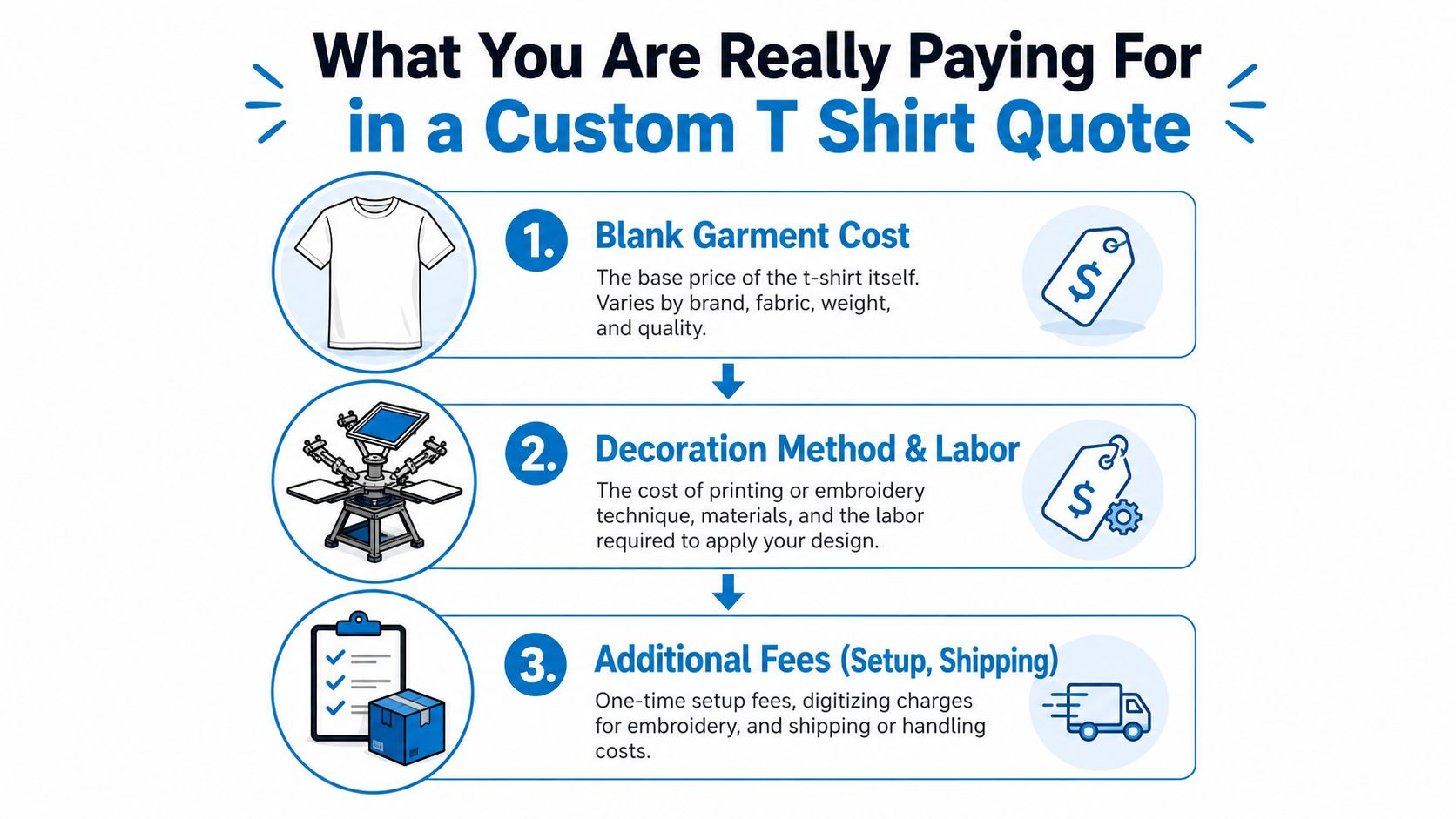
A custom apparel quote is a stack of cost layers. Read it from top to bottom, and you'll see exactly where your money goes.
Start with the garment
The blank shirt sets the foundation. A basic cotton shirt costs less than a premium retail-style blank, while performance polyester, heavier fabric, extended sizing, and specialty cuts can raise the base price. A $5 blank isn't overpriced by itself. It leaves less room for decoration and service costs before the final number reaches your budget.
Use the same discipline when selecting a shirt for printing. Compare fit, fabric, color, size range, and intended use in this guide to the best T-shirts for printing, rather than choosing only by the lowest blank price.
Add decoration and preparation
Decoration pays for the production method and labor. Screen printing spreads ink through prepared screens, digital methods apply artwork directly or through a transfer, and embroidery converts artwork into stitch instructions. The charge may appear per print, per shirt, or as a combined decoration line.
Screen-printing setup commonly runs about $20 to $50 per screen, with some guides citing $25 to $75 per color per design. A current screen-printing pricing guide explains why a one-color design costs less to prepare than a three-color or four-color design.
Embroidery usually adds a digitizing charge, commonly around $10 to $20, because the decorator must convert the logo into a stitch file. Extra print locations, such as a back, sleeve, or left chest, add production time and may create additional setup requirements.
Finish the landed-cost calculation
A quote can also include rush production, shipping, tax, and artwork preparation. These charges matter most on small orders because fixed fees are divided across fewer garments.
For example, a $5 blank can become a $14 finished shirt after decoration, preparation, and service costs are stacked together. That isn't automatically padding. Ask what each line pays for, then compare the same specification across vendors. If you're coordinating shirts alongside event media, a separate resource on pricing for event photo sharing can help you budget the broader event experience without confusing those services with apparel costs.
Practical rule: Ask for the total delivered price, the quantity used to calculate it, and every one-time fee before comparing vendors.
The Six Variables That Drive Custom T Shirt Prices
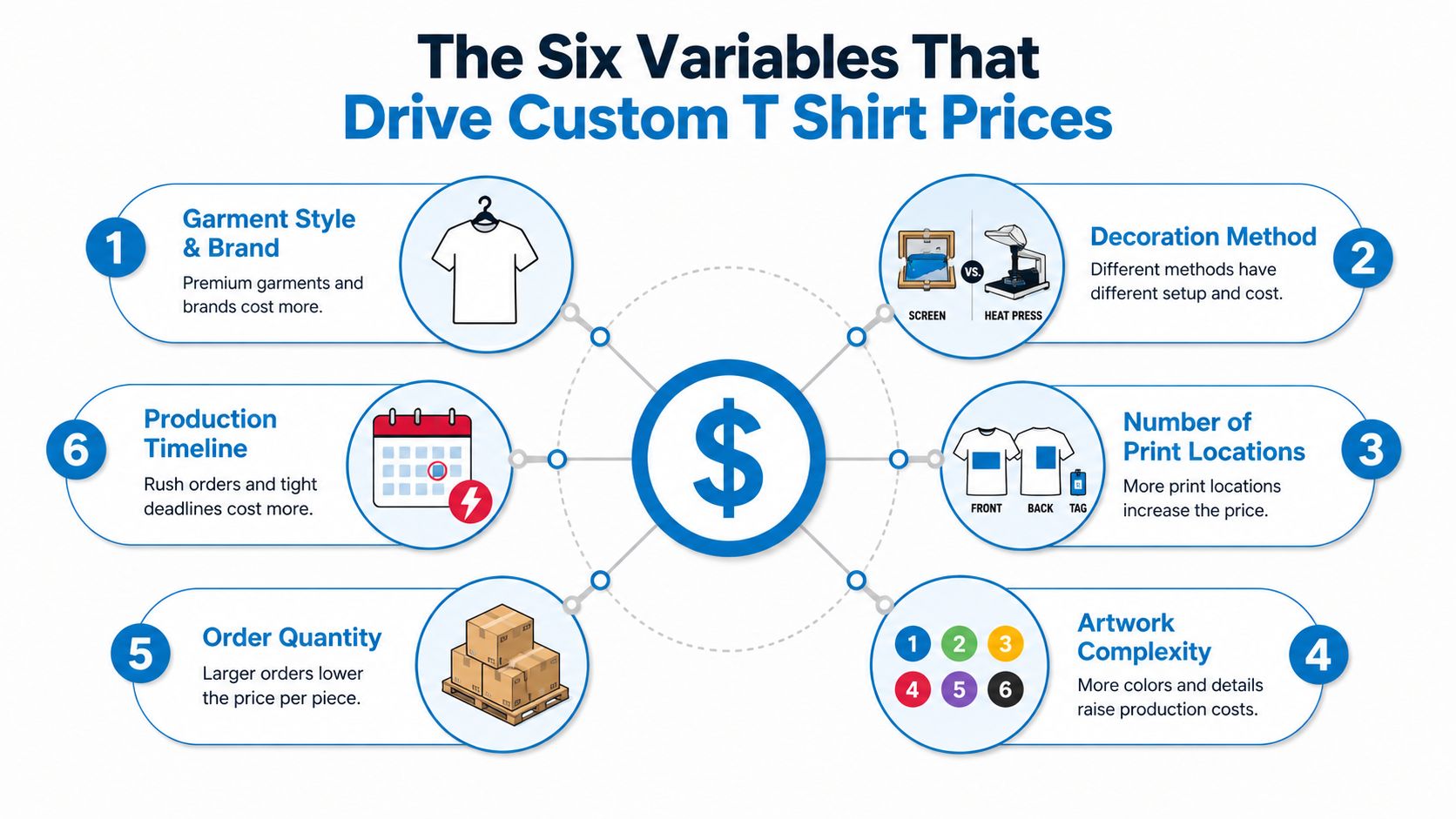
Custom apparel pricing is one allocation problem with six inputs competing for the same budget. Change one input and the other lines may shift with it.
Garment style and brand
A budget cotton blank, a soft retail-style shirt, a polo, and a performance garment serve different purposes. The garment's brand, weight, fabric, fit, and color can change the starting point before decoration begins.
Decoration method
Screen printing works efficiently when a design has limited colors and the order is large enough to absorb preparation. DTF, DTG, embroidery, and sublimation solve different problems, so the cheapest method depends on the artwork and garment rather than the machine alone.
Print locations
A front print is a simpler production job than front and back. Sleeves, neck labels, and specialty placements add handling and can require separate setup. A second location can therefore change the quote more than a buyer expects.
Artwork complexity
Color count, gradients, fine detail, photographic content, and individual personalization all affect preparation. A simple one-color logo gives a decorator fewer production steps than a full-color illustration with small text.
Quantity
Quantity determines how heavily each fixed setup charge affects the unit price. A 12-piece order may feel expensive beside a 24-piece order with the same design because the setup cost has half as many shirts over which to spread. Bulk pricing guides consistently identify quantity, garment, colors, and locations as the core quote variables. This pricing and minimum-order guide lays out that structure clearly.
Timeline and shipping
A short deadline compresses purchasing, artwork approval, production, and delivery into a smaller window. Rush service can add a material surcharge, and shipping still applies after the production schedule is solved.
The variables interact. Increasing quantity may lead to a lower garment tier, while simplifying artwork can make screen printing viable. Adding a second location can erase the savings from ordering more shirts. Method choice deserves a separate comparison because it controls both the visible print and the hidden labor behind it.
Picking the Right Decoration Method for Your Order
No method wins every job. Choose based on quantity, artwork, fabric, and how the shirts will be used.
| Decoration Method | Price Range Per Shirt | Best Order Size | Ideal Fabric | Artwork Sweet Spot |
|---|---|---|---|---|
| Screen printing | About $3 to $6 | Larger runs, especially 50 or more | Cotton and common blends | Simple designs with limited colors |
| DTF | About $4 to $9 | Small to mid-volume runs | Cotton, blends, and many compatible fabrics | Complex, full-color graphics |
| DTG | About $8 to $15 | Smaller runs, especially under 50 | 100% cotton | Photographic detail and gradients |
| Embroidery | About $5 to $12, plus digitizing | Polos, hats, and uniform programs | Stable fabrics and structured garments | Logos, names, and professional marks |
| Sublimation | About $7 to $14 | Polyester apparel programs | Polyester performance wear | All-over and vivid full-color designs |
Screen printing is the clear value choice for larger orders with one to three colors and one main location. Each added color requires another screen and preparation step, so complex artwork weakens its price advantage.
DTF is the flexible middle option. It handles detailed artwork without screen-by-screen color separation and suits buyers who need a smaller run or several fabric types. Learn the process in this explanation of DTF printing.
DTG makes sense for cotton shirts with photographic detail, especially when the quantity is too small for screen-printing efficiency. Dark garments may require pretreatment, which can affect both price and production handling.
Embroidery adds texture and a professional appearance to polos, hats, jackets, and uniforms. Stitch count can limit detail, and digitizing is an upfront cost, but a stable logo program can justify it over repeat orders.
Sublimation is powerful for polyester performance wear and all-over prints, but it isn't a general-purpose cotton method. The fabric restriction matters more than the advertised per-shirt price.
Decision rule: Use screen printing for larger, simpler runs, DTF for flexible full-color work, DTG for detailed cotton designs in smaller quantities, embroidery for uniform branding, and sublimation for polyester all-over decoration.
Real Price Examples by Quantity and Method
The cleanest comparison uses the same garments and the same front-plus-back brief. The examples below use a Gildan 5000 at $3.50, a Next Level 6010 at $4.75, a $40 screen setup per color with six colors, DTF at $2.50 per print, DTG at $4.50 per print with no setup, embroidery at $6 per shirt with $60 digitizing, and sublimation only for all-over polyester runs, as specified in the quote model.
| Decoration Method | 24 pcs (per shirt) | 24 pcs Total | 100 pcs (per shirt) | 100 pcs Total | Setup / Notes |
|---|---|---|---|---|---|
| Screen printing | About $19.83 | About $476 | About $7.20 | About $720 | Six colors, front and back, $240 total setup |
| DTF | About $11.00 | About $264 | About $7.25 | About $725 | Two $2.50 print placements plus garment |
| DTG | About $12.50 | About $300 | About $12.50 | About $1,250 | Two $4.50 prints, no setup |
| Embroidery | About $12.00 | About $288 | About $8.60 | About $860 | $6 per shirt plus $60 digitizing |
| Sublimation | Quote required | Quote required | Quote required | Quote required | Polyester all-over production only |
These figures are illustrative arithmetic based on the supplied assumptions, not universal vendor quotes. Screen printing carries the largest setup burden in this example because six colors create $240 in preparation charges, so the 24-piece order absorbs that cost heavily.
At 100 pieces, screen printing reaches about $7.20 per shirt, while DTG remains near $12.50 under the stated two-location model. The quantity change matters most for screen printing because setup is fixed while production volume grows. For a deeper explanation of screen-printing cost structures, see this screen-printing cost guide.
The practical takeaway is simple. Complex artwork can make digital decoration look attractive at small volume, but a larger run often changes the ranking once setup is spread across more garments.
When the Cheapest Method Is Not the Smartest Pick
The lowest line item can create the highest total cost. Buyers should judge a decoration method by durability, reorder behavior, garment compatibility, and the consequences of failure.
A small DTG run may look affordable until dark-shirt pretreatment, ink coverage, and reprint risk enter the calculation. If a client dislikes the result or the print wears prematurely, the original unit price doesn't protect the budget. Reprinting also consumes labor, shipping time, and trust.
Screen printing can fail when the decorator uses the wrong ink for an athletic polyester blend. A design that looks acceptable at delivery may crack or lose adhesion during use, forcing a rush reorder when the event date is already fixed. The replacement cost includes more than shirts. It can include missed distribution, staff time, and damage to the organizer's credibility.
Embroidery offers the opposite lesson. A digitizing fee can seem expensive on the first order, but the same logo may be reused across polos, hats, jackets, and future uniform runs. Once the file is prepared, repeat orders can avoid starting from zero.
Choose the method that survives the use case. A cheap print that needs replacement is more expensive than a durable method that costs more at checkout.
The decision is especially important when the artwork is complex, the order repeats, or the garment will face heavy wear. Total cost of ownership includes reprint labor, lost event days, brand perception, and future setup. Price the failure, not just the first invoice.
Side-by-Side Price Guide for Common Order Sizes
Use this matrix as a vendor-call reference, not as a promise of a universal quote. Each range includes the blank, decoration, and typical setup, but rush production and shipping still need to be added.
| Order Size | 1-Color Screen Print | 3-Color Screen Print (Front) | Screen Print (Front + Back) | DTF Transfer | DTG Direct | Left-Chest Embroidery |
|---|---|---|---|---|---|---|
| 12 | $8 to $18 | $10 to $22 | $12 to $25 | $8 to $18 | $10 to $20 | $10 to $22 |
| 24 | $8 to $15 | $10 to $18 | $12 to $20 | $8 to $16 | $9 to $18 | $9 to $18 |
| 50 | $6 to $12 | $8 to $15 | $9 to $16 | $7 to $13 | $8 to $16 | $8 to $15 |
| 100 | $4 to $9 | $6 to $11 | $7 to $12 | $6 to $10 | $8 to $15 | $7 to $12 |
| 250 | $2 to $6 | $4 to $8 | $5 to $9 | $4 to $8 | $7 to $13 | $5 to $9 |
| 500 | $2 to $5 | $3 to $7 | $4 to $8 | $3 to $7 | $6 to $12 | $4 to $8 |
The ranges reflect the broader market pattern that custom apparel commonly falls around $8 to $35 per unit, depending on method and quantity, while large screen-printed runs can fall much lower. The market overview from Printful estimates the global custom T-shirt printing market at $5.16 billion in 2024, with a projection of $9.82 billion by 2030 and a projected 11.5% compound annual growth rate from 2025 to 2030. That expanding supplier ecosystem gives buyers more methods and more quotes to compare.
Read the matrix by asking four questions:
- Setup: Are screens, digitizing, or artwork preparation included?
- Color: Does each additional ink or thread color change the charge?
- Location: Is the range for one print or multiple placements?
- Garment: Does the quote assume a basic blank, premium shirt, or performance fabric?
The screen-printing advantage usually becomes clearer as volume rises, while DTF remains attractive for complex designs. Embroidery can become more competitive at larger quantities because the setup cost spreads over more pieces. For a broader explanation of how tiered pricing models work, focus on the relationship between fixed costs, quantity breaks, and repeat purchasing.
Smart Ways to Lower Custom T Shirt Prices
Savings come from removing production friction, not from asking a decorator to cut the quote without changing the brief.
For SMBs and startups
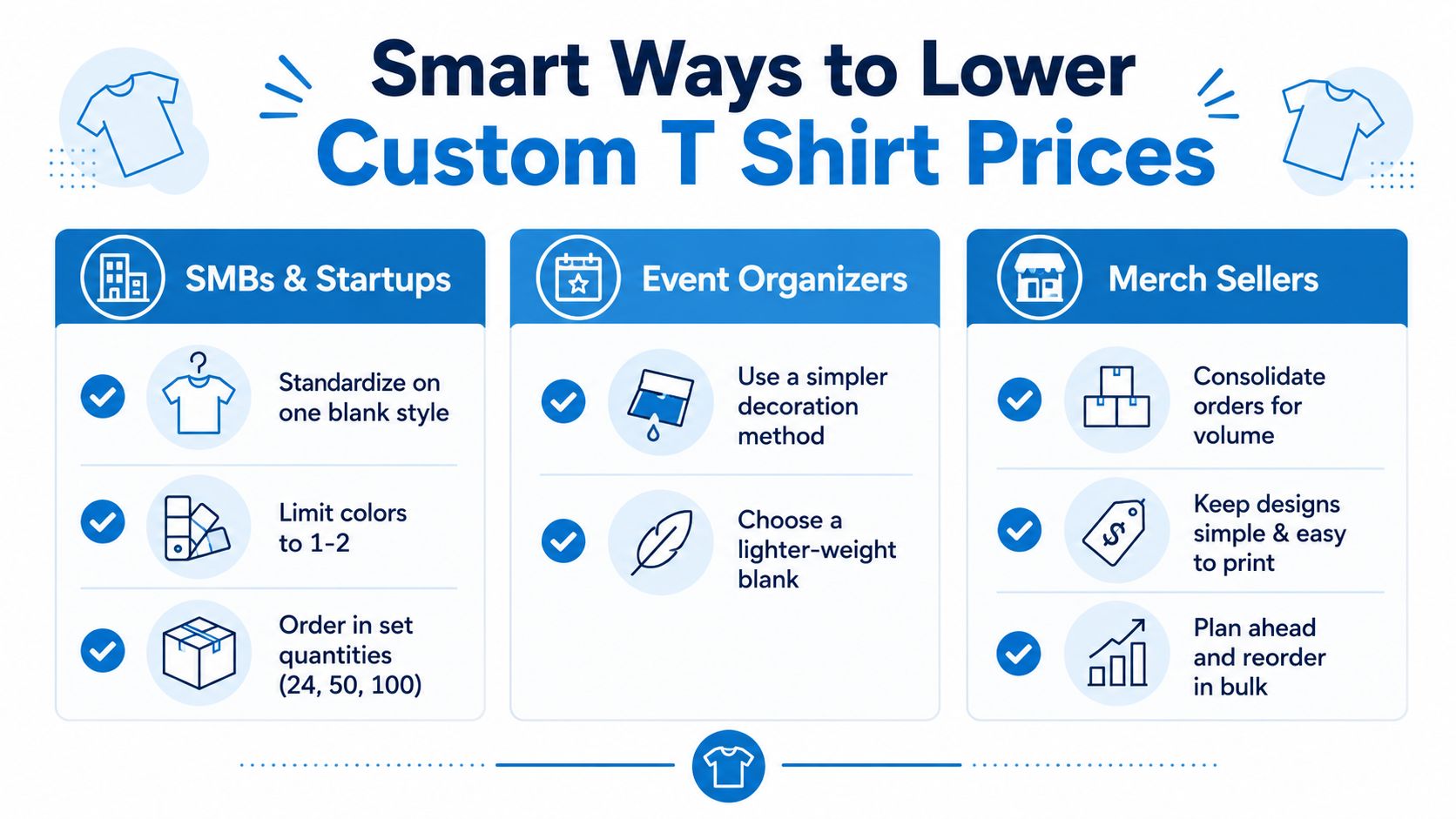
Standardize on one blank style so future orders use familiar sizing and fewer purchasing decisions. Limit artwork to one or two colors, choose a practical print location, and consolidate reorders instead of placing several small jobs.
Ask vendors to quote meaningful quantity breaks such as 24, 50, 100, and 250 pieces. Those thresholds can change how setup and garment pricing are allocated. A rate card can also help you compare the full landed quote rather than reacting to the cheapest blank.
For events and fundraisers
Lock artwork early, send production-ready vector files when possible, and ship the full order to one address. Individual delivery adds handling and makes a simple apparel job harder to control.
Skip unnecessary packaging extras when the shirts will be handed out at one location. Pick a decoration method that matches the artwork instead of forcing a highly detailed process onto a simple event logo.
For retailers and merch sellers
Negotiate around planned annual volume, approve a repeatable ink palette, and schedule gang runs when the design and garment allow it. Keep reorder specifications on file, including blank style, color, placement, and approved artwork.
Use a simple margin model before setting a retail price. These ecommerce pricing strategies are useful when you're deciding how decoration cost, shipping, and margin should work together.
For agencies and resellers
Build a printable rate card with clear assumptions. Use reusable mockup templates, separate one-time setup from recurring production, and spread setup amortization across repeat runs when the client commits to a program.
A reorder checklist should capture:
- Artwork: Final file, print size, placement, and approved proof.
- Color: Pantone references or thread colors where needed.
- Garment: Brand, style, fabric, color, and size breakdown.
- Logistics: Ship-to address, delivery window, and packaging requirements.
- Approval: The person authorized to release production.
If you want broader guidance on planning apparel and promotional purchases, the following video offers another practical perspective.
Ready to Order and Request a Quote
A complete brief is the fastest route to an accurate number. Send the garment style, garment colors, quantity by size, and preferred decoration method, whether that's screen printing, DTF, DTG, embroidery, or sublimation.
Include the number of print locations, the artwork file, and any Pantone or thread-color requirements. Add the in-hands date and ship-to ZIP code. Tell the decorator whether the artwork is final or still needs cleanup, because larger ink counts, multiple locations, and quantities under 24 can extend turnaround.
Dirt Cheap Product, Inc. handles screen printing, embroidery, DTF, sublimation, and custom patches across apparel such as T-shirts, polos, outerwear, hats, and bags. Production begins after art approval and deposit, and rush production windows are available for an added fee.
Submit the brief through the online quote form or email it with the required specifications. The more complete the first request, the less back-and-forth you'll need before approving the landed cost.
Dirt Cheap Product, Inc. can help businesses, events, retailers, nonprofits, and agencies compare garment choices, decoration methods, setup charges, and delivery requirements. Visit Dirt Cheap Product, Inc. with your artwork, quantity, and deadline to request a quote built around your actual custom T-shirt order.