You're probably here because the usual hat options aren't getting you where you need to go. Direct embroidery feels too limited for your logo, stock blank caps look generic, and you need something that can work for a staff program, a retail drop, or an event order without looking cheap.
That's where custom patches for hats start making sense. They give you more control over texture, finish, and brand presentation, but they also introduce decisions that first-time buyers often don't expect. Material, attachment method, artwork setup, placement, minimums, and long-term wear all affect whether the final hat looks polished or frustratingly off.
A good hat patch order isn't just about picking a cool patch type. It's about matching the patch to the hat, the use case, and the way the hats will be worn.
Table of Contents
- Why Custom Patches Are a Smart Choice for Hats
- A Material Guide to Custom Patch Types
- Choosing the Right Attachment Method
- Design and Placement for Professional Results
- Custom Patch Hats in Action
- Ordering with Dirt Cheap Product A Simple Walkthrough
- Caring for Your Custom Patch Hats
Why Custom Patches Are a Smart Choice for Hats
Most buyers start with the logo. Experienced buyers start with the decoration method.
Custom patches for hats work differently from direct embroidery because the decoration is created separately from the cap and then applied to it. Independent apparel sources describe patch hats this way and note that this separation opens up more material options, including leather, woven, embroidered, and sublimated patch styles, while also making it easier to reuse the same patch design across multiple hat SKUs for consistent branding across a line of products or programs (Whitefish Printing on how patch hats separate decoration from the hat itself).
That matters more than most first-time buyers realize.
If you're outfitting a sales team, launching branded merch, or ordering event hats in more than one cap style, a patch system gives you flexibility that direct embroidery usually doesn't. You can keep one visual identity across trucker hats, snapbacks, dad hats, and beanies without rebuilding the decoration approach every time.
Why buyers choose patches instead of stitching straight into the cap
A patch gives your brand a distinct surface. Instead of thread disappearing into the fabric of the hat, the patch creates a clear boundary, a stronger silhouette, and often a more premium feel.
That's especially useful when your logo needs one of these things:
- Material contrast: Leather, faux leather, PVC, woven, and embroidered constructions all communicate different brand moods.
- Consistent presentation: The same patch art can be carried across several hat styles with less visual drift.
- A dimensional look: Many patches create a raised or framed effect that reads more like product branding than standard promo decoration.
Practical rule: If the hat needs to look like merchandise someone would choose to wear, not just something they were handed, a patch is often the better path.
Where patches tend to work best
Custom patches for hats make the most sense when the order serves a clear brand purpose.
They're a strong fit for:
- Retail collections: You want a hat that feels designed, not merely logoed.
- Event programs: You need a recognizable visual that works across different hat colors or styles.
- Uniforms and teams: You want repeatable branding that stays consistent over reorders.
The key is to treat the patch as part of the product design, not an add-on at the end. Buyers who make that shift usually get much better results.
A Material Guide to Custom Patch Types
Material choice does more than change appearance. It affects detail, durability, perceived value, and whether the hat still looks good after real use.
Embroidered for texture and tradition
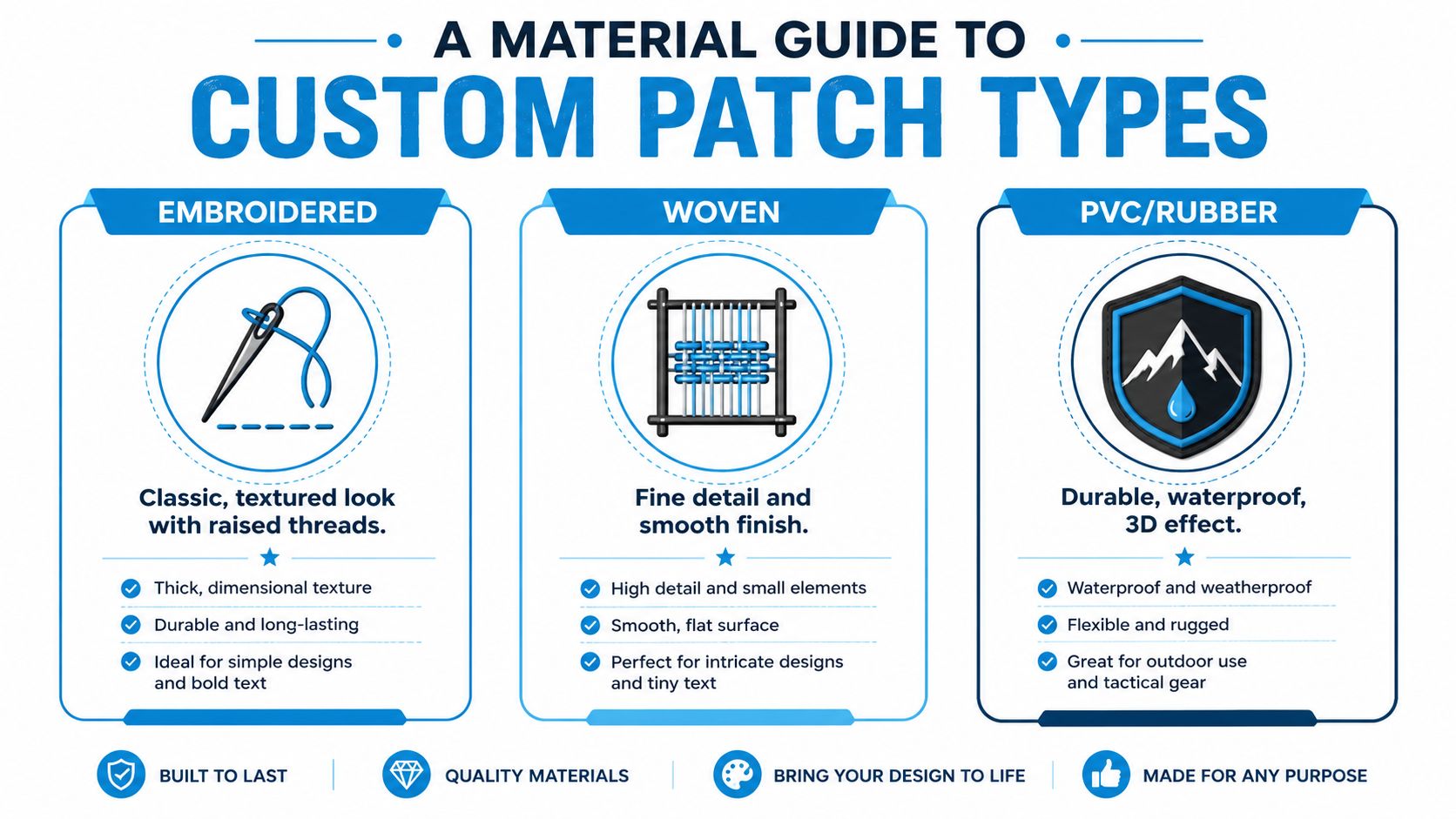
Embroidered patches are the familiar option. They create raised thread texture and a classic branded look that works well for bold logos, simple icons, mascots, and badge-style designs.
They do not handle every design equally well. Industry guidance notes that classic embroidered patches are better suited to bolder geometry and designs around 2 inches or larger, because heavy thread can crowd small details and fine lines (Monterey Company on patch material performance for hats).
Choose embroidered when you want:
- A traditional look: Good for heritage branding, workwear, clubs, and team identity.
- Noticeable texture: Thread adds visual depth, especially on structured caps.
- Simple artwork: Strong shapes and limited fine detail hold up best.
Skip embroidered if your logo depends on tiny text, thin outlines, or subtle interior detail. In those cases, thread bulk can make a smart design look muddy.
Woven and sublimated for detail
Woven patches are flatter and cleaner than embroidered patches. They hold smaller elements better and usually produce a sharper-looking logo when the artwork has finer lines or more intricate detail.
The same guidance that limits embroidery on small details points buyers toward woven or sublimated constructions when detail retention matters, because those formats preserve finer visual information better than thick stitched thread does.
That makes woven a better choice for:
- Detailed logos: Fine linework, smaller lettering, or more compact layouts.
- Modern retail aesthetics: Smooth finish, less bulk, cleaner edge definition.
- Softer hat styles: Dad hats and unstructured caps often look better with a patch that doesn't add as much visual weight.
Sublimated patches solve a different problem. They're useful when the design relies on print-style detail, color transitions, or artwork that would be clumsy in thread. They generally feel less tactile than embroidery, so they're more about image clarity than texture.
If your buying team is also comparing decoration formats across apparel categories, this overview of custom patches for uniforms is useful because the same trade-offs around detail, durability, and brand feel carry over to hats.
A logo can look perfect on a screen and still fail on a hat if the patch material fights the artwork.
PVC and leather for wear and brand feel
PVC or rubber-style patches are usually chosen for function first and style second, though they can do both well. They offer a bold, modern look and are often favored when the hats will face outdoor use, moisture, abrasion, or frequent handling. Material guidance for hat patches specifically notes that waterproof or highly durable materials are a smart choice when the patch will see outdoor wear or repeated washing.
PVC makes sense for:
- Outdoor events
- Fishing, marine, or fitness brands
- Workwear or utility programs
- Giveaway hats that will get worn hard
Leather and faux leather go in a different direction. They signal texture, craftsmanship, and a more retail-driven presentation. They're often the right call when the hat is meant to feel premium, understated, or private-label.
Use leather-style patches when you want the hat to feel:
- Rugged
- Boutique
- Lifestyle-oriented
- Giftable or shelf-ready
A quick comparison table
| Patch type | Best for | What it does well | Where it can struggle |
|---|---|---|---|
| Embroidered | Bold logos, traditional branding | Raised texture, classic look | Fine detail, very small text |
| Woven | Detailed logos, cleaner aesthetics | Sharp detail, smooth finish | Less tactile than embroidery |
| Sublimated | Print-heavy artwork, complex visuals | Preserves graphic detail | Less dimensional feel |
| PVC/Rubber | Outdoor wear, hard-use hats | Durable, modern, weather-friendly | Can feel too sporty for some retail looks |
| Leather/Faux leather | Premium retail, outdoor lifestyle branding | Texture, warmth, elevated brand feel | Not ideal for every wash routine |
Choosing the Right Attachment Method
Attachment is where many hat orders either become durable or become a headache later. A good-looking patch with the wrong backing can lift at the edges, sit awkwardly on the crown, or feel stiff in all the wrong ways.
Sew-on when permanence matters
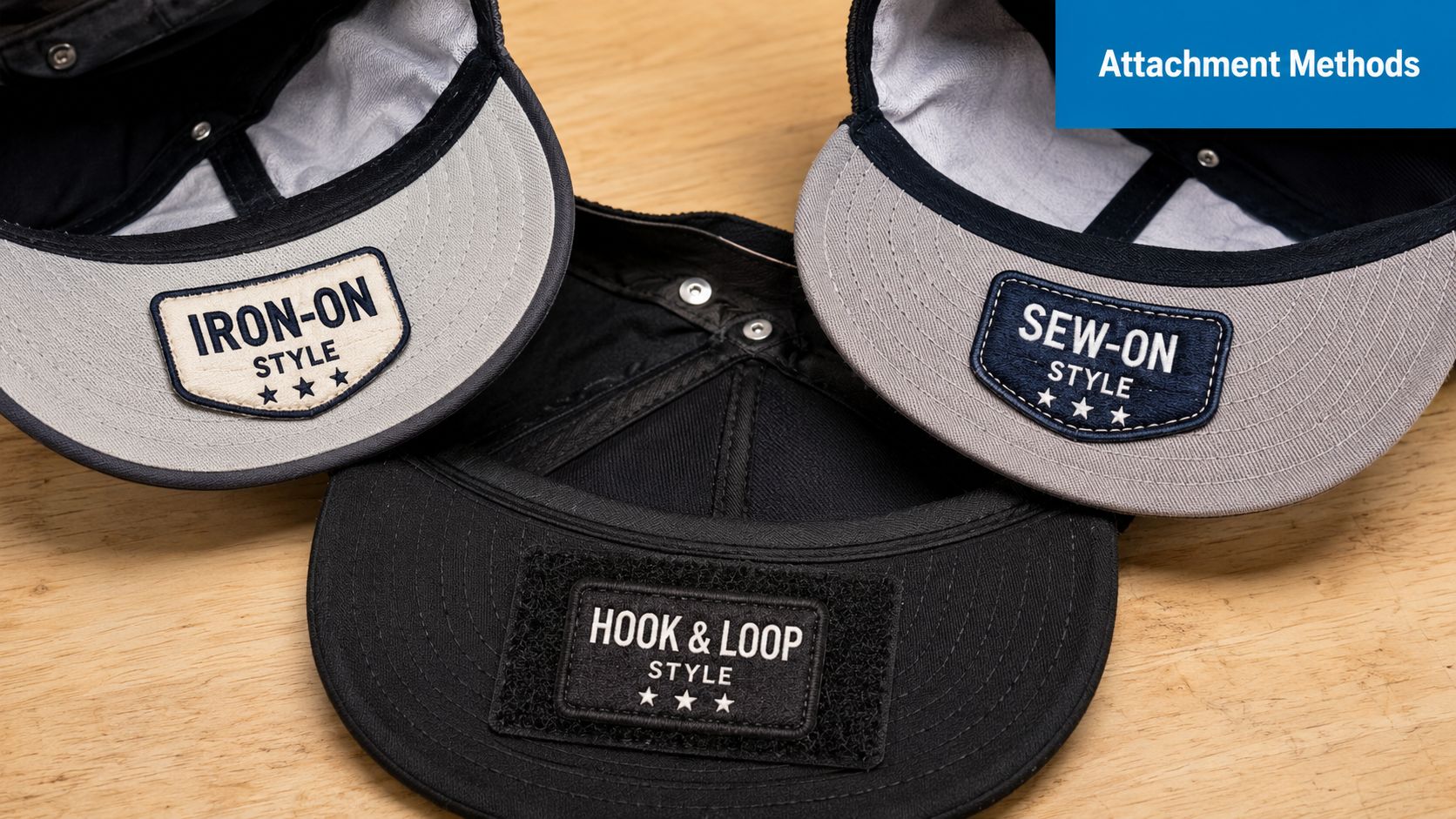
Sew-on is the safest choice when you want a patch to stay put through regular wear. It's the method I'd treat as the default for retail hats, staff uniforms, and any program where durability matters more than speed of application.
Sew-on usually works best when:
- The hat is part of a long-term uniform
- You're selling the hat at retail
- The patch material has some weight to it
- You want the cleanest long-term hold
A sewn patch generally looks more intentional because it's physically integrated into the hat. It also handles repeated wear better than lighter attachment methods.
If you're ordering hats people will keep for a long time, sew-on is the standard I'd measure everything else against.
Heat-applied when speed matters
Heat-seal or iron-on styles can be useful when you need faster application or a simpler production flow. They're often chosen for promotional runs, lighter-use event hats, or projects where the patch material and hat surface cooperate well.
The trade-off is simple. Heat-applied patches can save effort during application, but they're less forgiving if the hats face heavy washing, high heat, or hard wear over time.
That doesn't mean they're wrong. It means they're situational.
Choose heat-applied when:
- The hats are short-cycle event merchandise
- You need a clean front appearance without visible stitch lines
- The use case is lighter and less demanding
- Application speed is part of the budget decision
Here's a short visual reference if you want to see common attachment styles in context:
Hook-and-loop when flexibility matters
Hook-and-loop attachment is less common for standard retail branding, but it solves a real operational problem. If the patch needs to be swapped, updated, or customized by role, event, or team unit, this is the practical route.
That makes sense for hats used in:
- Tactical or field settings
- Staff roles that change by event
- Limited-run activations with interchangeable branding
- Programs where buyers want one hat base and multiple patch options
The downside is appearance. Hook-and-loop usually looks more functional than refined. If your brand needs a polished retail finish, it often isn't the first choice.
Design and Placement for Professional Results
A strong patch design can still fail on the hat if the artwork is overbuilt or the placement fights the shape of the cap. Most production problems start before manufacturing, usually in the art file.
Start with production-ready artwork
For custom patches for hats, the artwork should be prepared for small-scale legibility. Hat patch guides recommend vector files such as .AI, .EPS, or high-resolution PDF, and if you're supplying raster artwork, it should be at least 300 DPI so edge quality and stitch placement hold up during digitizing (Better Emblem on artwork setup for hat patches).
That file standard matters because hats don't give you much room to hide mistakes. Fine text, thin outlines, narrow gaps, and tiny decorative details often collapse once the design is translated into thread, weave, or molded material.
A practical checklist helps:
- Simplify small text: If it needs to be read at a glance, make it larger or remove it.
- Thicken delicate lines: Hairline detail usually doesn't survive physical production well.
- Reduce clutter: One clear mark beats a complicated logo squeezed into a small patch.
- Use strong contrast: The patch and the hat should support each other, not blend together.
For buyers comparing front, side, and specialty placements, this placement guide for embroidery is a useful reference because many of the same alignment and visibility principles apply to patches.
Shop-floor reality: The hat front is a small billboard. If the logo only works when enlarged on a screen, it needs revision before production.
Match the patch to the hat shape

Placement should follow the hat structure. A structured cap can carry a bolder front patch, while a soft dad hat usually looks better with a patch that feels lighter and more proportional to the curved crown.
Common placement choices work for a reason:
| Placement | Works best when | Watch out for |
|---|---|---|
| Center front | The logo is the main statement | Oversized patches on softer crowns |
| Side panel | You want a subtle branded accent | Losing visibility from a distance |
| Back arch area | Secondary logo or short wordmark | Detail becoming too small |
| Off-center front | The brand style is more fashion-driven | Looking accidental instead of intentional |
Round patches, badge shapes, and clean rectangles tend to be easier to place well than complicated die cuts. The more irregular the shape, the more carefully it needs to be tested against seams, crown curve, and front-panel height.
Custom Patch Hats in Action
A lot of buying decisions become easier once you stop asking which patch type is best in general and start asking which one fits the job.
Retail brands and premium presentation
A boutique-style retail brand usually doesn't want a hat that feels like generic promotional merchandise. In that setting, leather, faux leather, faux suede, and laser-cut styles often make more sense because they support a more designed, shelf-ready look.
Recent industry analysis aimed at apparel sellers points to a broader mix of patch styles, including leather, faux leather, faux suede, print-stitch, PVC, sublimated, and laser-cut, as some of the “hottest” options for 2025, signaling a visible shift toward texture and premium finishes in hat branding (Apparel Graphics on patch styles highlighted for 2025).
That trend lines up with what buyers often want in retail: less “company hat,” more “brand product.”
A few examples make the differences clear:
- Coffee roaster or brewery: A bold embroidered badge can feel familiar and collectible.
- Outdoor lifestyle label: Faux leather or leather-style patches often create the rugged retail look buyers expect.
- Streetwear capsule: Woven or print-stitch styles can keep logos crisp and modern without old-school bulk.
Events, teams, and practical branding
An event organizer usually has a different priority. The hat needs to survive transport, handling, weather, and a crowded setup day. In those cases, PVC becomes attractive because it combines a clear graphic presence with a material that handles rougher conditions better than some softer patch types.
Corporate and team orders often land elsewhere. They may still choose embroidered patches because the design is simpler, the look is more familiar, and the hats need to read as unified branded apparel rather than trend-driven merchandise.
Different situations call for different answers:
A patch that looks right in a retail shop may be the wrong choice for a beach event, and the patch that survives a field team's workday may be too aggressive for a boutique brand.
That's the practical lens buyers should use. Match the patch to the setting, not just the mood board.
Ordering with Dirt Cheap Product A Simple Walkthrough
A first hat order usually slows down in the same place. The buyer asks for pricing before the job is defined, then the proof comes back with avoidable revisions on size, material, or placement.
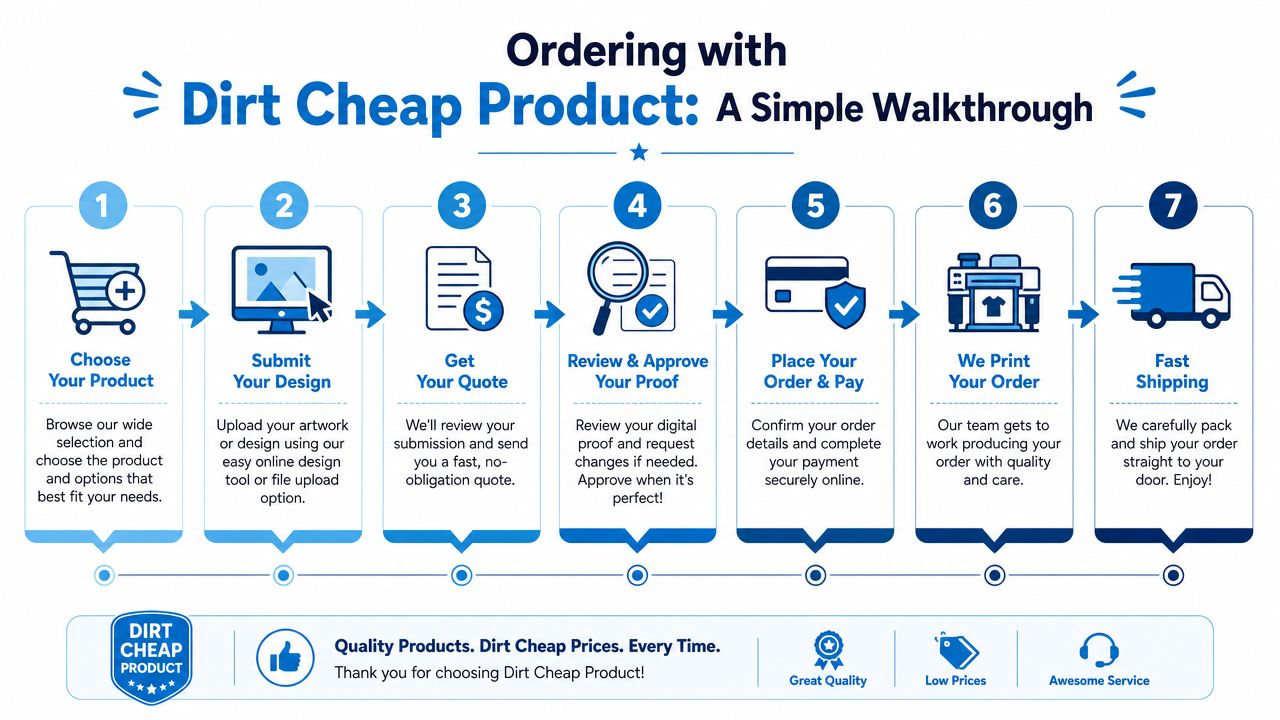
The fastest orders start with three decisions already made: which hat you want, which patch type fits the job, and how the hats will be used. That gives the supplier enough direction to quote accurately and flag production issues early.
What to prepare before you request a quote
Start with your artwork. Vector files are best because they hold detail cleanly during proofing and resizing. If you only have a PNG or a screenshot, send the cleanest version you have and expect some artwork cleanup if the logo has fine text, thin outlines, or small interior shapes.
Then define the production details that affect cost and quality:
- Hat style: Trucker cap, snapback, dad hat, beanie, or another base
- Patch material: Embroidered, woven, PVC, chenille, leather-look, or another finish
- Placement: Front center, side, back, or multiple locations
- Use case: Retail sale, staff uniform, event giveaway, fundraiser, or merch program
- Expected quantity: Your first run and any likely reorder volume
Quantity matters early because it affects whether a premium patch choice still makes sense on the budget side. A leather-look patch on a small retail run may work well. A large event order may call for a simpler patch and a hat blank that keeps the total unit cost under control.
If you are building around high-visibility colorways, review the hat first, then the patch. A bright base changes contrast more than many first-time buyers expect. For example, neon trucker hats for event merch or summer promotions can make dark borders and simple shapes read better than fine detail.
What happens after you submit artwork
After submission, the supplier reviews the art and builds a proof. Dirt Cheap Product, Inc. offers logo upload, proofing, and custom decoration across apparel and accessories. For hat patch orders, the proof is the point where buyers should slow down and check production reality, not just confirm that the logo looks familiar.
A useful proof review answers practical questions:
- Will the logo still read clearly at patch size?
- Does the patch shape sit naturally on the front panel?
- Does the chosen material support the artwork, or soften details too much?
- Will the finished hat feel right for the buyer, attendee, or staff member who will wear it?
This step catches expensive mistakes. I have seen buyers approve artwork that looked fine on screen but felt undersized once applied to a structured trucker front. I have also seen the opposite problem, where a large patch crowded the crown and made the hat look promotional instead of retail-ready.
What to expect on quantity and approval
Custom patch hats usually make the most sense for branded runs, not one-off personalization. Production setup, patch making, and decoration labor favor a batch order.
One retail-focused source notes a minimum order of 50 patches, which reflects a common threshold for custom branding programs rather than single-item customization (Jupmode on custom patch order minimums).
That minimum shapes the buying decision. It pushes the order toward a defined use case, such as a staff rollout, a seasonal merch drop, a customer giveaway, or an event package where the hats need to look consistent from the first carton to the last.
Once you approve the proof, keep the job stable. Last-minute changes to patch material, border shape, or placement often create the delays and quality problems buyers later attribute to production.
Caring for Your Custom Patch Hats
Care matters more than most buyers think. A hat can look excellent on delivery and disappoint later if the patch material wasn't matched to the way the hat would be worn and cleaned.
That's one reason care and durability remain such an overlooked topic in this category. Industry guidance notes that buyers increasingly want branding that survives sweat, heat, sun exposure, and repeated washing, but most content still doesn't explain material-specific care clearly enough (Dutch Label Shop on the gap in care guidance for hat patches).
Care by patch material
Different patch types need different handling.
- Embroidered and woven patches: Spot clean when possible. If the hat needs more than light cleaning, hand washing is usually the safer route because it reduces edge wear and helps preserve shape.
- PVC patches: Wipe clean with mild soap and water. These are often the easiest to maintain when the hats see outdoor use or frequent handling.
- Leather and faux leather styles: Avoid soaking and avoid machine washing. These materials are chosen for surface character, and rough washing can dry them out, distort them, or dull the finish.
- Heat-applied patches of any kind: Keep them away from excessive heat during cleaning and drying. High heat is one of the fastest ways to shorten the life of the bond.
What protects your brand image
The biggest care mistake isn't always washing. Sometimes it's storage.
Don't leave branded hats crushed in a hot vehicle, damp in a gear bag, or stacked under heavier merchandise for long periods. Sweat, sun, and pressure all affect how a patch ages. If the hats are part of a uniform issue or event package, include simple care instructions with the order so the branding stays presentable longer.
The right custom patches for hats can make a brand look more intentional, more retail-ready, and more memorable. Proper care is what keeps them that way.
If you're planning a hat order and want help sorting through patch materials, placement, or artwork setup, Dirt Cheap Product, Inc. can be a practical place to start. Upload your logo, define the hat style and use case, and review the proof carefully before production so the finished hats match the way your brand needs to show up.