You're probably ordering neon trucker hats for one of three reasons. You need staff easy to spot at an outdoor event, you want giveaway merch people will wear, or you're trying to build a loud retail look that doesn't disappear in a crowded booth.
That bright color helps, but it also changes how the job should be produced. Neon foam fronts react differently than standard cotton twill. Fine details can blur. Dense embroidery can pucker the crown. Too much heat can scorch the foam and ruin a whole run. The difference between a hat that looks sharp and one that looks cheap usually comes down to a few production choices made early.
A good order starts with the blank, then the decoration method, then the artwork, then the timeline. If you get those in the right order, neon trucker hats can look clean, hold up well, and do the job they're supposed to do.
Table of Contents
- First Decision: Selecting the Right Neon Hat Base
- Bringing Your Vision to Life: Custom Decoration Options
- Artwork and Proofing: Getting Your Design Ready
- Navigating the Ordering Process
- Beyond Delivery: Professional Packaging and Care
- Your Quick-Reference Guide to Success
First Decision: Selecting the Right Neon Hat Base
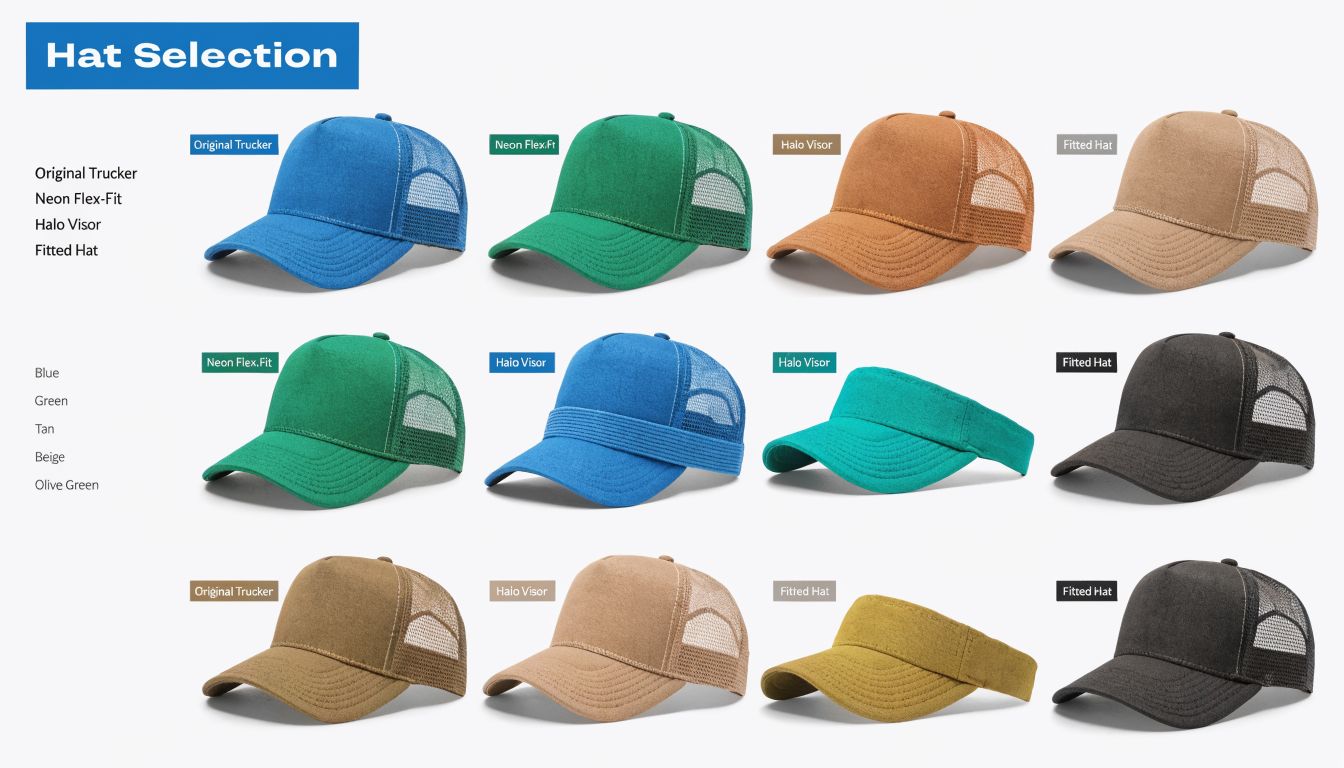
The hat blank matters more than most buyers expect. If the base is wrong, no decoration method will save it. Neon trucker hats need to look bright, but they also need to stay stable through printing or stitching.
Start with the front panel shape
If your logo needs a clean, uninterrupted face, a 5-panel trucker is usually the easiest canvas. The front panel gives your art one open area without a center seam breaking through text or a badge shape.
A 6-panel trucker can still work well, especially for simpler marks or designs that sit high and wide. But the center seam becomes part of the decoration decision. On some logos, that seam is harmless. On others, it cuts straight through the most important detail.
Check the foam and mesh like a decorator would
Foam quality matters because neon fronts are often where production problems start. For businesses in construction or outdoor event management, durability is key. Many listings praise visibility but leave out useful details about foam degradation, mesh quality, or dye fading under UV exposure, which is why evaluating technical specs matters before treating the hats like a long-term branding piece rather than a novelty item, as noted in this overview of durability concerns with neon foam trucker hats.
Use this quick screen when comparing blanks:
- Foam firmness: Too soft and the front collapses under stitching or pressure.
- Mesh recovery: Low-grade mesh stretches out fast and makes the hat look worn early.
- Crown structure: Structured crowns hold logos better, especially for uniform programs.
- Color consistency: Neon shades vary more than buyers expect across mills and batches.
Practical rule: If the blank already looks wavy, uneven, or flimsy before decoration, it won't improve once your logo goes on it.
Match the hat to the job
A festival giveaway, a retail drop, and a field crew uniform shouldn't all use the same base. Event teams often want maximum visibility and quick turnaround. Retail brands usually care more about profile, hand feel, and shape retention. Workwear buyers need consistency across repeat orders.
If you're still comparing silhouettes and want a wider view of what works across categories, it helps to find promotional headwear for businesses before you narrow down the final trucker style. For a more focused look at common cap constructions and blank options, this roundup of mesh hat brands is useful for sorting through practical differences.
Don't choose color in isolation
Neon green, neon yellow, neon orange, and hot pink don't all behave the same once decorated. Some shades make black thread look crisp. Others need a white layer under print to keep the artwork from getting muddy. A color that pops under daylight can feel harsher under indoor event lighting.
That's why the best first decision isn't “Which neon looks coolest?” It's “Which hat gives my logo the best chance to stay readable and professional?”
Bringing Your Vision to Life: Custom Decoration Options
Once the base is chosen, the decoration method decides whether the finished hat feels premium, playful, rugged, or rushed. Neon trucker hats don't forgive bad method matching. The wrong choice usually shows up fast through puckering, blurred detail, or a logo that feels disconnected from the hat.
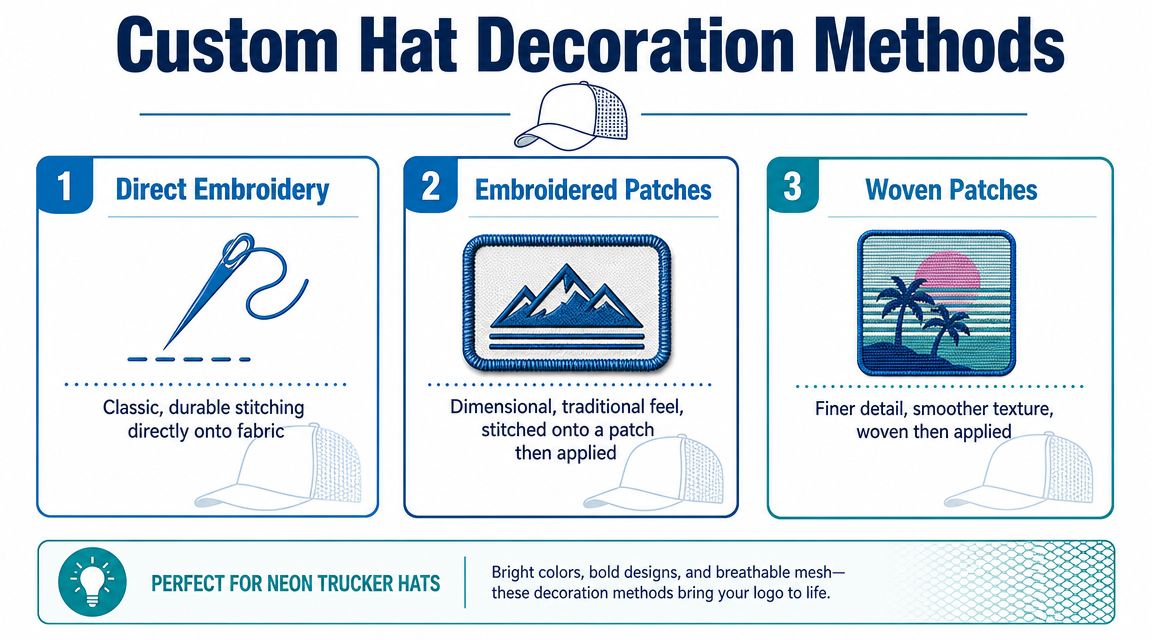
Direct embroidery
Embroidery gives neon trucker hats a familiar branded look. It's tactile, durable, and often the right fit for uniforms, golf-style branding, and logos that need a stitched finish instead of a printed one.
But foam fronts require discipline. For embroidery on foam, digitizing logos with a minimum height of 0.5 inches and using a 40 to 60% pull compensation setting is important to accommodate foam expansion. Stitching at 650 to 750 SPM with a ballpoint needle helps prevent runs, supporting a 96% first-pass approval rate on bulk orders according to the benchmark details in the Hudson Brights reference.
Embroidery works best when the logo is bold and not too intricate. It struggles when buyers try to force tiny text, thin outlines, or packed-in detail onto a puffy neon crown.
Patches
Patches solve a lot of problems embroidery can't. If your logo has a badge shape, an outlined border, or a lot of internal detail, a patch often reads cleaner than stitching straight into foam.
Here's the practical split:
| Method | Best for | Watch out for |
|---|---|---|
| Embroidered patch | Traditional logos, bold outlines, heritage look | Can feel heavier on lightweight fronts |
| Woven patch | Smaller detail, cleaner lines, smoother surface | Doesn't have the same raised texture as embroidery |
| PVC patch | Rugged outdoor look, modern branding, wipe-clean surface | Aesthetic can feel too tactical for some brands |
Patches also let you create a consistent logo piece first, then apply it to multiple hat colors without reworking the entire art setup.
If your logo has detail that barely survives on paper, don't force it into direct embroidery on foam. Use a patch and keep the front panel clean.
DTF and hybrid looks
For logos with gradients, multiple colors, or artwork that thread can't reproduce well, DTF is often the best fit on neon foam. It gives you color range that embroidery and standard stitched patches can't match.
This is especially useful for promo hats tied to seasonal campaigns, creative brands, or designs that need a printed look instead of a stitched one. It can also pair well with embroidery in a hybrid build, where one element carries texture and another carries color detail.
A lot of brands also order neon trucker hats for creator mailers, event drops, or branded seeding kits. If that's your use case, the operational side matters too, and this Famcut.com guide to influencer gifting platforms is a helpful planning resource for managing distribution around the merch itself.
What usually works best
Use direct embroidery when the logo is simple and you want a classic finish. Use patches when detail, edge control, or style flexibility matter more. Use DTF when the art is too colorful or too complex for thread.
The best-looking neon hats rarely come from forcing one method onto every logo. They come from matching the logo to the method authentically.
Artwork and Proofing: Getting Your Design Ready
Most production mistakes don't start on press or on the embroidery machine. They start with weak art files, unclear instructions, or a proof that got approved too quickly.
Give production a file that can actually be used
The cleanest starting point is a vector file, usually AI, EPS, or a well-built PDF. That gives the decorator scalable art with defined shapes instead of a flattened image pulled from a website.
A PNG can sometimes work for mockups. A low-resolution JPEG usually can't. If the logo is blurry on your screen, it won't get sharper once it hits a neon foam crown.
What to send with the art:
- Primary logo file: Vector whenever possible.
- Alternate version: A simplified logo if your main mark is too detailed.
- Brand colors: Thread or print color preferences, especially if black, white, or contrasting outlines are important.
- Placement notes: Front center, left front, oversized patch, or any special request.
Design for the hat, not just for the brand guide
Some logos were built for websites, signage, or packaging. That doesn't mean they'll survive on a trucker hat without edits.
When screen printing on neon foam, fonts should have a minimum height of 0.35 inches and a stroke thickness of at least 0.07 inches to avoid blurring. Using an under-base white can improve color pop by up to 30% on fluorescent surfaces, which is especially important for vibrant branding on neon fronts, according to the process notes in this screen printing reference for neon foam hats.
That tells you two things right away. Tiny lettering is risky, and contrast needs to be engineered, not assumed.
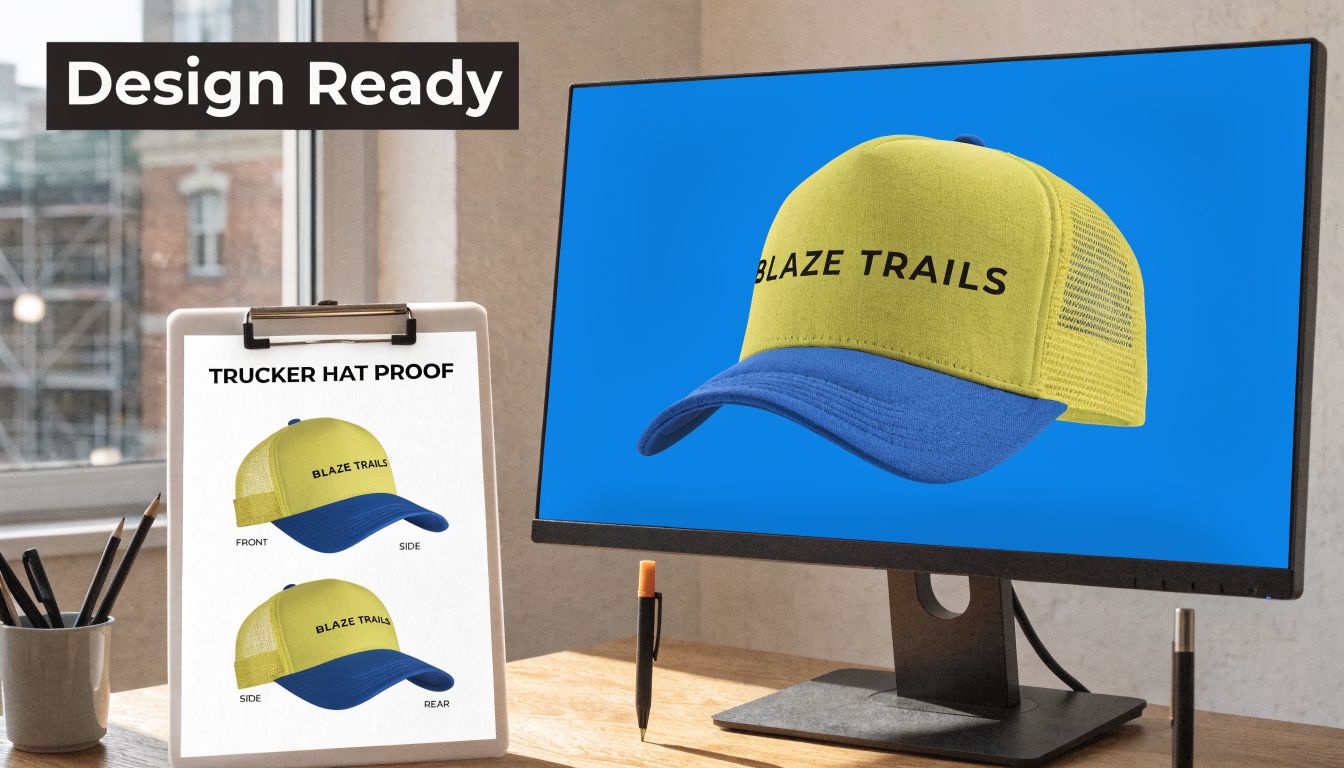
Read the proof like a buyer, not like a bystander
A proof is the last cheap fix in the whole project. After approval, changes become slower, messier, and more expensive.
Check these items every time:
- Spelling and punctuation. Simple, but preventable mistakes happen at this stage.
- Logo size. On hats, a quarter inch can change readability a lot.
- Placement. A centered logo on paper can still look too high or too low on a crown.
- Color contrast. Neon backgrounds can distort how your logo feels.
- Method fit. If the mockup shows detail that won't survive production, ask for a revision before approving it.
Review note: If a proof looks crowded on screen, it usually looks worse in real life once the curve of the hat comes into play.
For teams that want a better sense of how stitched layouts translate to a cap face, this placement guide for embroidery helps clarify common positioning choices.
Simplify before production forces the issue
The best proofing conversations often end with a smaller number of stronger design elements. A cleaner logo, a stronger outline, or a patch instead of direct stitching can prevent the kind of compromise no one likes seeing after the boxes arrive.
Neon trucker hats already do a lot visually. Your artwork doesn't have to fight them to get attention.
Navigating the Ordering Process
Ordering custom hats goes smoother when you treat quantity, timeline, and decoration as one decision instead of three separate ones. Buyers usually run into trouble when they lock a deadline first, then choose a complicated logo treatment second, and only ask about pricing last.
Think in terms of project fit, not just unit price
While product pages list prices, they often don't provide a real cost-benefit analysis. The more useful question is whether neon trucker hats can create stronger recall and engagement in the setting where you'll use them, which is the missing ROI angle described in this discussion of neon trucker hat promotional value.
That's why a cheaper hat isn't always the better buy. If the blank feels weak, the decoration fails, or the style doesn't fit the audience, the order costs less per piece and performs worse overall.
What changes your quote fastest
Pricing usually shifts for practical reasons, not mysterious ones. These are the levers buyers control most:
- Quantity: Larger runs usually open better economics than short runs.
- Decoration method: Direct embroidery, patches, and DTF each carry different setup and production demands.
- Artwork complexity: More detail can mean more prep, more thread changes, or added production time.
- Hat choice: Premium blanks change the look and the budget at the same time.
A buyer planning a trade show giveaway may choose a simpler logo and larger volume. A boutique brand may choose a better blank and a patch because the finish matters more than maximizing count.
Build the timeline backward from the event
A reliable order schedule usually includes time for quoting, artwork review, proof approval, production, packing, and shipping. The part buyers most often underestimate is proofing. One delayed approval can compress everything behind it.
Use a simple planning sequence:
| Stage | What should happen |
|---|---|
| Inquiry | Confirm blank style, color, quantity, and decoration method |
| Artwork review | Test whether the logo fits the hat and method cleanly |
| Proof approval | Catch placement, spelling, and scale issues before production |
| Production | Run the order with the approved specifications |
| Delivery buffer | Leave room for transit and event prep |
If you're ordering for a team, expo, fundraiser, or recurring staff use, this page on custom logo hats wholesale bulk orders gives a solid overview of the bulk-order side of planning.
The safest event order is the one approved early enough that nobody has to choose between speed and quality.
Rush orders can be done. They're just where compromises show up first.
Beyond Delivery: Professional Packaging and Care
The hats aren't finished when production ends. They're finished when someone opens the box, picks one up, and decides whether it feels like useful merch or throwaway swag.
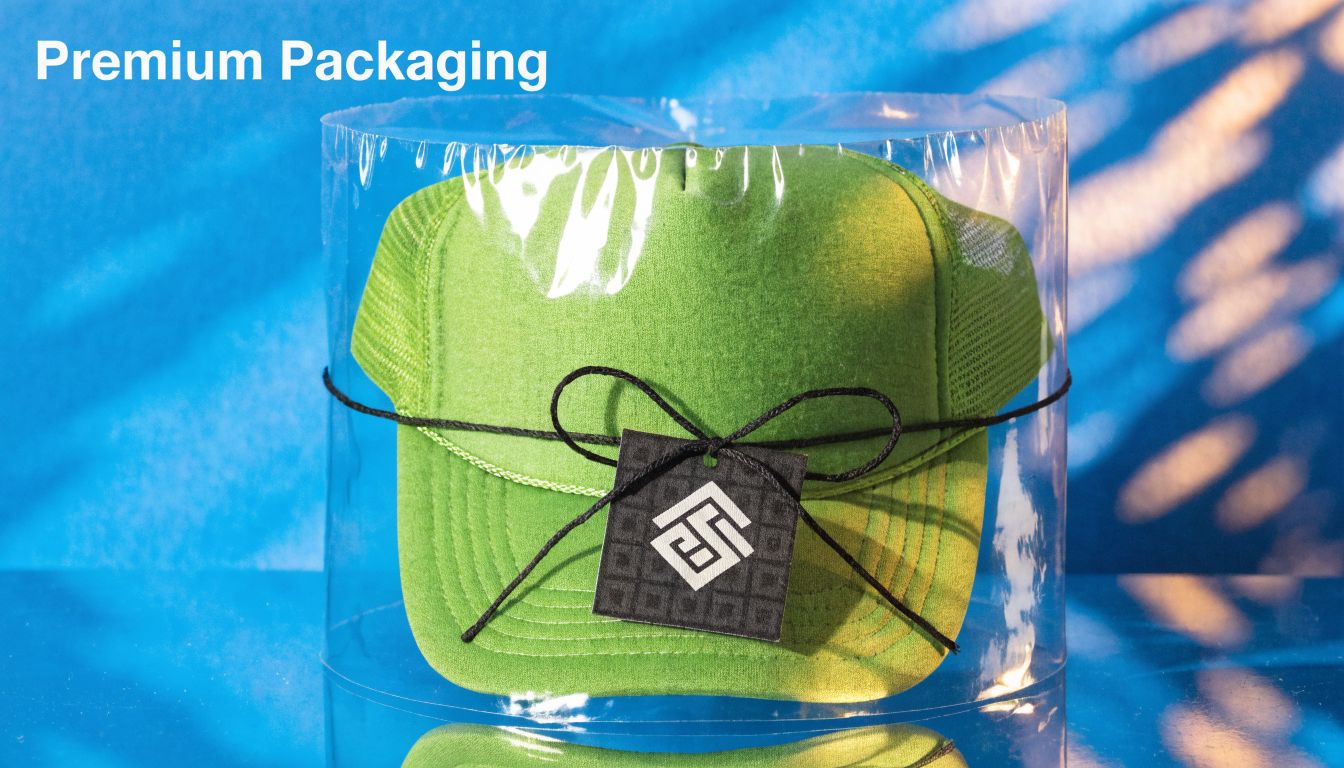
Packaging affects perceived value
Packaging doesn't need to be elaborate to work. It needs to protect the shape, keep the front panel clean, and present the hat like it belongs to a real brand.
Good options depend on how the hats will be used:
- Individual polybagging: Useful for shipping, cleaner handout conditions, and keeping bright hats dust-free.
- Hang tags: Better for retail racks or donor packs where branding context matters.
- Grouped event packing: Helpful when teams need sizes, colors, or departments sorted fast.
- Retail-style presentation: Stronger fit for boutiques, launch kits, or premium gift boxes.
A crushed crown or dirty foam front can make a perfectly good production run look careless on arrival.
Care instructions matter more with foam fronts
Neon trucker hats need simple, direct care guidance. Foam-front hats don't love aggressive washing, heat, or rough handling. If you hand them out without instructions, people will treat them like standard laundry items and shorten the life of the hat.
A basic care card should tell recipients to:
- Spot clean only with mild soap and a soft cloth.
- Avoid machine washing if they want to preserve shape and decoration.
- Air dry instead of using high heat.
- Store carefully so the foam crown doesn't get crushed.
That's not overexplaining. It protects the product and your brand at the same time.
A short visual check helps before distribution
Before the hats go to staff, customers, or attendees, open a sample carton and inspect a few pieces in normal light. Look for bent brims, dented crowns, or any issue created during transit rather than decoration.
This kind of handling video is useful when teams need a practical visual reference before packing or distributing headwear:
A hat that arrives looking retail-ready gets worn sooner. A hat that looks mishandled often never leaves the table.
The handoff is part of the branding
If the hats are for staff, packaging helps supervisors distribute them cleanly and quickly. If they're for merch sales, it helps the product hold shelf appeal. If they're for influencer kits or donor gifts, presentation shapes the first impression before the hat is even tried on.
That final layer is easy to overlook because it happens after production. It still changes how the entire order is perceived.
Your Quick-Reference Guide to Success
The best neon trucker hats don't happen because the color is loud. They happen because the decisions behind the order are disciplined. Bright blanks attract attention fast, but they also expose weak artwork, poor decoration choices, and rushed approvals even faster.
The fastest way to avoid expensive mistakes
Keep this checklist tight and practical before you place the order:
- Choose the base first: Pick the hat shape, front panel style, and mesh quality before talking decoration.
- Match method to logo: Simple logos usually do well with direct embroidery. Detail-heavy logos often look better as patches or DTF.
- Edit for readability: Tiny text and thin lines are where neon foam starts fighting back.
- Review the proof carefully: Spelling, placement, contrast, and size all need a second look.
- Leave production room: Event deadlines get missed when approvals drag.
- Plan the handoff: Packaging and care instructions keep the hats looking good after delivery.
Use the hat like a tool, not just a promo item
A lot of buyers approach neon trucker hats as novelty merch. That usually leads to weak blank choices, generic art placement, and decoration picked only on price. A better approach is to treat the hat like a functional branded item.
For staff visibility, the blank and color matter most. For retail, shape and finish matter more. For giveaways, the balance shifts toward readability, comfort, and broad audience appeal. The right choice depends on the job.
Watch the common failure points
Most disappointing orders follow familiar patterns. The front panel was too soft. The logo was too detailed. The buyer approved a proof without checking scale. The team pushed an embroidery file onto foam when a patch would've solved the problem.
Here's the short version of what usually goes wrong:
| Problem | What caused it | Better choice |
|---|---|---|
| Blurred print | Text was too small or too thin | Simplify the art and increase letter size |
| Puckered front | Stitch density fought the foam | Redigitize or switch to a patch |
| Scorched crown | Heat settings weren't controlled | Use a method and production setup suited to foam |
| Cheap-looking result | Blank and decoration didn't match the brand | Upgrade the base or use a more suitable finish |
Keep your goal visible
If you remember one thing, remember this. Neon trucker hats are not forgiving. They reward simple art, smart decoration choices, and enough time to do the job right.
That's good news for buyers, because the winning formula isn't complicated. Pick a stable blank. Use a decoration method that fits the logo instead of forcing one that doesn't. Approve the proof carefully. Protect the hats after production. Those steps do more for the final result than any trend ever will.
A strong neon hat order looks easy when it's done well. Behind that result is usually a buyer who asked the right questions early.
If you want help turning a logo into branded neon trucker hats that turn out right in production, Dirt Cheap Product, Inc. can help with blank selection, decoration guidance, fast proofs, and bulk ordering support for events, uniforms, merch, and promotional programs.