
You're probably ordering for a real event with a real deadline. The venue is warm, the guest list is set, your logo files are scattered across emails, and someone on your team just asked whether a custom paper fan should be glossy, matte, recycled, or “whatever ships fastest.”
That's where most buying guides stop being useful. They show a product photo, mention a few shape options, and skip the details that affect your outcome: whether your artwork will crease cleanly, whether the print will hold up outdoors, whether the sustainability claim can survive internal review, and whether the finished piece will feel like a giveaway people keep instead of event clutter.
A good custom paper fan works because it solves two jobs at once. It gives people relief in a hot room or outdoor line, and it keeps your branding visible while they use it. If you're comparing options for a conference, fundraiser, festival, wedding, or community event, the smart move is to treat the fan like a branded tool, not just a novelty. If you're also weighing other event handouts, this roundup of best giveaways at trade shows can help you decide where a fan fits in your broader mix.
Table of Contents
- Your Guide to High-Impact Promotional Giveaways
- Why Paper Fans Are Smart Promotional Tools
- Fan Anatomy Materials and Construction
- Printing Methods for Perfect Branding
- Designing Your Custom Fan Artwork Guidelines
- Sustainability Options and Creative Uses
- Your Ordering Checklist and FAQs
Your Guide to High-Impact Promotional Giveaways
A custom paper fan earns its place when people need it immediately. That's why it performs well at outdoor festivals, packed conferences, graduations, summer weddings, nonprofit walks, and community activations. People don't have to be convinced to use it. They reach for it on their own.
That practical usefulness gives you something many giveaway items never achieve: open visibility. A pen disappears into a tote. A fan stays in someone's hand. If your event also includes hospitality or patio setups, this guide to elevate your outdoor living space is useful for thinking through comfort details that shape the guest experience beyond the giveaway table.
Start with the event conditions
Before you look at shapes or finishes, answer three questions:
- Where will people use it: Indoor ballroom, outdoor queue, shaded tent, direct sun, or mixed conditions.
- What does it need to say: Pure branding, event schedule, sponsor list, QR code, seating info, or all of the above.
- How polished should it feel: Basic handout, premium keepsake, or something in between.
Those answers decide almost everything else. They affect the paper choice, print method, artwork complexity, and how much room you need around folds and trim lines.
Practical rule: Buy for the environment first, then for the design. A beautiful fan that buckles, smudges, or creases poorly won't help your campaign.
Treat it like a brand surface, not a spare extra
The strongest fan orders are usually simple. One clear logo. One short message. One reason to keep it. Buyers get into trouble when they try to fit a brochure onto a folding item.
A well-planned custom paper fan should do one of these jobs clearly:
| Use case | Best role for the fan |
|---|---|
| Trade show | Cooling tool with logo and booth callout |
| Fundraiser | Program, sponsor recognition, or donation prompt |
| Wedding or gala | Seating, timeline, menu, or thank-you keepsake |
| Festival | Brand exposure, map, lineup, or QR-led promotion |
Why Paper Fans Are Smart Promotional Tools
A paper fan works because it's useful in public. That matters more than novelty. If someone uses your giveaway in a crowd, your branding moves with them and stays visible while they solve a real problem.
That public utility isn't new. The popular idea of a secret “fan language” for flirtation is largely a myth created by 19th-century marketers to sell more fans. That history shows how long paper fans have functioned as commercial tools, not just accessories, a point explored in this history and mythbusting look at folding fans. For modern buyers, the takeaway is simple. Fans have always been good at carrying messages because people engage with them.
They stay visible when other giveaways disappear
Most promotional products compete for pocket space, bag space, or desk space. A custom paper fan competes for hand space, and that's a better place to be during a hot event.
When guests are standing in line, sitting in folding chairs, or moving through a venue, the fan becomes:
- A moving logo surface that other attendees see.
- A conversation starter because people ask where it came from.
- A practical relief item that doesn't feel wasteful in the moment.
- A lightweight handout that staff can distribute quickly.
That combination is hard to match with more static giveaway items.
They create perceived value without feeling complicated
A fan also has one advantage many buyers overlook. It feels event-specific. A bottle opener or stress ball can come from anyone. A fan often feels tied to the occasion itself. That makes it more memorable.
If the room is warm and your item helps immediately, people don't see it as advertising first. They see it as useful.
That's why fans often work well for churches, schools, political campaigns, tourism groups, healthcare outreach, and sponsor-supported events. The product makes sense in context.
They support simple branding better than crowded branding
Some of the best-performing fan designs are restrained. Large logo. Strong color contrast. Minimal copy. Maybe a website, QR code, or event date. That's it.
What doesn't work as well:
- Dense paragraphs: People won't read long blocks while using the fan.
- Tiny sponsor logos everywhere: The piece looks busy and loses impact.
- Low-contrast color choices: Fine on screen, weak in sunlight.
- Overcomplicated layouts: Fold lines and movement reduce clarity.
A custom paper fan rewards clean design and clear intent. If your brand already has solid visual standards, the fan becomes an easy extension of them. If it doesn't, the fan exposes that quickly. That's why it pays to make the layout disciplined before production starts.
Fan Anatomy Materials and Construction
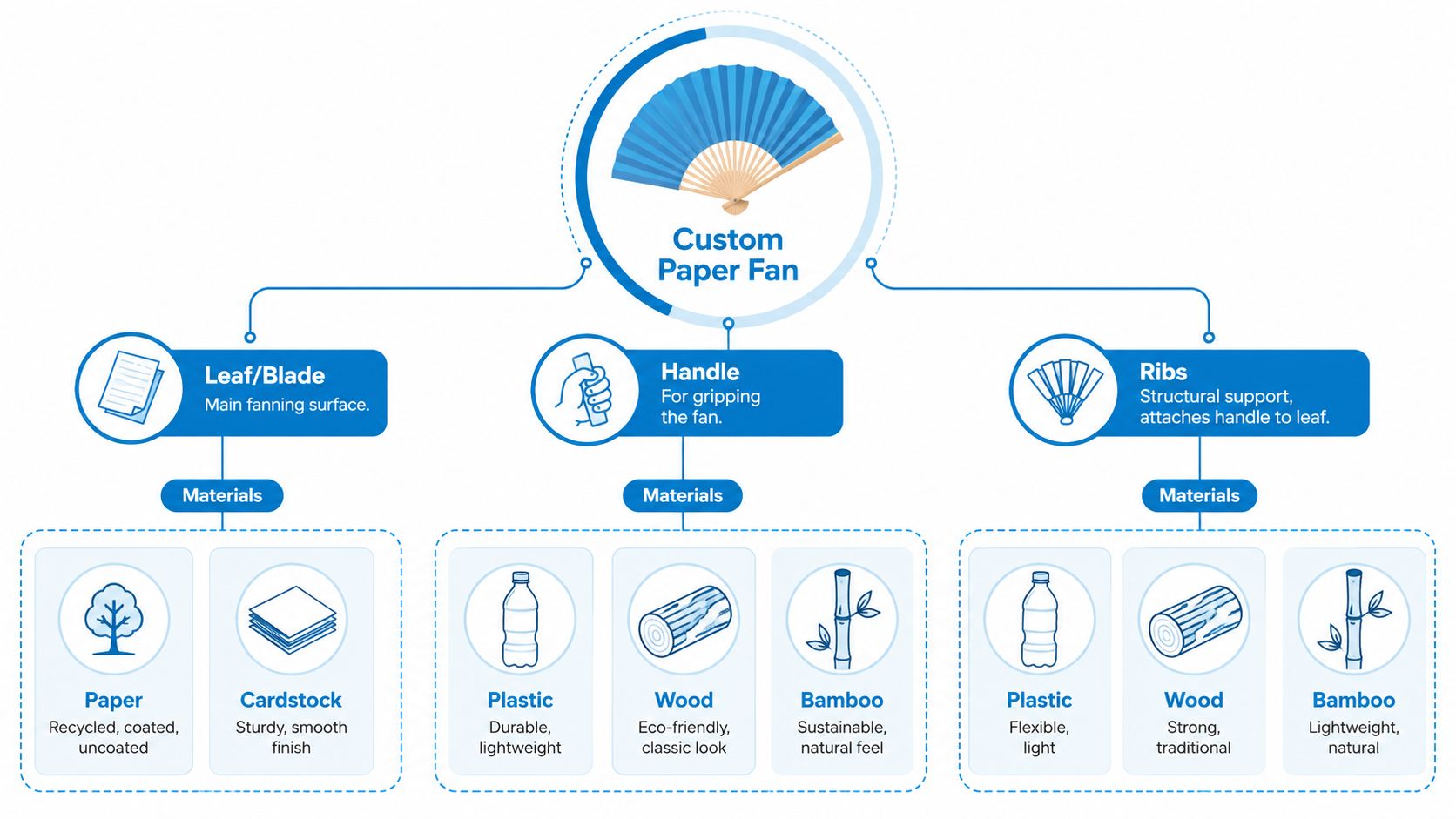
The material decision drives the outcome more than most first-time buyers expect. A custom paper fan isn't just “paper with a stick.” It's a combination of printable surface, structural support, and handling comfort. Each piece affects how the fan looks in a guest's hand and how well it survives the event.
The parts that affect performance
The printed surface is the first decision. Buyers usually compare coated paper, uncoated paper, and heavier cardstock-style options.
- Coated paper: Better when color pop matters and you want smoother print appearance.
- Uncoated paper: Softer, more natural feel. Often chosen when the brand wants a less shiny finish.
- Heavier stock: Better for stiffness and perceived quality, but folds and handling need more attention.
If you're comparing paper stiffness and finish expectations, this reference on heavy cardstock paper helps frame the trade-off between rigidity and print presentation.
The handle and ribs change how the item feels and how long it lasts in use. Common options include wood, bamboo, and plastic. Wood gives a classic promotional look. Bamboo often appeals to buyers trying to align with a more natural material story. Plastic can make sense when light weight and straightforward function matter most.
How to match construction to the event
Material choice gets more important outdoors. With 62% of promotional events now held outdoors, buyers must consider material trade-offs. The choice between coated and uncoated paper, for example, directly impacts how well a fan's printed logo resists fading from UV exposure or smudging from humidity, according to this discussion of paper fan durability and outdoor use.
That doesn't mean there's one universal best material. It means you should buy according to conditions.
| Event condition | Better fit | Watch for |
|---|---|---|
| Indoor conference hall | Uncoated or coated, depending on brand feel | Overcrowded design matters more than weather |
| Outdoor summer event | Coated surfaces often make more sense | Humidity, sunlight, and handling wear |
| Formal ceremony | Cleaner handle finish and sturdier stock | Balance elegance with readability |
| High-volume street handout | Lightweight construction | Keep branding large and simple |
Small build details buyers notice late
The edge finish matters. Rough cuts cheapen the piece fast. The attachment point matters too, because if the handle connection feels loose, guests notice immediately. For folding styles, crease quality matters just as much as print quality because bad folds make the artwork look distorted even when the file itself was fine.
Buyers should also separate two very different product ideas. A fan can carry contact details or a QR code, but it isn't the same thing as a flat handout. Our production lines are optimized for creating high-quality promotional products like custom paper fans, which involve specific folding and handle attachment processes. Because of this specialization, we do not create business cards or fliers. That distinction matters because the production process is different.
A fan should feel like a finished object, not a flyer with a handle attached as an afterthought.
The best construction choice is usually the one that supports your event conditions without forcing your artwork to fight the material.
Printing Methods for Perfect Branding
Print quality decides whether your fan looks promotional or polished. Buyers often focus on the front-end design and forget that a fan is a moving, folding surface. What prints well on a flat screen preview can break down fast once the material is folded, handled, and opened in bright light.
Digital printing versus offset printing
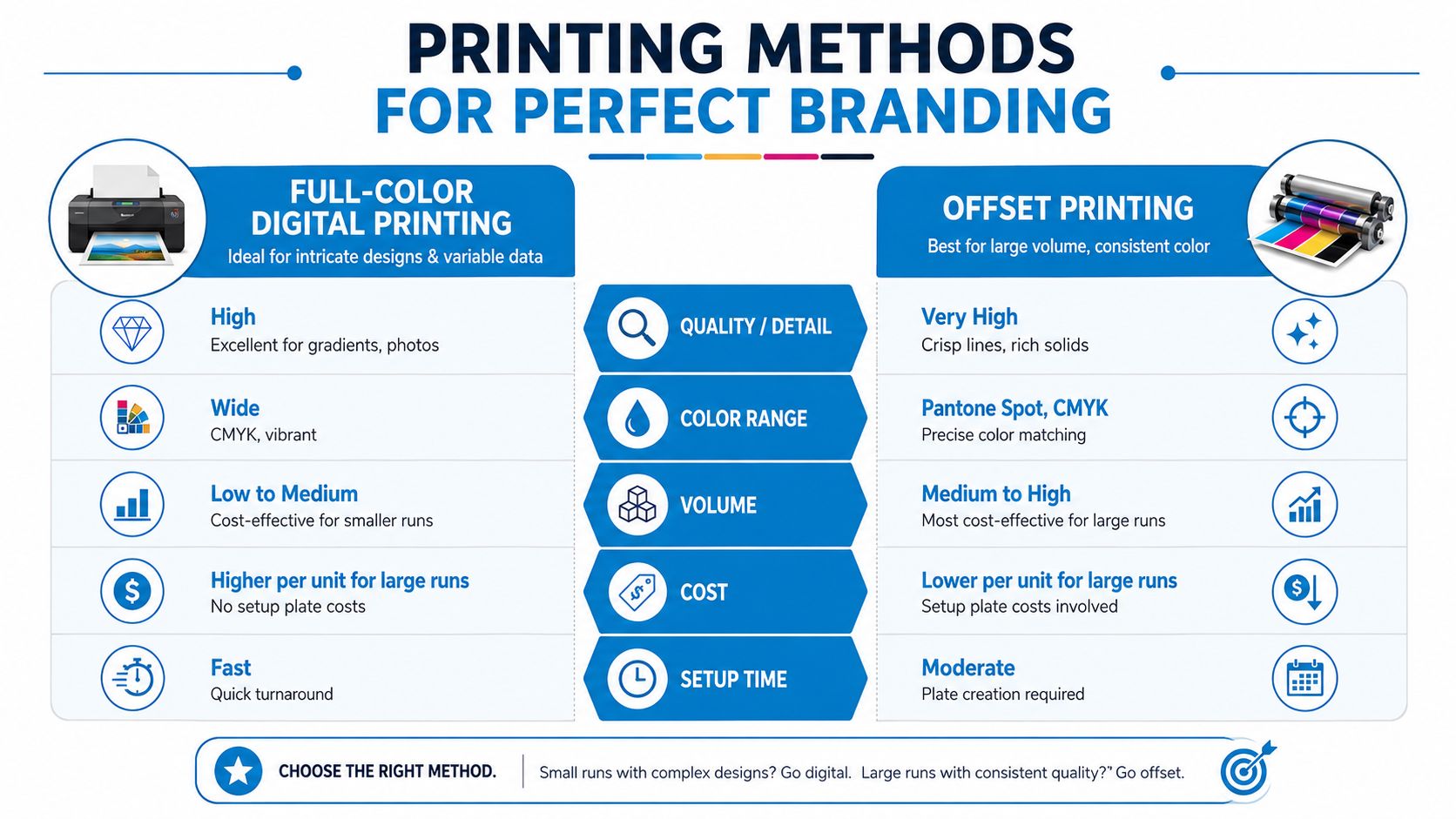
For most branded fan projects, the conversation comes down to full-color digital printing versus offset printing.
Digital printing is the practical choice when you have detailed artwork, gradients, photos, or a shorter timeline. It handles complex graphics well and avoids the setup burden tied to plates. Offset printing becomes attractive when the run is larger and color consistency across many pieces is the main priority.
Here's the clean comparison:
| Method | Best for | Main strength | Main trade-off |
|---|---|---|---|
| Digital printing | Complex artwork, smaller or mixed runs | Fast setup and strong detail | Less ideal when the whole job is built around long-run efficiency |
| Offset printing | Larger runs with stable branding | Consistent color and crisp solids | More setup involved |
If your logo includes gradients, texture, or photography, digital is often easier to approve confidently. If the design is simple and the volume is substantial, offset deserves a look.
File quality that protects your logo
The file you send can ruin a good print method. To ensure clarity and avoid pixelation, especially in the accordion-fold creases where distortion is most visible, digital printing standards for custom fans mandate high-resolution files of at least 300 DPI, as outlined in this overview of hand fan printing machine standards.
That's the minimum floor. Some custom paper fan workflows also use high-resolution digital printing in the 1200 to 2400 DPI range to support intricate logo reproduction and color accuracy, particularly when the goal is sharp branding on durable paper blanks, based on this printing demonstration.
What buyers should take from that:
- 300 DPI files are mandatory for supplied artwork.
- Higher output capability on the production side improves detail and smoothness.
- Creases are the danger zone. That's where low-quality files look worst.
Production note: If a logo looks barely acceptable at full size on your screen, it usually looks worse once it crosses a fold or rib line.
Terms worth understanding before approval
A few print terms matter on fans more than they do on flat handouts.
- Bleed: Extra printed area beyond the trim edge so you don't get white slivers.
- Safe zone: The area where logos and text should stay to avoid trim or fold problems.
- CMYK: Standard full-color print process for most artwork.
- Pantone spot color: Used when exact brand matching is critical and the print method supports it.
Sublimation comes up occasionally in custom fan discussions too, especially for specialty projects. When it's used, the process needs actual heat settings, not vague advice. Testing shows 350°F for 60 seconds achieves full color transfer for most projects, while around 400°F may be used for certain heat-resistant materials, as shown in this sublimation process example. That matters because “just heat press it” isn't a real production instruction.
For most buyers, the safest move is simple. Send the sharpest artwork you have, confirm the color expectations early, and ask for a proof that shows where the folds will land.
Designing Your Custom Fan Artwork Guidelines
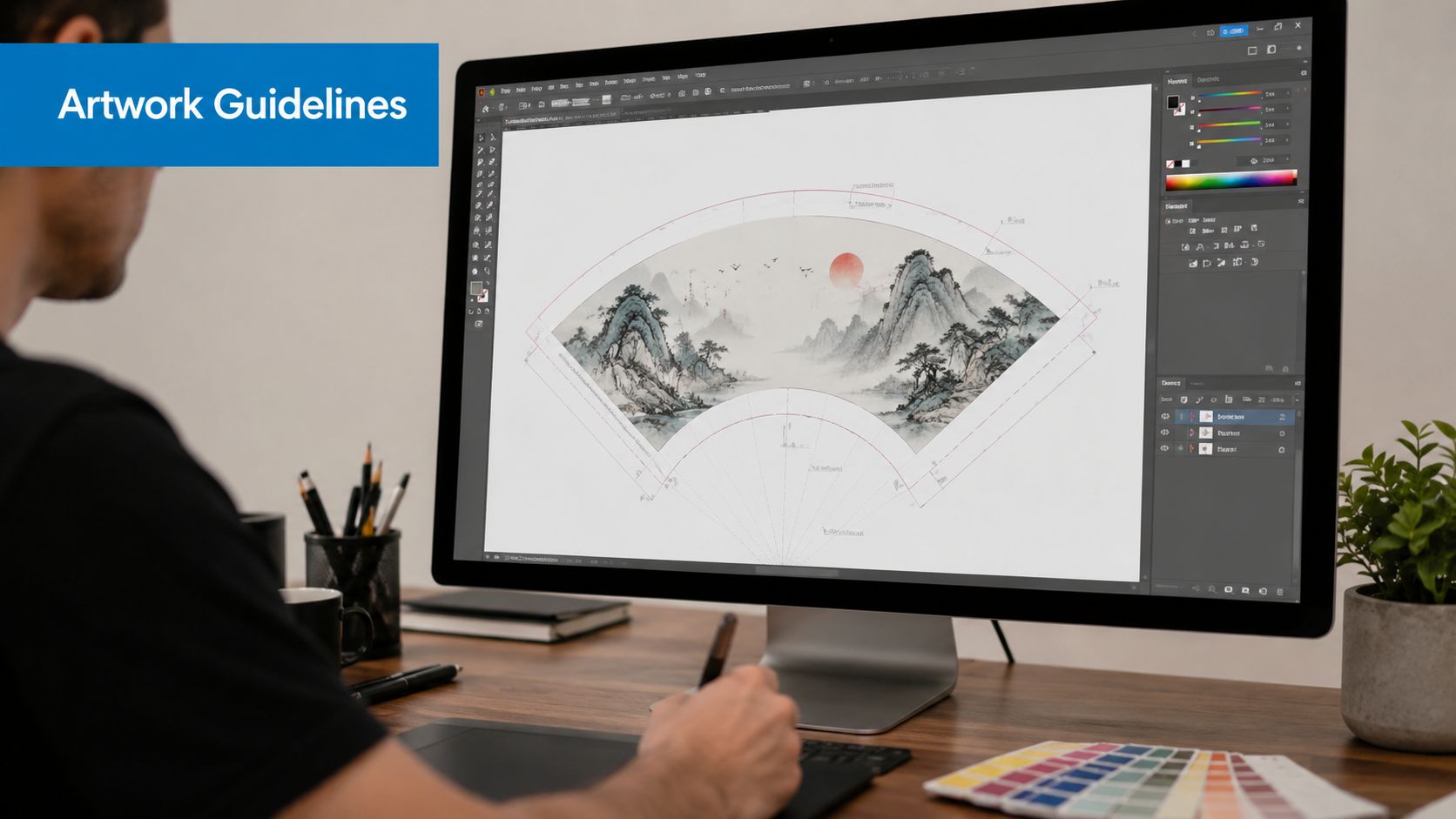
A good fan design reads fast. People won't study it the way they study packaging or signage. They'll glance at it while moving, sitting, talking, or cooling themselves off. That means the artwork has to do its job in seconds.
Set up the layout before styling it
Start with the hierarchy. Decide what must be seen first. Usually that's your logo, event name, sponsor mark, or one short line of copy. Everything else is secondary.
Keep these placement rules in mind:
- Put critical text in the safe zone: Don't let dates, URLs, or QR codes drift near folds or trim.
- Use bleed for background color or imagery: Extend art beyond the edge so trimming looks clean.
- Scale the logo larger than feels necessary: Fans are viewed in motion, not under perfect reading conditions.
- Limit copy: A fan is not a brochure.
Many teams also benefit from reviewing broader top ideas for event branding before finalizing a fan layout. It helps align this one item with the rest of the event environment so the piece doesn't feel visually isolated.
Choose files your printer can actually use
The best file is usually a vector file such as AI or EPS for logos and text. Vector artwork scales cleanly and holds edges better. Raster files like JPG or PNG can work for photos or completed layouts, but only if they're exported at sufficient quality.
A clean submission package often includes:
- Primary logo files in vector format.
- Brand colors noted clearly, especially if matching matters.
- Linked images or embedded art if the file contains placed graphics.
- A reference PDF so everyone sees the intended layout.
Common artwork mistakes that slow approval
The issue usually isn't creativity. It's file discipline.
| Problem | What happens |
|---|---|
| Tiny logos near edges | They risk trimming or visual loss |
| Low-resolution images | They pixelate, especially around folds |
| Thin type over busy backgrounds | Readability drops fast |
| Too many messages | The fan loses clarity |
Keep one main message per side. If you need people to remember three different things, split them across other event materials.
The strongest custom paper fan artwork tends to be bold, spare, and easy to proof. Buyers who simplify early usually get cleaner approvals and fewer last-minute revisions.
Sustainability Options and Creative Uses
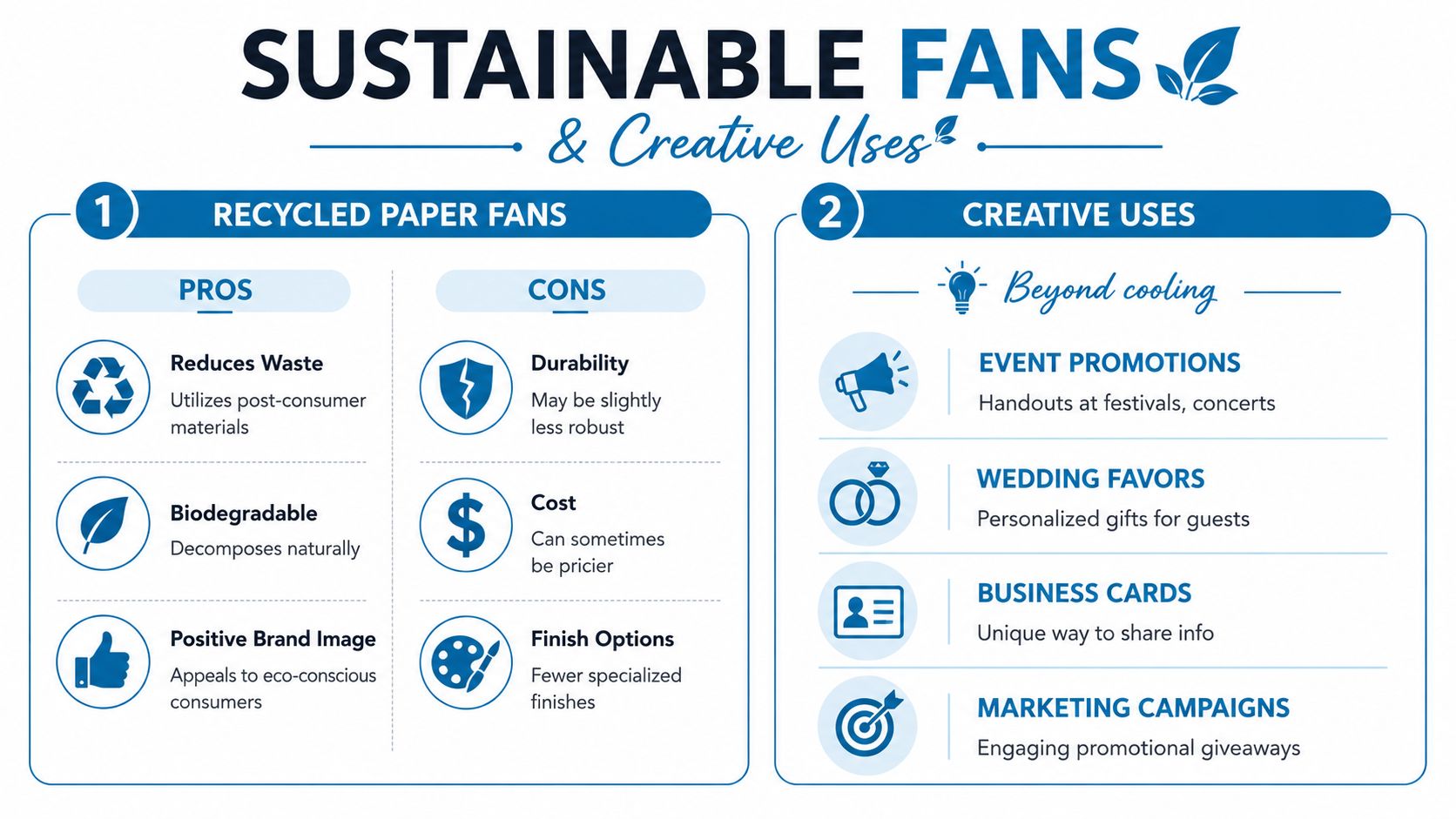
Sustainability has become part of the buying process, but many product pages still treat it like a checkbox. They mention recycled paper or bamboo and stop there. That's not enough for a buyer who has to answer to procurement, operations, or a sustainability lead.
Ask for proof, not just eco wording
Recycled paper and bamboo can be good starting points. A key issue is verification. While many suppliers mention “eco-friendly” options, there's a significant information gap regarding verifiable metrics. B2B buyers increasingly need data on material certifications like FSC or SFI to meet corporate sustainability mandates, a need that 78% of purchasers find challenging to address, according to this review of custom hand fan sustainability concerns.
That confusion shows up in real buying conversations. Teams want a greener option, but they also need supportable language.
Ask direct questions such as:
- What certification applies to the paper stock
- Whether the bamboo or wood source is documented
- How the vendor describes recycled content
- Whether the claim can appear in procurement paperwork without being softened later
If those answers stay vague, treat the sustainability claim cautiously. If you're building a wider giveaway package around lower-impact options, this collection of eco-friendly promotional products can help you compare categories more realistically.
Creative formats that earn more attention
The useful thing about a custom paper fan is that it can carry more than a logo if the layout stays disciplined. It works well in roles where utility and message support each other.
A few smart formats:
- Event program fan: Front for branding, back for agenda or schedule.
- Ceremony fan: Useful for weddings, graduations, and outdoor services.
- Sponsor recognition piece: Cleaner than stuffing every logo into a banner.
- Direct mail insert: Distinctive when folded flat with a simple message.
- Menu or seating aid: Works for hospitality events if readability stays large.
One caution matters here. A fan can hold contact information, but it isn't a replacement for every print product. Use it where the form supports the function.
Sustainable buying gets easier when the product has a clear job. A fan people use is easier to justify than a decorative giveaway with no event purpose.
The strongest creative use is usually the one that makes the item feel intentional, not generic.
Your Ordering Checklist and FAQs
At ordering time, most problems come from missing details, not bad intentions. Someone forgets the event date. The logo file turns out to be low resolution. Shipping instructions are still “TBD” the day the proof is approved. Tight projects get much easier when those basics are settled first.
What to have ready before you request a quote
Bring these details together before you ask for pricing:
- Final quantity: Even an estimate helps shape production planning.
- Event date: Lead time depends on when the fans must arrive, not when you'd like to start.
- Delivery location: Venue, office, multi-location drop, or agency handling.
- Artwork package: Logo files, brand colors, and any required wording.
- Decision-maker availability: Someone needs to approve proofs quickly.
If you're ordering for a congregation or community event, these best bulk church fan options are a useful reference for how fan programs are often structured in high-volume settings.
Quick answers buyers usually need
Can the fan include more than a logo?
Yes, but restraint usually wins. Schedules, sponsor recognition, QR codes, or event details can work if the layout stays readable.
What should I ask about sustainability?
Ask what certification or documentation supports the material claim. General “green” wording isn't enough for many organizations.
Can a fan replace other flat print pieces?
Only sometimes. It can carry information, but our production lines are optimized for creating high-quality promotional products like custom paper fans, which involve specific folding and handle attachment processes. Because of this specialization, we do not create business cards or fliers.
What causes delays most often?
Late artwork, unclear quantities, slow proof approval, and incomplete shipping information.
A strong order is simple on paper and specific in production. Clear files, realistic timing, and a fan built for the actual event conditions will get you much closer to a result that people use and remember.
If you're ready to turn a logo into a giveaway people will keep in hand, Dirt Cheap Product, Inc. can help with custom promotional products, fast proofs, and practical guidance that keeps your order moving without guesswork.