
The operations manager gets the same question every time: why spend more on branded shirts when plain workwear costs less upfront? The answer becomes obvious when a crew arrives at a customer's property, a retail team greets shoppers, or event staff must look organized before they say a word. A custom embroidered work shirt is part uniform, part identification, and part proof that the business pays attention to details.
Embroidery isn't automatically the right decoration for every garment. It earns its place when the shirt will be worn repeatedly, the logo needs a polished finish, and the fabric can support stitching without discomfort or distortion. The decisions below focus on what affects the result, from shirt construction and thread selection to artwork, pricing, placement, care, and safety rules.
Table of Contents
- Why Custom Embroidered Work Shirts Are Worth the Investment
- Choosing the Right Shirt Style and Fabric
- Embroidery Techniques, Threads, and Stitch Density
- Artwork Prep, Digitizing, and Proofing
- Pricing, Minimums, and Turnaround Time
- Placement, Use Cases, and Industry-Specific Rules
- Care, Washing, and Storage That Protect the Logo
- Final Checklist and Common Buyer Questions
Why Custom Embroidered Work Shirts Are Worth the Investment
A new operations manager usually inherits a uniform program with mismatched colors, tired garments, and no clear replacement process. Leadership sees the proposed order as another expense. Customers, however, see the team before they see the invoice, truck, showroom, or service result.
That makes embroidery a branding decision, not merely a decoration choice. A clean logo helps customers identify employees, gives a crew a shared visual identity, and makes the business look deliberate in customer-facing situations. It also gives employees something that feels issued for their role rather than pulled from a generic promotional box.
The market supports that broader view. The global workwear and uniform market was valued at USD 17.2 billion in 2022 and is projected to reach USD 25.6 billion by 2030, with a 5.1% compound annual growth rate, according to the uniform industry market overview. The same overview places U.S. uniform rental and laundering services at $6.5 billion in revenue in 2023, while Europe's corporate uniform market is projected to reach €12.4 billion by 2028, growing 4.2% annually from 2023. Embroidered work shirts sit inside that recurring professional apparel ecosystem, serving sectors such as healthcare, hospitality, construction, and retail.
The value is in repeated wear
Printed decoration can be the smarter choice for a large event shirt or a bold back graphic. Embroidery is stronger when the garment has a long service life and the logo must stay presentable through regular use. Polyester thread is particularly practical for workwear because it resists sunlight, abrasion, moisture, and many chemicals, and it handles washing and drying more easily than cotton thread, as explained by Madeira's polyester embroidery thread guidance.
Don't justify the purchase with an invented “per-wear” promise. Build your own calculation from the actual garment price, expected wears, replacement cycle, and laundering cost. A shirt worn often can become the cheaper choice over its useful life, even when its initial price is higher.
A simple buying comparison
| Factor | Custom Embroidered Shirt | Unbranded Alternative |
|---|---|---|
| Customer identification | Logo makes staff easier to recognize | Employees may blend into the setting |
| Brand presentation | Dimensional, intentional, and uniform | Depends on personal clothing choices |
| Replacement planning | Styles and artwork can be standardized | Each employee may replace garments differently |
| Long-term value | Suits repeated wear and professional uniforms | Lower upfront commitment, less brand consistency |
| Best use | Crews, service teams, retail, hospitality, and events | Temporary work, private use, or undecorated backup garments |
Practical rule: Spend more on the garments employees will wear in front of customers. Use simpler decoration on short-term promotional pieces.
Choosing the Right Shirt Style and Fabric
Start with the job, not the logo. A shirt that looks excellent on a showroom floor can feel heavy, trap heat, or lose its shape on an active crew.
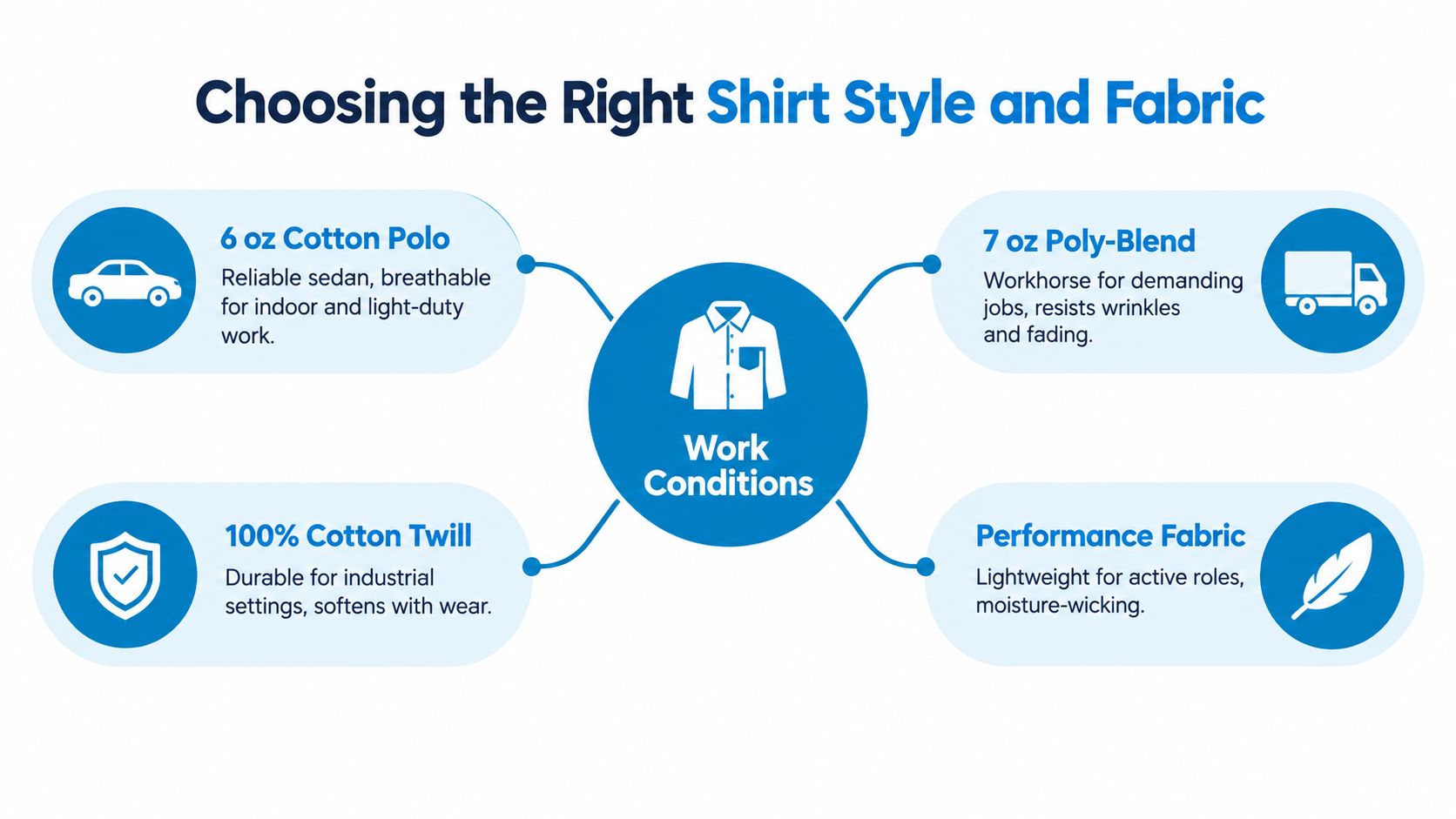
Think of a 6 oz cotton polo as a reliable sedan. It's comfortable, familiar, and sensible for indoor or light-duty work. A 7 oz poly-blend performance shirt is the workhorse truck, built for demanding conditions where wrinkle resistance, moisture management, and easier maintenance matter more than a soft office feel.
Match the fabric family to the work
Ring-spun cotton works well for office teams, retail associates, and hospitality roles where softness and a natural hand feel matter. Jersey is smooth and casual. Piqué has more texture and structure, making it a dependable polo surface for embroidery.
Poly-cotton blends are the practical middle ground for crews moving between indoor and outdoor settings. They typically balance comfort, wrinkle resistance, and maintenance better than a single-fiber shirt. Choose a stable knit or woven construction when the logo needs crisp edges.
100% performance polyester belongs on active crews, in kitchens, and in trades where sweat, moisture, and repeated washing are part of the workday. It's lightweight and functional, but the shirt must be selected carefully because slick or stretchy fabrics require better stabilization and digitizing.
Cotton twill and oxford are strong choices for industrial and professional work shirts. Twill feels structured and durable. Oxford looks more polished and suits service teams that move between fieldwork and client meetings.
Construction and collar decisions
A knit collar gives a traditional polo appearance. A spread collar looks more formal, while a button-down collar works when the uniform needs to sit closer to business-casual apparel. For restaurant teams, color, stain tolerance, and wash requirements usually matter more than a fashion-forward collar.
Use the polo shirts with logo collection to compare garment options before approving decoration. For hospitality teams, Simply Hospitality's uniform advice is also a useful reference for balancing appearance, comfort, and service conditions.
Make fit a policy decision
Choose classic fit when one shirt must accommodate varied body types and layering. Choose slim fit for a sharp corporate or retail appearance, but don't force it on a physically active crew. Choose relaxed fit when movement, tool belts, or heat are more important than a close silhouette.
Unisex sizing can simplify ordering, but it often leaves some employees with poor proportions at the shoulders, chest, or waist. A small wear test across representative body types is cheaper than correcting an entire uniform order.
Embroidery Techniques, Threads, and Stitch Density
The cleanest embroidery starts with the correct technique for the garment. Flat direct embroidery is the default for left-chest logos, sleeve marks, names, and most work shirts. It creates a durable, readable surface without adding unnecessary height.
3D puff embroidery raises the design with foam beneath the stitches. It works best on caps and heavier outerwear, especially for bold lettering. It's a poor choice for small text, fine details, or lightweight shirts where the raised profile can look excessive.
Appliqué uses a fabric piece for larger areas, then secures it with stitching. It can make an oversized chest or back design more economical than filling the entire shape with stitches, particularly when a large solid area would otherwise create a high stitch count.
Thread choice follows the wash environment
Rayon gives logos a bright, smooth sheen that can suit retail or corporate apparel. It isn't my first choice for industrial laundering or hard outdoor use. Polyester is the workwear standard because it handles sunlight, abrasion, moisture, and many chemicals more reliably, as covered in this embroidery thread color guide.
Metallic thread adds a premium accent but can snap under heavy abrasion or create production headaches if the design relies on long, dense runs. Matte polyester is the better answer when the brand wants understated, modern decoration rather than shine.
Density must follow the fabric
There is no universal stitch-density setting that works on every shirt. Density, underlay, backing, stretch, and garment structure interact, so the design should be digitized for the actual product. Fabric-specific stitch-density guidance recommends producing a garment-size sample and checking puckering, stiffness, edge sharpness, thread breaks, and comfort before approving bulk production.
A dense fill can look excellent on a stable twill and feel stiff on a lightweight knit. Stretch fabric needs suitable stabilizer and controlled hooping, otherwise the logo may distort during sewing and laundering.
| Scenario | Best Technique | Recommended Thread | Typical Stitch Density |
|---|---|---|---|
| Left-chest work shirt logo | Flat direct embroidery | Polyester | Moderate, adjusted to fabric |
| Bold cap lettering | 3D puff | Polyester or specialty thread | Controlled, with simplified detail |
| Large back or chest shape | Appliqué with outline stitching | Polyester or matte thread | Lower fill burden than solid embroidery |
| Premium retail accent | Flat direct embroidery | Rayon or matte specialty thread | Tuned for a smooth finish |
| Industrial or outdoor uniform | Flat direct embroidery | Polyester | Fabric-specific and wash-tested |
Embroidery has hard limits. Tiny text under 4 mm is a bad bet, and gradients don't translate like printed artwork. Simplify the logo before production rather than paying to reproduce details that will become muddy thread.
Artwork Prep, Digitizing, and Proofing
Send the cleanest artwork you have. AI, EPS, and SVG files give the digitizer usable shapes, while raster artwork should provide at least a 300 dpi equivalent at the intended size. Convert text to outlines so the font doesn't change, and provide Pantone or thread-color callouts instead of relying on CMYK screen approximations.
Digitizing converts flat artwork into a stitch file. The technician maps stitch direction, underlay, density, trims, and pull compensation. Those choices control whether a logo sits cleanly on a smooth twill, follows the texture of pique, or puckers a stretchy performance shirt.

Approve the stitch result, not the screen preview
A digital mockup confirms approximate size, location, and color. It doesn't show thread behavior, fabric texture, stiffness, or registration perfectly. For a meaningful uniform program, request a physical sewout, especially on pique polos, performance fabric, fleece, or textured twill.
Check these items before bulk approval:
- Registration: Borders and color sections should meet cleanly without visible gaps.
- Thread color: Compare the proposed thread to the actual garment, not only a monitor.
- Placement grid: Confirm distance from the collar, pocket, seam, and side edge.
- Final size: Make sure small text remains readable at the actual production dimensions.
- Backing: Match the stabilizer to the fabric's weight, stretch, and intended care.
- Comfort: Run a hand over the reverse side to catch excessive backing or sharp thread tails.
A JPG approval isn't a production approval. Neither is ignoring small text under 5 mm or skipping a stitch-out on a pique polo. For support with file conversion and logo preparation, review the logo digitizing service before the quote is finalized.
Pricing, Minimums, and Turnaround Time
Embroidery pricing is driven by stitch count, design size, decoration locations, garment cost, and quantity. Thread color count can matter, but it usually isn't the main cost lever in the way buyers expect. A small left-chest logo with a clean shape is a different production job from a large back design, even when both use the same number of colors.
The quote should separate garment cost, embroidery locations, digitizing or setup, and any special handling. Ask whether the setup applies per logo or per order, and whether a future reorder uses the existing approved file.
Compare the decoration methods honestly
| Factor | Embroidery | Screen Printing | DTF |
|---|---|---|---|
| Best use | Polos, work shirts, uniforms, jackets, and hats | Large runs, tees, hoodies, and bold graphics | Detailed artwork, small batches, and flexible designs |
| Main price driver | Stitch count and locations | Color setup and quantity | Artwork size, garment, and quantity |
| Feel | Raised and dimensional | Ink layer on the surface | Printed transfer with a defined surface feel |
| Durability profile | Strong choice for repeated uniform wear | Strong for suitable garments and proper care | Practical for detail and short-to-medium runs |
| Artwork strength | Clean logos, bold text, simple shapes | Flat graphics and strong color blocks | Full-color detail and complex artwork |
| Limitation | Poor fit for gradients and tiny detail | Setup makes small runs less attractive | Often less economical for large uniform programs |
Minimums vary by decorator and garment. Many providers set minimum orders somewhere from 6 to 24 pieces because digitizing, setup, handling, and machine scheduling make very small runs expensive. Don't assume a low quantity means a low total cost.
Keep the schedule realistic
The clock starts after artwork approval, not when the first quote is requested. A typical order moves through file review, digitizing, proof approval, production scheduling, sewing, inspection, and shipping. Exact turnaround depends on quantity, garment availability, decoration locations, and whether a physical sample is required.
To compress the timeline without damaging quality, approve a simplified logo early, choose an in-stock garment, limit decoration locations, and send a complete size breakdown with the order. Rush production cannot solve an artwork decision that hasn't been made.
Production advice: A fast proof is useful. A rushed approval of the wrong stitch file is expensive.
Placement, Use Cases, and Industry-Specific Rules
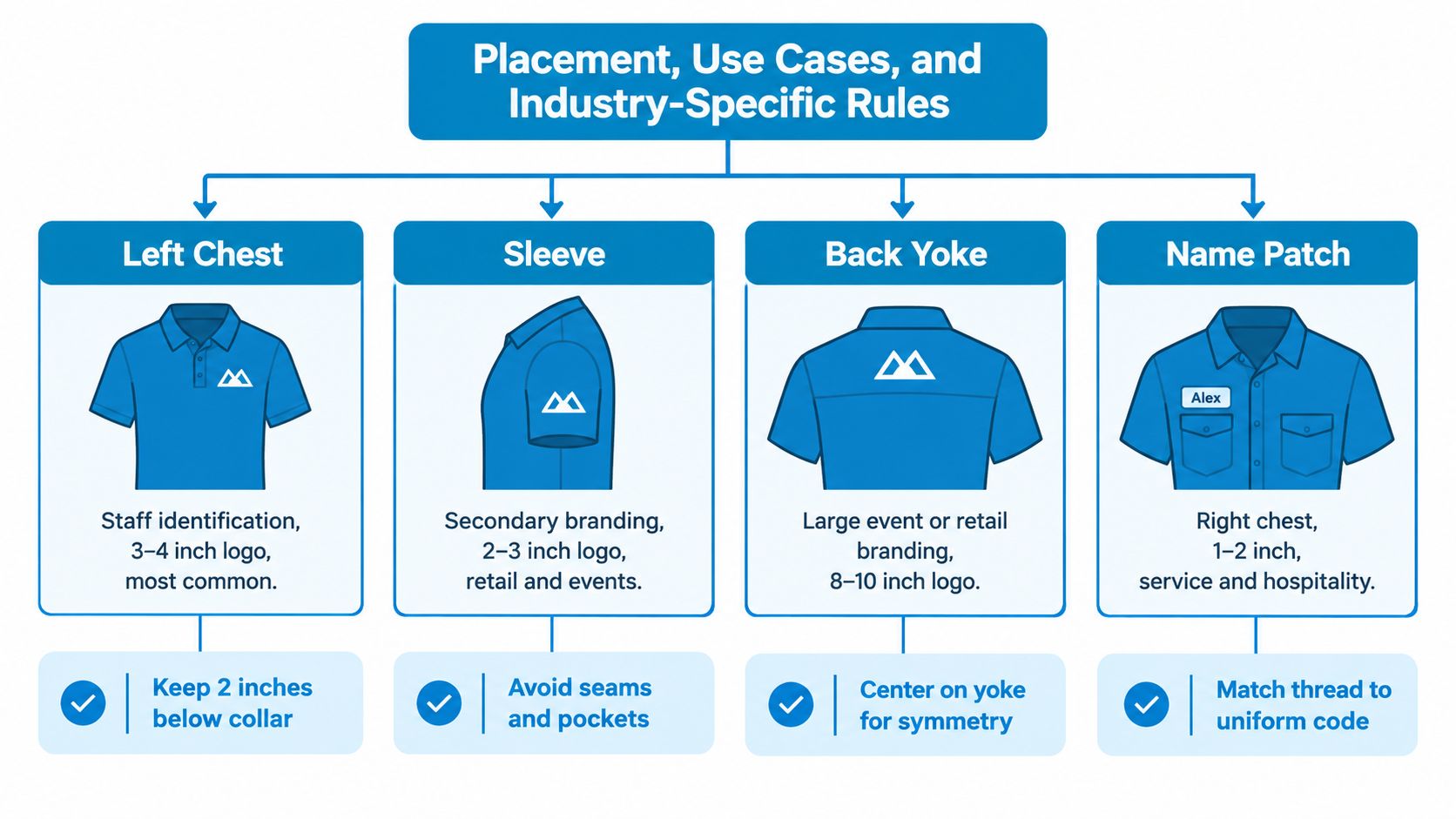
Placement should reflect how people use the shirt. The left chest identifies staff without overwhelming the garment. A sleeve works as secondary branding. A back yoke helps event and retail teams read as a group from behind. Center chest and full-back decoration make sense for larger marks, but they can feel too promotional for a customer-facing uniform.
Build a consistent placement system
Construction crews often need a left-chest logo, optional sleeve mark, and a garment compatible with visibility requirements. Hospitality teams benefit from restrained chest branding, name embroidery, and fabrics that tolerate frequent washing. Retail teams usually need a polished left chest or name patch that helps shoppers find staff without turning the shirt into a billboard.
Trade shows and corporate events can support a larger back or center-chest mark, particularly when staff spend much of the day moving through crowds. Use the same logo proportions and thread palette across polos, work shirts, jackets, and vests so the brand remains recognizable when garments change.
Treat safety standards as non-negotiable
For high-visibility garments, embroidery must not cover or interfere with reflective tape. One industry reference states that NFPA 2112 allows embroidery when the total embroidered area remains under 25 square inches per garment, so confirm the applicable garment certification and decoration limits before production through the workwear safety guidance.
ANSI/ISEA 107 defines Class 1, Class 2, and Class 3 garments according to worker hazards, work-environment complexity, and vehicle traffic speed, as summarized by this high-visibility apparel reference. Decoration must stay within the approved visibility zones.
FR garments require the same level of care. Confirm that thread, backing, and placement are approved for the specific certified garment. Food processing teams should also check color restrictions, wash-down chemistry, and hygiene requirements before selecting a thread or backing.
Custom work shirts can also support performance requirements such as ANSI-compliant visibility, antimicrobial properties, UV resistance, and moisture-wicking performance, according to this workwear customization resource. Branding should never compromise those functions.
Care, Washing, and Storage That Protect the Logo
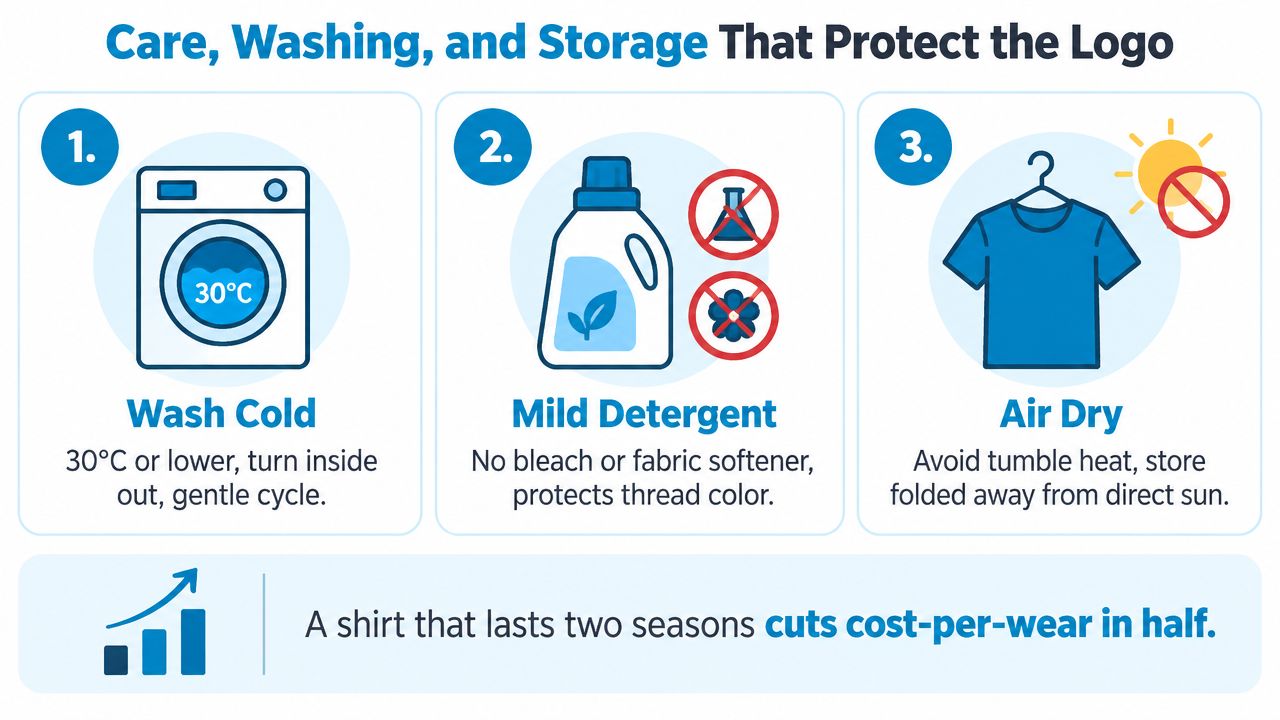
Care is part of the purchase decision. A shirt that lasts two seasons cuts cost per wear in half, so the care label and laundry process matter as much as the original stitch file.
Wash embroidered work shirts cold, turn them inside out, and use a gentle cycle with mild detergent. Skip chlorine bleach and fabric softener. Cold water reduces stress on thread color and fabric structure, while turning the garment inside out limits surface abrasion during agitation.
Control heat and friction
Low heat or hang drying is safer than a high-heat dryer cycle, which can shrink the shirt, stress the backing, and lift or distort stitches. Don't iron directly over raised embroidery. Turn the shirt inside out or place a pressing cloth between the iron and the logo.
Commercial laundry deserves separate attention. Foodservice, automotive, and healthcare crews may use industrial chemistry, high heat, and aggressive mechanical action that degrade some threads and backings faster than residential washing. Ask the decorator to approve the thread and stabilizer for the actual laundering system, not an assumed home-care routine.
Store uniforms like work equipment
Hang structured shirts on wide hangers to preserve the shoulder and knit structure. Fold shirts for shelves, with tissue between delicate embroidered layers if the thread catches easily. Keep garments in a low-humidity area away from direct sunlight, and don't store damp shirts in bins or bags where mildew can develop.
A care policy should be written into the uniform program. Give employees the same instructions, keep a spare garment available, and retire shirts when the fabric fails rather than waiting for the logo to become the only usable part.
Final Checklist and Common Buyer Questions
Use this checklist before requesting a quote:
- Define the use case: Decide whether the shirts serve field crews, hospitality, retail, office staff, events, or mixed roles.
- Confirm the garment: Select the shirt style, fabric, weight, collar, color, and available size range.
- Choose the fit: Decide between classic, slim, relaxed, women's, men's, or unisex options.
- Set the placement: Choose left chest, sleeve, back yoke, center chest, full back, or name patch.
- Simplify the artwork: Remove tiny details, gradients, and fine lines that won't survive stitching.
- Prepare the file: Send AI, EPS, or SVG artwork where possible, with outlined text and color references.
- Approve digitizing: Review the stitch plan, backing, underlay, density, and production-size proof.
- Request a sewout: Use a physical sample for textured, stretchy, lightweight, or safety garments.
- Check quantity: Confirm that the order meets the provider's minimum and includes size spares.
- Align the deadline: Allow time for artwork, production, inspection, and shipping.
- Plan reorders: Keep the approved garment style, color, logo size, placement, and stitch file documented.
- Write the care plan: Match employee washing instructions to the thread, garment, and laundry environment.
Buyer questions answered
How many colors can embroidery handle?
Several colors can work, but clean, limited palettes usually look sharper and control stitch complexity better. The constraint is whether each color remains readable at the final size.
What happens if a logo is too detailed?
The digitizer should simplify it, remove fine elements, or recommend printing instead. Don't force photographic detail or gradients into thread.
Can you match a specific PMS thread color?
A close thread match may be possible, but thread and ink are different materials. Approve the actual thread sample under the lighting where the shirts will be used.
Is there a setup fee per logo or per order?
It depends on the provider's policy. Ask specifically whether a new logo, a new placement, a size change, or a reorder requires another setup charge.
Can shirts be reordered two years later?
They can be, provided the garment style, color, sizing, and approved stitch file remain available. Keep the original order details instead of relying on memory.
What if an employee leaves and a shirt is unused?
Keep clean spare shirts in common sizes and assign them to new hires when the garment still fits the current uniform standard. Don't reorder a discontinued style just to replace a single shirt.
Is embroidery allowed on FR or high-visibility garments?
Sometimes, but only within the garment's certification and designated decoration rules. Confirm reflective-tape clearance, embroidered area, thread, backing, and placement with the garment supplier before sewing.
Choose embroidery when the garment needs to look professional, survive repeated wear, and give employees a consistent identity. Choose screen printing or DTF when the artwork, quantity, garment, or budget clearly favors those methods. The smart uniform program doesn't decorate every shirt the same way. It assigns each decoration method a job.
Dirt Cheap Product, Inc. offers custom embroidery, screen printing, DTF, sublimation, and patches across polos, work shirts, outerwear, hats, bags, and other apparel, with logo upload, proof review, and reorder support. Share your garment requirements, artwork, quantity, and deadline with Dirt Cheap Product, Inc. to start a practical quote.