You're looking at a winter event order, a staff uniform request, or a retail merchandise idea, and the supplier has offered a combination hat scarf instead of separate pieces. It sounds simple until you need to choose the right cut, confirm warmth, place a logo on a stretchy surface, and make sure the finished item carries the required textile information.
A combination hat scarf is a production decision, not just a styling choice. The right specification depends on whether people will wear it during outdoor work, receive it as an event giveaway, or buy it as fashion merchandise. Treat the project as a small apparel program, with a defined use case, tested material, approved artwork, and documented quality checks.
Table of Contents
- Choosing the Right Combination Hat Scarf Style and Material
- Selecting Decoration Methods for Knit and Fleece Accessories
- Preparing Artwork Files for Production
- Navigating the Sample and Proof Approval Process
- Understanding Cost Drivers and Lead Time Variables
- Quality Assurance and Labeling Compliance Essentials
Choosing the Right Combination Hat Scarf Style and Material
In production terms, a combination hat scarf is a single knitted or fleece accessory that covers the head and neck. Suppliers may call it a balaclava, hood-scarf, hat-scarf hybrid, or convertible headwear. That distinction matters because a pull-over design behaves differently from a wrap-style piece during decoration, packing, and wear.
Start with the wearing situation. Pull-over balaclava styles offer secure coverage and are practical for outdoor crews, winter service teams, and customers who want fast protection from cold air. They can be harder to fit across different head sizes, hair volumes, and glasses, so request measurements for the face opening, crown, and neck length rather than ordering from a product name alone.
Wrap-around hood-scarves give the wearer more styling flexibility. They can work well for retail merchandise and branded lifestyle collections because the wearer can adjust the drape, but loose fabric may be less suitable for active work. Convertible tube designs sit between those options. They can be worn around the neck, pulled over the head, or folded as a cap, making them useful for event giveaways where recipients will have different preferences.
Practical rule: Decide whether the product must stay secure during movement or offer several styling options. A work crew usually needs stability. A retail customer may value adjustability more.
Material selection creates the main performance trade-off. Knit structures can trap air for insulation, but greater thickness can interfere with moisture transport. Research on winter knit fabrics found that asymmetric or self-folding constructions delivered up to 333% higher insulation than a single-jersey reference, while standard knits often moved moisture more effectively because they offered more capillary spaces and less thickness. The study supports testing thermal resistance and wicking separately instead of assuming the warmest-feeling fabric is the most comfortable. (Research on knit winter fabrics)
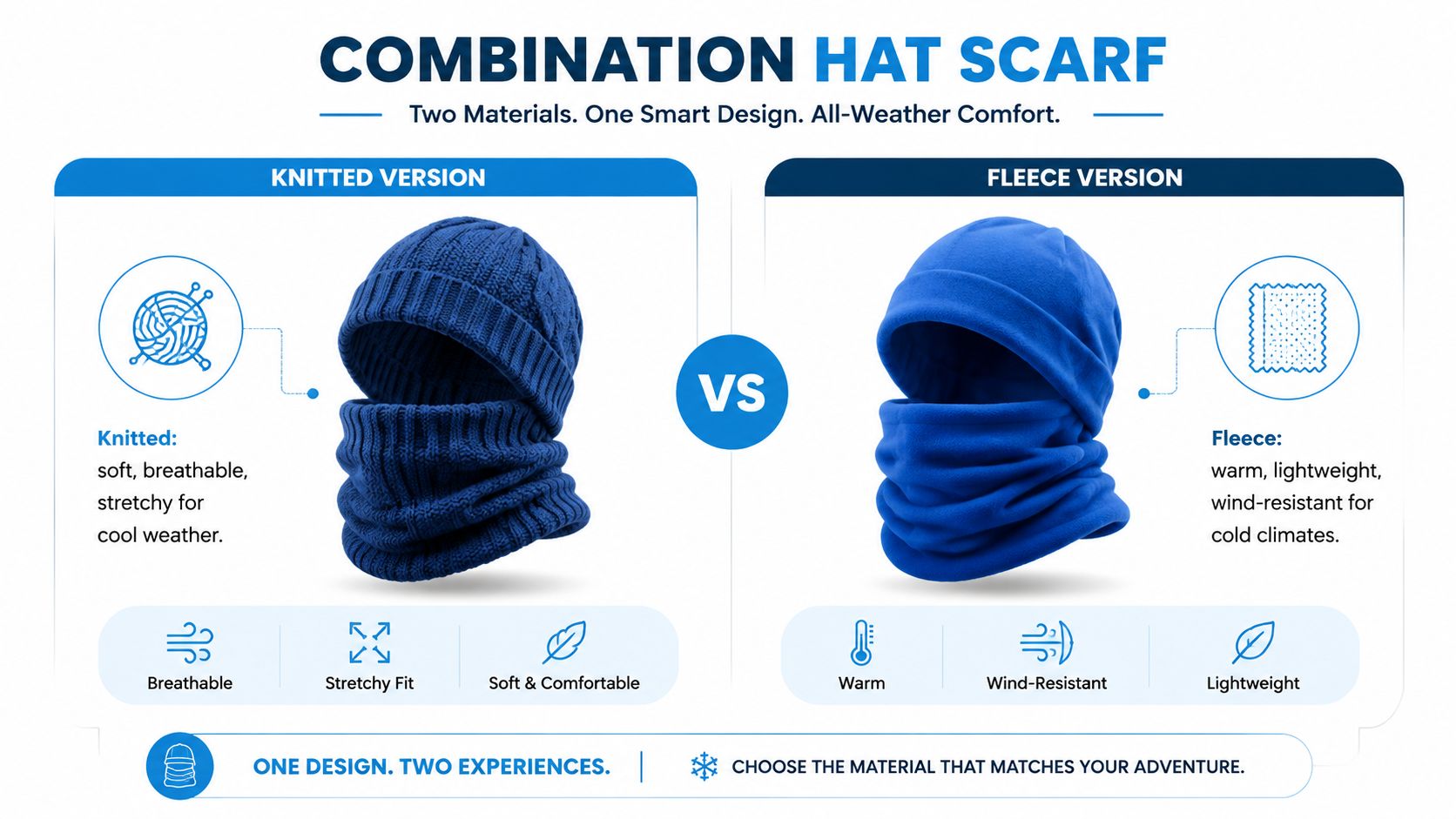
For a lighter, breathable accessory, specify the knit gauge, stretch, weight, and fiber blend in the quote request. For colder or windier conditions, ask about fleece density, wind resistance, and whether the face opening can be adjusted. A promotional fleece scarf for giveaways can help you compare the type of lightweight fleece construction commonly used for branded distribution.
Fiber choice also changes touch and comfort. A textile study of summer headscarf fabrics found that micropolyester and TENCEL™ performed strongly for tactile and thermal comfort, while matt weave performed best among the tested structures for summer use across drape, air permeability, thermal resistance, and moisture-management measures. Those findings don't make one fiber universally correct for winter, but they do reinforce the need to test fiber and structure together. (Textile comfort study)
If you're comparing a custom hat-scarf hybrid with separate pieces, ask which problem the hybrid solves. It reduces the number of loose items and creates a unified branded surface, but a separate hat and scarf may offer better adjustability, easier replacement, and more independent control of warmth. For related headwear planning, review custom hats for business before requesting a final specification.
Selecting Decoration Methods for Knit and Fleece Accessories
Decoration should follow the substrate, not the other way around. A logo that looks excellent on a structured cap may become distorted on a stretchy knit, while a heat-applied transfer that works on fleece can flatten or mark a delicate fabric if the press settings are wrong.
| Decoration Method | Best For | Material Compatibility | Detail Level | Relative Cost |
|---|---|---|---|---|
| Embroidery | Simple logos and text | Stable knits, fleece with support | Low to medium | Medium |
| DTF transfer | Full-color logos and illustrations | Many cotton, polyester, and blended fabrics, subject to heat testing | High | Medium |
| Sublimation | All-over or vibrant artwork | Polyester or polyester-rich materials | High | Medium |
| Custom patch | Premium tactile branding | Most surfaces that accept stitching or adhesive backing | Medium to high | Higher |
Embroidery gives a traditional, durable appearance and can suit a small chest-style mark on a denser knit. Stretch remains the limitation. Fine lettering, thin outlines, and large dense stitch fields can pucker or pull the fabric, especially around a face opening or curved seam. A backing layer can stabilize the area, but it may affect softness on the inside.
Direct-to-film, or DTF, transfers reproduce complex color artwork more easily than embroidery. They can work on fleece and many knit blends, but the production partner must test heat, pressure, dwell time, and stretch recovery. Excessive heat can damage or shine certain knits, and a thick transfer may feel stiff where the wearer expects softness.
Sublimation produces vibrant, permanent color when the product is polyester or a suitable polyester blend. It isn't a universal solution for natural-fiber knits, and it usually requires the material and artwork to be planned together. Dark base colors can also limit the result because standard sublimation relies on a light printable surface.
Patches add dimension and can make a simple emblem feel more premium. They also introduce another component, attachment step, and potential stiffness. For a small order, that added handling may be worthwhile. For a giveaway with a tight budget, a simpler transfer or restrained embroidery may be easier to control. Services focused on item personalization can provide a useful comparison point when you're deciding how much customization the accessory needs.
Use custom logo embroidery when your artwork is simple and the knit is stable enough to support it. Choose DTF when color complexity matters, sublimation when the polyester base supports it, and patches when the physical branding effect is central to the product.
Preparing Artwork Files for Production
Artwork problems cause avoidable delays because the decoration method can't compensate for a weak source file. Send the production partner the cleanest version of the logo you have, then tell them where the mark should sit, how large it should appear, and whether the wearer will see it from the front, side, or back.
For embroidery, provide a simplified vector file such as AI or EPS when available. Reduce unnecessary colors, remove tiny details, and convert gradients into solid areas or deliberate tonal steps. Embroidery machines translate artwork into stitches, so a fine line that looks clear on a monitor may disappear when reduced to thread.
For DTF and sublimation, use a high-resolution file, ideally 300 DPI minimum, with the color mode and background handled intentionally. A high-resolution PNG with transparency can work for many transfers, while vector AI or EPS files give the production team more control over scaling. Ask whether the supplier prefers RGB artwork for its workflow or a CMYK conversion for proofing, because the screen color and printed result won't always match automatically.

What to check before sending the logo
- Source quality: Don't pull a small logo from a website, social profile, or email signature. Those files often contain too few pixels for clean decoration.
- Color handling: Gradients, shadows, and transparency need a method-specific treatment. Embroidery generally needs simplified color blocks.
- Placement area: A logo near a seam, fold, or face opening may curve or stretch as the accessory is worn.
- Scale: A mark that looks balanced on a flat artboard may appear oversized once placed on a narrow scarf panel.
- Negative space: Small gaps can close during stitching or become difficult to read under a transfer film.
Request a digital mockup showing the actual combination hat scarf shape, not just a logo floating beside a blank rectangle. If the accessory stretches, ask for a second view showing the decoration on the worn or filled form. A guide to making logos in Illustrator can help your team prepare cleaner vector artwork before the quote becomes a production order.
Navigating the Sample and Proof Approval Process
A reliable order moves through distinct decisions. The quote establishes the product, material, decoration, quantity, packaging, and shipping assumptions. The digital proof then shows how those choices are expected to look. A physical sample tests what the rendering can't prove, including hand feel, fit, stretch, and decoration behavior.
Read the digital proof as a production document
Check the logo's position against seams and openings, not just the overall composition. Confirm the approved brand colors or Pantone references, review the apparent logo size on the actual product silhouette, and make sure the artwork isn't sitting in a fold that will hide part of the mark.
The digital proof stage is usually faster than physical sampling because it relies on supplied artwork and product specifications. Physical sample timing depends on material availability, decoration setup, and the supplier's queue. Instead of relying on a generic promised window, ask the production partner to separate the expected timing for proof preparation, sample creation, sample shipping, revisions, and bulk manufacturing.
A proof approval is the point where your responsibility changes. Before approval, you can correct placement and color. After approval, the factory is working from the version you accepted.
Inspect the physical sample under real conditions
Wear the sample over the hair and eyewear used by your audience. Pull the scarf section into its intended position, turn your head, sit down, and test whether the opening stays comfortable. For embroidery, look for puckering, skipped stitches, loose thread ends, and distortion after stretching. For DTF, flex the decorated area and check adhesion, edge lift, cracking, and unwanted stiffness.
Sublimation should be checked for color vibrancy, edge definition, and whether the print follows the intended panel shape. Also inspect the untreated side of the fabric, because a visually strong exterior doesn't solve scratchiness, excessive heat, or poor recovery.
Put every approved detail into writing. Save the proof, sample notes, product measurements, decoration size, color references, label information, and packaging instructions in one order file. If a revision is needed, approve a new proof rather than relying on a phone call or an informal email description.
Understanding Cost Drivers and Lead Time Variables
A custom combination hat scarf rarely has one meaningful “unit price” until the specification is complete. The quote should separate the product blank or cut-and-sew construction, decoration, setup, labeling, packaging, sampling, and shipping. That separation shows you which decision is driving the total and which adjustment can protect the budget.
Order volume often creates price breaks because production, setup, and purchasing work are distributed across more units. The exact breakpoints vary by supplier, product, and decoration method, so request pricing at the quantity you expect to order and at nearby planning levels. Don't order more than you can use to chase a lower per-unit figure. Unsold seasonal accessories can tie up cash and storage space.
Decoration changes both price and schedule. Embroidery may require digitizing and stabilizing the knit. DTF can require transfer preparation and heat testing. Sublimation may require a compatible polyester product and panel-specific artwork. Patches add manufacturing and attachment steps. Ask for setup charges as separate line items, especially if you're comparing a small event run with a recurring merchandise program.
Material also shifts the quote. A basic acrylic knit and a premium merino blend won't have the same yarn cost, hand feel, care expectations, or decoration behavior. The more expensive fiber isn't automatically the right choice. If the audience will wear the item briefly at an event, easy care and consistent sizing may matter more than a luxury hand. If the item will sit in a retail collection, tactile quality and finishing may justify a more complex specification.
Build the schedule backward from the delivery date
Work backward from the date the products must be in hand. Include time for artwork cleanup, digital proof review, physical sampling if needed, revisions, bulk production, inspection, packing, and transportation. Holiday demand and major events can create bottlenecks, so a supplier's normal production window may not apply during your selling season.
Rush production can add charges and reduce your ability to correct mistakes. Shipping also needs a deliberate choice. Parcel delivery may suit manageable cartons, while larger bulk orders may call for freight handling. Ask how cartons will be packed, whether the shipment is palletized, and who is responsible for receiving arrangements.
A practical budget worksheet should show quantity, material, decoration, setup, labels, packaging, freight or parcel shipping, and contingency for revisions. That format gives you a decision framework instead of a seductive but incomplete per-unit number.
Quality Assurance and Labeling Compliance Essentials
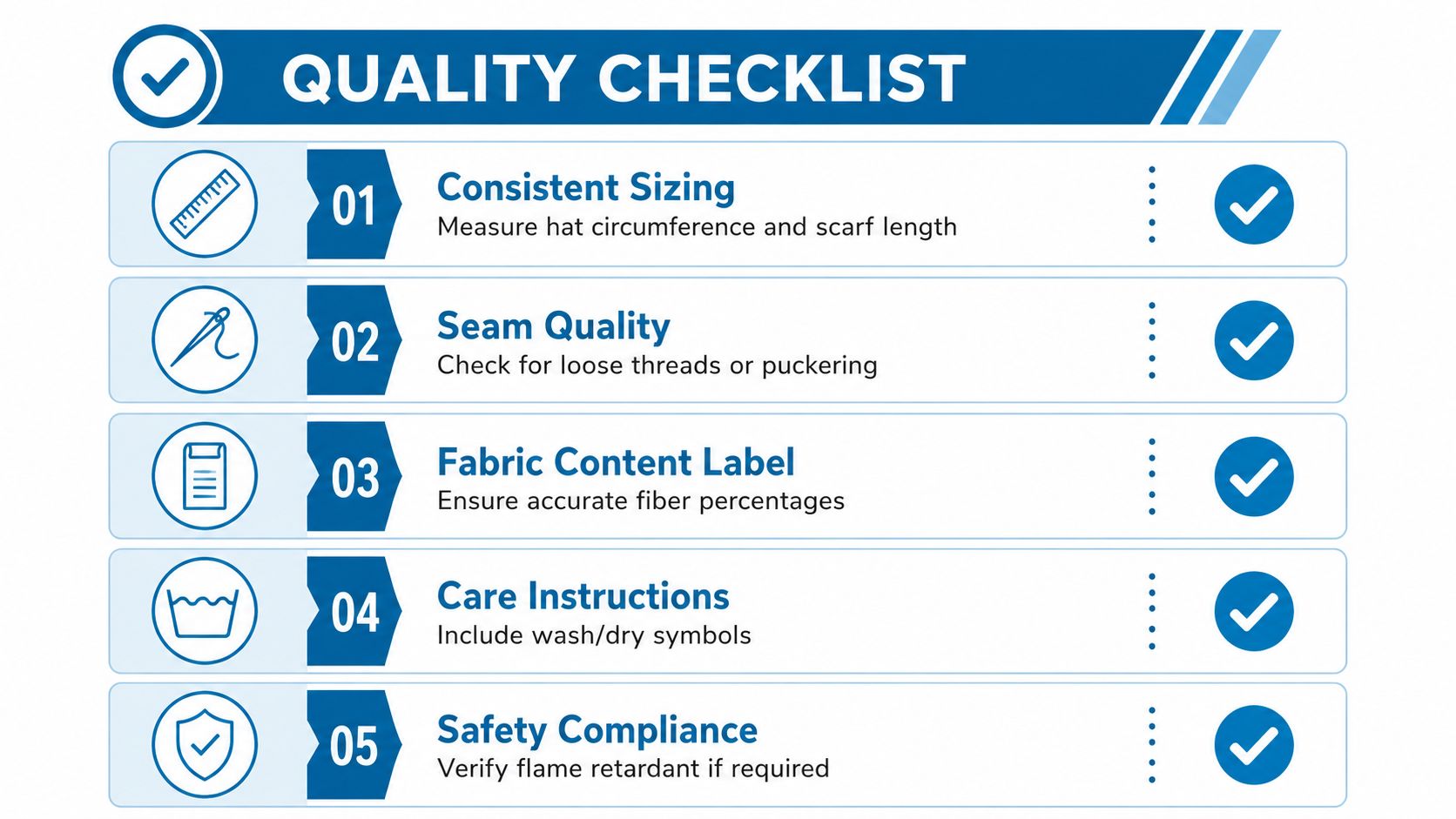
Quality control starts with a written specification, then continues with inspection of the finished units. Measure the product consistently across the run, including head circumference, face opening, scarf length, and any critical seam positions. A combination hat scarf can look acceptable on a table while fitting very differently once stretched over a head.
Use a simple receiving checklist:
- Sizing: Compare finished measurements against the approved sample and record any material variation.
- Seams and finishing: Look for loose threads, skipped stitches, open seams, puckering, and rough internal edges.
- Decoration: Check logo placement, adhesion, stitch density, transfer edges, color, and stretch recovery.
- Packaging: Confirm that units are clean, dry, folded consistently, and protected from crushing or moisture during distribution.
- Labels: Verify fiber information, origin, responsible business identity, care details, and market-specific requirements before shipment.
For U.S. sales, the FTC says most textile and wool products must carry labels identifying fiber content, country of origin, and the manufacturer or another responsible business. Its apparel-labeling guidance also addresses textile products generally and explains limited conditions under which promotional swatches may be exempt from ordinary labeling disclosures. (FTC apparel labeling guidance)
Canadian orders require closer fiber documentation. The Competition Bureau says each generic fiber name present at 5% or more of total mass must appear, with each fiber expressed as a percentage of total mass. The label must also identify the dealer and place of business or include a CA identification number. Certain textile items made for an organization's own use, or for its employees or students, may qualify for an exemption, so confirm the order's end use before applying a blanket rule. (Canadian textile labelling requirements)
Don't make comparative claims about warmth, safety, or performance without support. The FTC permits comparative advertising when references to competitors are truthful and not deceptive, and disclosures may be necessary to prevent consumer confusion. (FTC comparative advertising policy) For broader production planning, a resource on safe reliable gear standards can provide another practical reference point, but your production partner remains responsible for confirming the requirements that apply to your product and market.
The concept itself has a longer design history than many buyers realize. Scarf and headwear traditions extend back more than 3,000 years, with scarf fashion often traced to around 1300 B.C. (Historical scarf and headwear patent record) A U.S. patent application for a “combination hat, scarf and gloves” was filed on 2010-09-16, published as US20120066812A1 on 2012-03-22, and later abandoned following a discontinuation notice dated 2012-10-01. (U.S. patent record for a combination hat, scarf and gloves) The lesson for a business buyer is straightforward. Combining functions is not enough by itself. The product still needs a defensible fit, tested comfort, suitable decoration, accurate labeling, and a quality process that matches the way customers will use it.
Dirt Cheap Product, Inc. helps businesses source branded apparel and accessories with embroidery, DTF, sublimation, and custom patch services, along with artwork review and proof support. Visit Dirt Cheap Product, Inc. with your logo, target quantity, material preference, and delivery date to start a combination hat scarf order built around your actual use case.