
You need branded shirts for a launch, uniforms for a growing crew, or merchandise for an event. The artwork looks fine on screen, but that doesn't answer the practical questions: Will the logo fit the garment? Will the color hold after washing? Is the chosen fabric right for the decoration method? And can the order arrive packed correctly, not merely printed?
An experienced apparel printing company treats those questions as production decisions, not administrative details. The garment, artwork, ink, heat, thread, curing, proofing, and delivery all affect the finished result. A dependable decoration partner helps you make those choices before production begins.
Table of Contents
- What an Apparel Printing Company Actually Does
- Core Decoration Methods and When to Use Them
- The Step-by-Step Ordering Workflow
- Artwork Preparation and Quality Control Checks
- Navigating Pricing and Turnaround Timelines
- Evaluating Sustainable Apparel Printing Claims
- Choosing the Right Partner for Your Specific Needs
What an Apparel Printing Company Actually Does
A team orders polos for field staff, then learns the logo sits across a placket, the fabric is prone to dye migration, and the size curve is split across two warehouses. Another buyer wants soft event shirts, but the artwork has fine details that will fill in after curing. A reliable apparel printing company handles those production realities before they turn into wasted garments, late reprints, or prints that look good for one wear and fail after washing.
An apparel printing company decorates wearable products, but the job goes well beyond putting ink or thread on a finished item. The work includes matching the garment to the decoration method, preparing art for textile use, controlling placement, curing or pressing to spec, checking consistency across the run, and packing the order the way the customer needs it delivered. Typical products include T-shirts, polos, outerwear, hats, bags, and accessories. Buyers looking for garment-focused projects can review these screen printing services.
Decoration is not garment manufacturing
Most shops do not cut and sew garments from scratch. They source blank apparel, confirm the fabric and construction, adapt the artwork to the printable area, apply the decoration, inspect the result, and fulfill the order. Some businesses also print panels for cut-and-sew programs, but that is a different operating model from day-to-day contract decoration.
That distinction matters on the shop floor. Print quality depends on fabric content, knit texture, seams, pocket locations, stretch, moisture performance, dye behavior, and how the garment reacts under heat. A decorator who ignores those variables can hit the approved proof and still deliver a poor product in hand. The value is in controlling garment selection, artwork, decoration quality, proofing, sizing, packing, and delivery so the finished pieces wear well and stay consistent across the order.
The structure of the U.S. apparel industry helps explain why so many buyers use specialist decorators instead of in-house manufacturing. Bureau of Labor Statistics industry data report apparel-manufacturing employment at about 902,800 jobs in 1990 and about 150,000 jobs two decades later, and note an 85% decline from 1991 through 2016 in apparel employment, the largest drop among U.S. manufacturing industries during that period. BLS industry data also list private apparel-manufacturing establishments at 15,478 employing 426,027 workers in 2001 and 7,855 employing 157,587 workers in 2010. See the BLS apparel manufacturing industry data.
The boundary buyers should understand
A decorator works with textile surfaces, ink deposit, curing temperature, thread density, adhesion, shrinkage, and placement tolerance. A commercial printer works with paper stock, trimming, folding, and press finishing. Those are different production systems, equipment sets, and quality checks.
If the job is branded clothing or wearable accessories, choose a partner that can explain fabric compatibility, decoration limits, and durability trade-offs in plain language. We do not create business cards or fliers. Our focus is apparel and related wearable merchandise.
Core Decoration Methods and When to Use Them
The decoration method should follow the garment and the design, not the other way around. A small chest logo on a polo has different requirements from a photographic graphic on a polyester shirt or a raised mark on a cap.
Screen printing pushes plastisol or water-based ink through a mesh stencil onto the garment. It remains a strong choice for bold graphics, repeatable spot colors, and larger runs, especially on cotton T-shirts and fleece. The process can produce a durable, substantial print, but every additional color adds preparation and registration demands.
Embroidery uses thread rather than ink. It works well on polos, hats, jackets, work shirts, and structured garments where a professional stitched mark suits the brand. Very small lettering, fine gradients, and highly detailed photographic artwork don't translate cleanly into thread. For ceremonial pieces or sashes, buyers should also review practical premium stole embroidery tips before approving a design.
Direct-to-film, or DTF, prints artwork onto transfer film before heat-pressing it onto the garment. It supports full-color graphics across cotton, polyester, blends, and other fabrics, though the hand feel and visual result depend on the transfer and substrate. DTF can be useful when the design has many colors or when a screen setup isn't the most efficient fit.
Sublimation transfers dye into suitable garment fibers through heat and pressure. It is particularly suited to polyester and all-over designs. It isn't a universal solution for cotton, and the garment color affects the final appearance because the process doesn't create an opaque white base in the same way an opaque print can.
Custom patches provide a separate tactile treatment for hats, jackets, bags, and other products. They can offer a woven, embroidered, or printed appearance and may work well when a badge-like identity is part of the design language.
| Method | Best Use Case | Ideal Fabric | Volume |
|---|---|---|---|
| Screen printing | Bold graphics and controlled spot colors | Cotton, fleece, and suitable blends | Medium to large |
| Embroidery | Polos, hats, jackets, and uniform marks | Stable woven or structured garments | Small to large |
| Direct-to-film | Full-color artwork across varied garments | Cotton, polyester, and blends | Small to medium |
| Sublimation | All-over graphics and vivid synthetic decoration | Polyester and suitable synthetic fabrics | Small to large |
| Custom patches | Badge-style branding on accessories and apparel | Hats, outerwear, bags, and compatible garments | Small to large |
Production rule: Choose the blank garment and decoration method together. A visually attractive design can still fail if the fabric cannot support the intended process.
Screen printing, direct-to-garment printing, sublimation, and direct-to-film printing all rely on textile substrates, garment surfaces, curing, or heat transfer. They aren't substitutes for the paper-stock and finishing requirements used for business cards and flyers. For a deeper comparison of two common approaches, review screen printing versus heat transfer.
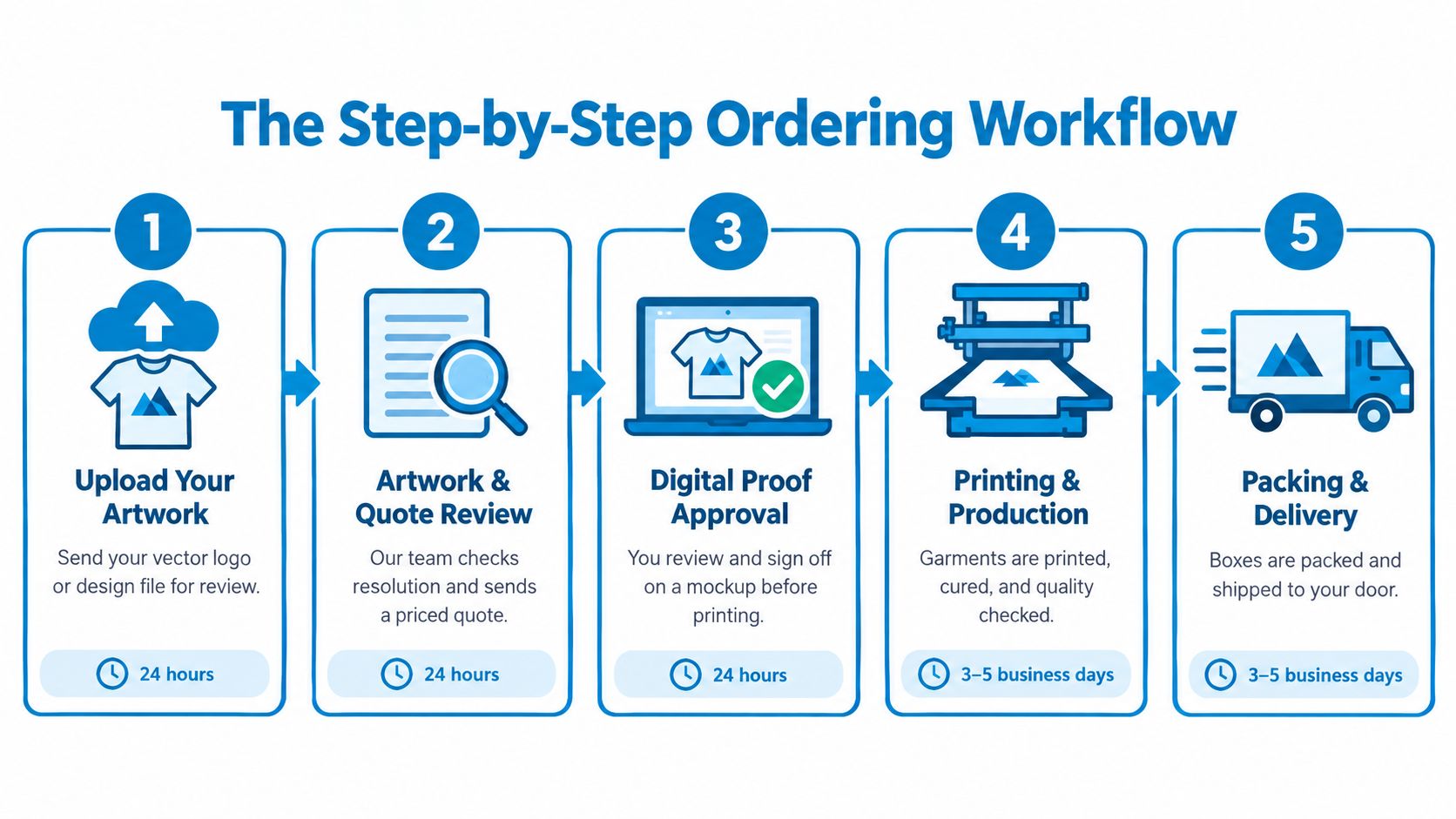
The Step-by-Step Ordering Workflow
A reliable order begins before anyone presses a machine. The cleanest projects follow a defined path, with the buyer making decisions at the points where those decisions can still prevent rework.
Upload the artwork. Send a vector logo when possible, such as an AI, EPS, or suitable PDF file. Include the intended garment, colors, quantity, sizes, placement, and deadline. If you only have a raster image, send the largest original file you have rather than a screenshot copied from a website.
Review artwork and receive a quote. The production team checks resolution, separations, fine details, decoration location, and garment compatibility. The quote should account for the selected blank, decoration method, artwork preparation, quantities, and delivery requirements.
Select the garment. Don't approve a shirt by color swatch alone. Fabric weight, blend ratio, cut, seam placement, and garment color all affect the finished decoration. A polo intended for customer-facing staff may need a different surface and treatment from a soft promotional T-shirt.
Approve the digital proof. Inspect logo scale, placement, color appearance, spelling, size breakdown, and embroidery details. A proof is your final opportunity to correct an obvious mistake before production. For graduation apparel or ceremonial items, it can also help to check Graduation Attire FAQs when garment conventions affect the order.
Produce, inspect, pack, and deliver. The team decorates the garments, cures or presses the application, checks representative pieces, sorts sizes, packs the order, and ships it. Keep your approval and final artwork with the reorder information so a later run has a clear reference.
For a practical outline of the information buyers should prepare, use this guide to order custom shirts.
Artwork Preparation and Quality Control Checks
A clean file helps, but file quality isn't the whole quality-control system. Production staff also need to understand how the logo interacts with the actual blank garment.
Vector artwork is usually preferable for logos because it can be scaled without the soft edges that appear when a small raster file is enlarged. Raster images can work well when they have enough resolution for the intended print size. Fine lines, tiny text, distressed textures, gradients, and transparent effects should be reviewed against the chosen process rather than assumed to reproduce exactly.
Brand color needs the same discipline. Screen printing may use separated spot colors, while digital processes interpret artwork through their own color workflow. A screen proof on a white cotton shirt won't predict the appearance of the same artwork on a dark polyester garment. The physical garment color, ink or transfer layer, and surface texture all influence what the customer sees.
Wash testing is a process test
Wash-fastness isn't an ink-only specification. It is a fabric, ink, and process interaction. An independent direct-to-garment study found that after five laundering cycles, untreated 100% cotton produced the strongest combination of color quality and fastness among the tested materials, while untreated polyester performed best in a separate printer-specific comparison. The result doesn't support a universal promise. It supports testing the exact blank and process selected for the order. The study's findings are useful because they show why fiber category alone isn't enough.
For brand-critical work, launder preproduction samples for at least five cycles, using consistent detergent and drying conditions. Record fading, staining, cracking, and visible color change. Keep a washed control sample with the garment composition, pretreatment, curing conditions, and print settings.
Color and durability need separate approvals
Color accuracy and wash durability can point to different methods. Research comparing screen printing, direct-to-garment, and dye-sublimation-related workflows reported that screen printing achieved the most accurate and consistent target-color reproduction across the tested textiles, with measured color differences at or below ΔE 2.5 and a best result of ΔE 1.35 on cotton. The same research found direct-to-garment printing on polyester or polyester-blend material delivered the strongest durability after the first laundering cycle. Review the comparative color and durability research when your specification depends on both appearance and wear.
A production checklist should include:
- Artwork integrity: Confirm dimensions, colors, spelling, separations, and transparency.
- Garment match: Verify fiber content, garment color, construction, and placement.
- Physical proof: Approve the actual blank, not only a digital mockup.
- Process record: Document pretreatment, curing, pressing, thread, or transfer settings.
- Final inspection: Check registration, edges, coverage, stitching, stains, and sorting.
If the project also includes small accessory identification, settle the budget for bag tag printing separately from the apparel decoration specification. Different substrates need different approvals.
Navigating Pricing and Turnaround Timelines
The blank garment is only one part of the price. The final quote can also reflect artwork preparation, screen setup, number of colors, print locations, embroidery stitch count, patch construction, transfer handling, sampling, packing, and shipping. Rush production adds another constraint because it compresses purchasing, scheduling, production, and inspection.
Ask for a quote that separates these variables. A low unit price can become less useful if it excludes a second print location, special-size handling, setup, or delivery. A higher-quality blank may also be the sensible choice when the garment will be worn repeatedly, washed often, or used as part of a public-facing uniform.
Plan around the real deadline
Start with the event date, then work backward through proof approval, garment selection, artwork corrections, production, inspection, packing, and transit. The buyer controls the proof stage, so delayed replies can move the entire schedule even when the decorator is ready to proceed.
Wholesale catalogs help buyers compare brands, cuts, colors, and price points without treating every order as a one-off custom garment. That choice should still be based on use. A soft fashion blank may suit retail merchandise, while a work shirt needs a surface and construction that tolerate regular wear.
A deadline isn't the day boxes need to leave the shop. It's the day the correct, inspected garments need to be in the right hands.
For a campaign or event, build a receiving plan too. Confirm the ship-to address, delivery window, size breakdown, packing labels, and whether multiple locations need separate cartons. International orders add customs and transit considerations, so they deserve more planning than a local delivery.
The best budget decision often comes from reducing avoidable changes, not just choosing the cheapest blank. Approve the artwork, garment, location, and decoration method together. That prevents a late substitution from creating a new proof, a new schedule, or a result that no longer matches the original intent.
Evaluating Sustainable Apparel Printing Claims
A sustainable print job starts with a harder question than "Is this eco-friendly?" Ask what the garment is made from, how the decoration behaves in use, and what the item can realistically survive before it is discarded. On the shop floor, weak sustainability claims usually fall apart at the same checkpoints where weak production claims do: fabric choice, ink or adhesive compatibility, curing, wash performance, and the likelihood that the garment will stay in service.
Textile consumption in the European Union has the fourth-highest environmental and climate impact among consumption categories and ranks third for water and land use from a global lifecycle perspective, according to the European Commission's textile and apparel information. That is why a single claim about "green ink" or a recycled fabric is too narrow. A recycled polyester shirt may reduce demand for virgin fiber, but polyester can still shed microfibers. A heavy print, transfer, or backing can improve decoration durability on one garment and make fiber recovery harder later. Small rush shipments can also change the transport impact compared with a planned, consolidated run.
Ask for evidence, not adjectives
A reliable supplier should be able to answer practical questions without hiding behind labels:
- Fiber content: What materials are in the blank, and in what proportions?
- Origin: Where was the garment produced, and where was it decorated?
- Chemicals and process: What pretreatment, ink, adhesive, or curing process was used?
- Care and durability: What care instructions support the intended service life?
- End of life: Can the garment be reused, resold, repaired, or separated for recycling?
- Order planning: Can production and shipping be consolidated to avoid unnecessary urgency?
Those details matter because fabric and decoration do not age the same way. Water-based ink on the right cotton can stay soft and wearable for a long time. The same sustainability claim means less if the print cracks early, bleeds on polyester, or leads the buyer to replace garments sooner than expected.
The European Commission identifies textiles as a priority product group under the Ecodesign for Sustainable Products Regulation framework, including work tied to the Digital Product Passport. The passport is intended to make lifecycle information easier to access and compare through online sales or a product-linked data carrier such as a QR code. Buyers who already collect fiber, origin, care, durability, and recycling information will be in a better position when product-level transparency becomes a normal buying requirement.
Sustainability is a fit-for-use decision. The better choice is the garment and decoration combination that gets worn, washes well, and stays useful long enough to justify making it in the first place.
Choosing the Right Partner for Your Specific Needs
The right supplier depends on what the apparel must survive and how the brand needs to appear. A construction crew, a boutique, and an event organizer shouldn't use the same selection criteria.
| Buyer | Priority | Questions to ask |
|---|---|---|
| Work-uniform buyer | Wear, wash performance, placement, and repeatability | Can you recommend blanks for regular use? How do you test and record the decoration process? |
| Retail or private-label buyer | Consistent color, refined finishing, and reorder control | Can you reproduce the approved garment and artwork? Can you provide physical samples? |
| Event organizer or nonprofit | Clear pricing, deadline control, and size sorting | What must be approved first? How will the order be packed and delivered? |
| Corporate or agency buyer | Multiple methods, catalog depth, and communication | Can one partner coordinate printing, embroidery, DTF, sublimation, and patches? |
A capable partner should explain why a method fits your garment instead of automatically selling the process they happen to run most often. Ask how they handle dark garments, polyester, blends, small lettering, oversized artwork, embroidery density, sample approval, and reorders.
Look for a documented proofing process and a willingness to discuss failure points. A supplier that won't address wash testing, garment substitutions, color variation, or delivery contingencies is asking you to absorb the production risk.
Dirt Cheap Product, Inc. is one example of a decoration partner that coordinates screen printing, embroidery, DTF, sublimation, and custom patches across T-shirts, polos, sweaters, outerwear, hats, bags, and other accessories. The company also supports artwork review, garment selection, proofing, wholesale catalog sourcing, and delivery for businesses, retailers, organizations, and events.
The strongest relationship is operational, not merely transactional. You should know who reviews your artwork, what gets approved, how quality is checked, what happens if a blank changes, and how the next order will match the first. That clarity is what separates a reliable decoration partner from a basic print shop.
Dirt Cheap Product, Inc. helps businesses, retailers, nonprofits, and event teams source and decorate apparel with screen printing, embroidery, DTF, sublimation, and custom patches. Visit Dirt Cheap Product, Inc. to submit your project, review garment options, and request a proof built around your artwork, fabric, deadline, and quality requirements.