You've been handed a summer event, a staff uniform refresh, or a giveaway that has to look like the brand spent money, and the deadline is six weeks out. One supplier comes back cheaper than everyone else. The sample photos look clean, the turnaround sounds fast, and you approve it. Then the carton lands, the logo is soft at the edges, the brim won't hold a curve, and the single size fits about half the people who try it on.
Demand is exactly why those hats are everywhere. Bucket hats represented 11.3% of the sports hats and caps market in 2025 (Dataintelo), and John Lewis reported a 40% increase in bucket-hat sales in the first half of 2025 compared with the same period in 2024 (Perspective Media). When a style moves that fast, low-cost supply arrives just as quickly, and the cheap option stops being a niche problem.
The category also has room for good product. Fortune Business Insights values the worldwide bucket-hat market at roughly USD 400 million in 2025 and projects USD 660 million by 2034, a 5.93% compound annual growth rate (Fortune Business Insights). Volume at that scale means buyers get choices, and the choices are not all equal.
So judge every quote the same way: landed cost per hat that someone wears. That's the invoice total, setup and freight included, divided by the hats delivered, then divided again by the share of people who keep putting them on. A hat at double the unit price that everyone wears beats a hat at half price that sits in a stockroom.
Table of Contents
- Decoration Methods Compared at a Glance
- Materials and Construction That Set the Base Price
- Minimums, Lead Times and Negotiating the Unit Price
- Sun Protection Specs and Claims to Verify
- Sizing Group Orders Without Wasted Stock
- How to Order and Check a Sample
- Lock In Your Affordable Bucket Hat Order
Decoration Methods Compared at a Glance
| Method | Best for | Main cost driver | Fit on a bucket hat |
|---|---|---|---|
| Screen printing | Simple logos, one to three colors, large runs | Screens and ink per color | Good on the front panel; ink can crack on very stretchy fabric |
| Embroidery | Crisp text and logos, premium look | Stitch count and thread colors | Best on a stable front panel; dense stitching can distort the crown |
| Direct-to-film (DTF) | Full-color artwork, gradients, small runs | Print size and film area | Flexible on the crown; confirm wash durability on the chosen fabric |
| Patch (woven or embroidered) | One bold mark on staff or event hats | Patch size and backing | Keeps the crown clean and foldable; adds a sewn-on cost |
Find your row before you read a price. The method decides three things at once: how sharp the logo reads at arm's length, how the crown behaves once it's stitched or pressed, and how much of the quote sits in fixed setup rather than per-piece work.
- Screen printing wins on per-hat cost for flat logos in one to three colors, provided the run is long enough to absorb the screens.
- Embroidery is what buyers read as premium, and stitch count is the number you're paying for.
- Direct-to-film handles gradients and photographic artwork on short runs where screens would eat the budget.
- A woven or embroidered patch puts one bold mark on a staff or event hat without loading the crown with thread.
Cost rankings flip with quantity and color count, so a method that wins at 50 hats can lose at 500. Screen printing needs a screen per color, and that setup is shared across the whole run: on 50 hats it dominates the price, on 500 it nearly disappears. DTF has almost no setup, so it wins small and multicolor, then loses ground when the run gets long and the artwork is simple.
Run one logo through two scenarios. A bakery with a two-color mark on 100 staff hats should be pricing screen printing or a patch. The same bakery with a photographic anniversary graphic on 30 hats is a DTF job. Neither choice is a compromise, they're different products at different quantities.
Dense embroidery deserves its own warning. A large, tightly packed stitch field adds weight to a light crown and pulls it out of shape, so a moderate-density logo on the front panel usually looks better than a mark that wraps the whole hat.
Write down three things before you go further: the number of colors in the mark, the quantity you need, and the placement you want. Those three answers point to a single row, and our guide to choosing a logo decoration method walks through how the trade-offs shift with artwork.
Materials and Construction That Set the Base Price
A low unit price can be false economy if the crown loses its shape or the hat stays in the box because it feels uncomfortable. Judge the shell and construction by what the finished hat can handle, then compare the landed cost per hat that gets worn.

Bucket hats are generally traced to rural Ireland around 1900, where farmers and fishermen wore wool felt or tweed for rain protection. Unwashed wool retains lanolin, which repels water, while a soft, flexible structure folds for storage and can be reshaped later (history and materials of bucket hats). Today's budget styles keep that simple form: a soft crown and sloping brim without a rigid frame.
Three base fabrics and what each one commits you to
Lightweight cotton twill is a common budget shell. It breathes and takes screen printing cleanly, but the fabric offers less support under dense embroidery, making puckering more likely.
A cotton-polyester blend can reduce shrinkage and hold color through repeat washing, usually at a higher price than basic cotton. It suits a moderate embroidered logo when the front panel is stable.
Polyester or nylon ripstop dries quickly and packs small. It works well with DTF and patches; dense stitching can add weight and stiffness to a lightweight shell.
Construction affects whether the hat holds up in use. Check for clean crown seams, eyelets that provide ventilation, and a brim that is stitched through rather than wired if packability matters. A stiffener behind the logo can support the panel, but may make the hat less flexible.
Embroidery and patches add localized weight and stiffness. On a light woven shell, that can distort the crown or make the hat harder to fold. A smaller mark on a stable front panel is often a safer choice than a large, dense design.
Before comparing quotes, ask for the fabric type, weight in grams per square meter, opacity, and brim construction. Then check a physical sample for fit, shape, and whether the decoration sits cleanly without crossing a seam or making the hat awkward to pack. The hat-making process and construction details can help you interpret those specifications.
Minimums, Lead Times and Negotiating the Unit Price
| Driver | Effect on price | How to lower it |
|---|---|---|
| Quantity | Setup is shared, so unit price falls as the run grows | Order a larger run or combine sizes of one design |
| Colors | Each added screen or thread color adds setup and ink | Cut the logo to fewer colors |
| Decoration size and stitch count | Larger or denser decoration uses more time and thread | Shrink the logo or choose a patch |
| Minimum order quantity | Some suppliers set minimums per style or color | Ask whether sizes or colors combine to reach the minimum |
| Sample fee | A one-time cost before the full run | Ask whether the fee is credited to the first order |
| Rush production | Faster turnaround usually costs more | Book early and confirm the production date in writing |
Most price surprises come from those six items. Setup costs such as screens, digitizing and film are fixed, so unit price falls as quantity rises, while every extra color or stitch count pushes the base back up.
Minimums bite in ways buyers don't expect. They're often set per style or per color rather than per order, which is why a design spread across four colors can miss a price break that the same total quantity in one color would hit. Ask directly whether sizes of one design count toward a single tier, and whether colors combine.
Sample fees usually apply, and they're sometimes credited against the first order, so ask rather than assume. Lead time is the quiet cost. Standard production runs in weeks, rush work carries a premium, and booking early is the cheapest way to protect an event date you can't move.
Four moves that change the number
- Request an itemized quote showing blank, decoration, setup and shipping on separate lines, so you can see which one is expensive.
- Ask for price breaks at two or three quantity tiers instead of one, then compare each tier against your real headcount plus a small buffer for replacements.
- Confirm how sizes and colors combine against the minimum, and consolidate the design if it buys you a better tier.
- Compare landed cost across two suppliers on identical specifications, never on the advertised per-hat figure.
Landed cost per worn hat is the total invoice, including setup, sample fees and shipping, divided by the hats delivered, and then divided by the share of people who wear one. That single figure lets you compare two quotes built on the same spec.
Practical rule: if a supplier can't itemize setup and decoration separately, you can't tell whether you're paying for hats or for screens.
Sun Protection Specs and Claims to Verify
A low-priced bucket hat can be poor value if its crown sits too high or its brim leaves the ears exposed. Check how much the sample shades, not just what the quote sheet calls it.

| UPF rating | UV blocked by fabric | Use it for |
|---|---|---|
| UPF 30 | 96.7% | Basic outdoor shade |
| UPF 40 | 97.5% | Festival and staff outdoor use |
| UPF 50 | About 98% | Sun-protection claims and long outdoor shifts |
These figures describe the fabric, not the coverage of the finished hat. SunSmart's guidance recommends a deep crown that sits low and shades the face, ears and neck, along with UPF 50 or 50+ fabric (SunSmart sun-protective hats info sheet). A high fabric rating cannot compensate for a shallow crown or a brim that leaves skin exposed.
Measure the sample, not the label
Brim width matters: larger brims generally reduce facial UV exposure more effectively than smaller ones, although diffuse and reflected UV can still reach the face. In a cloudless summer model, a wide-brimmed hat produced 1.7 standard erythema doses against 3.3 for an unprotected face at midday, roughly 48% lower modeled exposure. The best protection at any single facial zone reached only about 76% (Photochemistry and Photobiology study on facial UV exposure). Brim width, continuous crown coverage and minimal fabric disruption are more dependable selection criteria than an unverified UPF claim alone.
Use a ruler on the sample. Measure the brim and crown depth, check that the brim runs around the hat, and hold the fabric up to a window to see whether light passes through the weave.
A hat that shades the eyes but leaves the ears and neck exposed offers limited coverage.
If the hat or its marketing claims UPF protection, get supporting documentation before printing the claim. The Federal Trade Commission says performance and effectiveness claims require substantiation before publication (FTC advertising guidance for small business).
Without documentation, describe the hat as a shade style and leave the rating off the artwork. With documentation, pair the rating with a clear description of coverage. A fabric number alone does not tell buyers how much of the head the hat protects.
Sizing Group Orders Without Wasted Stock
A one-size label hides real differences, and a group order is where that costs you. Measure first, order second.
The method is a soft tape around the head, above the ears and just above the eyebrows, recorded per person in centimeters. Get the supplier's exact chart before you commit, because sizing isn't standardized across brands: one bucket-hat range spans head circumferences from roughly 53.5 to 61 cm across sizes S through XL, while another retailer lists overlapping bands with different US conversions (Outdoor Research sun bucket hat sizing).
| Size | Hats in a 100-piece order |
|---|---|
| Small | 15 |
| Medium | 40 |
| Large | 35 |
| Extra large | 10 |
Those shares are the order. A hundred measured hats that come out as 15 small, 40 medium, 35 large and 10 extra large get ordered in that ratio, not as a hundred identical units.
Check two things on the sample before you split. First, whether an adjustable back exists and how much it gives. Second, how deep the crown sits, because crown depth changes where the brim lands relative to the eyes and that's what people notice when they put it on.
A cheap hat that doesn't fit ends up in a box, while a correctly sized hat at a higher unit price costs less per hat that gets worn. That's the comparison that matters when the invoice is split across a department budget. The hat sizing guide covers measurement and conversions if you need the detail before you brief a supplier.
How to Order and Check a Sample
Each step below has a common slip that costs money when it's skipped, and the order matters as much as the checks themselves.
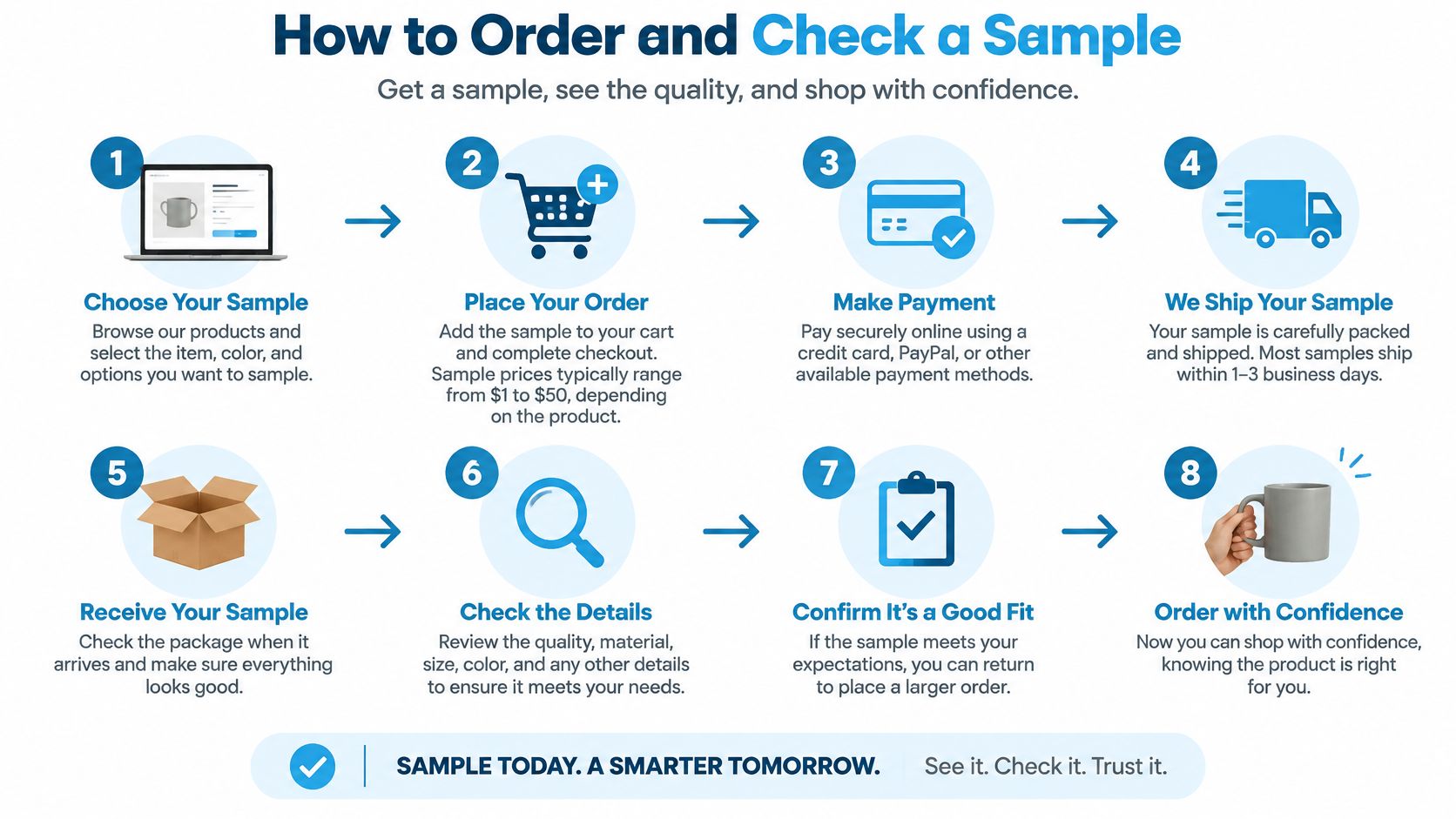
- Write the spec down. Confirm blank style, fabric weight, brim width and decoration method in writing. The common slip is approving a verbal spec that nobody can find three weeks later.
- Send a vector logo with placement measurements for the crown or front panel. The common slip is a low-resolution image that blurs at stitch size.
- Request a physical sample before the full run. The common slip is approving from a screen image.
- Check the sample against numbers. Measure the brim with a ruler, fold the hat flat and reshape it, and compare the logo color with your approved swatch. The common slip is skipping the fold test on a hat that's supposed to pack.
- Wash or stretch it once if the hat will be worn outdoors or resold. The common slip is never testing whether the decoration survives a wash.
- Sign off a proof showing placement, size and colors, and record any change in writing. The common slip is leaving changes unrecorded.
- Place the order after the deposit and confirm the production date. The common slip is ordering without a date in writing.
- Inspect the first carton against the sample before the rest ships. The common slip is accepting delivery without opening a box.
What a good sample looks like: a sharp logo with clean edges, a brim that holds an even curve all the way around, and a crown with no puckers around the stitching.
Proofing moves fast when the artwork is clean. One customer described the flow on an apparel order: "I was able to get hands on with the shirt, emailed the logo and received a proof in no time." The same sequence applies to a hat, and it's easier to hit when the logo arrives as a vector file with placement marked rather than as a screenshot.
If you're still choosing the silhouette, Cedar & Lily Clothier's hat guide is a useful second opinion on shapes and how they sit on different heads before you lock a style.
Lock In Your Affordable Bucket Hat Order
A low unit price can still produce an expensive order if the hats do not fit, hold their shape, or get worn. Before approval, confirm that the decoration suits the logo, the fabric can take that decoration, any sun claim has supporting test documentation, and the size split reflects the people who will wear the hats.
Send the same logo file, quantity, size split, and intended sun claim to each supplier. Compare the landed cost per hat likely to be worn, not just the quoted unit price. That makes the trade-off clearer: a cheaper blank is poor value if its fit or construction leaves you with unused stock.
Dirt Cheap Product, Inc. is a South Florida custom branding partner offering apparel and hats at wholesale pricing across brands, styles, and colors. Its team provides decoration services including screen printing, embroidery, DTF, and custom patches. Sales representatives are available Monday through Friday, 9 a.m. to 5 p.m. EST. Customer feedback highlights affordable pricing, quality, and timely service.
Gather the logo file, confirm the size split, and request a quote and sample. Dirt Cheap Product, Inc. provides proofs and quotes for apparel and hat decoration. Send the approved specifications to receive a proof and a quote, then check the sample before committing to the full run. Start with Dirt Cheap Product, Inc..