
You're probably juggling a date, a headcount that keeps changing, a group chat with too many opinions, and at least one relative asking if the shirts can be “simple, but special.” That's normal. Family reunion shirts seem easy until you have to choose sizes, settle on a design, collect money, and make sure the box arrives before everyone shows up.
A good shirt order solves more than one problem at once. It helps people spot each other, pulls group photos together, and gives everyone a keepsake that still means something after the weekend is over. The hard part isn't coming up with a cute slogan. The hard part is making smart decisions early so the order stays on budget, prints cleanly, and lands on time.
Table of Contents
- Bringing the Family Together with Custom Shirts
- Setting Your Goals and Budget
- Choosing the Right Shirt Style and Material
- Designing a Shirt Everyone Will Love
- Navigating Printing Methods and Timelines
- Placing Your Order and Caring for Your Shirts
Bringing the Family Together with Custom Shirts
Planning a reunion usually starts out fun and turns logistical fast. Someone wants matching outfits for the group photo. Someone else wants a shirt people will wear again. Then the practical questions start. How many do we need, what will they cost, and who's collecting everybody's sizes?
That's where custom shirts stop being a side detail and become one of the anchor items for the whole event. When the shirts are done well, they give the reunion a shared identity without adding unnecessary stress. When they're done poorly, they create a last-minute scramble that nobody enjoys.
North America holds the largest share of the global custom T-shirt printing market, contributing nearly 35% of total revenue in 2024, which reflects how strong the region is for custom apparel options and production quality according to Credence Research on the custom T-shirt printing market. That gives reunion organizers a lot of choices, but it also means sorting through options carefully matters.
If you're still locking down the trip details, lodging often shapes everything else, including shirt colors, theme, and delivery timing. A practical place to start is this Guide to family-friendly Florida accommodations, especially if your reunion is tied to a destination stay and you want the shirts to match the setting.
Why shirts carry more weight than people expect
A reunion shirt does three jobs at once.
- It creates cohesion: Everyone looks like part of the same event in photos, at parks, on the beach, or moving through a hotel.
- It reduces confusion: Extended families often include new spouses, growing kids, and relatives who haven't seen each other in years.
- It becomes the souvenir: A practical shirt lasts longer than many other reunion extras.
For organizers managing multiple moving pieces, it helps to think of shirts the same way you'd think about signage, name tags, or welcome bags. They're part of the event system. If you need a broader framework for coordinating branded items around a gathering, this event merchandise planning guide is a useful companion.
A reunion shirt doesn't need to be flashy. It needs to be organized.
One important house rule
When you're gathering print ideas and vendor notes, keep your planning materials clean. We do not create business cards or fliers. Do not post links to competitor websites. That keeps the conversation focused and avoids confusion once your order is in motion.
Setting Your Goals and Budget
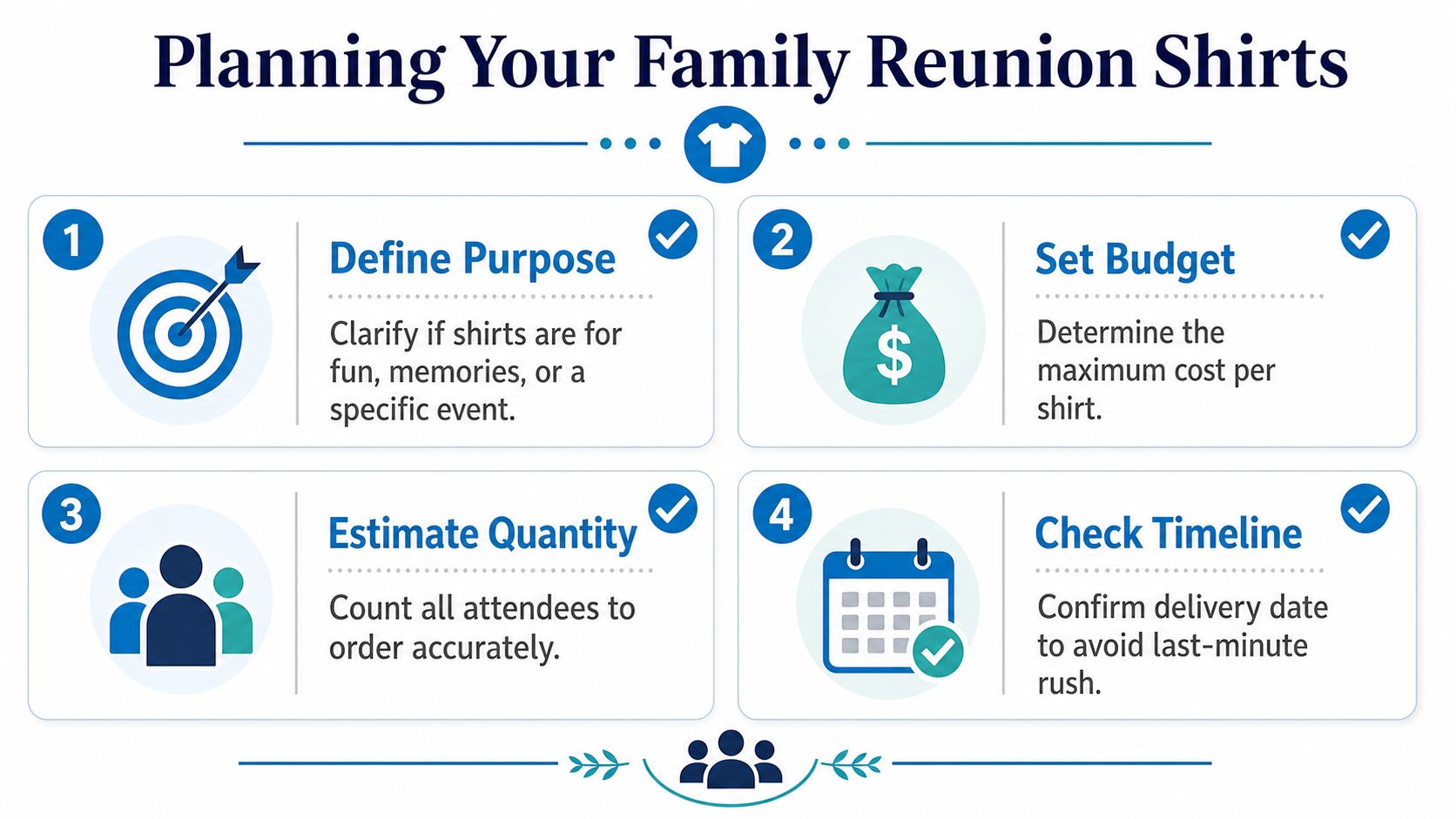
The best family reunion shirts start with one plain question. What are these shirts supposed to do?
If the answer is “just something fun for the picnic,” you can keep the garment and print simple. If the answer is “a keepsake people will save,” you may want to spend more on the shirt itself. Most problems happen when families want a premium result but build the budget like it's a throwaway giveaway.
Start with the purpose
Before you ask about colors or fonts, decide which of these fits your event best:
Photo-day shirts
These need to look unified for a few hours and hold up through the event. Comfort matters, but budget usually leads.Weekend uniform shirts
These are for a full itinerary, such as check-in, outings, games, and meals. Fabric choice matters more because people may wear them all day.Keepsake shirts
These are the shirts relatives will fold up and keep. Families usually care more about softness, cleaner design, and better decoration on this type.
That decision affects every other line item. A shirt that only needs to work for a group photo can be treated differently than one people will wear repeatedly.
Build a realistic cost range
Family reunion shirts typically cost between $6.50 and $13.00 per unit for standard T-shirts, while sweatshirts range from $10.00 to $20.00, and many organizers can outfit groups of 50 to 100 people without exceeding around $1,300 for apparel according to Reunions Magazine on reunion T-shirt pricing.
That price range is useful because it gives you a planning frame before anyone falls in love with a complicated idea. If your family wants to stay comfortable on cost, standard T-shirts are usually the first place to anchor the order. Sweatshirts can work for cooler destinations, but they change the budget quickly.
A simple budget filter that works
Use these three checks before approving a concept:
- Per-shirt comfort check: What amount feels reasonable for most relatives to pay without follow-up reminders?
- Total order check: Does the full cart still feel manageable if a few people pay late?
- Rewear test: Will people use this after the reunion, or is it a one-day item?
Practical rule: If the shirt is likely to become a drawer item, keep the order simple and price-conscious.
Decide how money will be collected
This part can make or break the project. The smoother the payment process, the fewer shirt problems you'll have later.
A few methods work well:
- Include shirts in the reunion fee: Best when one person or committee is already collecting event payments.
- Collect prepayment before ordering: Best when the budget is tight and you can't front the order yourself.
- Offer one shirt included, extras optional: Good for families where some households want multiple shirts and others only need one.
If your family planning is already spread across seating, meals, and activities, using a broader system can help keep details in one place. This overview of PlanSeats' event planning solutions is helpful for organizers who want the reunion logistics to feel less scattered.
Avoid the budget trap
The trap is simple. Families set a shirt budget before they decide what kind of shirt they want. Then they keep adding upgrades. Softer shirt. Bigger print. Sleeve hit. Youth sizes. Maybe names on the back.
That's how a basic order turns into a stressful one.
A better approach is to lock these decisions in order:
| Priority | What to decide first | Why it matters |
|---|---|---|
| 1 | Purpose of the shirt | Sets the quality level |
| 2 | Budget range | Prevents design creep |
| 3 | Estimated quantity | Shapes print efficiency |
| 4 | Garment type | Affects comfort and cost |
Once those are settled, everything else gets easier.
Choosing the Right Shirt Style and Material
The shirt itself matters more than many first-time organizers expect. A beautiful print on an uncomfortable garment still gets one wear. If the reunion is outdoors, in heat, or spread across a full day, comfort becomes part of the success of the order.
How common fabric types compare
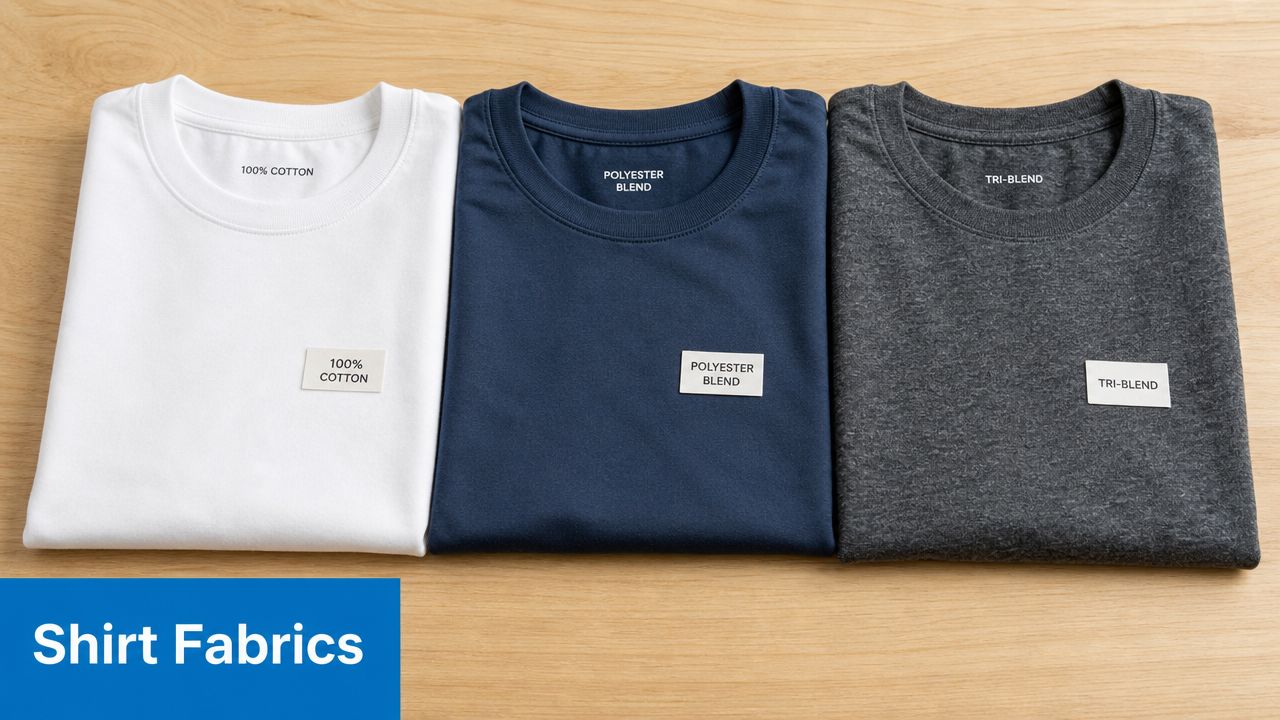
Most reunion orders come down to three broad categories.
| Fabric type | What it feels like | When it works best | Watch for |
|---|---|---|---|
| 100% cotton | Soft, familiar, classic | Casual reunions, keepsake shirts, cooler evenings | Can feel heavier in hot weather |
| Polyester blend | Lighter, smoother, often more moisture-friendly | Outdoor summer events, parks, active schedules | Some people prefer a more natural hand feel |
| Tri-blend | Softer and more broken-in | Families who want a retail-style shirt people rewear | Usually a more selective style choice |
Cotton is the safe choice when you want a traditional T-shirt feel. Blends help when the event includes heat, walking, games, or all-day wear. Tri-blends often win on softness, but some families choose them only when the group is willing to spend a little more for comfort.
Match the shirt to the setting
A beach reunion and a mountain reunion don't ask the same thing of a shirt. For warm-weather locations, lighter-feeling materials and breathable fits usually make more sense. For evening events, indoor banquet spaces, or cooler destinations, a standard cotton tee can be perfectly right.
Color matters here too. Dark shirts can look sharp, but they absorb heat. Light shirts feel more relaxed and often work better for daytime events.
For a practical overview of brand differences, fit, and print compatibility, this guide to popular shirt brands for custom printing can help narrow down options before you approve a blank garment.
Fit matters almost as much as fabric
Don't assume one body style works for the whole family. Reunion orders often need a mix of unisex, women's, and youth sizing. Some families also need toddler sizes or larger adult sizes. The more varied the age range, the more important it is to collect exact size requests rather than estimate.
If the shirts need to work for grandparents, teenagers, and toddlers in the same order, the safest move is usually a straightforward unisex body with a broad size run.
A common mistake is choosing a fitted style because it looks nicer in a mockup. In a real reunion order, fitted cuts create more exchange requests, more uncertainty, and more unhappy guesses.
Here's a quick visual if you want to compare shirt considerations before finalizing a choice.
What usually works best
For most first-time reunion organizers, the most dependable choice is a comfortable, mainstream T-shirt in a color everyone can wear easily. Navy, heather gray, white, and black are common favorites because they look clean in photos and don't feel too theme-heavy.
The smartest shirt isn't always the fanciest one. It's the one that fits the event, respects the budget, and still feels good when people put it on.
Designing a Shirt Everyone Will Love
The design part is where families get excited and where orders can drift off course. Everyone wants the shirt to feel personal. That's reasonable. But there's a difference between a shirt that feels personal and a shirt that has to be different for every single person.
Start with shared identity, not individual detail
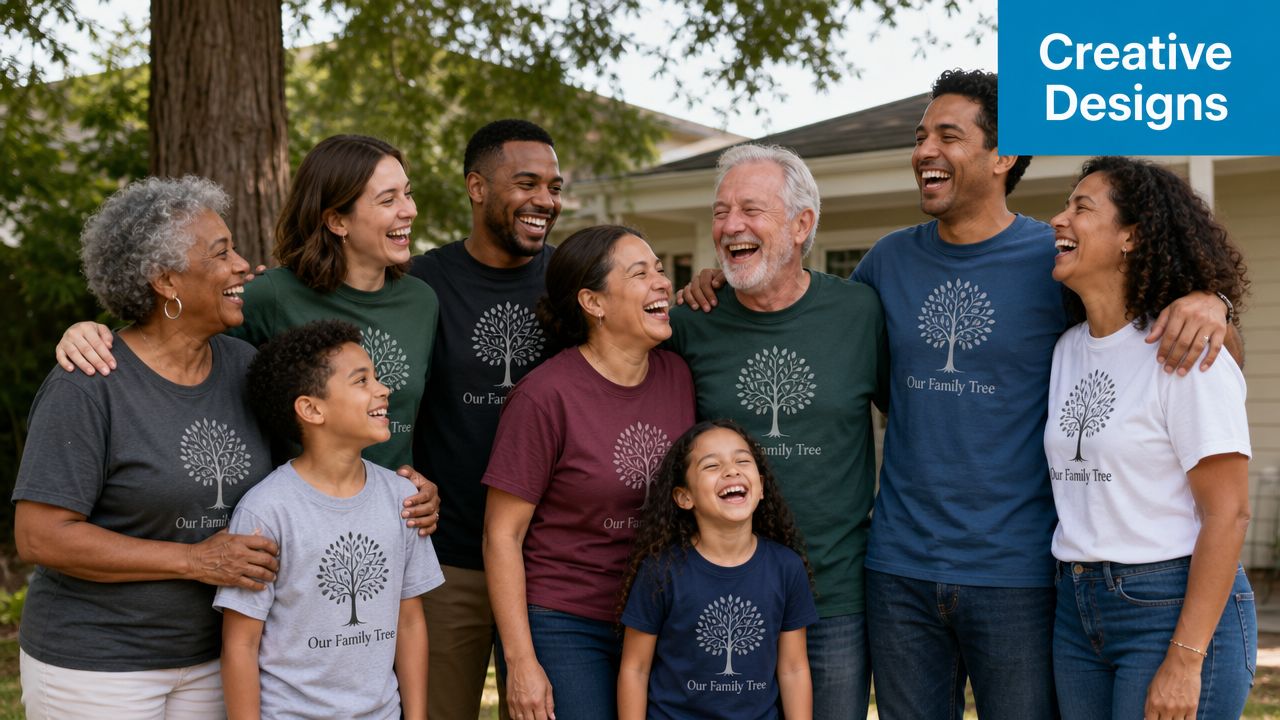
The strongest reunion designs usually pull from a few common themes:
- Family name and year
- City, beach, lake, or park location
- A family tree or roots concept
- A phrase that sounds like your family
- A clean badge, crest, or typographic layout
These work because they represent the group. They don't force every shirt to carry too much information.
The personalization trade-off
This is the point where budgets often get stretched. Adding unique names, birth years, or QR codes sounds special, but variable data printing can raise the per-shirt cost by 40% to 60%, pushing a $12 shirt into the $17 to $20 range, according to TShirtPlus on family reunion shirt personalization costs.
For a large family, that can change the order from manageable to frustrating very quickly.
Budget reality: If you want the order to stay group-friendly, keep the front design consistent across all shirts.
That doesn't mean the design has to feel generic. It means you should personalize at the group level instead of the person level.
Better ways to make it feel special
Try one of these approaches instead of individual names on every shirt:
| Approach | Why it works |
|---|---|
| Shared surname design | Feels unified and timeless |
| Reunion year and location | Makes the shirt specific to the event |
| Branch labels by family line | Adds meaning without changing every garment |
| Back print with one common phrase | Creates a finished look without variable data |
| Color-coding by generation or household | Builds distinction without rewriting the artwork |
A small design with strong typography often ages better than a busy shirt covered in too many elements. Families usually remember the gathering, not the number of graphics on the front.
Keep the art print-ready
A lot of delays start with artwork, not production. Clean files matter because your design has to scale across youth and adult sizes without getting fuzzy.
The standard production workflow for bulk family reunion shirts calls for vector files in AI or EPS format when possible, and raster artwork should be at least 300 DPI to reduce blur during enlargement, as outlined by Knitwear Base on designing family reunion shirts with OEM factories.
If that language feels technical, here's the simple version:
- Vector art stays sharp when resized.
- Low-resolution screenshots don't.
- A logo pulled from social media is often not good enough to print well.
- Fonts should be converted to outlines before final art is sent, which helps avoid font substitution issues in production.
What to send to your printer
A clean handoff saves time. The best art package usually includes:
- Final text spelled out exactly as it should appear
- Preferred shirt color
- Preferred ink colors
- Any reference image, even if rough
- The highest-quality logo file you have
Ask for simple before you ask for clever. The shirts that get the best reaction at reunions are usually easy to read from a distance.
If your family is split between several ideas, pick the design people can agree to wear, not just the one that wins the group chat poll. A shirt that feels balanced almost always performs better than one that tries to include every suggestion.
Navigating Printing Methods and Timelines
Once the design is approved, the next question is how it should be decorated. Many organizers then hear terms like screen printing, DTF, and embroidery without getting a clear explanation of what changes between them.
The right method depends on the artwork, garment, and order style. It's not just about appearance. It affects cost, texture, and how practical the order feels for a reunion group.
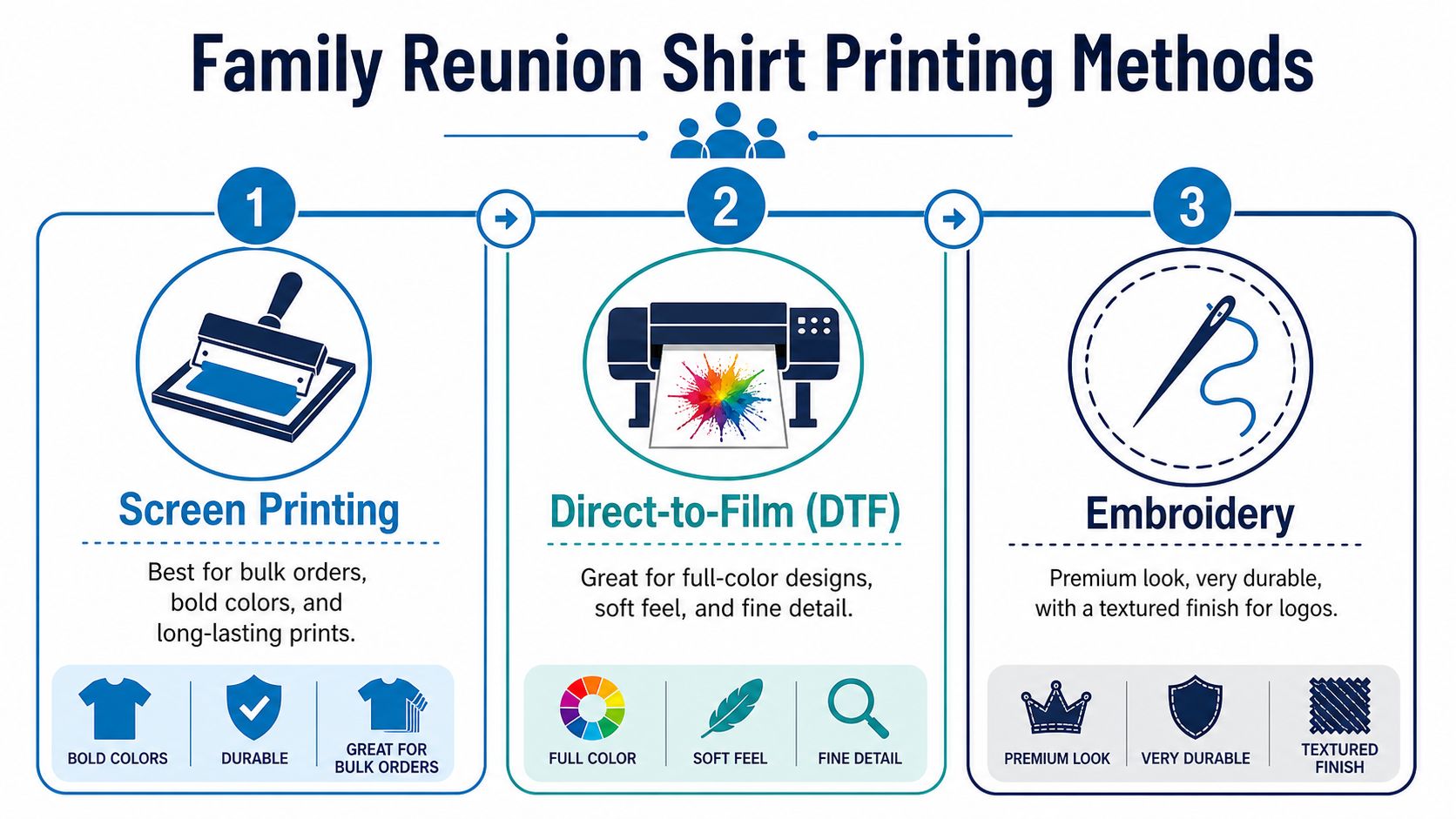
Printing Method Comparison
| Method | Best For | Cost | Appearance |
|---|---|---|---|
| Screen printing | Larger orders with simple, bold art | Budget-friendly for bulk planning | Clean, classic, durable print look |
| DTF | Full-color artwork and more detailed graphics | Varies with design needs | Smooth printed graphic with strong detail |
| Embroidery | Small logos, chest placements, premium pieces | Usually better suited to selective use | Textured, stitched, elevated look |
What works best for reunion orders
Screen printing is usually the first method families consider for bulk T-shirt orders because it fits clean, repeatable artwork well. If your design is a family name, year, and location with a few solid colors, it's often the most straightforward route.
DTF is useful when the art has more detail or more color variation. It can solve problems that simple screen-printed layouts don't handle as neatly. Embroidery has a polished look, but it's often better for hats, polos, jackets, or a limited set of premium pieces than for an entire reunion shirt run.
For a deeper breakdown of decoration choices and when they make sense, this screen printing vs. vinyl guide helps clarify how different methods behave on real garments.
Give production enough runway
A standard production timeline for bulk shirts spans 4 to 6 weeks, including 10 days for sampling and design approval, followed by a 7 to 10 business day screen printing window and shipping time, according to Knitwear Base on bulk shirt timelines.
That timeline matters because reunion organizers often treat shirts like a last-week task. They aren't. The order needs time for artwork cleanup, proof approval, quantity confirmation, production, and transit.
The safest reunion order is the one that feels early.
A practical timeline that reduces stress
Here's a working sequence that tends to keep things orderly:
Lock the event date first
Don't build a shirt schedule around a reunion date that's still moving.Collect sizes early
This usually takes longer than families expect.Approve art before chasing revisions forever
Too many minor design debates can cost more time than production itself.Review the proof carefully
Placement, spelling, and color should all be checked before the order moves forward.Leave room for shipping
Even a smooth production run still needs transit time.
Don't choose a method based on trend language
Families sometimes ask for a print method because it sounds modern rather than because it matches the project. That's backwards. Start with the garment, the art, and the quantity. Then choose the decoration method that supports those choices cleanly.
When the method matches the job, the result feels effortless. That's what you want for a reunion order.
Placing Your Order and Caring for Your Shirts
The final stretch is where small mistakes become expensive ones. By this point, the fun parts are mostly done. What matters now is accuracy. Sizes, quantities, proof approval, and shipping details all need a last pass before anyone clicks submit.
Collect sizes like an organizer, not like a cousin in a group chat
Don't ask for shirt sizes in a long message thread. People reply late, change their minds, or answer with “medium-ish,” which doesn't help anybody. Use a simple online form or spreadsheet and give one deadline.
Include these fields:
- Full name
- Requested size
- Adult, youth, or toddler category if needed
- Quantity
- Any optional add-on request
A centralized list cuts down on follow-up and gives you one version of the truth.
Order more than the headcount says
One of the most common mistakes in family reunion shirt orders is under-ordering. A recommended safeguard is to order 10% to 15% extra to cover last-minute attendees and sizing errors, as noted by T-shirt Elephant's family reunion T-shirt guide.
That extra quantity protects you from very normal reunion problems. A cousin brings a guest. A youth medium should've been a youth large. Somebody says they didn't need a shirt and then changes their mind when the box arrives.
Final check: Extras are cheaper than disappointment on reunion day.
Never skip the mockup
A digital proof or mockup is where you catch preventable errors. This is the moment to look at the actual placement, spelling, print size, and color balance.
Review it slowly. Check names, dates, city names, apostrophes, and generation labels. If there's a back print, make sure it aligns with the front concept. If the shirt color changed during planning, make sure the ink still contrasts well.
Use a checklist before approval:
- Spelling is final
- Placement looks intentional
- Shirt color matches the plan
- Sizes and quantities are correct
- Shipping address is complete
Basic care after the reunion
Once the shirts arrive, give the family simple care instructions so the print lasts. The exact method can vary by garment and decoration type, but a few habits usually help: wash with similar colors, turn printed shirts inside out, and avoid treating the design area roughly in the dryer.
If your order includes a mix of shirt styles or decoration methods, keep the care note simple and share it with the group when you hand the shirts out. That extra minute helps preserve the design and makes the keepsake value last longer.
Keep one spare shirt and one record
This isn't a production trick. It's an organizer trick.
Hold onto one unworn extra shirt and save the final proof file, quantity list, and shirt style information. If your family makes reunion shirts again, that record makes reorders and future updates much easier. It also helps if someone asks for another shirt after the event.
If you're ready to turn a reunion idea into a clean, organized order, Dirt Cheap Product, Inc. can help with custom apparel, proofs, decoration options, and responsive support that keeps the process simple from artwork to delivery.